
Introduction to Boundary Integral Equations Suvranu De Acknowledgements
Introduction to Boundary Integral Equations Suvranu De Acknowledgements: Prof K H Lee of NUS and Jacob White, MIT
Boundary Integral Equations 4 What are Integral Equations? 4 Green’s Functions and Integral Equations 4 Green’s Functions for Laplace 4 Exterior Dirichlet problem 4 Discretization Techniques
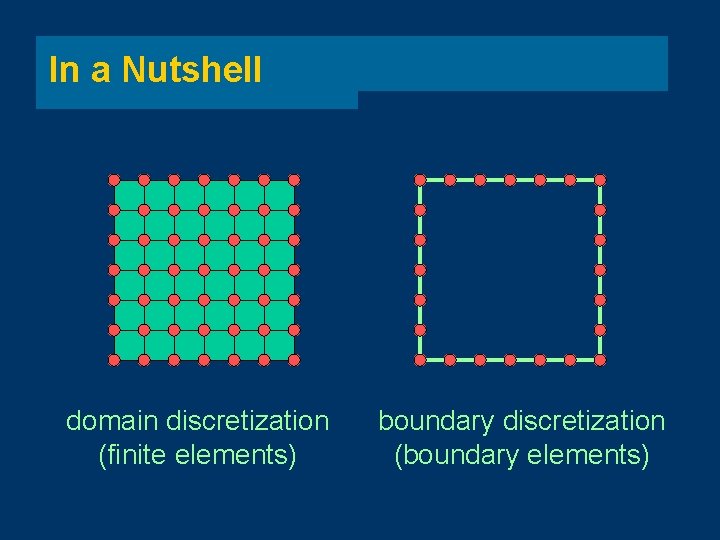
In a Nutshell domain discretization (finite elements) boundary discretization (boundary elements)
References • Gipson, G. S. , Boundary Element Fundamentals, CMP (1987) • Banerjee, P. K. and Butterfield, R. , Boundary Element Methods in Engineering Science, Mc. Graw-Hill (1981) • Brebbia, C. A. and Dominguez, J. , Boundary Elements: An Introductory Course, CMP & Mc. Graw-Hill (1989)

What are Integral Equations? • They are equations which contain the unknown function under the integral sign. • For example, known (function) known (kernel) unknown (function)
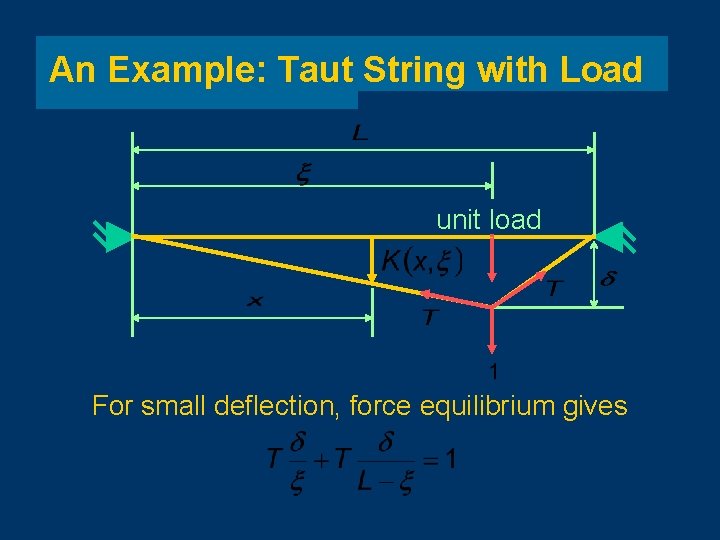
An Example: Taut String with Load unit load For small deflection, force equilibrium gives

An Example: Taut String with Load From we have
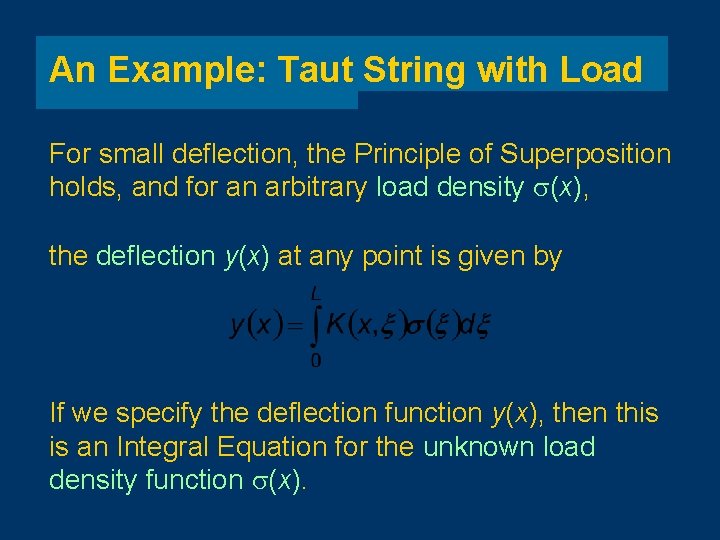
An Example: Taut String with Load For small deflection, the Principle of Superposition holds, and for an arbitrary load density (x), the deflection y(x) at any point is given by If we specify the deflection function y(x), then this is an Integral Equation for the unknown load density function (x).
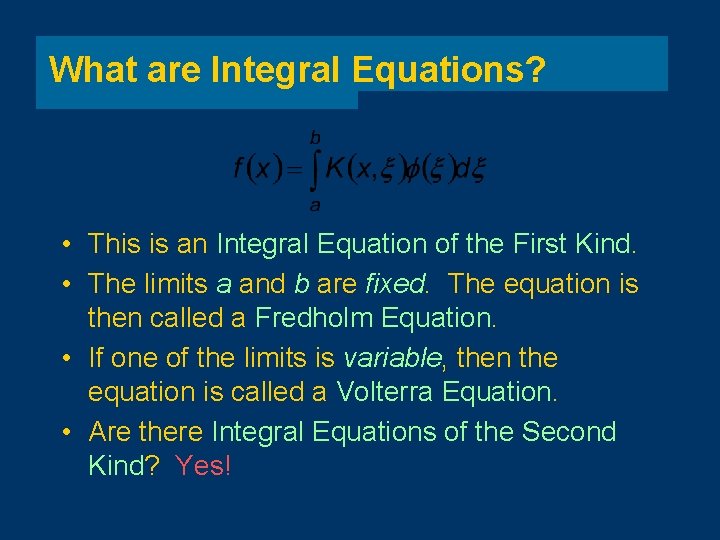
What are Integral Equations? • This is an Integral Equation of the First Kind. • The limits a and b are fixed. The equation is then called a Fredholm Equation. • If one of the limits is variable, then the equation is called a Volterra Equation. • Are there Integral Equations of the Second Kind? Yes!
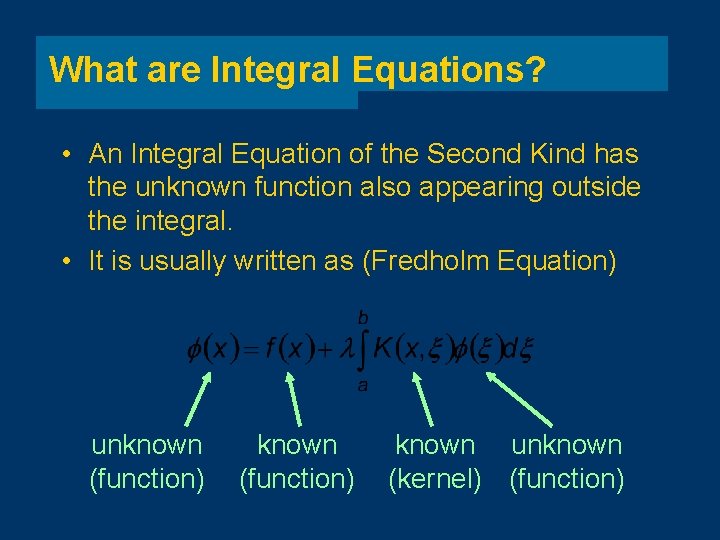
What are Integral Equations? • An Integral Equation of the Second Kind has the unknown function also appearing outside the integral. • It is usually written as (Fredholm Equation) unknown (function) known unknown (kernel) (function)
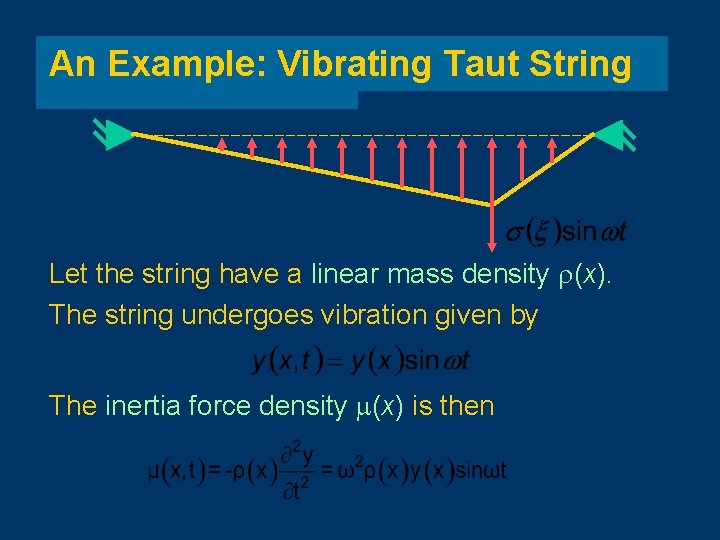
An Example: Vibrating Taut String Let the string have a linear mass density (x). The string undergoes vibration given by The inertia force density (x) is then
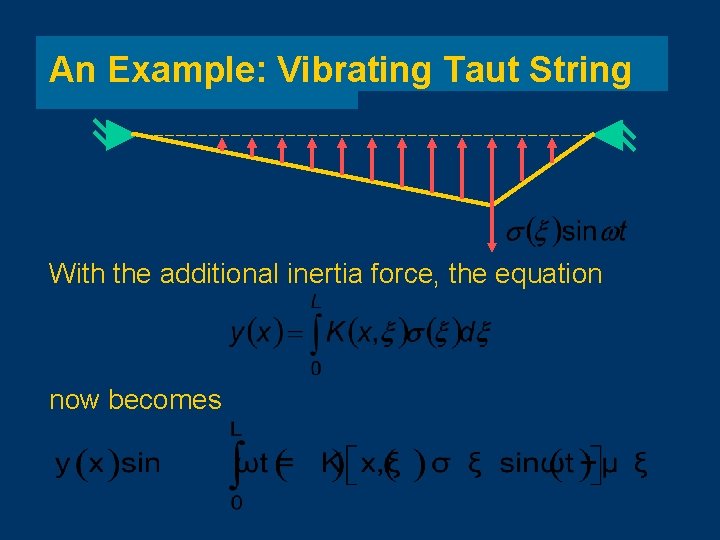
An Example: Vibrating Taut String With the additional inertia force, the equation now becomes
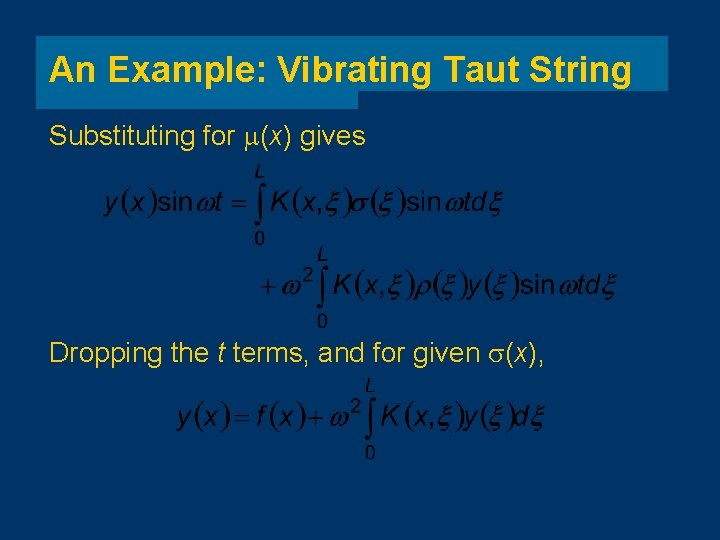
An Example: Vibrating Taut String Substituting for (x) gives Dropping the t terms, and for given (x),
So what? • • Everything seems so ad hoc. What’s it got to do with differential equations? What’s it got to do with Green’s functions? What is the advantage of integral equations? What about other physical phenomena? So far, it is only 1 D. What about 2 D and 3 D problems?
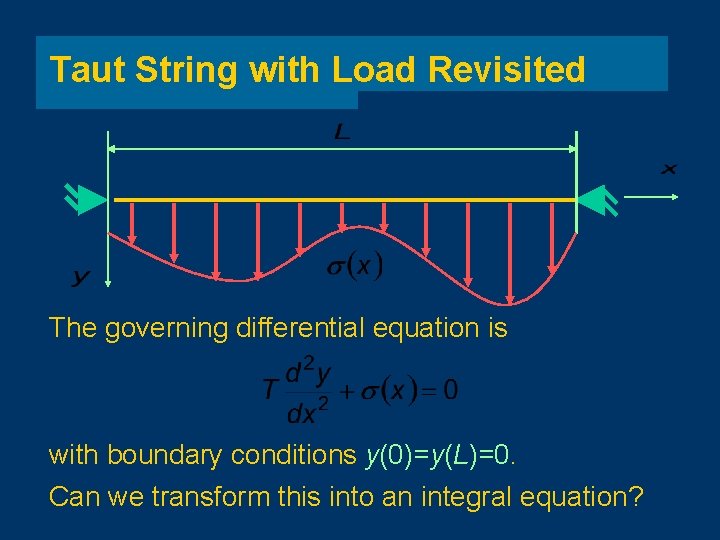
Taut String with Load Revisited The governing differential equation is with boundary conditions y(0)=y(L)=0. Can we transform this into an integral equation?
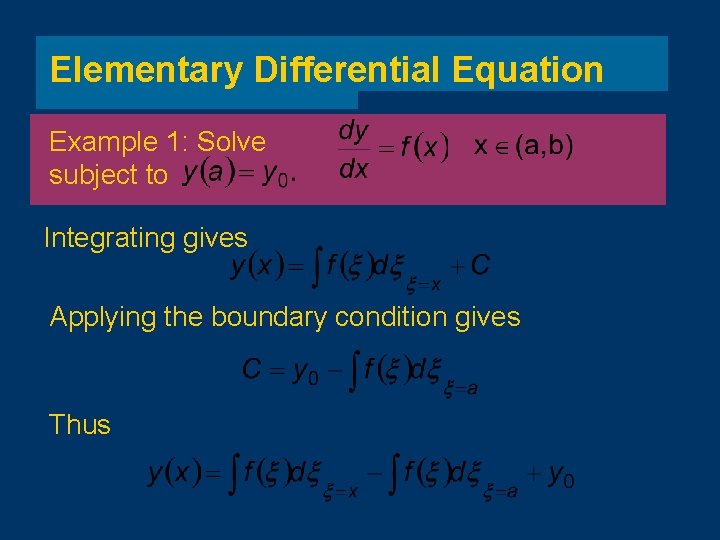
Elementary Differential Equation Example 1: Solve subject to Integrating gives Applying the boundary condition gives Thus
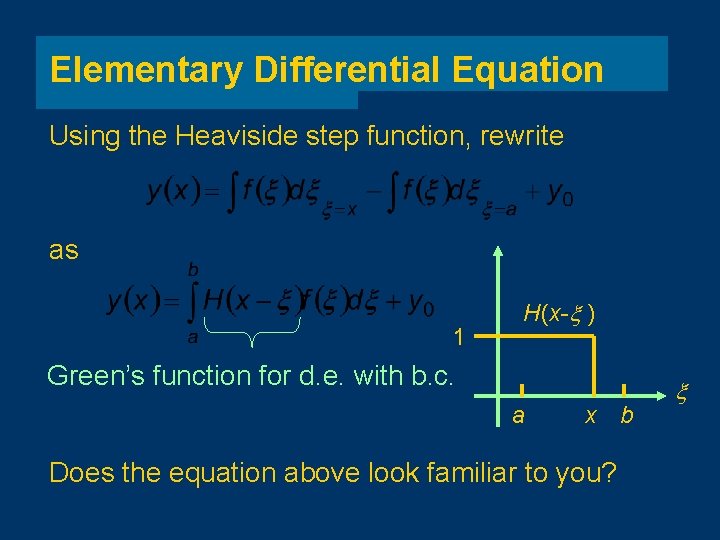
Elementary Differential Equation Using the Heaviside step function, rewrite as 1 H(x- ) Green’s function for d. e. with b. c. a x b Does the equation above look familiar to you?
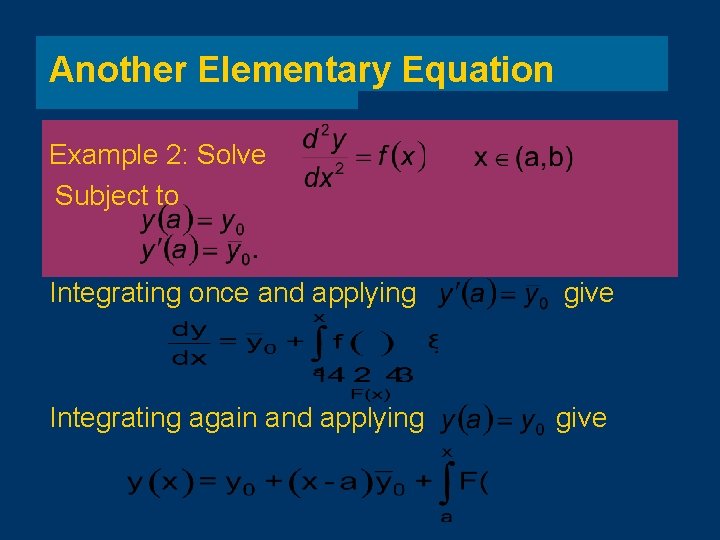
Another Elementary Equation Example 2: Solve Subject to Integrating once and applying give Integrating again and applying give
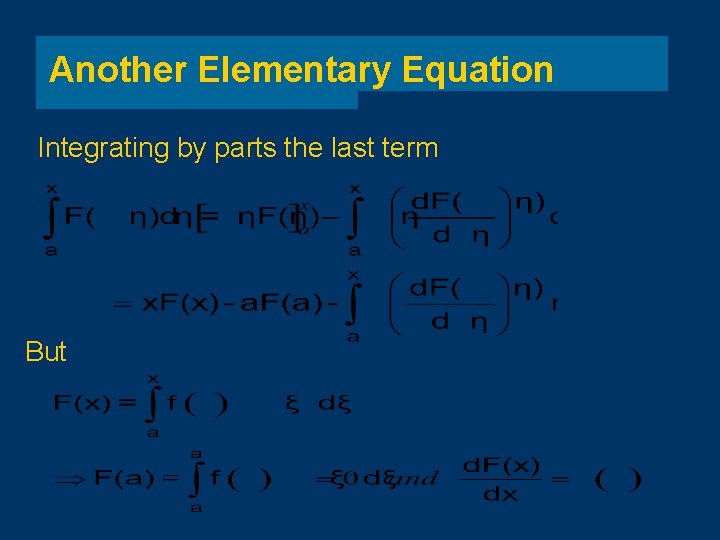
Another Elementary Equation Integrating by parts the last term But
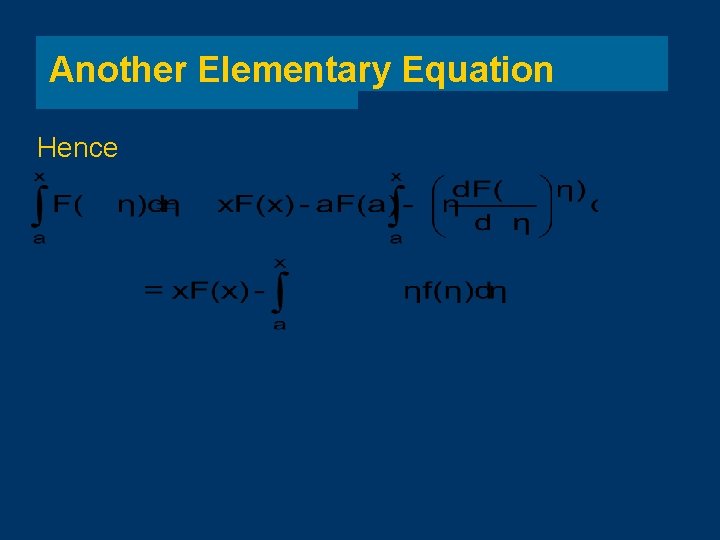
Another Elementary Equation Hence
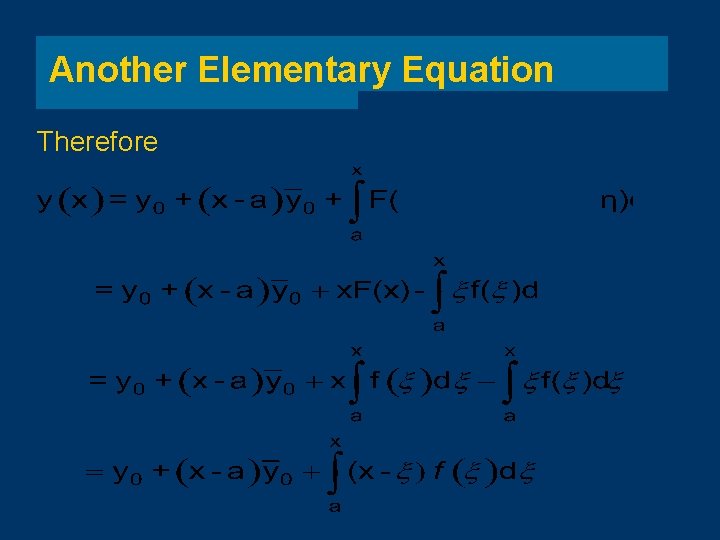
Another Elementary Equation Therefore

Another Elementary Equation Green’s function for d. e. with b. c. Problem #1 What is the Green’s function for subject to and ?
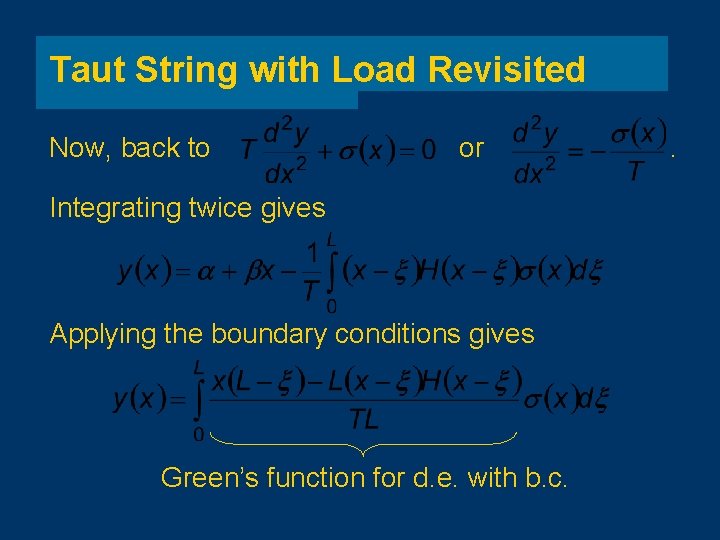
Taut String with Load Revisited Now, back to or Integrating twice gives Applying the boundary conditions gives Green’s function for d. e. with b. c. .
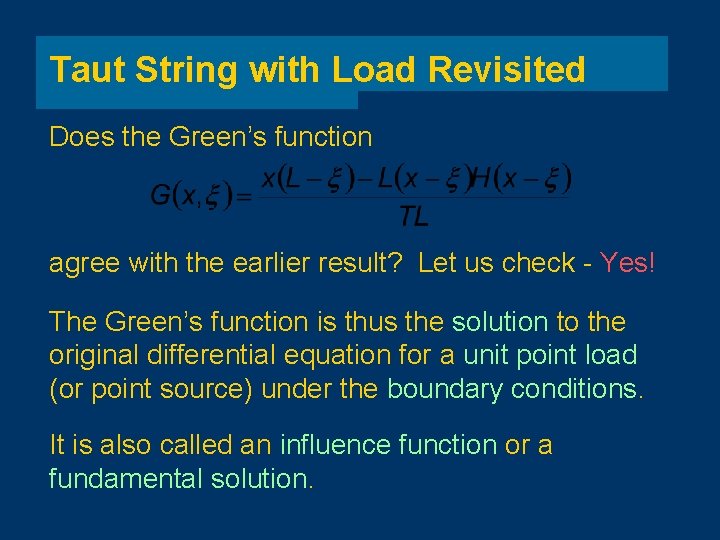
Taut String with Load Revisited Does the Green’s function agree with the earlier result? Let us check - Yes! The Green’s function is thus the solution to the original differential equation for a unit point load (or point source) under the boundary conditions. It is also called an influence function or a fundamental solution.
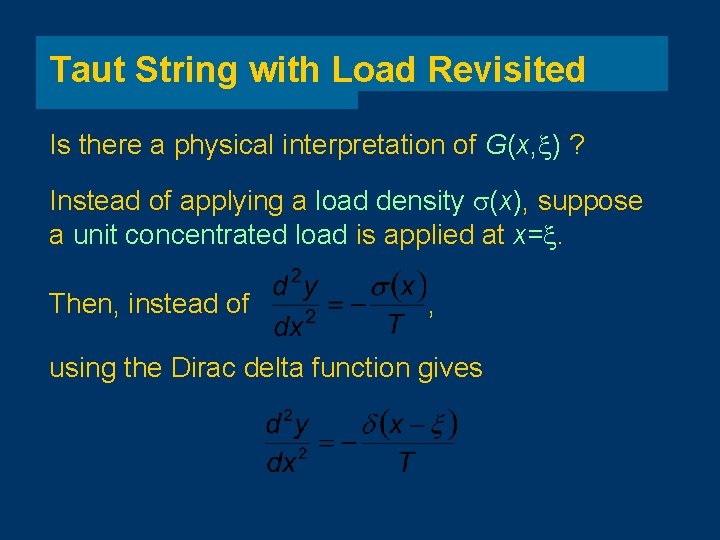
Taut String with Load Revisited Is there a physical interpretation of G(x, ) ? Instead of applying a load density (x), suppose a unit concentrated load is applied at x=. Then, instead of , using the Dirac delta function gives
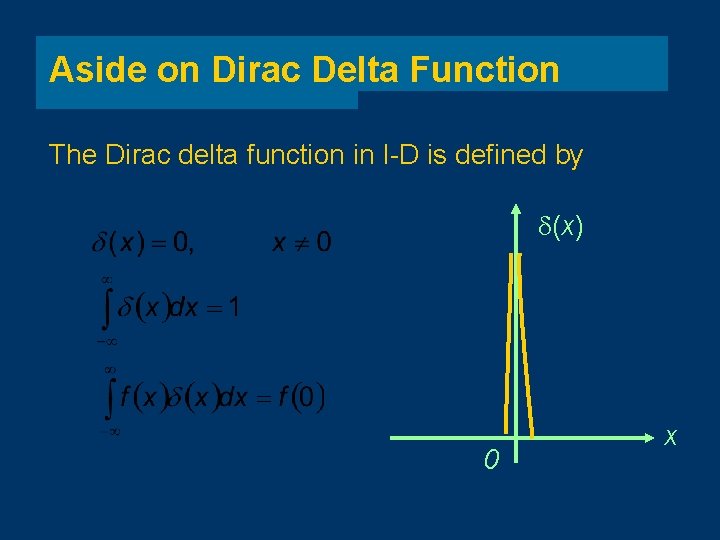
Aside on Dirac Delta Function The Dirac delta function in I-D is defined by (x) 0 x
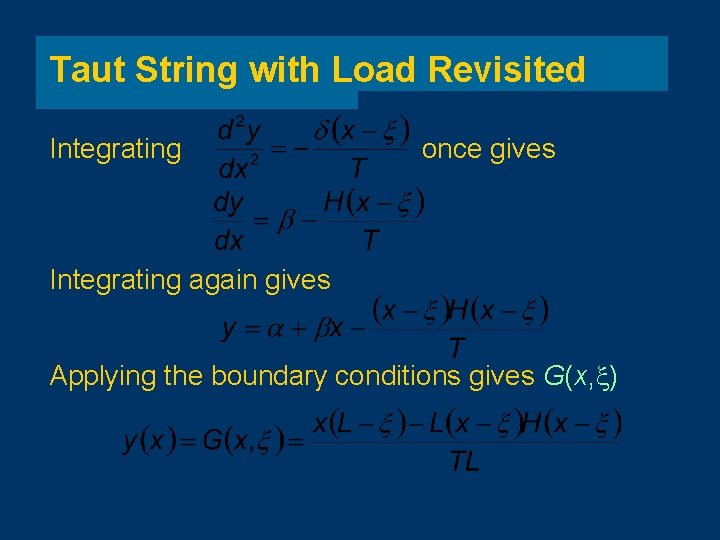
Taut String with Load Revisited Integrating once gives Integrating again gives Applying the boundary conditions gives G(x, )

Two Questions QUESTION 1: How to compute Green’s functions for a given problem? QUESTION 2: How to generate a “boundary integral equation” using the Green’s function?

How to get Green’s Function? Given • Differential equation of the form Ly = f. • Boundary conditions to make y unique. Recipe • Apply unit concentrated form of f, at x( source point) and compute the solution of the differential equation at y (field point) LG(x, y) = (x-y) y (field point) x (source)

Types of Green’s Function • The “particular solution” of this equation (that does not account for the boundary conditions) is known as the “Free Space Green’s function” • e. g. , in Example 2 • The homogeneous solution GH (x, y) satisfies LGH(x, y) = 0 and may be used to satisfy the boundary conditions. The “Region Dependent Green’s function” GR (x, y) is defined as GR(x, y) =GH(x, y)+ G(x, y) Even though we have derived the region dependent Green’s functions in the previous examples, henceforth we will use the “Free space Green’s function” to generate the boundary integral equations unless otherwise stated
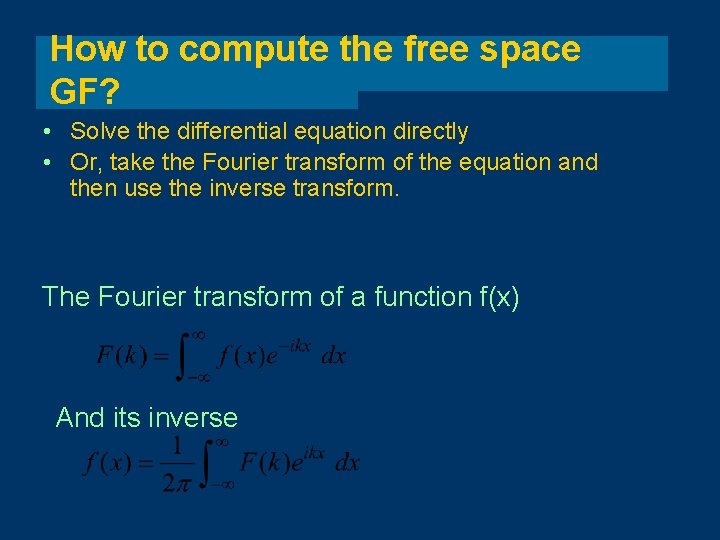
How to compute the free space GF? • Solve the differential equation directly • Or, take the Fourier transform of the equation and then use the inverse transform. The Fourier transform of a function f(x) And its inverse

Important Fourier transforms For a delta function For the derivative See standard tables on Fourier Transforms and inverse transforms
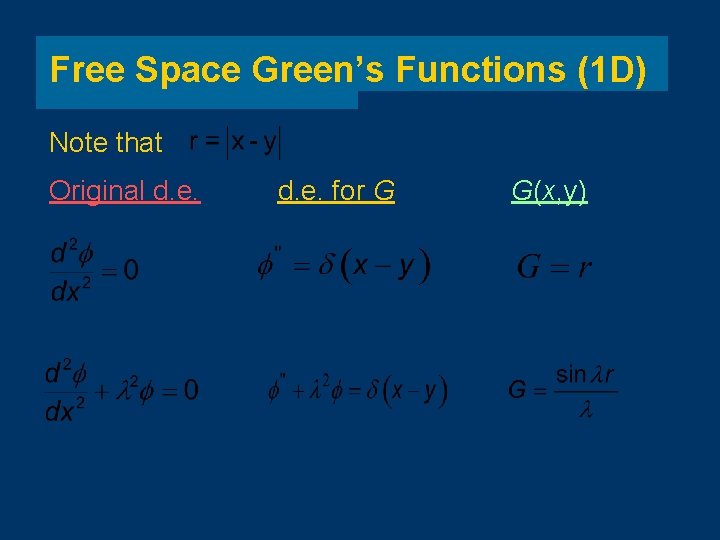
Free Space Green’s Functions (1 D) Note that Original d. e. for G G(x, y)

Free Space Green’s Functions (2 D) For unbounded space, noting that p. d. e. G(x, y) ,

Free Space Green’s Functions (3 D) For unbounded space, noting that p. d. e. G(x, y) ,

3 D Example: Laplace Equation The Green’s function corresponding to the equation is How? Start with

3 D Example: Laplace Equation Integrate on the volume of a sphere centered at x and of radius Divergence theorem Due to symmetry
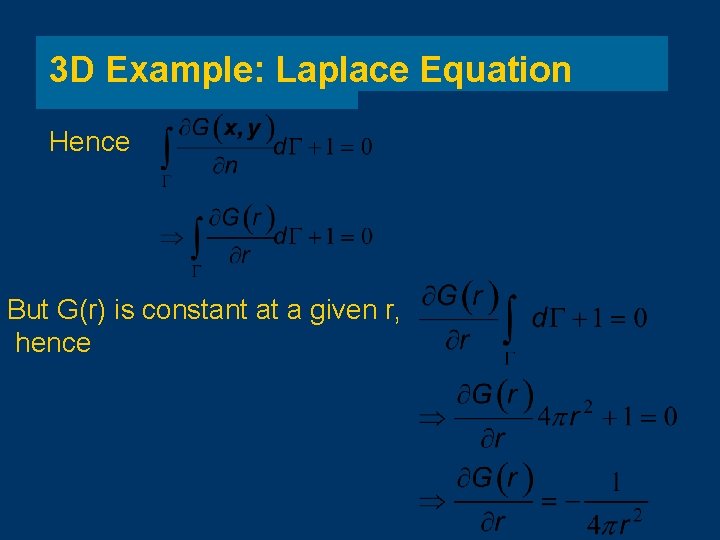
3 D Example: Laplace Equation Hence But G(r) is constant at a given r, hence
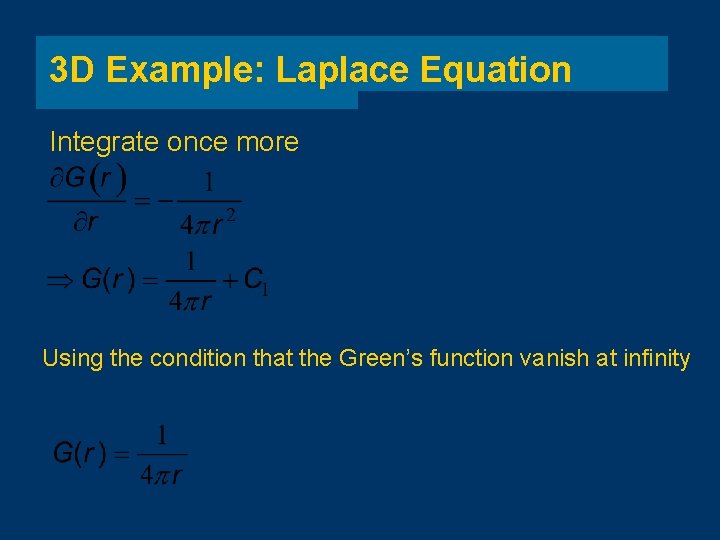
3 D Example: Laplace Equation Integrate once more Using the condition that the Green’s function vanish at infinity

Interior Versus Exterior Problems Interior Exterior outside inside Temperature known on surface “Temperature in a Tank” Temperature known on surface “Ice Cube in a Bath” What is the heat flow? Thermal conductivity
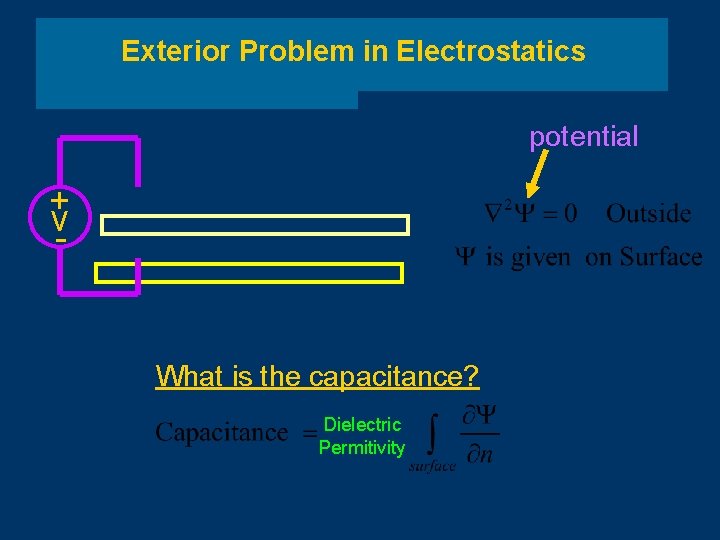
Exterior Problem in Electrostatics potential + v - What is the capacitance? Dielectric Permitivity
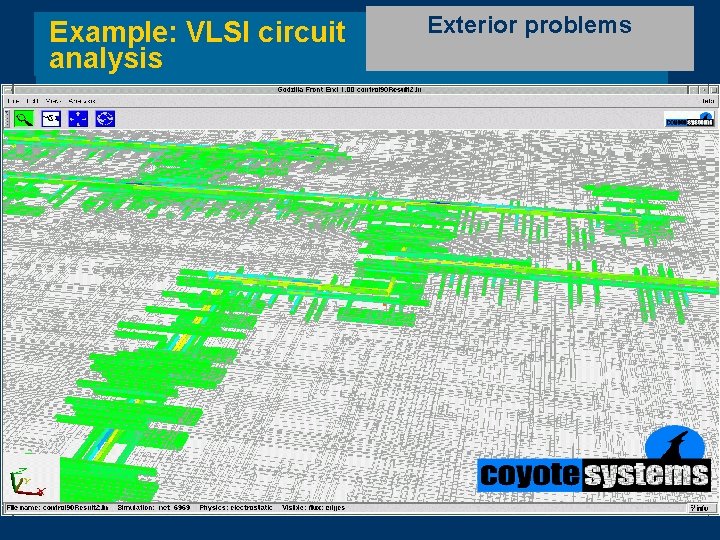
Example: VLSI circuit analysis Example: Exterior A problems Abracket
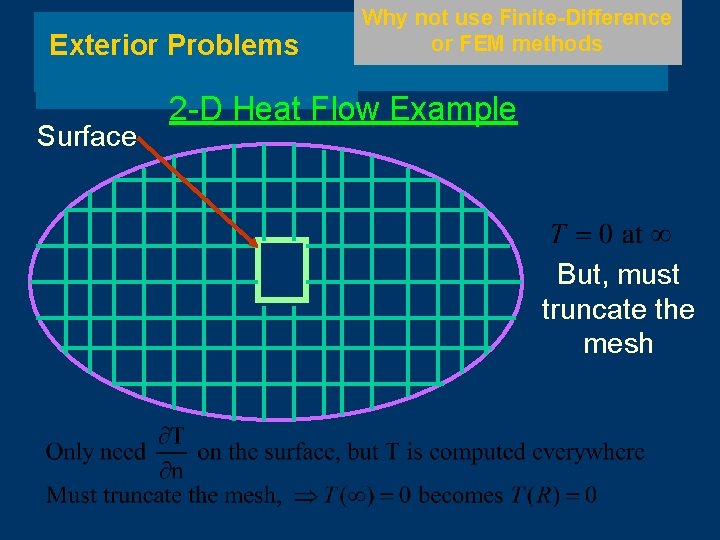
Exterior Problems Surface Why not use Finite-Difference or FEM methods 2 -D Heat Flow Example But, must truncate the mesh
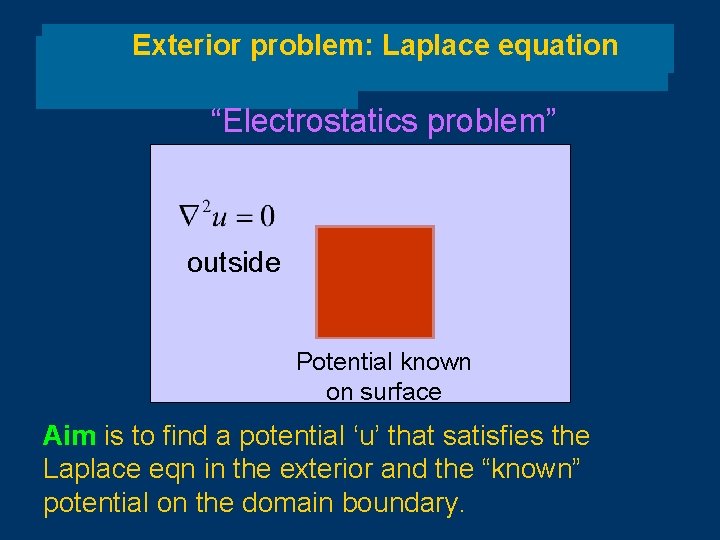
Exterior problem: Laplace equation “Electrostatics problem” outside Potential known on surface Aim is to find a potential ‘u’ that satisfies the Laplace eqn in the exterior and the “known” potential on the domain boundary.
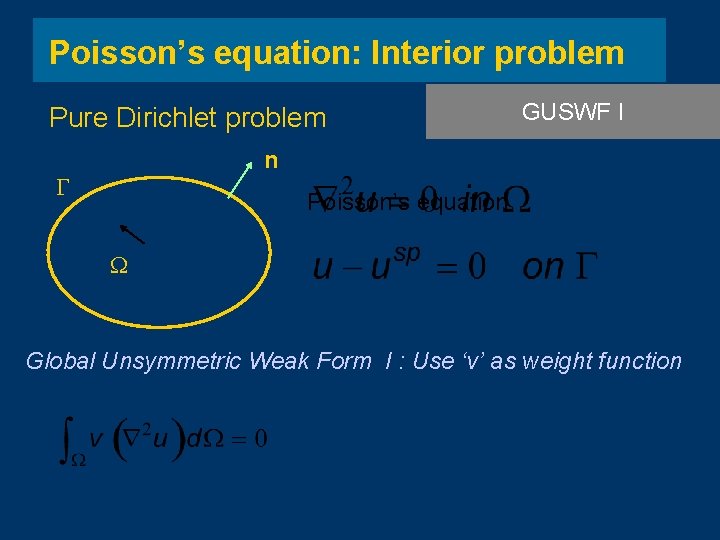
Poisson’s equation: Interior problem Pure Dirichlet problem GUSWF I n Poisson’s equation Global Unsymmetric Weak Form I : Use ‘v’ as weight function

Poisson’s equation: Interior problem Using Green’s Theorem twice GUSWF II This is the starting point of the boundary integral equation method We choose v=G (the Green’s function) with the source point (x) located within What happens if the source is outside ?

Poisson’s equation: Interior problem Hence Now, from the definition of G, For x

Poisson’s equation: Interior problem n Y (field point) x (source) When the field point is on the boundary we will represent it as ‘Y’ Note that the source point cannot be on the boundary. Unknown boundary flux Known from b. c

Indirect from Direct Formulation Domain ’= R 3 - Domain n’ Y r x Boundary n
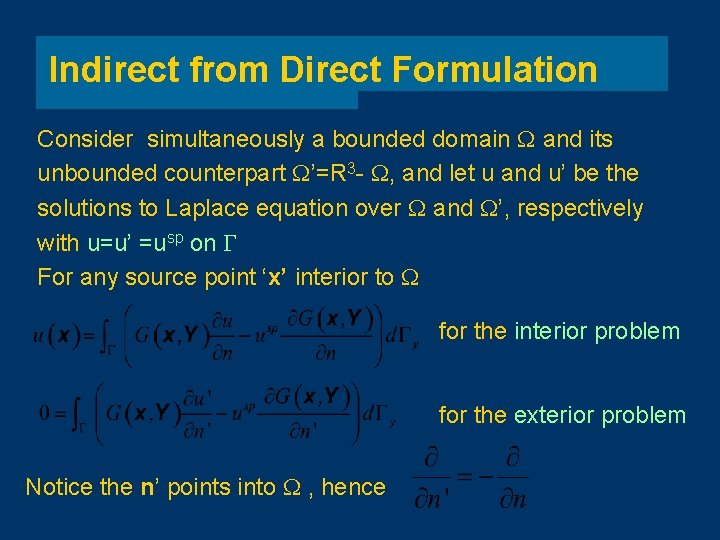
Indirect from Direct Formulation Consider simultaneously a bounded domain and its unbounded counterpart ’=R 3 - , and let u and u’ be the solutions to Laplace equation over and ’, respectively with u=u’ =usp on For any source point ‘x’ interior to for the interior problem for the exterior problem Notice the n’ points into , hence
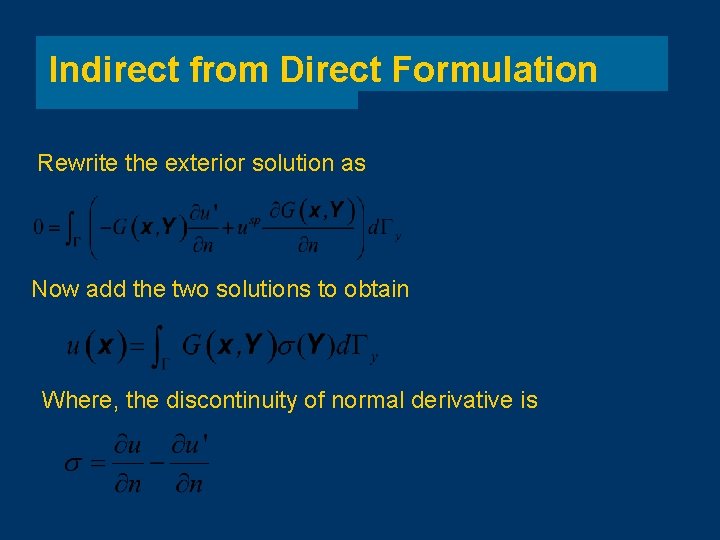
Indirect from Direct Formulation Rewrite the exterior solution as Now add the two solutions to obtain Where, the discontinuity of normal derivative is

Taking x to X Is the integral equation of the ‘boundary’-type? Domain X x Y r Boundary n No! We must ‘take’ x to the boundary (to X).

3 D Example: Laplace Equation When we take x to X, we have to make sure that the integrals are convergent. It may be proved that This is a Fredholm Integral equation of the First kind and will be used extensively in the following discussions as
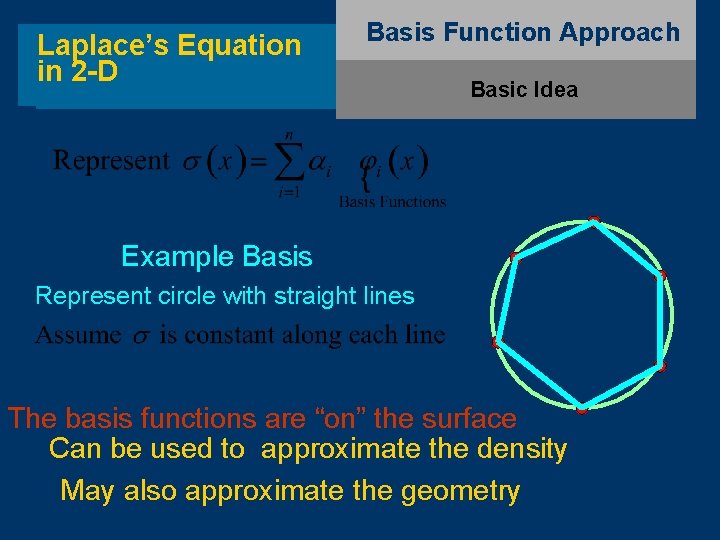
Laplace’s Equation in 2 -D Basis Function Approach Basic Idea Example Basis Represent circle with straight lines The basis functions are “on” the surface Can be used to approximate the density May also approximate the geometry

Laplace’s Equation in 2 -D Basis Function Approach Geometric Approximation is not new. Piecewise Straight surface basis Triangles for 2 -D FEM functions approximate the circle too!
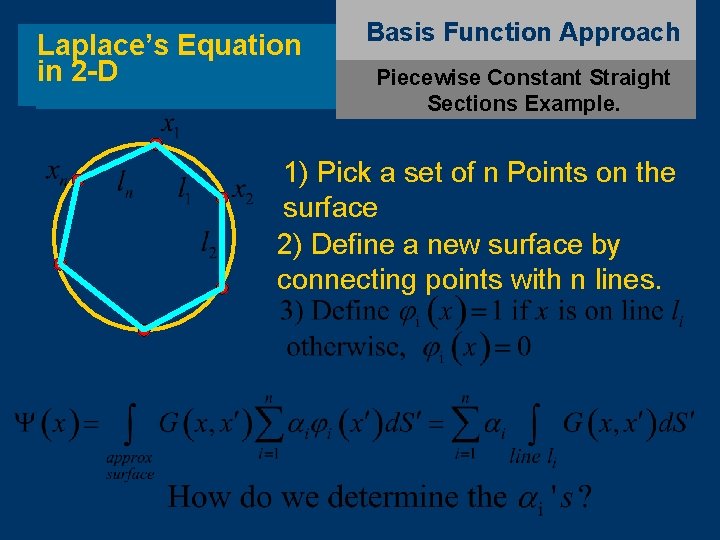
Laplace’s Equation in 2 -D Basis Function Approach Piecewise Constant Straight Sections Example. 1) Pick a set of n Points on the surface 2) Define a new surface by connecting points with n lines.
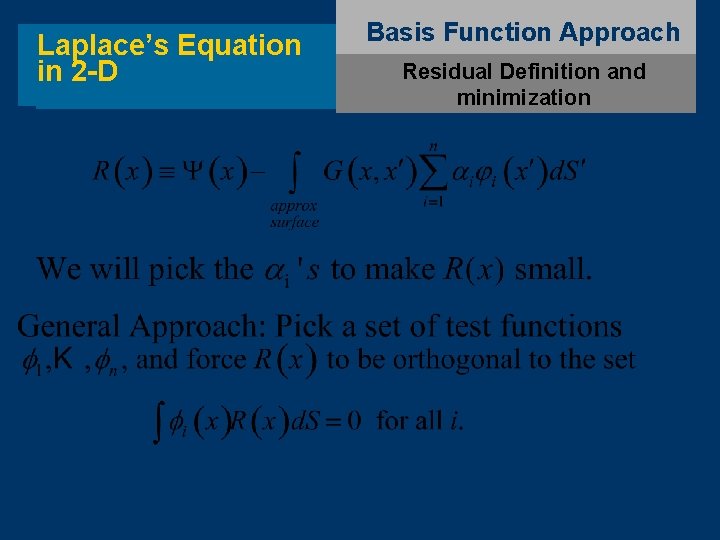
Laplace’s Equation in 2 -D Basis Function Approach Residual Definition and minimization
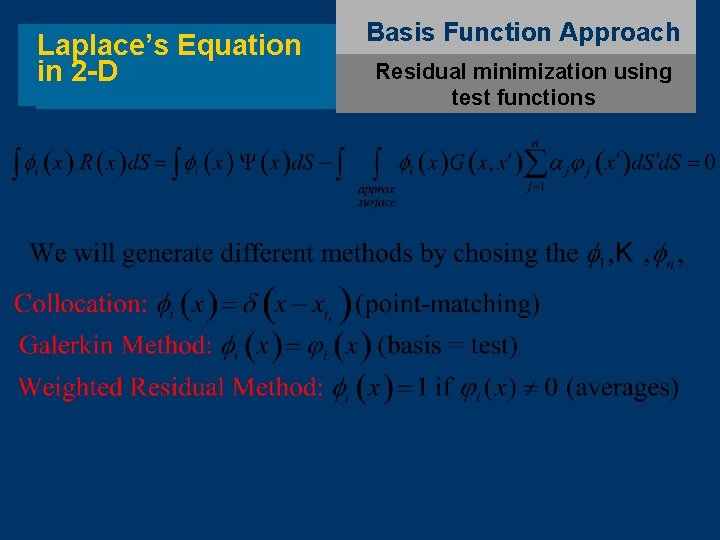
Laplace’s Equation in 2 -D Basis Function Approach Residual minimization using test functions

Laplace’s Equation in 2 -D Basis Function Approach Collocation

Laplace’s Equation in 2 -D Basis Function Approach Centroid Collocation for Piecewise Constant Bases Collocation point in line center
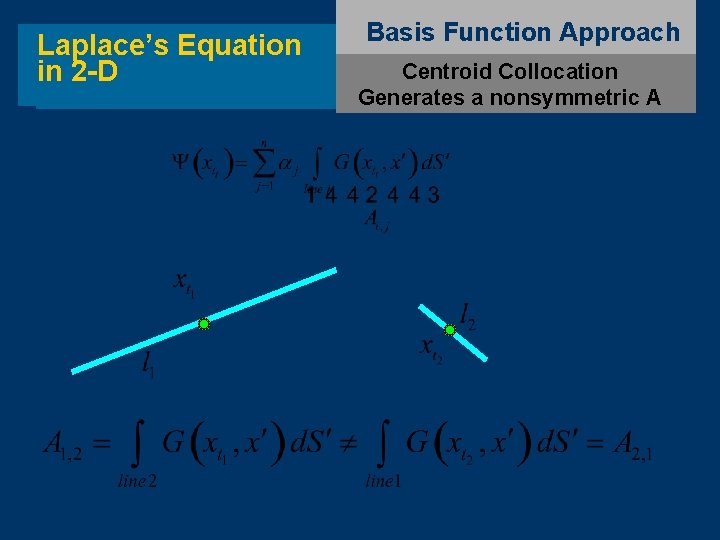
Laplace’s Equation in 2 -D Basis Function Approach Centroid Collocation Generates a nonsymmetric A
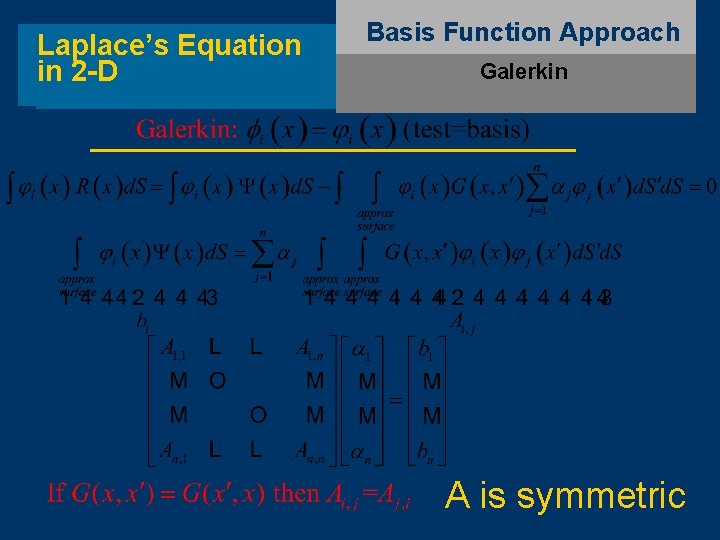
Laplace’s Equation in 2 -D Basis Function Approach Galerkin A is symmetric

Laplace’s Equation in 2 -D Basis Function Approach Galerkin for Piecewise Constant Bases

Laplace’s Equation in 3 -D Integral Equation: Discretize Surface into Panels Panel j Electrostatics Example Piecewise Constant Basis
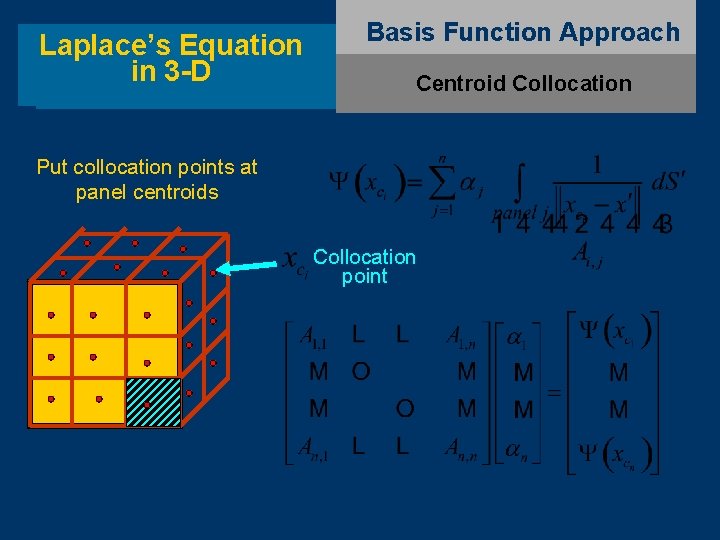
Laplace’s Equation in 3 -D Basis Function Approach Centroid Collocation Put collocation points at panel centroids Collocation point
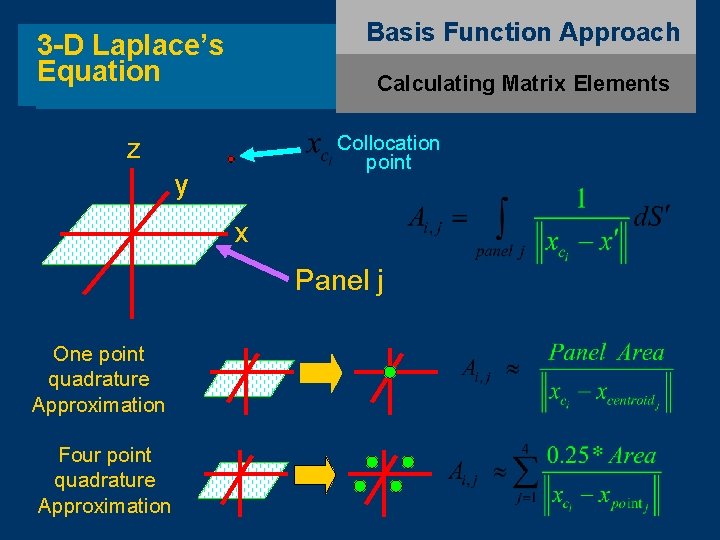
Basis Function Approach 3 -D Laplace’s Equation Calculating Matrix Elements Collocation point z y x Panel j One point quadrature Approximation Four point quadrature Approximation

Basis Function Approach 3 -D Laplace’s Equation Calculating “Self-Term” Collocation point z y x Panel i One point quadrature Approximation

Basis Function Approach 3 -D Laplace’s Equation Calculating “Self-Term” Tricks of the trade z Collocation point y x Panel i Disk of radius R surrounding collocation point Integrate in two pieces Disk Integral has singularity but has analytic formula

Basis Function Approach 3 -D Laplace’s Equation Calculating “Self-Term” Other Tricks of the trade z Collocation point y x Panel i 1) If panel is a flat polygon, analytical formulas exist 2) Curved panels can be handled with projection
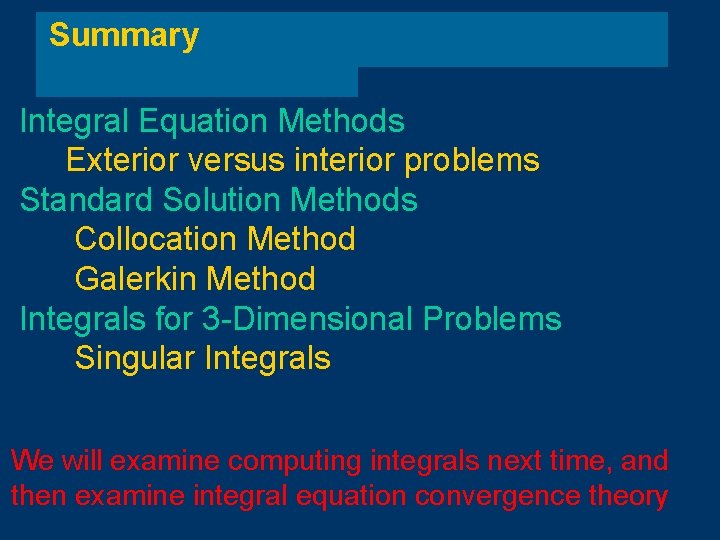
Summary Integral Equation Methods Exterior versus interior problems Standard Solution Methods Collocation Method Galerkin Method Integrals for 3 -Dimensional Problems Singular Integrals We will examine computing integrals next time, and then examine integral equation convergence theory
- Slides: 70