
Introduction to Bioinformatics Prof Dr Nizamettin AYDIN Introduction
Introduction to Bioinformatics Prof. Dr. Nizamettin AYDIN Introduction to Statistics naydin@yildiz. edu. tr http: //www 3. yildiz. edu. tr/~naydin 1
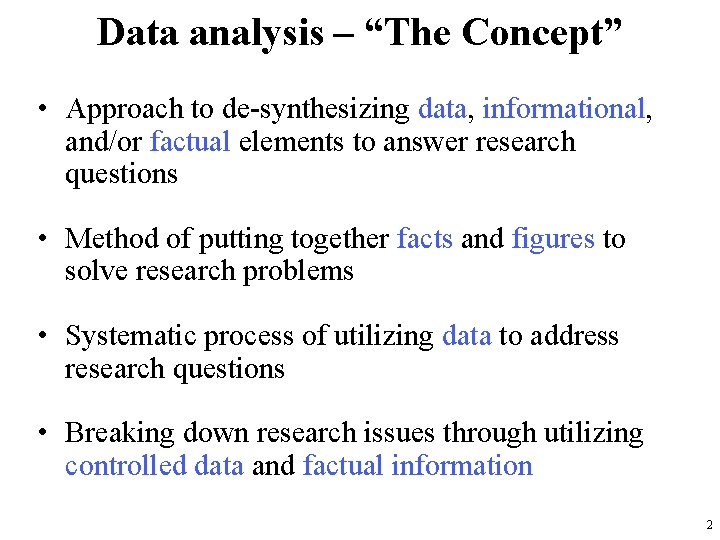
Data analysis – “The Concept” • Approach to de-synthesizing data, informational, and/or factual elements to answer research questions • Method of putting together facts and figures to solve research problems • Systematic process of utilizing data to address research questions • Breaking down research issues through utilizing controlled data and factual information 2
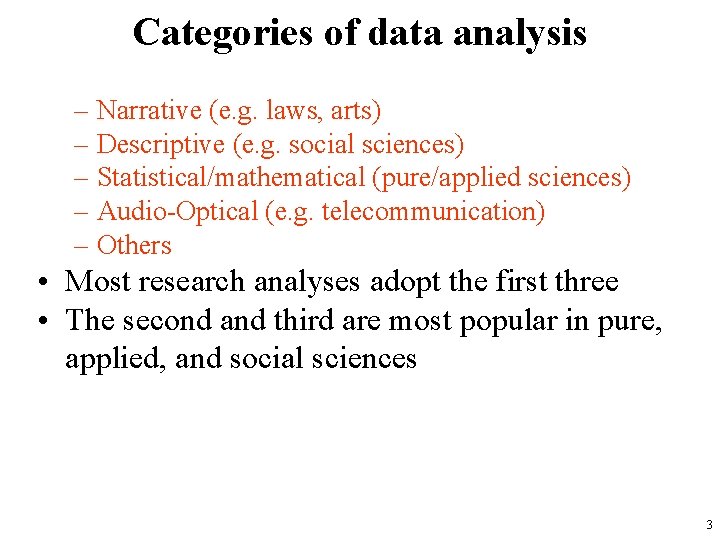
Categories of data analysis – Narrative (e. g. laws, arts) – Descriptive (e. g. social sciences) – Statistical/mathematical (pure/applied sciences) – Audio-Optical (e. g. telecommunication) – Others • Most research analyses adopt the first three • The second and third are most popular in pure, applied, and social sciences 3
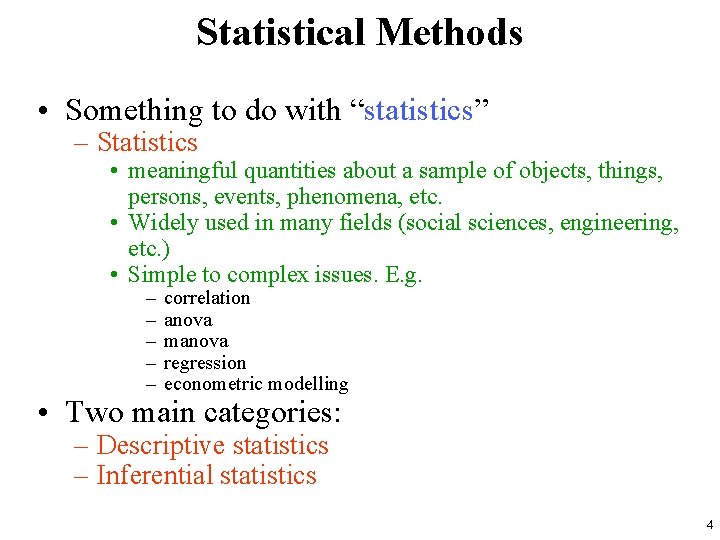
Statistical Methods • Something to do with “statistics” – Statistics • meaningful quantities about a sample of objects, things, persons, events, phenomena, etc. • Widely used in many fields (social sciences, engineering, etc. ) • Simple to complex issues. E. g. – – – correlation anova manova regression econometric modelling • Two main categories: – Descriptive statistics – Inferential statistics 4
Descriptive statistics • Use sample information to explain/make abstraction of population “phenomena” • Common “phenomena”: – – – – Association Tendency Causal relationship Trend, Pattern, Dispersion, Range • Used in non-parametric analysis – e. g. chi-square, t-test, 2 -way anova 5
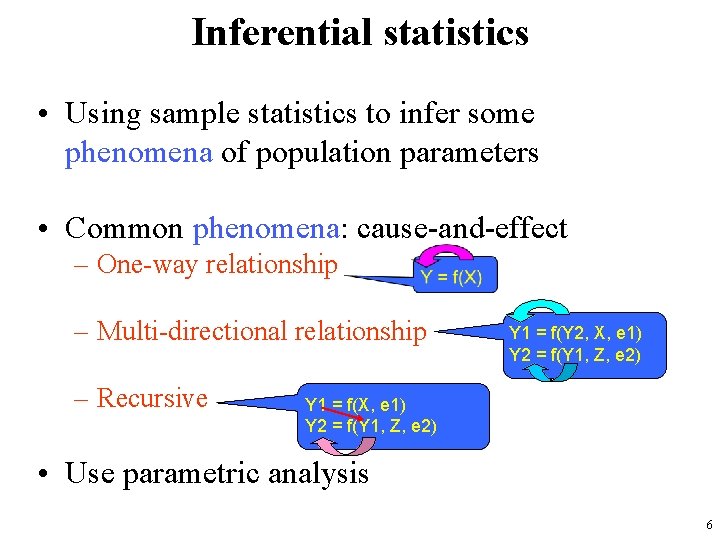
Inferential statistics • Using sample statistics to infer some phenomena of population parameters • Common phenomena: cause-and-effect – One-way relationship – Multi-directional relationship – Recursive Y 1 = f(Y 2, X, e 1) Y 2 = f(Y 1, Z, e 2) Y 1 = f(X, e 1) Y 2 = f(Y 1, Z, e 2) • Use parametric analysis 6
Which one to use? • Nature of research – Descriptive in nature? – Attempts to infer, predict, find cause-and-effect, influence, relationship? – Is it both? • Research design (including variables involved) – E. g. outputs/results expected • research issue • research questions • research hypotheses 7
How to avoid mistakes - Useful tips • Crystalize the research problem – operability of it! • Read literature on data analysis techniques • Evaluate various techniques that can do similar things with respect to research problem • Know what a technique does and what it doesn’t • Consult people, esp. supervisor • Pilot-run the data and evaluate results 8
Principles of analysis… • Goal of an analysis is to… – explain cause-and-effect phenomena – relate research with real-world event – predict/forecast the real-world phenomena based on research – find answers to a particular problem – make conclusions about real-world event based on the problem – learn a lesson from the problem 9
…Principles of analysis… • Data cannot talk • An analysis contains some aspects of scientific reasoning/argument: – Define – Interpret – Evaluate – Illustrate – Discuss – Explain – Clarify – Compare – Contrast 10
…Principles of analysis… • An analysis must have four elements: – Data/information (what) – Scientific reasoning/argument • what? who? where? how? what happens? – Finding • what results? – Lesson/conclusion • so what? so how? therefore, … 11
…Principles of data analysis… • Basic guide to data analysis: – Analyze, not narrate – Go back to research flowchart – Break down into research objectives and research questions – Identify phenomena to be investigated – Visualize the expected answers – Validate the answers with data – Do not tell something not supported by data 12
…Principles of data analysis • When analyzing: – Be objective – Be accurate – Be true • Separate facts and opinion • Avoid “wrong” reasoning/argument. – E. g. mistakes in interpretation. 13
Description of samples and populations • Statistics is about making statements about a population from data observed from a representative sample of the population. • A population – a collection of subjects whose properties are to be analyzed. – contains all subjects of interest. • A sample – a part of the population of interest – a subset selected by some means from the population. 14
Description of samples and populations • A parameter – a numerical value that describes a characteristic of a population • A statistic – a numerical measurement that describes a characteristic of a sample • We use a statistic to infer something about a parameter. 15
Data exploration • After collecting data, the next step towards statistical inference and decision making is to perform data exploration, – which involves visualizing and summarizing the data. • The objective of data visualization is to obtain a high level understanding of the sample and their observed (measured) characteristics. • To make the data more manageable, we need to further reduce the amount of information in some meaningful ways so that we can focus on the key aspects of the data. – Summary statistics are used for this purpose. 16
Data exploration • Using data exploration techniques, we can learn about the distribution of a variable. – The distribution of a variable tells us • the possible values it can take, • the chance of observing those values, • how often we expect to see them in a random sample from the population. • Through data exploration, we might detect previously unknown patterns and relationships that are worth further investigation. – We can also identify possible data issues, such as unexpected or unusual measurements, known as outliers. 17
Statistical inference • We collect data on a sample from the population in order to learn about the whole population. – {For example, Mackowiak, et al. (1992) measure the normal body temperature for 148 people to learn about the normal body temperature for the entire population. • In this case, we say we are estimating the unknown population average. – However, the characteristics and relationships in the whole population remain unknown. • Therefore, there is always some uncertainty associated with our estimations. } 18
Statistical inference • The mathematical tool to address uncertainty in Statistics – probability. • The process of using the data to draw conclusions about the whole population, while acknowledging the extent of our uncertainty about our findings, is called statistical inference. – The knowledge we acquire from data through statistical inference allows us to make decisions with respect to the scientific problem that motivated our study and our data analysis. 19
Data types • The type(s) of data collected in a study determine – the type of statistical analysis that can be used – which hypotheses can be tested – which model we can use for prediction. • Broadly speaking, data can be classified into two major types: – categorical – quantitative 20
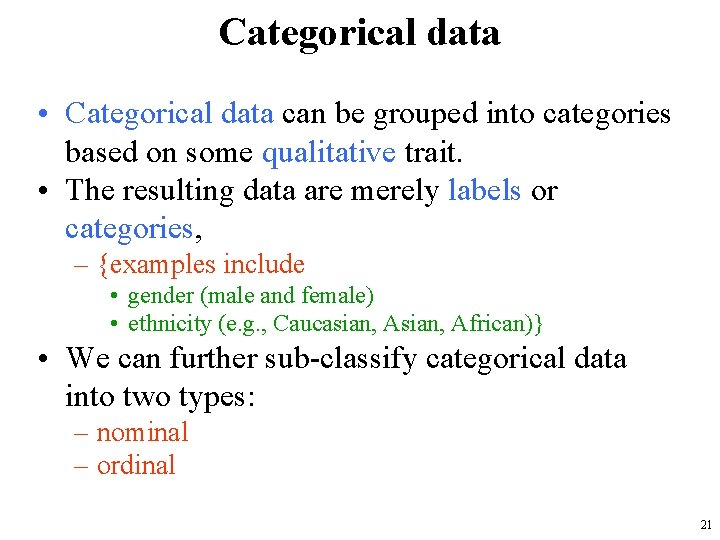
Categorical data • Categorical data can be grouped into categories based on some qualitative trait. • The resulting data are merely labels or categories, – {examples include • gender (male and female) • ethnicity (e. g. , Caucasian, African)} • We can further sub-classify categorical data into two types: – nominal – ordinal 21
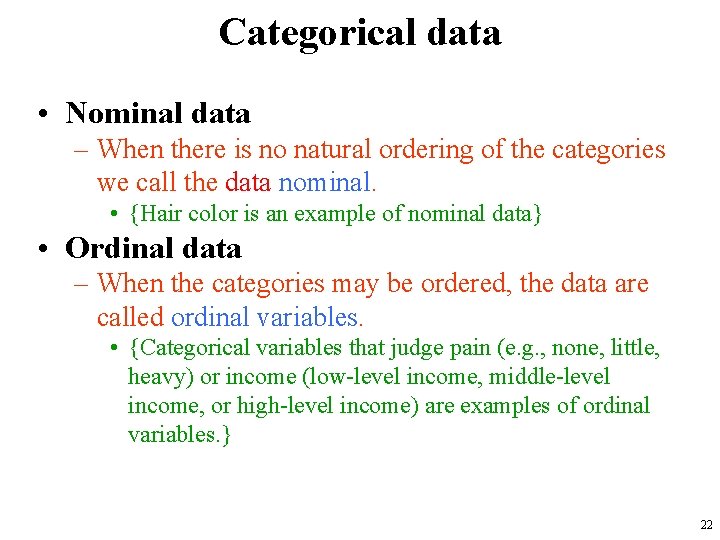
Categorical data • Nominal data – When there is no natural ordering of the categories we call the data nominal. • {Hair color is an example of nominal data} • Ordinal data – When the categories may be ordered, the data are called ordinal variables. • {Categorical variables that judge pain (e. g. , none, little, heavy) or income (low-level income, middle-level income, or high-level income) are examples of ordinal variables. } 22
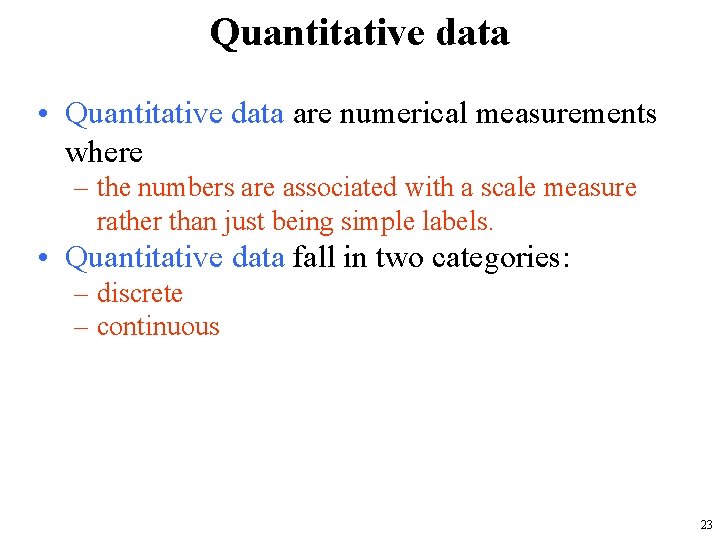
Quantitative data • Quantitative data are numerical measurements where – the numbers are associated with a scale measure rather than just being simple labels. • Quantitative data fall in two categories: – discrete – continuous 23
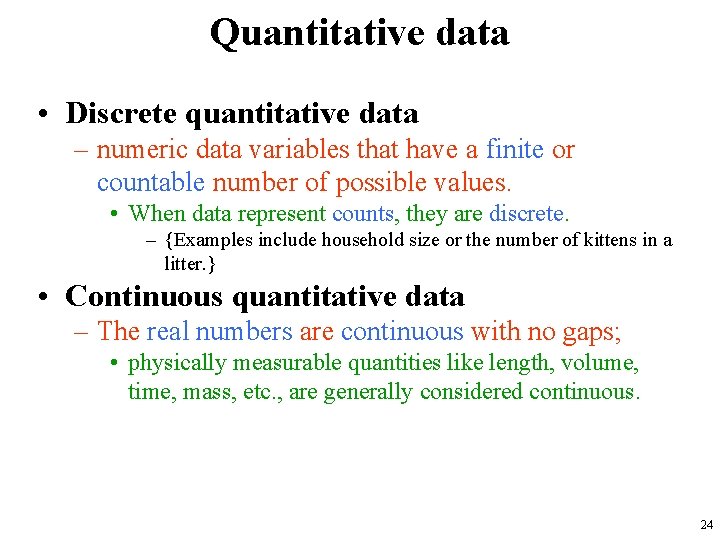
Quantitative data • Discrete quantitative data – numeric data variables that have a finite or countable number of possible values. • When data represent counts, they are discrete. – {Examples include household size or the number of kittens in a litter. } • Continuous quantitative data – The real numbers are continuous with no gaps; • physically measurable quantities like length, volume, time, mass, etc. , are generally considered continuous. 24
Categorical vs Quantitative data • Categorical data are typically summarized using frequencies or proportions of observations in each category • Quantitative data typically are summarized using averages or means. 25
Describing Data • Once data are collected, the next step is to summarize it all to get a handle on the big picture. • Statisticians describe data in two major ways: – with pictures • that is, charts and graphs – with numbers, • called descriptive statistics. 26
Charts and graphs • Data are summarized in a visual way using charts and/or graphs – Some of the basic graphs used include pie charts and bar charts – Some data are numerical – Data representing counts or measurements need a different type of graph that either keeps track of the numbers themselves or groups them into numerical groupings. • One major type of graph that is used to graph numerical data is a histogram. 27
Descriptive statistics • Numbers that describe a data set in terms of its important features – Categorical data are typically summarized using • the number of individuals in each group (the frequency) • the percentage of individuals in each group (the relative frequency) – Numerical data represent measurements or counts, where the actual numbers have meaning • more features can be summarized – measures of center – measures of spread – measures of the relationship between two variables • Some descriptive statistics are better than others, • some are more appropriate than others 28
Data Visualization and Summary Statistics • Preliminary steps before analysis: – defining the scientific question we try to answer, – selecting a set of representative members from the population of interest – collecting data (either through observational studies or randomized experiments), • Analysis usually exploration. begins with data – We start by focusing on data exploration techniques for one variable at a time. 29
Data Visualization and Summary Statistics • Objective is – to develop a high-level understanding of the data, – learn about the possible values for each characteristic, – find out how a characteristic varies among individuals in our sample. • Basicaly, we want to learn about the distribution of variables. – Recall that for a variable, the distribution shows • the possible values, • the chance of observing those values, • how often we expect to see them in a random sample from the population. 30
Data Visualization and Summary Statistics • The data exploration methods allow us to reduce the amount of information so that we can focus on the key aspects of the data. • We do this by using data visualization techniques and summary statistics. • The visualization techniques and summary statistics we use for a variable depend on its type – Recall that we can classify them into two general groups: • Numerical (quantitative) variables – discrete, continuous • Categorical variables – nominal, ordinal 31
Graphical summarization of data • Before blindly applying the statistical analysis, it is always good to look at the raw data, – usually in a graphical form, and then use graphical methods to summarize the data in an easy to interpret format. – A Picture is worth a thousand word • The types of graphical displays that are most frequently used by engineers – scatterplots, time series, box-and-whisker plots, and histograms. 32
Exploring Categorical Variables • 33
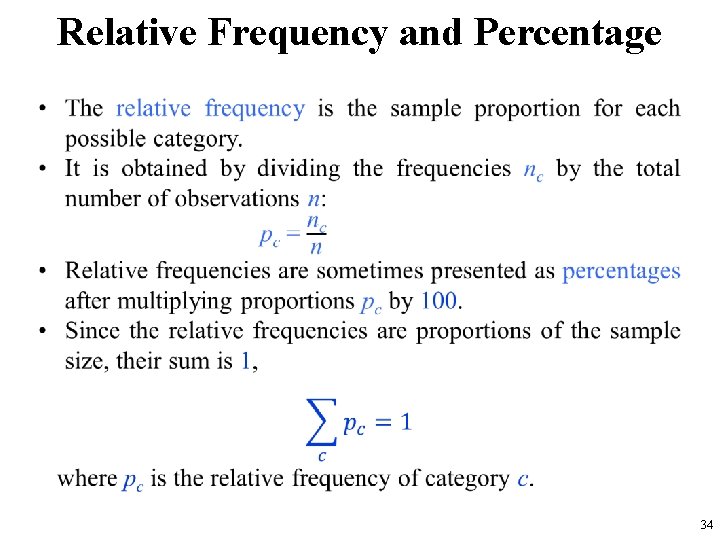
Relative Frequency and Percentage • 34
Exploring Numerical Variables • For numerical variables, we are especially interested in two key aspects of the distribution: – its location • refers to the central tendency of values, that is, the point around which most values are gathered. – its spread • refers to the dispersion of possible values, that is, how scattered the values are around the location. 35
Histograms • defined as a frequency distribution commonly used to visualize numerical variables. • A histogram is similar to a bar graph after the values of the variable are grouped (binned) into a finite number of nonoverlapping intervals (bins), usually of equal width. • Given N samples or measurements, xi ranging from Xmin to Xmax, the samples are binned into bins • Typically, the number of bins is on the order of 7– 14, depending on the nature of the data. – In addition, we typically expect to have at least 3 samples per bin. • Sturgess’rule may also be used to estimate the number of bins and is given by k = 1 + 3. 3 log(n). – where k is the number of bins and n is the number of samples. 36
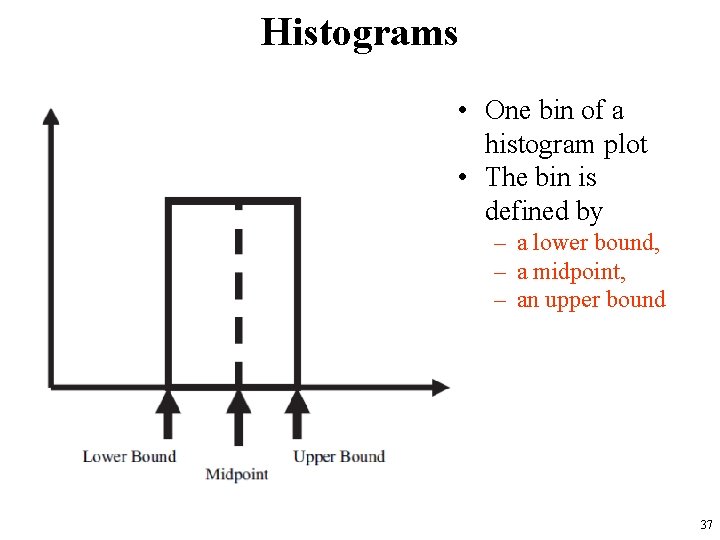
Histograms • One bin of a histogram plot • The bin is defined by – a lower bound, – a midpoint, – an upper bound 37
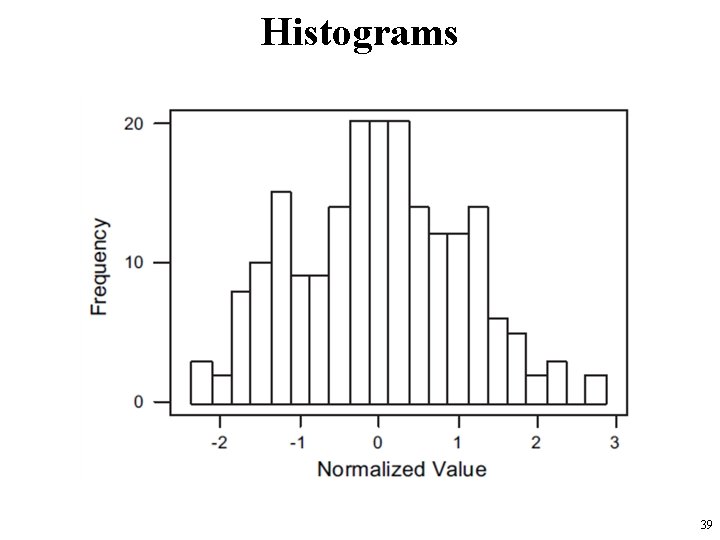
Histograms • constructed by plotting the number of samples in each bin. – horizontal axis, • the sample value, – the vertical axis, • the number of occurrences of samples falling within a bin • Next slide illustrates a histogram for 1000 samples drawn from a normal distribution with mean (μ) = 0 and standard deviation (σ) = 1. 0. 38
Histograms 39
Histograms • Two useful measures in describing a histogram: – the absolute frequency in one or more bins • fi = absolute frequency in ith bin – the relative frequency in one or more bins • fi /n = relative frequency in ith bin, – where n is the total number of samples being summarized in the histogram • The histogram can exhibit several shapes – symmetric, skewed, or bimodal. 40
Histograms • The bar height for each interval could be set to its relative frequency pc= nc/n, or the percentage pc× 100, of observations that fall into that interval. • For histograms, however, it is more common to use the density instead of the relative frequency or percentage. – The density is the relative frequency for a unit interval. • It is obtained by dividing the relative frequency by the interval width: fc = pc/wc – Here, pc= nc/n is the relative frequency with nc as the frequency of interval c and n as the total sample size. – The width of interval c is denoted wc. 41
Histograms • The height of each bar in density histogram shows the density of the corresponding interval (as opposed to its frequency). • For each interval c, the area of the corresponding bar in the density histogram is calculated as follows (hight×width): ac = fc × wc = (pc / wc) × wc = pc • Therefore, the area of each bar (rectangle) is the relative frequency for the corresponding interval. – Since the sum of relative frequencies is 1, the total area of bars in a density histogram is 1. 42
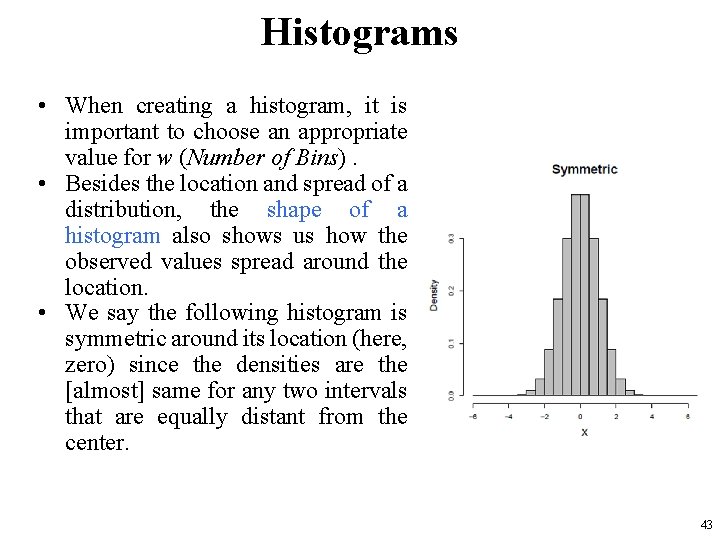
Histograms • When creating a histogram, it is important to choose an appropriate value for w (Number of Bins). • Besides the location and spread of a distribution, the shape of a histogram also shows us how the observed values spread around the location. • We say the following histogram is symmetric around its location (here, zero) since the densities are the [almost] same for any two intervals that are equally distant from the center. 43
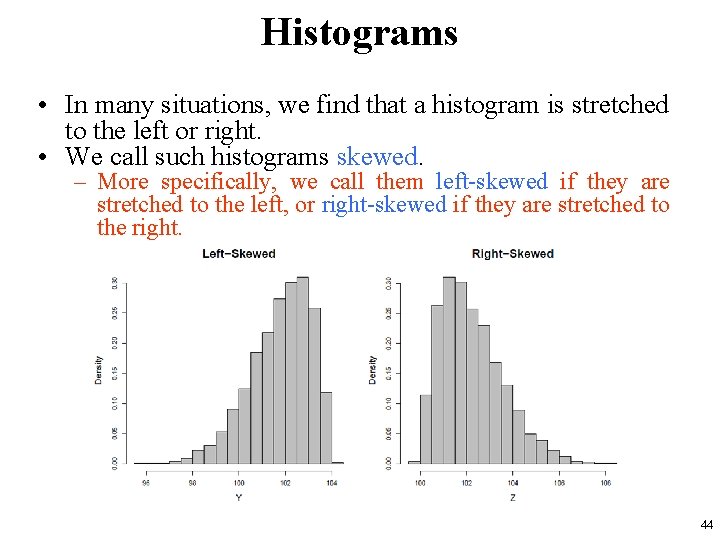
Histograms • In many situations, we find that a histogram is stretched to the left or right. • We call such histograms skewed. – More specifically, we call them left-skewed if they are stretched to the left, or right-skewed if they are stretched to the right. 44
Histograms • The histograms in previous slides, whether symmetric or skewed, have one thing in common – they all have one peak (or mode). • We call such histograms (and their corresponding distributions) unimodal. • Sometimes histograms have multiple modes. – The bimodal histogram appears to be a combination of two unimodal histograms. • Indeed, in many situations bimodal histograms (and multimodal histograms in general) indicate that the underlying population is not homogeneous and may include two (or more in case of multimodal histograms) subpopulations. 45
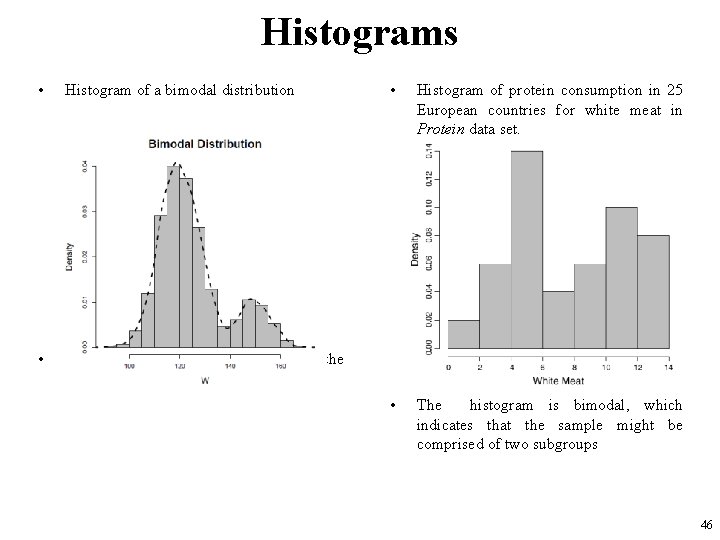
Histograms • Histogram of a bimodal distribution • A smooth curve is superimposed so that the two peaks are more evident • Histogram of protein consumption in 25 European countries for white meat in Protein data set. • The histogram is bimodal, which indicates that the sample might be comprised of two subgroups 46
Histograms • The histogram is important because it serves as – a rough estimate of the true probability density function or – probability distribution of the underlying random process from which the samples are being collected. • The probability density function or probability distribution is a function that quantifies the probability of a random event, x, occurring. – When the underlying random event is discrete in nature, we refer to the probability density function as the probability mass function 47
Measures of Central Tendency • Histograms are useful for visualizing numerical data and identifying their location and spread. • However, we typically use descriptive or summary statistics for more precise specification of the – central tendency – dispersion of observed values. 48
Measures of Central Tendency • A central tendency is a central or typical value for a probability distribution. – also called a center or location of the distribution. • Measures of central tendency are often called averages. • There are several measures that reflect the central tendency – sample mean, – sample median, – sample mode. 49
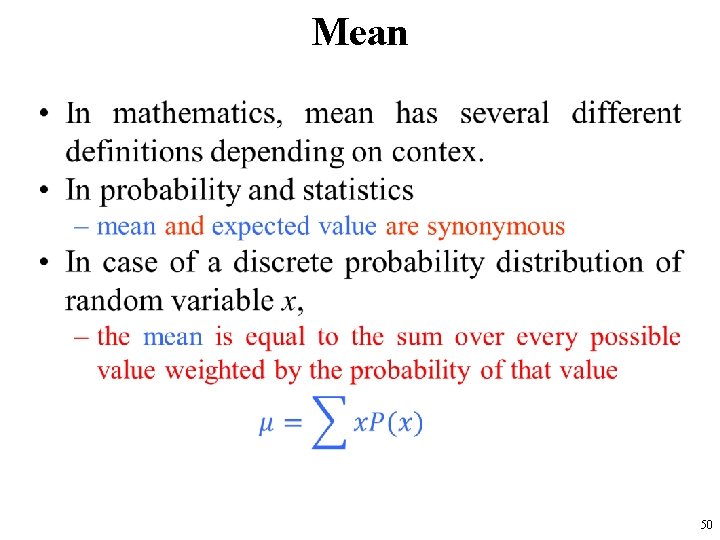
Mean • 50
Mean • For a data set, the terms – arithmetic mean, – mathematical expectation, – sometimes average are used synonymously to refer to a central value of a discrete set of numbers – specifically, the sum of the values divided by the number of values. • If the data set were based on a series of observations obtained by sampling from a statistical population, – the arithmetic mean is termed as the sample mean to distinguish it from the population mean 51
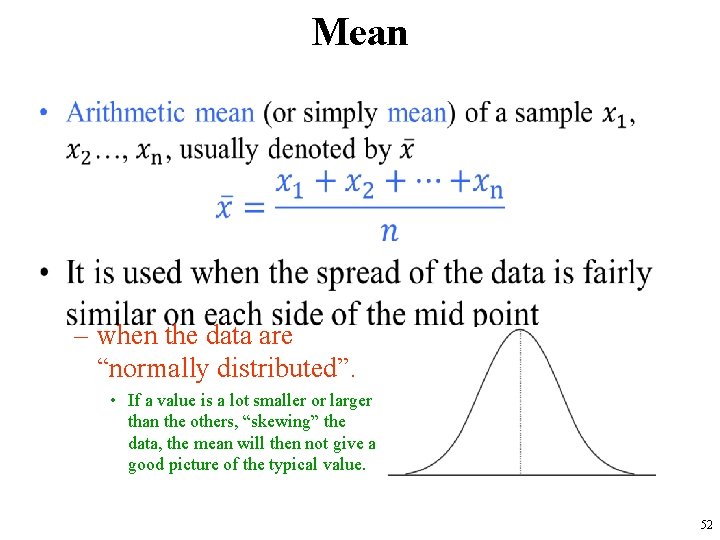
Mean • – when the data are “normally distributed”. • If a value is a lot smaller or larger than the others, “skewing” the data, the mean will then not give a good picture of the typical value. 52
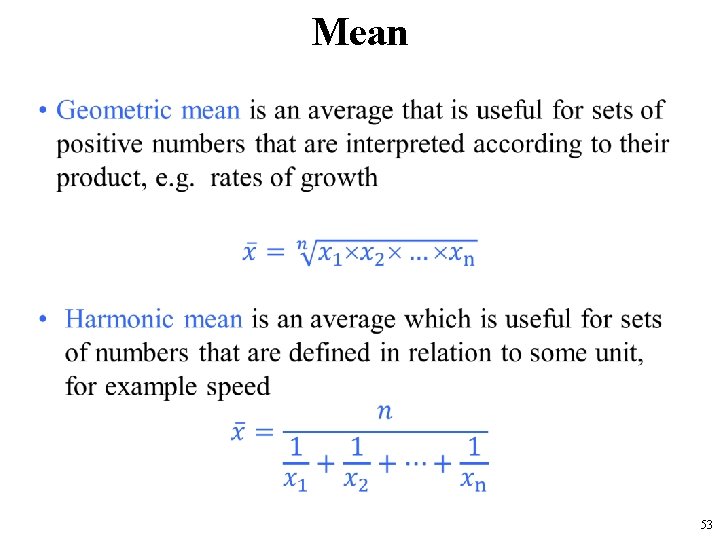
Mean • 53
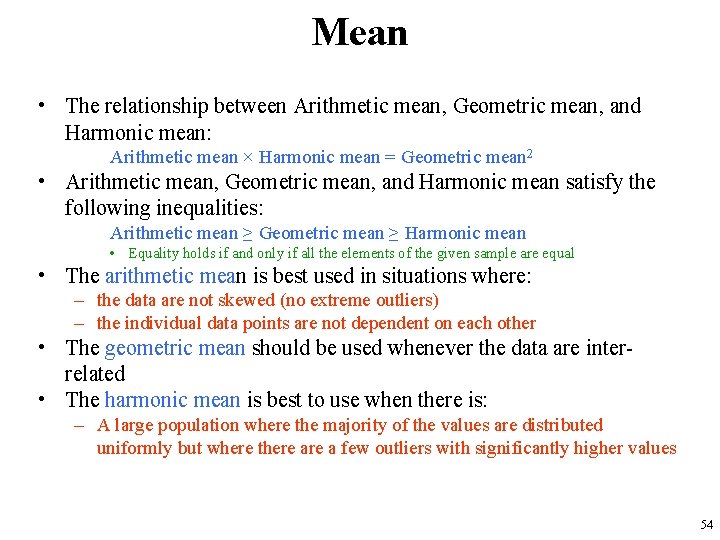
Mean • The relationship between Arithmetic mean, Geometric mean, and Harmonic mean: Arithmetic mean × Harmonic mean = Geometric mean 2 • Arithmetic mean, Geometric mean, and Harmonic mean satisfy the following inequalities: Arithmetic mean ≥ Geometric mean ≥ Harmonic mean • Equality holds if and only if all the elements of the given sample are equal • The arithmetic mean is best used in situations where: – the data are not skewed (no extreme outliers) – the individual data points are not dependent on each other • The geometric mean should be used whenever the data are interrelated • The harmonic mean is best to use when there is: – A large population where the majority of the values are distributed uniformly but where there a few outliers with significantly higher values 54
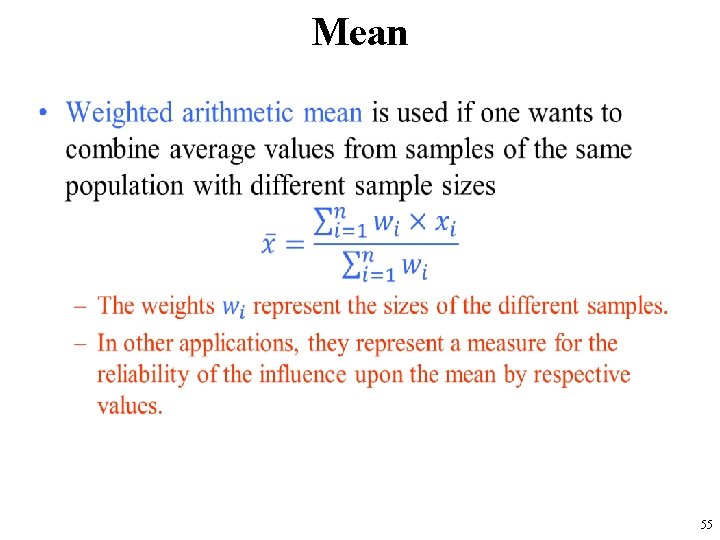
Mean • 55
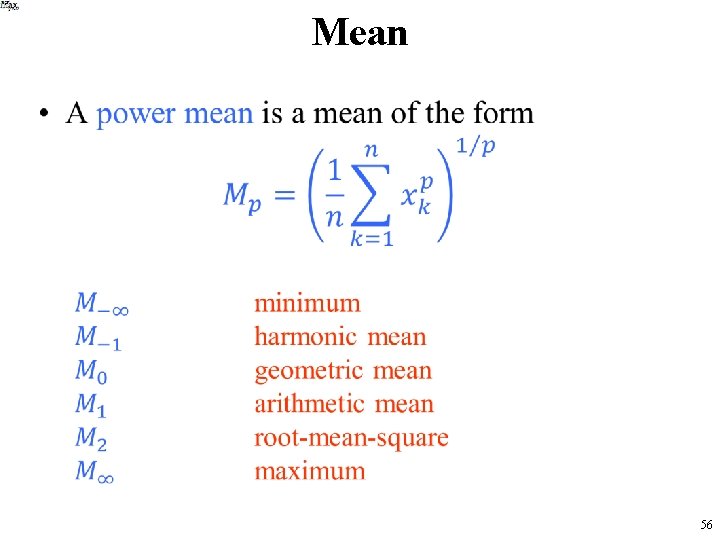
Mean • 56
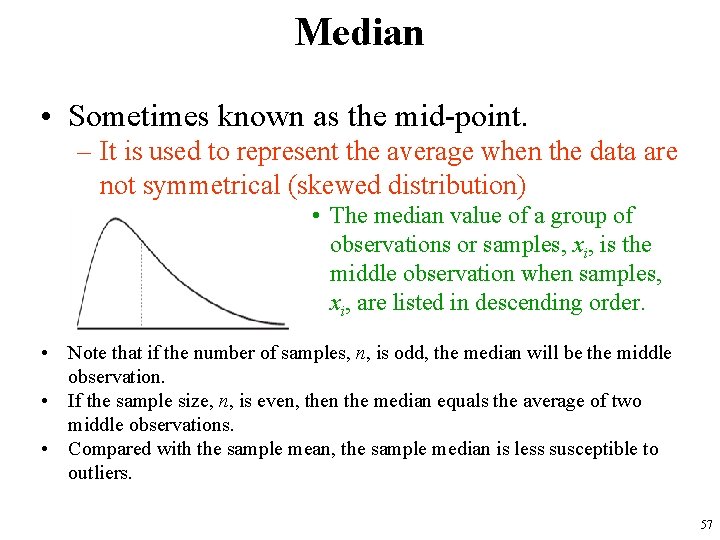
Median • Sometimes known as the mid-point. – It is used to represent the average when the data are not symmetrical (skewed distribution) • The median value of a group of observations or samples, xi, is the middle observation when samples, xi, are listed in descending order. • Note that if the number of samples, n, is odd, the median will be the middle observation. • If the sample size, n, is even, then the median equals the average of two middle observations. • Compared with the sample mean, the sample median is less susceptible to outliers. 57
Median • The median may be given with its inter-quartile range (IQR). • The 1 st quartile point has the 1⁄4 of the data below it • The 3 rd quartile point has the 3⁄4 of the sample below it • The IQR contains the middle 1⁄2 of the sample • This can be shown in a “box and whisker” plot. 58
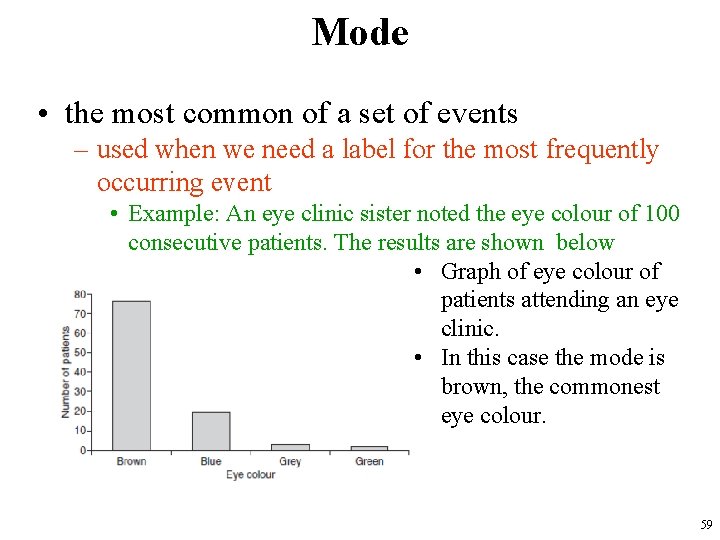
Mode • the most common of a set of events – used when we need a label for the most frequently occurring event • Example: An eye clinic sister noted the eye colour of 100 consecutive patients. The results are shown below • Graph of eye colour of patients attending an eye clinic. • In this case the mode is brown, the commonest eye colour. 59
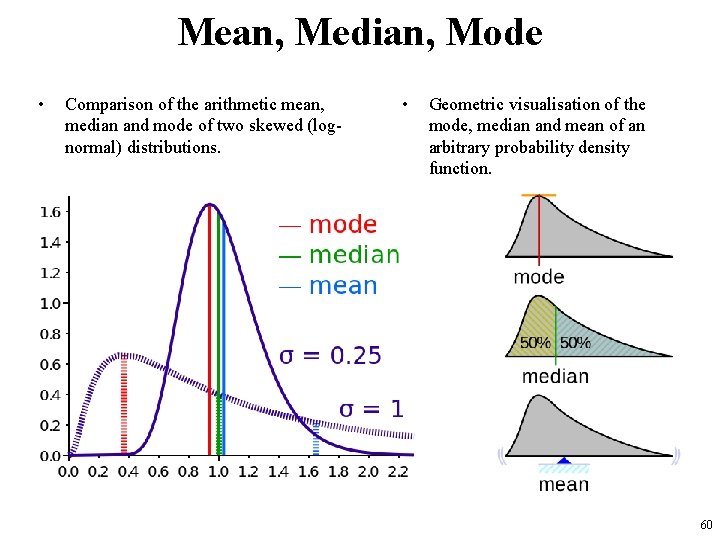
Mean, Median, Mode • Comparison of the arithmetic mean, median and mode of two skewed (lognormal) distributions. • Geometric visualisation of the mode, median and mean of an arbitrary probability density function. 60
Measures of Variability • When summarizing the variability of a population or process, we typically ask, – “How far from the center (sample mean) do the samples (data) lie? ” • To answer this question, we typically use the following estimates that represent the spread of the sample data: – sample variance, – sample standard deviation. – interquartile ranges, 61
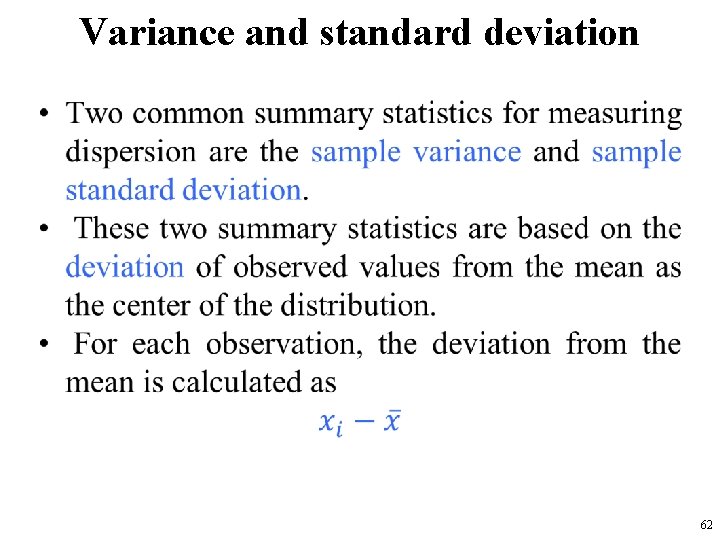
Variance and standard deviation • 62
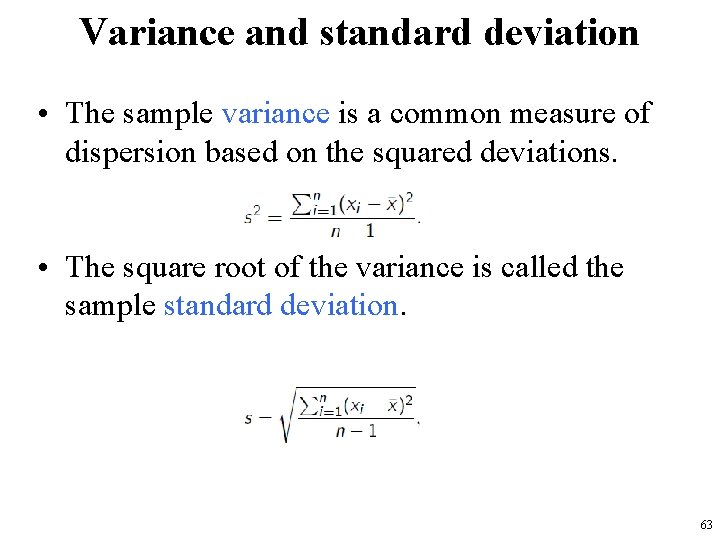
Variance and standard deviation • The sample variance is a common measure of dispersion based on the squared deviations. • The square root of the variance is called the sample standard deviation. 63
Measures of Variability • Standard deviation (SD) is used for data which are “normally distributed”, – to provide information on how much the data vary around their mean. • SD indicates how much a set of values is spread around the average. • A range of one SD above and below the mean (abbreviated to ± 1 SD) includes 68. 2% of the values. • ± 2 SD includes 95. 4% of the data. • ± 3 SD includes 99. 7%. 64
Variance and standard deviation • Some properties that can help you when interpreting a standard deviation: – The standard deviation can never be a negative number. – The smallest possible value for the standard deviation is 0 • (when every number in the data set is exactly the same). – Standard deviation is affected by outliers, as it’s based on distance from the mean, which is affected by outliers. – The standard deviation has the same units as the original data, while variance is in square units. 65
Measures of Variability • It is important to note that for normal distributions (symmetrical histograms), – sample mean and sample deviation are the only parameters needed to describe the statistics of the underlying phenomenon. • Thus, if one were to compare two or more normally distributed populations, – one only needs to test the equivalence of the means and variances of those populations. 66
Quantile • comes from the word quantity • A quantile is where a sample is divided into equal-sized, adjacent, subgroups – (quantile is also called a fractile) • It can also refer to dividing a probability distribution into areas of equal probability • Quartiles are also quantiles; – they divide the distribution into 4 equal parts. • Percentiles are quantiles; – they divide a distribution into 100 equal parts • Deciles are quantiles; – they divide a distribution into 10 equal parts. 67
Percentiles • the most common way to report relative standing of a number within a data set • A percentile is the percentage of individuals in the data set who are below where your particular number is located. – For example, – if your exam score is at the 90 th percentile, that means • 90% of the people taking the exam with you scored lower than you did • 10 percent scored higher than you did 68
Quartile • For sampled data, the median is also known as – the 2 nd quartile, Q 2. • Given Q 2, we can find the 1 st quartile, Q 1, – by simply taking the median value of those samples that lie below the 2 nd quartile. • We can find the 3 d quartile, Q 3, – by taking the median value of those samples that lie above the 2 nd quartile. • Quartiles can also be found in terms of percentiles: – 1 st quartile is 25 th percentile – 2 nd quartile is 50 th percentile – 3 rd quartile is 75 th percentile 69
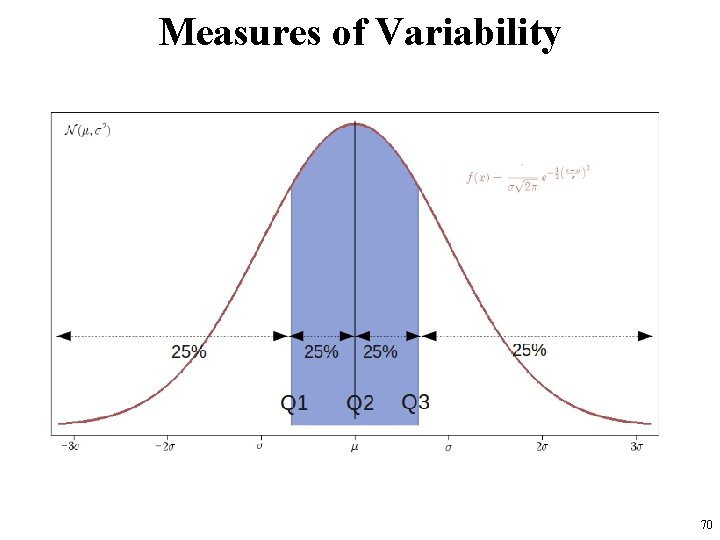
Measures of Variability 70
Five-number summary • The minimum (min), which is the smallest value of the variable in our sample, is in fact the 0 quantile. • On the other hand, the maximum (max), which is the largest value of the variable in our sample, is the 1 quantile. • The minimum and maximum along with quartiles (Q 1, Q 2, and Q 3) are known as five-number summary. • These are usually presented in the increasing order: – min, 1 st quartile, median, 3 rd quartile, max – min, 25 th percentile, median, 75 th percentile, max • This way, the five-number summary provides – 0, 0. 25, 0. 50, 0. 75, and 1 quantiles 71
Five-number summary • The five-number summary can be used to derive two measures of dispersion: – the range • the difference between the maximum observed value and the minimum observed value. – the interquartile range (IQR) • the difference between the third quartile (Q 3) and the first quartile (Q 1). IQR = Q 3 - Q 1 72
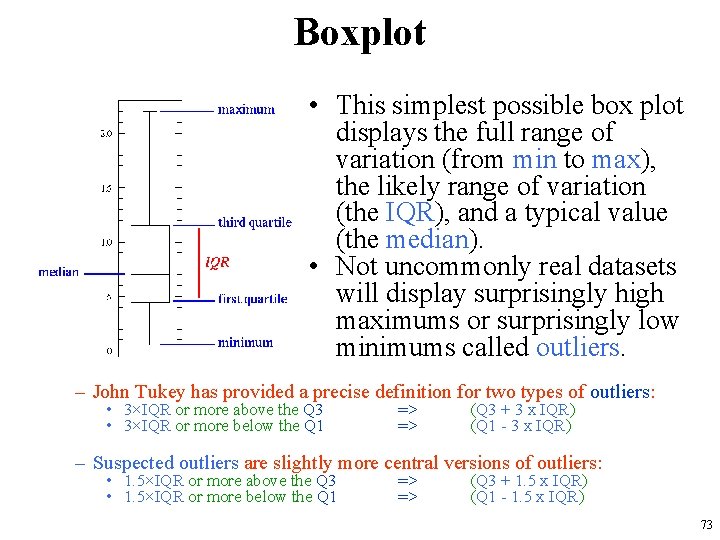
Boxplot • This simplest possible box plot displays the full range of variation (from min to max), the likely range of variation (the IQR), and a typical value (the median). • Not uncommonly real datasets will display surprisingly high maximums or surprisingly low minimums called outliers. – John Tukey has provided a precise definition for two types of outliers: • 3×IQR or more above the Q 3 • 3×IQR or more below the Q 1 => => (Q 3 + 3 x IQR) (Q 1 - 3 x IQR) – Suspected outliers are slightly more central versions of outliers: • 1. 5×IQR or more above the Q 3 • 1. 5×IQR or more below the Q 1 => => (Q 3 + 1. 5 x IQR) (Q 1 - 1. 5 x IQR) 73
Data Transformation • We rely on data transformation techniques – to reduce the influence of extreme values in our analysis. • The reasons for data transformation: – to make the distribution of the data normal, – to create more informative graphs of the data, – better outlier identification – increasing the sensitivity of statistical tests • Two of the most common transformation functions for this purpose are – logarithm – square root. 74
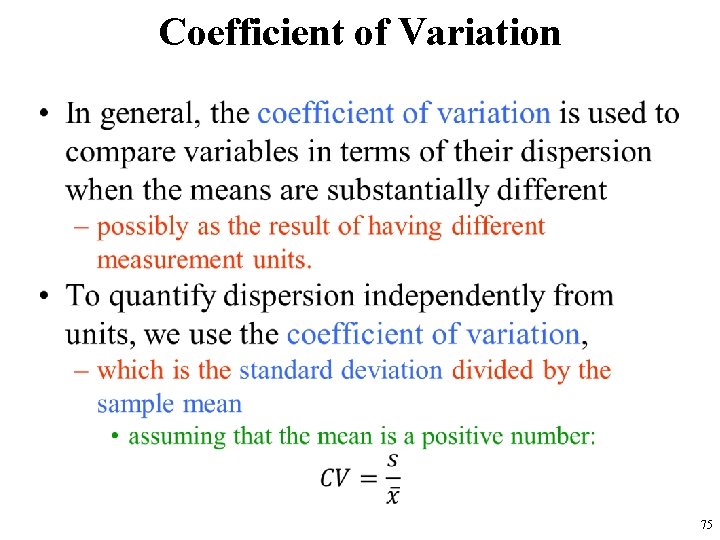
Coefficient of Variation • 75
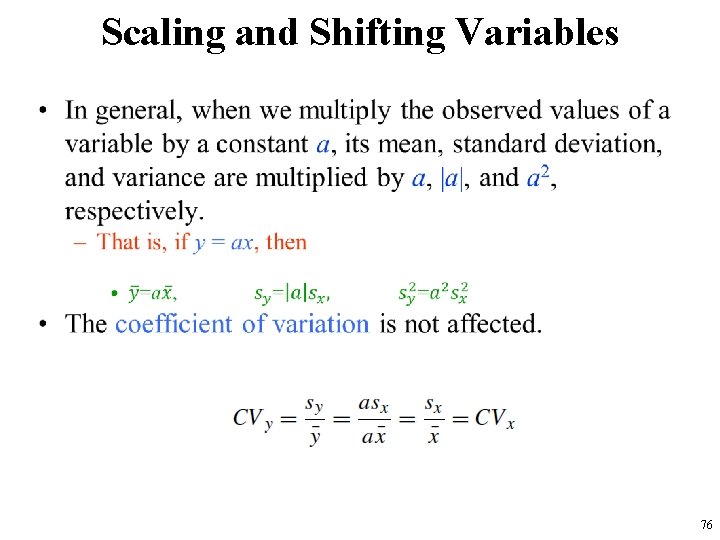
Scaling and Shifting Variables • 76
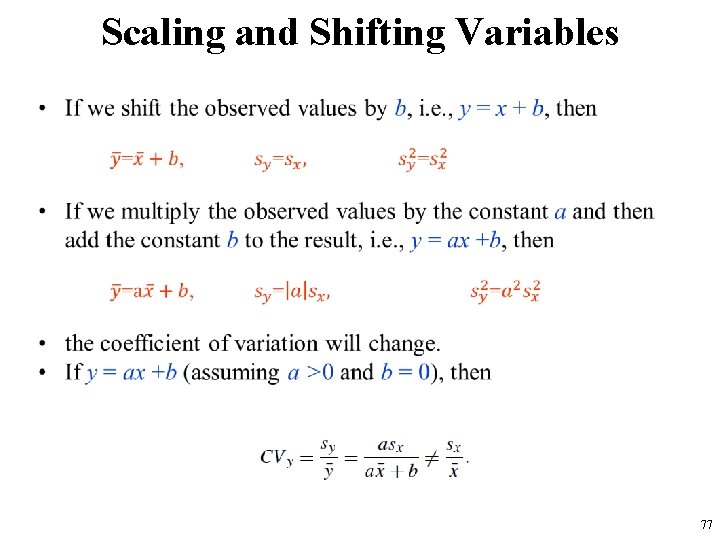
Scaling and Shifting Variables • 77
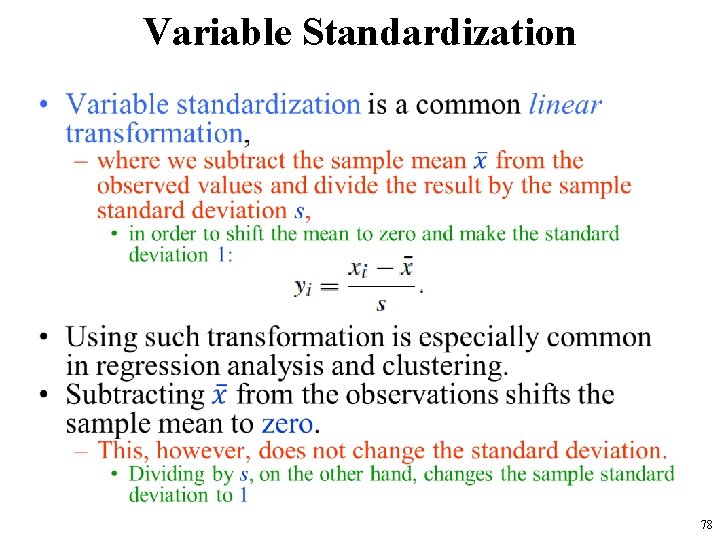
Variable Standardization • 78
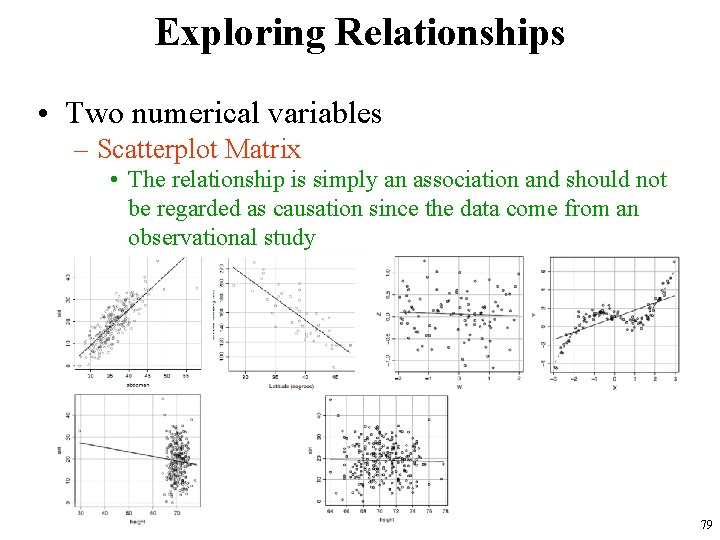
Exploring Relationships • Two numerical variables – Scatterplot Matrix • The relationship is simply an association and should not be regarded as causation since the data come from an observational study 79
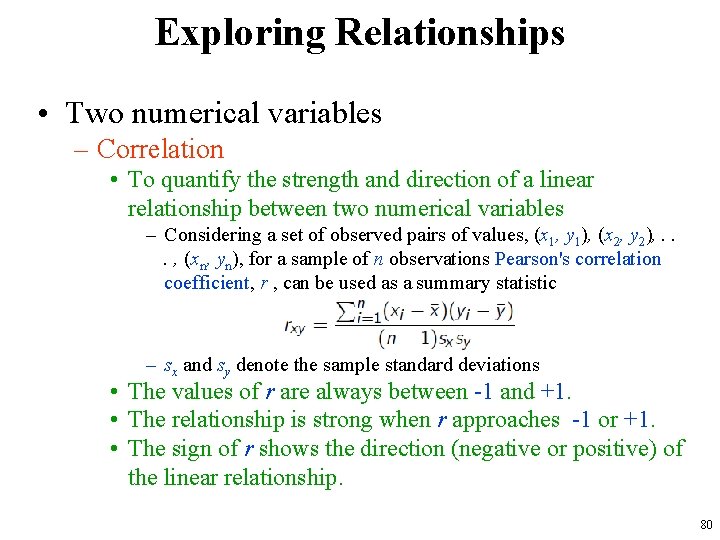
Exploring Relationships • Two numerical variables – Correlation • To quantify the strength and direction of a linear relationship between two numerical variables – Considering a set of observed pairs of values, (x 1, y 1), (x 2, y 2), . . . , (xn, yn), for a sample of n observations Pearson's correlation coefficient, r , can be used as a summary statistic – sx and sy denote the sample standard deviations • The values of r are always between -1 and +1. • The relationship is strong when r approaches -1 or +1. • The sign of r shows the direction (negative or positive) of the linear relationship. 80
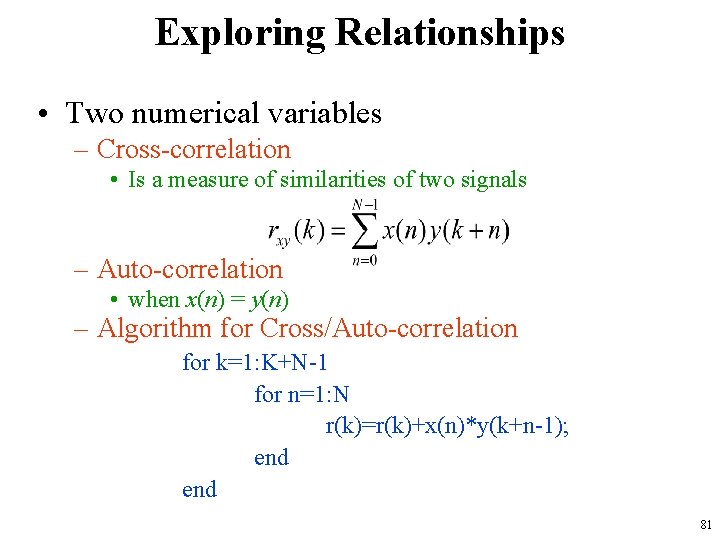
Exploring Relationships • Two numerical variables – Cross-correlation • Is a measure of similarities of two signals – Auto-correlation • when x(n) = y(n) – Algorithm for Cross/Auto-correlation for k=1: K+N-1 for n=1: N r(k)=r(k)+x(n)*y(k+n-1); end 81
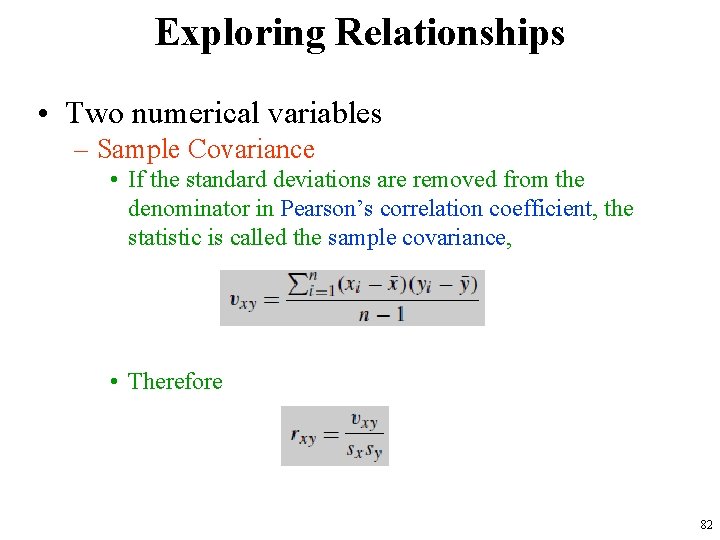
Exploring Relationships • Two numerical variables – Sample Covariance • If the standard deviations are removed from the denominator in Pearson’s correlation coefficient, the statistic is called the sample covariance, • Therefore 82
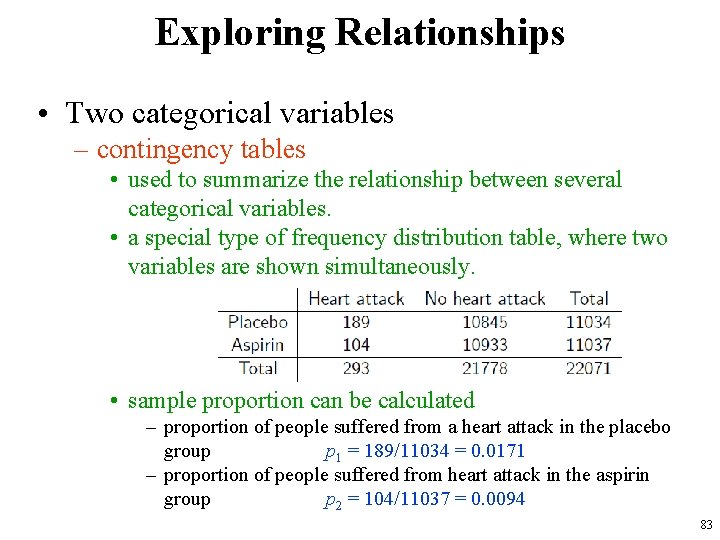
Exploring Relationships • Two categorical variables – contingency tables • used to summarize the relationship between several categorical variables. • a special type of frequency distribution table, where two variables are shown simultaneously. • sample proportion can be calculated – proportion of people suffered from a heart attack in the placebo group p 1 = 189/11034 = 0. 0171 – proportion of people suffered from heart attack in the aspirin group p 2 = 104/11037 = 0. 0094 83
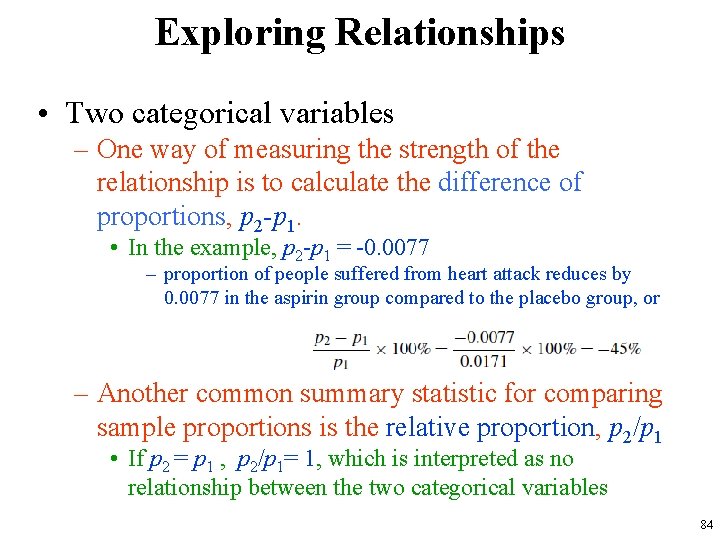
Exploring Relationships • Two categorical variables – One way of measuring the strength of the relationship is to calculate the difference of proportions, p 2 -p 1. • In the example, p 2 -p 1 = -0. 0077 – proportion of people suffered from heart attack reduces by 0. 0077 in the aspirin group compared to the placebo group, or – Another common summary statistic for comparing sample proportions is the relative proportion, p 2/p 1 • If p 2 = p 1 , p 2/p 1= 1, which is interpreted as no relationship between the two categorical variables 84
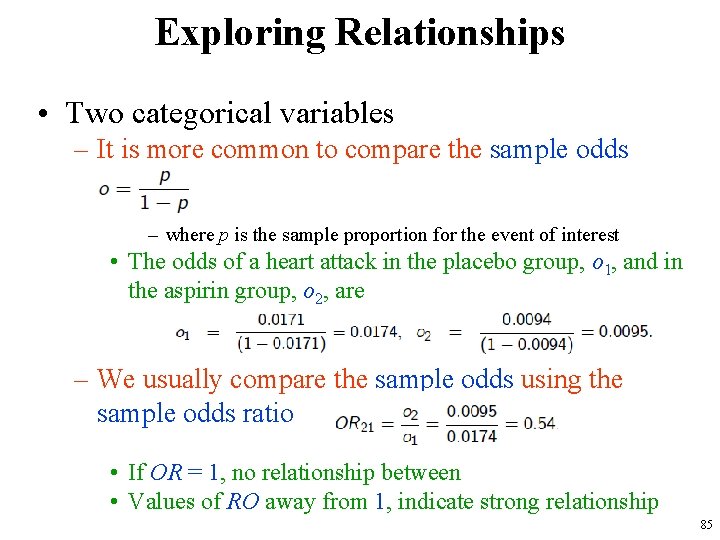
Exploring Relationships • Two categorical variables – It is more common to compare the sample odds – where p is the sample proportion for the event of interest • The odds of a heart attack in the placebo group, o 1, and in the aspirin group, o 2, are – We usually compare the sample odds using the sample odds ratio • If OR = 1, no relationship between • Values of RO away from 1, indicate strong relationship 85
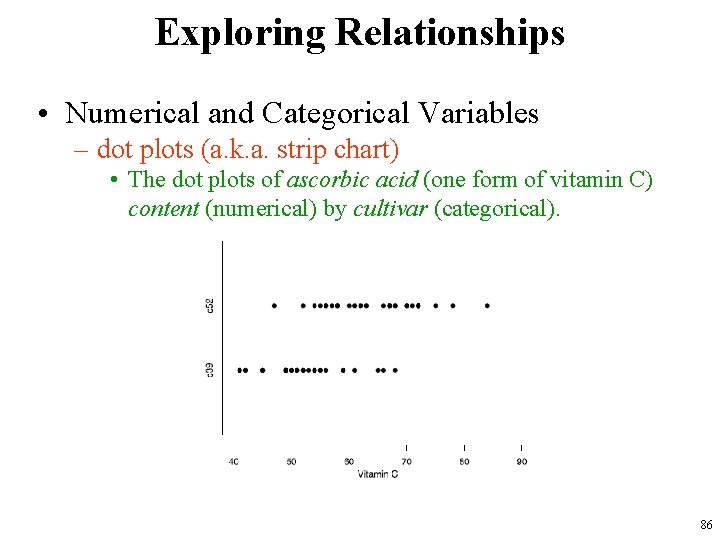
Exploring Relationships • Numerical and Categorical Variables – dot plots (a. k. a. strip chart) • The dot plots of ascorbic acid (one form of vitamin C) content (numerical) by cultivar (categorical). 86
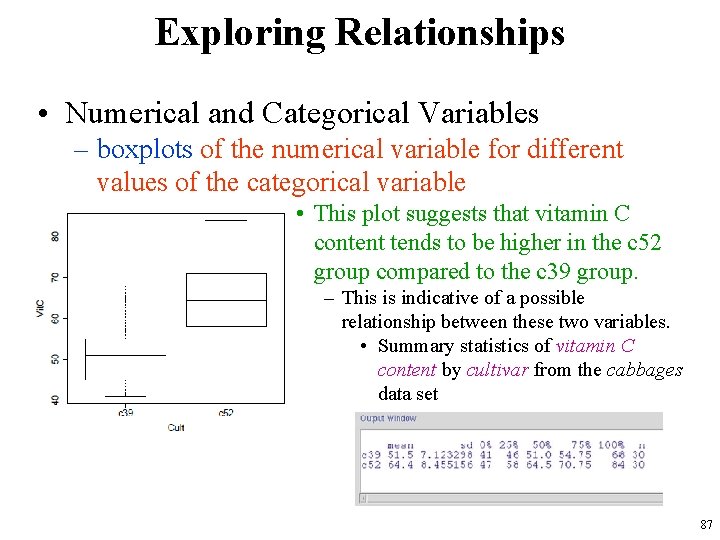
Exploring Relationships • Numerical and Categorical Variables – boxplots of the numerical variable for different values of the categorical variable • This plot suggests that vitamin C content tends to be higher in the c 52 group compared to the c 39 group. – This is indicative of a possible relationship between these two variables. • Summary statistics of vitamin C content by cultivar from the cabbages data set 87
Probability as a Measure of Uncertainty • Plots and summary statistics are used to learn about the distribution of variables and to investigate their relationships. – However, we always remain uncertain about the true distributions and relationships in the population since we almost never have access to all of its members. – Furthermore, our findings based on the observed sample can change if different samples from the population were obtained. • Therefore, when we generalize our findings from a sample to the whole population, we should explicitly specify the extent of our uncertainty. – We use probability as a measure of uncertainty. 88
Probability as a Measure of Uncertainty • A phenomenon is called random if its outcome (value) cannot be determined with certainty before it occurs. • The collection of all possible outcomes S is called the sample space. • To each possible outcome in the sample space, we assign a probability P, – which represents how certain we are about the occurrence of the corresponding outcome. • For an outcome o, we denote the probability as P(o), where 0 ≤ P(o) ≤ 1. • The total probability of all outcomes in the sample space is always 1 89
Probability as a Measure of Uncertainty • An event is a subset of the sample space S. • We denote the probability of event E as P(E). – The probability of an event is the sum of the probabilities for all individual outcomes included in that event. • For any event E, we define its complement, Ec, as the set of all outcomes that are in the sample space S but not in E. • The probability of the complement event is P(Ec) = 1− P(E) 90
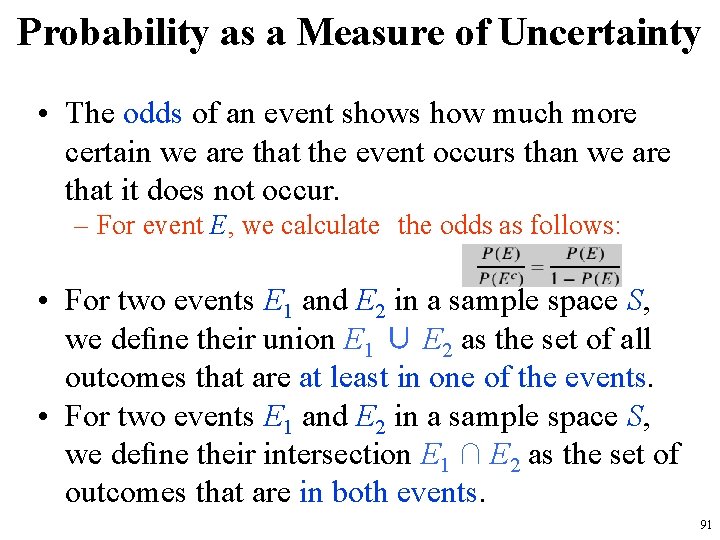
Probability as a Measure of Uncertainty • The odds of an event shows how much more certain we are that the event occurs than we are that it does not occur. – For event E, we calculate the odds as follows: • For two events E 1 and E 2 in a sample space S, we define their union E 1 ∪ E 2 as the set of all outcomes that are at least in one of the events. • For two events E 1 and E 2 in a sample space S, we define their intersection E 1 ∩ E 2 as the set of outcomes that are in both events. 91
Probability as a Measure of Uncertainty • We refer to the probability of the intersection of two events, P(E 1 ∩ E 2), as their joint probability. • In contrast, we refer to probabilities P(E 1) and P(E 2) as the marginal probabilities of events E 1 and E 2. • For any two events E 1 and E 2, we have P(E 1 ∪ E 2) = P(E 1) + P(E 2) − P(E 1 ∩ E 2) • Two events are called disjoint or mutually exclusive if they never occur together 92
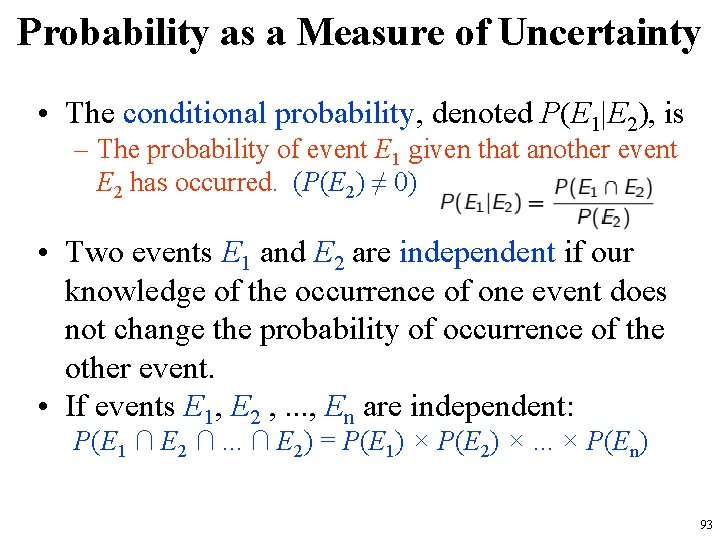
Probability as a Measure of Uncertainty • The conditional probability, denoted P(E 1|E 2), is – The probability of event E 1 given that another event E 2 has occurred. (P(E 2) ≠ 0) • Two events E 1 and E 2 are independent if our knowledge of the occurrence of one event does not change the probability of occurrence of the other event. • If events E 1, E 2 , . . . , En are independent: P(E 1 ∩ E 2 ∩. . . ∩ E 2) = P(E 1) × P(E 2) ×. . . × P(En) 93
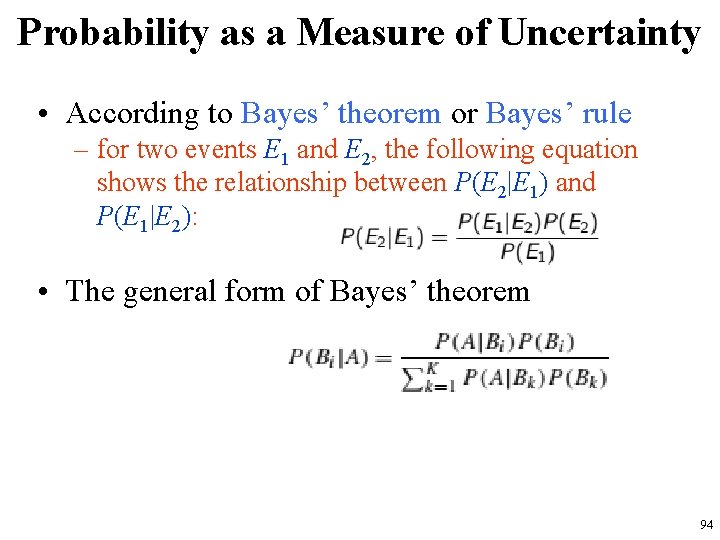
Probability as a Measure of Uncertainty • According to Bayes’ theorem or Bayes’ rule – for two events E 1 and E 2, the following equation shows the relationship between P(E 2|E 1) and P(E 1|E 2): • The general form of Bayes’ theorem 94
Interpretation of Probability as the Relative Frequency • The random phenomena can be observed repeatedly. – These repeated experiments or observations are called trials. • For such random phenomena, the probability of an event can be interpreted in terms of the relative frequency. • The above interpretation of probability requires two important assumptions. – We assume that the probability of events does not change from one trial to another. – We also assume that the outcome of one trial does not affect the outcome of another trial. 95
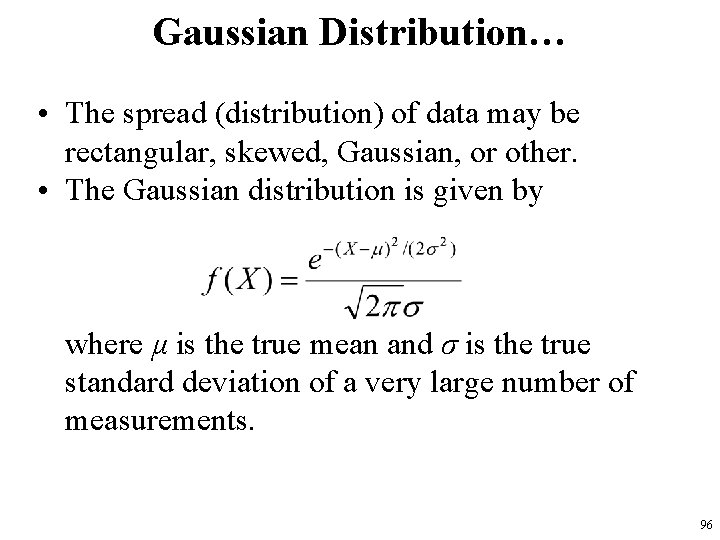
Gaussian Distribution… • The spread (distribution) of data may be rectangular, skewed, Gaussian, or other. • The Gaussian distribution is given by where μ is the true mean and σ is the true standard deviation of a very large number of measurements. 96
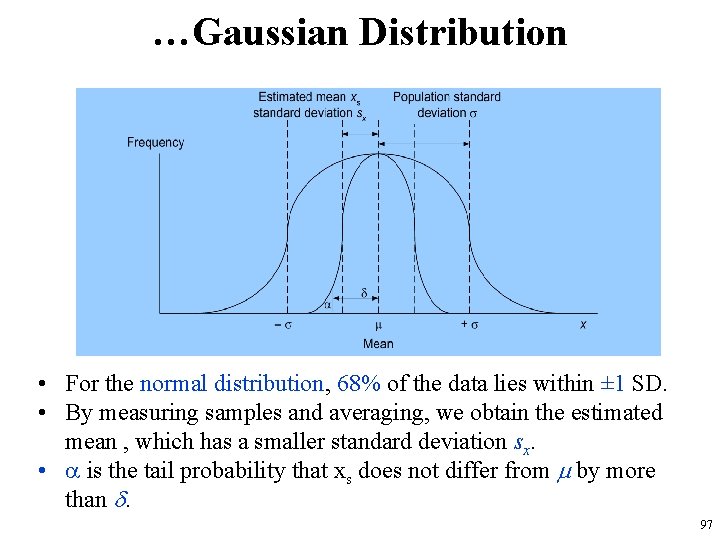
…Gaussian Distribution • For the normal distribution, 68% of the data lies within ± 1 SD. • By measuring samples and averaging, we obtain the estimated mean , which has a smaller standard deviation sx. • is the tail probability that xs does not differ from by more than . 97
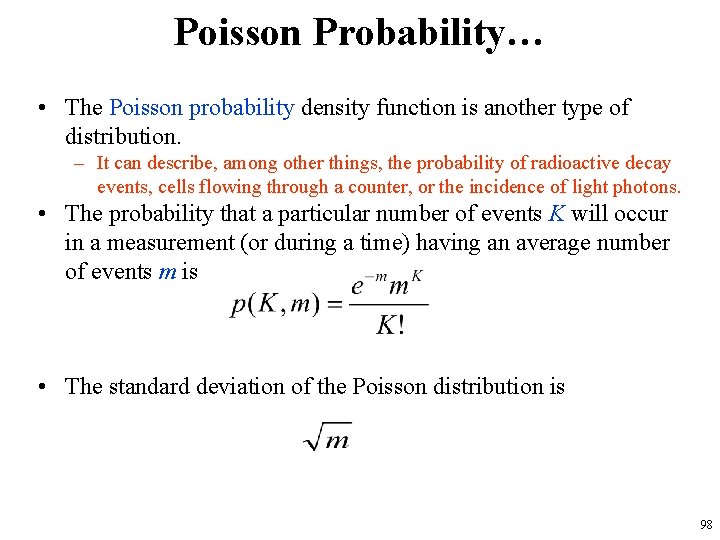
Poisson Probability… • The Poisson probability density function is another type of distribution. – It can describe, among other things, the probability of radioactive decay events, cells flowing through a counter, or the incidence of light photons. • The probability that a particular number of events K will occur in a measurement (or during a time) having an average number of events m is • The standard deviation of the Poisson distribution is 98
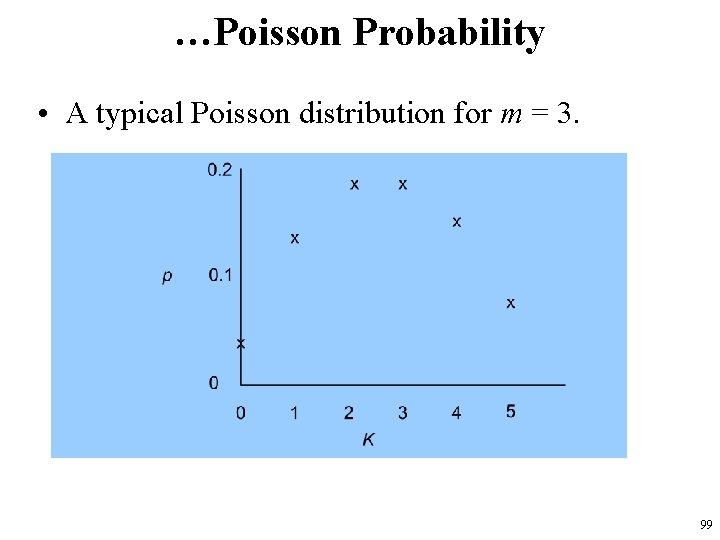
…Poisson Probability • A typical Poisson distribution for m = 3. 99
Parameter Estimation • The objective of statistics is to make inferences about a population based on information contained in a sample. • Populations are characterized by numerical descriptive measures called parameters. • Typical population parameters are the mean , the median M, the standard deviation s, and a proportion p. • Most inferential problems can be formulated as an inference about one or more parameters of a population. 100
Parameter Estimation • Methods for making inferences about parameters fall into one of two categories: – estimate the value of the population parameter of interest – test a hypothesis about the value of the parameter • These two methods of statistical inference involve different procedures, and they answer two different questions about the parameter. – In estimating a population parameter, we are answering the question • “What is the value of the population parameter? ” – In testing a hypothesis, we are seeking an answer to the question • “Does the population parameter satisfy a specified condition? ” 101
Parameter Estimation • Estimation refers to the process of guessing the unknown value of a parameter (e. g. , population mean) using the observed data. • For this, an estimator, which is a statistic, is used. – A statistic is a function of the observed data only. • Sometimes we only provide a single value as our estimate. – This is called point estimation. • Point estimates do not reflect our uncertainty when estimating a parameter. • We always remain uncertain regarding the true value of the parameter when we estimate it using a sample from the population. • To address this issue, we can present our estimates in terms of a range of possible values. – This is called interval estimation. 102
Hypothesis Testing • A hypothesis (plural: hypotheses), – a testable statement about the relationship between two or more variables – a proposed explanation for some observed phenomenon. • In a scientific experiment or study, the hypothesis is – a brief summation of the researcher's prediction of the study's findings, which may be supported or not by the outcome. • Hypothesis testing is the core of the scientific method. 103
Scientific method • an approach to seeking knowledge that involves forming and testing a hypothesis. • used to answer questions in a wide variety of disciplines outside of science, including business. • provides a logical, systematic way to answer questions and removes subjectivity by requiring each answer to be authenticated with objective evidence that can be reproduced. • Goal of scientific method is to gather data that will validate or invalidate a cause and effect relationship. – often carried out in a linear manner, but the approach can also be cyclical, because once a conclusion has been reached, it often raises more questions. 104
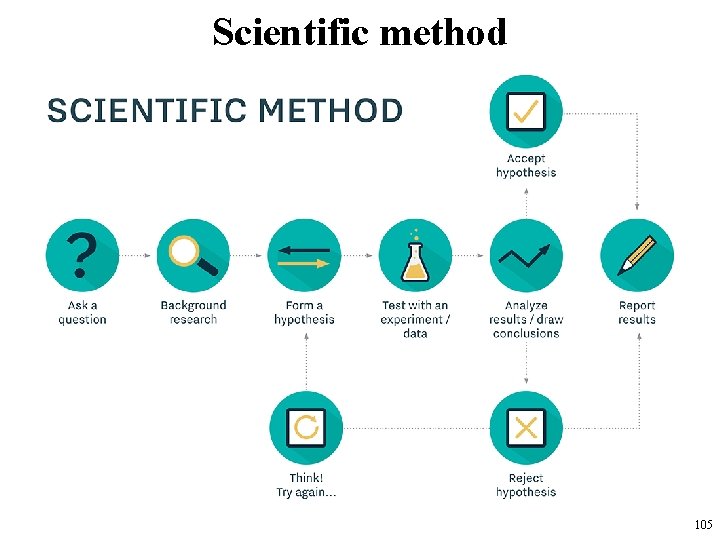
Scientific method 105
Hypothesis • In general, many scientific investigations start by expressing a hypothesis. • To evaluate hypotheses, we rely on – estimators, – their sampling distributions, – their specific values from observed data. • For example, – Mackowiak et al. * hypothesized that the average normal (i. e. , for healthy people) body temperature is less than the widely accepted value of 98. 6°F. – If we denote the population mean of normal body temperature as μ, then we can express this hypothesis as μ<98. 6. *Mackowiak, P. A. , Wasserman, S. S. , Levine, M. M. : A critical appraisal of 98. 6°F, the upper limit of the normal body temperature, and other legacies of Carl Reinhold August. Wunderlich. JAMA 268, 1578– 1580 (1992) 106
Null and Alternative hypotheses • The null hypothesis usually reflects the “status quo" or “nothing of interest". • In contrast, we refer to our hypothesis (i. e. , the hypothesis we are investigating through a scientific study) as the alternative hypothesis and denote it as HA. • The procedure for evaluating a hypothesis is called hypothesis testing, and it rises in many scientific problems. • For hypothesis testing, we focus on the null hypothesis since it tends to be simpler. • To this end, we examine the evidence that the observed data provide against the null hypothesis H 0. – If the evidence against H 0 is strong, we reject H 0. – If not, we state that the evidence provided by the data is not strong enough to reject H 0, and we fail to reject it. 107
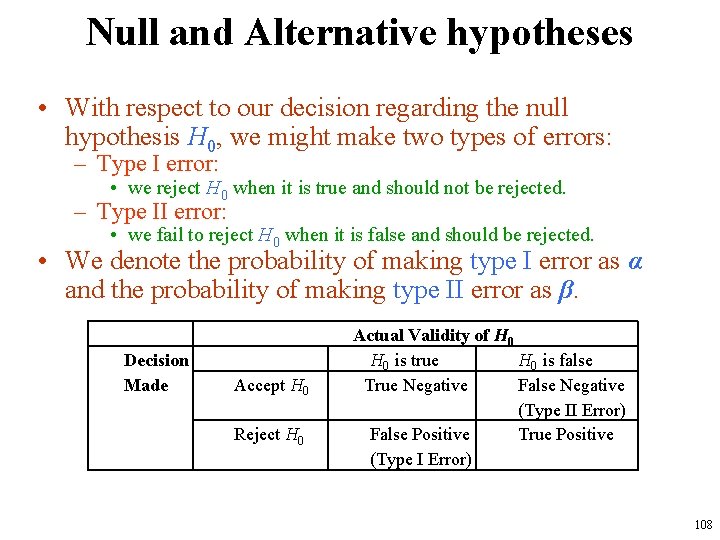
Null and Alternative hypotheses • With respect to our decision regarding the null hypothesis H 0, we might make two types of errors: – Type I error: • we reject H 0 when it is true and should not be rejected. – Type II error: • we fail to reject H 0 when it is false and should be rejected. • We denote the probability of making type I error as α and the probability of making type II error as β. Decision Made Accept H 0 Reject H 0 Actual Validity of H 0 is true H 0 is false True Negative False Negative (Type II Error) False Positive True Positive (Type I Error) 108
Null and alternative hypotheses • Now suppose that we have a hypothesis testing procedure that fails to reject the null hypothesis when it should be rejected with probability β. – This means that our test correctly rejects the null hypothesis with probability 1 − β. • Note that the two events are complementary. – We refer to this probability (i. e. , 1 − β) as the power of the test. • In practice, it is common to first agree on a tolerable type I error rate α, such as 0. 01, 0. 05, and 0. 1. • Then try to find a test procedure with the highest power among all reasonable testing procedures. 109
Hypothesis testing for the population mean • 110
Regression Analysis • The modeling of the relationship between a response variable and a set of explanatory variables is one of the most widely used of all statistical techniques. – We refer to this type of modeling as regression analysis. • A regression model provides the user with a functional relationship between the response variable and explanatory variables that allows the user to determine which of the explanatory variables have an effect on the response. – The regression model allows the user to explore what happens to the response variable for specified changes in the explanatory variables. 111
Regression Analysis • The basic idea of regression analysis is to obtain a model for the functional relationship between a response variable (often referred to as the dependent variable) and one or more explanatory variables (often referred to as the independent variables). • Regression models have a number of uses: – The model provides a description of the major features of the data set. • In some cases, a subset of the explanatory variables will not affect the response variable, and, hence, the researcher will not have to measure or control any of these variables in future studies. – This may result in significant savings in future studies or experiments. 112
Regression Analysis – The equation relating the response variable to the explanatory variables produced from the regression analysis provides estimates of the response variable for values of the explanatory variables not observed in the study. • For example, a clinical trial is designed to study the response of a subject to various dose levels of a new drug. • Because of time and budgetary constraints, only a limited number of dose levels are used in the study. – The regression equation will provide estimates of the subjects’ response for dose levels not included in the study. – In business applications, the prediction of future sales of a product is crucial to production planning. • If the data provide a model that has a good fit in relating current sales to sales in previous months, prediction of sales in future months is possible. 113
The linear relationship • The linear relationship between Y and X in the entire population can be presented in a similar form, Y = α +βX +ε • where α is the intercept, and β is the slope of the regression line , ε is called the error term, representing the difference between the estimated and the actual values of Y in the population. • We refer to the above equation as the linear regression model. – We refer to α and β as the regression parameters. – More specifically, β is called the regression coefficient for the explanatory variable. – The process of finding the regression parameters is called fitting a regression model to the data. 114
Supervised learning • Linear regression models are used to predict the unknown values of the response variable. – In these models, the response variable has a central role; • the model building process is guided by explaining the variation of the response variable or predicting its values. – Therefore, building regression models is known as supervised learning. 115
Unsupervised learning • Building statistical models to identify the underlying structure of data is known as unsupervised learning. – An important class of unsupervised learning is clustering, • which is commonly used to identify subgroups within a population. • In general, cluster analysis refers to the methods that attempt to divide the data into subgroups such that – the observations within the same group are more similar compared to the observations in different groups. 116
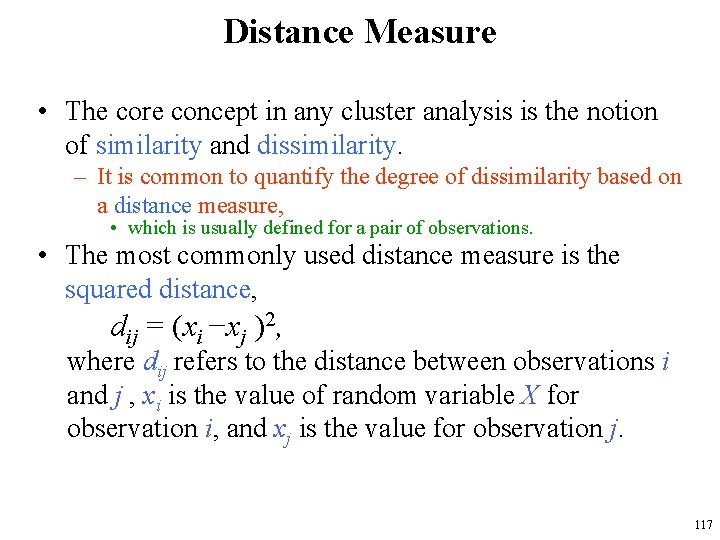
Distance Measure • The core concept in any cluster analysis is the notion of similarity and dissimilarity. – It is common to quantify the degree of dissimilarity based on a distance measure, • which is usually defined for a pair of observations. • The most commonly used distance measure is the squared distance, dij = (xi −xj )2, where dij refers to the distance between observations i and j , xi is the value of random variable X for observation i, and xj is the value for observation j. 117
Similarity and Dissimilarity • Similarity – is a numerical measure of how alike two data objects are – is higher when objects are more alike – often falls in the range [0, 1] • Dissimilarity – is a numerical measure of how two data objects are different – is lower when objects are more alike • Minimum dissimilarity is often 0 • Upper limit varies • Proximity refers to a similarity or dissimilarity 118
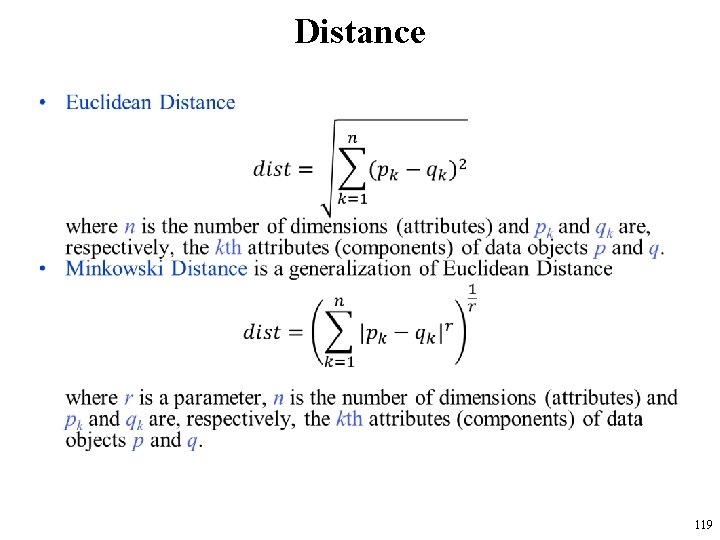
Distance • 119
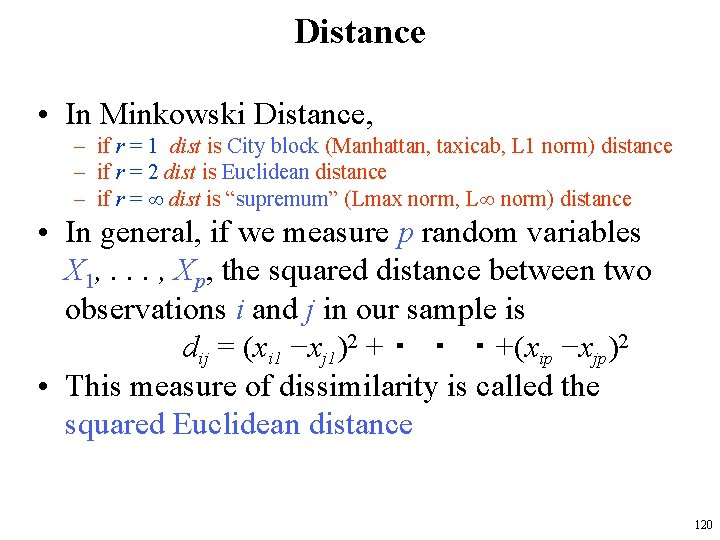
Distance • In Minkowski Distance, – if r = 1 dist is City block (Manhattan, taxicab, L 1 norm) distance – if r = 2 dist is Euclidean distance – if r = dist is “supremum” (Lmax norm, L norm) distance • In general, if we measure p random variables X 1, . . . , Xp, the squared distance between two observations i and j in our sample is dij = (xi 1 −xj 1)2 +・ ・ ・+(xip −xjp)2 • This measure of dissimilarity is called the squared Euclidean distance 120
K-means Clustering • K-means clustering is a simple algorithm that uses the squared Euclidean distance as its measure of dissimilarity. • After randomly partitioning the observations into K groups and finding the center or centroid of each cluster, the K-means algorithm finds the best clusters by iteratively repeating the following steps – For each observation, find its squared Euclidean distance to all K centers, and assign it to the cluster with the smallest distance. – After regrouping all the observations into K clusters, recalculate the K centers. • These steps are applied until the clusters do not change – i. e. , the centers remain the same after each iteration. 121
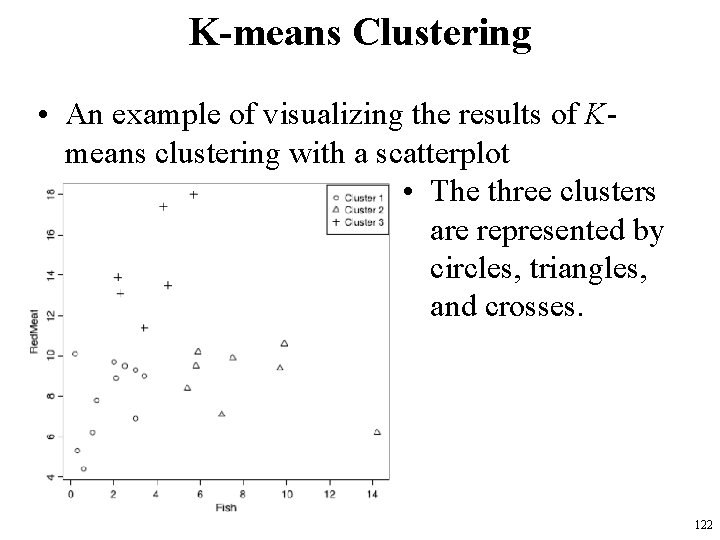
K-means Clustering • An example of visualizing the results of Kmeans clustering with a scatterplot • The three clusters are represented by circles, triangles, and crosses. 122
Hierarchical Clustering • There are two potential problems with the K-means clustering algorithm. – It is a flat clustering method. – We need to specify the number of clusters K a priori. • An alternative approach that avoids these issues is hierarchical clustering. • The result of this method is a dendrogram (a tree). – The root of the dendrogram is its highest level and contains all n observations. – The leaves of the tree are its lowest level and are each a unique observation. 123
Hierarchical Clustering • There are two general algorithms for hierarchical clustering: – Divisive (top-down): • We start at the top of the tree, where all observations are grouped in a single cluster. • Then we divide the cluster into two new clusters that are most dissimilar. – Now we have two clusters. • We continue splitting existing clusters until every observation is its own cluster. 124
Hierarchical Clustering – Agglomerative (bottom-up): • We start at the bottom of the tree, where every observation is a cluster – i. e. , there are n clusters. • Then we merge two of the clusters with the smallest degree of dissimilarity – i. e. , the two most similar clusters. – Now we have n − 1 clusters. • We continue merging clusters until we have only one cluster (the root) that includes all observations. 125
Hierarchical Clustering • We can use one of the following methods to calculate the overall distance between two clusters – Single linkage clustering uses the minimum dij among all possible pairs as the distance between the two clusters. – Complete linkage clustering uses the maximum dij as the distance between the two clusters. – Average linkage clustering uses the average dij over all possible pairs as the distance between the two clusters. – Centroid linkage clustering finds the centroids of the two clusters and uses the distance between the centroids as the distance between the two clusters. 126
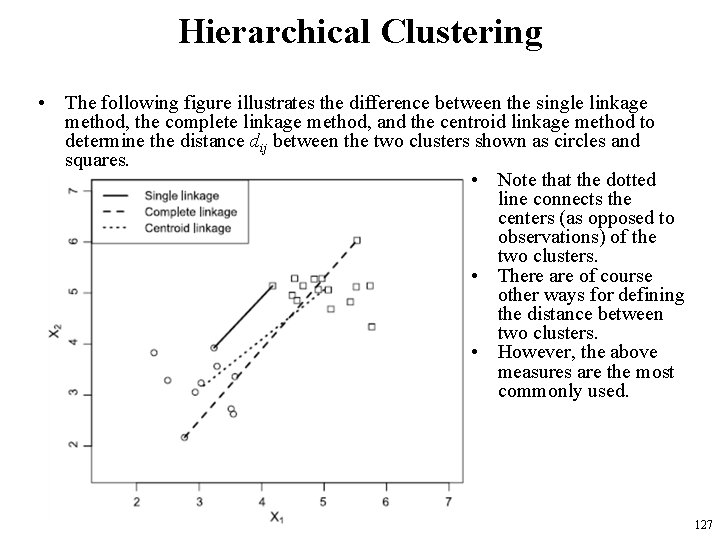
Hierarchical Clustering • The following figure illustrates the difference between the single linkage method, the complete linkage method, and the centroid linkage method to determine the distance dij between the two clusters shown as circles and squares. • Note that the dotted line connects the centers (as opposed to observations) of the two clusters. • There are of course other ways for defining the distance between two clusters. • However, the above measures are the most commonly used. 127
- Slides: 127