
Introduction to Bioinformatics Fall 2013 Week 12 Perl
Introduction to Bioinformatics Fall 2013 Week 12 Perl Regular Expressions
Regular Expression Humor
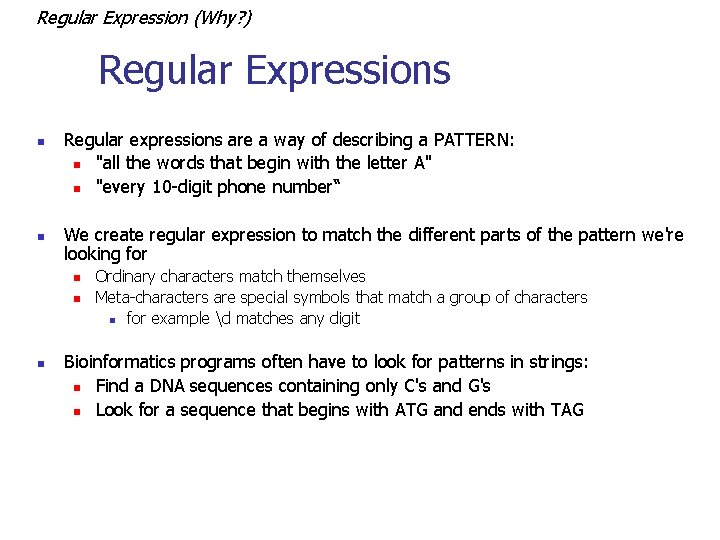
Regular Expression (Why? ) Regular Expressions n n Regular expressions are a way of describing a PATTERN: n "all the words that begin with the letter A" n "every 10 -digit phone number“ We create regular expression to match the different parts of the pattern we're looking for n n n Ordinary characters match themselves Meta-characters are special symbols that match a group of characters n for example d matches any digit Bioinformatics programs often have to look for patterns in strings: n Find a DNA sequences containing only C's and G's n Look for a sequence that begins with ATG and ends with TAG
![Regular Expression (How? ) Meta Characters . match any single character [atcg] match any](http://slidetodoc.com/presentation_image_h2/12b6c9c77af834cd3b2e87cd44cb08b0/image-4.jpg "Regular Expression (How? ) Meta Characters . match any single character [atcg] match any")
Regular Expression (How? ) Meta Characters . match any single character [atcg] match any single a, t, c, or g [A-Z] match any character in given range [^atcg] match any character NOT in the set CHAR takes away meta meaning of character CHAR [. |*] matches ". " or "|" or "*" ^ or A true at start of string $ or z true at end of string b B true at word boundary true when not at word boundary d D match any digit match any non-digit n t match newline character match tab character s S match any white space character match any non-whitespace character w W match any "word" character (alphanumeric plus "_") match any non-word character
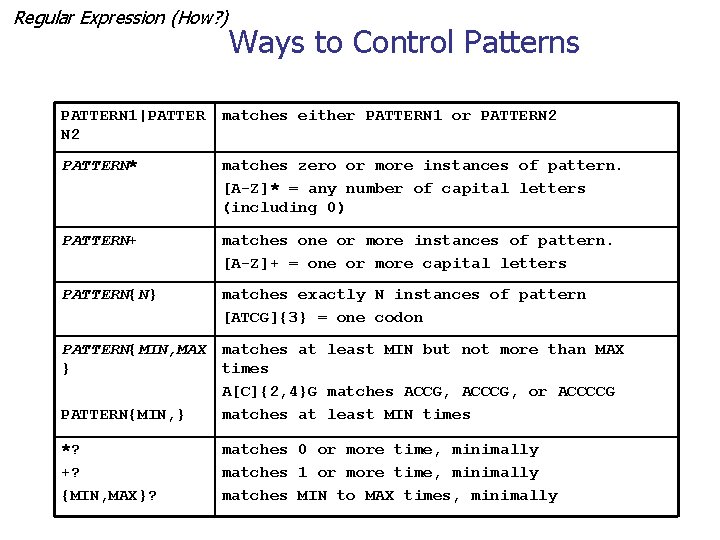
Regular Expression (How? ) Ways to Control Patterns PATTERN 1|PATTER N 2 matches either PATTERN 1 or PATTERN 2 PATTERN* matches zero or more instances of pattern. [A-Z]* = any number of capital letters (including 0) PATTERN+ matches one or more instances of pattern. [A-Z]+ = one or more capital letters PATTERN{N} matches exactly N instances of pattern [ATCG]{3} = one codon PATTERN{MIN, MAX } PATTERN{MIN, } matches at least MIN but not more than MAX times A[C]{2, 4}G matches ACCG, ACCCG, or ACCCCG matches at least MIN times *? +? {MIN, MAX}? matches 0 or more time, minimally matches 1 or more time, minimally matches MIN to MAX times, minimally
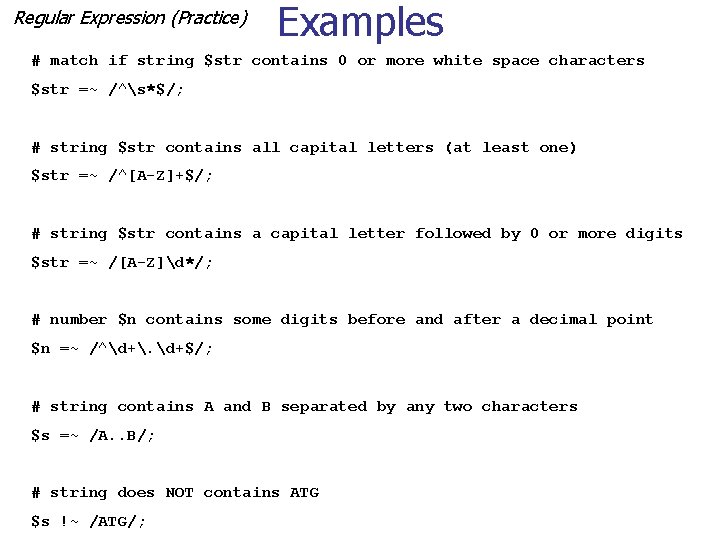
Regular Expression (Practice) Examples # match if string $str contains 0 or more white space characters $str =~ /^s*$/; # string $str contains all capital letters (at least one) $str =~ /^[A-Z]+$/; # string $str contains a capital letter followed by 0 or more digits $str =~ /[A-Z]d*/; # number $n contains some digits before and after a decimal point $n =~ /^d+. d+$/; # string contains A and B separated by any two characters $s =~ /A. . B/; # string does NOT contains ATG $s !~ /ATG/;
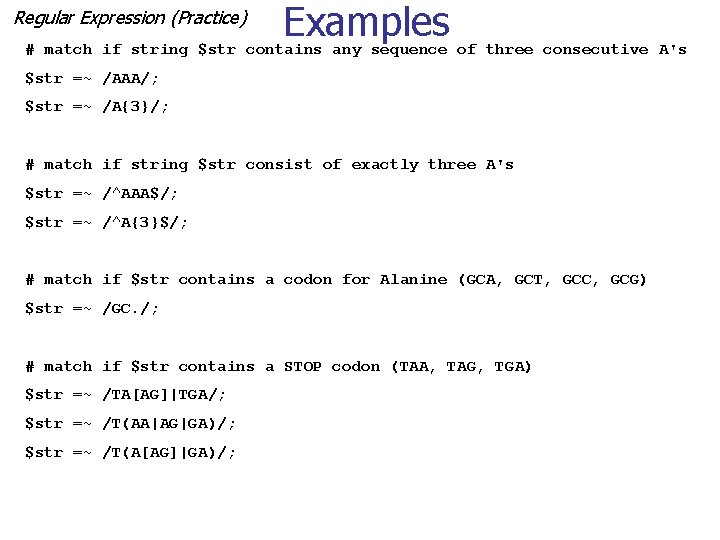
Regular Expression (Practice) Examples # match if string $str contains any sequence of three consecutive A's $str =~ /AAA/; $str =~ /A{3}/; # match if string $str consist of exactly three A's $str =~ /^AAA$/; $str =~ /^A{3}$/; # match if $str contains a codon for Alanine (GCA, GCT, GCC, GCG) $str =~ /GC. /; # match if $str contains a STOP codon (TAA, TAG, TGA) $str =~ /TA[AG]|TGA/; $str =~ /T(AA|AG|GA)/; $str =~ /T(A[AG]|GA)/;
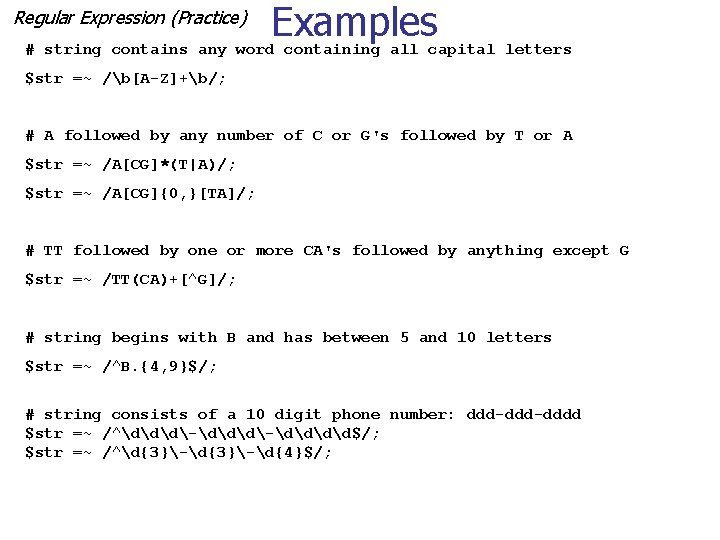
Regular Expression (Practice) Examples # string contains any word containing all capital letters $str =~ /b[A-Z]+b/; # A followed by any number of C or G's followed by T or A $str =~ /A[CG]*(T|A)/; $str =~ /A[CG]{0, }[TA]/; # TT followed by one or more CA's followed by anything except G $str =~ /TT(CA)+[^G]/; # string begins with B and has between 5 and 10 letters $str =~ /^B. {4, 9}$/; # string consists of a 10 digit phone number: ddd-dddd $str =~ /^ddd-dd$/; $str =~ /^d{3}-d{4}$/;

Regular Expression (What Did We Match? ) Capturing Matches n n n When we match a string with a regular expression, we may want to find out what matched Do this by surrounding the part of interest with ( ) Then access special variables $1, $2, etc to get matches: $str = "Perl is a programming language used for bioinformatics. "; $str =~ /(. *) is. *(b. *). /; $first = $1; $second = $2; print "$first $secondn"; # prints "Perl bioinformatics" # or, you can capture the results in a list assignment: ($first, $second) = $str =~ /(. *) is. *(b. *). /; print "$first $secondn"; # prints "Perl bioinformatics"
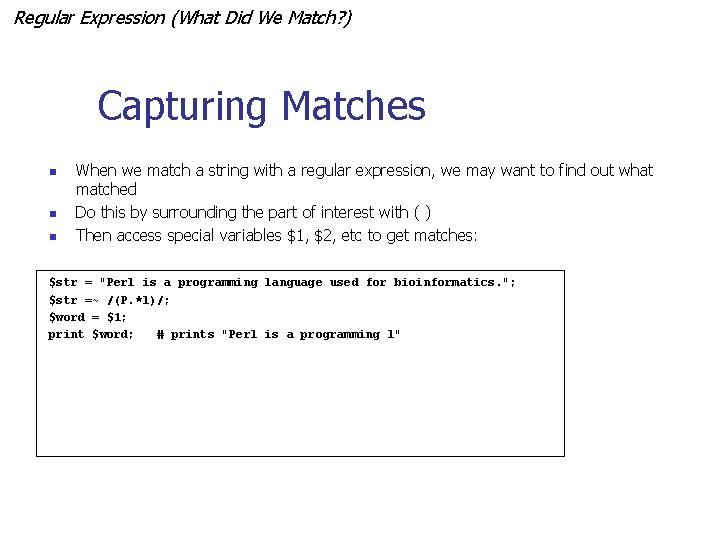
Regular Expression (What Did We Match? ) Capturing Matches n n n When we match a string with a regular expression, we may want to find out what matched Do this by surrounding the part of interest with ( ) Then access special variables $1, $2, etc to get matches: $str = "Perl is a programming language used for bioinformatics. "; $str =~ /(P. *l)/; $word = $1; print $word; # prints "Perl is a programming l"
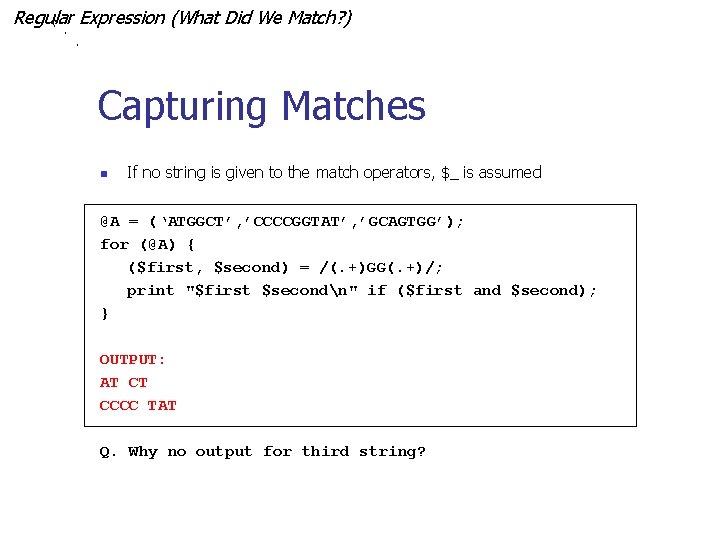
Regular Expression (What Did We Match? ) (' ' ' Capturing Matches n If no string is given to the match operators, $_ is assumed @A = (‘ATGGCT’, ’CCCCGGTAT’, ’GCAGTGG’); for (@A) { ($first, $second) = /(. +)GG(. +)/; print "$first $secondn" if ($first and $second); } OUTPUT: AT CT CCCC TAT Q. Why no output for third string?
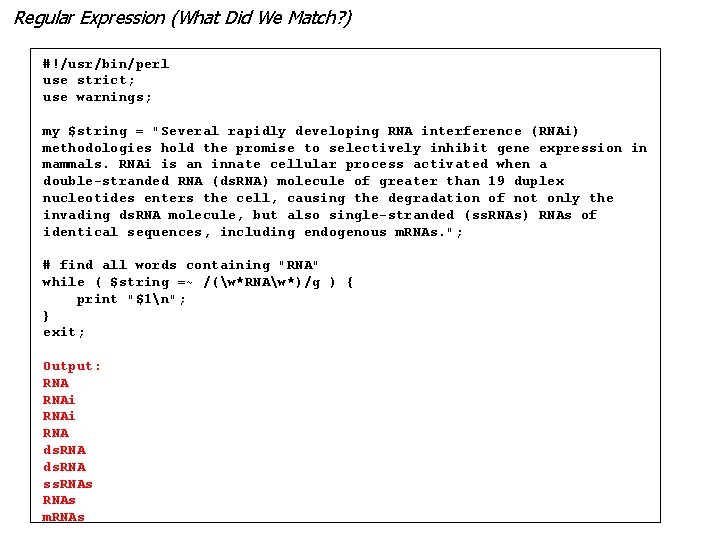
Regular Expression (What Did We Match? ) #!/usr/bin/perl use strict; use warnings; my $string = "Several rapidly developing RNA interference (RNAi) methodologies hold the promise to selectively inhibit gene expression in mammals. RNAi is an innate cellular process activated when a double-stranded RNA (ds. RNA) molecule of greater than 19 duplex nucleotides enters the cell, causing the degradation of not only the invading ds. RNA molecule, but also single-stranded (ss. RNAs) RNAs of identical sequences, including endogenous m. RNAs. "; # find all words containing "RNA" while ( $string =~ /(w*RNAw*)/g ) { print "$1n"; } exit; Output: RNAi RNA ds. RNA ss. RNAs m. RNAs
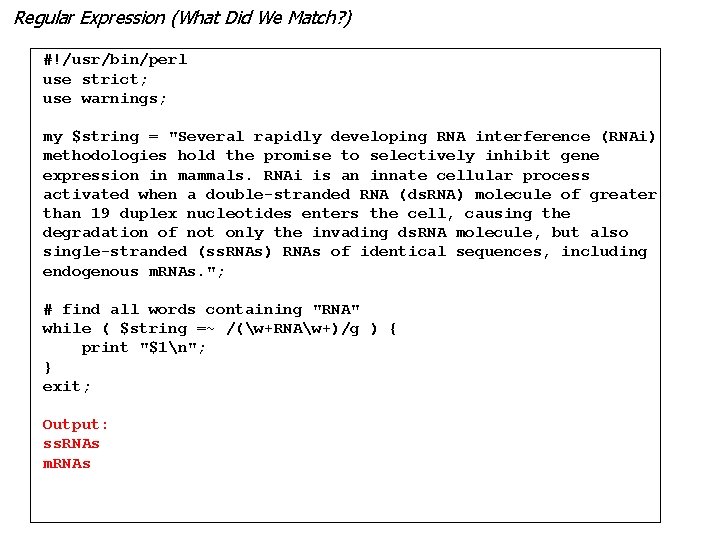
Regular Expression (What Did We Match? ) #!/usr/bin/perl use strict; use warnings; my $string = "Several rapidly developing RNA interference (RNAi) methodologies hold the promise to selectively inhibit gene expression in mammals. RNAi is an innate cellular process activated when a double-stranded RNA (ds. RNA) molecule of greater than 19 duplex nucleotides enters the cell, causing the degradation of not only the invading ds. RNA molecule, but also single-stranded (ss. RNAs) RNAs of identical sequences, including endogenous m. RNAs. "; # find all words containing "RNA" while ( $string =~ /(w+RNAw+)/g ) { print "$1n"; } exit; Output: ss. RNAs m. RNAs
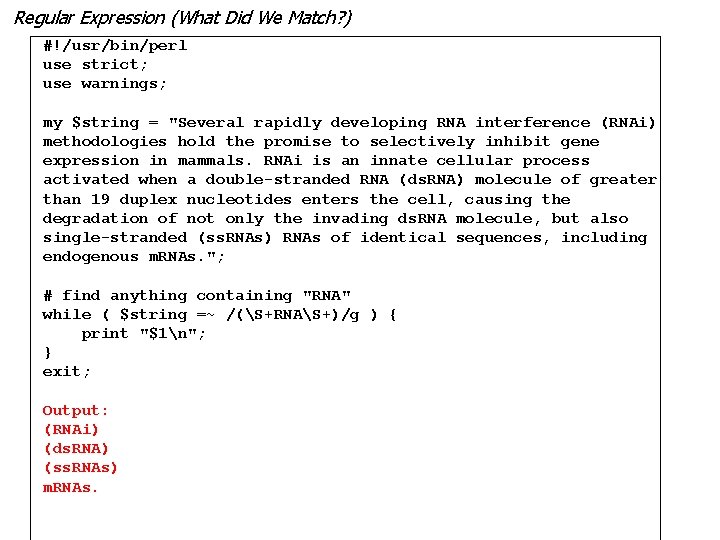
Regular Expression (What Did We Match? ) #!/usr/bin/perl use strict; use warnings; my $string = "Several rapidly developing RNA interference (RNAi) methodologies hold the promise to selectively inhibit gene expression in mammals. RNAi is an innate cellular process activated when a double-stranded RNA (ds. RNA) molecule of greater than 19 duplex nucleotides enters the cell, causing the degradation of not only the invading ds. RNA molecule, but also single-stranded (ss. RNAs) RNAs of identical sequences, including endogenous m. RNAs. "; # find anything containing "RNA" while ( $string =~ /(S+RNAS+)/g ) { print "$1n"; } exit; Output: (RNAi) (ds. RNA) (ss. RNAs) m. RNAs.
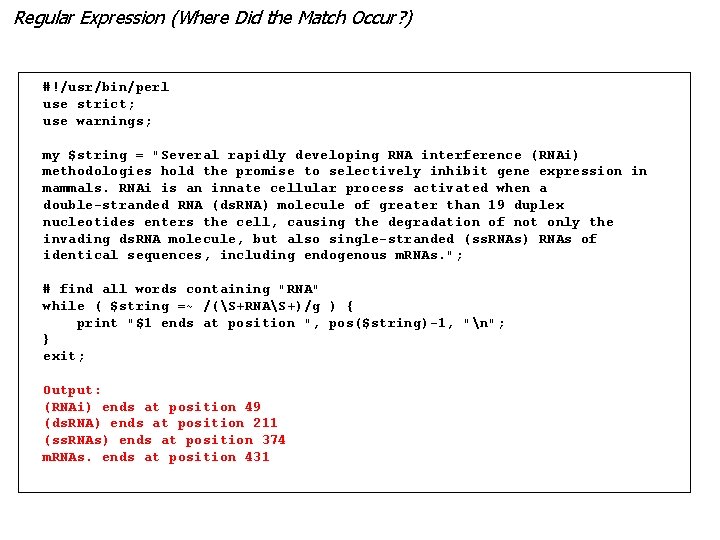
Regular Expression (Where Did the Match Occur? ) #!/usr/bin/perl use strict; use warnings; my $string = "Several rapidly developing RNA interference (RNAi) methodologies hold the promise to selectively inhibit gene expression in mammals. RNAi is an innate cellular process activated when a double-stranded RNA (ds. RNA) molecule of greater than 19 duplex nucleotides enters the cell, causing the degradation of not only the invading ds. RNA molecule, but also single-stranded (ss. RNAs) RNAs of identical sequences, including endogenous m. RNAs. "; # find all words containing "RNA" while ( $string =~ /(S+RNAS+)/g ) { print "$1 ends at position ", pos($string)-1, "n"; } exit; Output: (RNAi) ends at position 49 (ds. RNA) ends at position 211 (ss. RNAs) ends at position 374 m. RNAs. ends at position 431
Additional Reading Some Useful URLs n n http: //docs. python. org/library/re. html http: //www. regular-expressions. info/tutorial. html http: //www. bjnet. edu. cn/tech/book/perl/ n n Nice tutorial regexp discussed on Day 7 http: //www. troubleshooters. com/codecorn/littperl/perlreg. htm
- Slides: 16