
INTRODUCTION TO BIBLICAL INTERPRETATION LECTURE 16 Maritime Christian
INTRODUCTION TO BIBLICAL INTERPRETATION LECTURE 16 Maritime Christian College Scott Jacobsen, Instructor
HAPPY BIRTHDAY, JON!
AGENDA • Wisdom literature: the Psalms • Vocabulary review • Introduction to Worksheet 5

WISDOM LITERATURE Psalms

GENRE OF PSALMS • Hymns: Ps. 104; Ps. 105; Ps. 103: 1; Ps. 103: 2; Ps. 103: 3– 19; Ps. 103: 20– 22; Ps. 8; Ps. 19; Ps. 29; Ps. 33; Ps. 65; Ps. 67; Ps. 68; Ps. 93; Ps. 96; Ps. 98; Ps. 100; Ps. 111; Ps. 113; Ps. 114; Ps. 117; Ps. 135; Ps. 146; Ps. 147; Ps. 148; Ps. 149; Ps. 150 • Laments: Ps. 44; Ps. 88; Ps. 6: 1– 7; Ps. 6: 8; Ps. 6: 9; Ps. 3; Ps. 5; Ps. 7; Ps. 13; Ps. 17; Ps. 22; Ps. 25; Ps. 26; Ps. 27; Ps. 28; Ps. 39; Ps. 42; Ps. 43; Ps. 51; Ps. 54; Ps. 55; Ps. 56; Ps. 57; Ps. 59; Ps. 61; Ps. 63; Ps. 64; Ps. 69; Ps. 70; Ps. 71; Ps. 74; Ps. 79; Ps. 80; Ps. 83; Ps. 86; Ps. 89; Ps. 102; Ps. 109; Ps. 120; Ps. 130; Ps. 141; Ps. 142; Ps. 143 • Thanksgiving: Ps. 116; Ps. 116: 1– 3; Ps. 116: 3– 11; Ps. 116: 12– 19; Ps. 18; Ps. 30; Ps. 34; Ps. 40; Ps. 41; Ps. 66; Ps. 92; Ps. 118; Ps. 124; Ps. 138 • Confidence or Trust: Ps. 16; Ps. 23; Ps. 27; Ps. 62; Ps. 73; Ps. 91; Ps. 115; Ps. 121; Ps. 125; Ps. 131 • Kingship: Ps. 47; Ps. 45; Ps. 24; Ps. 29; Ps. 48; Ps. 93; Ps. 95; Ps. 96; Ps. 97; Ps. 98; Ps. 99; Ps. 145; Ps. 20; Ps. 21; Ps. 63; Ps. 72 • Wisdom: Ps. 1; Ps. 19; Ps. 32; Ps. 34; Ps. 37; Ps. 49; Ps. 73; Ps. 112; Ps. 119; Ps. 128
FIVE BOOKS OF PSALMS • • • I. BOOK I, PSALMS 1– 41 II. BOOK II, PSALMS 42– 72 III. BOOK III, PSALMS 73– 89 IV. BOOK IV, PSALMS 90– 106 V. BOOK V, PSALMS 107– 150
DOXOLOGY • Psalm 1– 41; • 42– 72; • 73– 89; • 90– 106; • 107– 150
AUTHORSHIP • David: 1 Sam. 16: 14– 23; 2 Sam. 1: 17– 27; 2 Sam. 22; 2 Sam. 23: 1; 1 Chr. 6: 31; 15: 16; 16: 7; Ps. 18; Amos 6: 5; Matt. 22: 43; Acts 1: 16 • Moses: Psalm 90 • Solomon: 72, 127 • Sons of Korah: 42– 49; 84; 85; 87; 88 • Asaph: 50; 73 -83 • Ethan the Ezrahite: 89 • Unnamed: 1, 71
DATES • Moses – Babylonian Exile, 1000
REPRESENTATIVE PSALMS 1. Psalm 1: The Rewarded Life 2. Psalm 2: Ask of Me, My Son 3. Psalm 3: Living in the Borderland: Morning Prayer After a Dark Night 4. Psalm 4: An Evening Prayer in Crisis 5. Psalm 8: I AM Rules Through “Infants” 6. Psalm 15 A Liturgical Decalogue 7. Psalm 16: My Body Will Not Decay
REPRESENTATIVE PSALMS 8. Psalm 19: A Royal Sage Praises and Petitions I AM 9. Psalm 22: Prophetic Psalm of Christ’s Passion 10. Psalm 23: The Good Shepherd 11. Psalm 51: “The Psalm of All Psalms” in Penitential Devotion 12. Psalm 110: “Sit at My Right Hand” 13. Psalm 139: Search Me, God
INTERPRETING THE PSALMS • As a hymnal • Christian Music • Words from the heart

VOCABULARY REVIEW
CHRONICLES 1. A written history 2. Name of two OT books 3. Chronicler: name of unknown author of the Books of Chronicles 4. Chronicles of Gad (1 Chronicles 29: 29) 5. Chronicles of Iddo the Seer (2 Chronicles 9: 29; 12: 15; 13: 22) 6. Chronicles of Jehu (2 Chronicles 20: 34; 32: 32)
DISCOURSE • DISCOURSE, DIRECT The quotation of another’s speech. Often performs special functions in addition to quoting speech. The form of the phrase that introduces the quoted speech may signal additional information about the status of the quote in regard to the larger narrative. It is distinct from indirect discourse, where another’s speech is reported but not quoted • Nathan M. White, “Discourse, Direct, ” ed. John D. Barry et al. , The Lexham Bible Dictionary (Bellingham, WA: Lexham Press, 2016).
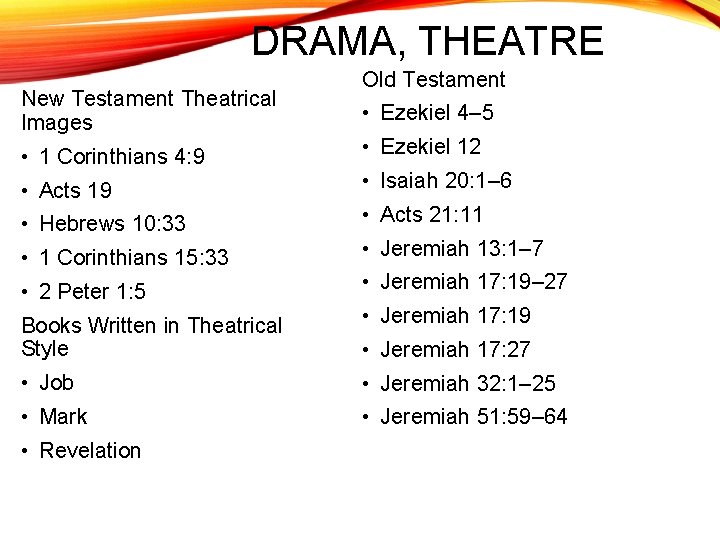
DRAMA, THEATRE New Testament Theatrical Images • 1 Corinthians 4: 9 • Acts 19 • Hebrews 10: 33 • 1 Corinthians 15: 33 Old Testament • Ezekiel 4– 5 • Ezekiel 12 • Isaiah 20: 1– 6 • Acts 21: 11 • Jeremiah 13: 1– 7 • 2 Peter 1: 5 • Jeremiah 17: 19– 27 Books Written in Theatrical Style • Jeremiah 17: 19 • Jeremiah 17: 27 • Job • Jeremiah 32: 1– 25 • Mark • Jeremiah 51: 59– 64 • Revelation
EPISTEMOLOGY That part of philosophy concerned with theory of knowledge, its nature, limits and validity. • Francis A. Schaeffer, The Complete Works of Francis A. Schaeffer: A Christian Worldview, vol. 1 (Westchester, IL: Crossway Books, 1982), 200.
EPISTLE Gk. epistolē and Lat. epistula represent a letter of any kind: originally simply a written communication between persons apart, whether personal and private or official. In this sense epistles are a part of the heritage of all literate peoples, and examples are to be found in the OT (2 Sa. 11; 1 Ki. 21; 2 Ki. 5; 10; 2 Ch. 30; 32; Ezr. 4– 5; 7; Ne. 2; 6; Est. 1; 3; 8– 9; Is. 37; 39; Je. 29) and in the Greek papyri from Egypt. • J. H. Harrop, “Epistle, ” ed. D. R. W. Wood et al. , New Bible Dictionary (Leicester, England; Downers Grove, IL: Inter. Varsity Press, 1996), 330.
EXEGESIS (“drawing out”): the attempt to determine the meaning of a text intended by the author(s) and warranted to be understood by the original audience. Bruce K. Waltke, James M. Houston, and Erika Moore, The Psalms as Christian Worship: A Historical Commentary (Grand Rapids, MI; Cambridge, U. K. : William B. Eerdmans Publishing Company, 2010), 576.
EXPOSITION/EXPOSITO RY exposition. n. Biblical interpretation, with an emphasis on contemporary relevance and application. Matthew S. De. Moss, Pocket Dictionary for the Study of New Testament Greek (Downers Grove, IL: Inter. Varsity Press, 2001), 54.
GENEALOGY An account of the ancestry of an individual or group or of the descendants of an individual. Martin A. Shields, “Genealogy, ” ed. John D. Barry et al. , The Lexham Bible Dictionary (Bellingham, WA: Lexham Press, 2016).
GENERAL EPISTLES Aka “Catholic Epistles”: A number of New Testament letters which, unlike the Pauline letters addressed to individual churches, were written to a wider and more general (Gk. katholikós) readership. Allen C. Myers, The Eerdmans Bible Dictionary (Grand Rapids, MI: Eerdmans, 1987), 196.
GENRE A classification of literary composition characterized by particular elements of form and content. Allen C. Myers, The Eerdmans Bible Dictionary (Grand Rapids, MI: Eerdmans, 1987), 410.
GENRE Psalms: hymn or song of praise (e. g. , Pss. 8, 29, 145– 150); enthronement psalm (47, 96– 99); lament (6, 12– 14, 60, 88); wisdom psalm (37, 73). Narrative: chronicle, list, saga, novelette. Wisdom literature: proverb, saying, instruction, disputation.
GENRE Prophetic: oracle, judgment speech. Gospels: discourse, parable, miracle story, and narrative. New Testament: epistle, doxology, and apocalypse. Allen C. Myers, The Eerdmans Bible Dictionary (Grand Rapids, MI: Eerdmans, 1987), 410.
GOSPEL GENRE Adapted from the Old English “godspel, ” means “good news. ” Found primarily in the New Testament to describe the message, preaching, or story of Jesus Christ. Indicates the four canonical Gospels: Matthew, Mark, Luke, and John. In contemporary scholarship, designates a literary genre. Zachary G. Smith, “Gospel Genre, ” ed. John D. Barry et al. , The Lexham Bible Dictionary (Bellingham, WA: Lexham Press, 2016).
HERMENEUTICS • Aka Interpretation. For our purposes, Biblical interpretation, but be aware of Philosophical Hermeneutics and its influence on Biblical Hermeneutics.
HISTORICAL CONTEXT • The place of a text within history; what was happening both in Biblical times and extra. Biblical history at the time of writing. • Example: Psalm 51 and 2 Samuel 11 -12.
IMPERATIVE • A command, or statement that reads like a demand. 1. Imperative Mood 2. Permissive Imperative 3. Prohibitive Imperative
INCLUSIO • A literary framing device in which the same word or phrase stands at the beginning and the end of a section. Sometimes called bracketing. • Matthew S. De. Moss, Pocket Dictionary for the Study of New Testament Greek (Downers Grove, IL: Inter. Varsity Press, 2001), 71.
ASSIGNMENT 5 • Text: Matthew 5: 1 -12 1. Read and re-read carefully 2. Pay special attention to: 1. Context 2. Verb forms, especially tenses 3. Voice 4. Repetition, parallels, etc.
- Slides: 31