
Introduction to BIBFRAME an overview of concepts and
Introduction to BIBFRAME an overview of concepts and BIBFRAME Editor demo Jim Kalwara Carole Griffin Emily Semenoff September 11, 2019 Colorado Alliance Cat-Ref Meeting
Goals for today • Gain a general understanding of the purpose of BIBFRAME • Gain a beginner-level familiarity with some of the vocabulary terms used in BIBFRAME • Gain a general understanding of the differences between BIBFRAME and MARC metadata input • Receive exposure to the demo BIBFRAME Editor
Background and context • In 2011, LC’s Working Group of the Future of Bibliographic Control recommended a transition plan to create a new bibliographic framework which could sunset MARC and support bibliographic data creation and exchange within a linked data environment • Group identified various requirements for this new model http: //www. loc. gov/bibframe/news/framework-103111. html
Background and context • Broad accommodation of content rules and data models (cataloging rules agnostic) • Provision for types of data that logically accompany or support bibliographic description (holdings, authority, classification, rights data, etc. ) • Accommodation of textual data, linked data with URIs instead of text, and both textual data and URIs • Compatibility with MARC-based records • Provision of transformation from MARC 21 to a new bibliographic environment (MARC 2 BIBFRAME Converter) • Continuation of maintenance of MARC until no longer necessary http: //www. loc. gov/bibframe/news/framework-103111. html
Bibliographic Framework Initiative • BIBFRAME: a linked data model https: //www. loc. gov/bibframe/ • Initiated by the Library of Congress • “BIBFRAME provides a foundation for the future of bibliographic description, both on the web, and in the broader networked world that is grounded in Linked Data techniques. ” • “A major focus of the initiative is to determine a transition path for MARC 21 formats while preserving a robust data exchange that has supported resource sharing and cataloging cost savings in recent decades. ” • Currently in an ongoing process of development • BIBFRAME 1. 0: initial draft published November 2012 • BIBFRAME 2. 0: published in April 2016
Linked Data & Semantic Web • Semantic Web: a web of linked data or linked things and entities o An extension of the current web environment which enables machines and people to understand reuse/share data on the web more easily o An environment where metadata is connected by semantically meaningful links o Named links, which indicate specific relationships between entities or things o Entities or Things: Persons, places, objects, events, concepts, etc. • Making parts of the web operate more like a database, to be queried like a database • Attempt to expose metadata on the web, and better exchange metadata within our own library systems so that it is suitable for machine consumption – to better serve humans http: //www. loc. gov/catworkshop/bibframe/Training/Bf 2. 0/Setting-thestage. pdf
Linked Data • Linked data is not a specification or fully defined technology, but really a set of best practices for supporting a data infrastructure that makes it easier to share data across the Web o Techniques for publication, consumption, and reuse/sharing of data on the web for machine processing, in addition to human • Makes data linkable to other data with the end goal of creating a large web of linked data that both machines and people can explore • Music Linked Data Project: https: //linkedjazz. org/ http: //linkeddata. org/
Linked Data Principles • Using Data (not text) o From controlled vocabularies and ontologies (LCSH, NAF, VIAF, ISNI, ORCID, etc. ) • Using Identifiers (not words) to represent: o Things or Entities (person, place, concepts, event, organization, etc. ) o Relationships • Creating Statements (not records) o Using Triple statements (subject -> predicate -> object) to create relationships between things and entities o This Work -> Was written by -> this author o Their eyes were watching God (subject) -> has author (predicate) -> Zora Neale Hurston (object) o URI for work -> URI for relationship -> URI for object o https: //lccn. loc. gov/91014282 -> http: //rdvocab. info/roles/author. Work -> http: //viaf. org/viaf/62824341 Coyle, K. (2011). ASIST webinar: Library linked data, part I: Introduction to the Semantic Web [PDF file]. http: //kcoyle. net/presentations/asisti. pdf
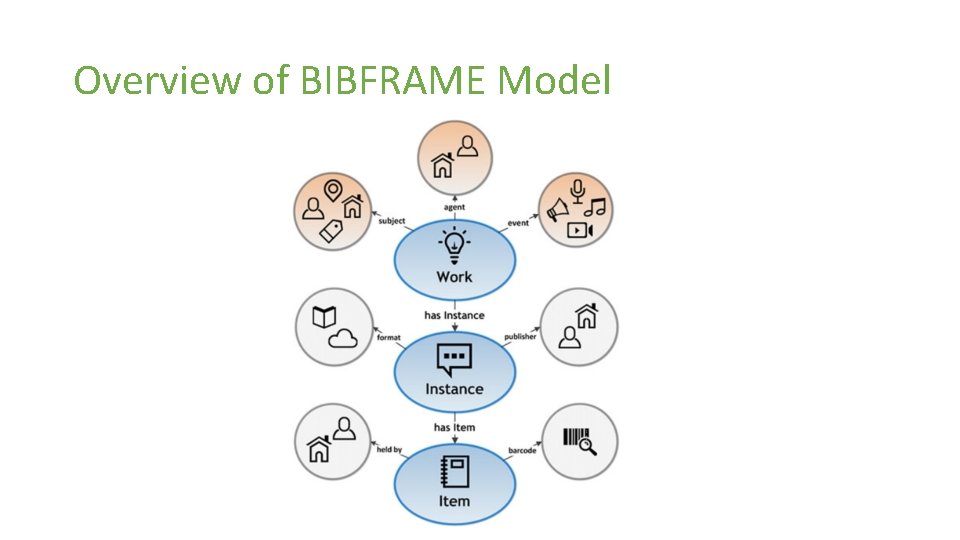
BIBFRAME and linked data practices • Necessary to create a vocabulary that aligns itself with linked data practices • BIBFRAME 2. 0 Ontology • Consists of Resource Description Framework (standard model for data interchange on the web) classes and properties • Organized into three core classes • Work, Instance, and Item • Includes additional three classes to define relationships with the core classes: Agents, Subjects, and Events http: //www. loc. gov/bibframe/docs/bibframe 2 -model. html
Overview of BIBFRAME Model
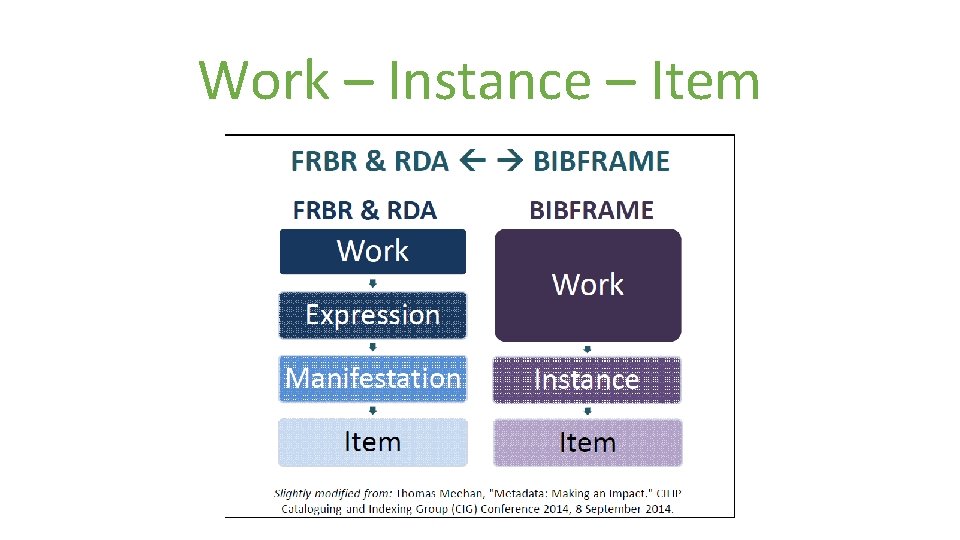
Work – Instance – Item
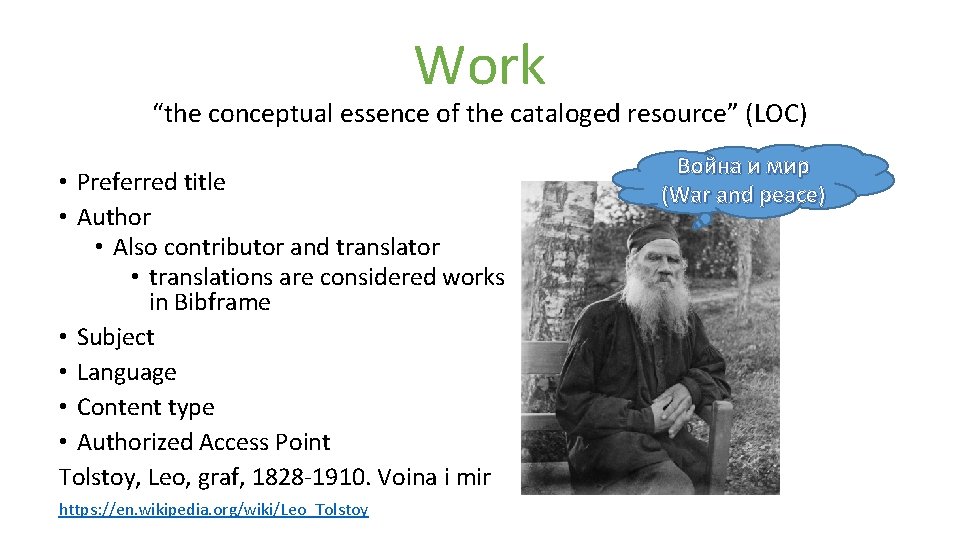
Work “the conceptual essence of the cataloged resource” (LOC) • Preferred title • Author • Also contributor and translator • translations are considered works in Bibframe • Subject • Language • Content type • Authorized Access Point Tolstoy, Leo, graf, 1828 -1910. Voina i mir https: //en. wikipedia. org/wiki/Leo_Tolstoy Война и мир (War and peace)
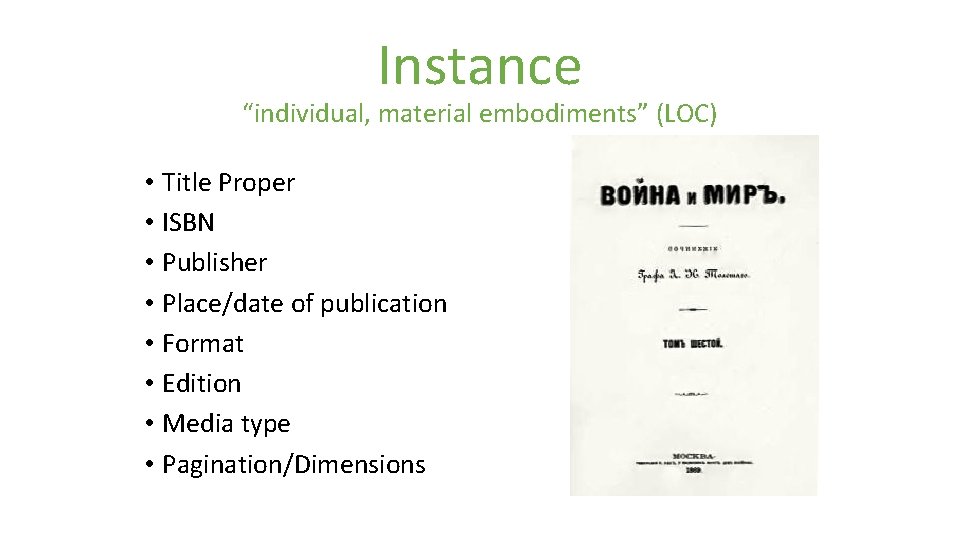
Instance “individual, material embodiments” (LOC) • Title Proper • ISBN • Publisher • Place/date of publication • Format • Edition • Media type • Pagination/Dimensions
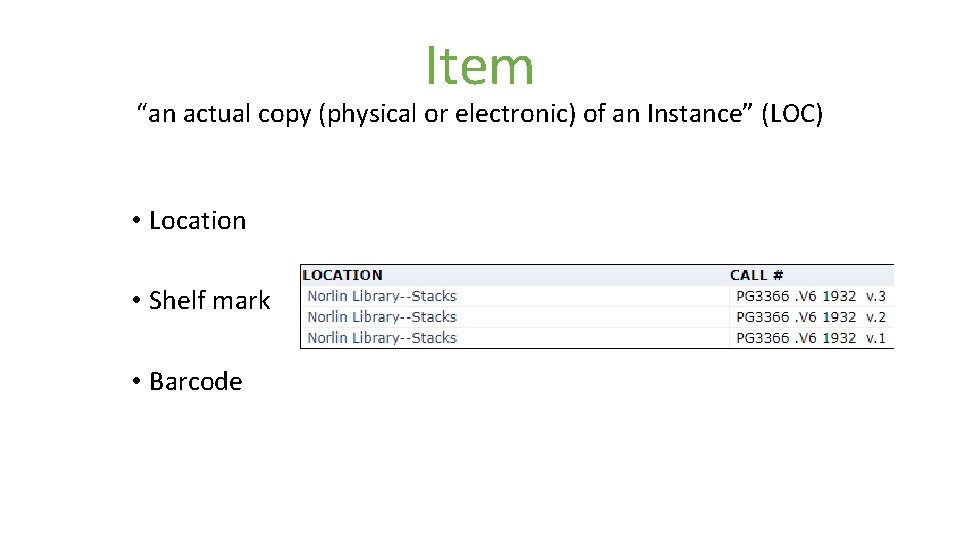
Item “an actual copy (physical or electronic) of an Instance” (LOC) • Location • Shelf mark • Barcode
Agents Three additional classes that define relationships to the core classes • Agents: Agents are people, organizations, jurisdictions, etc. , associated with a Work or Instance through roles such as author, editor, artist, photographer, composer, illustrator, etc. Hurston, Zora Neale, author Abbott, Elenore Plaisted, illustrator Parks, Gordon, 1912 -2006, photographer
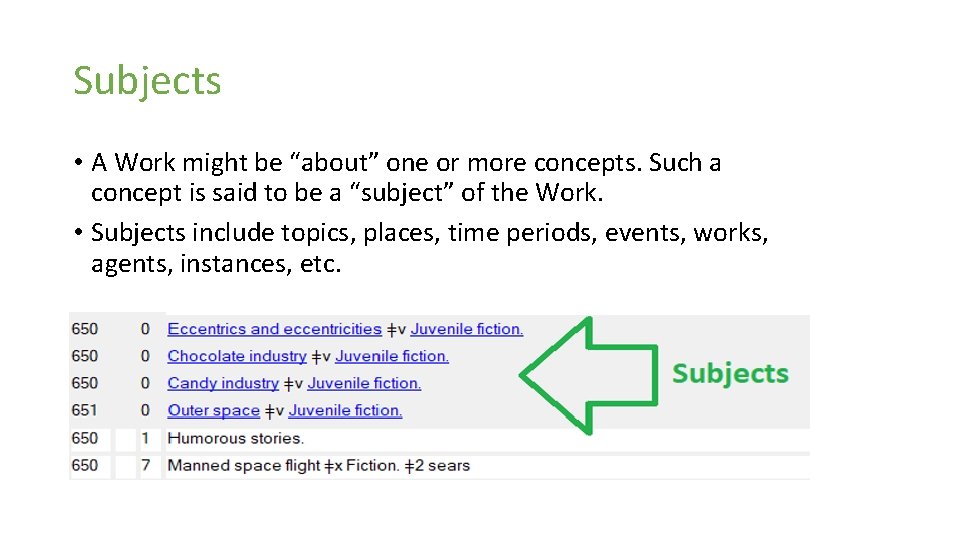
Subjects • A Work might be “about” one or more concepts. Such a concept is said to be a “subject” of the Work. • Subjects include topics, places, time periods, events, works, agents, instances, etc.
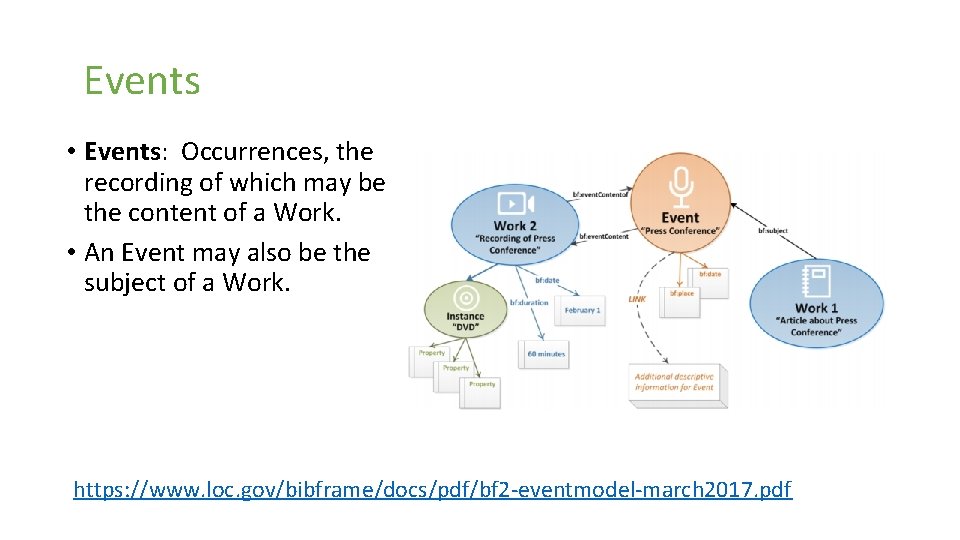
Events • Events: Occurrences, the recording of which may be the content of a Work. • An Event may also be the subject of a Work. https: //www. loc. gov/bibframe/docs/pdf/bf 2 -eventmodel-march 2017. pdf
MARC vs BIBFRAME Data Input
General differences between MARC and BIBFRAME • MARC combines information about conceptual work and its physical carrier and uses text strings for access points • BIBFRAME approach differs by emphasizing relationships between other resource descriptions (Work-to-Work relationships; Work-to. Instance relationships; Work-to-Agent relationships) by using controlled identifiers, instead of text strings, to represent entities or things (people, places, corporate bodies, subjects, languages, etc. ) • The idea being that this will enable library metadata to be leveraged or better exposed on the web BIBFRAME FAQs: https: //www. loc. gov/bibframe/faqs/
So how does it look when actually cataloging?
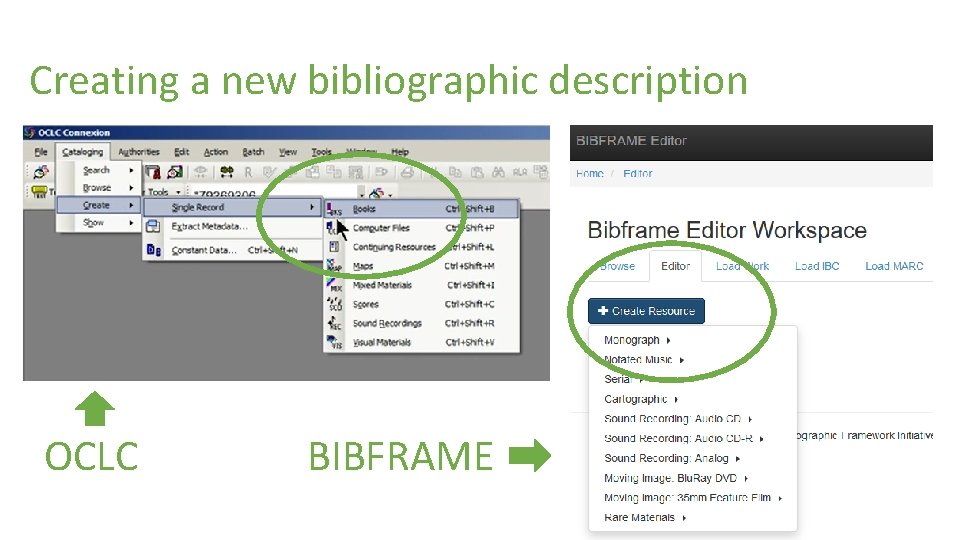
Creating a new bibliographic description OCLC BIBFRAME
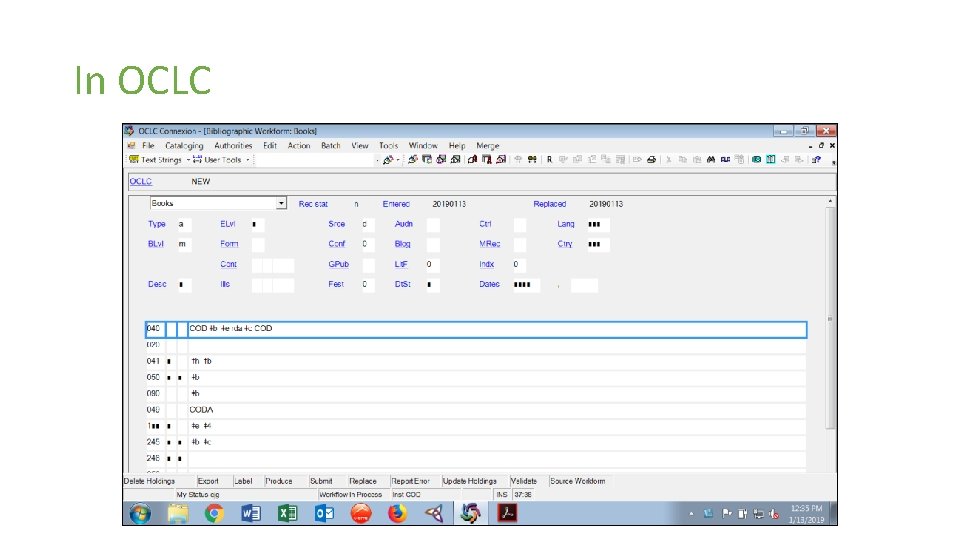
In OCLC
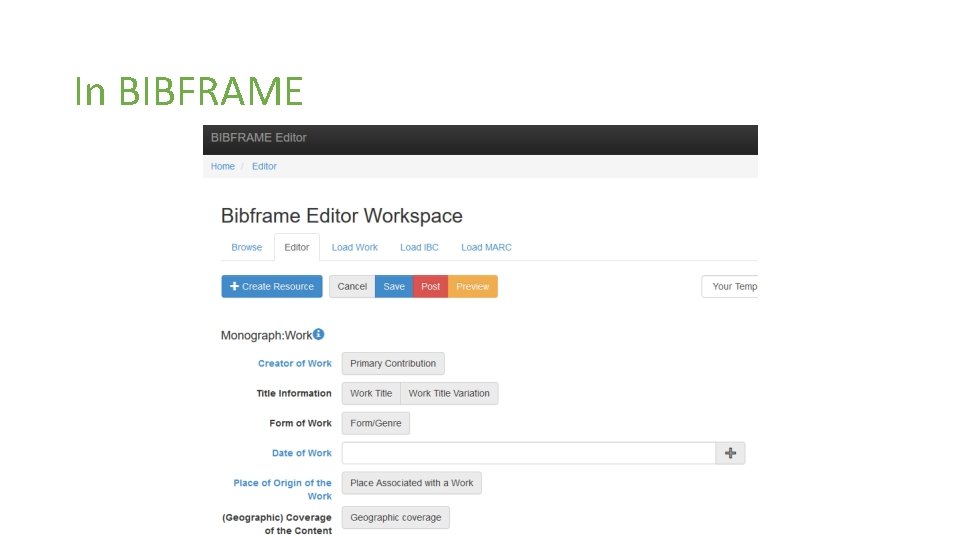
In BIBFRAME
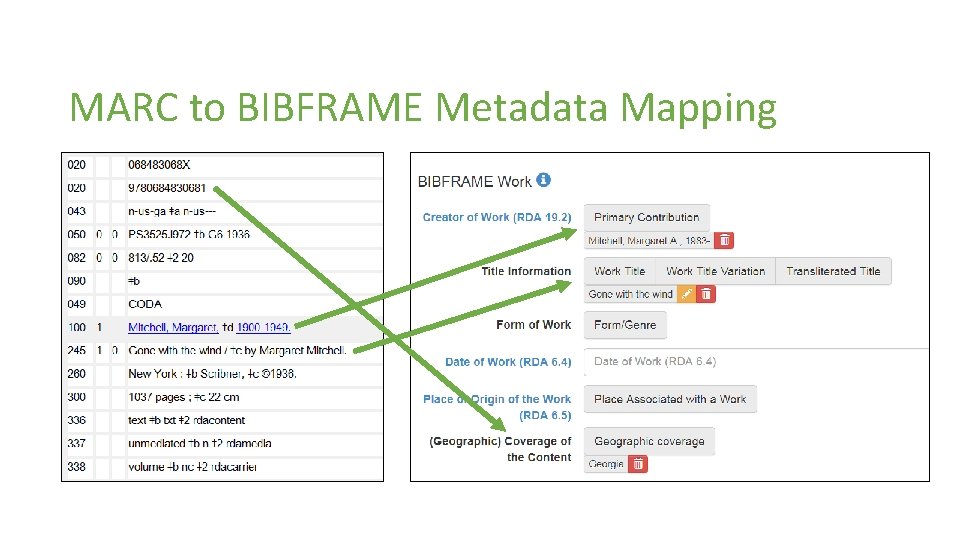
MARC to BIBFRAME Metadata Mapping
BIBFRAME Resources • BIBFRAME Home page: http: //www. loc. gov/bibframe/ • BIBFRAME Training at the LC: https: //www. loc. gov/catworkshop/bibframe/ • BIBFRAME Demo Editor: http: //bibframe. org/bfe/index. html • Intro to Semantic Web & Linked Data (from LC): https: //www. loc. gov/aba/pcc/bibframe/Selected-Videos-Reading-2019. pdf • LC Linked Data Service site: https: //id. loc. gov/
Thanks for listening! Questions? • Jim Kalwara, james. kalwara@colorado. edu • Carole Griffin, carole. griffin@colorado. edu • Emily Semenoff, emily. semenoff@colorado. edu
- Slides: 26