
Introduction to Beekeeping Why Keep Bees People take
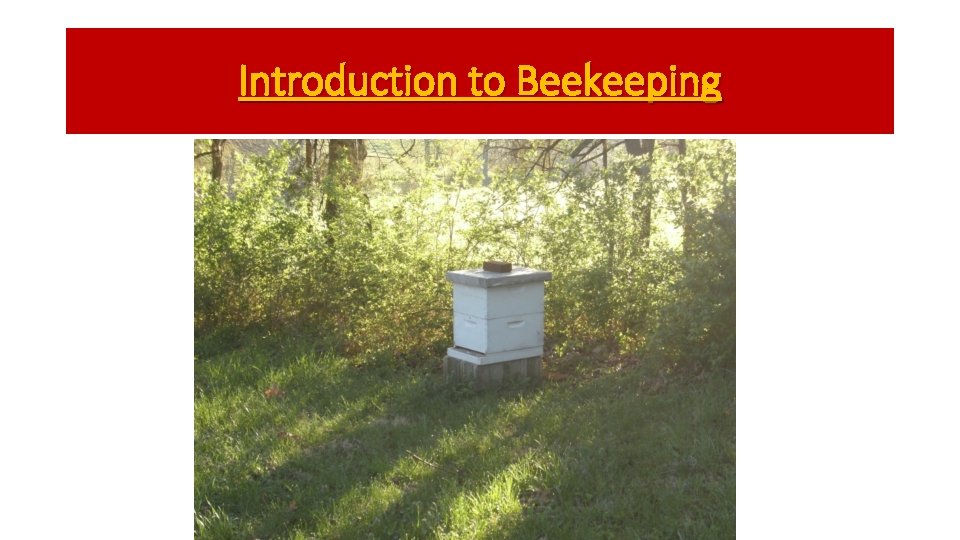
Introduction to Beekeeping
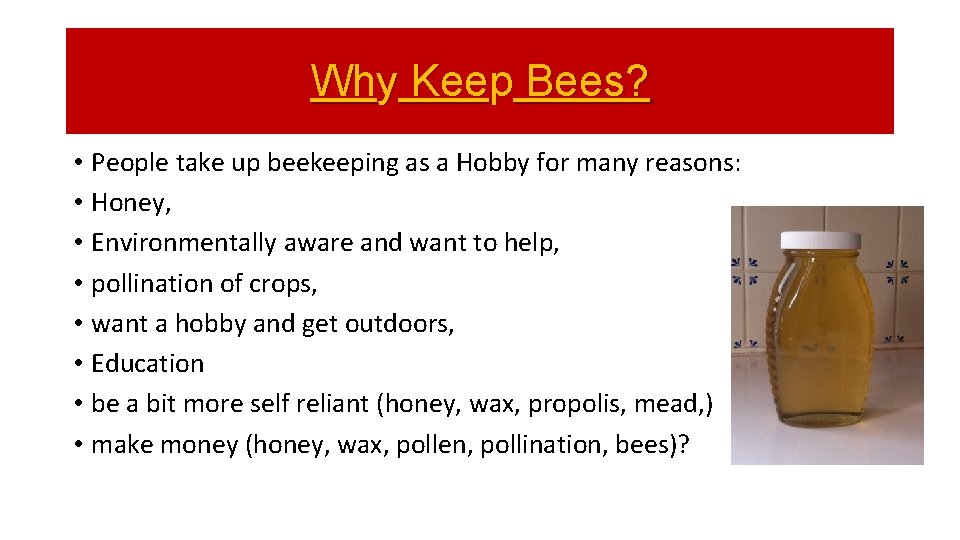
Why Keep Bees? • People take up beekeeping as a Hobby for many reasons: • Honey, • Environmentally aware and want to help, • pollination of crops, • want a hobby and get outdoors, • Education • be a bit more self reliant (honey, wax, propolis, mead, ) • make money (honey, wax, pollen, pollination, bees)?
Three major hive products • Honey • Wax • Pollen
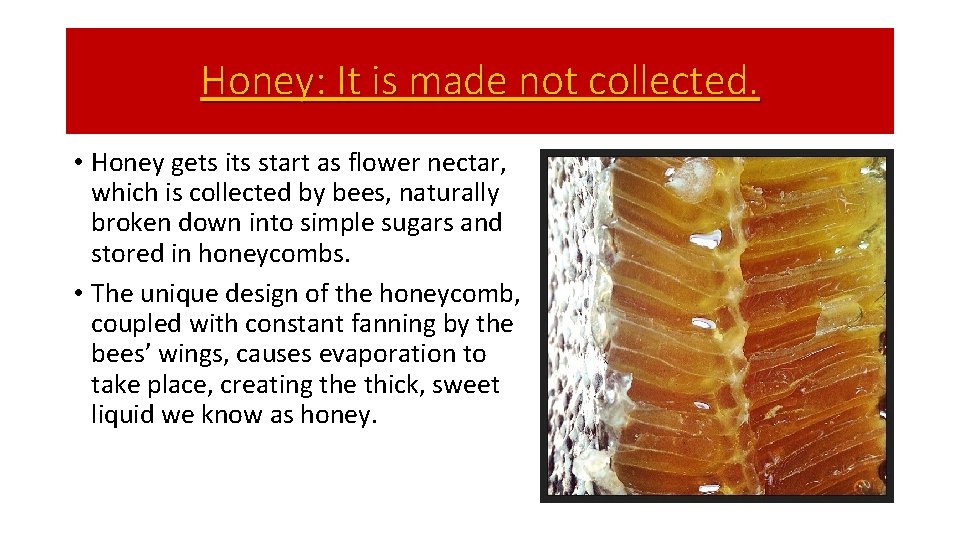
Honey: It is made not collected. • Honey gets its start as flower nectar, which is collected by bees, naturally broken down into simple sugars and stored in honeycombs. • The unique design of the honeycomb, coupled with constant fanning by the bees’ wings, causes evaporation to take place, creating the thick, sweet liquid we know as honey.
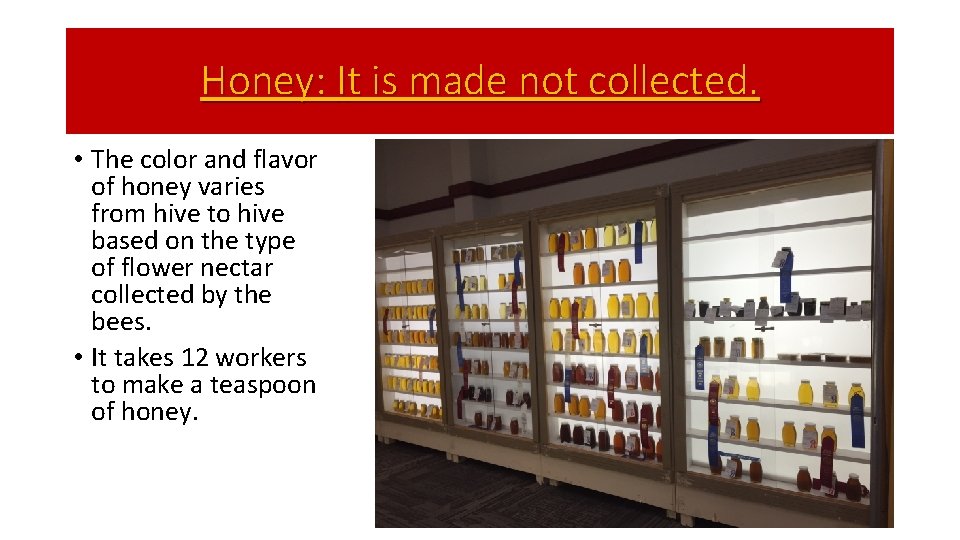
Honey: It is made not collected. • The color and flavor of honey varies from hive to hive based on the type of flower nectar collected by the bees. • It takes 12 workers to make a teaspoon of honey.
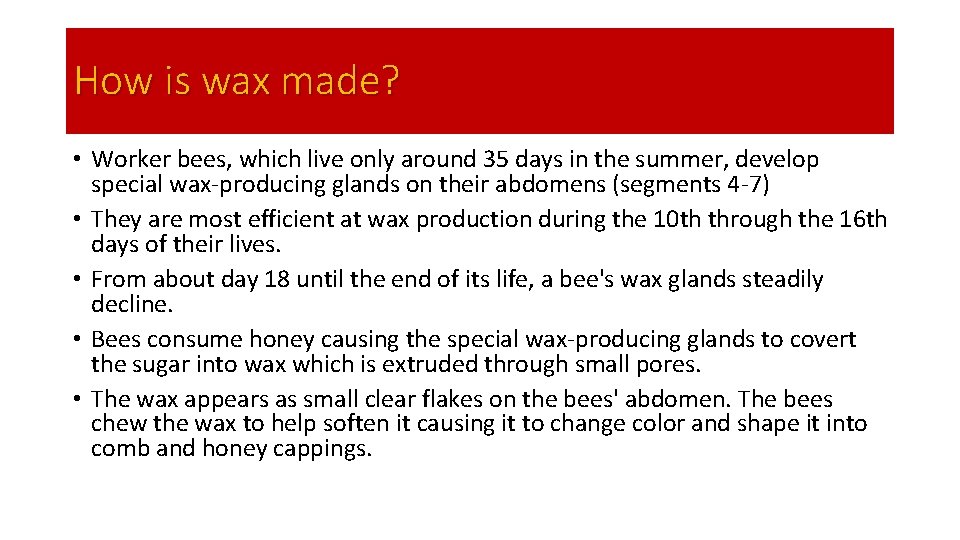
How is wax made? • Worker bees, which live only around 35 days in the summer, develop special wax-producing glands on their abdomens (segments 4 -7) • They are most efficient at wax production during the 10 th through the 16 th days of their lives. • From about day 18 until the end of its life, a bee's wax glands steadily decline. • Bees consume honey causing the special wax-producing glands to covert the sugar into wax which is extruded through small pores. • The wax appears as small clear flakes on the bees' abdomen. The bees chew the wax to help soften it causing it to change color and shape it into comb and honey cappings.
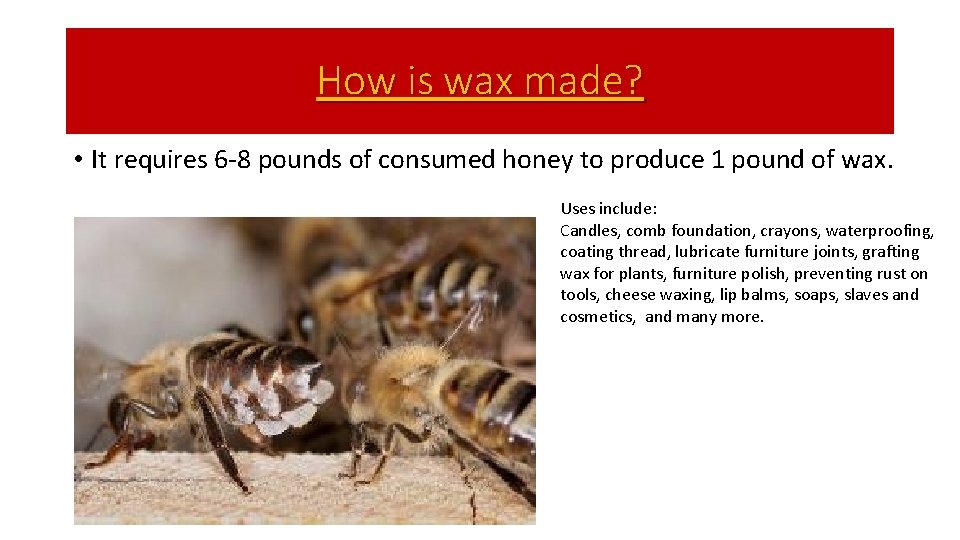
How is wax made? • It requires 6 -8 pounds of consumed honey to produce 1 pound of wax. Uses include: Candles, comb foundation, crayons, waterproofing, coating thread, lubricate furniture joints, grafting wax for plants, furniture polish, preventing rust on tools, cheese waxing, lip balms, soaps, slaves and cosmetics, and many more.

Pollen? • Collected from plants, pollen sticks to the hairs covering the bee’s body and as the bee grooms herself packs it into it pollen sacs on its legs.
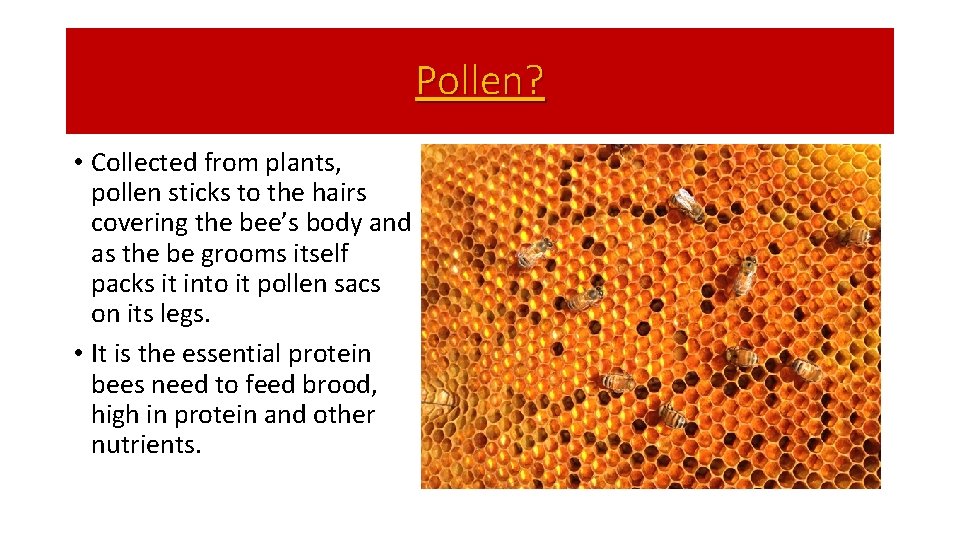
Pollen? • Collected from plants, pollen sticks to the hairs covering the bee’s body and as the be grooms itself packs it into it pollen sacs on its legs. • It is the essential protein bees need to feed brood, high in protein and other nutrients.
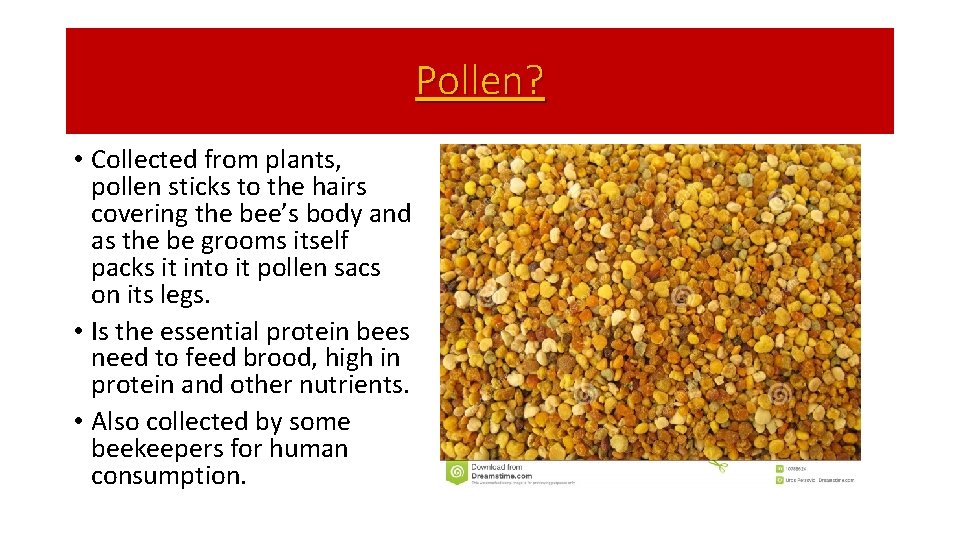
Pollen? • Collected from plants, pollen sticks to the hairs covering the bee’s body and as the be grooms itself packs it into it pollen sacs on its legs. • Is the essential protein bees need to feed brood, high in protein and other nutrients. • Also collected by some beekeepers for human consumption.

Pollen? • Collected from plants, pollen sticks to the hairs covering the bee’s body and as the be grooms itself packs it into it pollen sacs on its legs. • Is the essential protein bees need to feed brood, high in protein and other nutrients. üFound in health food stores. üBelieved by herbalists to help with • Also collected by some beekeepers for human allergies, asthma, health maintenance, consumption. stomach problems, even the affects of chemotherapy
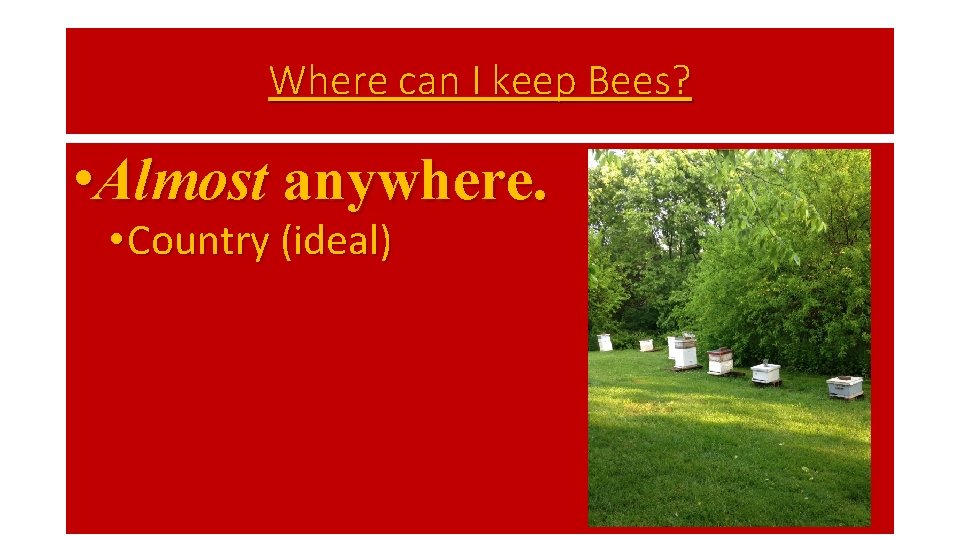
Where can I keep Bees? • Almost anywhere. • Country (ideal)

Where can I keep Bees? • Almost anywhere. • Country (ideal) • City (rooftops) (Jens Bassburg, Downtown Louisville)
Where can I keep Bees? • Almost anywhere. • Country (ideal) • City (rooftops) • Suburbs (backyard, be considerate) • Let your neighbors know • Consult local laws, HOA’s, etc • Give neighbors some honey.
What do you think is one of the biggest questions asked of Beekeepers? Do you get Stung? YES
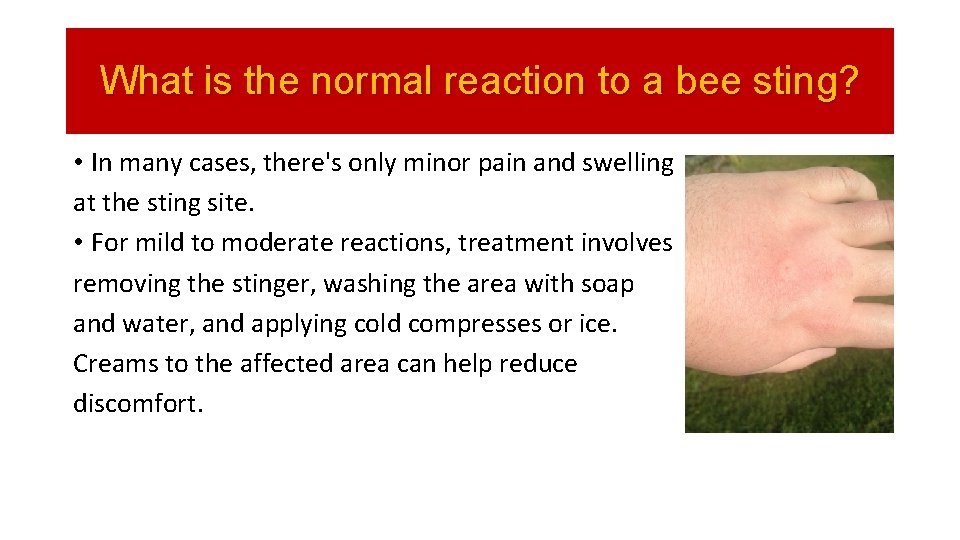
What is the normal reaction to a bee sting? • In many cases, there's only minor pain and swelling at the sting site. • For mild to moderate reactions, treatment involves removing the stinger, washing the area with soap and water, and applying cold compresses or ice. Creams to the affected area can help reduce discomfort.

• In rare cases, a life-threatening allergic reaction (anaphylactic shock) can cause difficulty breathing, tongue swelling, nausea, and unconsciousness. This may require emergency medical attention. • Severe reactions may need epinephrine, for example with an Epi-Pen.
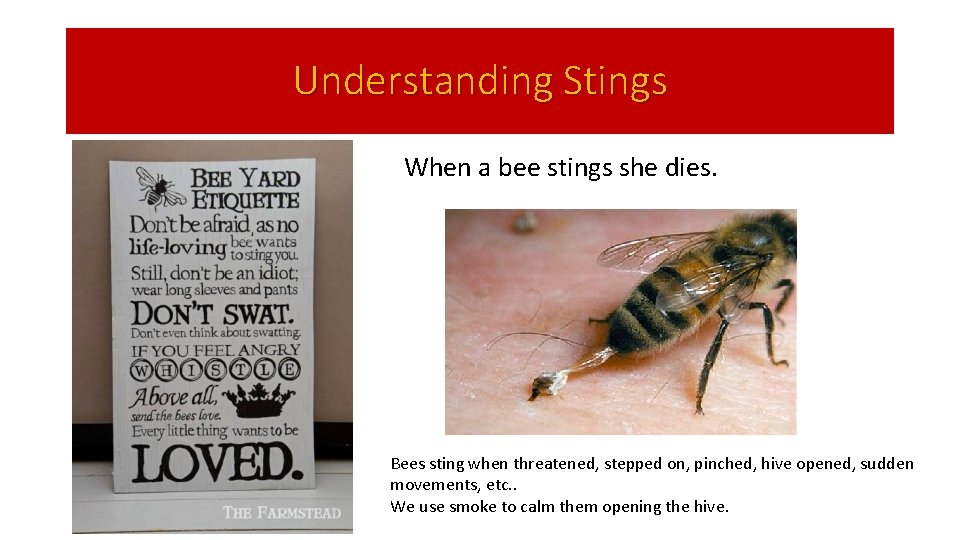
Understanding Stings When a bee stings she dies. Bees sting when threatened, stepped on, pinched, hive opened, sudden movements, etc. . We use smoke to calm them opening the hive.
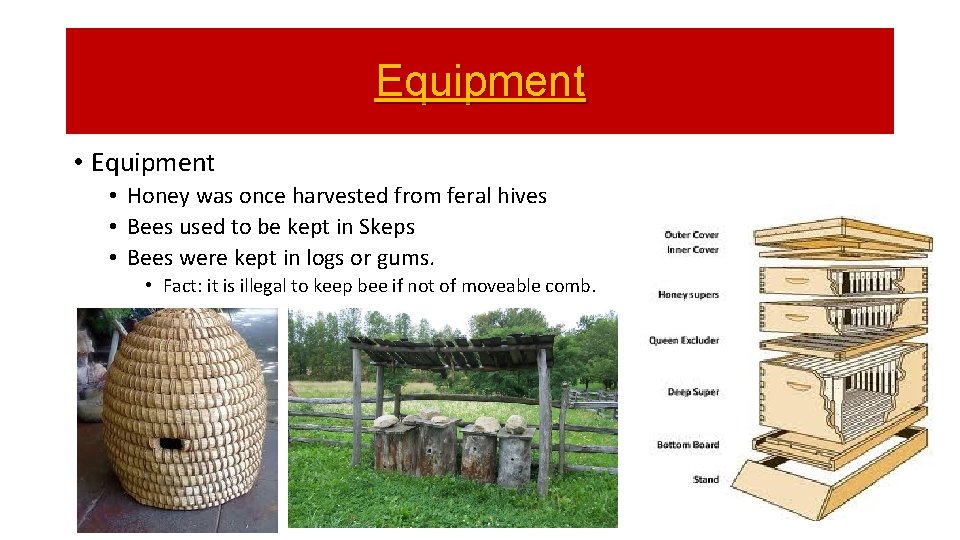
Equipment • Honey was once harvested from feral hives • Bees used to be kept in Skeps • Bees were kept in logs or gums. • Fact: it is illegal to keep bee if not of moveable comb.
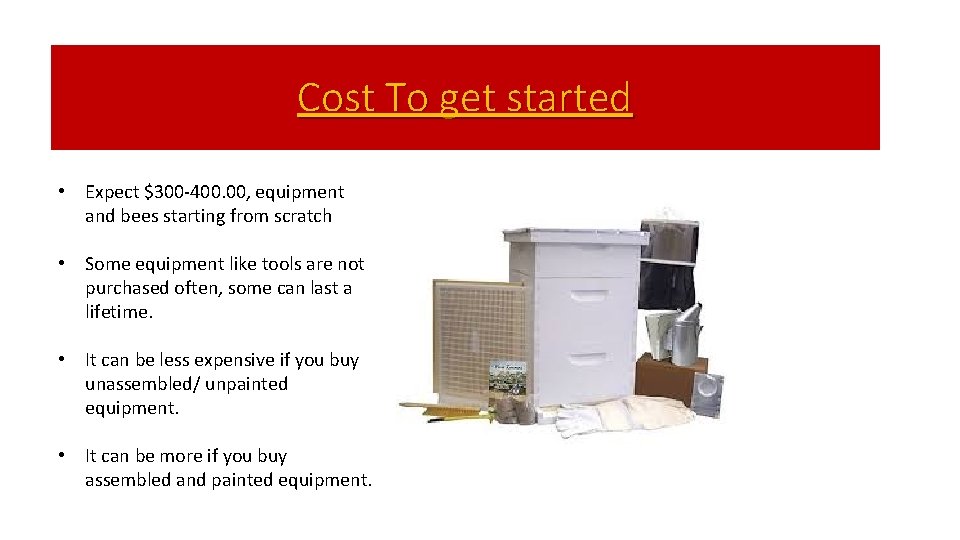
Cost To get started • Expect $300 -400. 00, equipment and bees starting from scratch • Some equipment like tools are not purchased often, some can last a lifetime. • It can be less expensive if you buy unassembled/ unpainted equipment. • It can be more if you buy assembled and painted equipment.
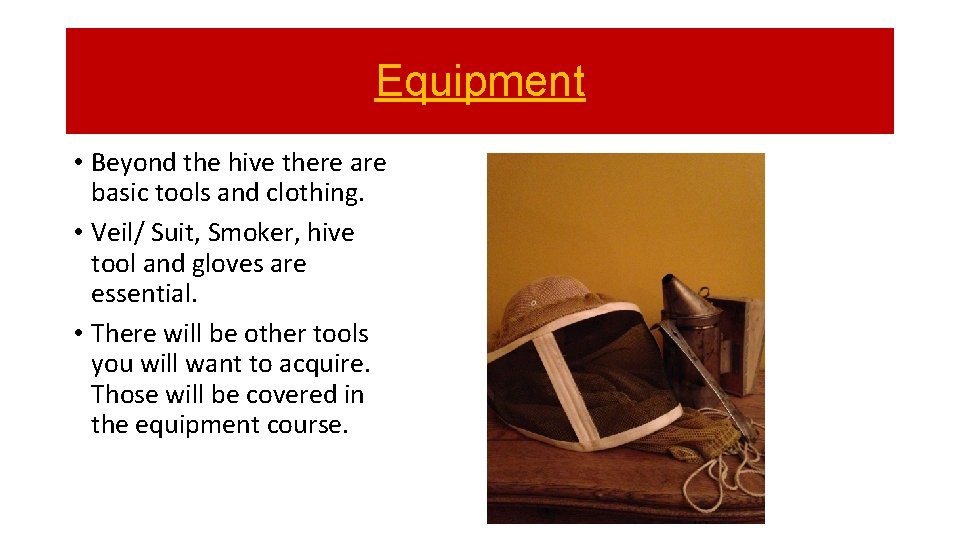
Equipment • Beyond the hive there are basic tools and clothing. • Veil/ Suit, Smoker, hive tool and gloves are essential. • There will be other tools you will want to acquire. Those will be covered in the equipment course.
Of course you need the Bees: Acquiring Bees • There are three methods for acquiring bees: • Packages • Nuc (nucleous hive) • Swarms (natural or artificial/ splits)
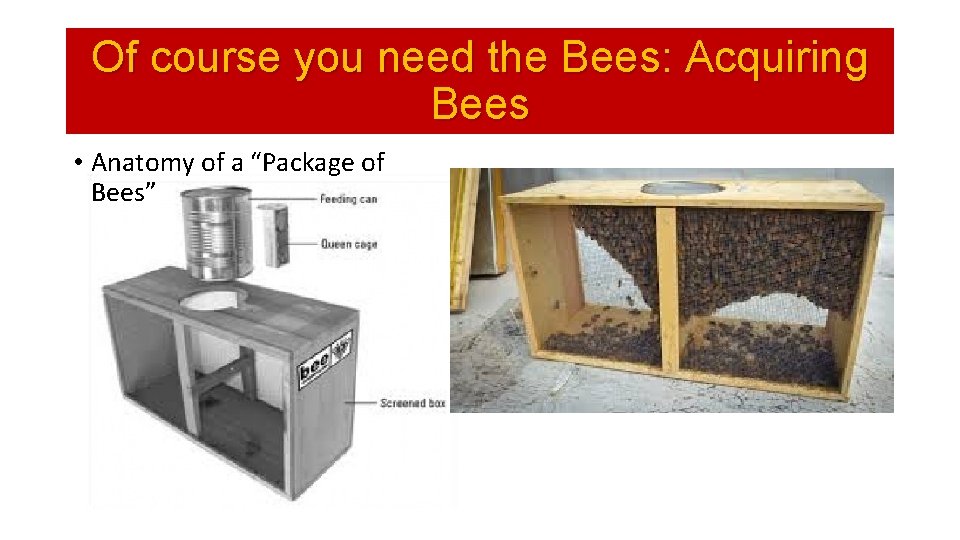
Of course you need the Bees: Acquiring Bees • Anatomy of a “Package of Bees”

Package Day!!
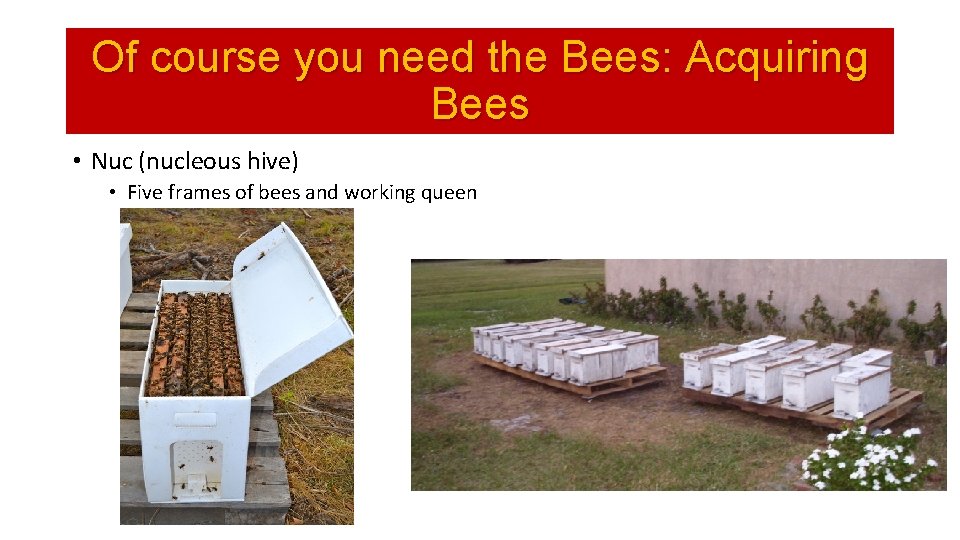
Of course you need the Bees: Acquiring Bees • Nuc (nucleous hive) • Five frames of bees and working queen
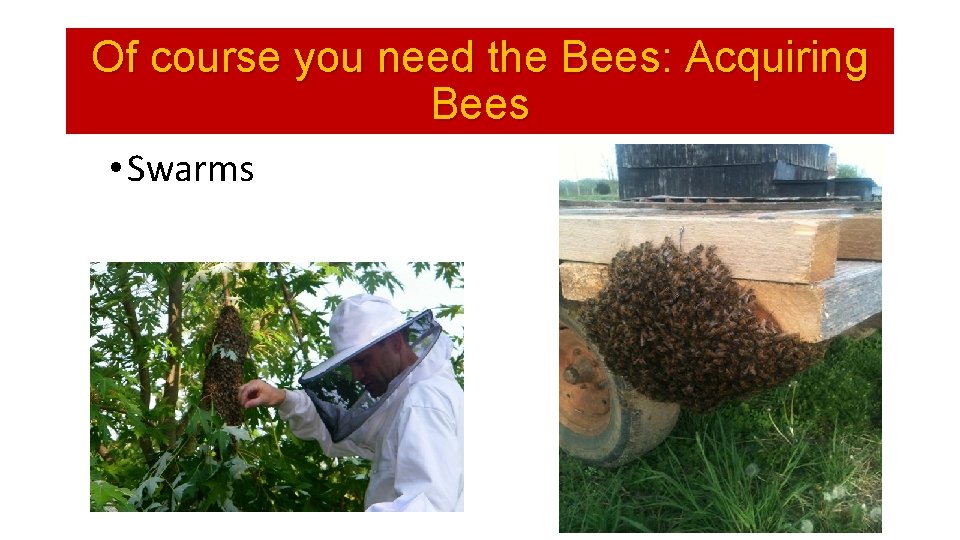
Of course you need the Bees: Acquiring Bees • Swarms
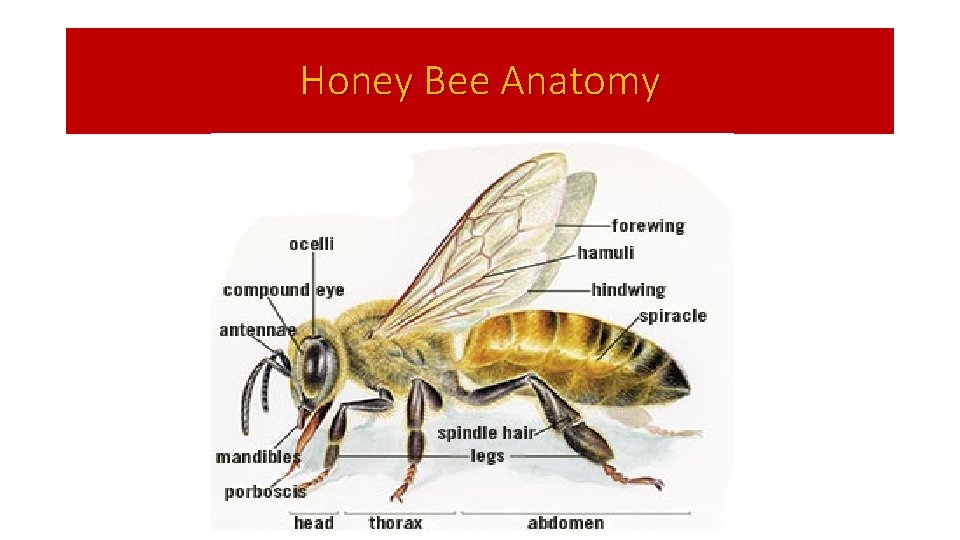
Honey Bee Anatomy
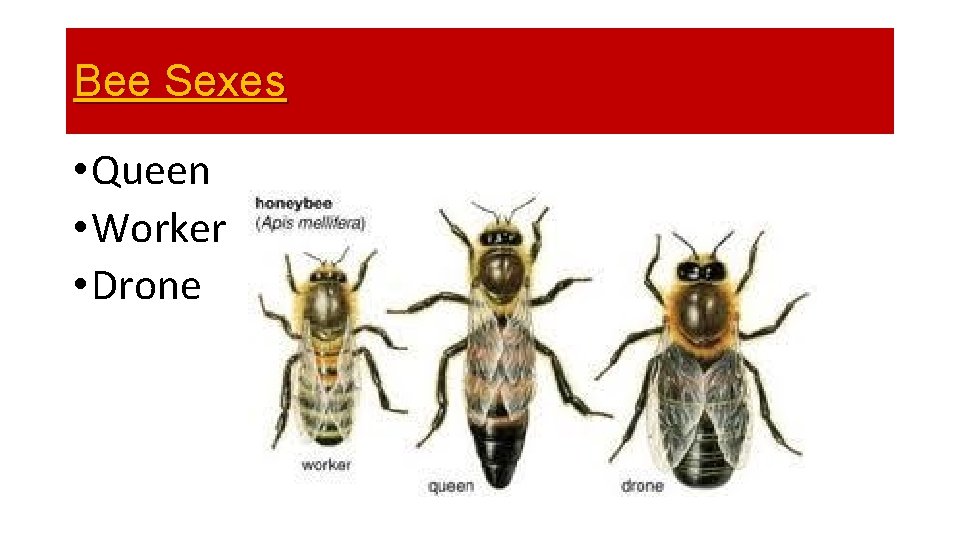
Bee Sexes • Queen • Worker • Drone
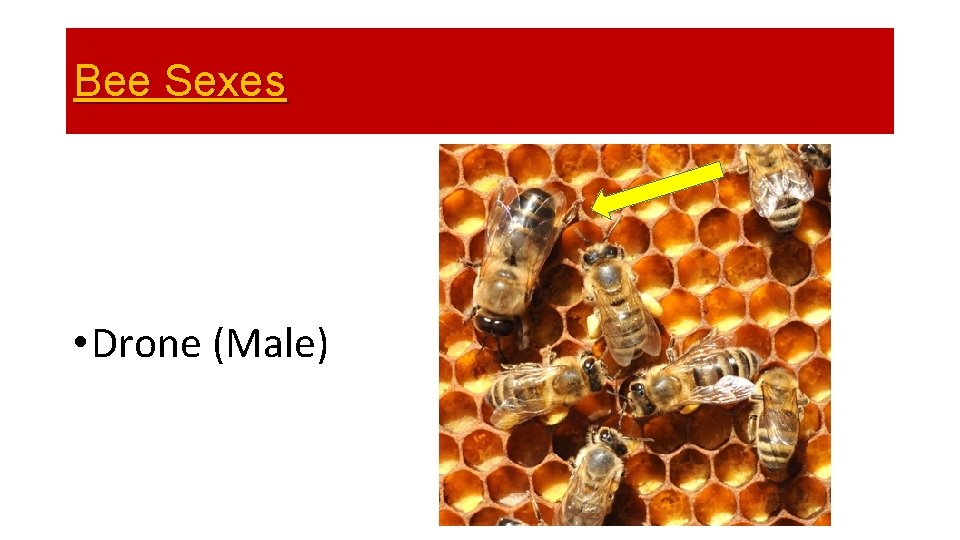
Bee Sexes • Drone (Male)
Bee Sexes Drone Bee • Males • Does not collect (nectar, water, pollen, etc. ), nor does any hive duties. • Can not Protect the hive (no stinger) • Only eats and flys to congregation areas to mate with a virgin queen then dies.
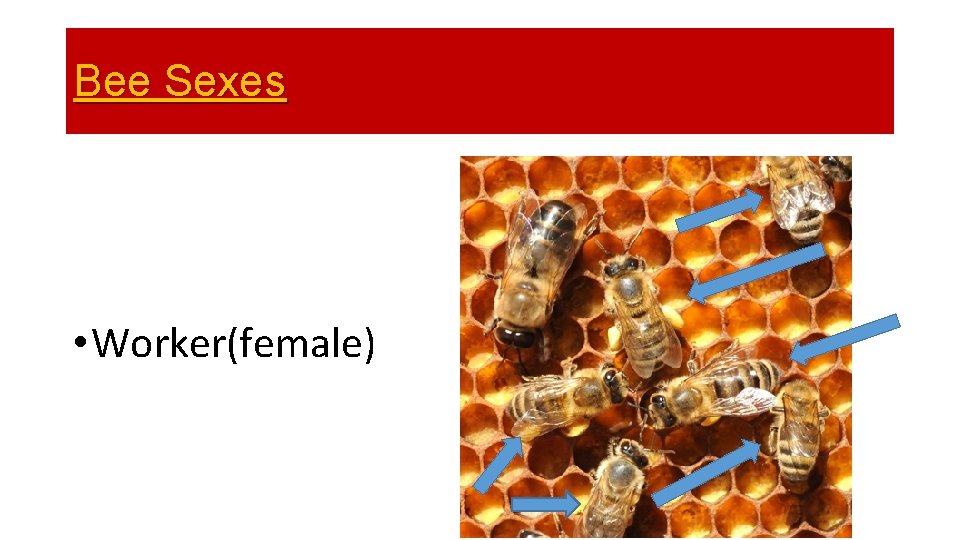
Bee Sexes • Worker(female)
Bee Sexes Worker Bee • Does all the work • Collects nectar, pollen, and water, feeds brood, makes wax, builds comb, makes propolis, makes honey, controls temperature of hive, clears the hive of debris and dead bees, feeds the queen, carries her waste out of the hive, protects the hive and more • They are, tireless, relentless, ceasless, selfless, fearless. • They “die with their reigns on”- L. L. Langstroth
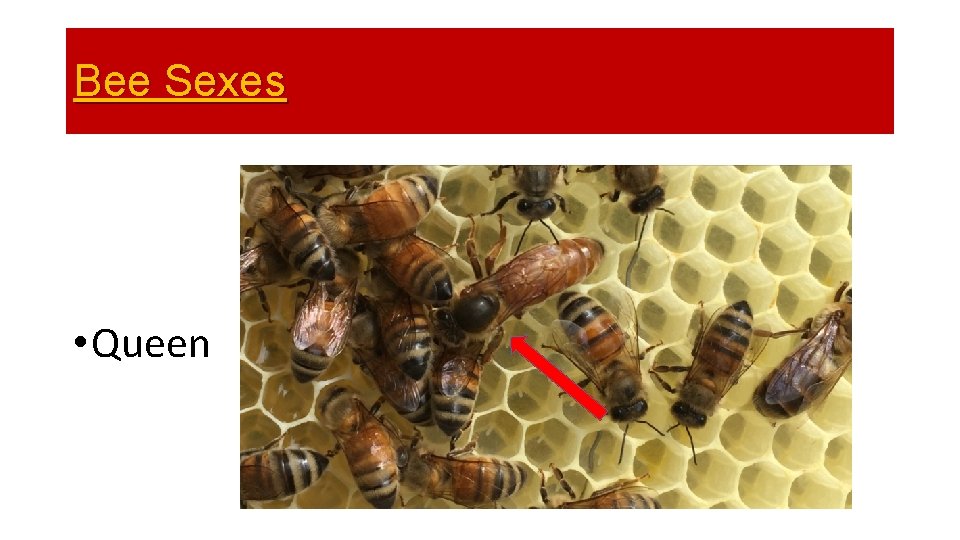
Bee Sexes • Queen
Bee Sexes Queen Bee • The life/ mother of the hive. • Emits Pheremone: keeps hive “queenright” • Determines characteristics of a hive. • Only one in each colony (few exceptions) • She mates with several drones on nuptial flight and never leaves the hive again unless there’s a swarm. • Viable 2 -3 years • Decides if egg will become drone or worker bee.
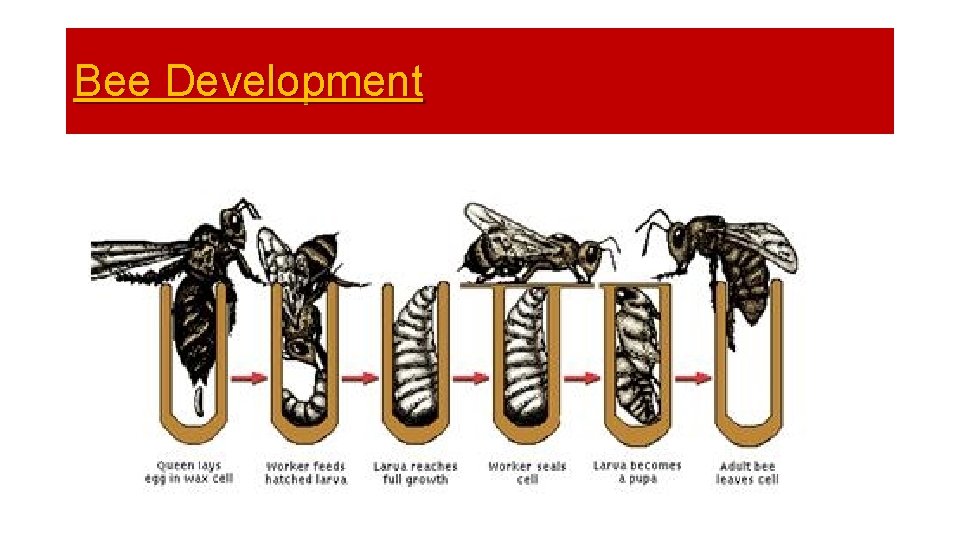
Bee Development
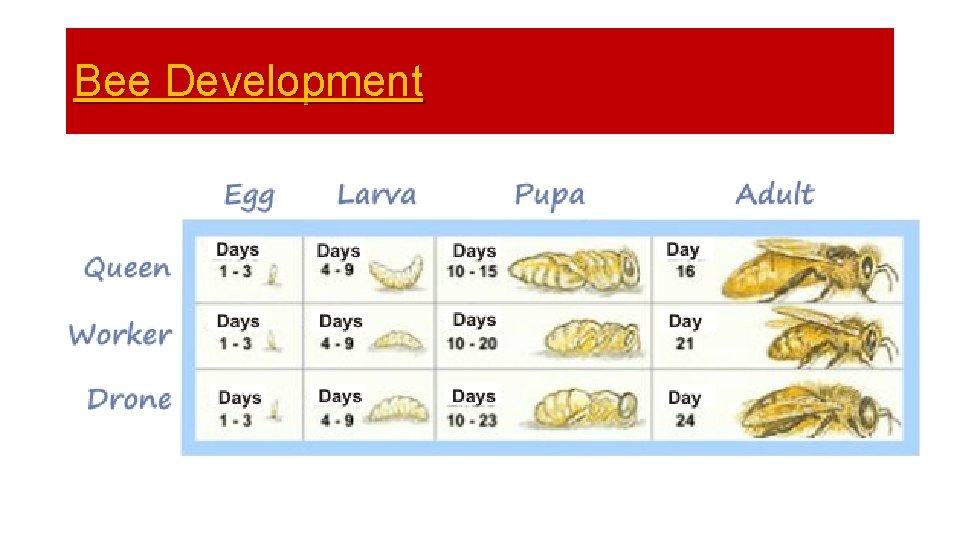
Bee Development
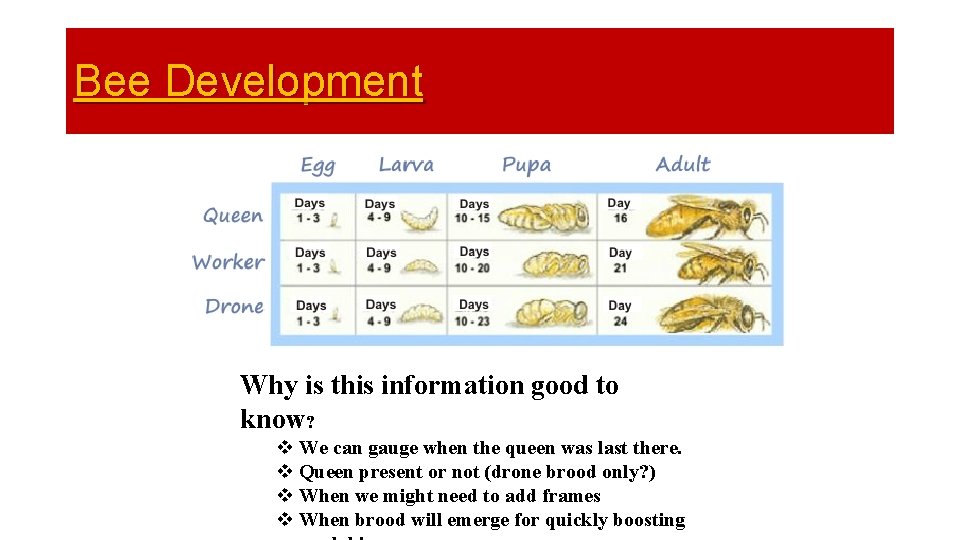
Bee Development Why is this information good to know? v We can gauge when the queen was last there. v Queen present or not (drone brood only? ) v When we might need to add frames v When brood will emerge for quickly boosting
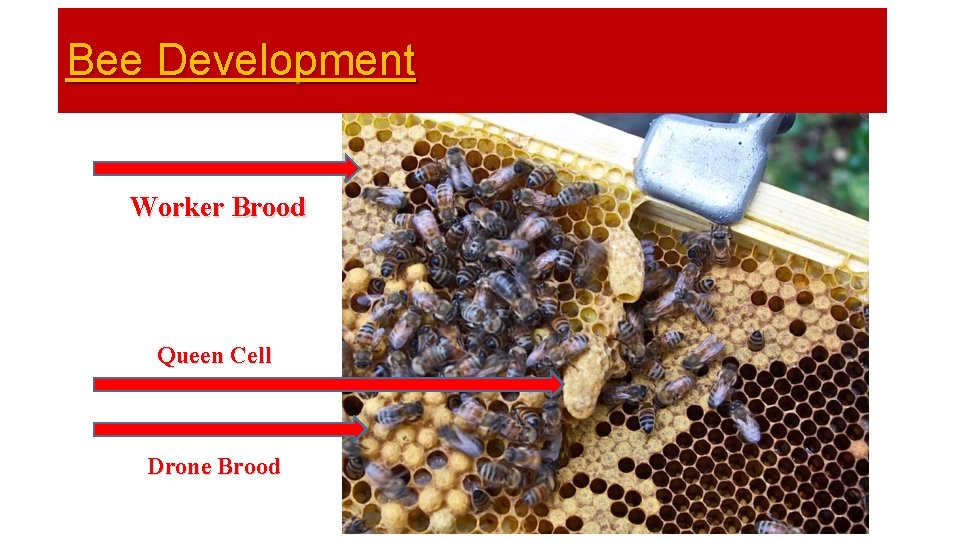
Bee Development Worker Brood Queen Cell Drone Brood
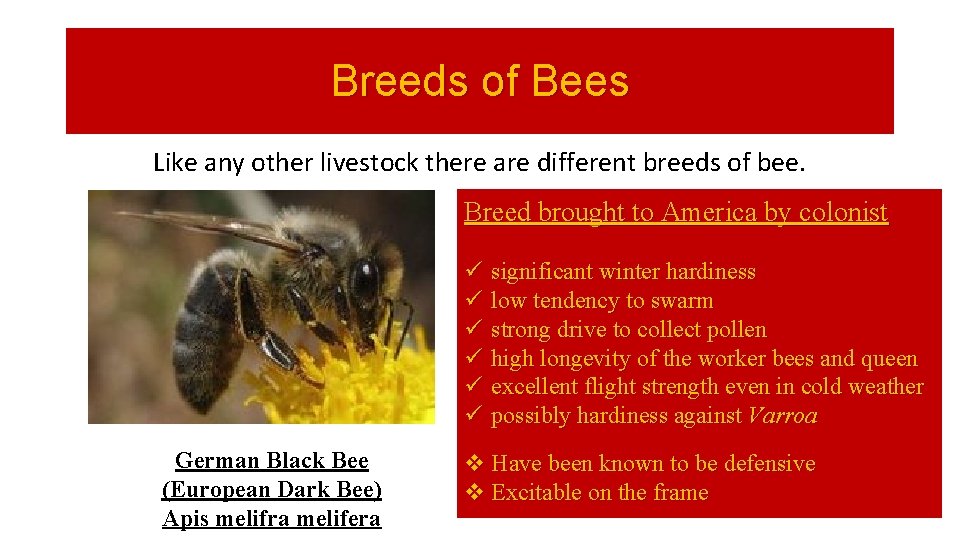
Breeds of Bees Like any other livestock there are different breeds of bee. Breed brought to America by colonist ü significant winter hardiness ü low tendency to swarm ü strong drive to collect pollen ü high longevity of the worker bees and queen ü excellent flight strength even in cold weather ü possibly hardiness against Varroa German Black Bee (European Dark Bee) Apis melifra melifera v Have been known to be defensive v Excitable on the frame
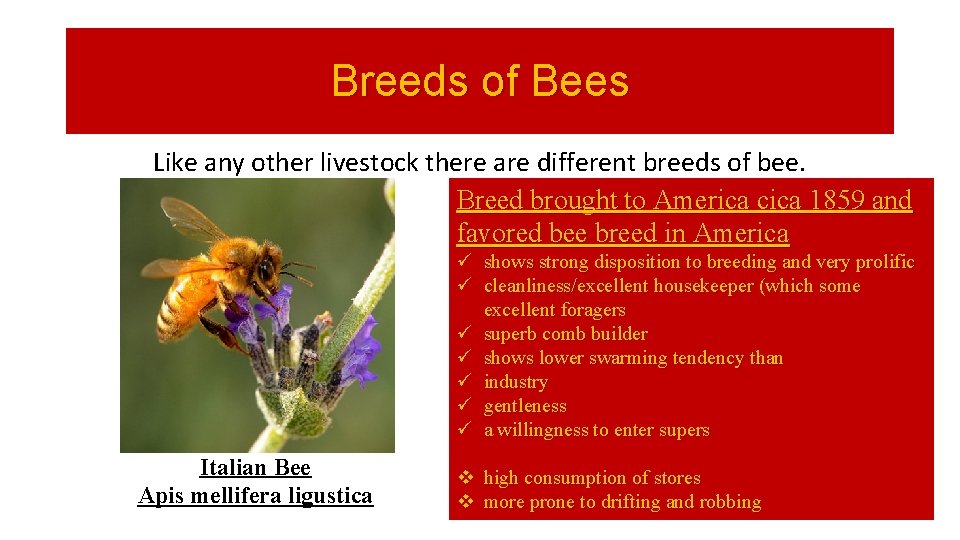
Breeds of Bees Like any other livestock there are different breeds of bee. Breed brought to America cica 1859 and favored bee breed in America ü shows strong disposition to breeding and very prolific ü cleanliness/excellent housekeeper (which some excellent foragers ü superb comb builder ü shows lower swarming tendency than ü industry ü gentleness ü a willingness to enter supers Italian Bee Apis mellifera ligustica v high consumption of stores v more prone to drifting and robbing
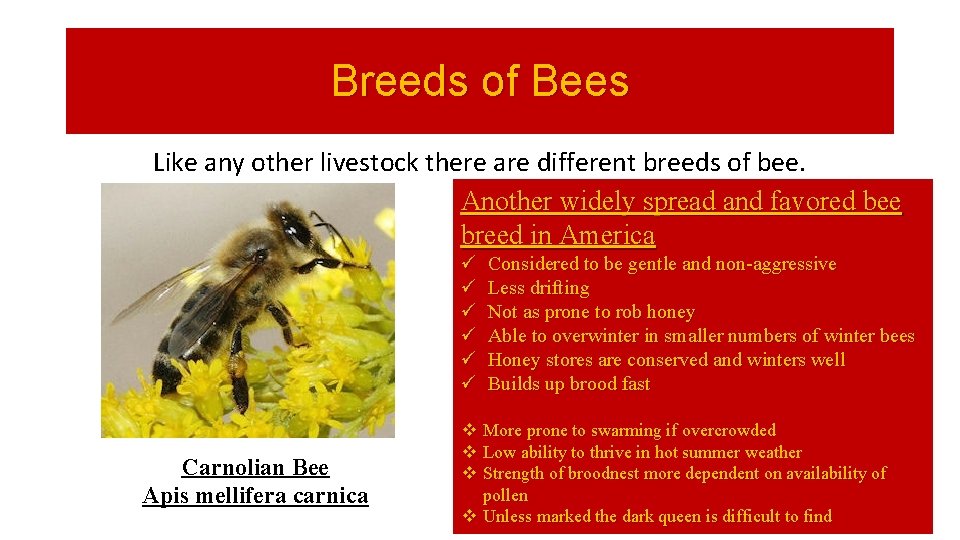
Breeds of Bees Like any other livestock there are different breeds of bee. Another widely spread and favored bee breed in America ü ü ü Carnolian Bee Apis mellifera carnica Considered to be gentle and non-aggressive Less drifting Not as prone to rob honey Able to overwinter in smaller numbers of winter bees Honey stores are conserved and winters well Builds up brood fast v More prone to swarming if overcrowded v Low ability to thrive in hot summer weather v Strength of broodnest more dependent on availability of pollen v Unless marked the dark queen is difficult to find
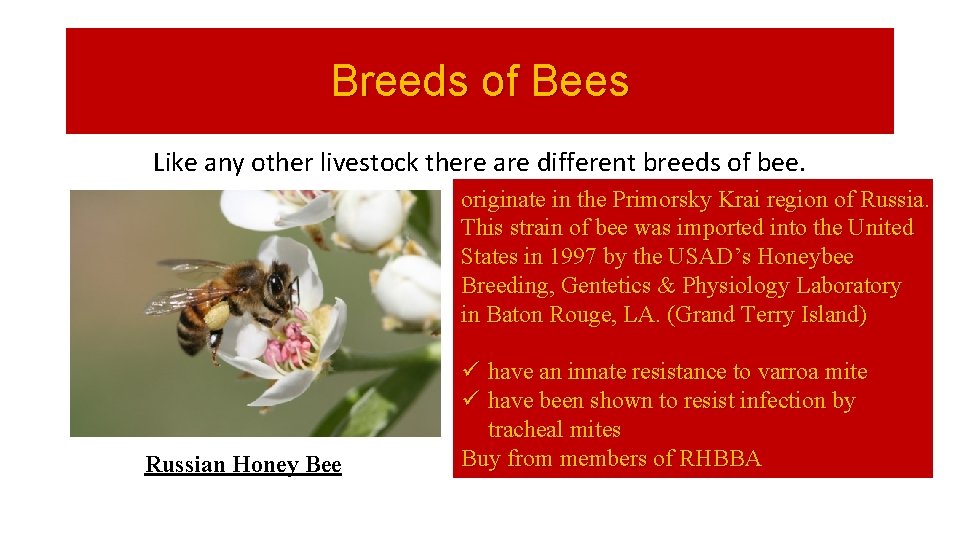
Breeds of Bees Like any other livestock there are different breeds of bee. originate in the Primorsky Krai region of Russia. This strain of bee was imported into the United States in 1997 by the USAD’s Honeybee Breeding, Gentetics & Physiology Laboratory in Baton Rouge, LA. (Grand Terry Island) Russian Honey Bee ü have an innate resistance to varroa mite ü have been shown to resist infection by tracheal mites Buy from members of RHBBA
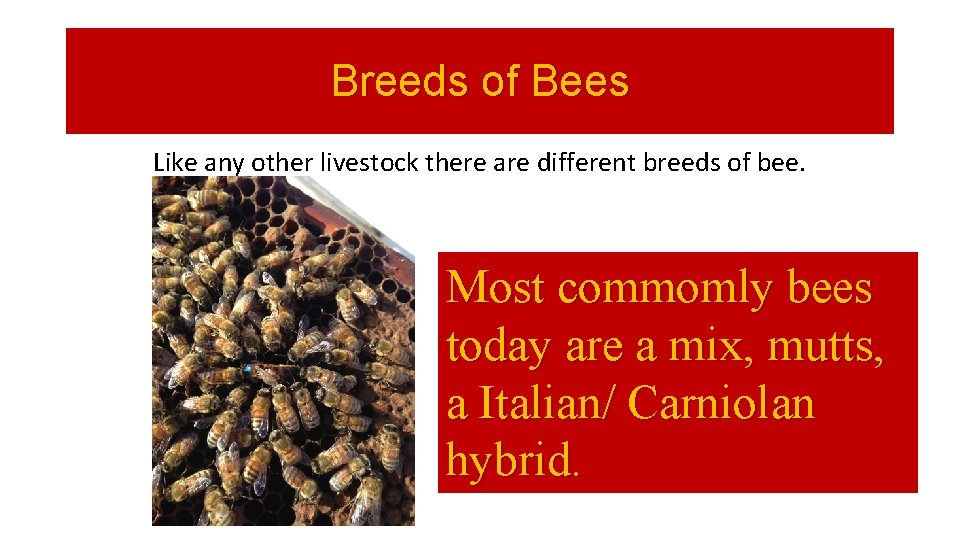
Breeds of Bees Like any other livestock there are different breeds of bee. Most commomly bees today are a mix, mutts, a Italian/ Carniolan hybrid.
What are your Expectations? • You most likely will not have surplus honey your first year. • You can not “set it and forget it” (March-November is season) • “We don’t have bees, we ‘keep’ bees”- strong hives prevent a lot, pests, and disease, must treat for varroa mites. • • • You will not find the queen every hive inspection. You will make mistakes, but the bees are forgiving. You will be fascinated. It will be rewarding. You will become an entomologist, a botanist, chemist, biologist, gardener, carpenter, photographer, meteorologist, of sorts and more.
- Slides: 44