
Introduction to Beam Instrumentation Hermann Schmickler CERN Beam
Introduction to Beam Instrumentation Hermann Schmickler (CERN Beam Instrumentation Group) Hermann Schmickler – CERN Beam Instrumentation Group
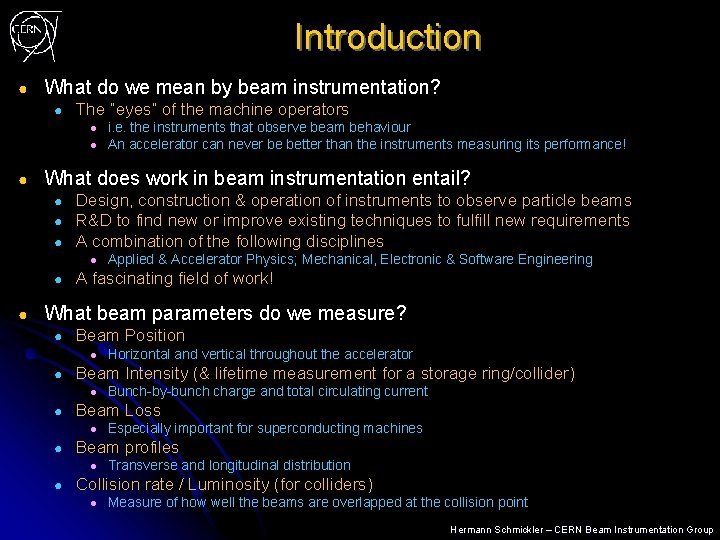
Introduction ● What do we mean by beam instrumentation? ● The “eyes” of the machine operators ● i. e. the instruments that observe beam behaviour ● An accelerator can never be better than the instruments measuring its performance! ● What does work in beam instrumentation entail? ● ● ● Design, construction & operation of instruments to observe particle beams R&D to find new or improve existing techniques to fulfill new requirements A combination of the following disciplines ● Applied & Accelerator Physics; Mechanical, Electronic & Software Engineering ● ● A fascinating field of work! What beam parameters do we measure? ● Beam Position ● Horizontal and vertical throughout the accelerator ● Beam Intensity (& lifetime measurement for a storage ring/collider) ● Bunch-by-bunch charge and total circulating current ● Beam Loss ● Especially important for superconducting machines ● Beam profiles ● Transverse and longitudinal distribution ● Collision rate / Luminosity (for colliders) ● Measure of how well the beams are overlapped at the collision point Hermann Schmickler – CERN Beam Instrumentation Group
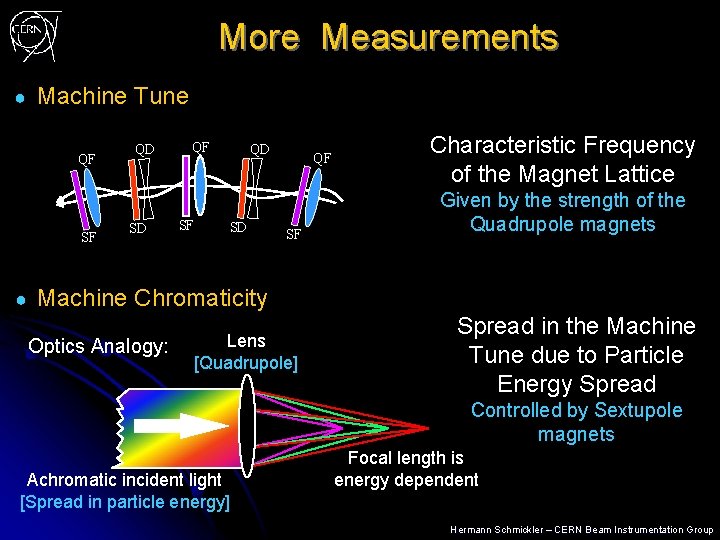
More Measurements ● Machine Tune QF SF ● QD SD QF SF Characteristic Frequency of the Magnet Lattice Given by the strength of the Quadrupole magnets Machine Chromaticity Optics Analogy: Lens [Quadrupole] Spread in the Machine Tune due to Particle Energy Spread Controlled by Sextupole magnets Achromatic incident light [Spread in particle energy] Focal length is energy dependent Hermann Schmickler – CERN Beam Instrumentation Group
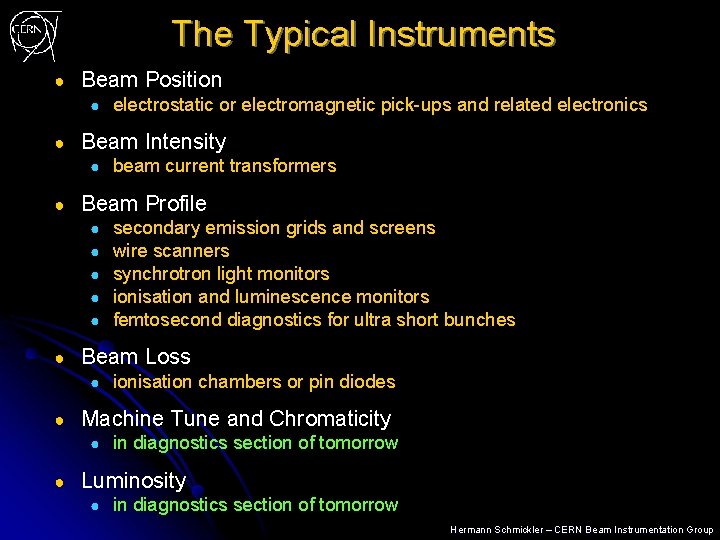
The Typical Instruments ● Beam Position ● ● Beam Intensity ● ● ionisation chambers or pin diodes Machine Tune and Chromaticity ● ● secondary emission grids and screens wire scanners synchrotron light monitors ionisation and luminescence monitors femtosecond diagnostics for ultra short bunches Beam Loss ● ● beam current transformers Beam Profile ● ● ● electrostatic or electromagnetic pick-ups and related electronics in diagnostics section of tomorrow Luminosity ● in diagnostics section of tomorrow Hermann Schmickler – CERN Beam Instrumentation Group
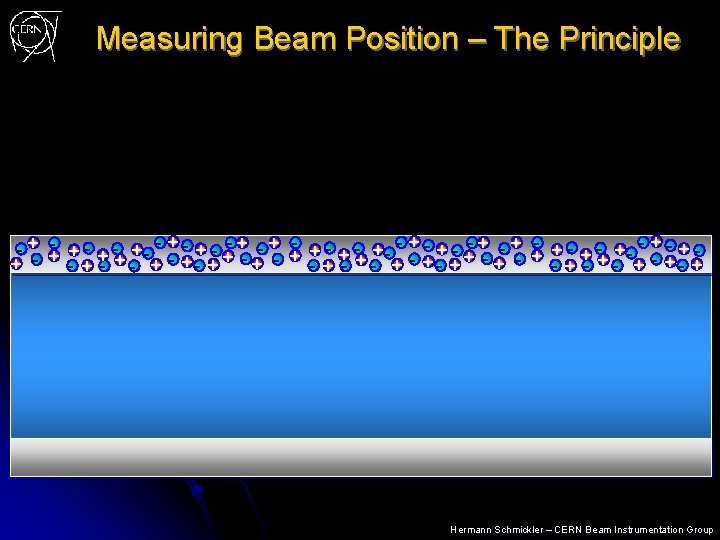
Measuring Beam Position – The Principle - + +- + - + - + - +- + - + - + + - + - +- + -+ - + - +- + -+ - Hermann Schmickler – CERN Beam Instrumentation Group
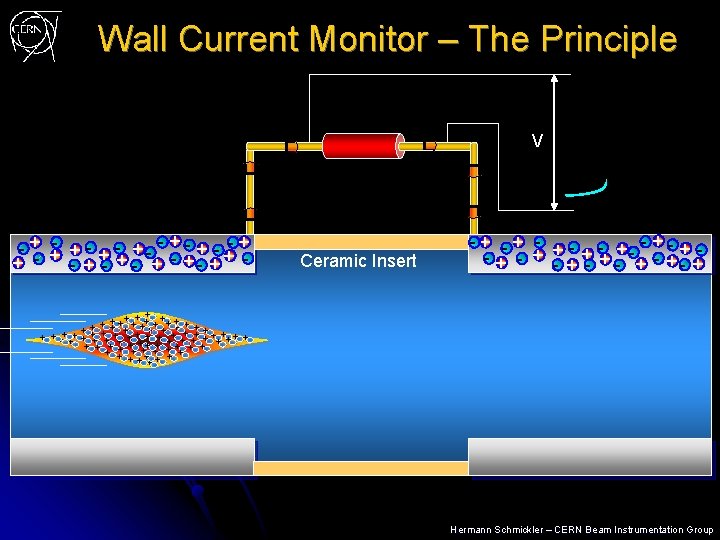
Wall Current Monitor – The Principle V - + +- + - +- + + - + - +- + - Ceramic Insert -+ -+ - - + - + - + +- + - -+ - + + + ++++++ + + +++++ ++ +++++ + + ++ ++++ + + +++ + + Hermann Schmickler – CERN Beam Instrumentation Group
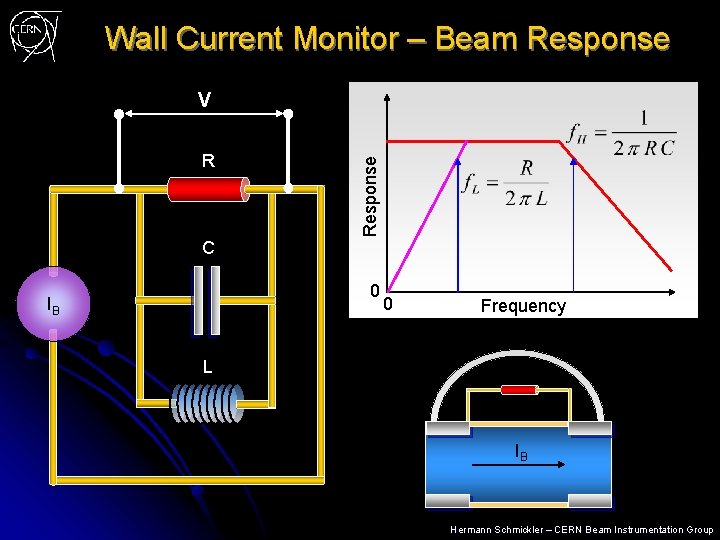
Wall Current Monitor – Beam Response R Response V C 0 IB 0 Frequency L IB Hermann Schmickler – CERN Beam Instrumentation Group
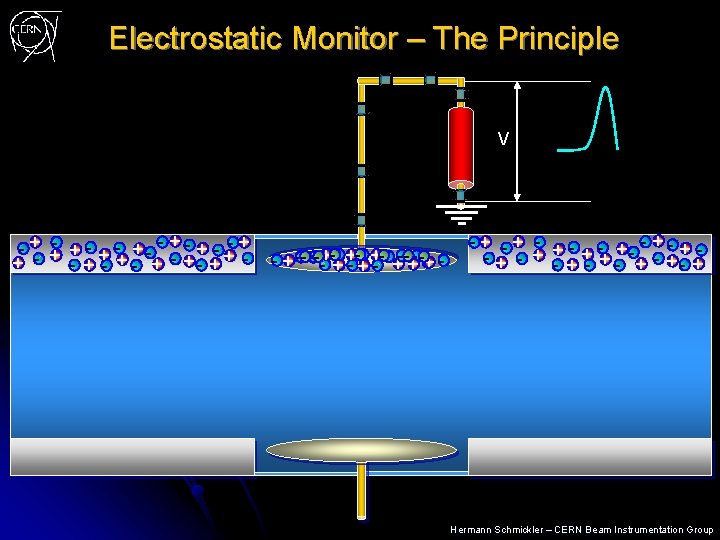
Electrostatic Monitor – The Principle V - + +- + - +- + + - + - +- + - -- +- - + +--+--+ - + - +- + -+- -+ -+ -+ - - + - + - + +- + - -+ - + Hermann Schmickler – CERN Beam Instrumentation Group
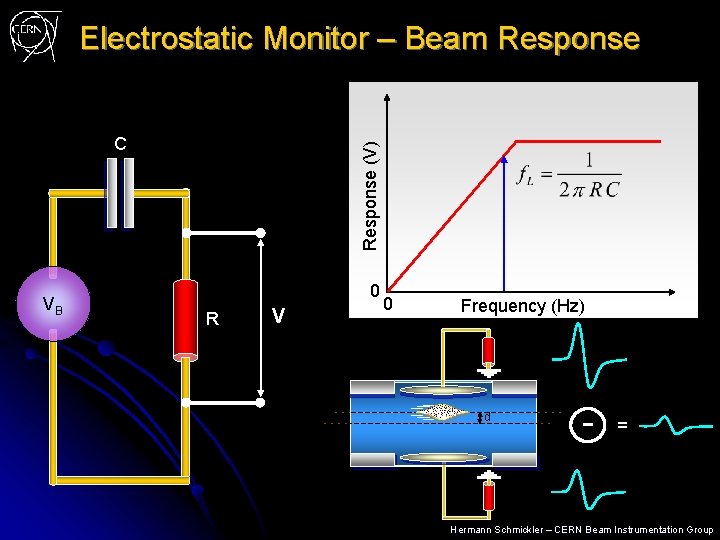
Electrostatic Monitor – Beam Response VB Response (V) C 0 R V 0 Frequency (Hz) + + ++ ++ + + + ++ + + + + + + ++ + + + ++ ++ d - = Hermann Schmickler – CERN Beam Instrumentation Group
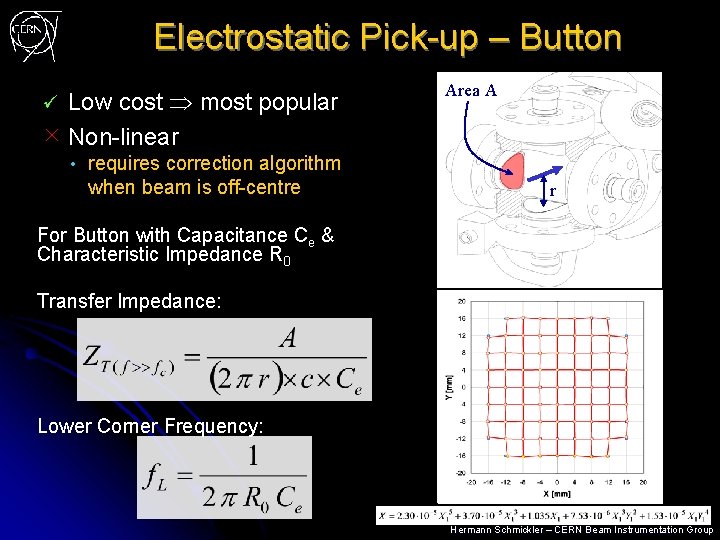
Electrostatic Pick-up – Button Low cost most popular × Non-linear ü • requires correction algorithm when beam is off-centre Area A r For Button with Capacitance Ce & Characteristic Impedance R 0 Transfer Impedance: Lower Corner Frequency: Hermann Schmickler – CERN Beam Instrumentation Group
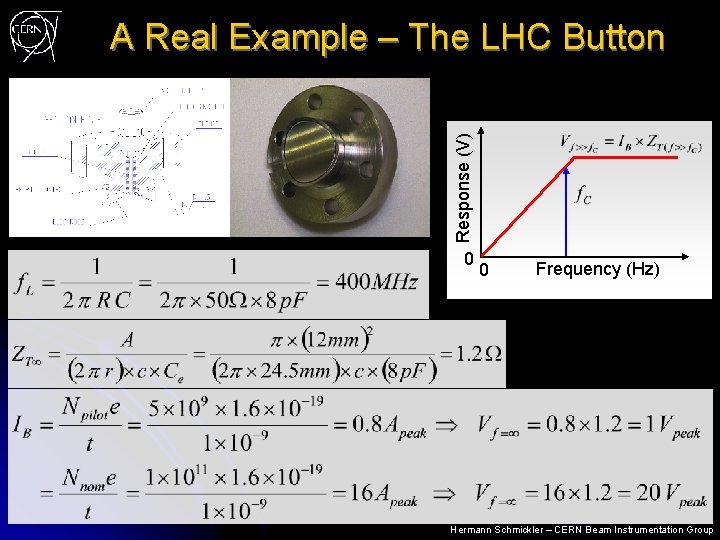
Response (V) A Real Example – The LHC Button 0 0 Frequency (Hz) Hermann Schmickler – CERN Beam Instrumentation Group
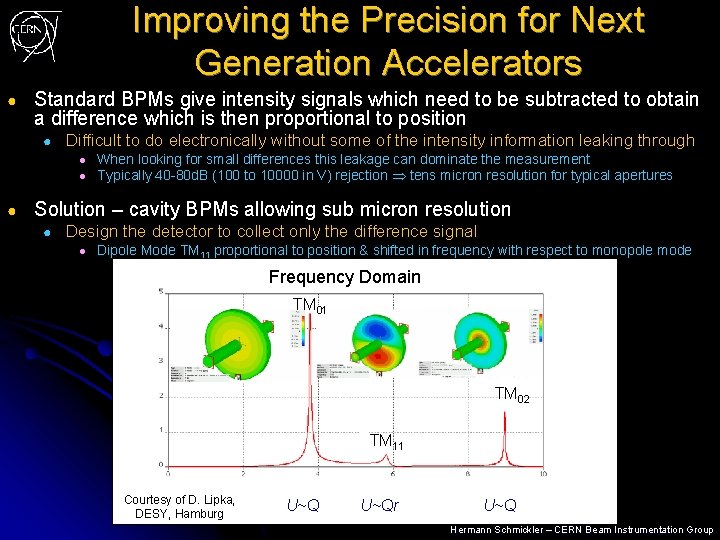
Improving the Precision for Next Generation Accelerators ● Standard BPMs give intensity signals which need to be subtracted to obtain a difference which is then proportional to position ● Difficult to do electronically without some of the intensity information leaking through ● When looking for small differences this leakage can dominate the measurement ● Typically 40 -80 d. B (100 to 10000 in V) rejection tens micron resolution for typical apertures Solution – cavity BPMs allowing sub micron resolution ● Design the detector to collect only the difference signal ● Dipole Mode TM 11 proportional to position & shifted in frequency with respect to monopole mode Frequency Domain U/V ● TM 01 01 TM 02 02 TM TM TM 1111 f / GHz Courtesy of D. Lipka, DESY, Hamburg U~Qr U~Q Hermann Schmickler – CERN Beam Instrumentation Group
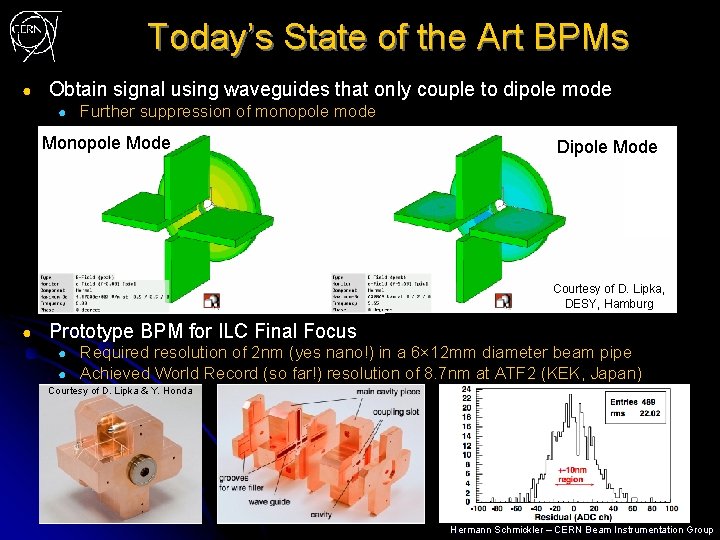
Today’s State of the Art BPMs ● Obtain signal using waveguides that only couple to dipole mode ● Further suppression of monopole mode Monopole Mode Dipole Mode Courtesy of D. Lipka, DESY, Hamburg ● Prototype BPM for ILC Final Focus ● ● Required resolution of 2 nm (yes nano!) in a 6× 12 mm diameter beam pipe Achieved World Record (so far!) resolution of 8. 7 nm at ATF 2 (KEK, Japan) Courtesy of D. Lipka & Y. Honda Hermann Schmickler – CERN Beam Instrumentation Group

Criteria for Electronics Choice so called “Processor Electronics” ● Accuracy mechanical and electromagnetic errors ● electronic components ● ● Resolution ● Stability over time ● Sensitivity and Dynamic Range ● Acquisition Time measurement time ● repetition time ● ● Linearity ● ● aperture & intensity Radiation tolerance Hermann Schmickler – CERN Beam Instrumentation Group
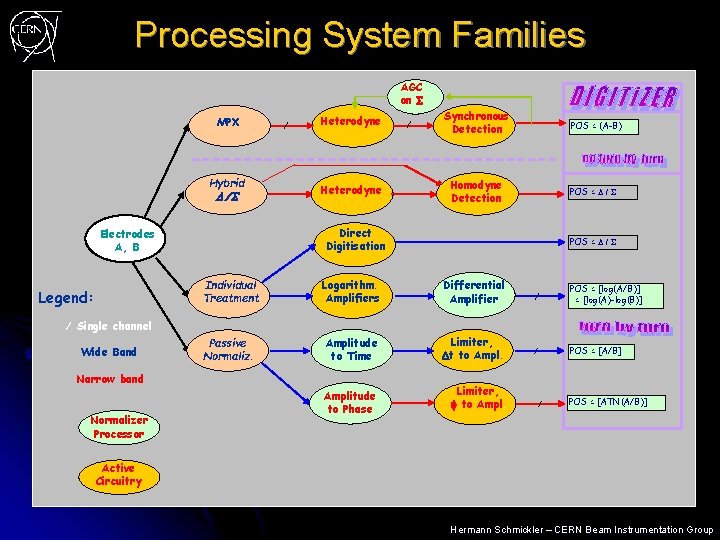
Processing System Families AGC on S MPX Hybrid D/S Synchronous Detection Heterodyne Homodyne Detection Direct Digitisation Electrodes A, B Legend: Heterodyne POS = (A-B) POS = D / S Individual Treatment Logarithm. Amplifiers Differential Amplifier POS = [log(A/B)] = [log(A)-log(B)] Passive Normaliz. Amplitude to Time Limiter, Dt to Ampl. POS = [A/B] Amplitude to Phase Limiter, . f to Ampl. / Single channel Wide Band Narrow band Normalizer Processor POS = [ATN(A/B)] Active Circuitry Hermann Schmickler – CERN Beam Instrumentation Group
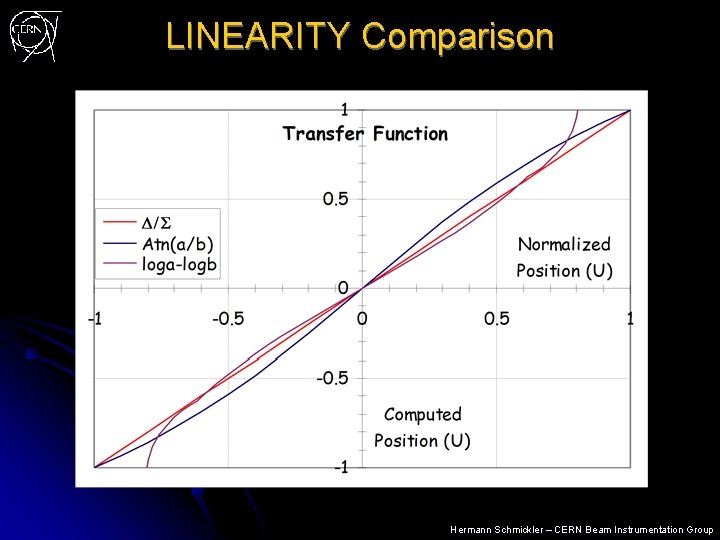
LINEARITY Comparison Hermann Schmickler – CERN Beam Instrumentation Group
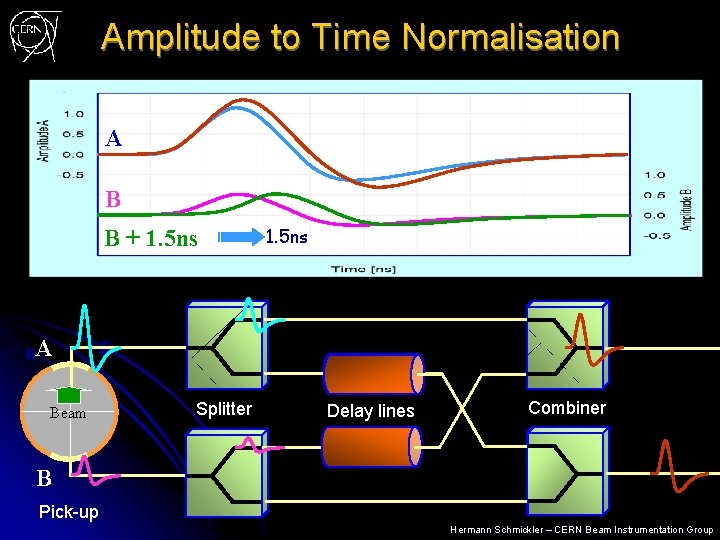
Amplitude to Time Normalisation A B B + 1. 5 ns A Beam Splitter Delay lines Combiner B Pick-up Hermann Schmickler – CERN Beam Instrumentation Group
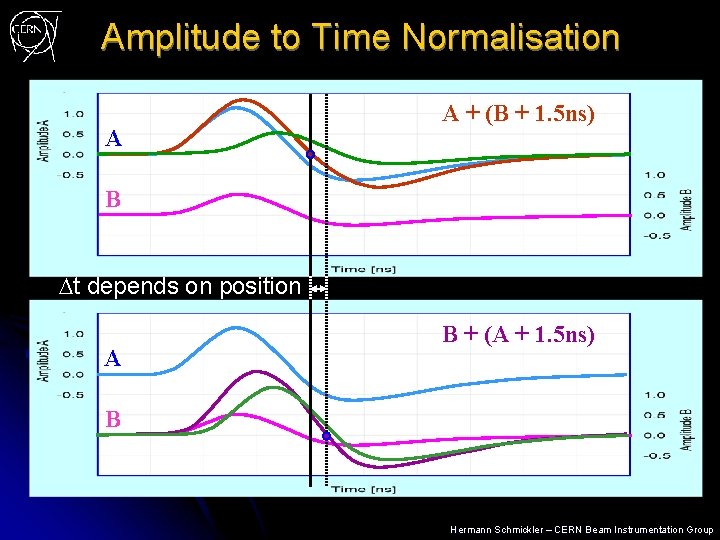
Amplitude to Time Normalisation A A + (B + 1. 5 ns) B Dt depends on position A B + (A + 1. 5 ns) B Hermann Schmickler – CERN Beam Instrumentation Group
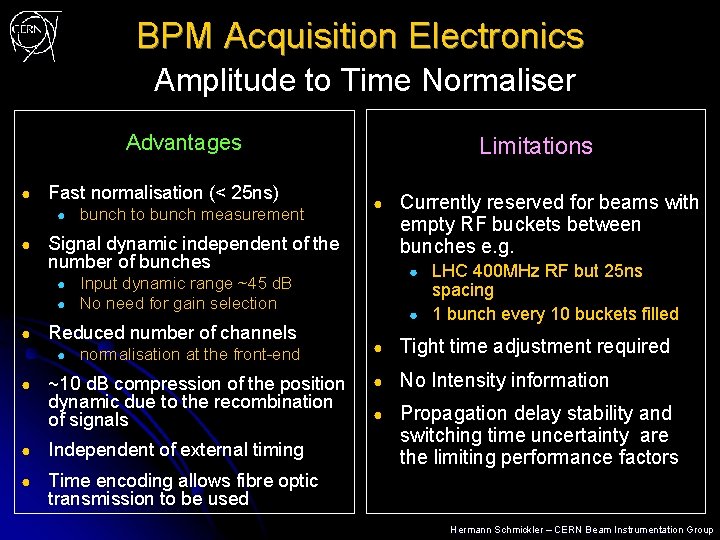
BPM Acquisition Electronics Amplitude to Time Normaliser Advantages ● Fast normalisation (< 25 ns) ● ● normalisation at the front-end ~10 d. B compression of the position dynamic due to the recombination of signals ● Independent of external timing ● Time encoding allows fibre optic transmission to be used Currently reserved for beams with empty RF buckets between bunches e. g. LHC 400 MHz RF but 25 ns spacing ● 1 bunch every 10 buckets filled ● Input dynamic range ~45 d. B No need for gain selection Reduced number of channels ● ● ● Signal dynamic independent of the number of bunches ● ● ● bunch to bunch measurement Limitations ● Tight time adjustment required ● No Intensity information ● Propagation delay stability and switching time uncertainty are the limiting performance factors Hermann Schmickler – CERN Beam Instrumentation Group
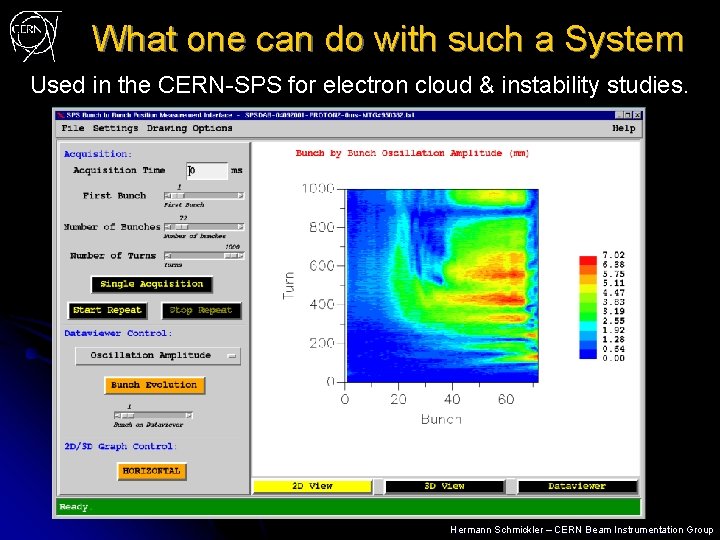
What one can do with such a System Used in the CERN-SPS for electron cloud & instability studies. Hermann Schmickler – CERN Beam Instrumentation Group
The Typical Instruments ● Beam Position ● ● Beam Intensity ● ● ionisation chambers or pin diodes Machine Tunes and Chromacitities ● ● secondary emission grids and screens wire scanners synchrotron light monitors ionisation and luminescence monitors Femtosecond diagnostics for ultra short bunches Beam Loss ● ● beam current transformers Beam Profile ● ● ● electrostatic or electromagnetic pick-ups and related electronics in diagnostics section of tomorrow Luminosity ● in diagnostics section of tomorrow Hermann Schmickler – CERN Beam Instrumentation Group
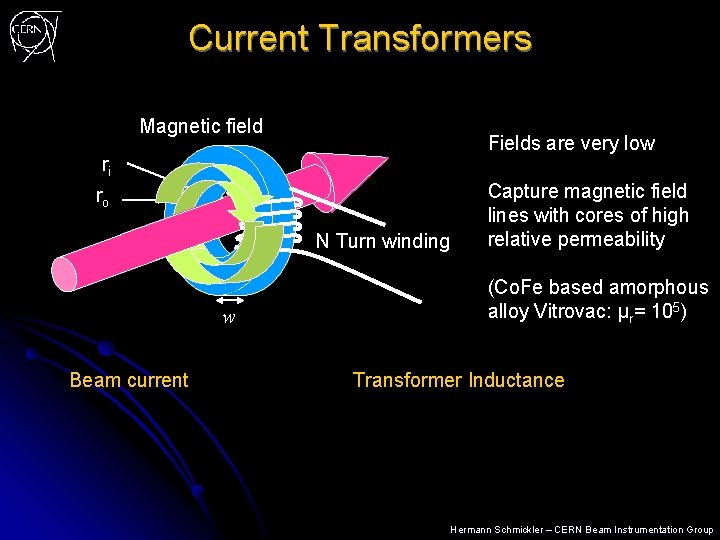
Current Transformers Magnetic field Fields are very low ri ro N Turn winding w Beam current Capture magnetic field lines with cores of high relative permeability (Co. Fe based amorphous alloy Vitrovac: μr= 105) Transformer Inductance Hermann Schmickler – CERN Beam Instrumentation Group
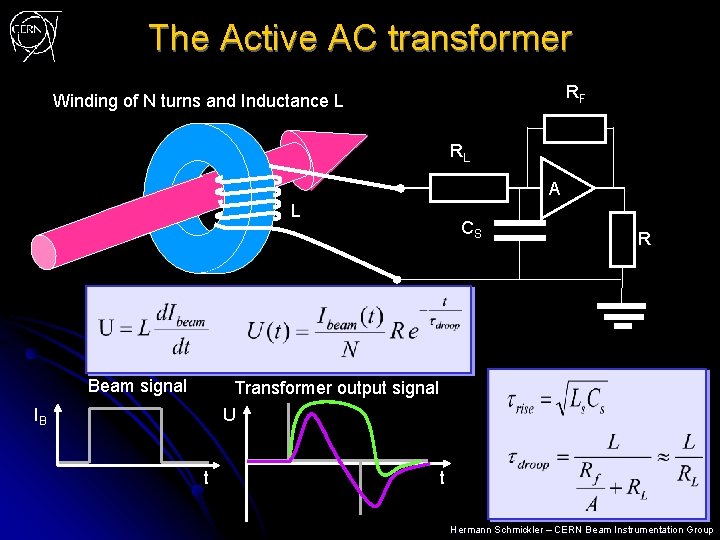
The Active AC transformer RF Winding of N turns and Inductance L RL A L Beam signal CS R Transformer output signal IB U t t Hermann Schmickler – CERN Beam Instrumentation Group

Fast Beam Current Transformer 1: 40 Passive Transformer Image Current Ceramic Gap BEAM 80 nm Ti Coating 20 W to improve impedance Calibration winding ● 500 MHz Bandwidth ● Low droop (< 0. 2%/ms) Hermann Schmickler – CERN Beam Instrumentation Group
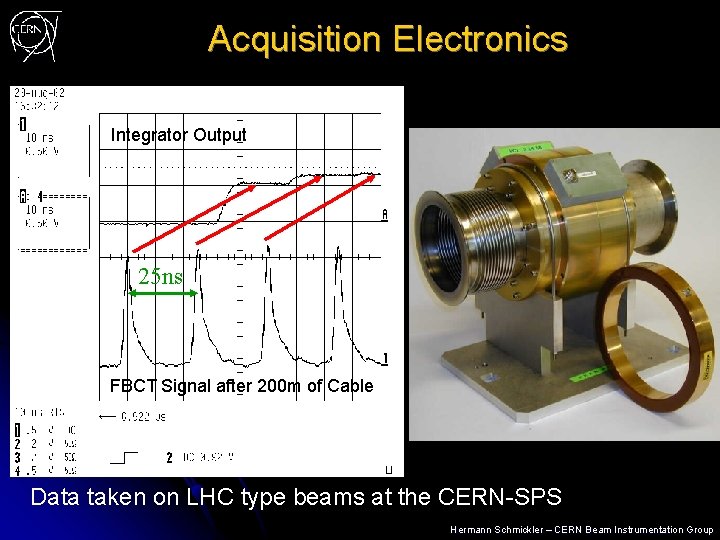
Acquisition Electronics Integrator Output 25 ns FBCT Signal after 200 m of Cable Data taken on LHC type beams at the CERN-SPS Hermann Schmickler – CERN Beam Instrumentation Group
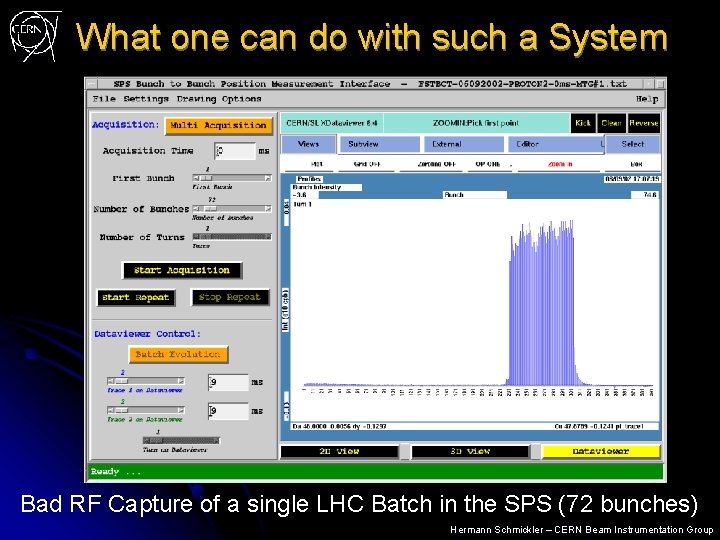
What one can do with such a System Bad RF Capture of a single LHC Batch in the SPS (72 bunches) Hermann Schmickler – CERN Beam Instrumentation Group
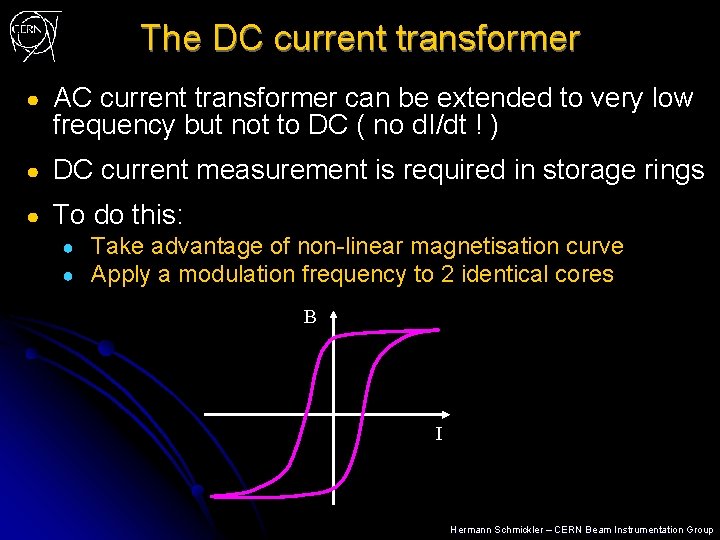
The DC current transformer ● AC current transformer can be extended to very low frequency but not to DC ( no d. I/dt ! ) ● DC current measurement is required in storage rings ● To do this: ● ● Take advantage of non-linear magnetisation curve Apply a modulation frequency to 2 identical cores B I Hermann Schmickler – CERN Beam Instrumentation Group
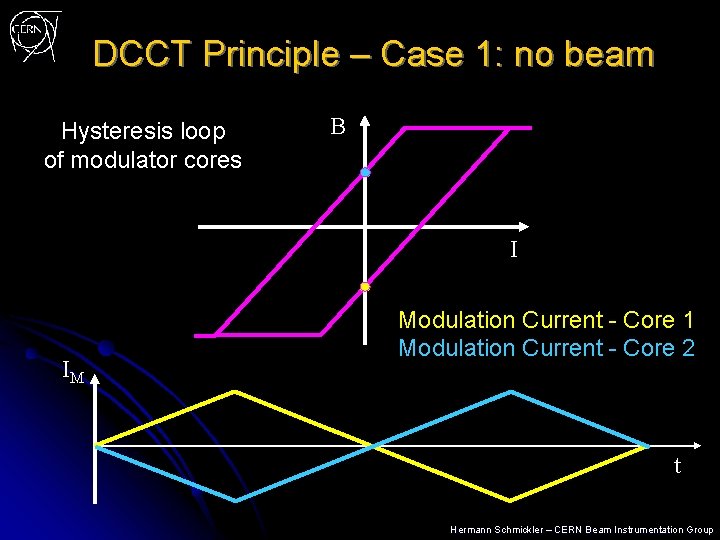
DCCT Principle – Case 1: no beam Hysteresis loop of modulator cores B I IM Modulation Current - Core 1 Modulation Current - Core 2 t Hermann Schmickler – CERN Beam Instrumentation Group
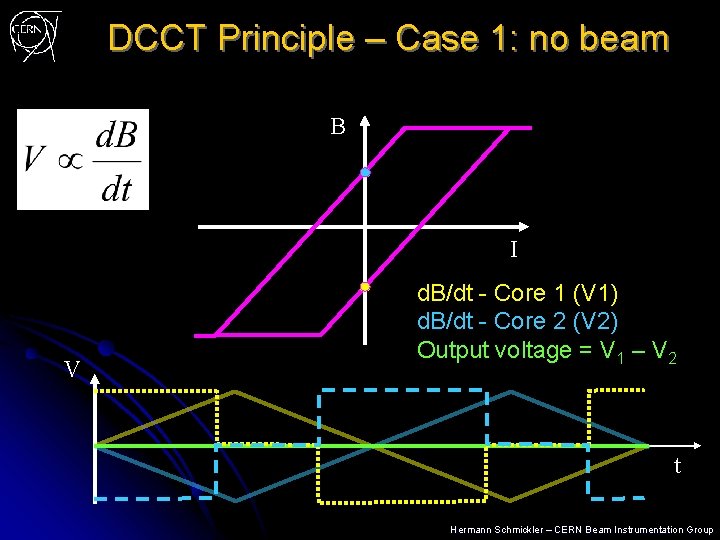
DCCT Principle – Case 1: no beam B I V d. B/dt - Core 1 (V 1) d. B/dt - Core 2 (V 2) Output voltage = V 1 – V 2 t Hermann Schmickler – CERN Beam Instrumentation Group

DCCT Principle – Case 2: with beam Beam Current IB B I Output signal is at twice the modulation frequency IB V d. B/dt - Core 1 (V 1) d. B/dt - Core 2 (V 2) Output voltage = V 1 – V 2 t Hermann Schmickler – CERN Beam Instrumentation Group
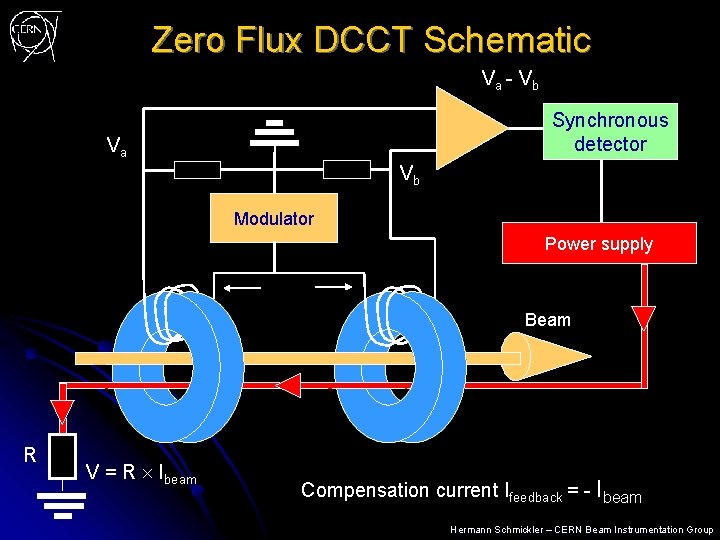
Zero Flux DCCT Schematic Va - V b Synchronous detector Va Vb Modulator Power supply Beam R V = R Ibeam Compensation current Ifeedback = - Ibeam Hermann Schmickler – CERN Beam Instrumentation Group
The Typical Instruments ● Beam Position ● ● Beam Intensity ● ● ionisation chambers or pin diodes Machine Tunes and Chromacitities ● ● secondary emission grids and screens wire scanners synchrotron light monitors ionisation and luminescence monitors femtosecond diagnostics for ultra short bunches Beam Loss ● ● beam current transformers Beam Profile ● ● ● electrostatic or electromagnetic pick-ups and related electronics in diagnostics section of tomorrow Luminosity ● in diagnostics section of tomorrow Hermann Schmickler – CERN Beam Instrumentation Group

Secondary Emission (SEM) Grids ● When the beam passes through secondary electrons are ejected from the wires ● The liberated electrons are removed using a polarisation voltage ● The current flowing back onto the wires is measured ● One amplifier/ADC chain is used for each wire Hermann Schmickler – CERN Beam Instrumentation Group
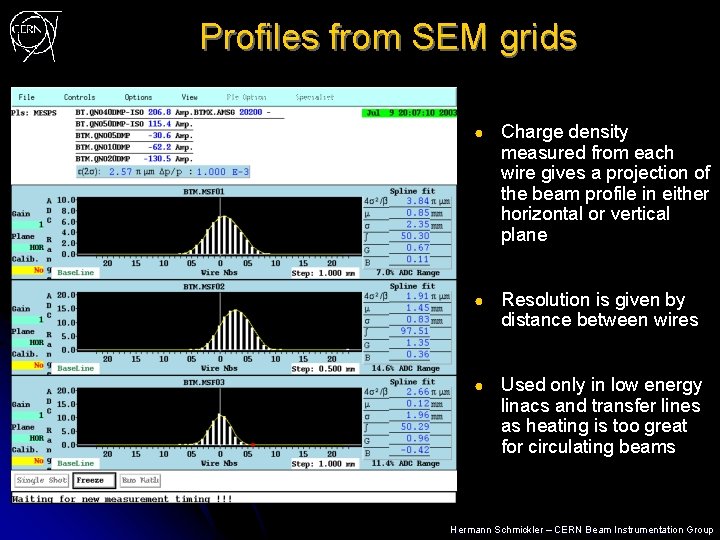
Profiles from SEM grids ● Charge density measured from each wire gives a projection of the beam profile in either horizontal or vertical plane ● Resolution is given by distance between wires ● Used only in low energy linacs and transfer lines as heating is too great for circulating beams Hermann Schmickler – CERN Beam Instrumentation Group
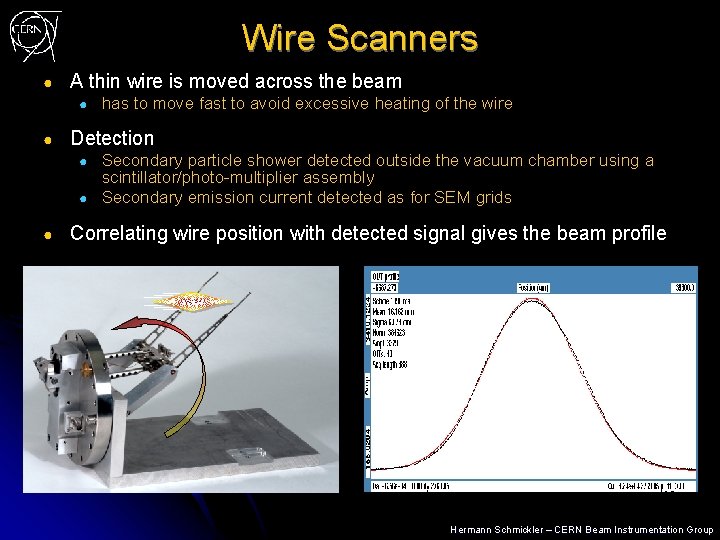
Wire Scanners ● A thin wire is moved across the beam ● ● has to move fast to avoid excessive heating of the wire Detection Secondary particle shower detected outside the vacuum chamber using a scintillator/photo-multiplier assembly ● Secondary emission current detected as for SEM grids ● ● Correlating wire position with detected signal gives the beam profile + + ++ ++ + + ++ ++ + + ++ ++ + + + ++ + + ++ ++ Hermann Schmickler – CERN Beam Instrumentation Group

Beam Profile Monitoring using Screens ● Optical Transition Radiation emitted when a charged particle beam goes through the interface of 2 media with different dielectric constants ● surface phenomenon allows the use of very thin screens (~10 mm) ● OTR Screen Beam Exit window Intensifier CCD Mirror Lens Hermann Schmickler – CERN Beam Instrumentation Group
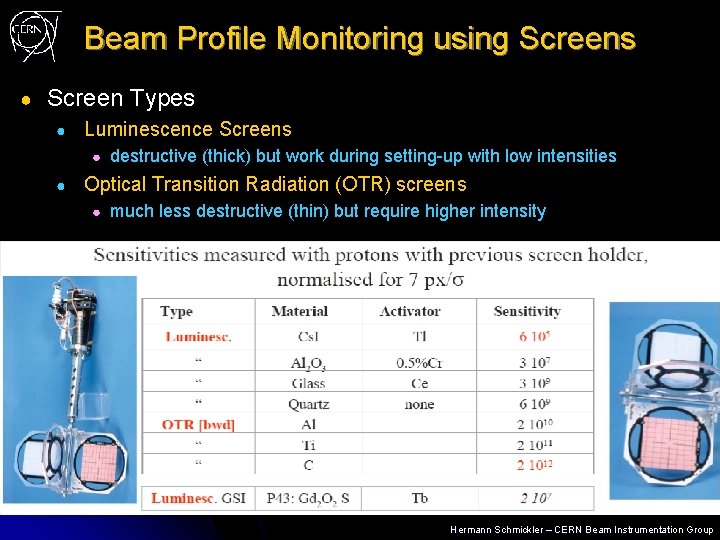
Beam Profile Monitoring using Screens ● Screen Types ● Luminescence Screens ● ● destructive (thick) but work during setting-up with low intensities Optical Transition Radiation (OTR) screens ● much less destructive (thin) but require higher intensity Hermann Schmickler – CERN Beam Instrumentation Group
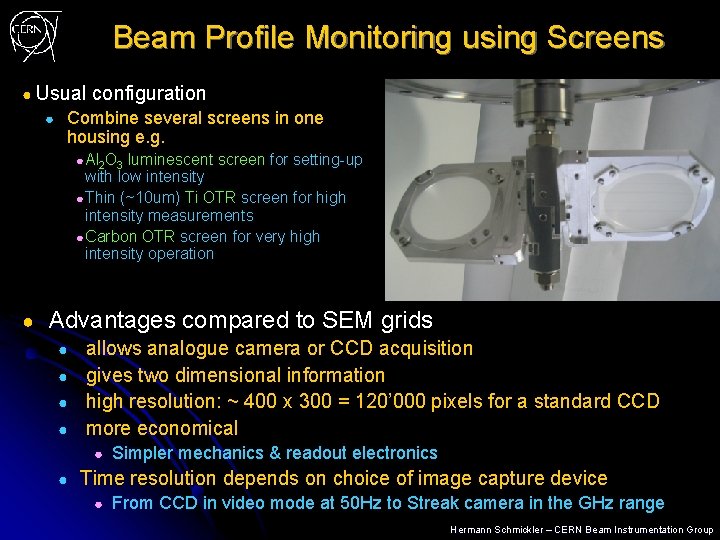
Beam Profile Monitoring using Screens ● Usual ● configuration Combine several screens in one housing e. g. ● Al 2 O 3 luminescent screen for setting-up with low intensity ● Thin (~10 um) Ti OTR screen for high intensity measurements ● Carbon OTR screen for very high intensity operation ● Advantages compared to SEM grids allows analogue camera or CCD acquisition ● gives two dimensional information ● high resolution: ~ 400 x 300 = 120’ 000 pixels for a standard CCD ● more economical ● ● ● Simpler mechanics & readout electronics Time resolution depends on choice of image capture device ● From CCD in video mode at 50 Hz to Streak camera in the GHz range Hermann Schmickler – CERN Beam Instrumentation Group
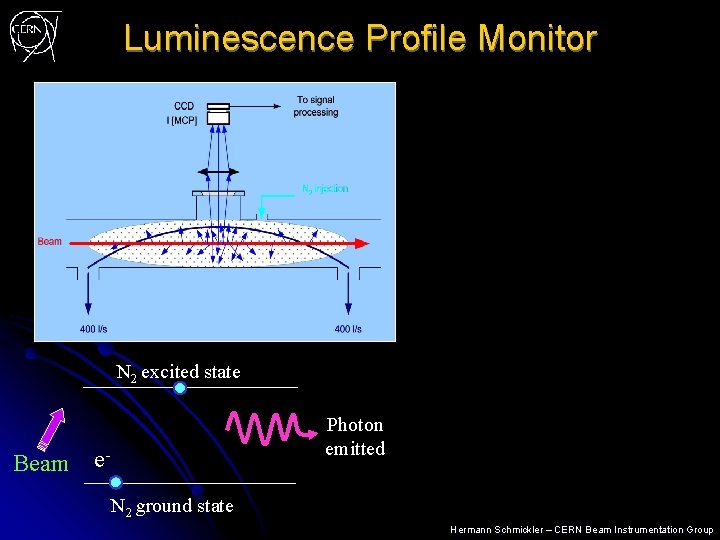
Luminescence Profile Monitor N 2 excited state Beam Photon emitted e. N 2 ground state Hermann Schmickler – CERN Beam Instrumentation Group
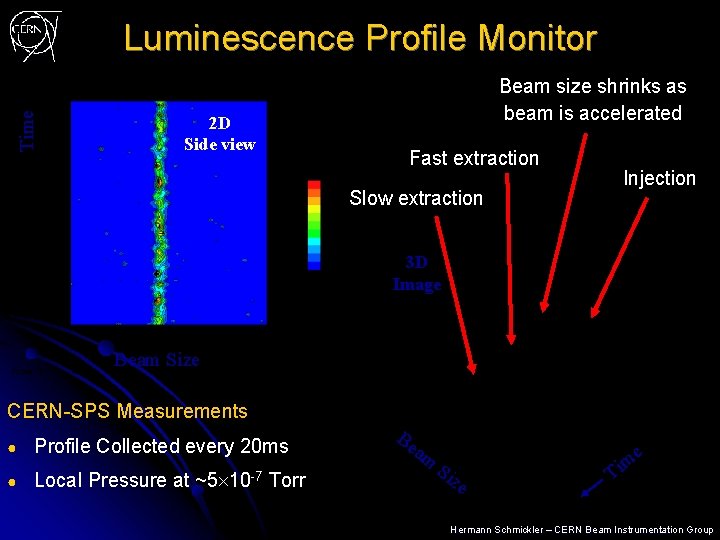
Time Luminescence Profile Monitor 2 D Side view Beam size shrinks as beam is accelerated Fast extraction Injection Slow extraction 3 D Image Beam Size CERN-SPS Measurements ● Profile Collected every 20 ms ● Local Pressure at ~5 10 -7 Torr Be am Si ze e T im Hermann Schmickler – CERN Beam Instrumentation Group
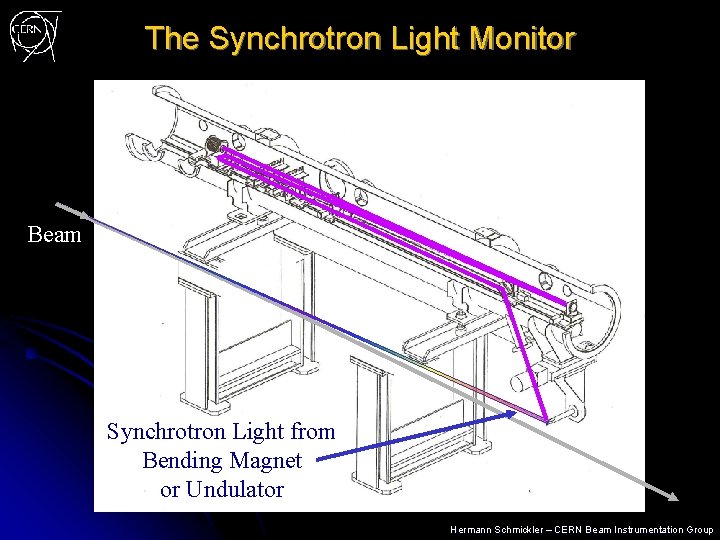
The Synchrotron Light Monitor Beam Synchrotron Light from Bending Magnet or Undulator Hermann Schmickler – CERN Beam Instrumentation Group
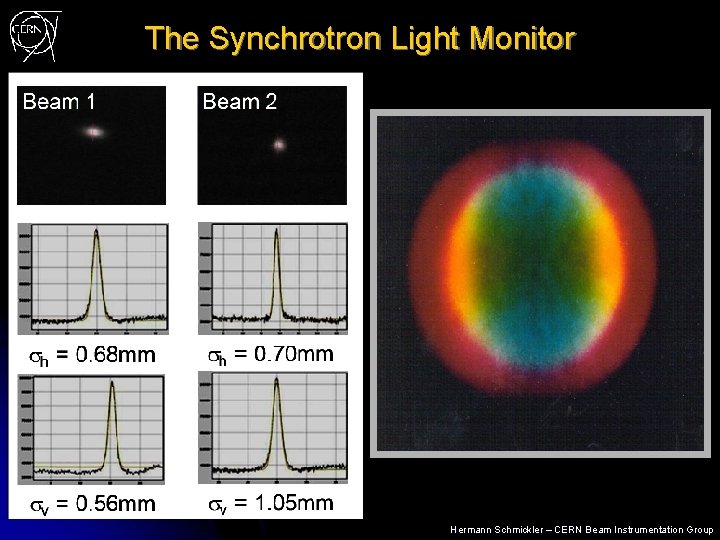
The Synchrotron Light Monitor Hermann Schmickler – CERN Beam Instrumentation Group
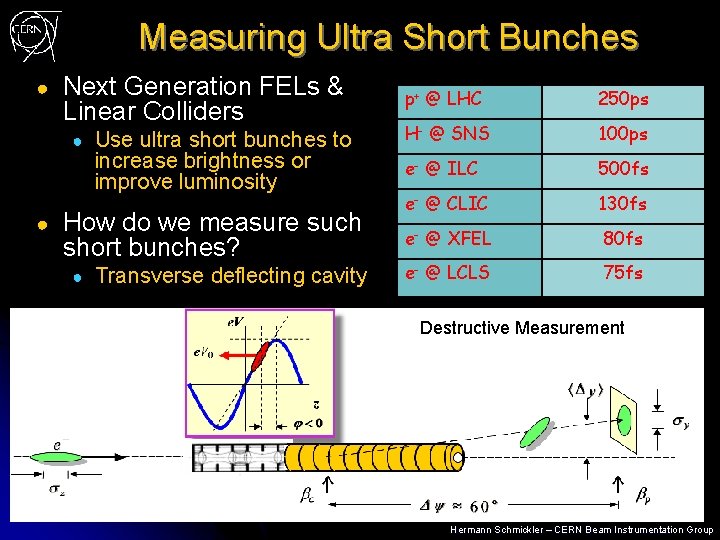
Measuring Ultra Short Bunches ● Next Generation FELs & Linear Colliders ● ● Use ultra short bunches to increase brightness or improve luminosity How do we measure such short bunches? ● Transverse deflecting cavity p+ @ LHC 250 ps H- @ SNS 100 ps e- @ ILC 500 fs e- @ CLIC 130 fs e- @ XFEL 80 fs e- @ LCLS 75 fs Destructive Measurement Hermann Schmickler – CERN Beam Instrumentation Group
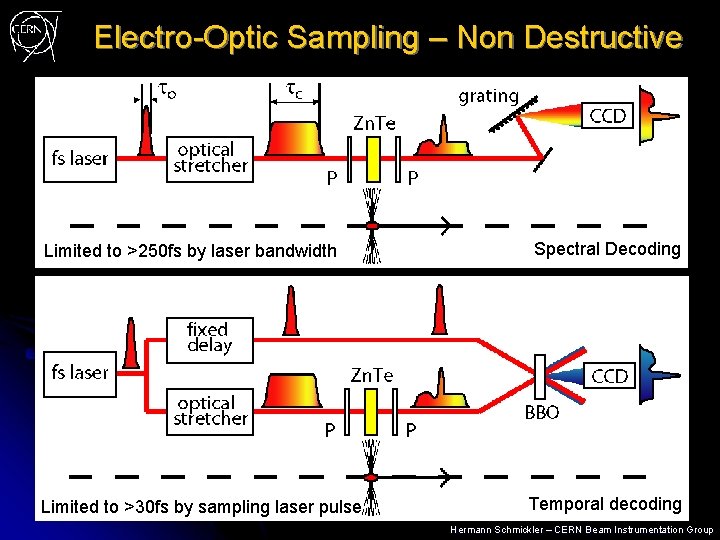
Electro-Optic Sampling – Non Destructive Limited to >250 fs by laser bandwidth Limited to >30 fs by sampling laser pulse Spectral Decoding Temporal decoding Hermann Schmickler – CERN Beam Instrumentation Group
The Typical Instruments ● Beam Position ● ● Beam Intensity ● ● ionisation chambers or pin diodes Machine Tunes and Chromacitities ● ● secondary emission grids and screens wire scanners synchrotron light monitors ionisation and luminescence monitors femtosecond diagnostics for ultra short bunches Beam Loss ● ● beam current transformers Beam Profile ● ● ● electrostatic or electromagnetic pick-ups and related electronics in diagnostics section of tomorrow Luminosity ● in diagnostics section of tomorrow Hermann Schmickler – CERN Beam Instrumentation Group
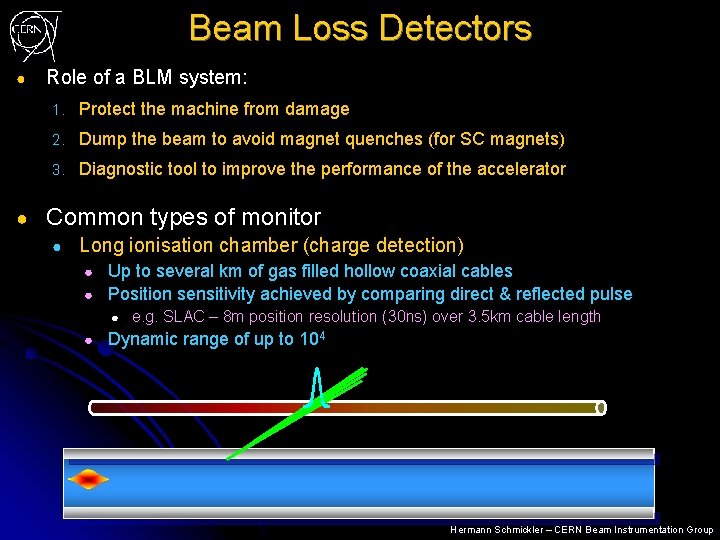
Beam Loss Detectors ● ● Role of a BLM system: 1. Protect the machine from damage 2. Dump the beam to avoid magnet quenches (for SC magnets) 3. Diagnostic tool to improve the performance of the accelerator Common types of monitor ● Long ionisation chamber (charge detection) Up to several km of gas filled hollow coaxial cables ● Position sensitivity achieved by comparing direct & reflected pulse ● ● ● e. g. SLAC – 8 m position resolution (30 ns) over 3. 5 km cable length Dynamic range of up to 104 Hermann Schmickler – CERN Beam Instrumentation Group
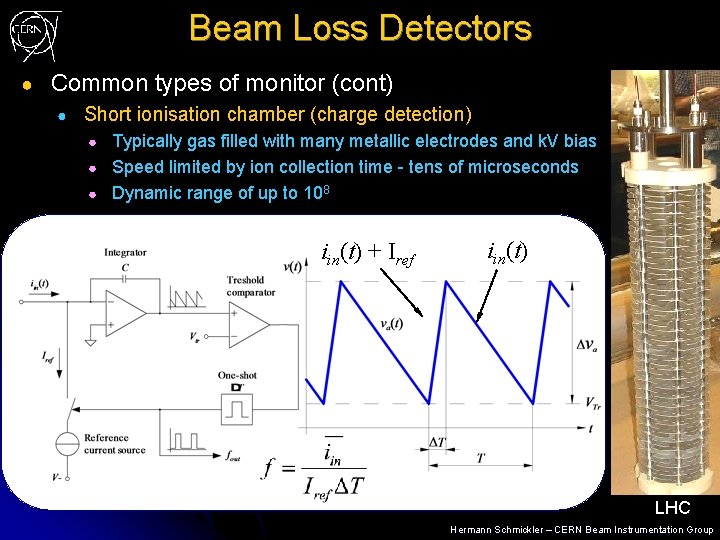
Beam Loss Detectors ● Common types of monitor (cont) ● Short ionisation chamber (charge detection) Typically gas filled with many metallic electrodes and k. V bias ● Speed limited by ion collection time - tens of microseconds ● Dynamic range of up to 108 ● iin(t) + Iref iin(t) LHC Hermann Schmickler – CERN Beam Instrumentation Group
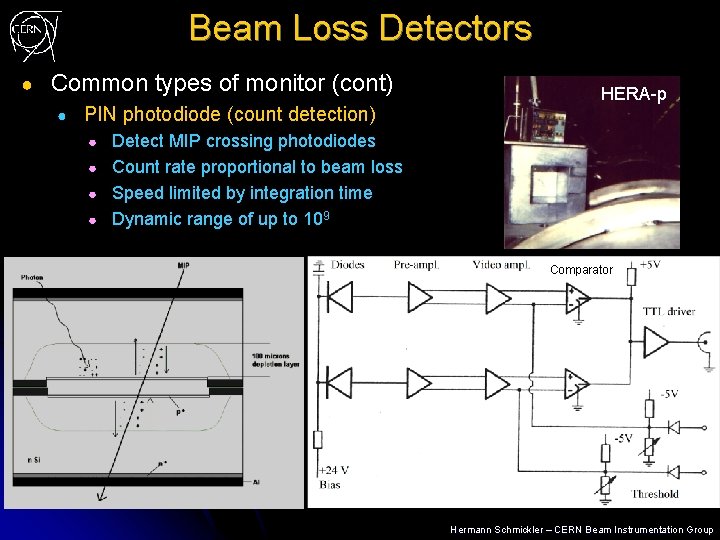
Beam Loss Detectors ● Common types of monitor (cont) ● PIN photodiode (count detection) HERA-p Detect MIP crossing photodiodes ● Count rate proportional to beam loss ● Speed limited by integration time ● Dynamic range of up to 109 ● Comparator Hermann Schmickler – CERN Beam Instrumentation Group
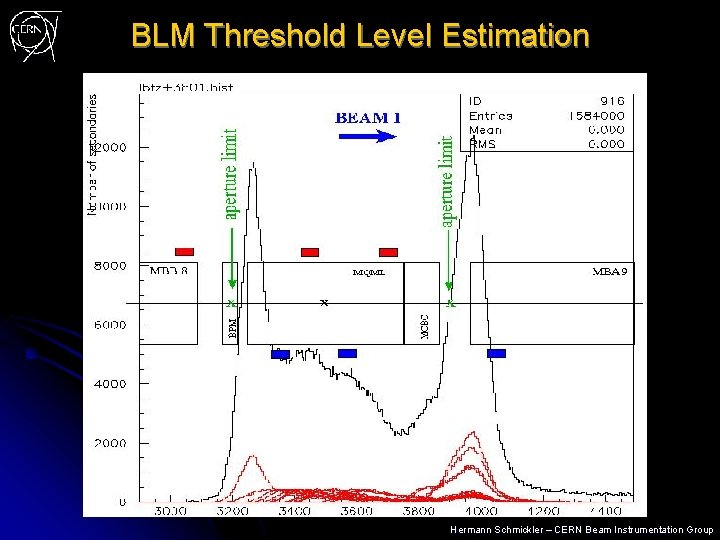
BLM Threshold Level Estimation Hermann Schmickler – CERN Beam Instrumentation Group
Summary ● I’ve tried to give you an overview of the common types of instruments that can be found in most accelerators ● ● Tomorrow you will see how to use these instruments to run and optimise accelerators ● ● This is only a small subset of those currently in use or being developed with many exotic instruments tailored for specific accelerator needs Introduction to Accelerator Beam Diagnostics (H. Schmickler) Afternoon course : Beam Instrumentation & Diagnostics ● For an in-depth analysis of all these instruments and on their application in various accelerators Hermann Schmickler – CERN Beam Instrumentation Group
- Slides: 50