
Introduction to Bandwidth on Demand Concepts Inder Monga
Introduction to Bandwidth on Demand Concepts Inder Monga Chief Technologist, ESnet Co-chair, NSI working group LHCONE P 2 P workshop Geneva, December 2012
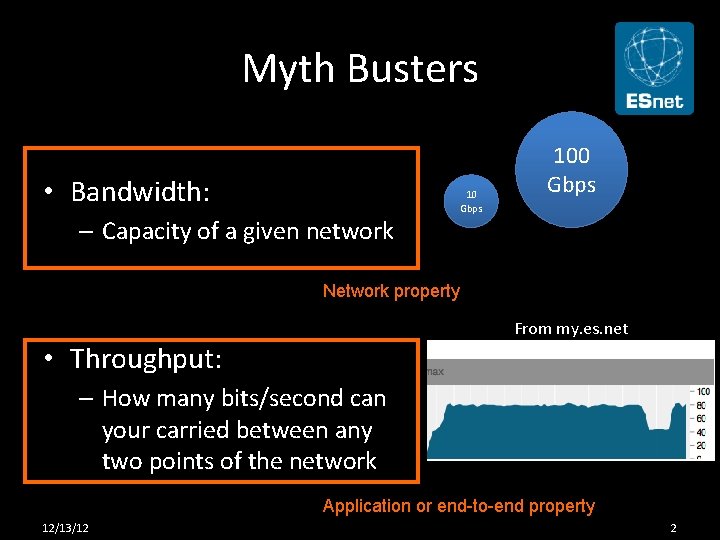
Myth Busters • Bandwidth: 10 Gbps 100 Gbps – Capacity of a given network Network property From my. es. net • Throughput: – How many bits/second can your carried between any two points of the network Application or end-to-end property 12/13/12 2
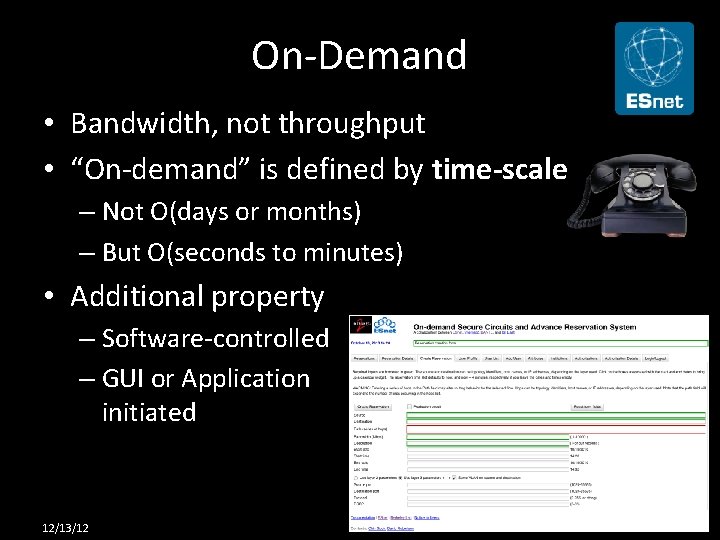
On-Demand • Bandwidth, not throughput • “On-demand” is defined by time-scale – Not O(days or months) – But O(seconds to minutes) • Additional property – Software-controlled – GUI or Application initiated 12/13/12 3

Some more truths • Application can try engineer their endto-end throughput TCP congestion performance • Application currently can request point-to-point bandwidth – As supported in most installations today – Point-to-multi-point investigated • Throughput ? Bandwidth • != • ≤ 12/13/12 Application A 12 Gbps Application B 28 Gbps 100 Gbps 4

“Guaranteed” Bandwidth • Bandwidth reserved for a single flow or set of application flows – Edge-to-edge – End-to-end ESnet BNL NERSC • Related concepts – Best Effort • Public Internet – Oversubscription • Aggregation 12/13/12 5
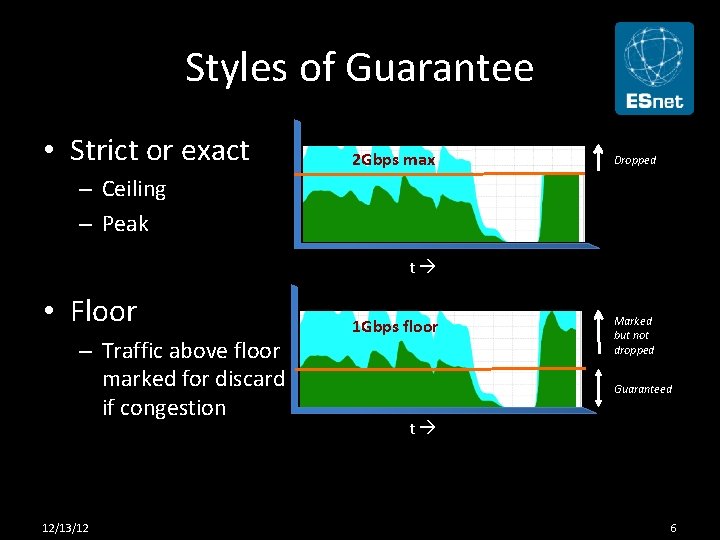
Styles of Guarantee • Strict or exact 2 Gbps max Dropped – Ceiling – Peak t • Floor – Traffic above floor marked for discard if congestion 12/13/12 1 Gbps floor Marked but not dropped Guaranteed t 6
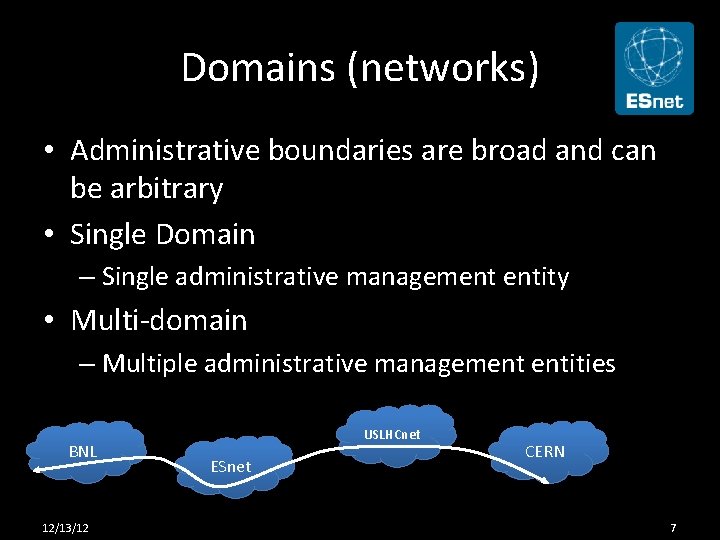
Domains (networks) • Administrative boundaries are broad and can be arbitrary • Single Domain – Single administrative management entity • Multi-domain – Multiple administrative management entities BNL 12/13/12 USLHCnet ESnet CERN 7
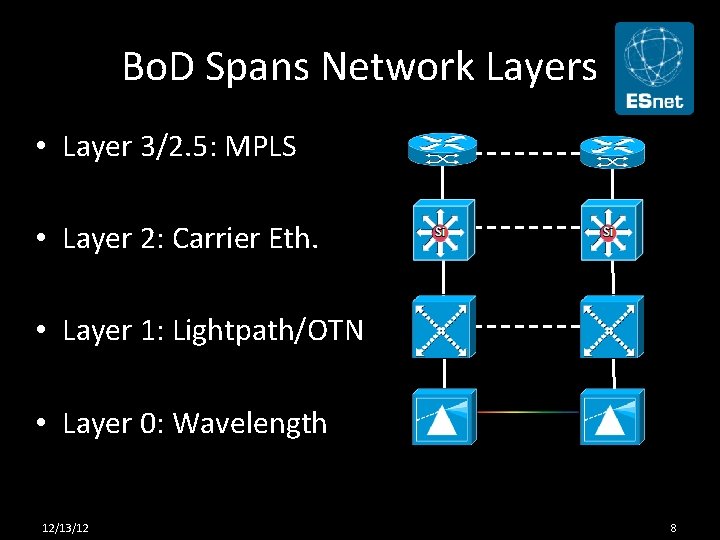
Bo. D Spans Network Layers • Layer 3/2. 5: MPLS • Layer 2: Carrier Eth. • Layer 1: Lightpath/OTN • Layer 0: Wavelength 12/13/12 8
Scheduling • On-Demand – Time: Now – Duration: Till when I please • Scheduled – Time: Start-time, specific time in the future – Duration: End-time OR time duration 12/13/12 9

Reservation • Guaranteed Bandwidth reserved for a certain application at a certain “schedule” • On-demand is equivalent to instant bandwidth reservation with no specified end-time 12/13/12 10
Path-Finding • Two ends of the network – Start = A point – End = Z point • Path – Creating a physical or virtual circuit between points A and Z passing through multiple network devices • Can be single or multi-domain 12/13/12 11
Topology • Map of interconnected devices – Intra-domain – Inter-domain • Network and technology characteristics • Can represent the physical layer limitations 12/13/12 12
Path Computation Engine (PCE) • Choose a path based on Topology, current state and certain criteria • Current state – Available capacity and resource commitments • Criteria – – – 12/13/12 Bandwidth Layer Latency Green energy Your favorite metric 13
Modify • Ability to change certain parameters of the reservation – May or may not cause service outage – Focus on a very limited set of parameters • Modify can be powerful for applications facing a varying workload – Can only be implemented at Layer 2 or above in the network – Duration is typically the most modified parameter where the connection remains the same – Bandwidth is the next most common 12/13/12 14
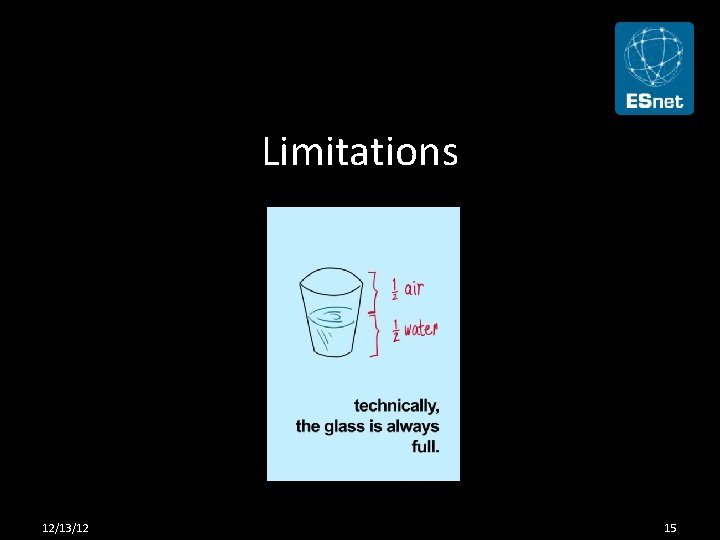
Limitations 12/13/12 15

Physical Infrastructure • Most applications not familiar with the topology might assume Bo. D capabilities that is not physically possible – For example: • 40 G NIC on application host, 10 G WAN connectivity of DC • Can’t do 40 G flows over nx 10 G connectivity 12/13/12 16
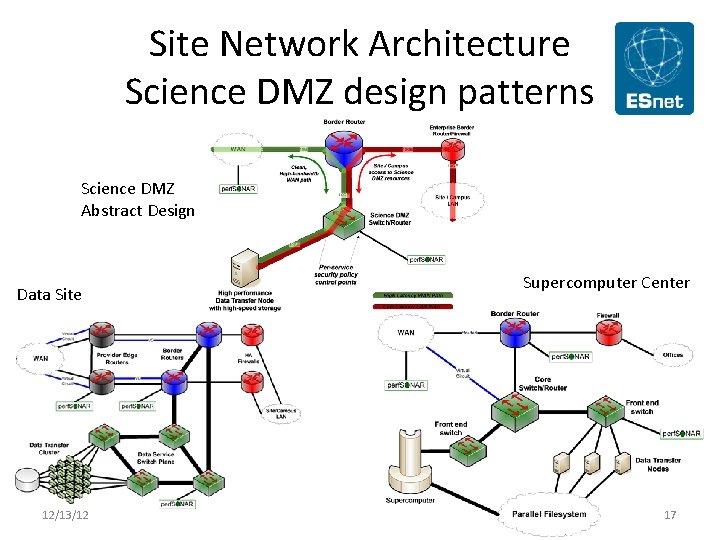
Site Network Architecture Science DMZ design patterns Science DMZ Abstract Design Data Site 12/13/12 Supercomputer Center 17

Blocking • ‘Guaranteed Reservations’ of other applications might consume all resources – Even though the traffic profile indicates a lot of headroom • Some of these reservations might be scheduled – Similar to hotel reservation • An intermediate network domain might have resource constraints – Path finding needs to be intelligent – Path computation may take a lot of cycles if network is ‘reservation congested’ 12/13/12 18
Putting it all together • Multi-layer, multi-domain, multi-vendor, On. Demand, Bandwidth Scheduling and Reservation Service • Service is the most important aspect, protocols only are building blocks 12/13/12 19
What else is needed for a service? • Authorization and Authentication – Global federated system that works well with applications • Service Level Agreements – What is the lowest common denominator across the multidomain network? • Service Definition – Consistent view of the end-to-end service – Homogenous service over heterogeneous technologies • Monitoring and measurement – End-to-end as well • Multi-domain debugging – How do you find errors, report them so they can be debugged and fixed? 12/13/12 20
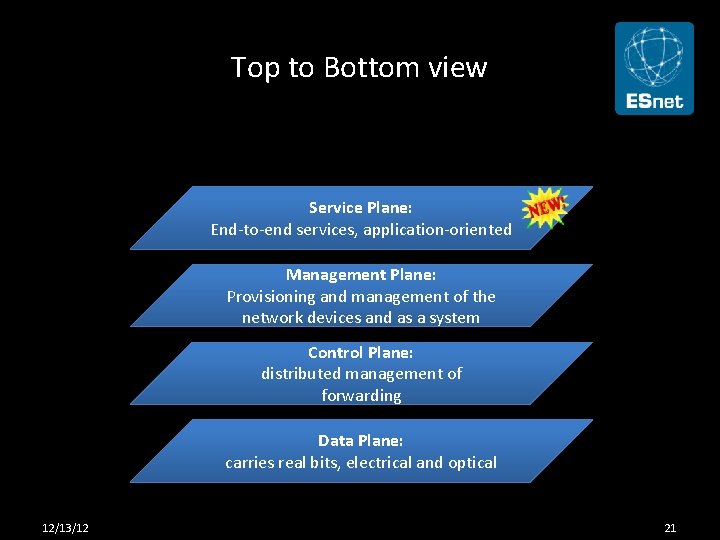
Top to Bottom view Service Plane: End-to-end services, application-oriented Management Plane: Provisioning and management of the network devices and as a system Control Plane: distributed management of forwarding Data Plane: carries real bits, electrical and optical 12/13/12 21
Does this really work? An ESnet perspective • OSCARS was introduced into ESnet as a proto-production service in early 2007, by mid-late 2008 was a supported production service • The DICE collaboration (DANTE, Internet 2, ESnet) had a prototype of the inter-domain control protocol (IDCP) working by late 2008 – early 2009 • The service has managed all LHCOPN Tier 0 – Tier 1 traffic since mid-2008 in ESnet, most T 2 -T 1 traffic since 2009 • A lot of what OSCARS is about from ESnet’s point of view is capacity management • A lot of what OSCARS is about from the user’s point of view is capacity guarantees 11/2/2020 22
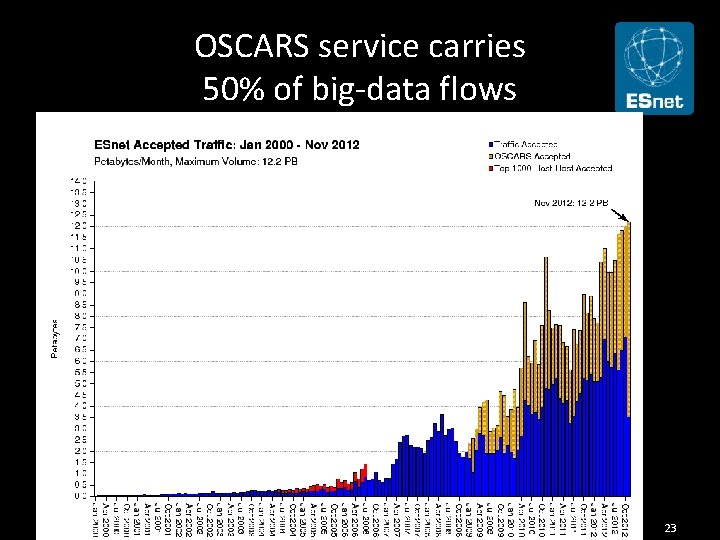
OSCARS service carries 50% of big-data flows 12/13/12 23

Monitoring is Done Automatically 11/2/2020 24
Network Services Interface • Standards process in OGF • Strong participation from NREN community 12/13/12 25
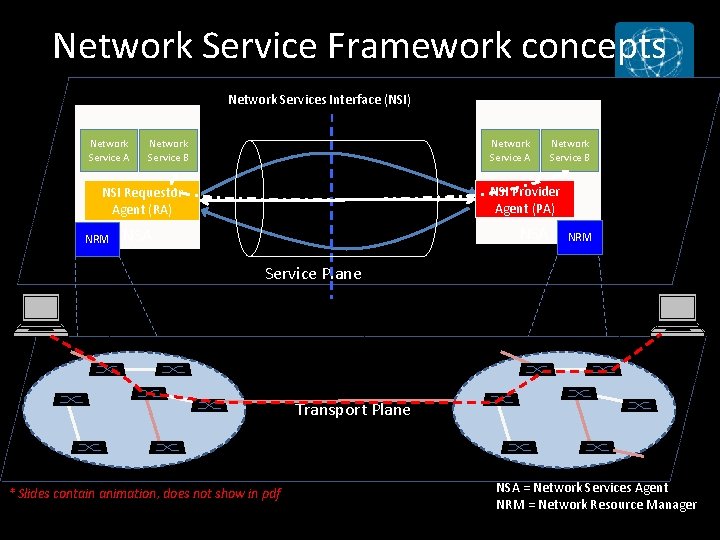
Network Service Framework concepts Network Services Interface (NSI) Network Service A Network Service B Network Service A Service NSI Provider Agent (PA) NSI Requestor Agent (RA) NRM Network Service B NSA NRM Service Plane Local Resources * Slides contain animation, does not show in pdf Transport Plane Local Resources NSA = Network Services Agent NRM = Network Resource Manager
Imonga at es. net QUESTIONS? 12/13/12 27
- Slides: 27