
Introduction to Autonomic Nervous System Dr Nirbhay Kumar
Introduction to Autonomic Nervous System Dr. Nirbhay Kumar Asstt. Professor & Head Deptt. of Veterinary Pharmacology & Toxicology Bihar Veterinary College, Bihar Animal Sciences University, Patna
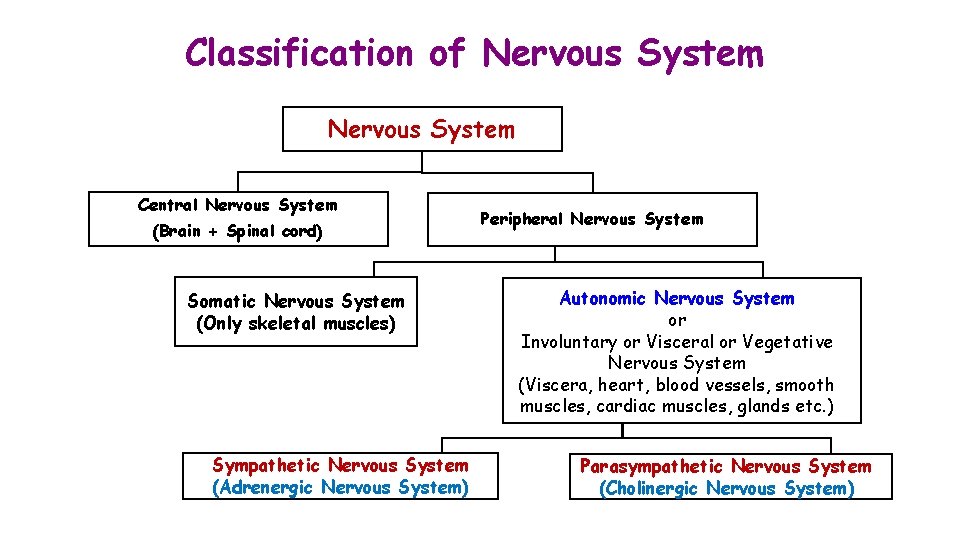
Classification of Nervous System Central Nervous System (Brain + Spinal cord) Somatic Nervous System (Only skeletal muscles) Sympathetic Nervous System (Adrenergic Nervous System) Peripheral Nervous System Autonomic Nervous System or Involuntary or Visceral or Vegetative Nervous System (Viscera, heart, blood vessels, smooth muscles, cardiac muscles, glands etc. ) Parasympathetic Nervous System (Cholinergic Nervous System)
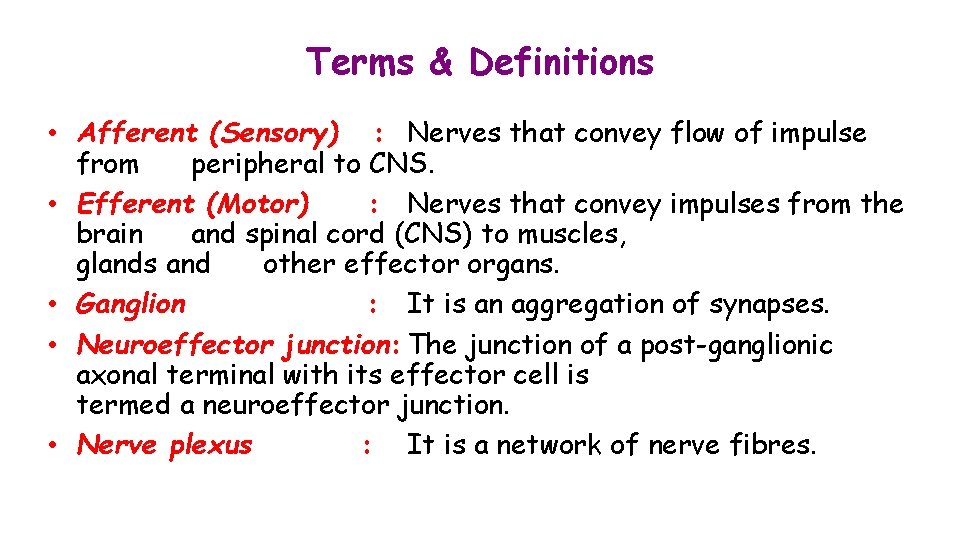
Terms & Definitions • Afferent (Sensory) : Nerves that convey flow of impulse from peripheral to CNS. • Efferent (Motor) : Nerves that convey impulses from the brain and spinal cord (CNS) to muscles, glands and other effector organs. • Ganglion : It is an aggregation of synapses. • Neuroeffector junction: The junction of a post-ganglionic axonal terminal with its effector cell is termed a neuroeffector junction. • Nerve plexus : It is a network of nerve fibres.
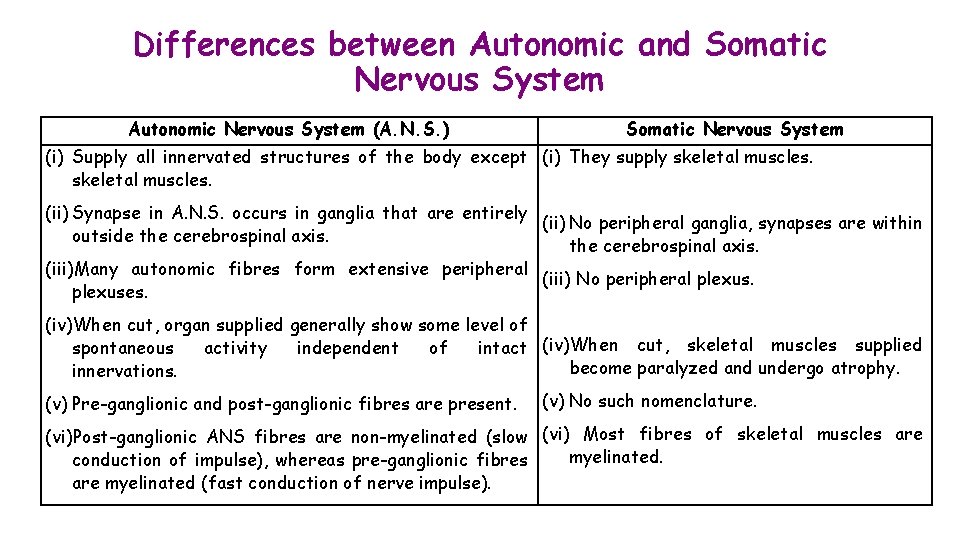
Differences between Autonomic and Somatic Nervous System Autonomic Nervous System (A. N. S. ) Somatic Nervous System (i) Supply all innervated structures of the body except (i) They supply skeletal muscles. (ii) Synapse in A. N. S. occurs in ganglia that are entirely (ii) No peripheral ganglia, synapses are within outside the cerebrospinal axis. (iii)Many autonomic fibres form extensive peripheral (iii) No peripheral plexuses. (iv)When cut, organ supplied generally show some level of spontaneous activity independent of intact (iv)When cut, skeletal muscles supplied become paralyzed and undergo atrophy. innervations. (v) Pre-ganglionic and post-ganglionic fibres are present. (v) No such nomenclature. (vi)Post-ganglionic ANS fibres are non-myelinated (slow (vi) Most fibres of skeletal muscles are myelinated. conduction of impulse), whereas pre-ganglionic fibres are myelinated (fast conduction of nerve impulse).
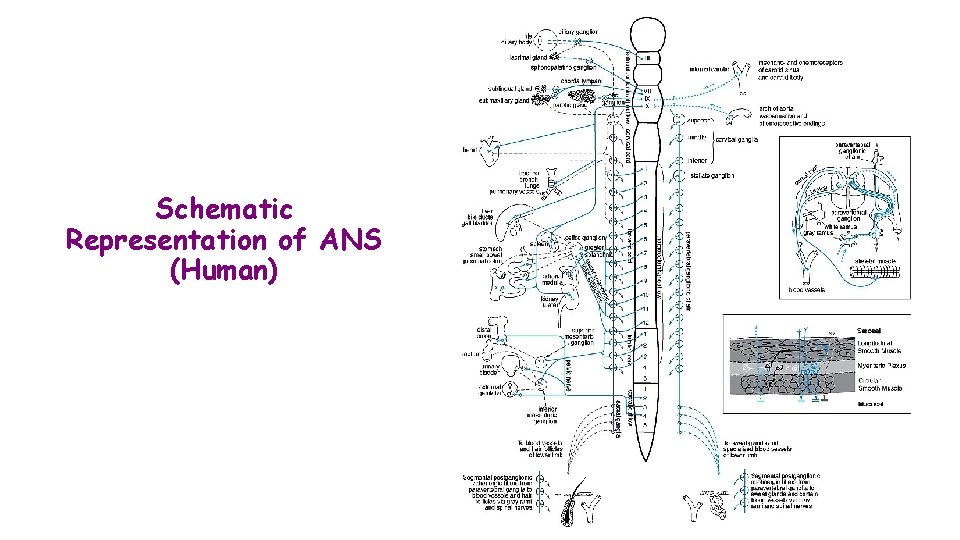
Schematic Representation of ANS (Human)
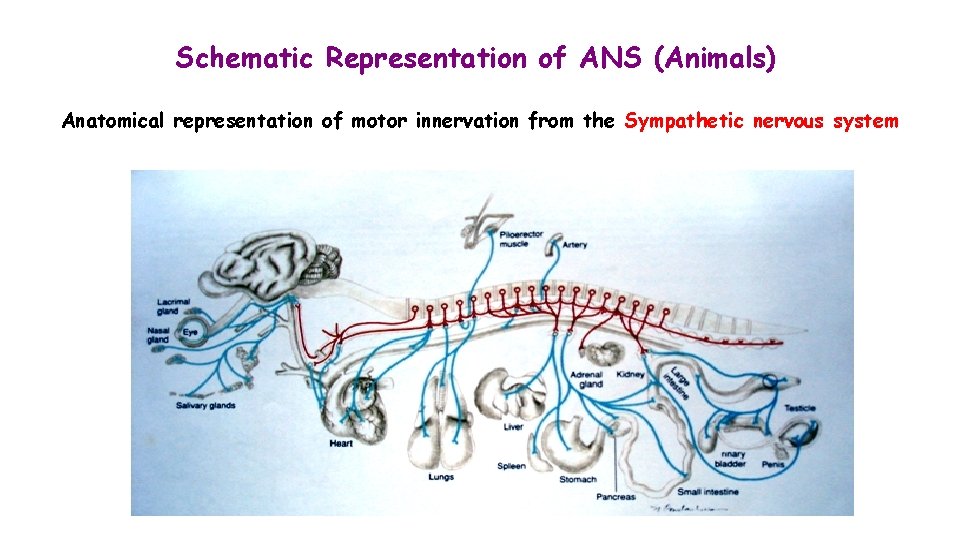
Schematic Representation of ANS (Animals) Anatomical representation of motor innervation from the Sympathetic nervous system
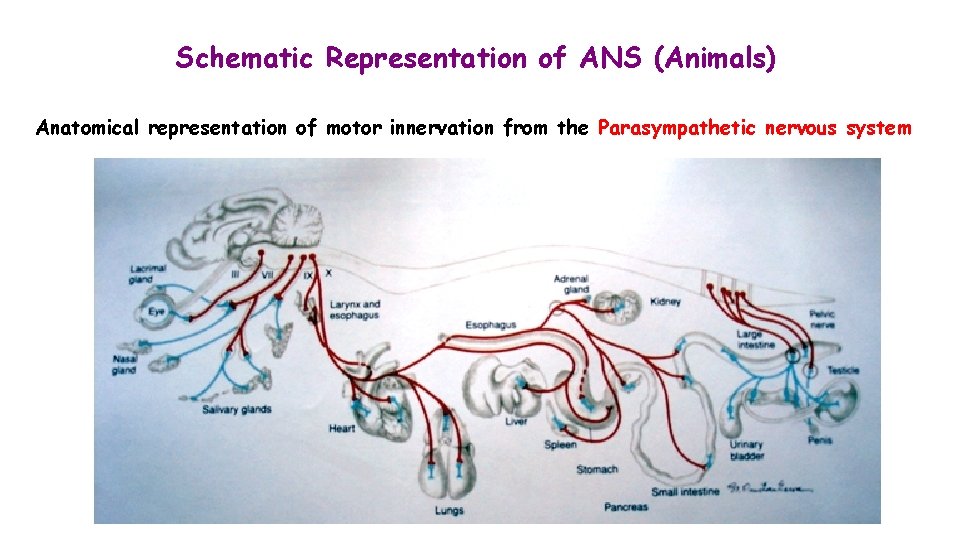
Schematic Representation of ANS (Animals) Anatomical representation of motor innervation from the Parasympathetic nervous system
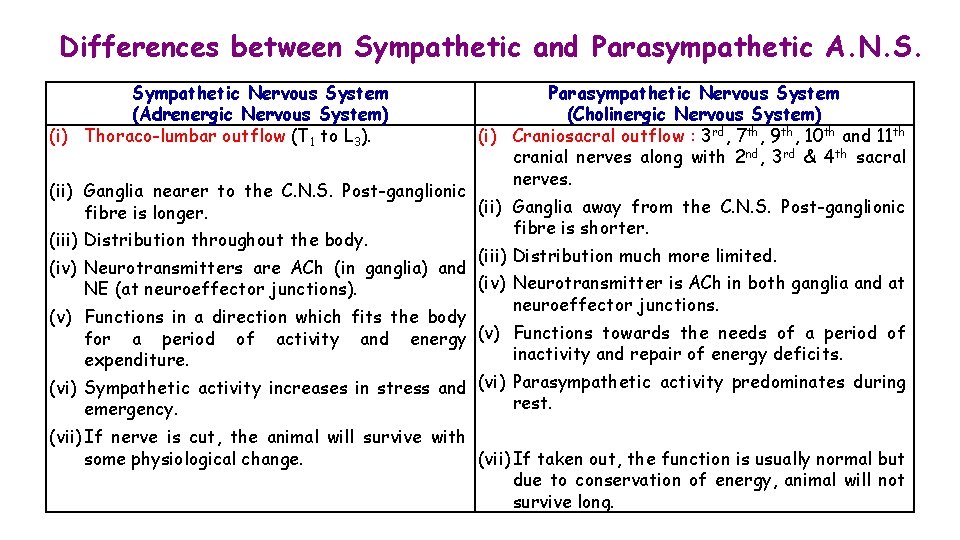
Differences between Sympathetic and Parasympathetic A. N. S. Sympathetic Nervous System (Adrenergic Nervous System) (i) Thoraco-lumbar outflow (T 1 to L 3). (ii) Ganglia nearer to the C. N. S. Post-ganglionic fibre is longer. (iii) Distribution throughout the body. (iv) Neurotransmitters are ACh (in ganglia) and NE (at neuroeffector junctions). (v) Functions in a direction which fits the body for a period of activity and energy expenditure. (vi) Sympathetic activity increases in stress and emergency. (vii) If nerve is cut, the animal will survive with some physiological change. Parasympathetic Nervous System (Cholinergic Nervous System) (i) Craniosacral outflow : 3 rd, 7 th, 9 th, 10 th and 11 th cranial nerves along with 2 nd, 3 rd & 4 th sacral nerves. (ii) Ganglia away from the C. N. S. Post-ganglionic fibre is shorter. (iii) Distribution much more limited. (iv) Neurotransmitter is ACh in both ganglia and at neuroeffector junctions. (v) Functions towards the needs of a period of inactivity and repair of energy deficits. (vi) Parasympathetic activity predominates during rest. (vii) If taken out, the function is usually normal but due to conservation of energy, animal will not survive long.
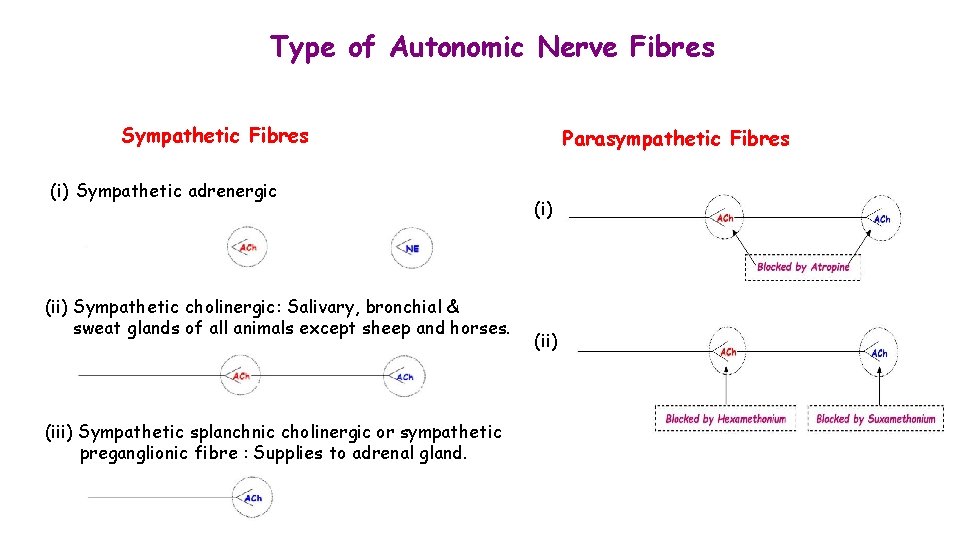
Type of Autonomic Nerve Fibres Sympathetic Fibres (i) Sympathetic adrenergic (ii) Sympathetic cholinergic: Salivary, bronchial & sweat glands of all animals except sheep and horses. (iii) Sympathetic splanchnic cholinergic or sympathetic preganglionic fibre : Supplies to adrenal gland. Parasympathetic Fibres (i) (ii)
Central Autonomic Connections ü There is no any exclusive autonomic area in the C. N. S. ü Considerable intermixing and integration of somatic and autonomic innervation occurs. ü The highest seat regulating autonomic functions is in hypothalamus – posterior and lateral nuclei are primarily sympathetic while anterior and medial nuclei are primarily parasympathetic. ü Many autonomic centres (pupillary, vagal, respiratory etc. ) are located in the mid-brain and medulla in relation to the cranial nerves. ü The lateral column in the thoracic spinal cord contains cells which give rise to the sympathetic outflow.

Thank You
- Slides: 11