
Introduction to Audio Introduction Sound is a physical

- Slides: 8
Introduction to Audio
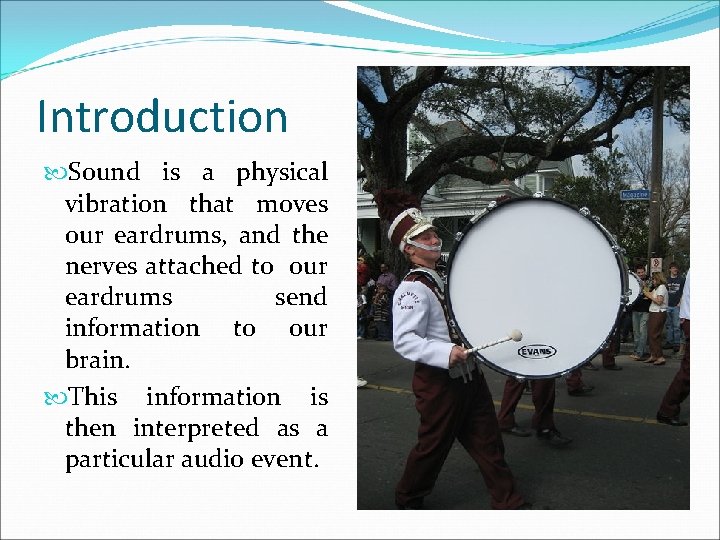
Introduction Sound is a physical vibration that moves our eardrums, and the nerves attached to our eardrums send information to our brain. This information is then interpreted as a particular audio event.
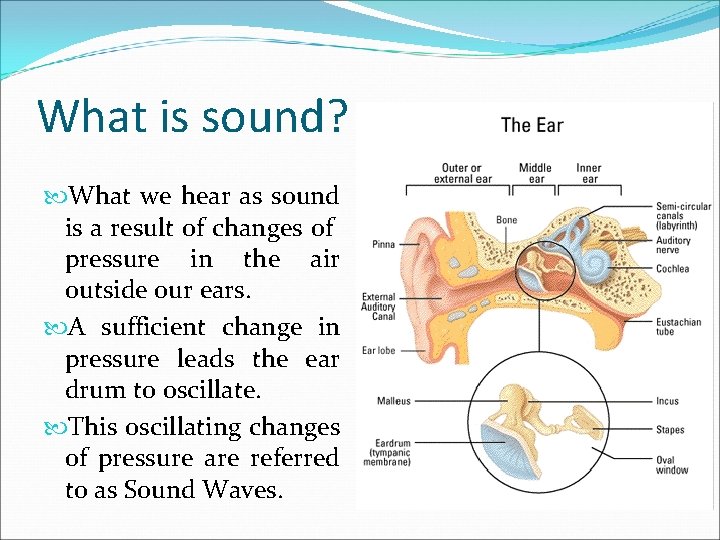
What is sound? What we hear as sound is a result of changes of pressure in the air outside our ears. A sufficient change in pressure leads the ear drum to oscillate. This oscillating changes of pressure are referred to as Sound Waves.
Properties of Sound is a continuous wave that travels through the air. The wave is made up of pressure difference. Sound is detected by measuring the pressure level at a location. Sound waves have normal wave properties such as reflection, refraction, etc. Air pressure changes, Loud Speaker (Electrical) and acoustic (Direct Pressure Variations) are various sound sources that can generate sounds. Microphones and human ear are examples for destination that can receive sounds.
How sound is created? When an object vibrates it moves the air particles around it. This air particle in turn move the air particle around them, carrying the pulse of the vibration through the air. In this way, a vibrating object sends a wave of pressure fluctuation through the atmosphere. When we hear a sound, we are sensing a change in the air pressure around our eardrum. These vibrations are then picked up by our ears and converted to electrical signals that our brain interprets as sound.
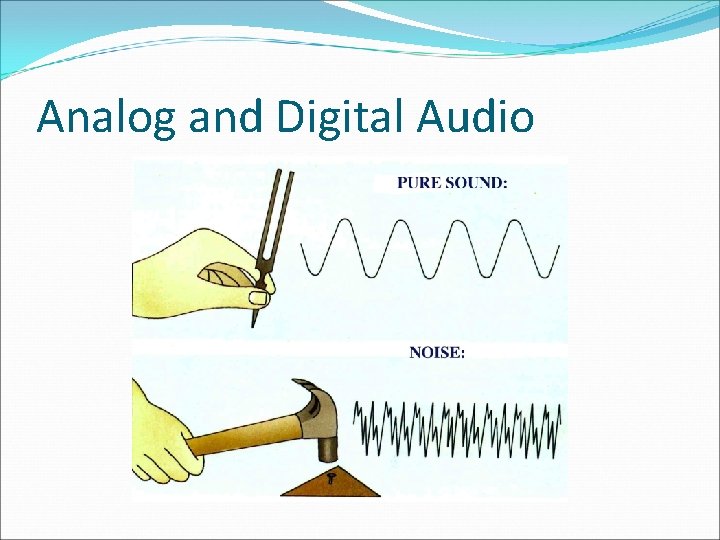
Analog and Digital Audio
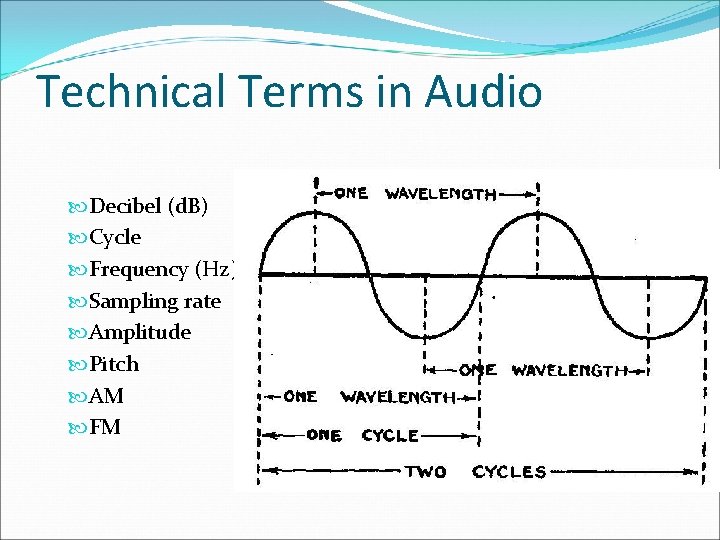
Technical Terms in Audio Decibel (d. B) Cycle Frequency (Hz) Sampling rate Amplitude Pitch AM FM
Thank You