
Introduction to ATSAP ATSAP stands for Air Traffic




- Slides: 15
Introduction to ATSAP • • ATSAP stands for Air Traffic Safety Action Program A voluntary, non-punitive Air Traffic Controller safety reporting system Used to identify and proactively remove safety risks from the NAS Designed based on the fundamentals of a just culture
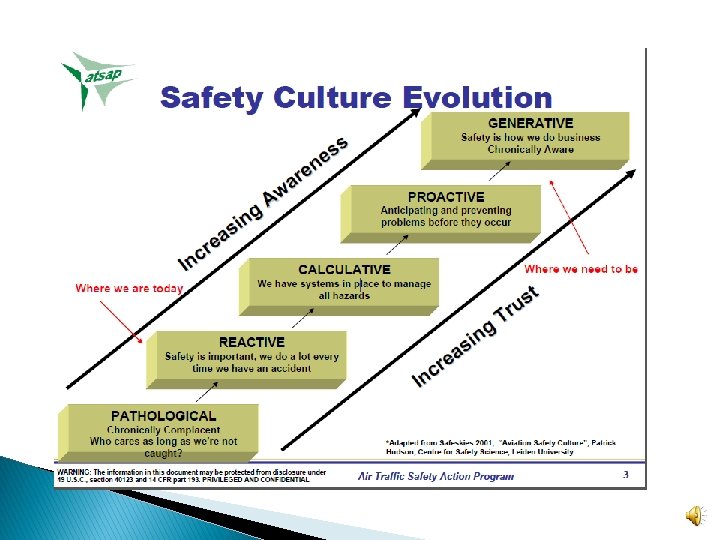
Just Culture � Avoids fear of retribution and blame thereby encouraging flow of safety related information � Promotes trust and supports learning from unsafe acts � It is neither blameless nor punitive, there will always be difference between acceptable and unacceptable behavior � Promotes constructive attitude which will tend to prevent future violations
Organizational Chart
Role & Responsibility � AOV provides independent oversight and monitors ATO operations to determine compliance with standards and directives � ATO is responsible for the daily operation of Air Traffic Control � NATCA is employee union to represent the Air Traffic Controllers
What’s Reportable? Controllers may file: � OEs/ODs/PEs/RIs/PDs � Any potential safety risk to the NAS such as: Poor or confusing airport signage Unsafe policies or procedures Equipment, software or automation problems Traffic management initiatives that don’t properly address sector needs ◦ Aircraft operating procedures & airspace configurations ◦ Human factors (fatigue, scheduling…) ◦ Unsafe or inadequate training practices ◦ ◦
Who and What is Covered? � All air traffic personnel engaged in and supporting air traffic services, and only to events that occur while acting in that capacity � Events involving noncompliance as determined by the ERC Events caused by gross negligence or reckless conduct are not accepted by ATSAP
Incentives In exchange for voluntary reporting, � ATO won’t decertify or take disciplinary action for events that are accepted into ATSAP � AOV will use lesser action or no action based on the level of noncompliance with applicable air traffic directives
Report Types � Safety Problem: Issues at a local, regional, or national level related to policies, procedures, equipment, automation, and publications, deals largely with Systemic issues � Safety Event: Incidents which result in actual or potential lost of separation or situations that results in safety degradation in the NAS. Examples are: OE/OD/PE, NMAC, RI, VPD, military facility deviation, spill out, surface incident, go arounds
ATSAP Process � For each submitted reports, pre-analysis is conducted by the analysts � Identifying and confidential information is removed and the reports are made ready � Reports are added to respective ERC (Event Review Committee meetings � Actual decision for each report is done by the ERC during meetings
ERC � ERC is composed of AOV, ATO, and NATCA, with experts from areas such as Oceanic Procedures, Flight Service, Tech Ops, Automation etc. � There is one ERC for each service area and each handle reports from its own service area � ERC meets every week, two to three days and make decisions. If a decision is difficult to make, the report is carried over to the next meeting
ERC Decision � Act on problems based on reports � Generate AIR and CAR to fix problems by coordinating with Facility Managers � Provides feedback to individual controllers by coordinating with Fac Rep � Add proper taxonomies in reports and close for future analysis and trending � Categorize as known or unknown issues and put in watch list if necessary � Make corrective action recommendations for: ◦ individuals, like skill enhancement training ◦ Organizations, systemic correction
Summary � ATSAP is a success story for the FAA and the industry � The largest safety program in the world � 50, 000 reports in just three years � Hundred of positive changes in the NAS � Help build just culture where controllers openly share their mistakes without fear of punishment