
Introduction to Atom Economy and the Hydroamination Reaction
- Slides: 8
Introduction to Atom Economy and the Hydroamination Reaction Created by Eugene Chong, University of Michigan (chongugn@umich. edu) and posted on (www. ionicviper. org ) on July 1, 2016. Copyright Eugene Chong, 2016. This work is licensed under the Creative Commons Attribution Non-commercial Share Alike License. To view a copy of this license visit http: //creativecommons. org/license/
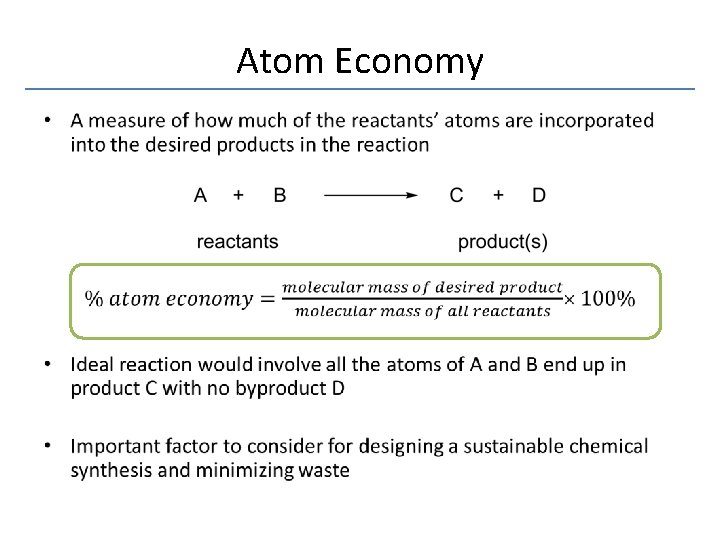
Atom Economy •
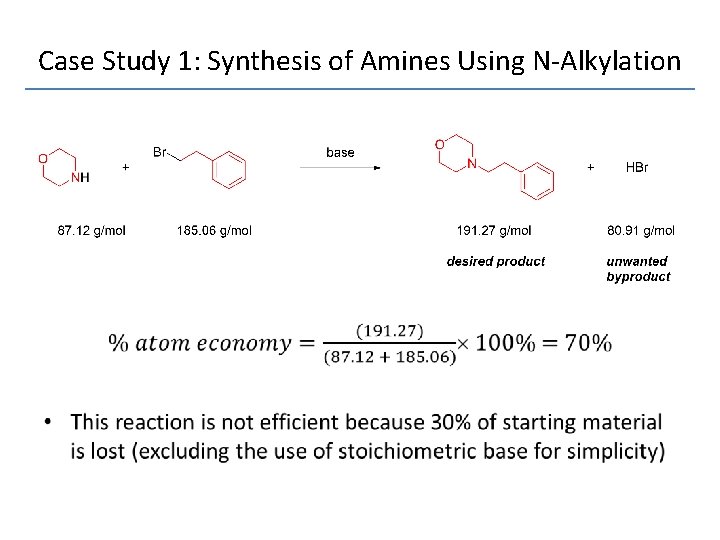
Case Study 1: Synthesis of Amines Using N-Alkylation •
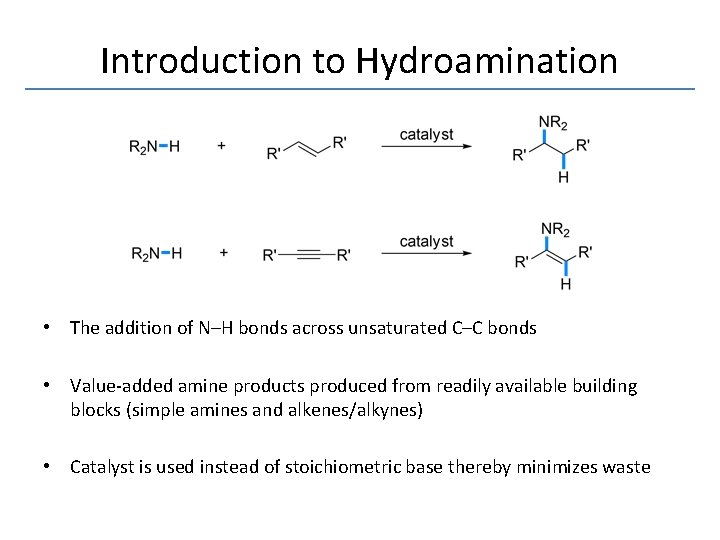
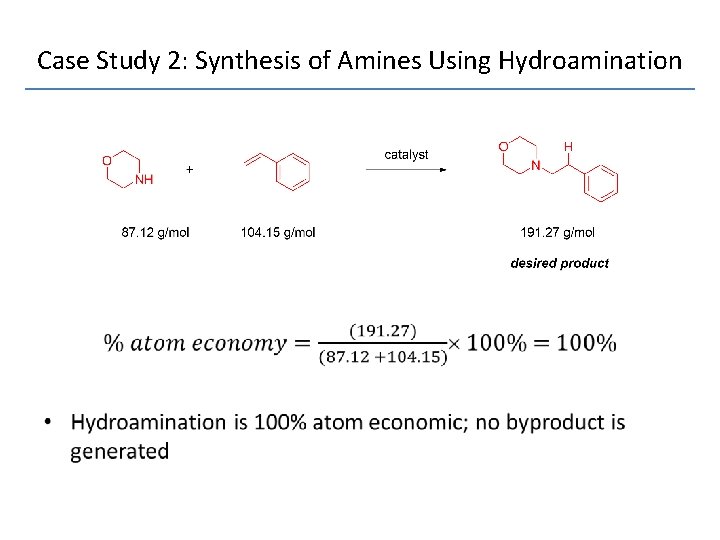
Introduction to Hydroamination • The addition of N–H bonds across unsaturated C–C bonds • Value-added amine products produced from readily available building blocks (simple amines and alkenes/alkynes) • Catalyst is used instead of stoichiometric base thereby minimizes waste
Case Study 2: Synthesis of Amines Using Hydroamination •
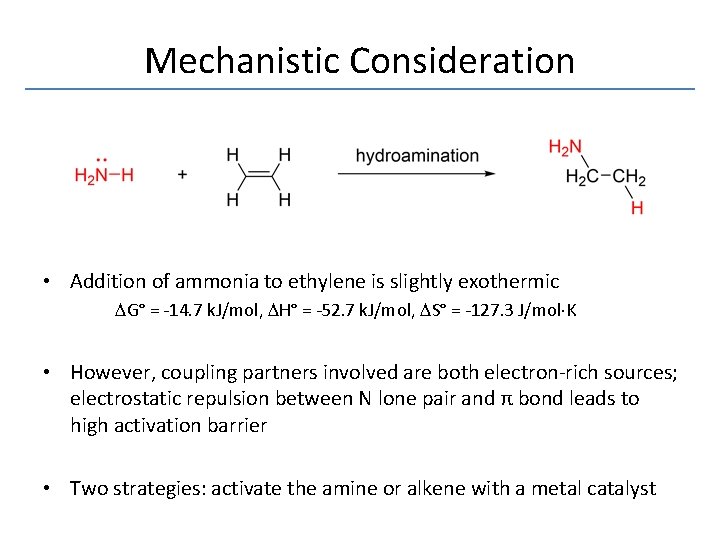
Mechanistic Consideration • Addition of ammonia to ethylene is slightly exothermic G° = -14. 7 k. J/mol, H° = -52. 7 k. J/mol, S° = -127. 3 J/mol·K • However, coupling partners involved are both electron-rich sources; electrostatic repulsion between N lone pair and π bond leads to high activation barrier • Two strategies: activate the amine or alkene with a metal catalyst
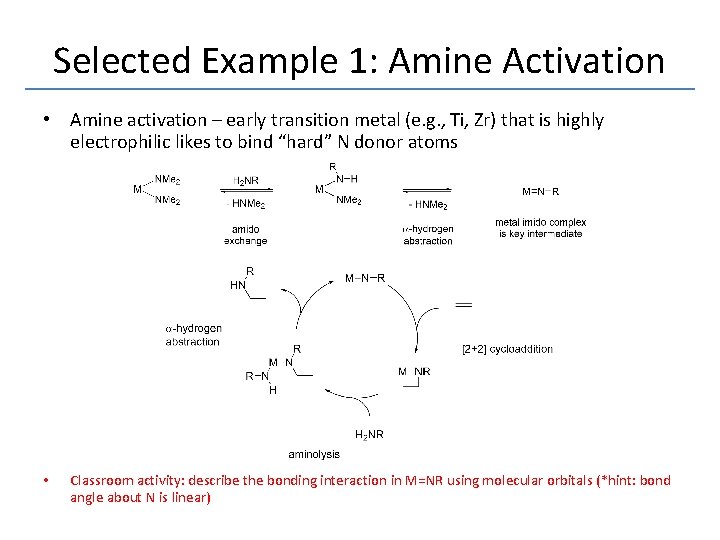
Selected Example 1: Amine Activation • Amine activation – early transition metal (e. g. , Ti, Zr) that is highly electrophilic likes to bind “hard” N donor atoms • Classroom activity: describe the bonding interaction in M=NR using molecular orbitals (*hint: bond angle about N is linear)
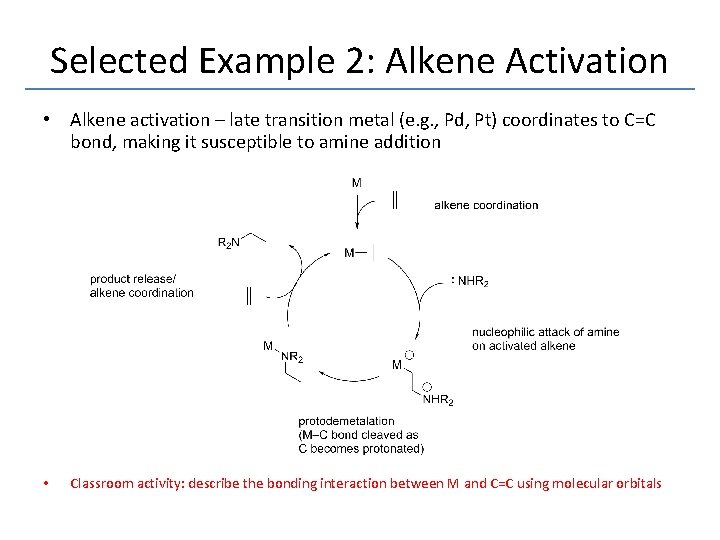
Selected Example 2: Alkene Activation • Alkene activation – late transition metal (e. g. , Pd, Pt) coordinates to C=C bond, making it susceptible to amine addition • Classroom activity: describe the bonding interaction between M and C=C using molecular orbitals