
Introduction to Assessment and Intervention Celeste Malone Ph
- Slides: 14
Introduction to Assessment and Intervention Celeste Malone, Ph. D, MS Psychoeducational Assessment January 29, 2015
Questions, Comments, Concerns… In the article about math difficulties it mentions reading and math skills depending highly on stored knowledge. Is there an assessment that can analyze and measure how much an individual can remember, and how long it takes for them to remember something? After assessing those students and getting the results about their capacity, Is there a way to enhance to a student’s capacity? The WIAT can be exceedingly lengthy. What are some tips when assessing younger children who are antsy? In this week's reading a concern I had was that if the content of these curriculum based assessments and measurement are based on the idea that "one should test what one teaches. " Curriculum vary across districts and even across schools, so how can it be a direct measurement and evaluation on what is being taught if schools with limited resources or in certain areas are not provided with the same resources as their counterparts in "wealthier" neighborhoods? How do curriculum based assessments address the discrepancies between school districts when they have different benchmarks, different courses and their own time frames to cover the material? Are there alternative solutions for schools who do not have the resources or personnel to deliver certain interventions? Is their option to use possibly less effective interventions that are more feasible?
Purpose of Academic Assessment To measure academic performance, especially on basic academic skills (i. e. , reading, math, writing) To inform teaching and learning To determine eligibility criteria for specific learning disability
Types of Individual Assessment Methods Norm-Referenced Tests Items sample specific academic skills within a content area Scores are derived by comparing the student’s performance to that of a same-age/samegrade norm group Primary purpose: deciding the relative standing of an individual within a peer group Have the potential to contribute to decisions regarding special education eligibilty Criterion-Referenced Test Examine mastery of specific skills Comparison of student’s performance against an absolute standard May be helpful for screening decisions Can contribute to identification of target areas for educational intervention
Basic Assumptions in Addressing Academic Problems (Lentz & Shapiro, 1985) Assessment must reflect an evaluation of the behavior in the natural environment. Assessment should be idiographic rather than nomothetic. What is taught and expected to be learned should be what is tested. The results of the assessment should be strongly related to planning interventions. Assessment methods should be appropriate for continuous monitoring of student progress, so that intervention strategies can be altered as indicated. Measures used need to be based upon empirical research and have adequate validity. Measures should be useful in making many types of educational decisions.
Curriculum-Based Assessment Direct assessment of academic skills Underlying assumption: One should test what one teaches General Outcome Measurement Use standardized measures with acceptable levels of reliability and validity Typically presented as brief, timed samples of performance Primary objective: to index long-term growth in the curriculum and across a wide range of skills Specific Subskill-Mastery Models Criterion-referenced and usually based on the development of a skills hierarchy Not standardized because a shift in measurement is required with the teaching of each new objective Primary objective: to determine whether students are meeting short-term instructional objectives of the curriculum
Curriculum Based Assessment vs. Norm. Referenced Tests
Direct Interventions for Academic Problems Interventions are considered direct if the responses targeted for change are identical to those observed in the natural environment Derived from three types of empirical research Relationship of time variables to academic performance Increased active engaged time (e. g. , opportunities to respond) related to increased academic performance Performance models of instruction Academic enablers – motivation, academic engagement, study skills Instructional environment – teacher instruction, feedback, reinforcement Effective instructional design Direct instruction approach
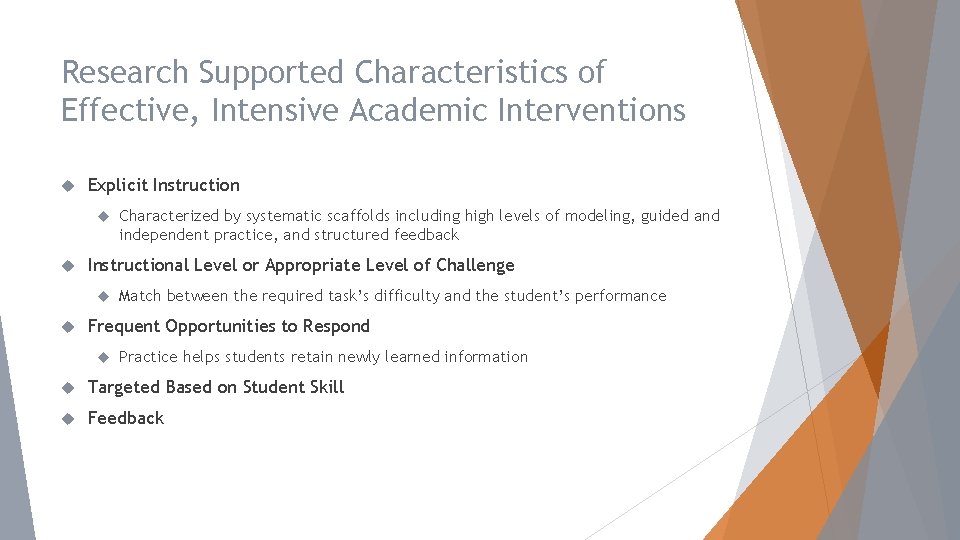
Research Supported Characteristics of Effective, Intensive Academic Interventions Explicit Instructional Level or Appropriate Level of Challenge Characterized by systematic scaffolds including high levels of modeling, guided and independent practice, and structured feedback Match between the required task’s difficulty and the student’s performance Frequent Opportunities to Respond Practice helps students retain newly learned information Targeted Based on Student Skill Feedback
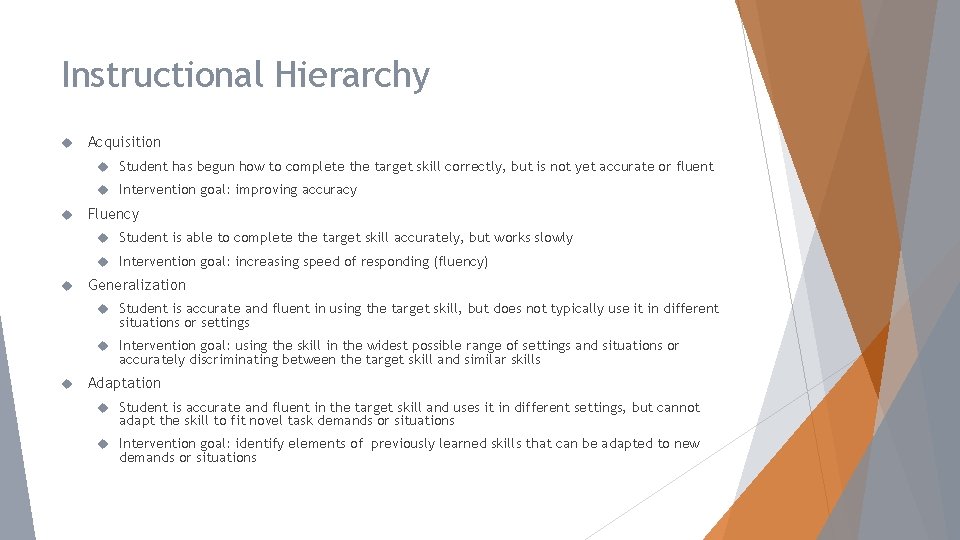
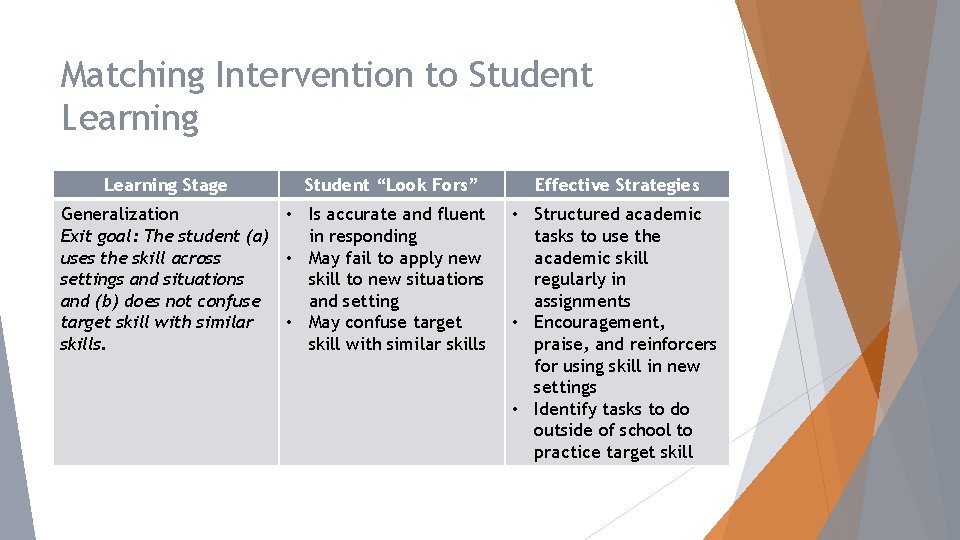
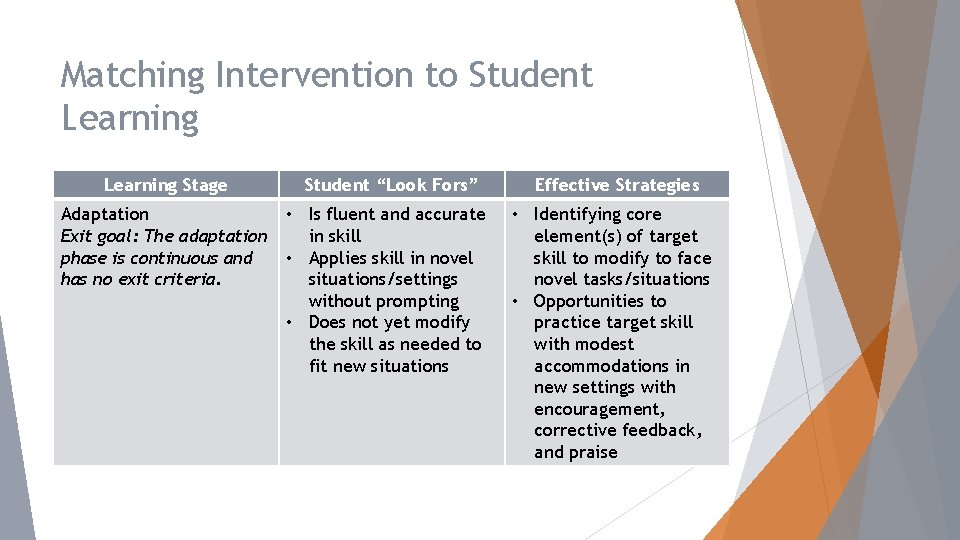
Instructional Hierarchy Acquisition Student has begun how to complete the target skill correctly, but is not yet accurate or fluent Intervention goal: improving accuracy Fluency Student is able to complete the target skill accurately, but works slowly Intervention goal: increasing speed of responding (fluency) Generalization Student is accurate and fluent in using the target skill, but does not typically use it in different situations or settings Intervention goal: using the skill in the widest possible range of settings and situations or accurately discriminating between the target skill and similar skills Adaptation Student is accurate and fluent in the target skill and uses it in different settings, but cannot adapt the skill to fit novel task demands or situations Intervention goal: identify elements of previously learned skills that can be adapted to new demands or situations
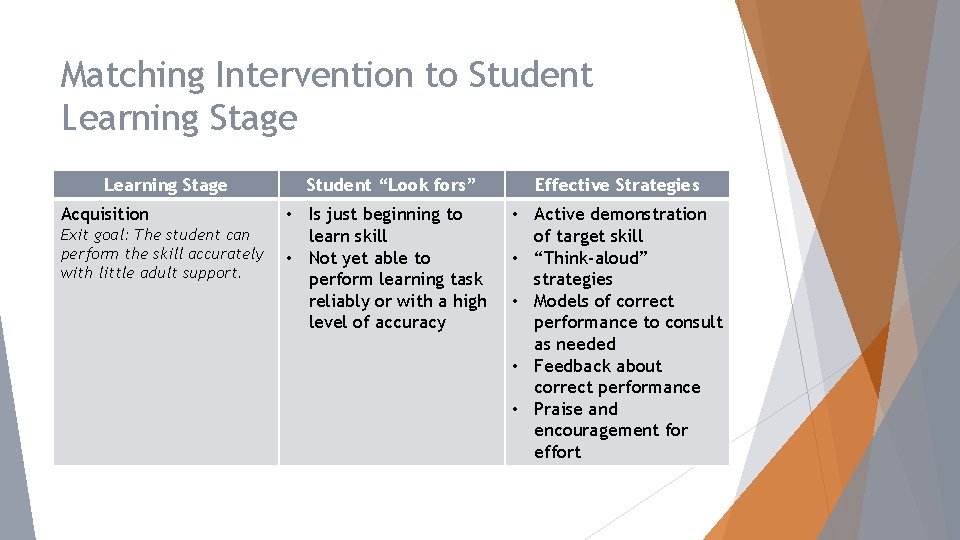
Matching Intervention to Student Learning Stage Acquisition Exit goal: The student can perform the skill accurately with little adult support. Student “Look fors” Effective Strategies • Is just beginning to learn skill • Not yet able to perform learning task reliably or with a high level of accuracy • Active demonstration of target skill • “Think-aloud” strategies • Models of correct performance to consult as needed • Feedback about correct performance • Praise and encouragement for effort
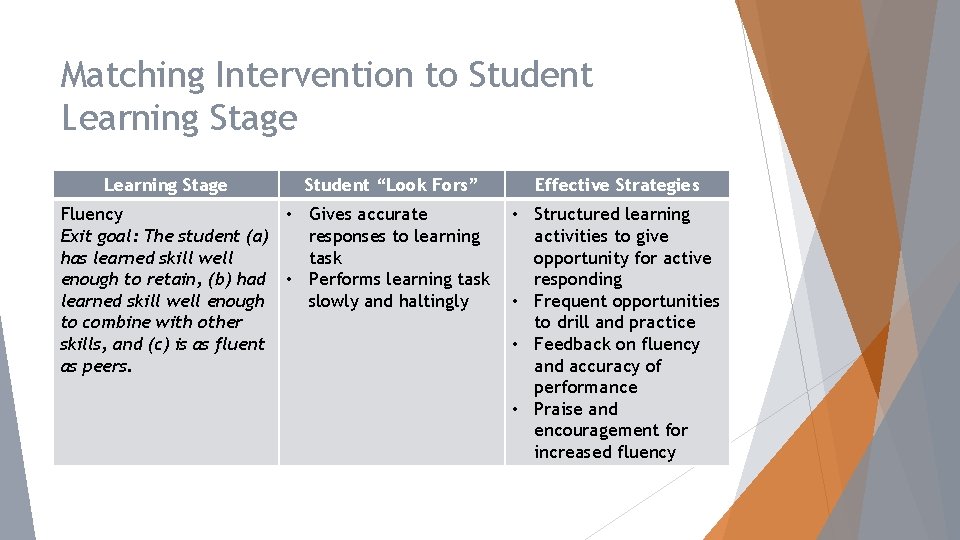
Matching Intervention to Student Learning Stage Student “Look Fors” Fluency • Gives accurate Exit goal: The student (a) responses to learning has learned skill well task enough to retain, (b) had • Performs learning task learned skill well enough slowly and haltingly to combine with other skills, and (c) is as fluent as peers. Effective Strategies • Structured learning activities to give opportunity for active responding • Frequent opportunities to drill and practice • Feedback on fluency and accuracy of performance • Praise and encouragement for increased fluency
Matching Intervention to Student Learning Stage Student “Look Fors” Generalization • Is accurate and fluent Exit goal: The student (a) in responding uses the skill across • May fail to apply new settings and situations skill to new situations and (b) does not confuse and setting target skill with similar • May confuse target skills. skill with similar skills Effective Strategies • Structured academic tasks to use the academic skill regularly in assignments • Encouragement, praise, and reinforcers for using skill in new settings • Identify tasks to do outside of school to practice target skill
Matching Intervention to Student Learning Stage Adaptation Exit goal: The adaptation phase is continuous and has no exit criteria. Student “Look Fors” • Is fluent and accurate in skill • Applies skill in novel situations/settings without prompting • Does not yet modify the skill as needed to fit new situations Effective Strategies • Identifying core element(s) of target skill to modify to face novel tasks/situations • Opportunities to practice target skill with modest accommodations in new settings with encouragement, corrective feedback, and praise