
Introduction to Artificial Intelligence AI Computer Science cpsc

- Slides: 56
Introduction to Artificial Intelligence (AI) Computer Science cpsc 502, Lecture 14 Oct, 27, 2011 Slide credit: C. Conati, S. Thrun, P. Norvig, WEKA book CPSC 502, Lecture 14 Slide 1
Today Oct 27 Machine Learning • Introduction • Supervised Machine Learning • Naïve Bayes • Markov-Chains (learning the parameters of the model) • Decision Trees CPSC 502, Lecture 14 2
Machine Learning Up until now: how to reason in a model and how to make optimal decisions Machine learning: how to acquire a model on the basis of data / experience • Learning parameters (e. g. probabilities) • Learning structure (e. g. BN graphs) • Learning hidden concepts (e. g. clustering) CPSC 502, Lecture 14 Slide 3
Why is Machine Learning So Popular? • We have lots of data! • Web • User Behavior on the Web • Human Genome • Huge medical, financial …. databases • Need for autonomous Agents (robots and softbots) that cannot be pre-programmed CPSC 502, Lecture 14 Slide 4
Fielded applications The result of learning—or the learning method itself —is deployed in practical applications ● Processing loan applications ◆Screening images for oil slicks More details on ◆Electricity supply forecasting some of these ◆Diagnosis of machine faults apps at the end ◆Marketing and sales ◆Separating crude oil and natural gas ◆Reducing banding in rotogravure printing ◆Finding appropriate technicians for telephone faults ◆Scientific applications: biology, astronomy, chemistry ◆Automatic selection of TV programs ◆Monitoring intensive care patients ◆ CPSC 502, Lecture 14 5
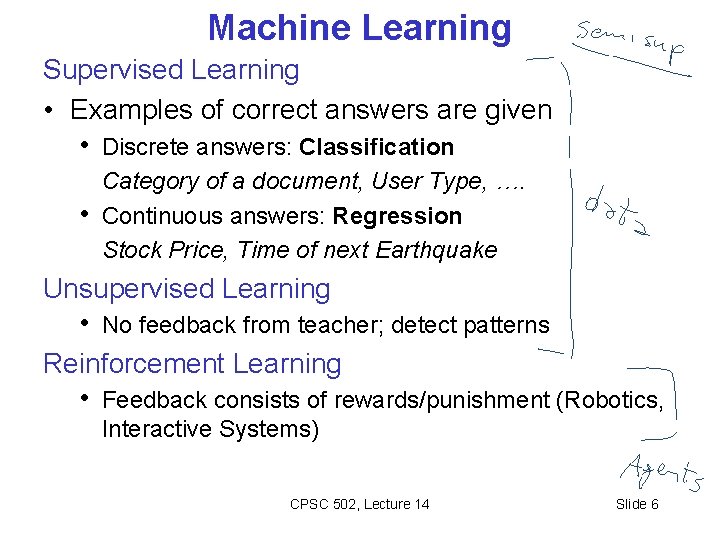
Machine Learning Supervised Learning • Examples of correct answers are given • Discrete answers: Classification • Category of a document, User Type, …. Continuous answers: Regression Stock Price, Time of next Earthquake Unsupervised Learning • No feedback from teacher; detect patterns Reinforcement Learning • Feedback consists of rewards/punishment (Robotics, Interactive Systems) CPSC 502, Lecture 14 Slide 6
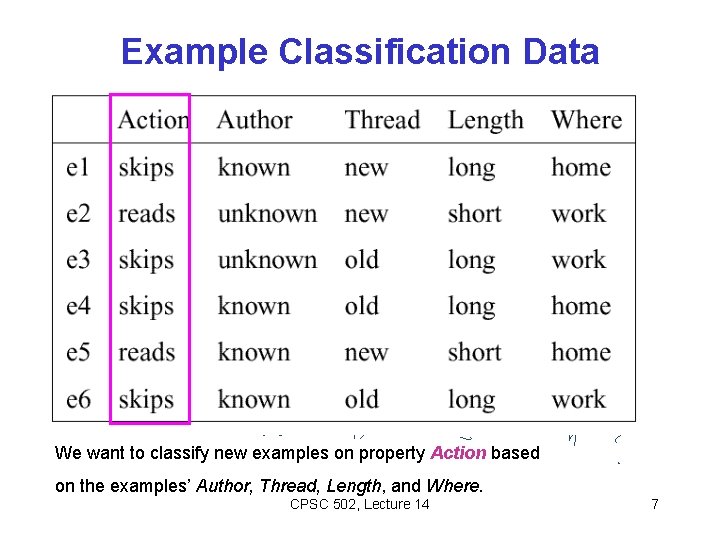
Example Classification Data We want to classify new examples on property Action based on the examples’ Author, Thread, Length, and Where. CPSC 502, Lecture 14 7
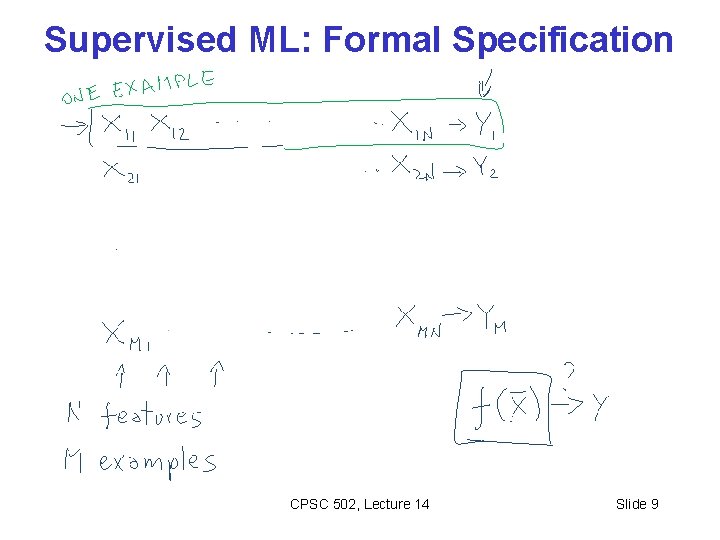
Supervised ML: Formal Specification CPSC 502, Lecture 14 Slide 9
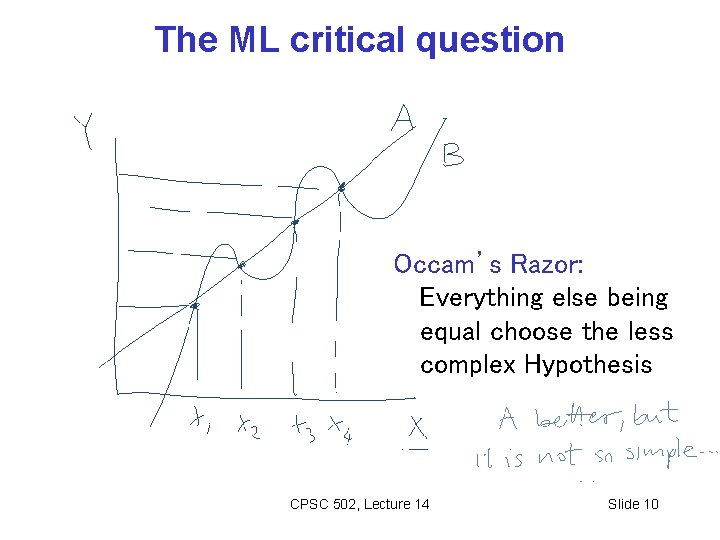
The ML critical question Occam’s Razor: Everything else being equal choose the less complex Hypothesis CPSC 502, Lecture 14 Slide 10
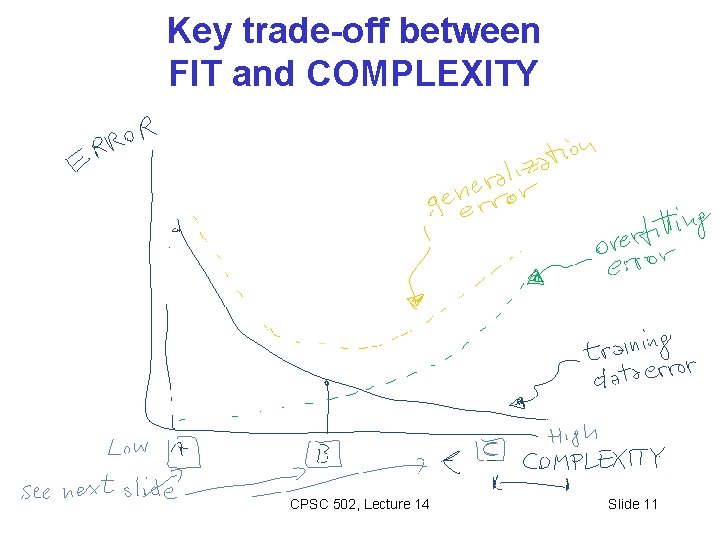
Key trade-off between FIT and COMPLEXITY CPSC 502, Lecture 14 Slide 11
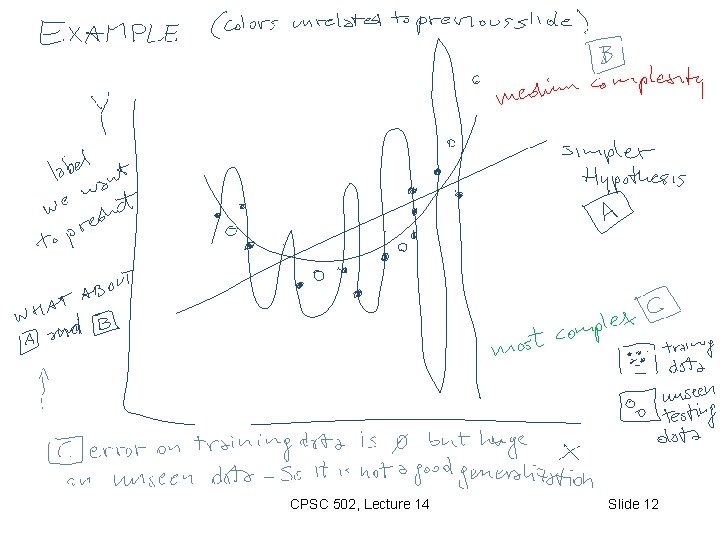
CPSC 502, Lecture 14 Slide 12
Today Oct 27 Machine Learning Intro • Definitions • Supervised Machine Learning • Naïve Bayes • Markov-Chains • Decision Trees CPSC 502, Lecture 14 13
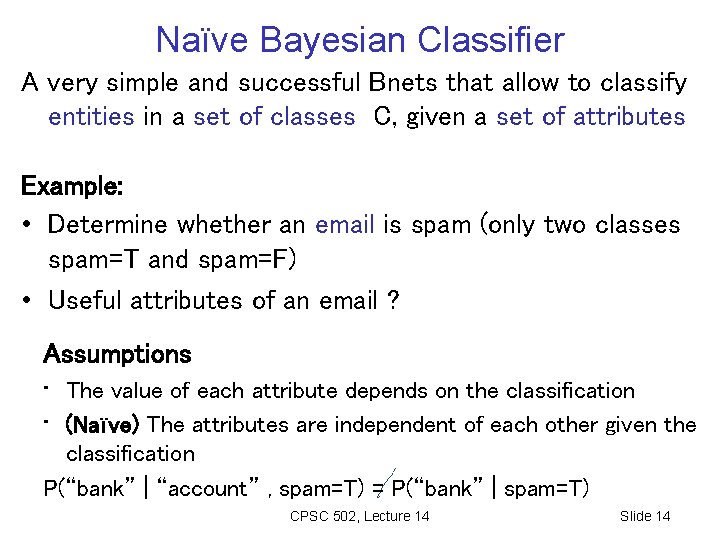
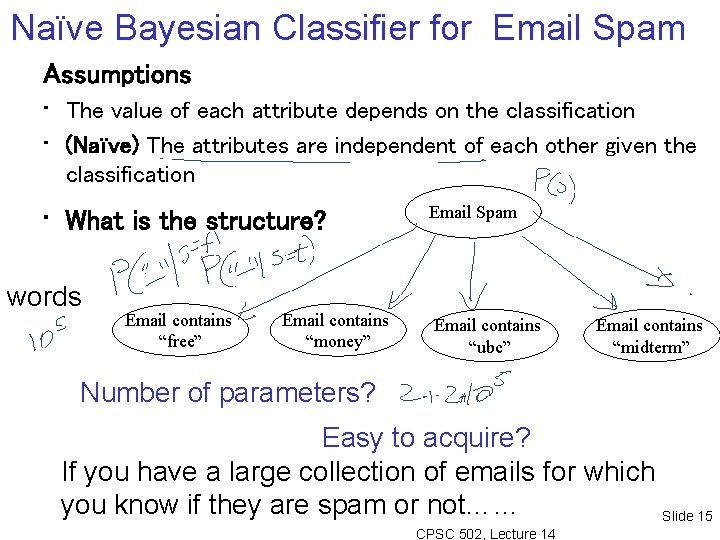
Naïve Bayesian Classifier A very simple and successful Bnets that allow to classify entities in a set of classes C, given a set of attributes Example: • Determine whether an email is spam (only two classes spam=T and spam=F) • Useful attributes of an email ? Assumptions • The value of each attribute depends on the classification • (Naïve) The attributes are independent of each other given the classification P(“bank” | “account” , spam=T) = P(“bank” | spam=T) CPSC 502, Lecture 14 Slide 14
Naïve Bayesian Classifier for Email Spam Assumptions • The value of each attribute depends on the classification • (Naïve) The attributes are independent of each other given the classification • What is the structure? words Email contains “free” Email contains “money” Email Spam Email contains “ubc” Email contains “midterm” Number of parameters? Easy to acquire? If you have a large collection of emails for which you know if they are spam or not…… Slide 15 CPSC 502, Lecture 14
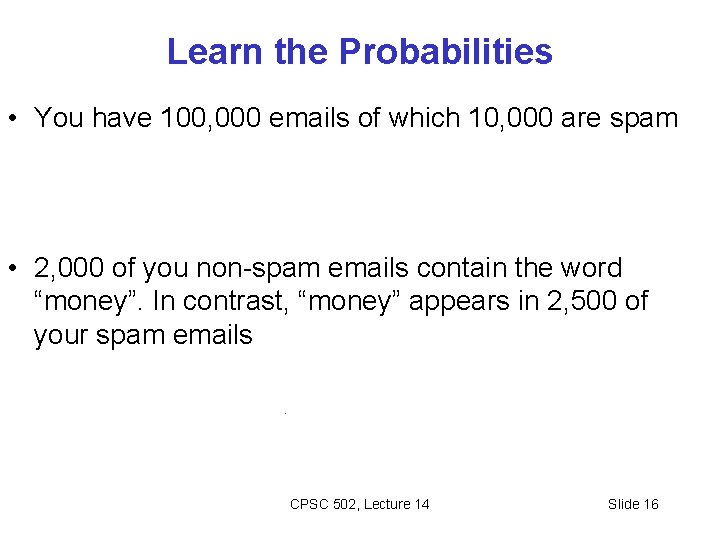
Learn the Probabilities • You have 100, 000 emails of which 10, 000 are spam • 2, 000 of you non-spam emails contain the word “money”. In contrast, “money” appears in 2, 500 of your spam emails CPSC 502, Lecture 14 Slide 16
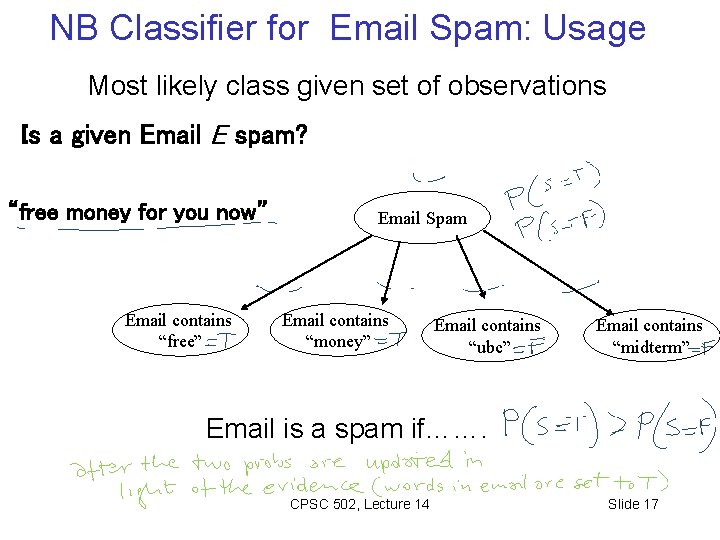
NB Classifier for Email Spam: Usage Most likely class given set of observations Is a given Email E spam? “free money for you now” Email contains “free” Email Spam Email contains “money” Email contains “ubc” Email contains “midterm” Email is a spam if……. CPSC 502, Lecture 14 Slide 17
How to improve this model? Need more features– words aren’t enough! • Have you emailed the sender before? • Have 1 K other people just gotten the same email? • Is the sending information consistent? • Is the email in ALL CAPS? • Do inline URLs point where they say they point? • Does the email address you by (your) name? Can add these information sources as new variables in the Naïve Bayes model
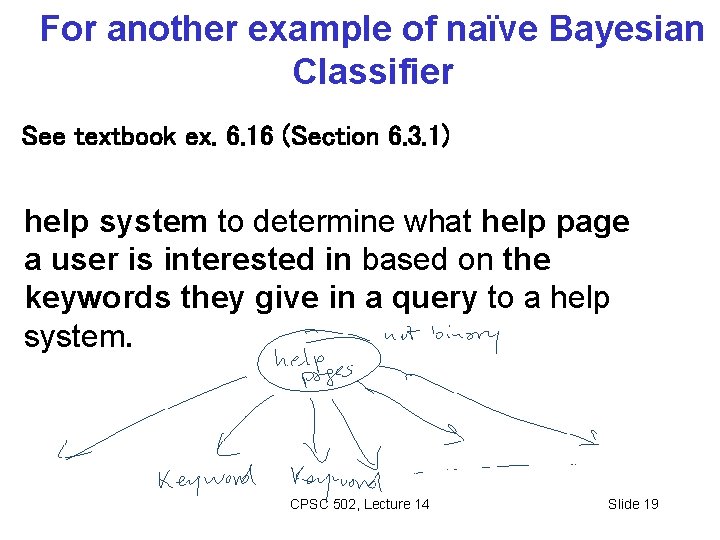
For another example of naïve Bayesian Classifier See textbook ex. 6. 16 (Section 6. 3. 1) help system to determine what help page a user is interested in based on the keywords they give in a query to a help system. CPSC 502, Lecture 14 Slide 19
Today Oct 27 Machine Learning • Introduction • Supervised Machine Learning • Naïve Bayes • Markov-Chains (learning the parameters of the model) • Decision Trees CPSC 502, Lecture 14 20
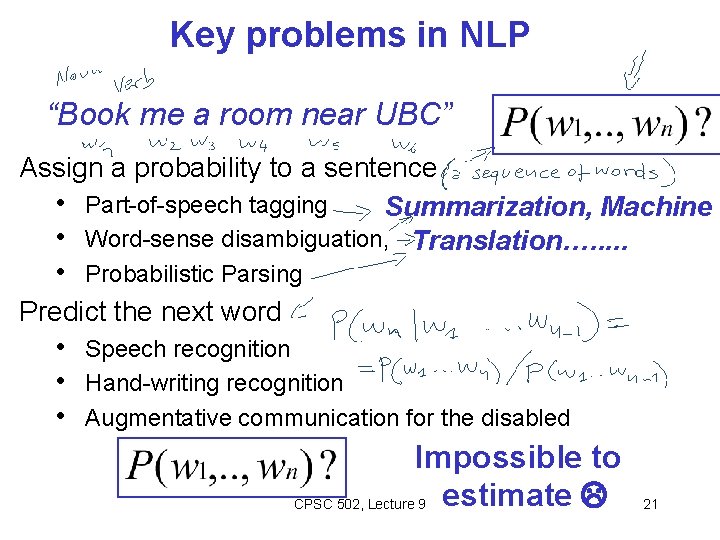
Key problems in NLP “Book me a room near UBC” Assign a probability to a sentence • Part-of-speech tagging Summarization, Machine • Word-sense disambiguation, Translation…. . . • Probabilistic Parsing Predict the next word • Speech recognition • Hand-writing recognition • Augmentative communication for the disabled Impossible to CPSC 502, Lecture 9 estimate 21
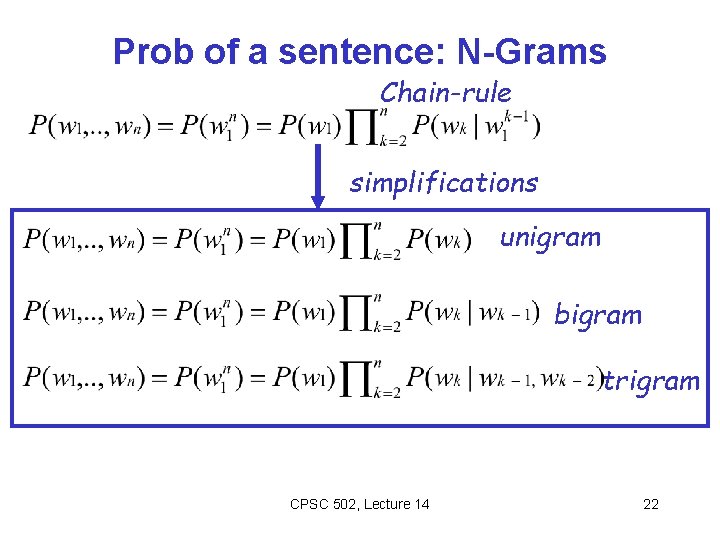
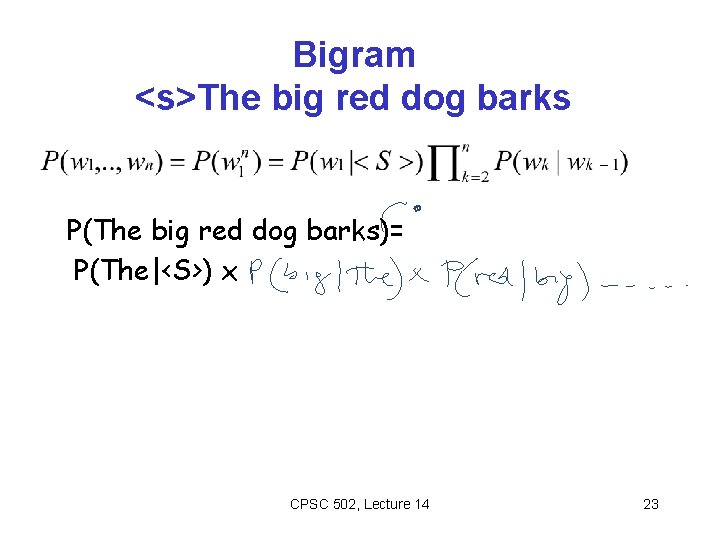
Prob of a sentence: N-Grams Chain-rule simplifications unigram bigram trigram CPSC 502, Lecture 14 22
Bigram <s>The big red dog barks P(The big red dog barks)= P(The|<S>) x CPSC 502, Lecture 14 23
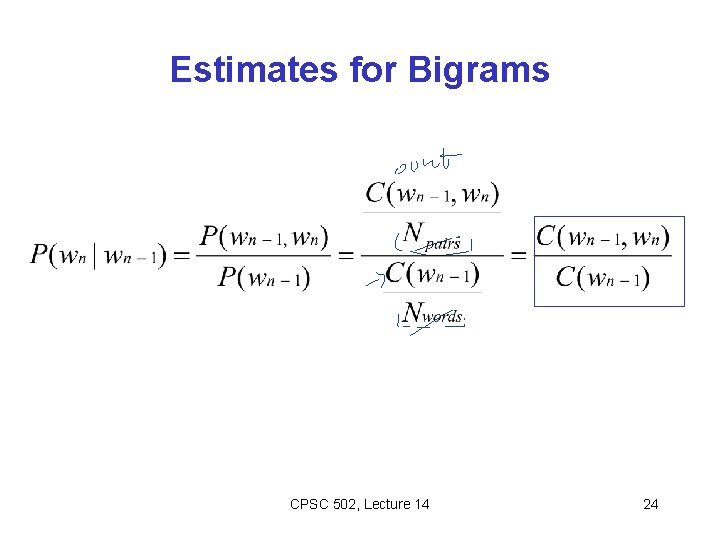
Estimates for Bigrams CPSC 502, Lecture 14 24
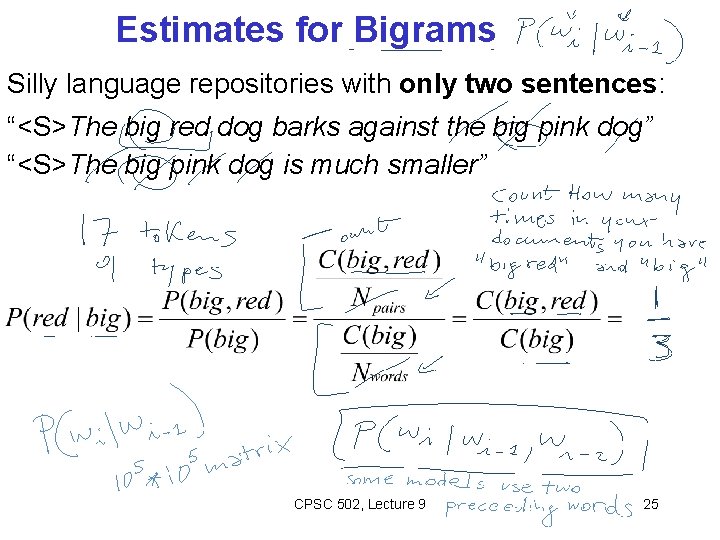
Estimates for Bigrams Silly language repositories with only two sentences: “<S>The big red dog barks against the big pink dog” “<S>The big pink dog is much smaller” CPSC 502, Lecture 9 25
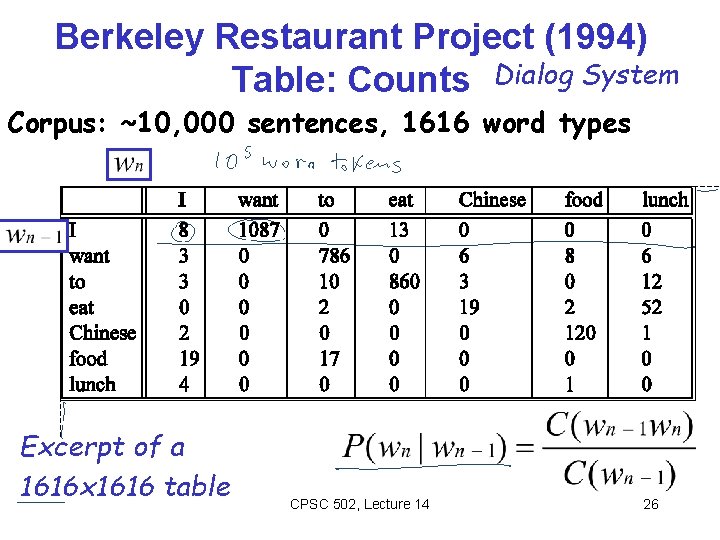
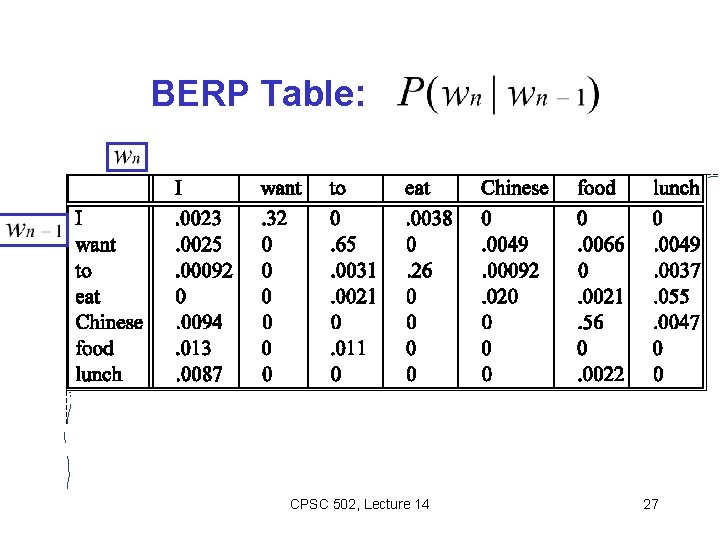
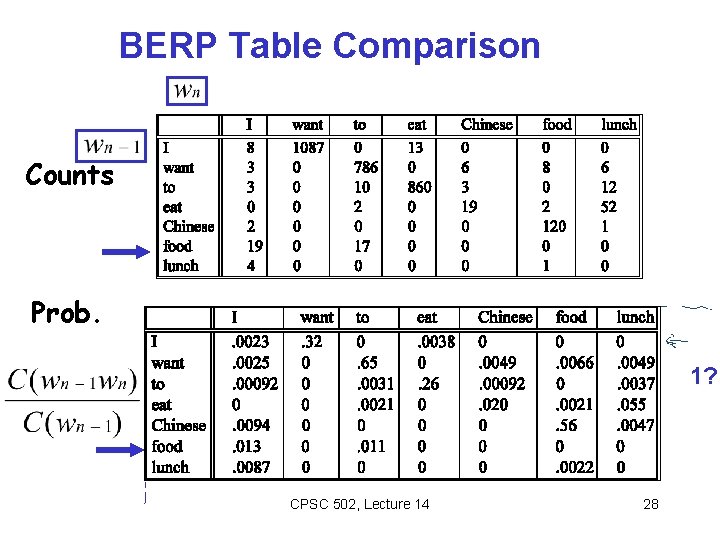
Berkeley Restaurant Project (1994) Table: Counts Dialog System Corpus: ~10, 000 sentences, 1616 word types Excerpt of a 1616 x 1616 table CPSC 502, Lecture 14 26
BERP Table: CPSC 502, Lecture 14 27
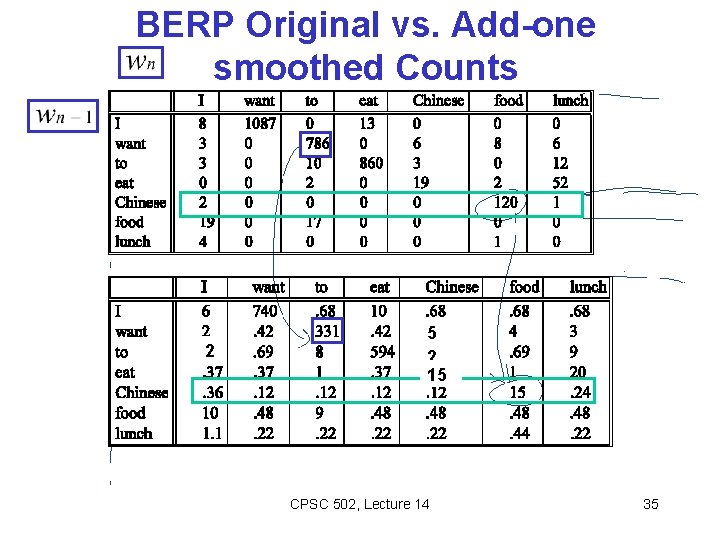
BERP Table Comparison Counts Prob. 1? CPSC 502, Lecture 14 28
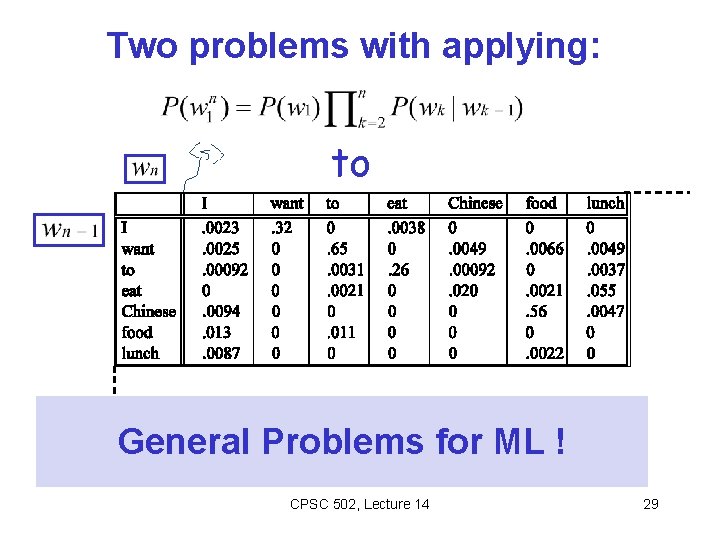
Two problems with applying: to General Problems for ML ! CPSC 502, Lecture 14 29
Problem (1) We may need to multiply many very small numbers (underflows!) Easy Solution: • Convert probabilities to logs and then sum • To get the real probability (if you need it) go back to the antilog. CPSC 502, Lecture 14 30
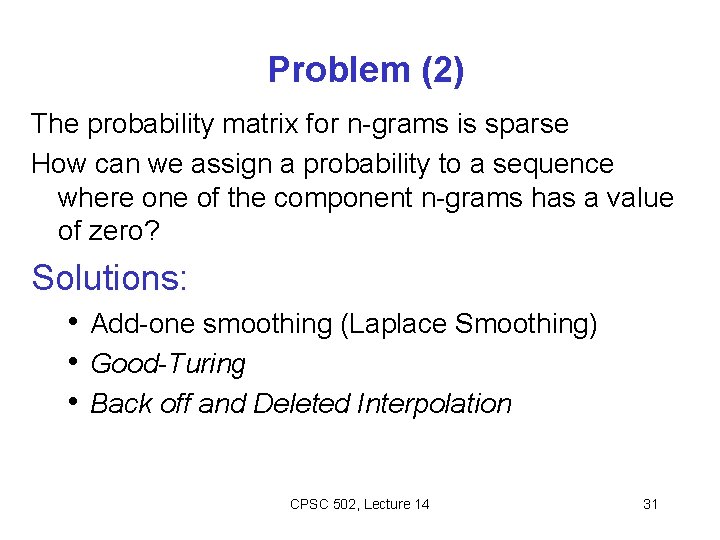
Problem (2) The probability matrix for n-grams is sparse How can we assign a probability to a sequence where one of the component n-grams has a value of zero? Solutions: • Add-one smoothing (Laplace Smoothing) • Good-Turing • Back off and Deleted Interpolation CPSC 502, Lecture 14 31
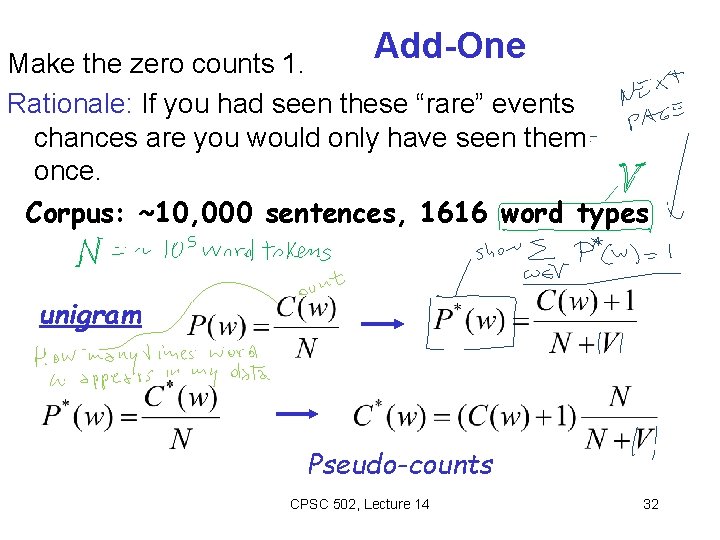
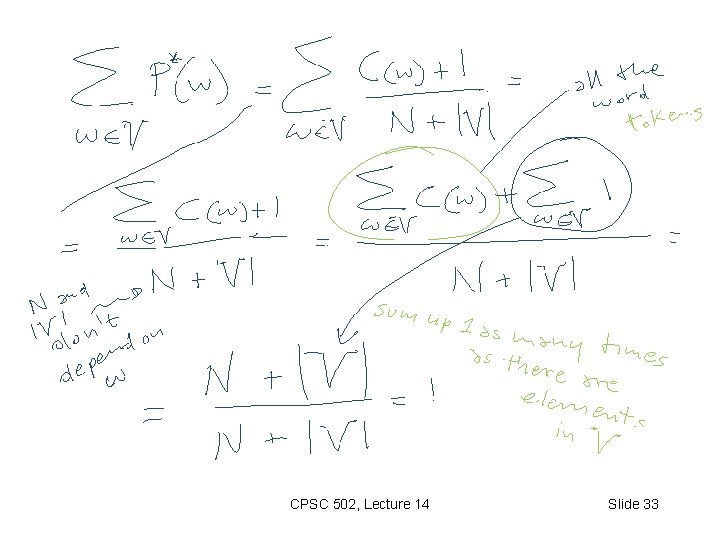
Add-One Make the zero counts 1. Rationale: If you had seen these “rare” events chances are you would only have seen them once. Corpus: ~10, 000 sentences, 1616 word types unigram Pseudo-counts CPSC 502, Lecture 14 32
CPSC 502, Lecture 14 Slide 33
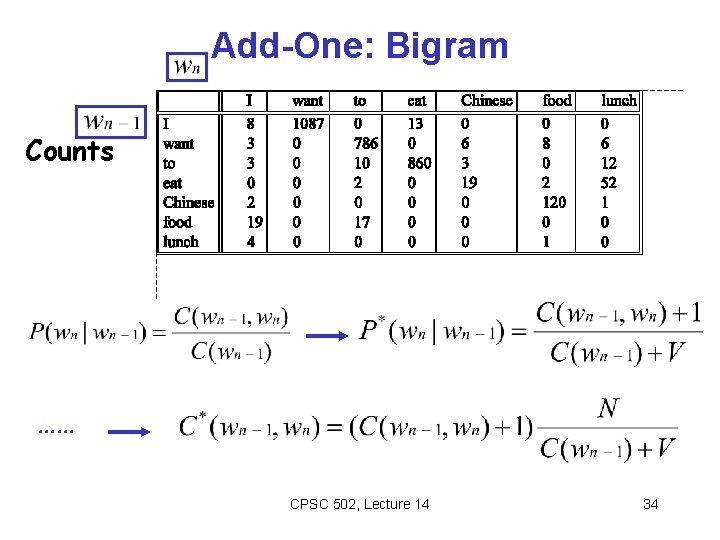
Add-One: Bigram Counts …… CPSC 502, Lecture 14 34
BERP Original vs. Add-one smoothed Counts 2 5 6 2 19 15 CPSC 502, Lecture 14 35
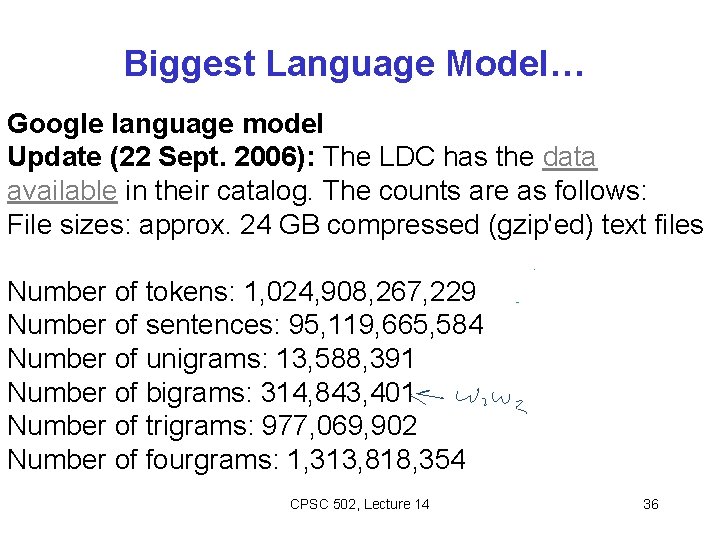
Biggest Language Model… Google language model Update (22 Sept. 2006): The LDC has the data available in their catalog. The counts are as follows: File sizes: approx. 24 GB compressed (gzip'ed) text files Number of tokens: 1, 024, 908, 267, 229 Number of sentences: 95, 119, 665, 584 Number of unigrams: 13, 588, 391 Number of bigrams: 314, 843, 401 Number of trigrams: 977, 069, 902 Number of fourgrams: 1, 313, 818, 354 CPSC 502, Lecture 14 36
Today Oct 27 Machine Learning • Introduction • Supervised Machine Learning • Naïve Bayes • Markov Chains • Decision Trees CPSC 502, Lecture 14 37
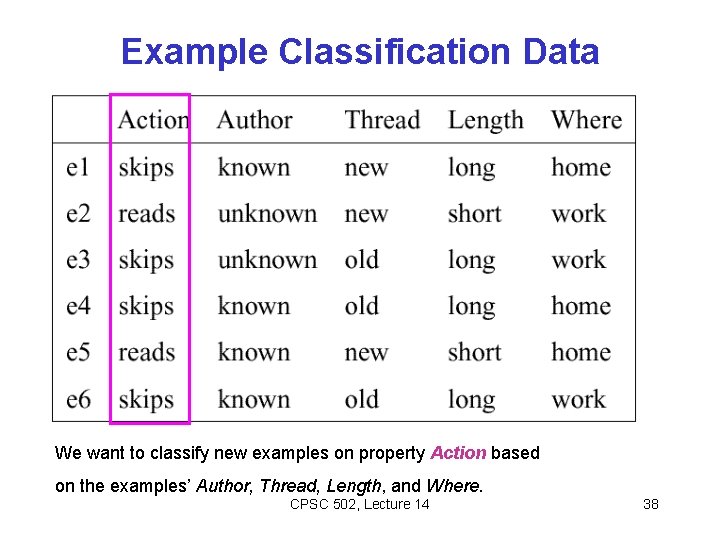
Example Classification Data We want to classify new examples on property Action based on the examples’ Author, Thread, Length, and Where. CPSC 502, Lecture 14 38
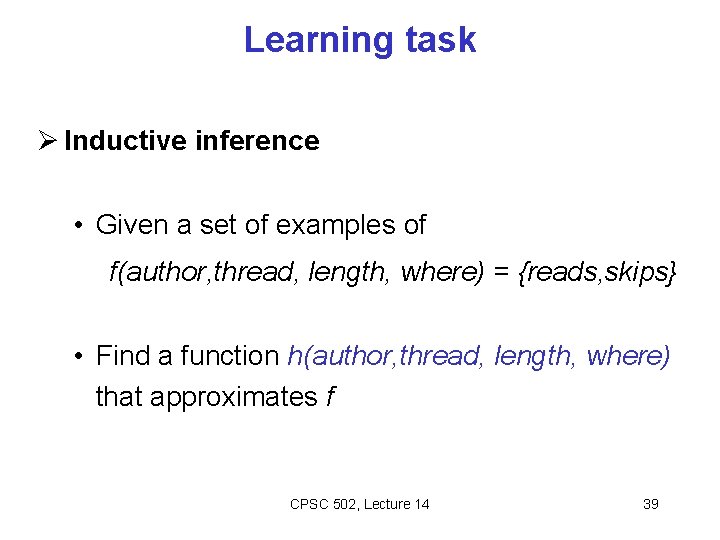
Learning task Ø Inductive inference • Given a set of examples of f(author, thread, length, where) = {reads, skips} • Find a function h(author, thread, length, where) that approximates f CPSC 502, Lecture 14 39
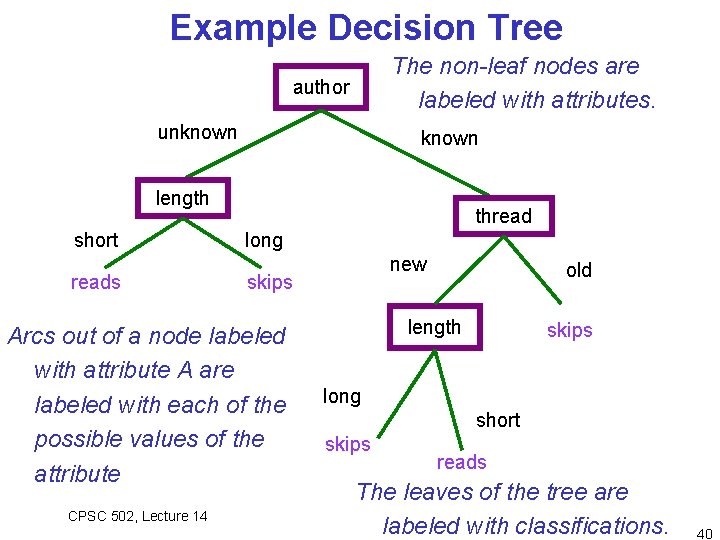
Example Decision Tree The non-leaf nodes are labeled with attributes. author unknown length short reads thread long skips Arcs out of a node labeled with attribute A are labeled with each of the possible values of the attribute CPSC 502, Lecture 14 new old length skips long short skips reads The leaves of the tree are labeled with classifications. 40
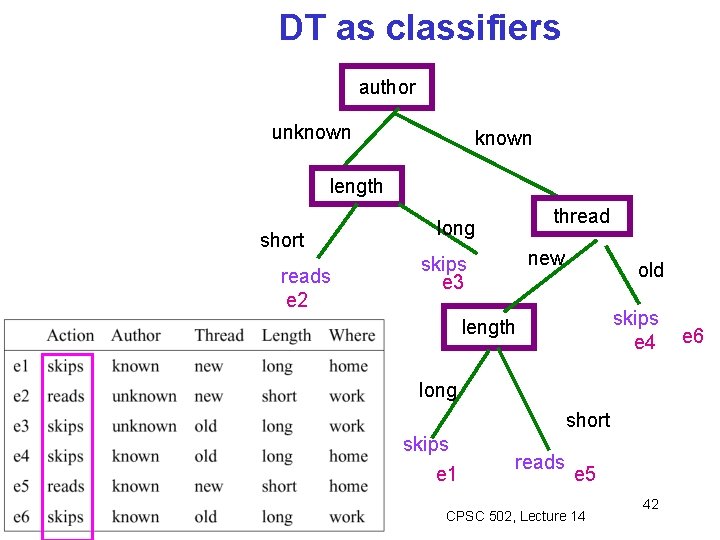
DT as classifiers To classify an example, filter in down the tree • For each attribute of the example, follow the branch corresponding to that attribute’s value. • When a leaf is reached, the example is classified as the label for that leaf. CPSC 502, Lecture 14 41
DT as classifiers author unknown length short reads e 2 thread long new skips e 3 old skips e 4 length long short skips e 1 reads e 5 CPSC 502, Lecture 14 42 e 6
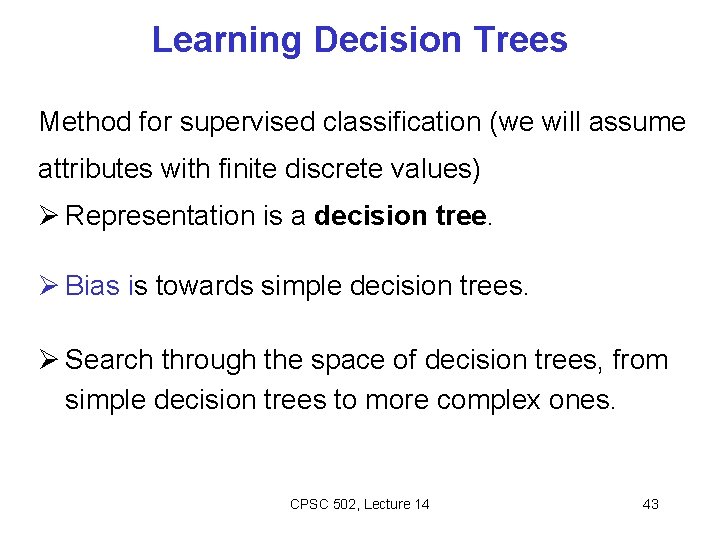
Learning Decision Trees Method for supervised classification (we will assume attributes with finite discrete values) Ø Representation is a decision tree. Ø Bias is towards simple decision trees. Ø Search through the space of decision trees, from simple decision trees to more complex ones. CPSC 502, Lecture 14 43
DT Applications Ø DT are often the first method tried in many areas of industry and commerce, when task involves learning from a data set of examples Ø Main reason: the output is easy to interpret by humans CPSC 502, Lecture 14 44
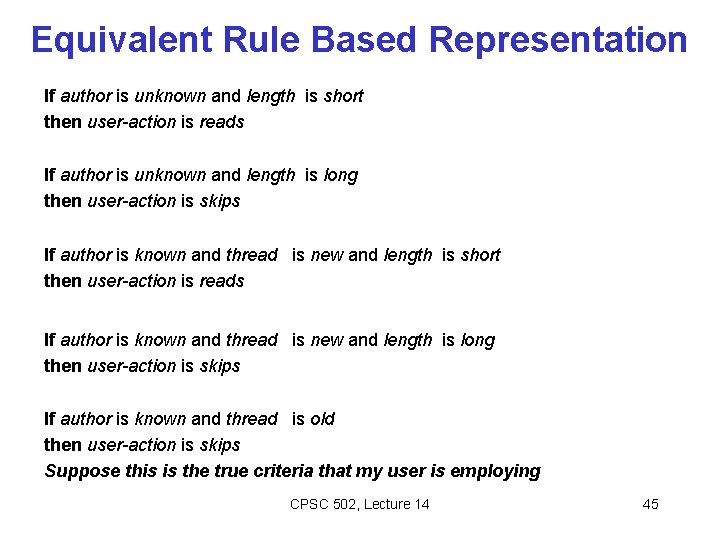
Equivalent Rule Based Representation If author is unknown and length is short then user-action is reads If author is unknown and length is long then user-action is skips If author is known and thread is new and length is short then user-action is reads If author is known and thread is new and length is long then user-action is skips If author is known and thread is old then user-action is skips Suppose this is the true criteria that my user is employing CPSC 502, Lecture 14 45
TODO for next Tue • Read textbook 7. 3 • Also Do exercise 7. A http: //www. aispace. org/exercises. shtml CPSC 502, Lecture 14 Slide 46
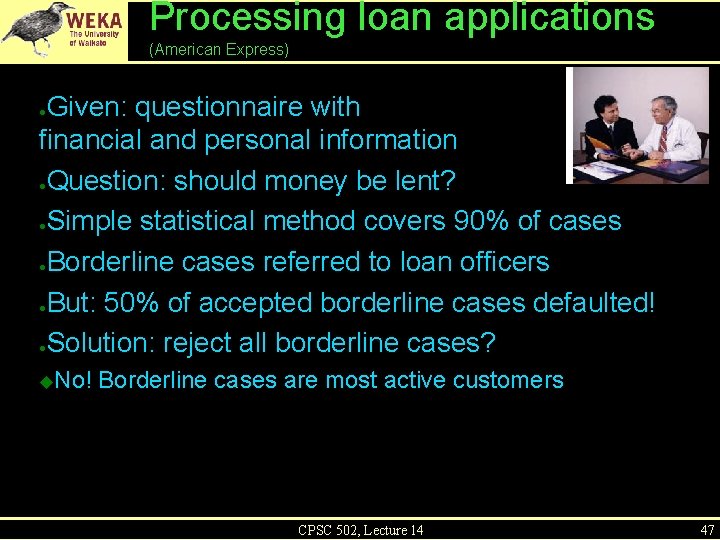
Processing loan applications (American Express) Given: questionnaire with financial and personal information ●Question: should money be lent? ●Simple statistical method covers 90% of cases ●Borderline cases referred to loan officers ●But: 50% of accepted borderline cases defaulted! ●Solution: reject all borderline cases? ● No! Borderline cases are most active customers ◆ CPSC 502, Lecture 14 47
Enter machine learning 1000 training examples of borderline cases ● 20 attributes: ● age ◆years with current employer ◆years at current address ◆years with the bank ◆other credit cards possessed, … ◆ ● Learned rules: correct on 70% of cases human experts only 50% ◆ Rules could be used to explain decisions to customers ● CPSC 502, Lecture 14 48
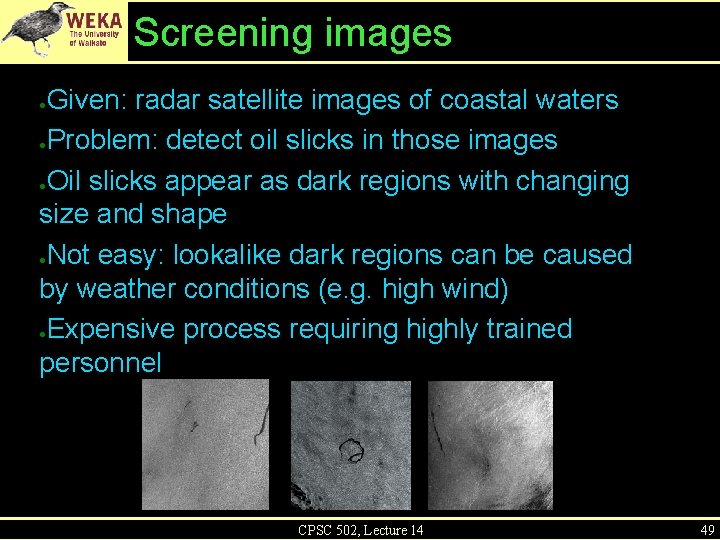
Screening images Given: radar satellite images of coastal waters ●Problem: detect oil slicks in those images ●Oil slicks appear as dark regions with changing size and shape ●Not easy: lookalike dark regions can be caused by weather conditions (e. g. high wind) ●Expensive process requiring highly trained personnel ● CPSC 502, Lecture 14 49
Enter machine learning Extract dark regions from normalized image ●Attributes: ● size of region ◆shape, area ◆intensity ◆sharpness and jaggedness of boundaries ◆proximity of other regions ◆info about background ◆ ● Constraints: Few training examples—oil slicks are rare! ◆Unbalanced data: most dark regions aren’t slicks ◆Regions from same image form a batch ◆Requirement: adjustable false-alarm rate ◆ CPSC 502, Lecture 14 50
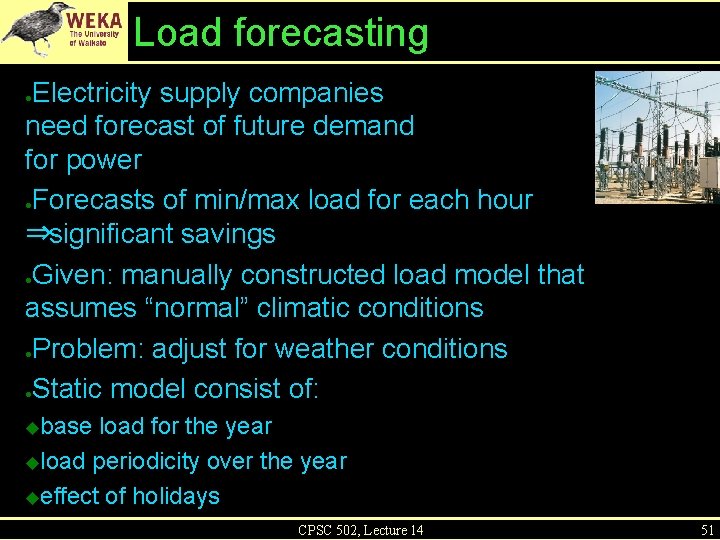
Load forecasting Electricity supply companies need forecast of future demand for power ●Forecasts of min/max load for each hour ⇒significant savings ●Given: manually constructed load model that assumes “normal” climatic conditions ●Problem: adjust for weather conditions ●Static model consist of: ● base load for the year ◆load periodicity over the year ◆effect of holidays ◆ CPSC 502, Lecture 14 51
Enter machine learning Prediction corrected using “most similar” days ●Attributes: ● temperature ◆humidity ◆wind speed ◆cloud cover readings ◆plus difference between actual load and predicted load ◆ Average difference among three “most similar” days added to static model ●Linear regression coefficients form attribute weights in similarity function ● CPSC 502, Lecture 14 52
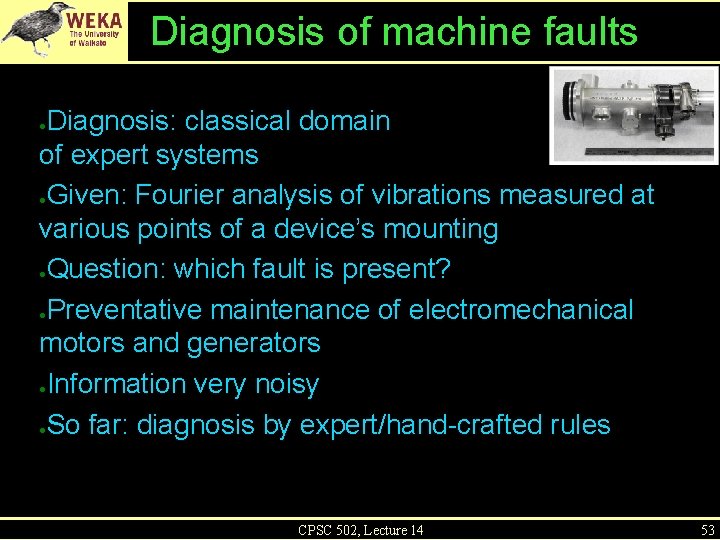
Diagnosis of machine faults Diagnosis: classical domain of expert systems ●Given: Fourier analysis of vibrations measured at various points of a device’s mounting ●Question: which fault is present? ●Preventative maintenance of electromechanical motors and generators ●Information very noisy ●So far: diagnosis by expert/hand-crafted rules ● CPSC 502, Lecture 14 53
Enter machine learning Available: 600 faults with expert’s diagnosis ●~300 unsatisfactory, rest used for training ●Attributes augmented by intermediate concepts that embodied causal domain knowledge ●Expert not satisfied with initial rules because they did not relate to his domain knowledge ●Further background knowledge resulted in more complex rules that were satisfactory ●Learned rules outperformed hand-crafted ones ● CPSC 502, Lecture 14 54
Marketing and sales I Companies precisely record massive amounts of marketing and sales data ●Applications: ● Customer loyalty: identifying customers that are likely to defect by detecting changes in their behavior (e. g. banks/phone companies) ◆Special offers: identifying profitable customers (e. g. reliable owners of credit cards that need extra money during the holiday season) ◆ CPSC 502, Lecture 14 55
Marketing and sales II ● Market basket analysis Association techniques find groups of items that tend to occur together in a transaction (used to analyze checkout data) ◆ Historical analysis of purchasing patterns ●Identifying prospective customers ● Focusing promotional mailouts (targeted campaigns are cheaper than mass-marketed ones) ◆ CPSC 502, Lecture 14 56
Machine learning and statistics ● Historical difference (grossly oversimplified): Statistics: testing hypotheses ◆Machine learning: finding the right hypothesis ◆ ● But: huge overlap Decision trees (C 4. 5 and CART) ◆Nearest-neighbor methods ◆ ● Today: perspectives have converged Most ML algorithms employ statistical techniques ◆ CPSC 502, Lecture 14 57