
Introduction to Argumentation What are the primary characteristics
- Slides: 19
Introduction to Argumentation
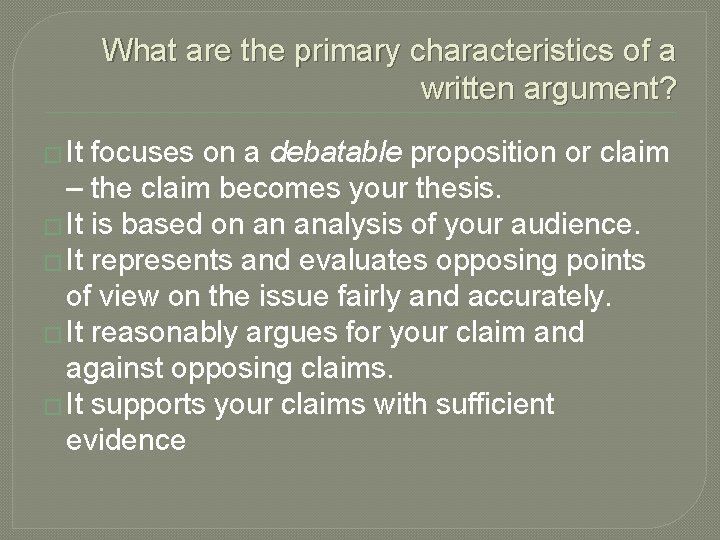
What are the primary characteristics of a written argument? � It focuses on a debatable proposition or claim – the claim becomes your thesis. � It is based on an analysis of your audience. � It represents and evaluates opposing points of view on the issue fairly and accurately. � It reasonably argues for your claim and against opposing claims. � It supports your claims with sufficient evidence
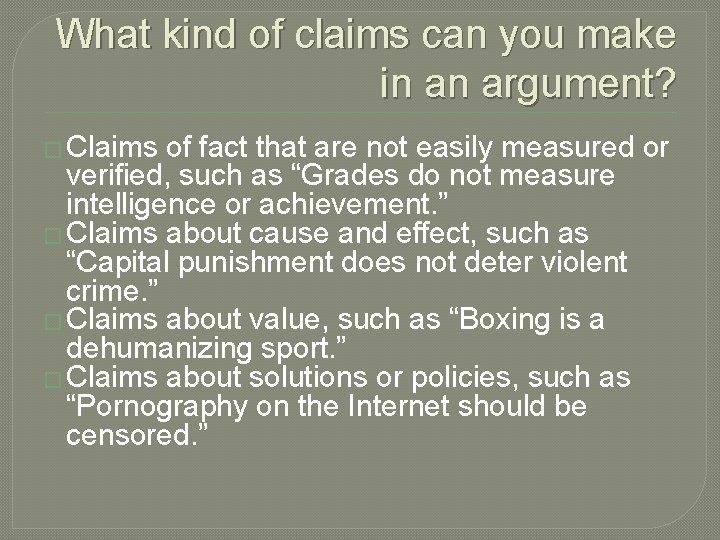
What kind of claims can you make in an argument? � Claims of fact that are not easily measured or verified, such as “Grades do not measure intelligence or achievement. ” � Claims about cause and effect, such as “Capital punishment does not deter violent crime. ” � Claims about value, such as “Boxing is a dehumanizing sport. ” � Claims about solutions or policies, such as “Pornography on the Internet should be censored. ”
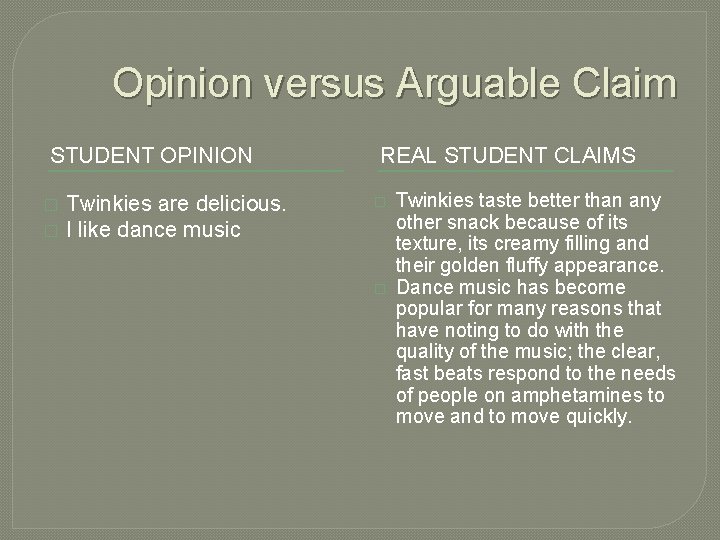
Opinion versus Arguable Claim STUDENT OPINION � � Twinkies are delicious. I like dance music REAL STUDENT CLAIMS � � Twinkies taste better than any other snack because of its texture, its creamy filling and their golden fluffy appearance. Dance music has become popular for many reasons that have noting to do with the quality of the music; the clear, fast beats respond to the needs of people on amphetamines to move and to move quickly.
What is the difference? � An argument is supported by evidence which can be debated or challenged. Opinion tends to be supported by more opinion. � A claim can be substantiated with research, evidence, testimony and academic reasoning. � A claim is something more than a statement and support; an arguable claim also goes on to address the “so what” question, the implications and why we should care in the first place. � The best claims are focused, specific, complex and relevant.
What is an appeal to an audience? �A strategy for gaining their trust or confidence that the argument you are presenting is reasonable, appropriate, and worthwhile
Strategies to Set-up an Argument � � � On average, the successful (6 or higher) essay has at least 3 full pages. Note: This strategy will only work if the prompt asks you to take a position. It will not work if the argumentative essay asks you to discuss an author’s use of argument in a piece of writing. If the prompt asks you to analyze how an author develops his or her argument, use the same format and strategies that you use for rhetorical and stylistic analysis. However, your essay must focus on how the individual built and supported his or her argument, not focus on the stylistic elements. The exam will most likely ask you to defend (agree), challenge (disagree), or qualify (agree and disagree) an assertion (claim/statement).
Pre-writing � � � Underline the specific task. Take your time and make sure you KNOW what the prompt is asking. Make columns for defend and challenge, qualify List specific examples that support the assertion (agree/defend). List specific examples that challenge the assertion (disagree/find fault). List specific examples that make exceptions to a side. • Evidence: �Be specific and accurate—named and factually correct �Avoid using movies and other more informal aspects of society as evidence. �Reflect a well-educated, widely-read, mature individual's thoughtful reaction �Be unified, specific, accurate, adequate, relevant, and representative. �Avoid evidence that everybody will cite. (To avoid this, reject first thoughts and keep digging until you find things that are not so easy to grasp at first. ) Be aware of prejudices, stereotypes, and bias that you might “bring to the table” concerning the issue Think critically…avoid the common and generic examples that all students will use Choose your stance by examining which column has the strongest examples/evidence
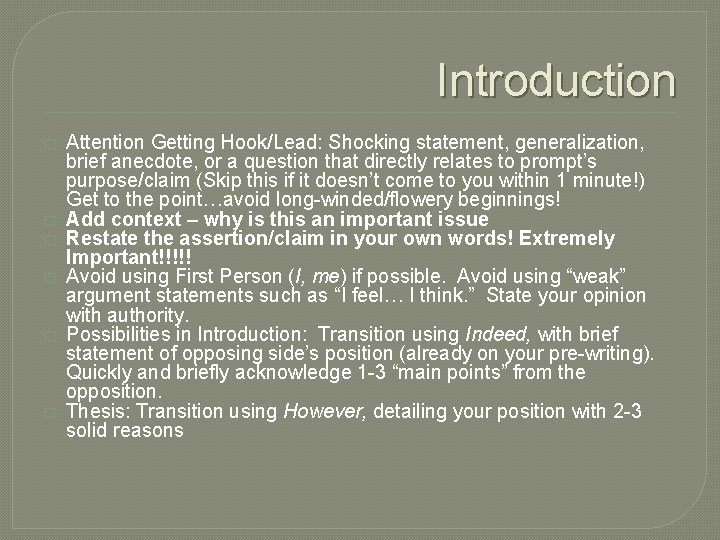
Introduction � � � Attention Getting Hook/Lead: Shocking statement, generalization, brief anecdote, or a question that directly relates to prompt’s purpose/claim (Skip this if it doesn’t come to you within 1 minute!) Get to the point…avoid long-winded/flowery beginnings! Add context – why is this an important issue Restate the assertion/claim in your own words! Extremely Important!!!!! Avoid using First Person (I, me) if possible. Avoid using “weak” argument statements such as “I feel… I think. ” State your opinion with authority. Possibilities in Introduction: Transition using Indeed, with brief statement of opposing side’s position (already on your pre-writing). Quickly and briefly acknowledge 1 -3 “main points” from the opposition. Thesis: Transition using However, detailing your position with 2 -3 solid reasons
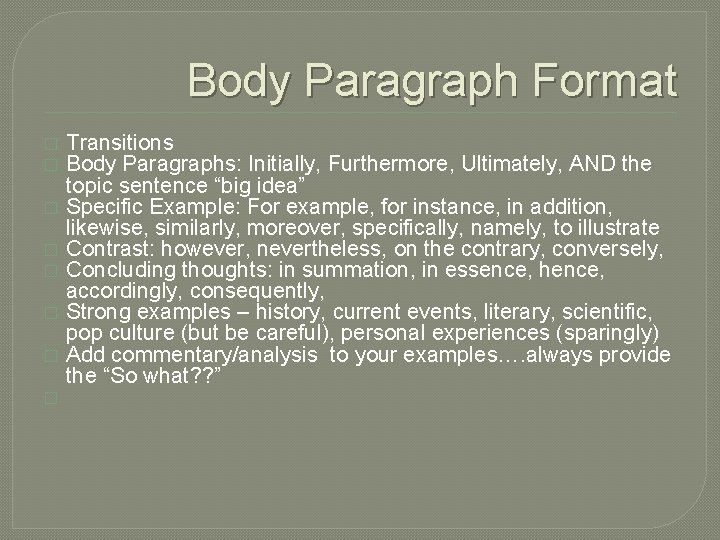
Body Paragraph Format � � � � Transitions Body Paragraphs: Initially, Furthermore, Ultimately, AND the topic sentence “big idea” Specific Example: For example, for instance, in addition, likewise, similarly, moreover, specifically, namely, to illustrate Contrast: however, nevertheless, on the contrary, conversely, Concluding thoughts: in summation, in essence, hence, accordingly, consequently, Strong examples – history, current events, literary, scientific, pop culture (but be careful), personal experiences (sparingly) Add commentary/analysis to your examples…. always provide the “So what? ? ”
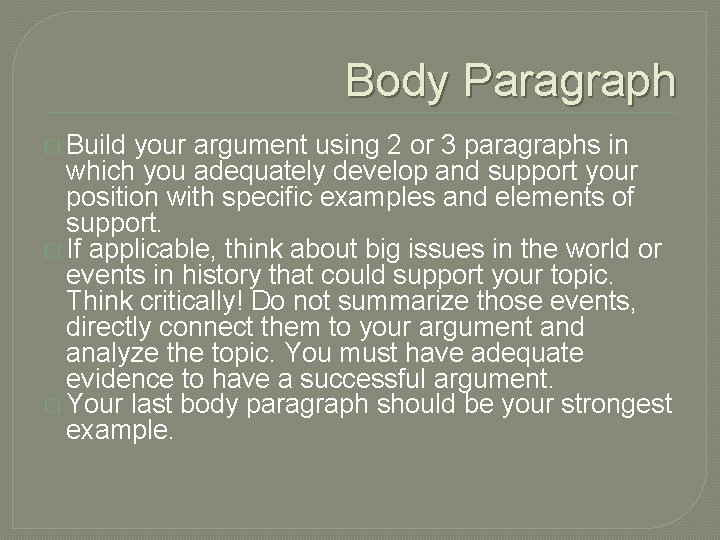
Body Paragraph � Build your argument using 2 or 3 paragraphs in which you adequately develop and support your position with specific examples and elements of support. � If applicable, think about big issues in the world or events in history that could support your topic. Think critically! Do not summarize those events, directly connect them to your argument and analyze the topic. You must have adequate evidence to have a successful argument. � Your last body paragraph should be your strongest example.
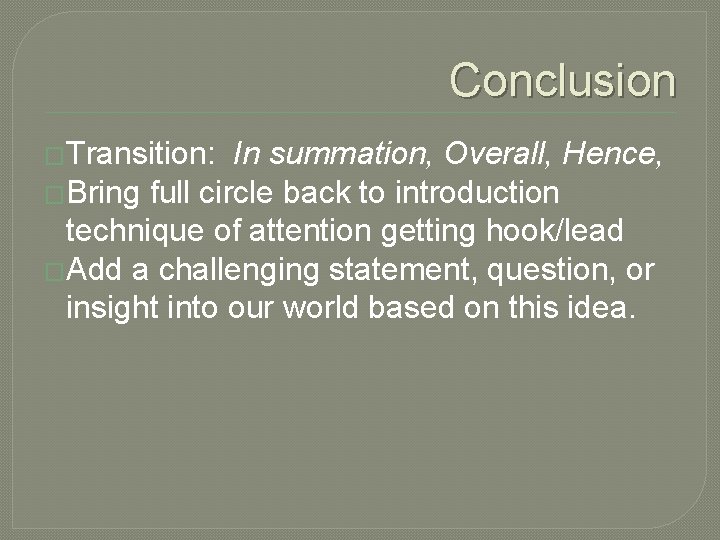
Conclusion �Transition: In summation, Overall, Hence, �Bring full circle back to introduction technique of attention getting hook/lead �Add a challenging statement, question, or insight into our world based on this idea.
Overall Strategies � Consider using the following strategies to make your point: � Analogies (or comparisons in general) � Specific examples drawn from history or contemporary society. AP graders LOVE writers who are able to connect the prompt to the world around them. � Use a connective theme (or thread) in your paper. Tie all your ideas together through a reoccurring motif. (For advanced writers only. ) � Use a dramatic or well-placed sentence, to make a point. Show that you know how to manipulate your sentence structure for effect. Perhaps you use parallelism, or antithesis, or repetition, or…. .
Overall Strategies � Use cause-effect argumentation, if appropriate. emotionally-charged words (diction) to establish your tone or attitude. � Show personality—this helps establish your credibility, as one whose opinion is worth knowing. � Either refute the opposition or concede a point. � A thoughtful simile, metaphor, or other figurative language can enhance your paper. � Remember: You can show why you are right—or why others are wrong. Either way, you draw people to your side. � Above all else: If you are asked to write an argument, avoid logical fallacies.
Patterns in High Scoring Essays � � � Concrete Illustrations of Abstract Ideas. Every paragraph will present concrete examples. Every single one. It is simply a must. Ideas that exist only in the mind are rarely convincing because your audience cannot see how they apply in the real world. How and Why. The writers spend time explaining how and why their ideas are correct. You cannot simply assume that the reader will agree with you. Talk to your audience. Show the why they should think as you do. Explain your reasoning. Engage your audience. Fully Developed Points. Examples and explanations take time. A detailed example should run 3 -4 sentences. Commentary and explanation should be at least 2 -5 sentences. Don’t state that “Gandhi faced obstacles, ” show them!
Classical Model Topics �Physical Education should (or should not) be a required subject for four years. �The drinking age should (or should not) be lowered to eighteen. �High school health education courses adequately (or inadequately) teach health concerns that are important to teens.
Peer Review �Organize yourself according to the topic you wrote. Then, evaluate TWO peers use of the classical model of argumentation through the peer review sheet. Staple your reviews to the paper you reviewed. �At 8: 25, each topic group will select the essay that best represents the model and the writer will read it aloud for extra credit (you cannot vote for yourself).
Toulmin Model Topics � Going away physically to college. � College or employers should or should not be allowed to use social media as a means of accepting/hiring you. � The end of the world is/is not inevitable during your lifetime. � Marijuana should be decriminalized and follow the same laws as alcohol. � English should or should not be the official language of the United States.
Rogerian Topics �Gay Marriage �Regulation regarding school lunches �College campuses becoming smoke-free �Declaring sexual preference on college applications