
Introduction to APC MPC How to issue Tax

- Slides: 26
Introduction to APC & MPC How to issue Tax Refunds & Stimulus Money
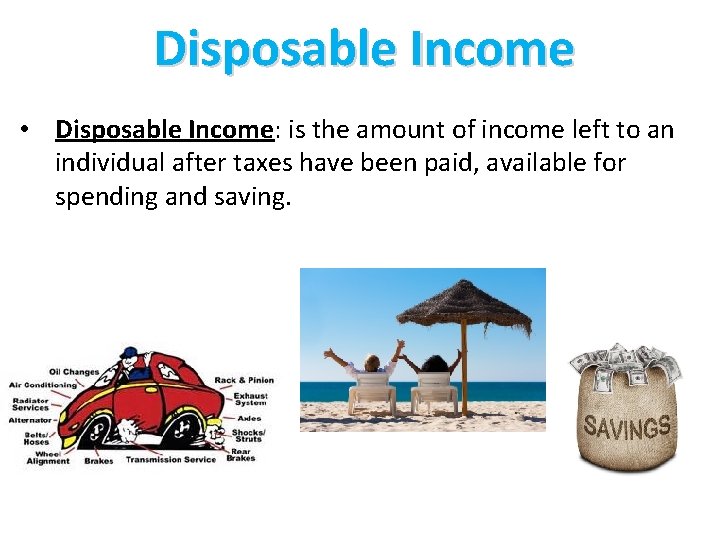
Disposable Income • Disposable Income: is the amount of income left to an individual after taxes have been paid, available for spending and saving.
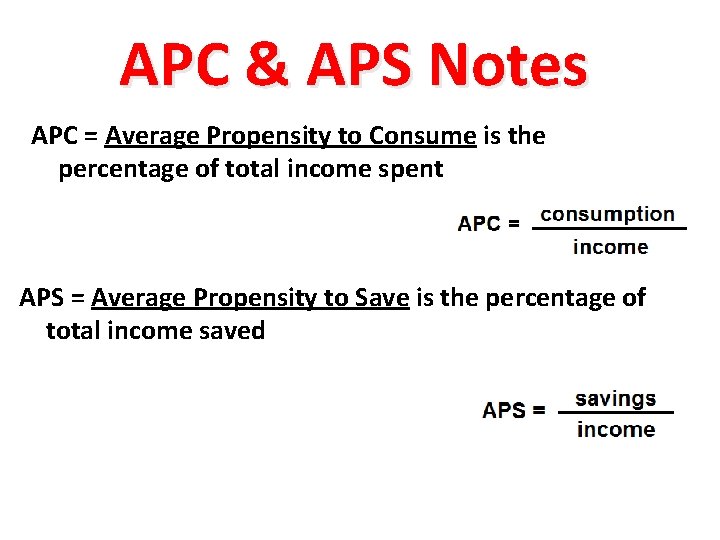
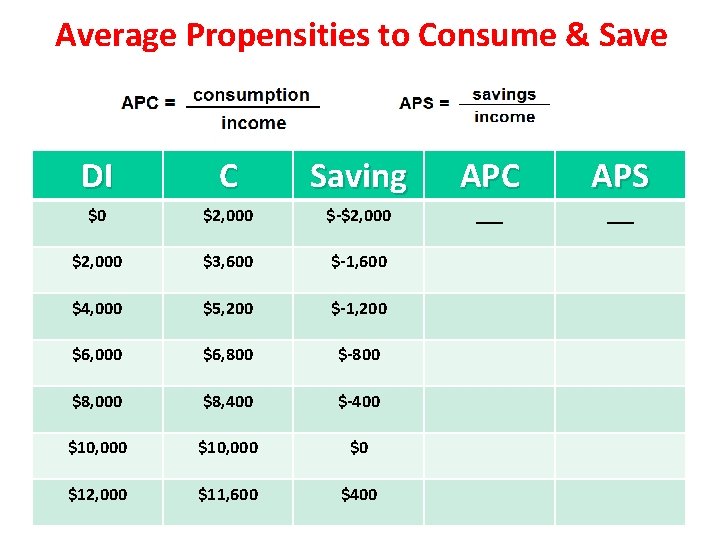
APC & APS Notes APC = Average Propensity to Consume is the percentage of total income spent APS = Average Propensity to Save is the percentage of total income saved
Average Propensities to Consume & Save DI C Saving APC APS $0 $2, 000 $-$2, 000 ___ $2, 000 $3, 600 $-1, 600 $4, 000 $5, 200 $-1, 200 $6, 000 $6, 800 $-800 $8, 000 $8, 400 $-400 $10, 000 $0 $12, 000 $11, 600 $400
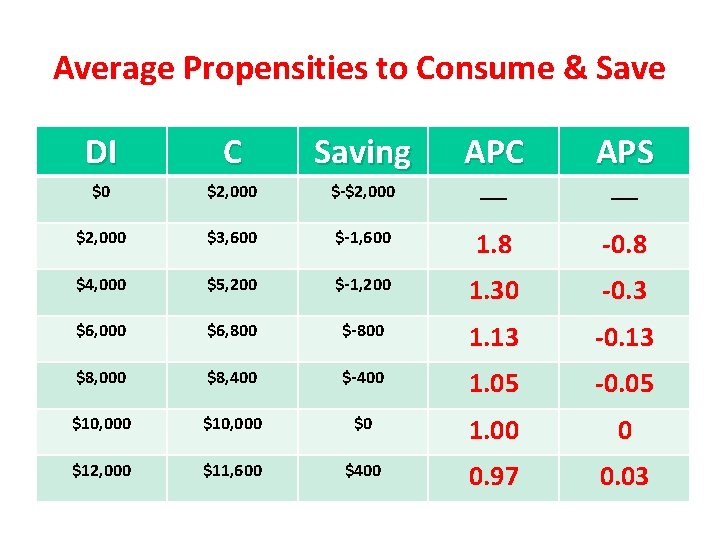
Average Propensities to Consume & Save DI C Saving APC APS $0 $2, 000 $-$2, 000 ___ $2, 000 $3, 600 $-1, 600 1. 8 -0. 8 $4, 000 $5, 200 $-1, 200 1. 30 -0. 3 $6, 000 $6, 800 $-800 1. 13 -0. 13 $8, 000 $8, 400 $-400 1. 05 -0. 05 $10, 000 $0 1. 00 0 $12, 000 $11, 600 $400 0. 97 0. 03
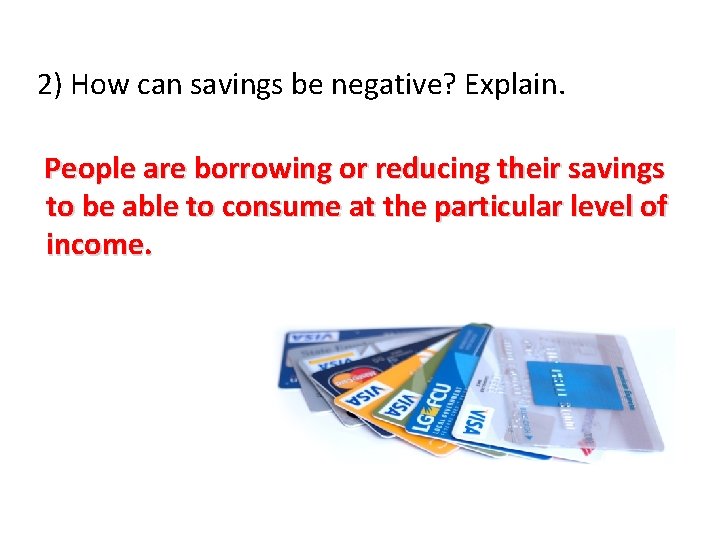
2) How can savings be negative? Explain. People are borrowing or reducing their savings to be able to consume at the particular level of income.
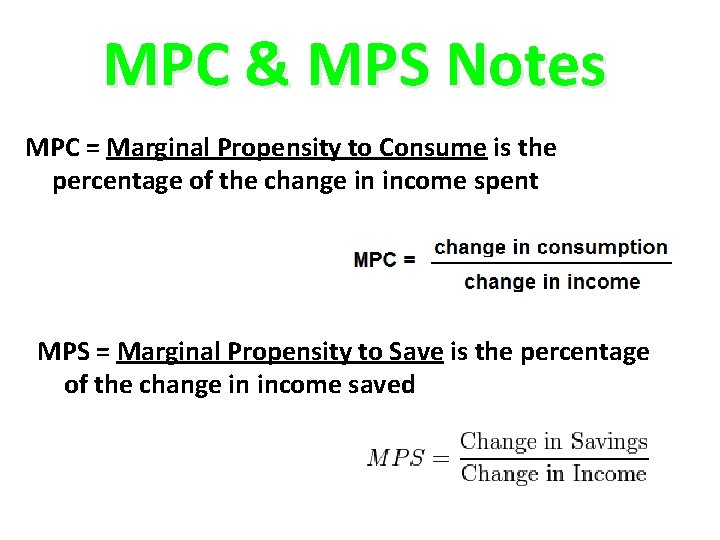
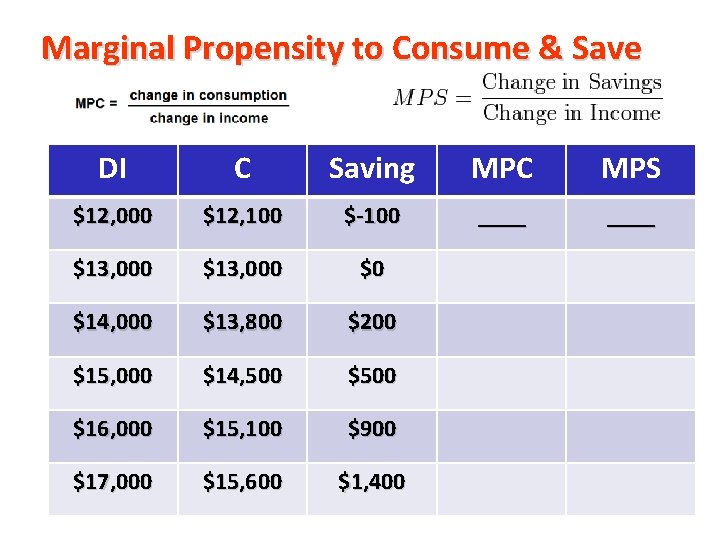
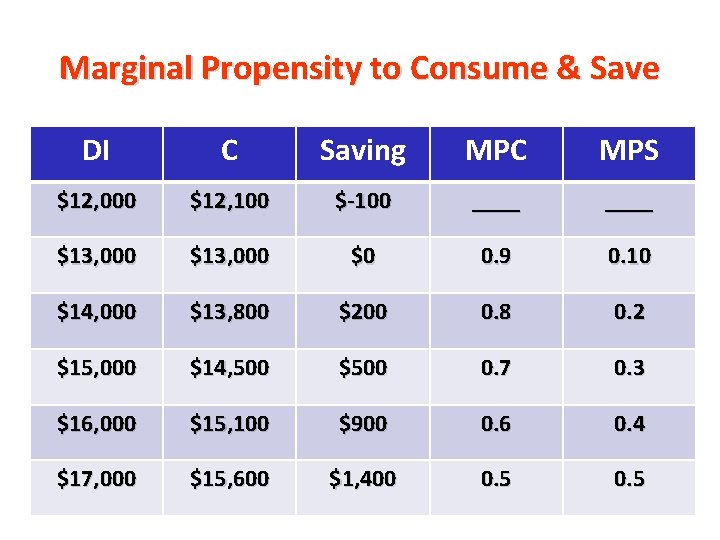
MPC & MPS Notes MPC = Marginal Propensity to Consume is the percentage of the change in income spent MPS = Marginal Propensity to Save is the percentage of the change in income saved
Marginal Propensity to Consume & Save DI C Saving MPC MPS $12, 000 $12, 100 $-100 ____ $13, 000 $0 $14, 000 $13, 800 $200 $15, 000 $14, 500 $16, 000 $15, 100 $900 $17, 000 $15, 600 $1, 400
Marginal Propensity to Consume & Save DI C Saving MPC MPS $12, 000 $12, 100 $-100 ____ $13, 000 $0 0. 9 0. 10 $14, 000 $13, 800 $200 0. 8 0. 2 $15, 000 $14, 500 $500 0. 7 0. 3 $16, 000 $15, 100 $900 0. 6 0. 4 $17, 000 $15, 600 $1, 400 0. 5
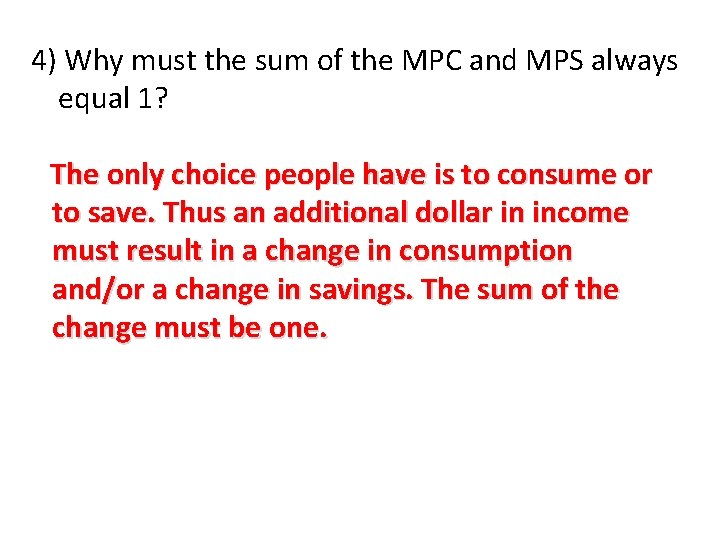
4) Why must the sum of the MPC and MPS always equal 1? The only choice people have is to consume or to save. Thus an additional dollar in income must result in a change in consumption and/or a change in savings. The sum of the change must be one.
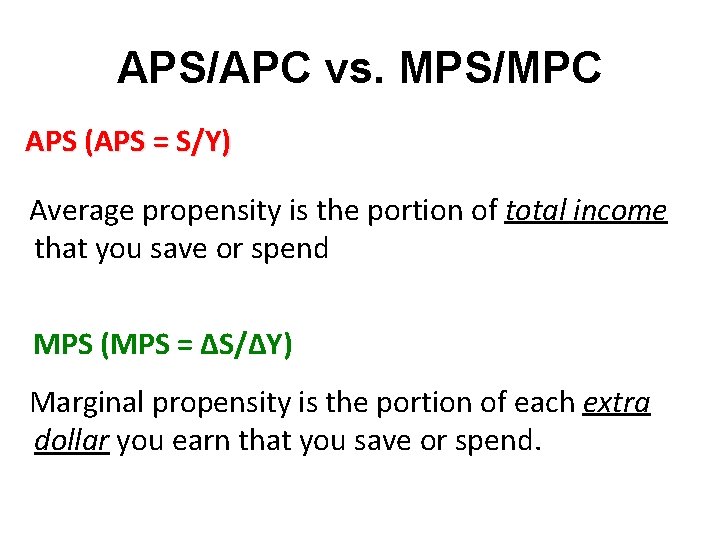
APS/APC vs. MPS/MPC APS (APS = S/Y) Average propensity is the portion of total income that you save or spend MPS (MPS = ∆S/∆Y) Marginal propensity is the portion of each extra dollar you earn that you save or spend.
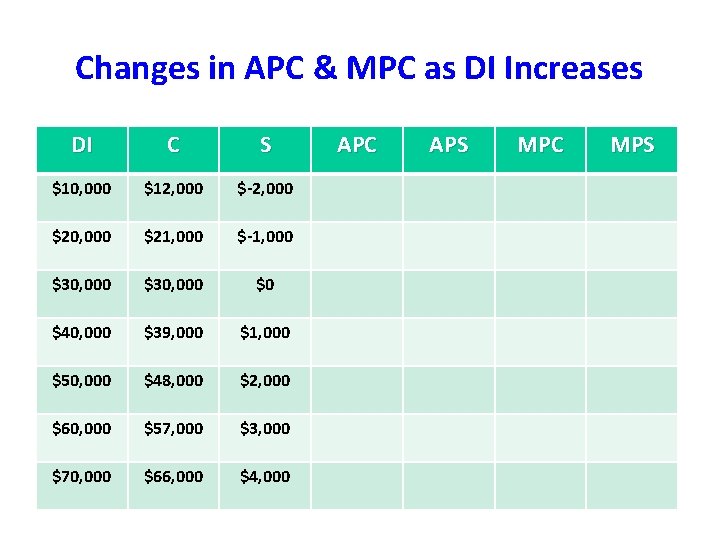
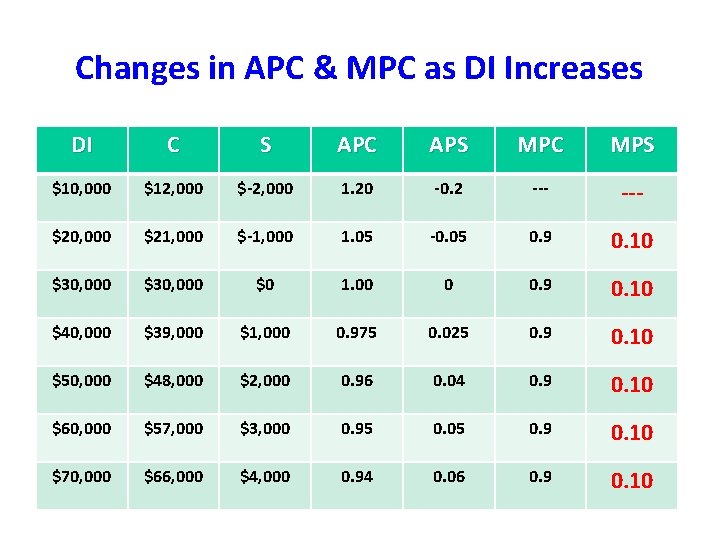
Changes in APC & MPC as DI Increases DI C S $10, 000 $12, 000 $-2, 000 $20, 000 $21, 000 $-1, 000 $30, 000 $0 $40, 000 $39, 000 $1, 000 $50, 000 $48, 000 $2, 000 $60, 000 $57, 000 $3, 000 $70, 000 $66, 000 $4, 000 APC APS MPC MPS
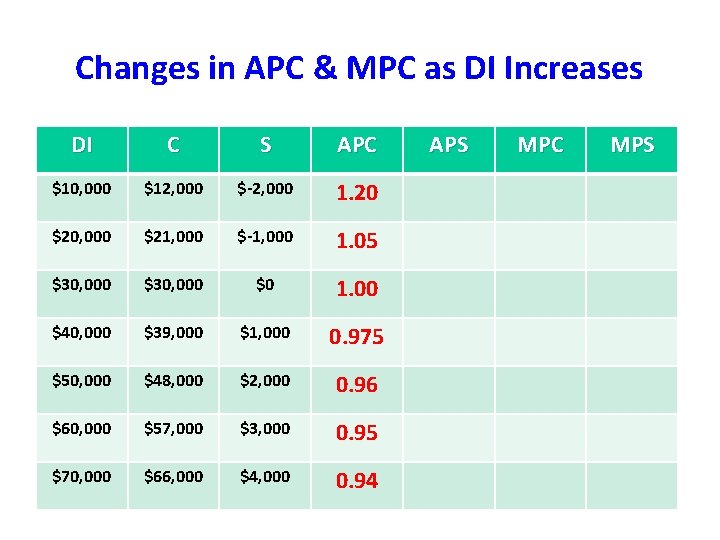
Changes in APC & MPC as DI Increases DI C S APC $10, 000 $12, 000 $-2, 000 1. 20 $20, 000 $21, 000 $-1, 000 1. 05 $30, 000 $0 1. 00 $40, 000 $39, 000 $1, 000 0. 975 $50, 000 $48, 000 $2, 000 0. 96 $60, 000 $57, 000 $3, 000 0. 95 $70, 000 $66, 000 $4, 000 0. 94 APS MPC MPS
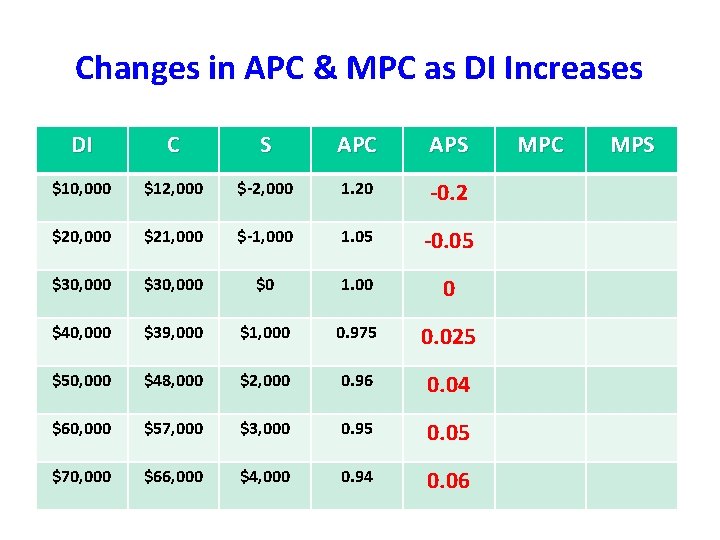
Changes in APC & MPC as DI Increases DI C S APC APS $10, 000 $12, 000 $-2, 000 1. 20 -0. 2 $20, 000 $21, 000 $-1, 000 1. 05 -0. 05 $30, 000 $0 1. 00 0 $40, 000 $39, 000 $1, 000 0. 975 0. 025 $50, 000 $48, 000 $2, 000 0. 96 0. 04 $60, 000 $57, 000 $3, 000 0. 95 0. 05 $70, 000 $66, 000 $4, 000 0. 94 0. 06 MPC MPS
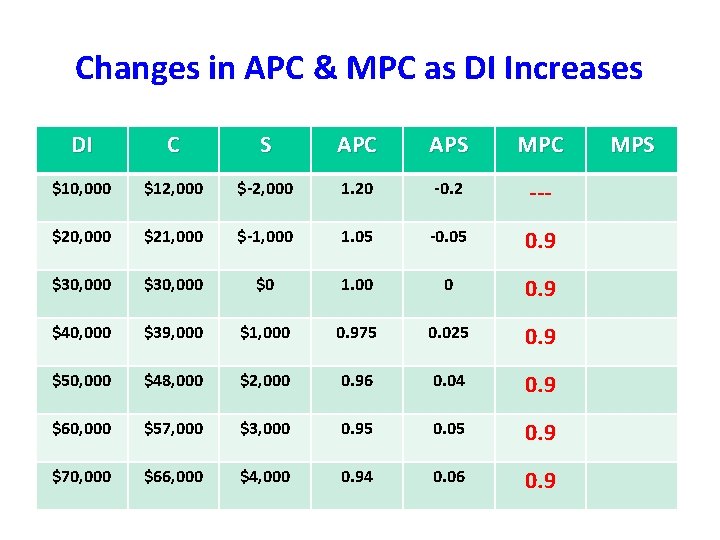
Changes in APC & MPC as DI Increases DI C S APC APS MPC $10, 000 $12, 000 $-2, 000 1. 20 -0. 2 --- $20, 000 $21, 000 $-1, 000 1. 05 -0. 05 0. 9 $30, 000 $0 1. 00 0 0. 9 $40, 000 $39, 000 $1, 000 0. 975 0. 025 0. 9 $50, 000 $48, 000 $2, 000 0. 96 0. 04 0. 9 $60, 000 $57, 000 $3, 000 0. 95 0. 05 0. 9 $70, 000 $66, 000 $4, 000 0. 94 0. 06 0. 9 MPS
Changes in APC & MPC as DI Increases DI C S APC APS MPC MPS $10, 000 $12, 000 $-2, 000 1. 20 -0. 2 --- $20, 000 $21, 000 $-1, 000 1. 05 -0. 05 0. 9 0. 10 $30, 000 $0 1. 00 0 0. 9 0. 10 $40, 000 $39, 000 $1, 000 0. 975 0. 025 0. 9 0. 10 $50, 000 $48, 000 $2, 000 0. 96 0. 04 0. 9 0. 10 $60, 000 $57, 000 $3, 000 0. 95 0. 05 0. 9 0. 10 $70, 000 $66, 000 $4, 000 0. 94 0. 06 0. 9 0. 10
Too little or too much? Spending & Tax Multipliers
Spending Multiplier Spending our way to prosperity!
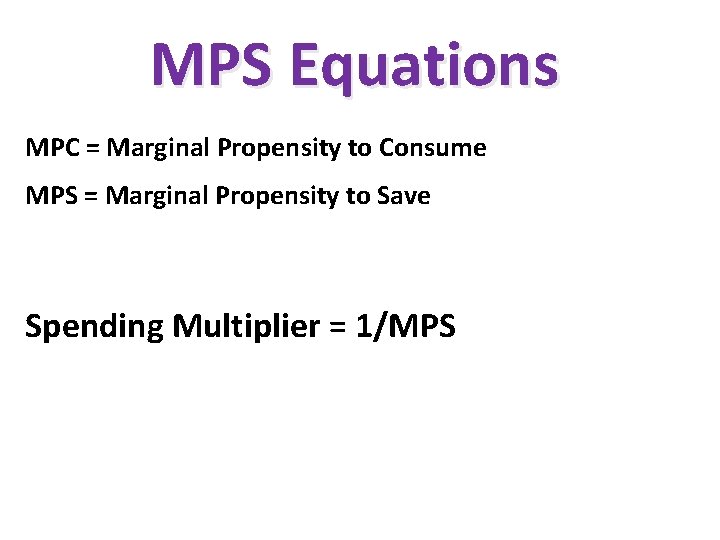
MPS Equations MPC = Marginal Propensity to Consume MPS = Marginal Propensity to Save Spending Multiplier = 1/MPS
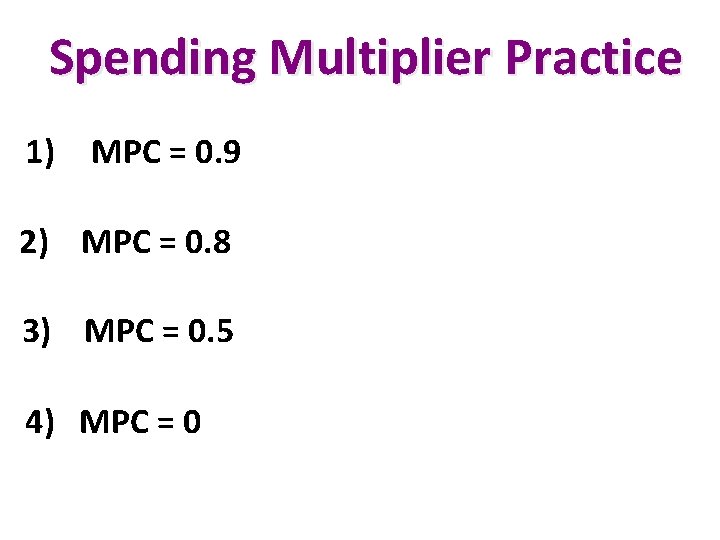
Spending Multiplier Practice 1) MPC = 0. 9 2) MPC = 0. 8 3) MPC = 0. 5 4) MPC = 0
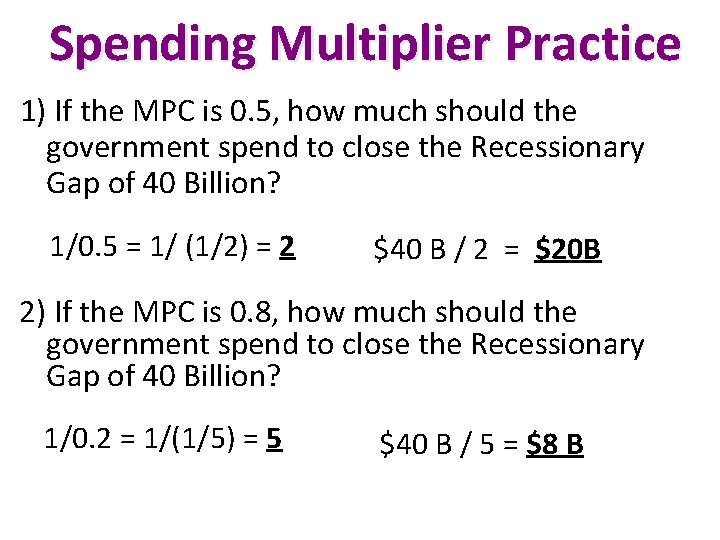
Spending Multiplier Practice 1) If the MPC is 0. 5, how much should the government spend to close the Recessionary Gap of 40 Billion? 1/0. 5 = 1/ (1/2) = 2 $40 B / 2 = $20 B 2) If the MPC is 0. 8, how much should the government spend to close the Recessionary Gap of 40 Billion? 1/0. 2 = 1/(1/5) = 5 $40 B / 5 = $8 B
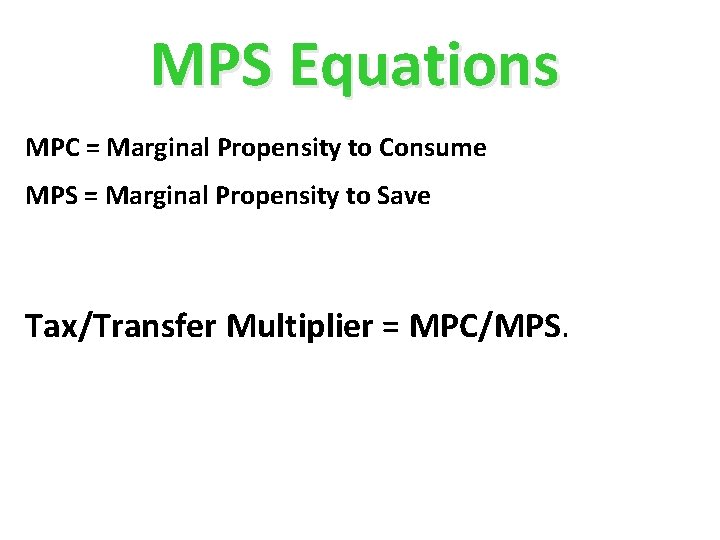
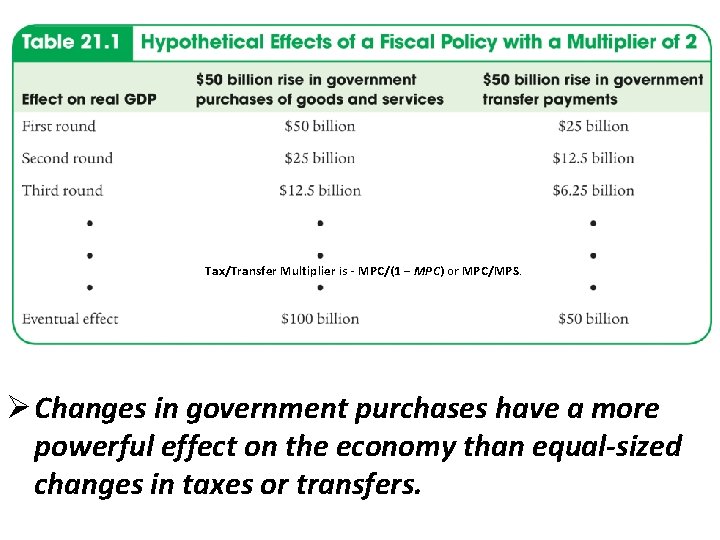
MPS Equations MPC = Marginal Propensity to Consume MPS = Marginal Propensity to Save Tax/Transfer Multiplier = MPC/MPS.
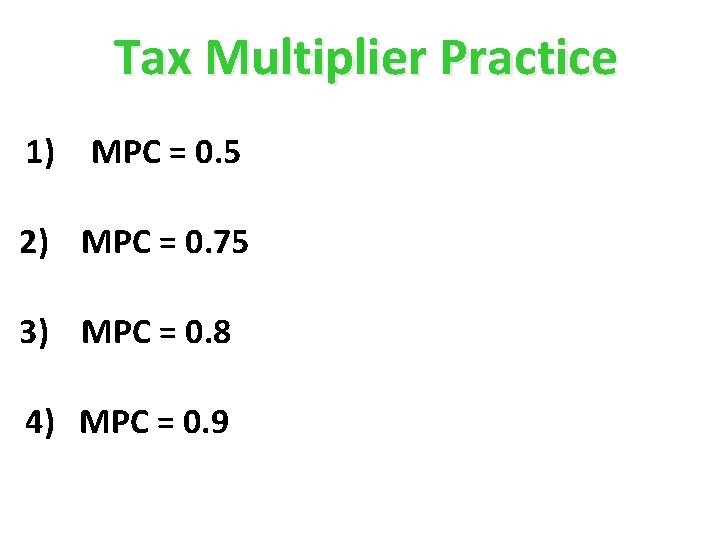
Tax Multiplier Practice 1) MPC = 0. 5 2) MPC = 0. 75 3) MPC = 0. 8 4) MPC = 0. 9
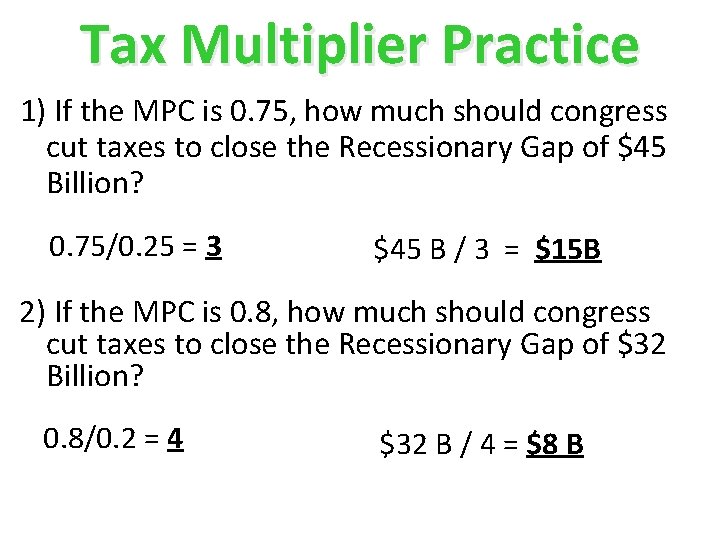
Tax Multiplier Practice 1) If the MPC is 0. 75, how much should congress cut taxes to close the Recessionary Gap of $45 Billion? 0. 75/0. 25 = 3 $45 B / 3 = $15 B 2) If the MPC is 0. 8, how much should congress cut taxes to close the Recessionary Gap of $32 Billion? 0. 8/0. 2 = 4 $32 B / 4 = $8 B
Tax/Transfer Multiplier is - MPC/(1 − MPC) or MPC/MPS. Ø Changes in government purchases have a more powerful effect on the economy than equal-sized changes in taxes or transfers.