
Introduction to Apache Spark Patrick Wendell Databricks What
Introduction to Apache Spark Patrick Wendell - Databricks
What is Spark? Fast and Expressive Cluster Computing Engine Compatible with Apache Hadoop 10× faster o 100× in m n disk, 2 -5× less emory code Efficient Usable Up to • General execution graphs • In-memory storage • Rich APIs in Java, Scala, Python • Interactive shell
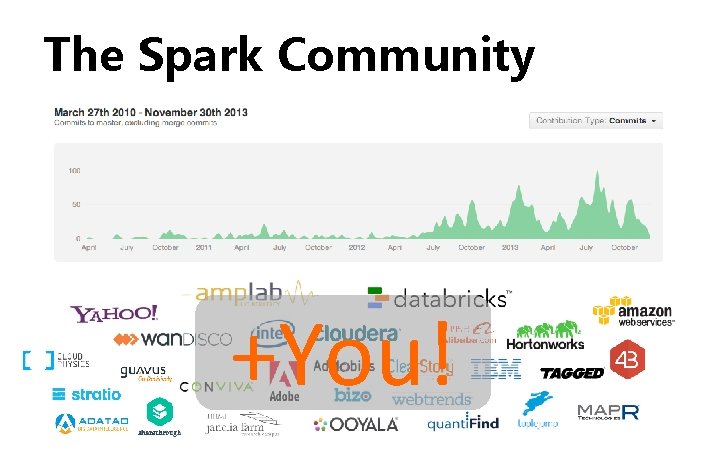
The Spark Community +You!
Today’s Talk • The Spark programming model • Language and deployment choices • Example algorithm (Page. Rank)
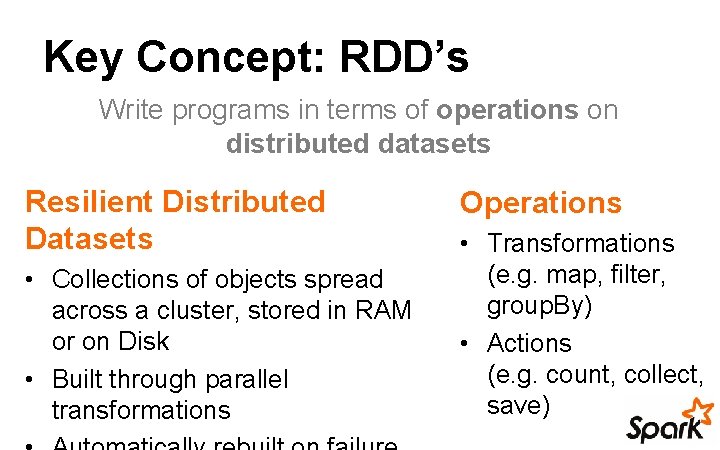
Key Concept: RDD’s Write programs in terms of operations on distributed datasets Resilient Distributed Datasets • Collections of objects spread across a cluster, stored in RAM or on Disk • Built through parallel transformations Operations • Transformations (e. g. map, filter, group. By) • Actions (e. g. count, collect, save)
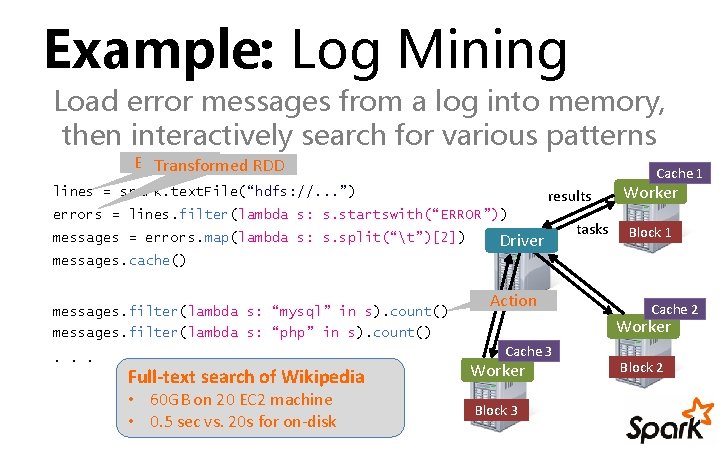
Example: Log Mining Load error messages from a log into memory, then interactively search for various patterns Base RDD Transformed RDD Cache 1 lines = spark. text. File(“hdfs: //. . . ”) results errors = lines. filter(lambda s: s. startswith(“ERROR”)) messages = errors. map(lambda s: s. split(“t”)[2]) Driver tasks Worker Block 1 messages. cache() messages. filter(lambda s: “mysql” in s). count() Action Worker messages. filter(lambda s: “php” in s). count(). . . Cache 3 Full-text search of Wikipedia • 60 GB on 20 EC 2 machine • 0. 5 sec vs. 20 s for on-disk Cache 2 Worker Block 3 Block 2
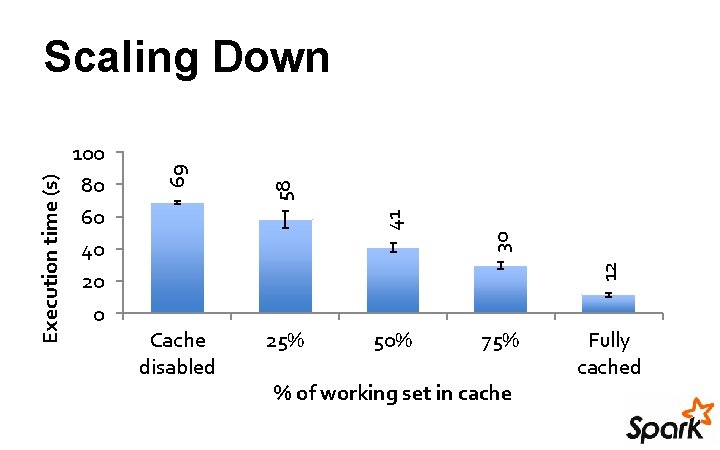
12 30 41 58 100 80 60 40 20 0 69 Execution time (s) Scaling Down Cache disabled 25% 50% 75% % of working set in cache Fully cached
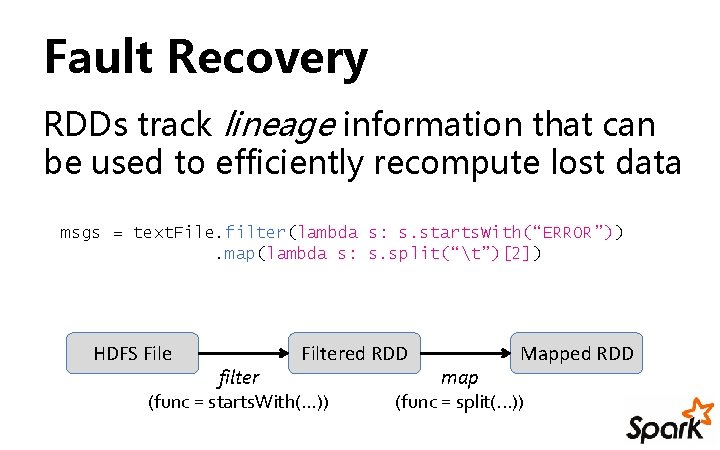
Fault Recovery RDDs track lineage information that can be used to efficiently recompute lost data msgs = text. File. filter(lambda s: s. starts. With(“ERROR”)). map(lambda s: s. split(“t”)[2]) HDFS File Filtered RDD filter (func = starts. With(…)) Mapped RDD map (func = split(. . . ))
Programming with RDD’s
Spark. Context • Main entry point to Spark functionality • Available in shell as variable sc • In standalone programs, you’d make your own (see later for details)
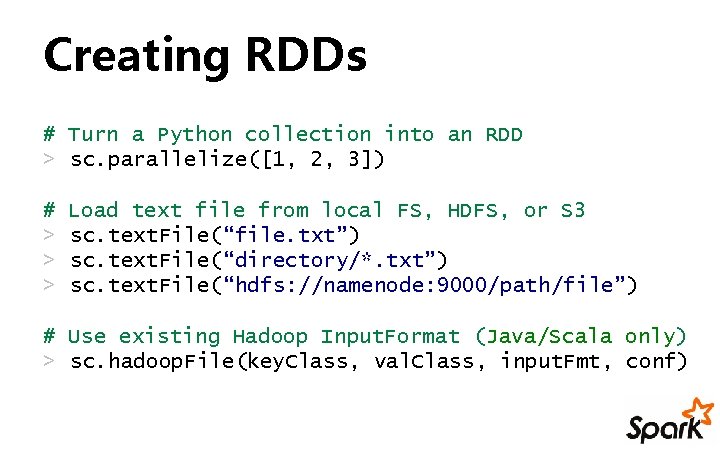
Creating RDDs # Turn a Python collection into an RDD > sc. parallelize([1, 2, 3]) # > > > Load text file from local FS, HDFS, or S 3 sc. text. File(“file. txt”) sc. text. File(“directory/*. txt”) sc. text. File(“hdfs: //namenode: 9000/path/file”) # Use existing Hadoop Input. Format (Java/Scala only) > sc. hadoop. File(key. Class, val. Class, input. Fmt, conf)
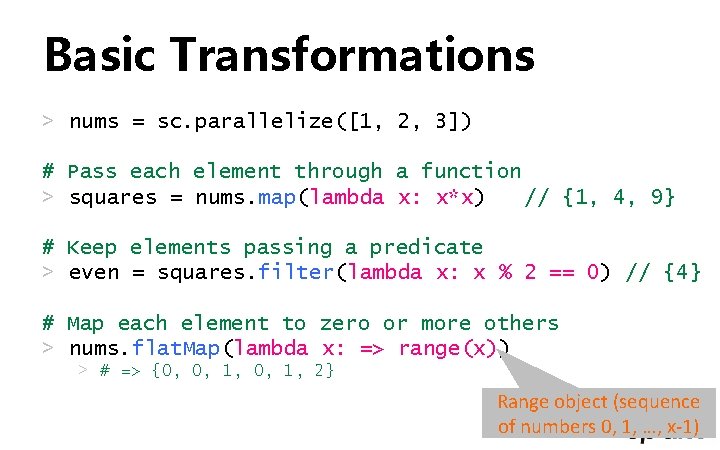
Basic Transformations > nums = sc. parallelize([1, 2, 3]) # Pass each element through a function > squares = nums. map(lambda x: x*x) // {1, 4, 9} # Keep elements passing a predicate > even = squares. filter(lambda x: x % 2 == 0) // {4} # Map each element to zero or more others > nums. flat. Map(lambda x: => range(x)) > # => {0, 0, 1, 2} Range object (sequence of numbers 0, 1, …, x-1)
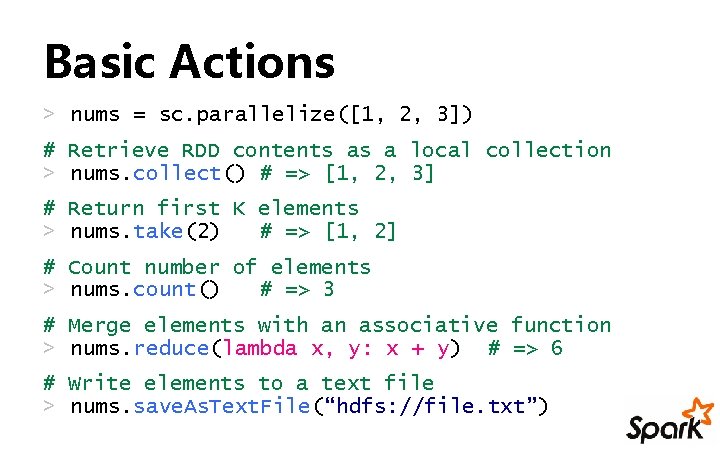
Basic Actions > nums = sc. parallelize([1, 2, 3]) # Retrieve RDD contents as a local collection > nums. collect() # => [1, 2, 3] # Return first K elements > nums. take(2) # => [1, 2] # Count number of elements > nums. count() # => 3 # Merge elements with an associative function > nums. reduce(lambda x, y: x + y) # => 6 # Write elements to a text file > nums. save. As. Text. File(“hdfs: //file. txt”)
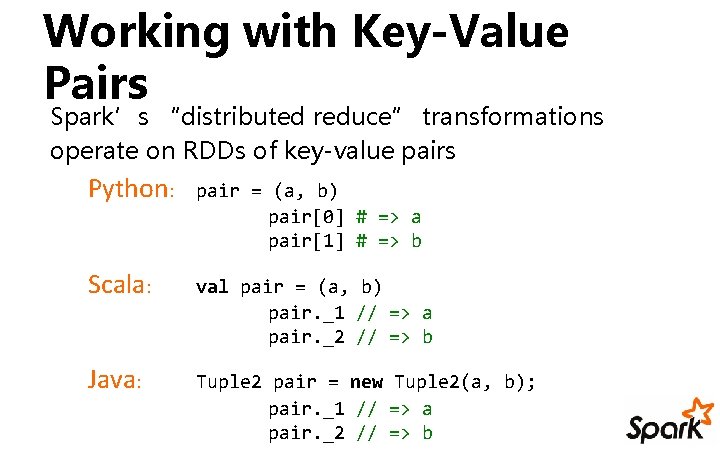
Working with Key-Value Pairs Spark’s “distributed reduce” transformations operate on RDDs of key-value pairs Python: pair = (a, b) pair[0] # => a pair[1] # => b Scala: val pair = (a, b) pair. _1 // => a pair. _2 // => b Java: Tuple 2 pair = new Tuple 2(a, b); pair. _1 // => a pair. _2 // => b
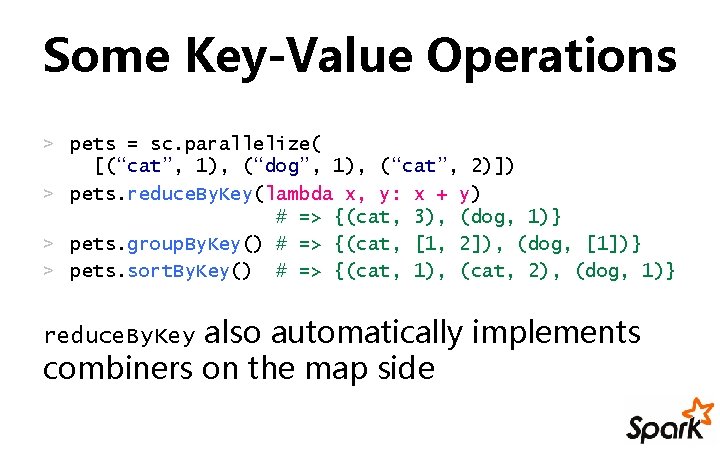
Some Key-Value Operations > pets = sc. parallelize( [(“cat”, 1), (“dog”, 1), (“cat”, 2)]) > pets. reduce. By. Key(lambda x, y: x + y) # => {(cat, 3), (dog, 1)} > pets. group. By. Key() # => {(cat, [1, 2]), (dog, [1])} > pets. sort. By. Key() # => {(cat, 1), (cat, 2), (dog, 1)} also automatically implements combiners on the map side reduce. By. Key
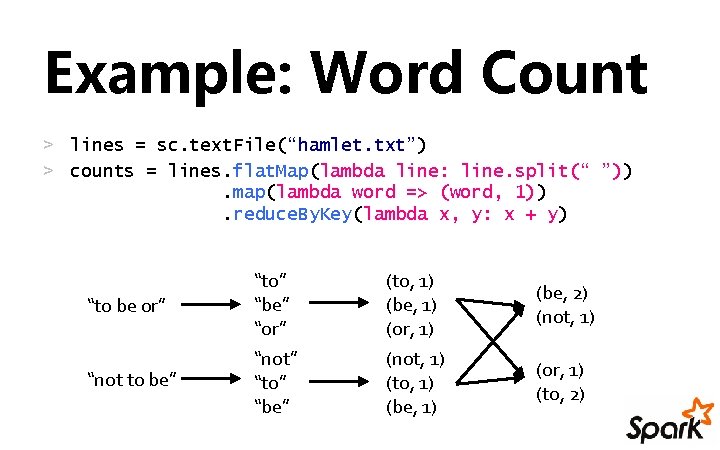
Example: Word Count > lines = sc. text. File(“hamlet. txt”) > counts = lines. flat. Map(lambda line: line. split(“ ”)). map(lambda word => (word, 1)). reduce. By. Key(lambda x, y: x + y) “to be or” “not to be” “to” “be” “or” “not” “to” “be” (to, 1) (be, 1) (or, 1) (not, 1) (to, 1) (be, 2) (not, 1) (or, 1) (to, 2)
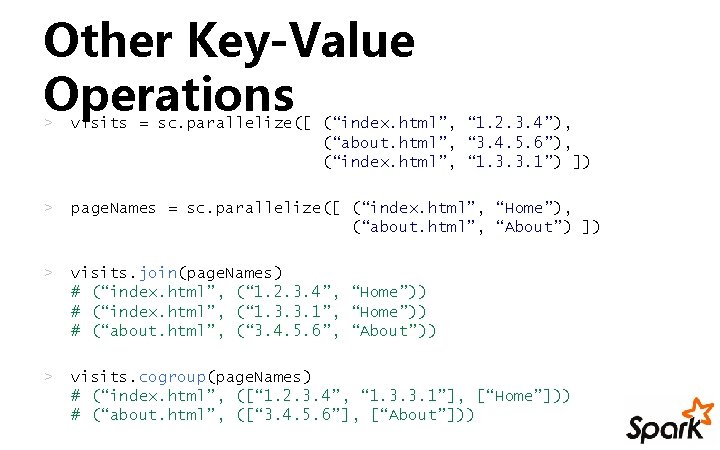
Other Key-Value Operations > visits = sc. parallelize([ (“index. html”, “ 1. 2. 3. 4”), (“about. html”, “ 3. 4. 5. 6”), (“index. html”, “ 1. 3. 3. 1”) ]) > page. Names = sc. parallelize([ (“index. html”, “Home”), (“about. html”, “About”) ]) > visits. join(page. Names) # (“index. html”, (“ 1. 2. 3. 4”, “Home”)) # (“index. html”, (“ 1. 3. 3. 1”, “Home”)) # (“about. html”, (“ 3. 4. 5. 6”, “About”)) > visits. cogroup(page. Names) # (“index. html”, ([“ 1. 2. 3. 4”, “ 1. 3. 3. 1”], [“Home”])) # (“about. html”, ([“ 3. 4. 5. 6”], [“About”]))
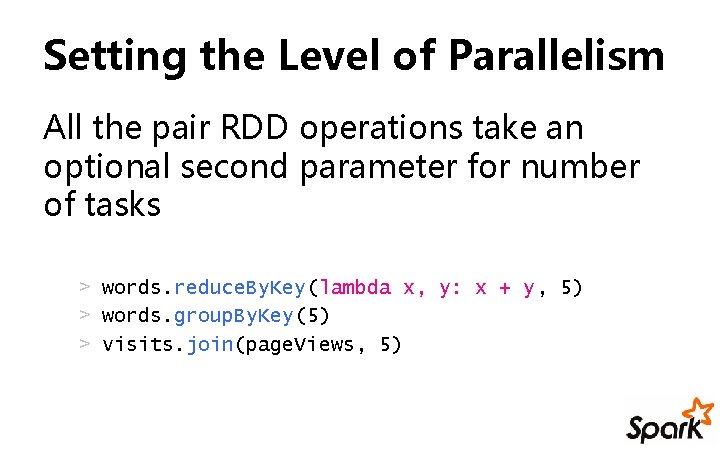
Setting the Level of Parallelism All the pair RDD operations take an optional second parameter for number of tasks > words. reduce. By. Key(lambda x, y: x + y, 5) > words. group. By. Key(5) > visits. join(page. Views, 5)
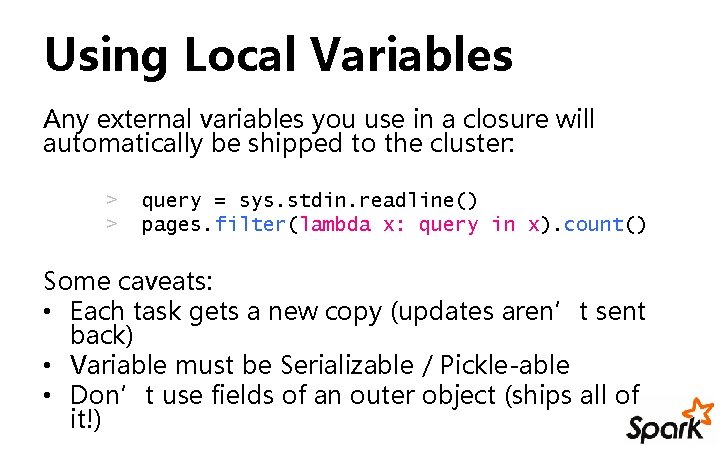
Using Local Variables Any external variables you use in a closure will automatically be shipped to the cluster: > > query = sys. stdin. readline() pages. filter(lambda x: query in x). count() Some caveats: • Each task gets a new copy (updates aren’t sent back) • Variable must be Serializable / Pickle-able • Don’t use fields of an outer object (ships all of it!)
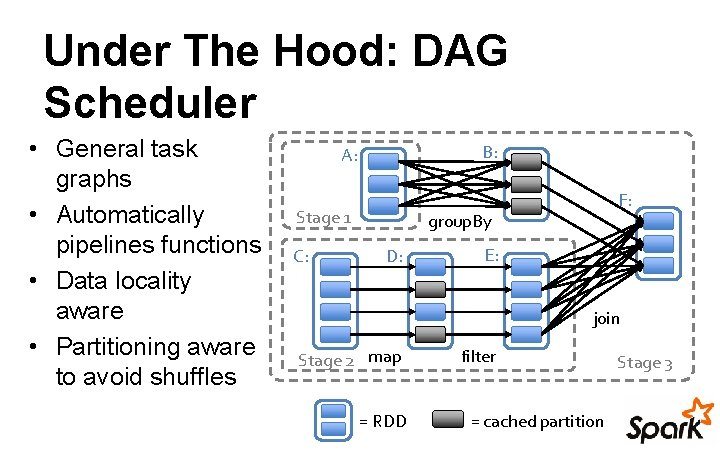
Under The Hood: DAG Scheduler • General task graphs • Automatically pipelines functions • Data locality aware • Partitioning aware to avoid shuffles B: A: Stage 1 C: F: group. By D: E: join Stage 2 map = RDD filter = cached partition Stage 3
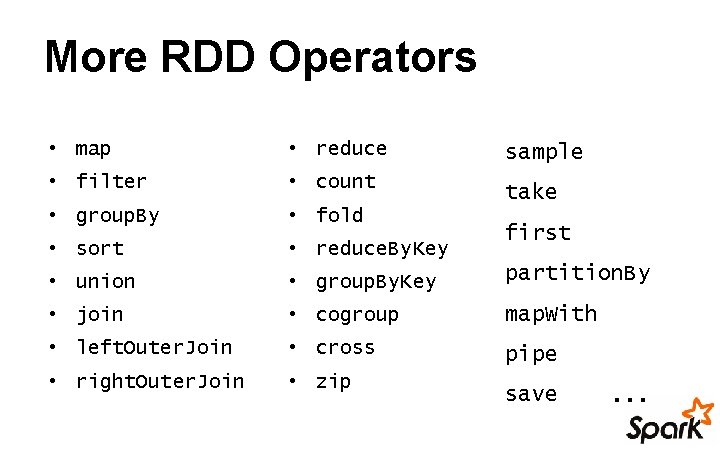
More RDD Operators • map • reduce • filter • count • group. By • fold • sort • reduce. By. Key • union • group. By. Key partition. By • join • cogroup map. With • left. Outer. Join • cross pipe • right. Outer. Join • zip sample take first save . . .
How to Run Spark
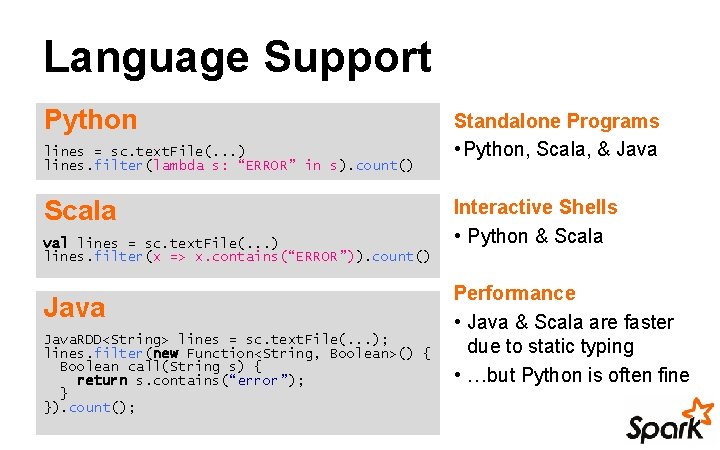
Language Support Python lines = sc. text. File(. . . ) lines. filter(lambda s: “ERROR” in s). count() Scala val lines = sc. text. File(. . . ) lines. filter(x => x. contains(“ERROR”)). count() Java. RDD<String> lines = sc. text. File(. . . ); lines. filter(new Function<String, Boolean>() { Boolean call(String s) { return s. contains(“error”); } }). count(); Standalone Programs • Python, Scala, & Java Interactive Shells • Python & Scala Performance • Java & Scala are faster due to static typing • …but Python is often fine
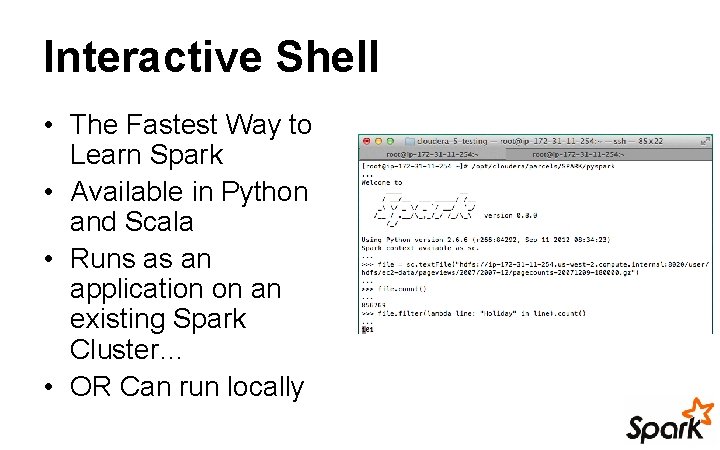
Interactive Shell • The Fastest Way to Learn Spark • Available in Python and Scala • Runs as an application on an existing Spark Cluster… • OR Can run locally
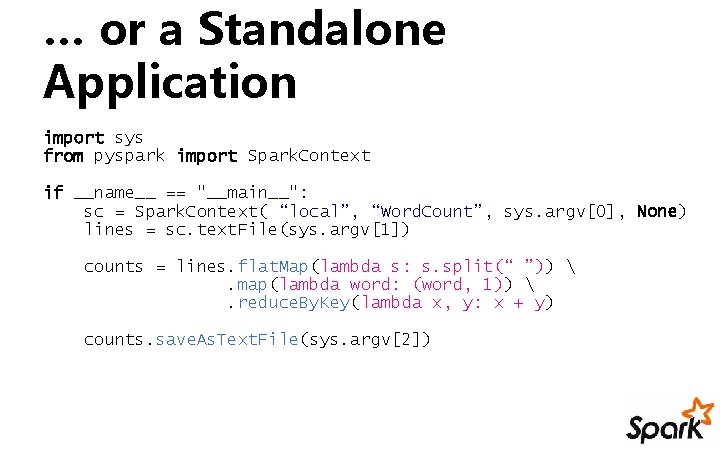
… or a Standalone Application import sys from pyspark import Spark. Context if __name__ == "__main__": sc = Spark. Context( “local”, “Word. Count”, sys. argv[0], None) lines = sc. text. File(sys. argv[1]) counts = lines. flat. Map(lambda s: s. split(“ ”)) . map(lambda word: (word, 1)) . reduce. By. Key(lambda x, y: x + y) counts. save. As. Text. File(sys. argv[2])
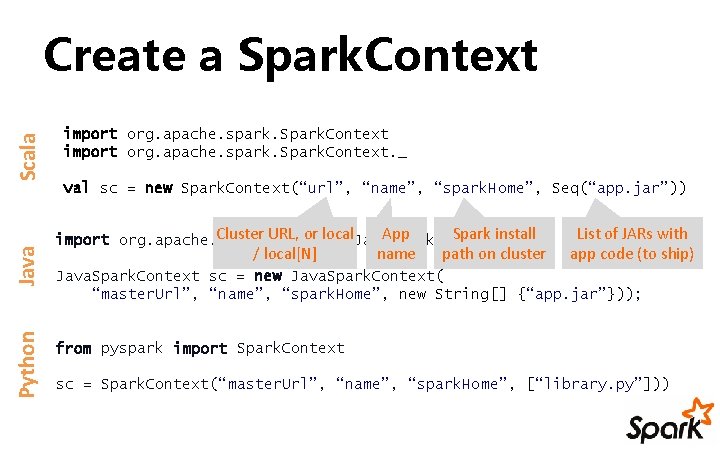
Python Java Scala Create a Spark. Context import org. apache. spark. Spark. Context. _ val sc = new Spark. Context(“url”, “name”, “spark. Home”, Seq(“app. jar”)) Cluster URL, or local App Spark install import org. apache. spark. api. java. Java. Spark. Context; / local[N] name path on cluster List of JARs with app code (to ship) Java. Spark. Context sc = new Java. Spark. Context( “master. Url”, “name”, “spark. Home”, new String[] {“app. jar”})); from pyspark import Spark. Context sc = Spark. Context(“master. Url”, “name”, “spark. Home”, [“library. py”]))
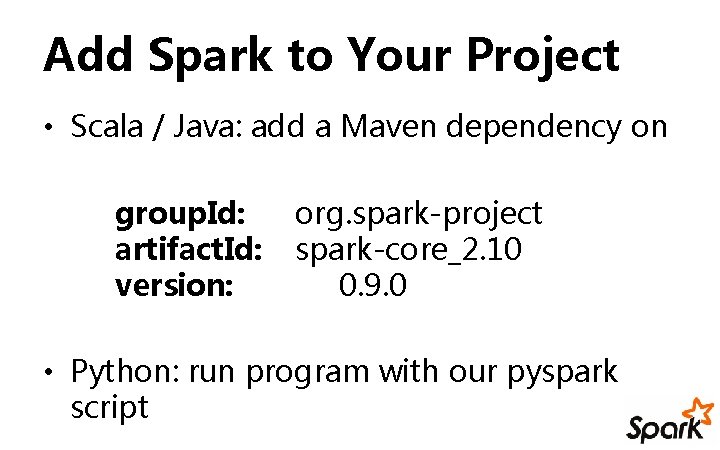
Add Spark to Your Project • Scala / Java: add a Maven dependency on group. Id: artifact. Id: version: org. spark-project spark-core_2. 10 0. 9. 0 • Python: run program with our pyspark script
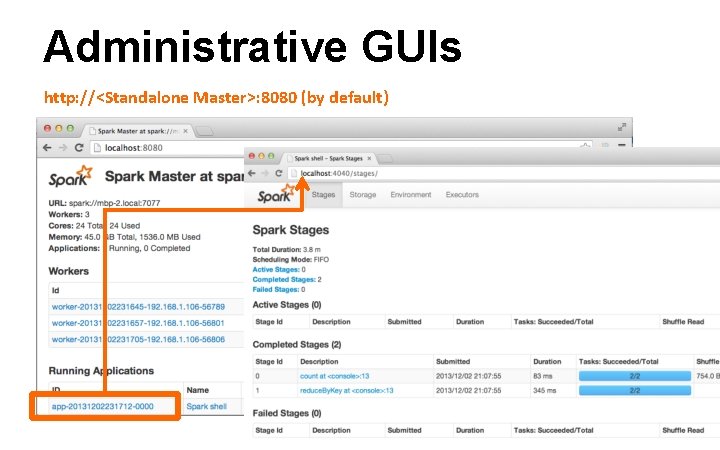
Administrative GUIs http: //<Standalone Master>: 8080 (by default)
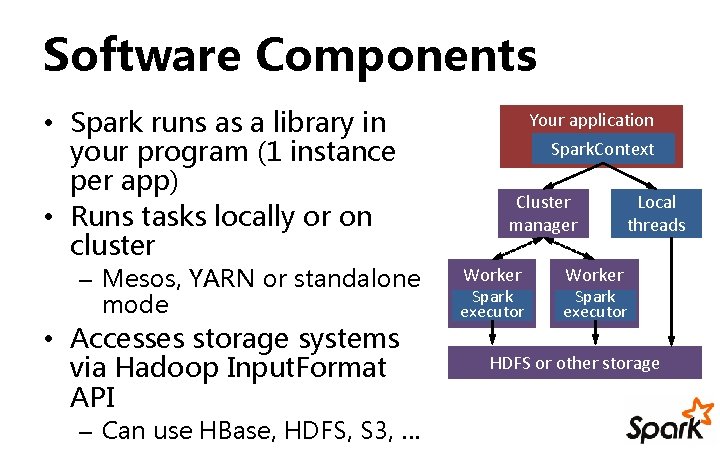
Software Components • Spark runs as a library in your program (1 instance per app) • Runs tasks locally or on cluster – Mesos, YARN or standalone mode • Accesses storage systems via Hadoop Input. Format API – Can use HBase, HDFS, S 3, … Your application Spark. Context Cluster manager Worker Spark executor Local threads Worker Spark executor HDFS or other storage
EXAMPLE APPLICATION: PAGERANK
Example: Page. Rank • Good example of a more complex algorithm – Multiple stages of map & reduce • Benefits from Spark’s in-memory caching – Multiple iterations over the same data
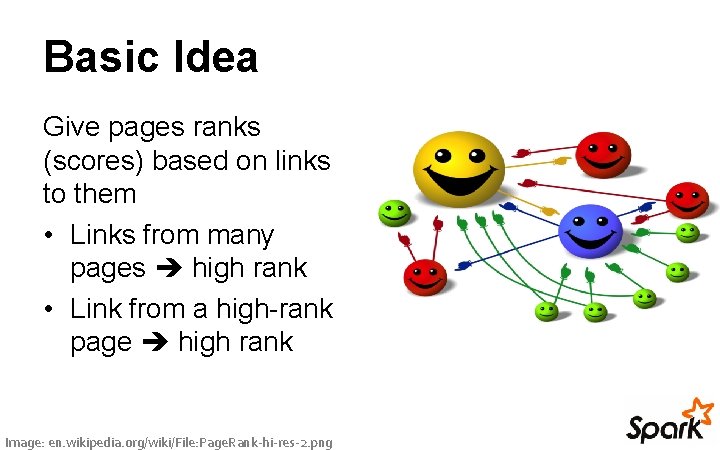
Basic Idea Give pages ranks (scores) based on links to them • Links from many pages high rank • Link from a high-rank page high rank Image: en. wikipedia. org/wiki/File: Page. Rank-hi-res-2. png
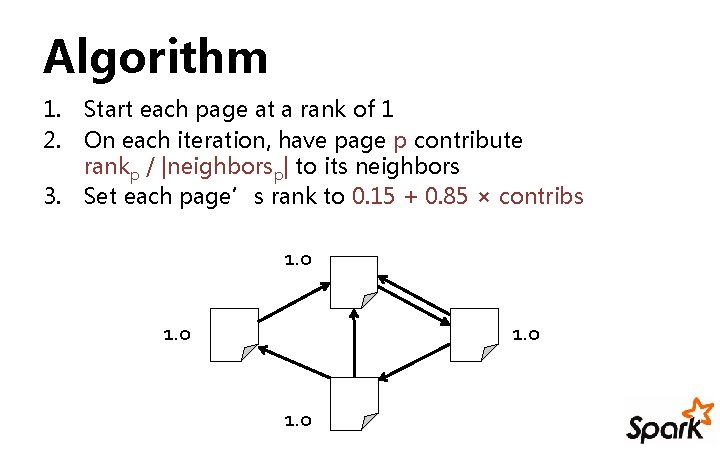
Algorithm 1. Start each page at a rank of 1 2. On each iteration, have page p contribute rankp / |neighborsp| to its neighbors 3. Set each page’s rank to 0. 15 + 0. 85 × contribs 1. 0
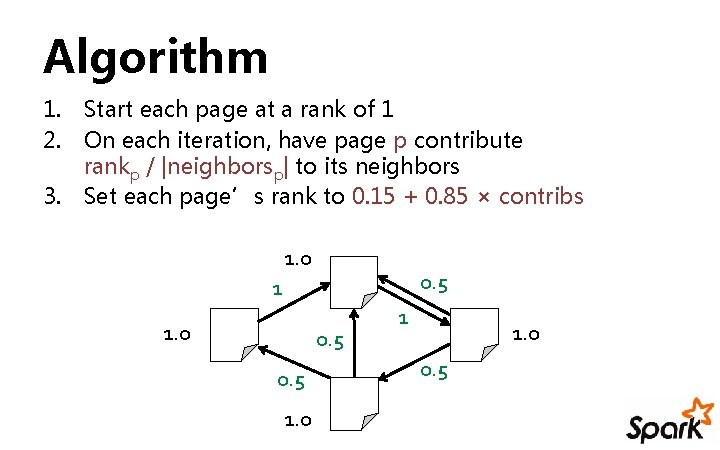
Algorithm 1. Start each page at a rank of 1 2. On each iteration, have page p contribute rankp / |neighborsp| to its neighbors 3. Set each page’s rank to 0. 15 + 0. 85 × contribs 1. 0 0. 5 1. 0 1 1. 0 0. 5
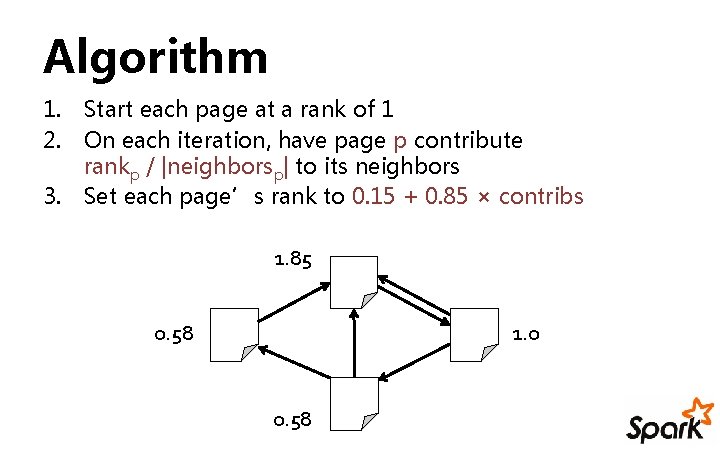
Algorithm 1. Start each page at a rank of 1 2. On each iteration, have page p contribute rankp / |neighborsp| to its neighbors 3. Set each page’s rank to 0. 15 + 0. 85 × contribs 1. 85 1. 0 0. 58
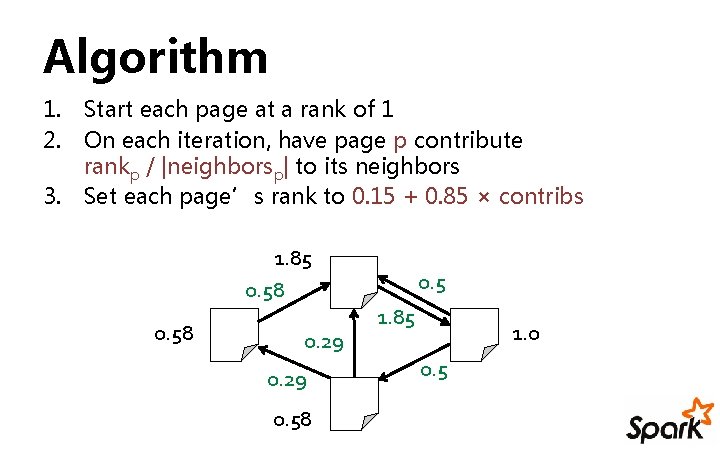
Algorithm 1. Start each page at a rank of 1 2. On each iteration, have page p contribute rankp / |neighborsp| to its neighbors 3. Set each page’s rank to 0. 15 + 0. 85 × contribs 1. 85 0. 58 0. 29 0. 58 0. 5 1. 85 1. 0 0. 5
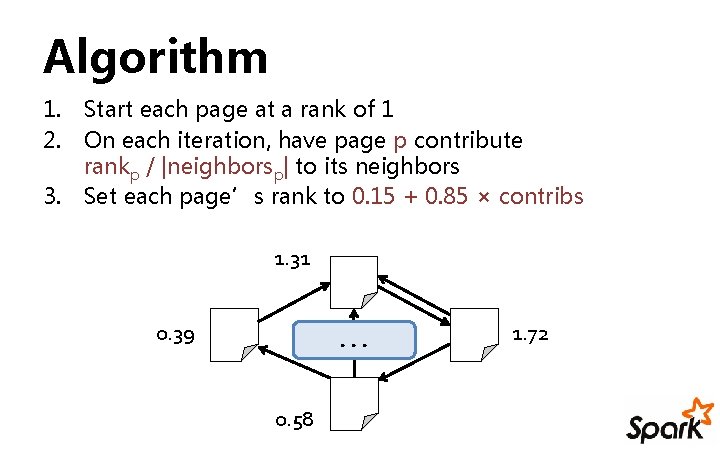
Algorithm 1. Start each page at a rank of 1 2. On each iteration, have page p contribute rankp / |neighborsp| to its neighbors 3. Set each page’s rank to 0. 15 + 0. 85 × contribs 1. 31 0. 39 . . . 0. 58 1. 72
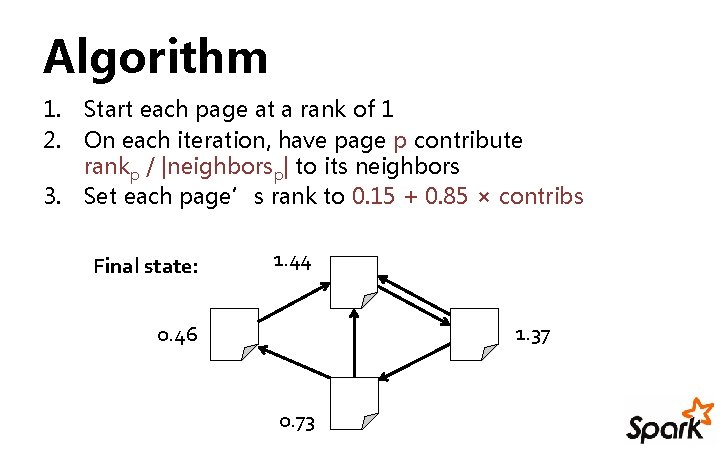
Algorithm 1. Start each page at a rank of 1 2. On each iteration, have page p contribute rankp / |neighborsp| to its neighbors 3. Set each page’s rank to 0. 15 + 0. 85 × contribs Final state: 1. 44 1. 37 0. 46 0. 73
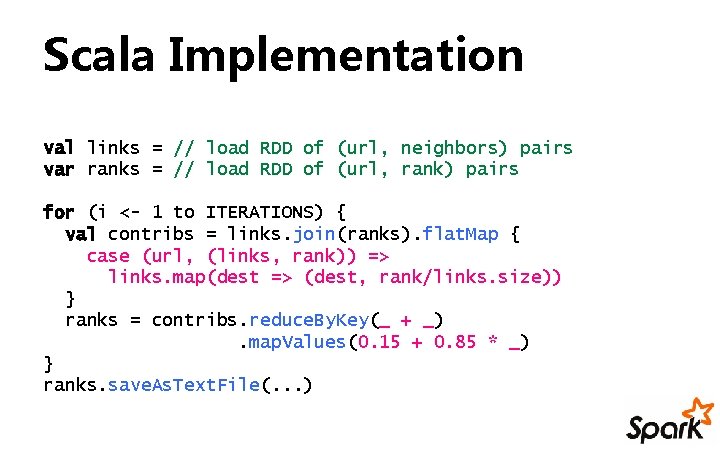
Scala Implementation val links = // load RDD of (url, neighbors) pairs var ranks = // load RDD of (url, rank) pairs for (i <- 1 to ITERATIONS) { val contribs = links. join(ranks). flat. Map { case (url, (links, rank)) => links. map(dest => (dest, rank/links. size)) } ranks = contribs. reduce. By. Key(_ + _). map. Values(0. 15 + 0. 85 * _) } ranks. save. As. Text. File(. . . )
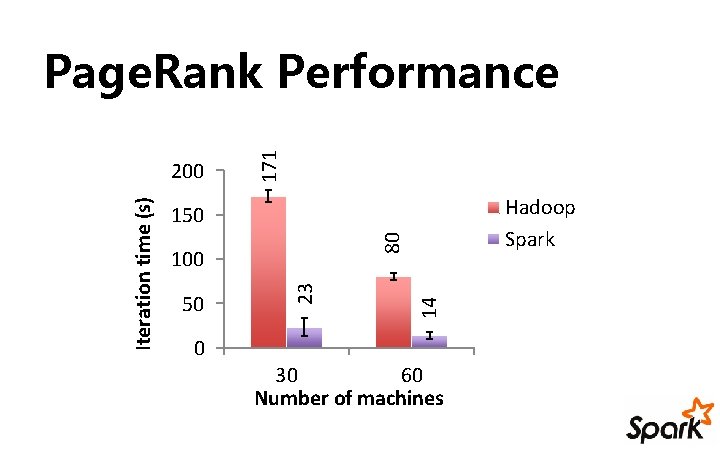
Hadoop Spark 100 50 0 14 80 150 23 Iteration time (s) 200 171 Page. Rank Performance 30 60 Number of machines
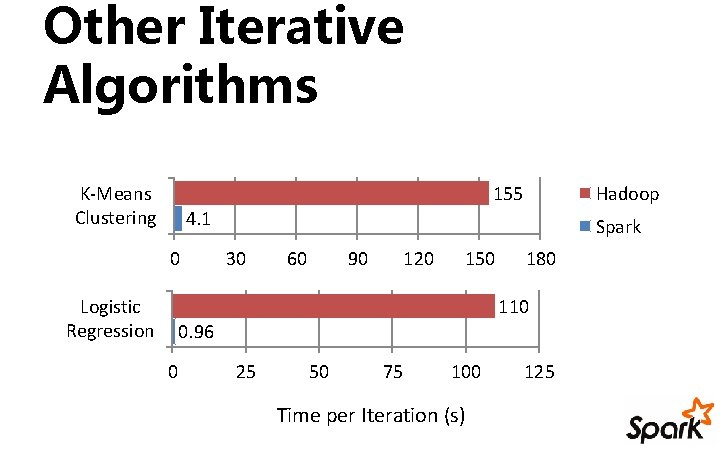
Other Iterative Algorithms 155 K-Means Clustering Hadoop 4. 1 0 Spark 30 60 90 120 150 180 110 Logistic Regression 0. 96 0 25 50 75 100 Time per Iteration (s) 125
CONCLUSION
Conclusion • Spark offers a rich API to make data analytics fast: both fast to write and fast to run • Achieves 100 x speedups in real applications • Growing community with 25+ companies contributing
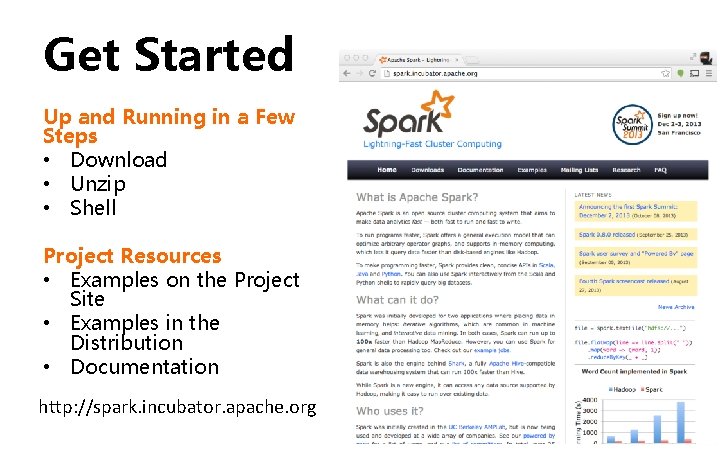
Get Started Up and Running in a Few Steps • Download • Unzip • Shell Project Resources • Examples on the Project Site • Examples in the Distribution • Documentation http: //spark. incubator. apache. org
Datasets And Dataframes • https: //spark. apache. org/docs/latest/sq l-programming-guide. html
Dataset • A Dataset is a distributed collection of data. – Like RDDs: Strong typing, ability to use powerful lambda functions – Plus the benefits of Spark SQL’s optimized execution engine. – A Dataset can be constructed from JVM objects and then manipulated using functional transformations (map, flat. Map, filter, etc. ). – The Dataset API is available in Scala and Java. – Python does not have the support for the Dataset API. But due to Python’s dynamic nature, many of the benefits of the Dataset API are already available • i. e. you can access the field of a row by name naturallyrow. column. Name). – The case for R is similar to Python
Data. Sets • Datasets are similar to RDDs, however, instead of using Java serialization or Kryo they use a specialized Encoder to serialize the objects for processing or transmitting over the network. • While both encoders and standard serialization are responsible for turning an object into bytes, encoders are code generated dynamically and use a format that allows Spark to perform many operations like filtering, sorting and hashing without deserializing the bytes back into an object • Data sets also expose more internals to query planning (expressions, fields, etc) https: //spark. apache. org/docs/latest/sql-getting-started. html#creating-datasets
Creating Datasets • See code here: – https: //spark. apache. org/docs/latest/sqlgetting-started. html#creating-datasets
Dataframes • A Data. Frame is a Dataset organized into named columns. – It is conceptually equivalent to a table in a relational database or a data frame in R/Python, but with richer optimizations under the hood. • Data. Frames can be constructed from a wide array of sources such as: structured data files, tables in Hive, external databases, or existing RDDs. • The Data. Frame API is available in Scala, Java, Python, and R. – In Scala and Java, a Data. Frame is represented by a Dataset of Rows. – In the Scala API, Data. Frameis simply a type alias of Dataset[Row]. – While, in Java API, users need to use Dataset<Row> to represent a Data. Frame.
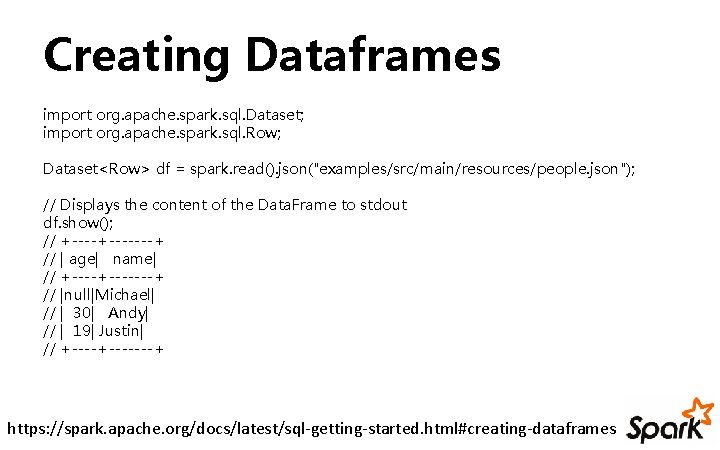
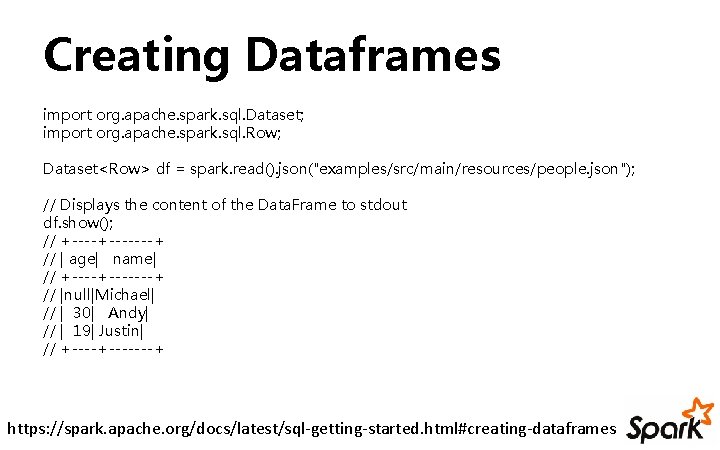
Creating Dataframes import org. apache. spark. sql. Dataset; import org. apache. spark. sql. Row; Dataset<Row> df = spark. read(). json("examples/src/main/resources/people. json"); // Displays the content of the Data. Frame to stdout df. show(); // +-------+ // | age| name| // +-------+ // |null|Michael| // | 30| Andy| // | 19| Justin| // +-------+ https: //spark. apache. org/docs/latest/sql-getting-started. html#creating-dataframes
Creating Dataframes import org. apache. spark. sql. Dataset; import org. apache. spark. sql. Row; Dataset<Row> df = spark. read(). json("examples/src/main/resources/people. json"); // Displays the content of the Data. Frame to stdout df. show(); // +-------+ // | age| name| // +-------+ // |null|Michael| // | 30| Andy| // | 19| Justin| // +-------+ https: //spark. apache. org/docs/latest/sql-getting-started. html#creating-dataframes
RDDs or Datasets and Dataframes? • Probably Datasets and Dataframes • Finer grained expressiveness allows more fully decoupled DAG for scheduler – This means more opportunities for parallelism.
- Slides: 52