
Introduction to APA Understanding Style Why APA Establishes
Introduction to APA Understanding Style
Why APA? � Establishes the standards for scientific communication. � Provides a set of procedures – style rules – to ensure ease of understanding. � Ensures disclosure of specific components in a uniform manner. � Removes distractions to focus on content
What does this mean? �The audience who reads your document will understand the format. �The rules become shortcuts for sharing information. �All the expected information can be clearly addressed and shared. �The content becomes the focus, not the format.
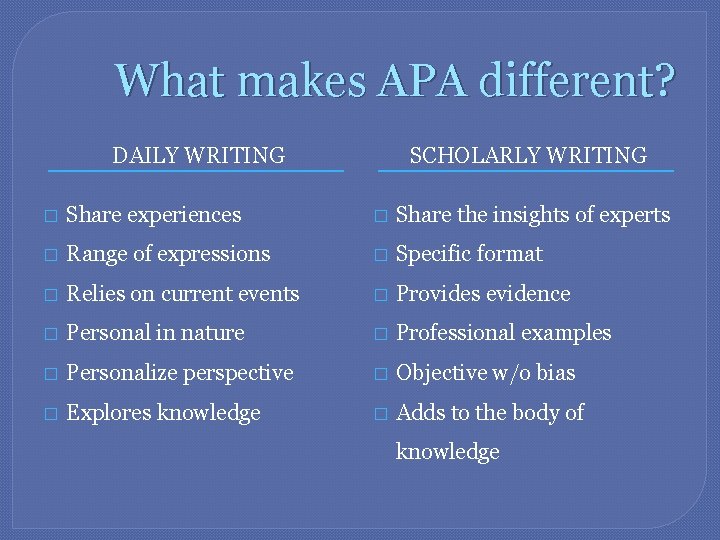
What makes APA different? DAILY WRITING SCHOLARLY WRITING � Share experiences � Share the insights of experts � Range of expressions � Specific format � Relies on current events � Provides evidence � Personal in nature � Professional examples � Personalize perspective � Objective w/o bias � Explores knowledge � Adds to the body of knowledge
Scholarly writing How do we share the insights of experts? �By using the words of experts in direct quotes. Example: Smith (2013) said, “Factors …”. �Paraphrasing ideas and concepts. Example: Several factors influenced the outcome including…(Smith, 2013).
Scholarly writing Why does style matter? �Uniform approach for sharing specific information. Example: (Smith, 2013, p. 3). This is the author, date of publication and page number where the information is located. �Recognized in the field. Anticipated key components will be present including critical details of analysis.
Scholarly writing Why is evidence important? �Collective �Impacts a broader audience �Identifies �Adds insight practices to the body of knowledge �Separates truth and fact
Scholarly writing How do professional examples support understanding? �Brings theory and practice together �Illustrates �Builds concepts or applications awareness of influencing factors �Clarifies potential miscommunication �Accuracy
Scholarly writing Why is being objective a concern? � Free from implied evaluation � Avoids “demeaning attitudes and biased assumptions” (APA Manual, 2010, pp. 70 -71). � Conscience � Avoids of potential influences inaccuracies � Minimizes personal views

Scholarly writing How should adding knowledge valuable? � Changes � Quality understanding and attitudes information supports decisions � Influences one’s approach to professional practices � Enables thinking processes � Encourages new ideas and innovation

Scholarly writing Examples Scholarly writing guides new understanding, shaping the direction of research in order to enhance awareness of current issues and their potential impact on the future.
Reference American Psychological Association. (2010). APA Manual, 6 th Edition. Washington, D. C. : Author.
- Slides: 12