
INTRODUCTION TO ANIMAL CLASSIFICATION DISTANCE LEARNING 4 20
- Slides: 10
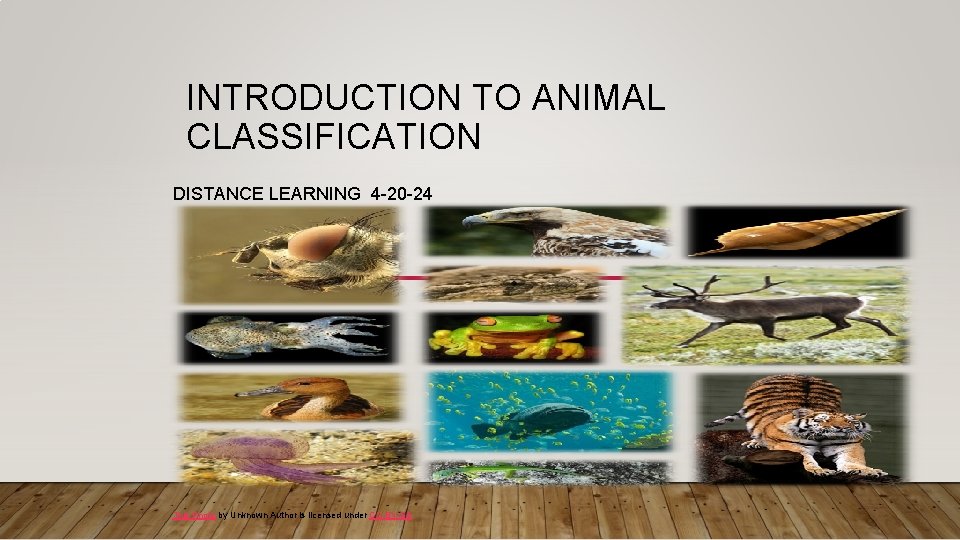
INTRODUCTION TO ANIMAL CLASSIFICATION DISTANCE LEARNING 4 -20 -24 This Photo by Unknown Author is licensed under CC BY-SA
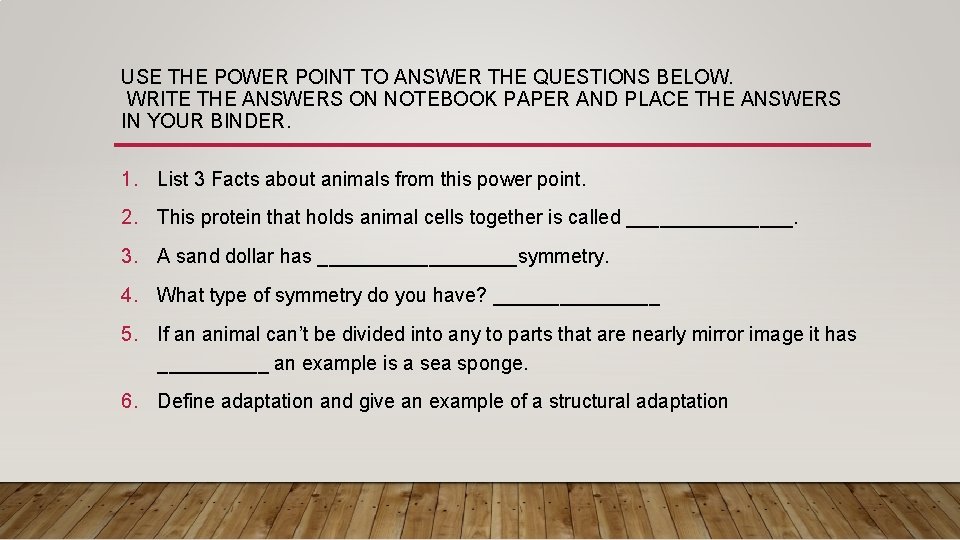
FACTS ABOUT ANIMALS • Animals are not Unicellular • Animals cells have a nucleus at some point in its life. • A protein called collegian hold animal cells together. • Animals can not create their own food. • Animals begin as fertilized eggs.
HOW SCIENTIST CLASSIFY ANIMALS • Science uses symmetry to help classify animals, there are 3 types of symmetry. Bilateral symmetry has a body plan which can be divided into two parts that are nearly mirror images of each other. (ex. humans or frogs) Radial symmetry has a body plan that can be divided anywhere through its central axis into two parts that are nearly mirror images. (ex. A sand dollar) Asymmetry they have body parts that can not be divided into any two parts that are nearly a mirror image. (ex. A sea sponge)
ANIMAL ADAPTATIONS USED IN CLASSIFICATION • An adaptation is an inherited trait that increases an organisms chances of surviving and reproducing in its environment. There are 3 types of animal adaptations. Behavioral – they are called instincts (ex. Birds instinctively migrate) Structural- animals have structural adaptations such as skeleton, senses, and their circulation. (ex, Some animals with eyes that work like cameras. ) Functional is a function that enables its species to survive and reproduce (ex. Fish lay thousands of eggs in a pond to increase the chance of survival. )
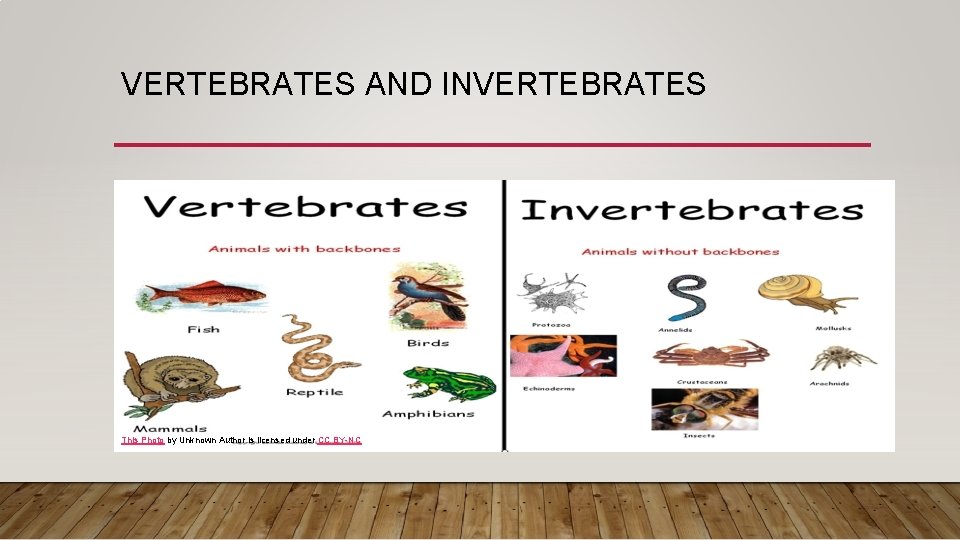
VERTEBRATES AND INVERTEBRATES This Photo by Unknown Author is licensed under CC BY-NC
IF YOU’RE AN INVERTEBRATE YOU GOT NO BACKBONE! Animals with no backbone are supported by either hydrostatic skeleton which is a fluid filled sac or they are supported by an exoskeleton which is a hard outer covering. Invertebrates make up about 95% of all known animal species. Invertebrates have many adaptations that enable them to survive. Parasites are animals that survive by living inside or on another organism, they get food from the organism and do not help the host organism survive. Some invertebrates must hunt for food and some can even change color to adapt to their environment.
THE 8 MOST COMMON INVERTEBRATES. • Sponges are the oldest branch of the animal family • Cnidarians are more complex than sponges because they have true tissues. • Flatworms they are bilateral and most live in water fresh or salt. • Segmented worms the body is small segments they have a hydrostatic skeleton and bilateral symmetry. • Mollusk commonly known as snails or slugs Shells often protect the soft body but some are soft bodied and catch prey such as an octopus. • Roundworms some are parasites some are harmless they have bilateral symmetry and a hydrostatic skeleton. • Arthropods there are more animals in this phylum than all phyla groups. • Echinoderms live in seawater all of them move slowly with suction like feet.
IT TAKES BACKBONE TO BE A VERTEBRATE Vertebrates are animals with a backbone. The majority of the animals you are familiar with are vertebrate. (ex. Cats, Dogs, Fish, Snakes, Dogs and Birds) Fish are vertebrates they breathe with gills and have powerful tails. (jawless, boney, sharks, & rays. ) Amphibians live in both worlds they can adapt with both gills and lungs. (ex. Frogs) Reptiles the 3 most common are lizards, snakes turtles alligators and crocodiles Birds the one trait that makes birds different from other mammals is their feathers. Mammals we know mammals have characteristics give birth to live young have fur and nurse their young. Monotremes lay eggs, Marsupials raise young in a pouch Placental grow their young inside the mother.
USE THE POWER POINT TO ANSWER THE QUESTIONS BELOW. WRITE THE ANSWERS ON NOTEBOOK PAPER AND PLACE THE ANSWERS IN YOUR BINDER. 1. List 3 Facts about animals from this power point. 2. This protein that holds animal cells together is called ________. 3. A sand dollar has _________symmetry. 4. What type of symmetry do you have? ________ 5. If an animal can’t be divided into any to parts that are nearly mirror image it has _____ an example is a sea sponge. 6. Define adaptation and give an example of a structural adaptation
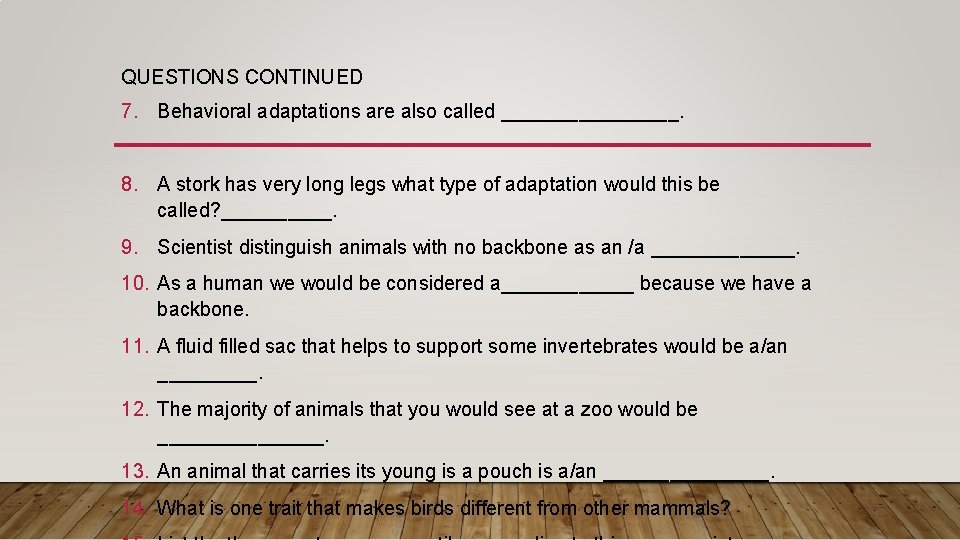
QUESTIONS CONTINUED 7. Behavioral adaptations are also called ________. 8. A stork has very long legs what type of adaptation would this be called? _____. 9. Scientist distinguish animals with no backbone as an /a _______. 10. As a human we would be considered a______ because we have a backbone. 11. A fluid filled sac that helps to support some invertebrates would be a/an _____. 12. The majority of animals that you would see at a zoo would be ________. 13. An animal that carries its young is a pouch is a/an ________. 14. What is one trait that makes birds different from other mammals?