
Introduction to Ancient Medieval History Historical Thinking Concepts
- Slides: 16
Introduction to Ancient Medieval History
Historical Thinking Concepts 1. Cause & Consequence 2. Taking an historical perspective 3. The ethical dimension 4. Historical Significance 5. Evidence 6. Continuity and Change
Skill to improve! 1. 2. 3. 4. 5. 6. 7. 8. Read critically Research Map skills Present summary reports or arguments Express and support point of view Forming questions Essay writing Note taking
What do Historians do? �They study of change over time. �Historians gather information from a particular time period when a significant change or development took place. �They try and answer two important questions: �Why did this change take place? �What effects did this change have on the people who experienced it?
Getting a complete picture �To create a complete picture of a particular time, the historian must gather material related to specific areas of development: What areas do you think? 1. Culture, language, education and art. 2. Science and technology. 3. Government and law. 4. Religion 5. Conflict �The farther back we go in our investigations, the more difficult the gathering of historical information becomes.
History Basics • When studying early humans and civilizations, we traditionally date from the birth of Jesus Christ (BC and AD) • What do BC & AD stand for? • BC = Before Christ • AD = Anno Domini (which means “in the year of our Lord, " and is used for dates after Jesus's birth. • Now we use these two important expressions: • BCE = Before Common Era ( was BC) • CE = Common Era ( was AD) • Historians focus on putting things in chronological order putting events in the order in which they happened.
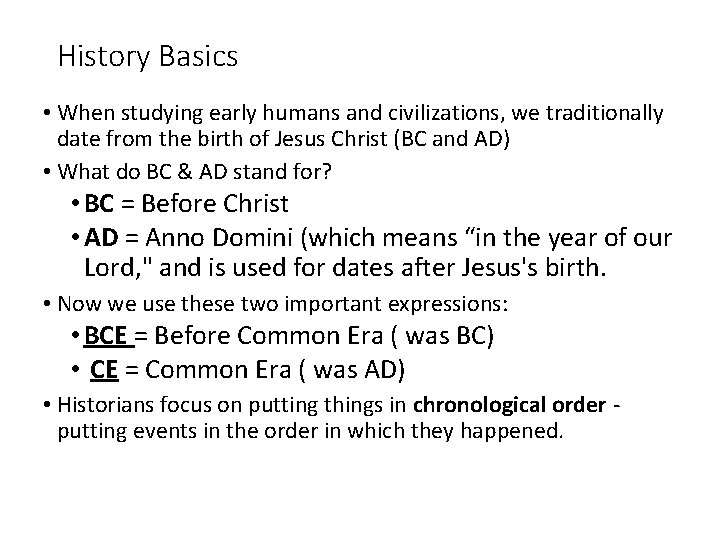
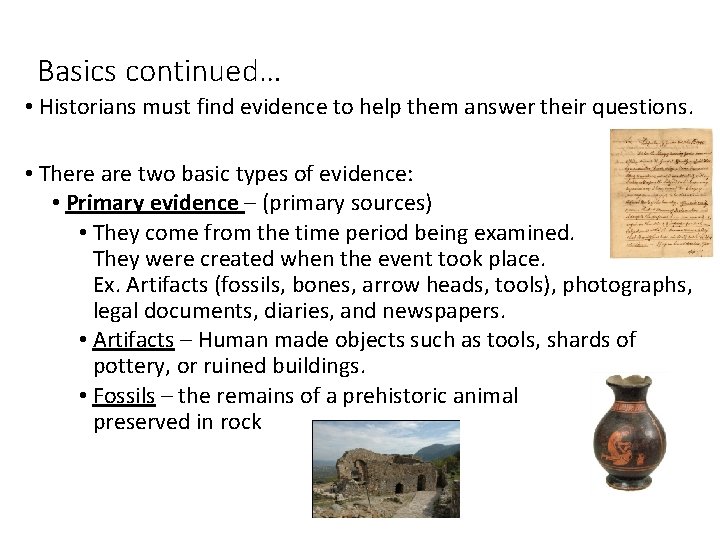
Basics continued… • Historians must find evidence to help them answer their questions. • There are two basic types of evidence: • Primary evidence – (primary sources) • They come from the time period being examined. They were created when the event took place. Ex. Artifacts (fossils, bones, arrow heads, tools), photographs, legal documents, diaries, and newspapers. • Artifacts – Human made objects such as tools, shards of pottery, or ruined buildings. • Fossils – the remains of a prehistoric animal preserved in rock
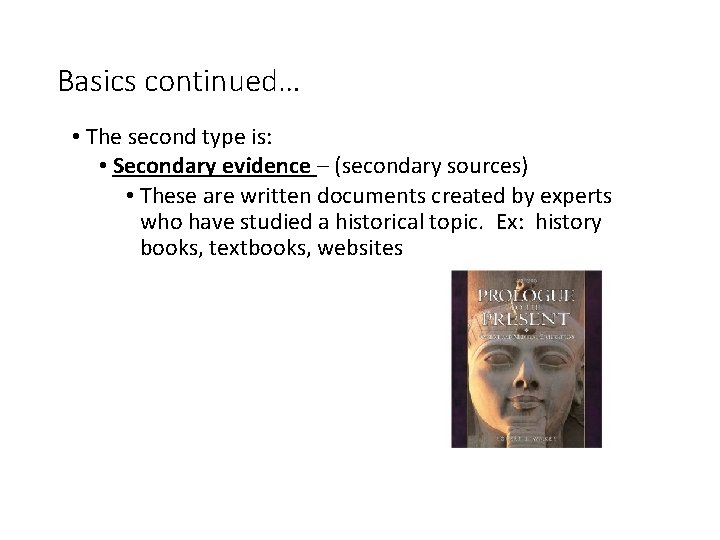
Basics continued… • The second type is: • Secondary evidence – (secondary sources) • These are written documents created by experts who have studied a historical topic. Ex: history books, textbooks, websites
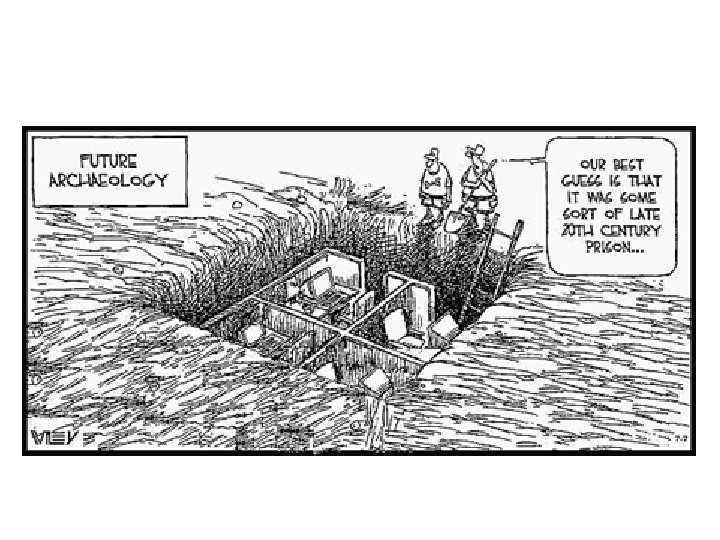
Historians and Bias • Since historians are rarely able to discover ALL the facts in their investigations, they must make educated guesses. • Historians call this bias. • Bias: making a judgment based on personal knowledge, experience, and attitudes, and not just on facts and data. • Reconstruction of history always involves some bias because they base their explanations on their interpretations of the evidence. • Complete Understanding Bias sheet.
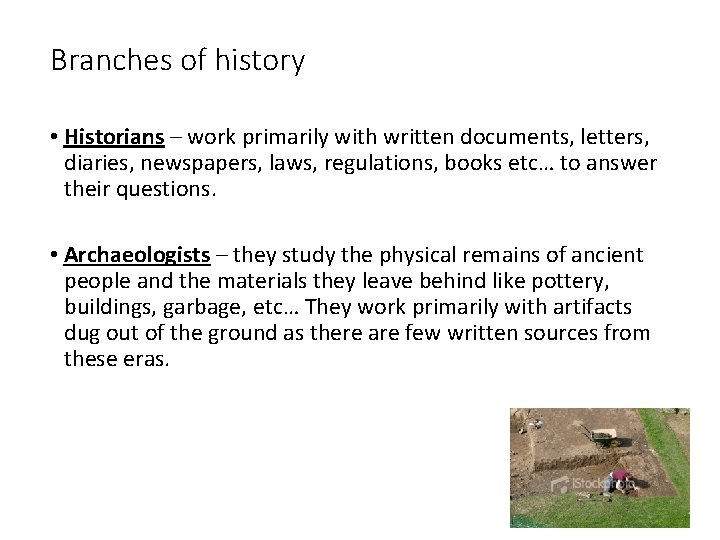
Branches of history • Historians – work primarily with written documents, letters, diaries, newspapers, laws, regulations, books etc… to answer their questions. • Archaeologists – they study the physical remains of ancient people and the materials they leave behind like pottery, buildings, garbage, etc… They work primarily with artifacts dug out of the ground as there are few written sources from these eras.
Branches of History • Anthropologists – study the origin, development, distribution, social habits, and culture of humans living. • Paleontologists- examine the fossil remains of animal and plant life. • Paleoanthropologists – combine the work of the paleontologist and the anthropologists to learn about how they affected early human civilizations.
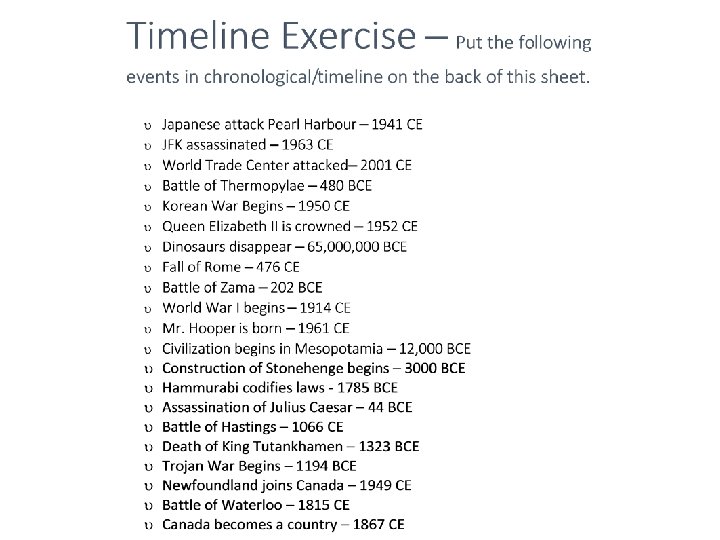
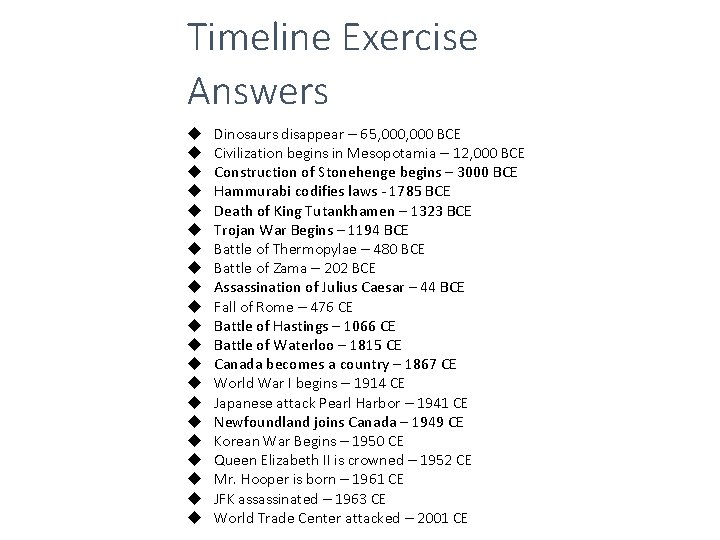
Timeline Exercise Answers Dinosaurs disappear – 65, 000 BCE Civilization begins in Mesopotamia – 12, 000 BCE Construction of Stonehenge begins – 3000 BCE Hammurabi codifies laws - 1785 BCE Death of King Tutankhamen – 1323 BCE Trojan War Begins – 1194 BCE Battle of Thermopylae – 480 BCE Battle of Zama – 202 BCE Assassination of Julius Caesar – 44 BCE Fall of Rome – 476 CE Battle of Hastings – 1066 CE Battle of Waterloo – 1815 CE Canada becomes a country – 1867 CE World War I begins – 1914 CE Japanese attack Pearl Harbor – 1941 CE Newfoundland joins Canada – 1949 CE Korean War Begins – 1950 CE Queen Elizabeth II is crowned – 1952 CE Mr. Hooper is born – 1961 CE JFK assassinated – 1963 CE World Trade Center attacked – 2001 CE
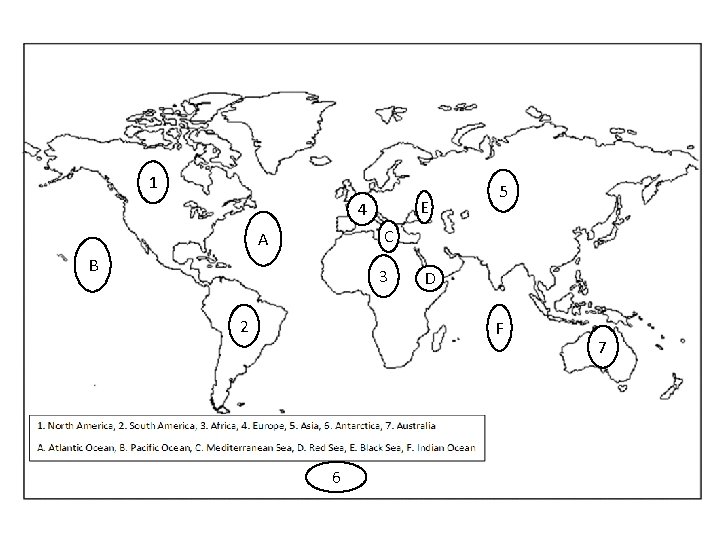
1 E 4 5 C A B 3 2 D F 6 7
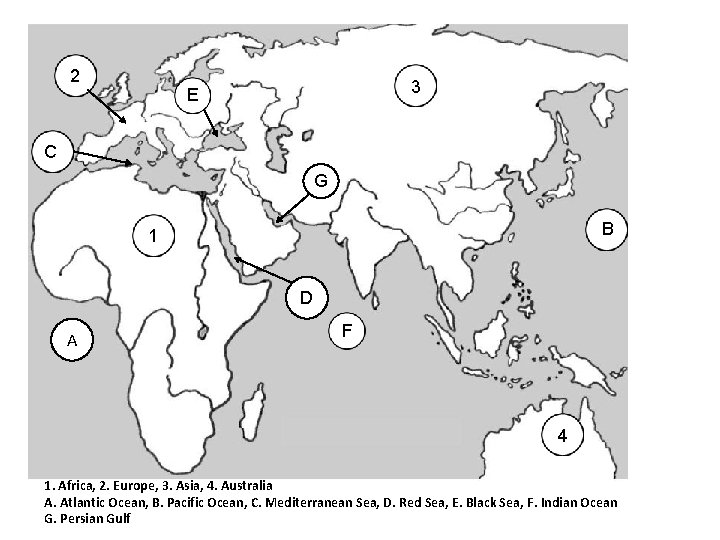
2 3 E C G B 1 D A F 4 1. Africa, 2. Europe, 3. Asia, 4. Australia A. Atlantic Ocean, B. Pacific Ocean, C. Mediterranean Sea, D. Red Sea, E. Black Sea, F. Indian Ocean G. Persian Gulf