
Introduction to Anatomy By Dr Maher T ALHadidi
Introduction to Anatomy By Dr. Maher T. AL-Hadidi Faculty of Medicine University of Jordan Spring 2012
Medical Language n n n Most derived from Latin and / Greek language. Important for clear communication in Medicine. To describe the body clearly and indicate the position of its parts in relative to each other.

Objectives Divide medical words into their basic parts. Find the meaning of basic combining words.

Basic word parts § Word Root § Suffix Origin of the word. eg: Gastr = Stomach Word ending. • Gastr / ic Related to. • Gastr / itis Inflammation. • Gastr / ectomy Removal. • ………/ Logy Science.

Basic word parts …continued n Prefix • • n Epi Hypo Anti A Word beginning. Above Below Against NO eg: Epi/gastr /ic eg: Hypo/gastr /ic eg: Anti/bio /tic eg: A/vascular Combining Vowel Joining the root to another or to the suffix. [Usually O] eg: • • • Gastr /o/logy /o/intestinal /o/ hepatic
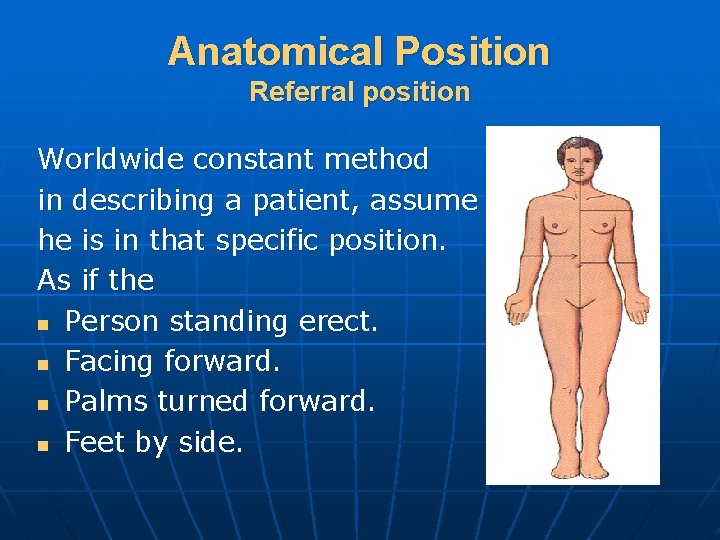
Anatomical Position Referral position Worldwide constant method in describing a patient, assume he is in that specific position. As if the n Person standing erect. n Facing forward. n Palms turned forward. n Feet by side.
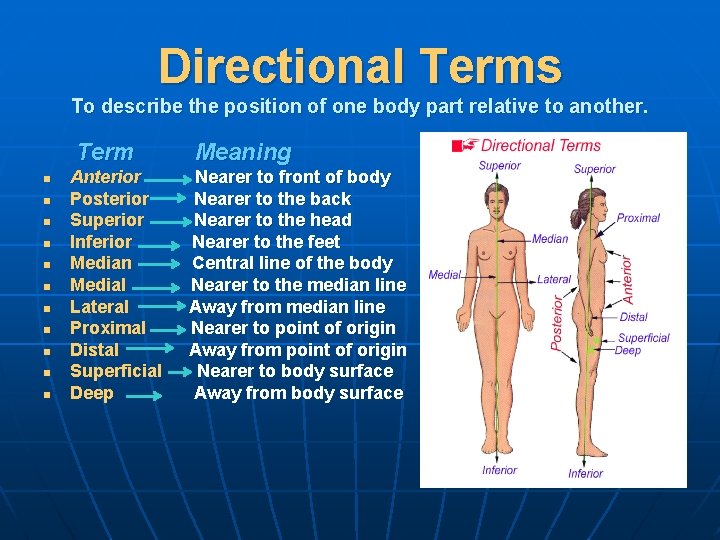
Directional Terms To describe the position of one body part relative to another. Term n n n Anterior Posterior Superior Inferior Median Medial Lateral Proximal Distal Superficial Deep Meaning Nearer to front of body Nearer to the back Nearer to the head Nearer to the feet Central line of the body Nearer to the median line Away from median line Nearer to point of origin Away from point of origin Nearer to body surface Away from body surface
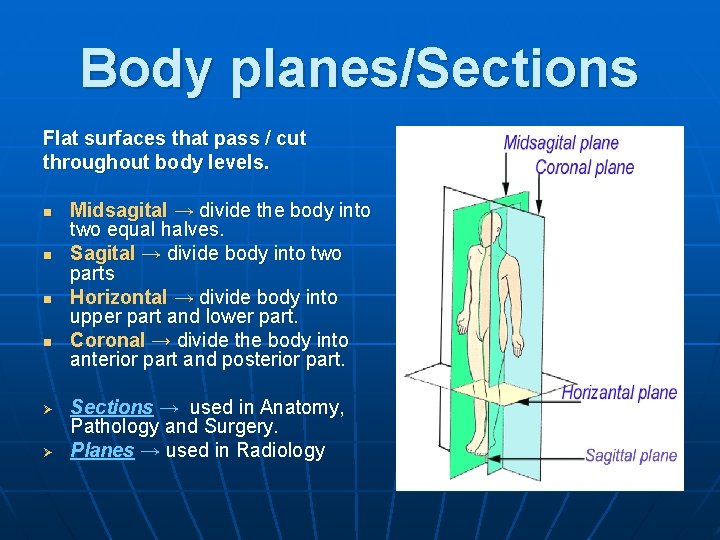
Body planes/Sections Flat surfaces that pass / cut throughout body levels. n n Ø Ø Midsagital → divide the body into two equal halves. Sagital → divide body into two parts Horizontal → divide body into upper part and lower part. Coronal → divide the body into anterior part and posterior part. Sections → used in Anatomy, Pathology and Surgery. Planes → used in Radiology
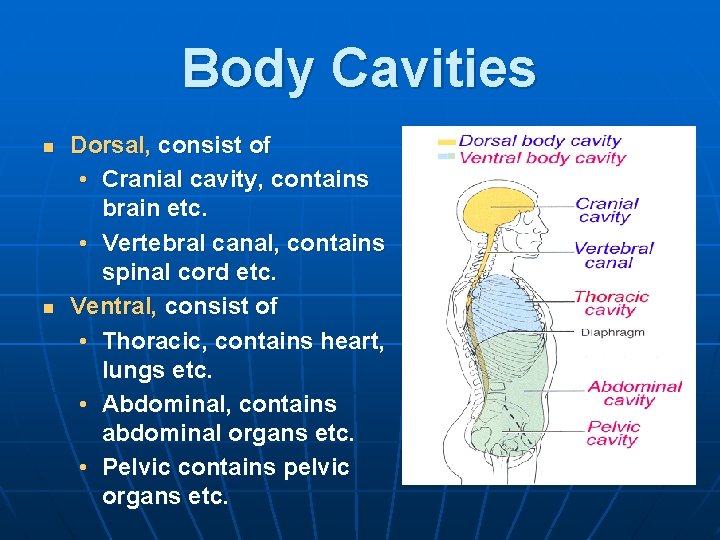
Body Cavities n n Dorsal, consist of • Cranial cavity, contains brain etc. • Vertebral canal, contains spinal cord etc. Ventral, consist of • Thoracic, contains heart, lungs etc. • Abdominal, contains abdominal organs etc. • Pelvic contains pelvic organs etc.
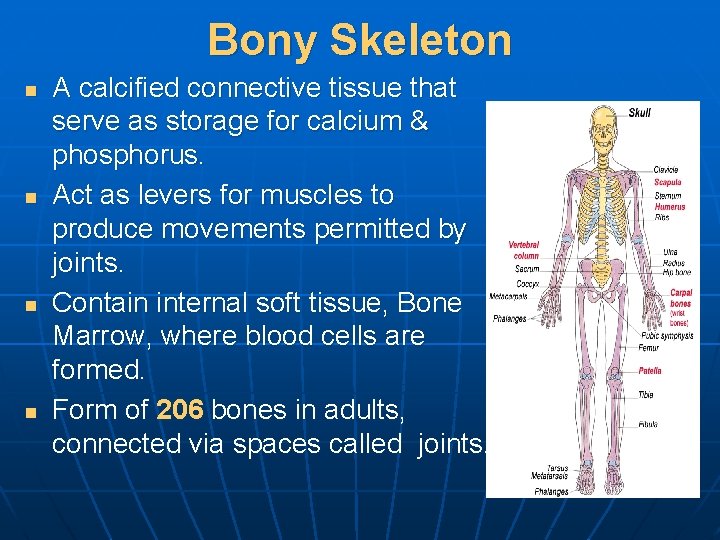
Bony Skeleton n n A calcified connective tissue that serve as storage for calcium & phosphorus. Act as levers for muscles to produce movements permitted by joints. Contain internal soft tissue, Bone Marrow, where blood cells are formed. Form of 206 bones in adults, connected via spaces called joints.

Divisions Two divisions: 1. 2. Axial skeleton (80 bones) Appendicular skeleton (126 bones) • Upper: n n • Shoulder girdle Bones of upper limb Lower: n n Pelvic girdle Bones of lower limb
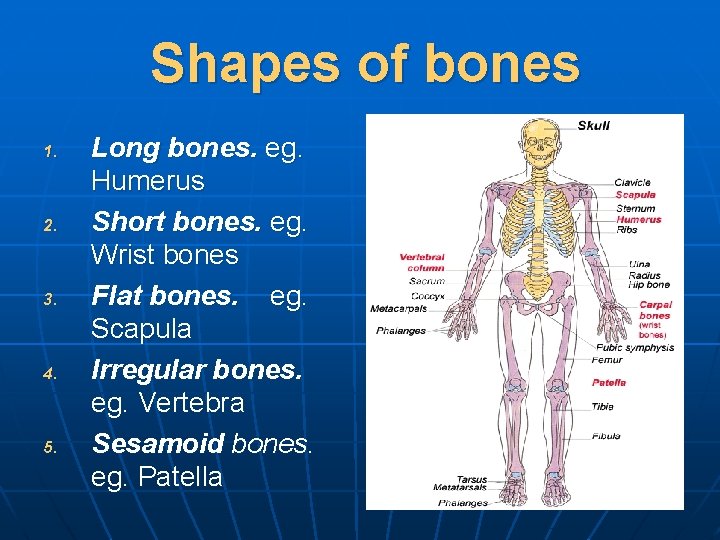
Shapes of bones 1. 2. 3. 4. 5. Long bones. eg. Humerus Short bones. eg. Wrist bones Flat bones. eg. Scapula Irregular bones. eg. Vertebra Sesamoid bones. eg. Patella
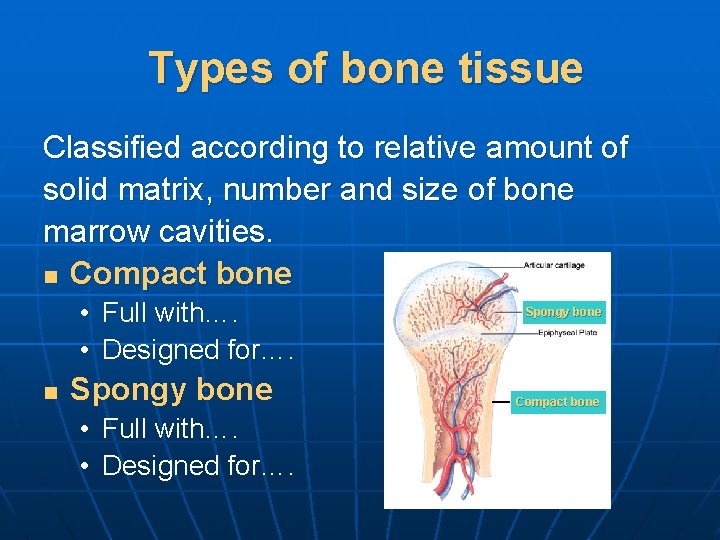
Types of bone tissue Classified according to relative amount of solid matrix, number and size of bone marrow cavities. n Compact bone • Full with…. • Designed for…. n Spongy bone • Full with…. • Designed for…. Spongy bone Compact bone

Types of Joints Classified according to connective tissue type between articulating bones. 1. Synovial J. Contains (Synovial fluid) eg. Knee joint. 2. Cartilaginous J. Contains (cartilage) eg. Intervertebral Joints 3. Fibrous Joints. Contains (fibrous CT) eg. Sutures between bones of skull.
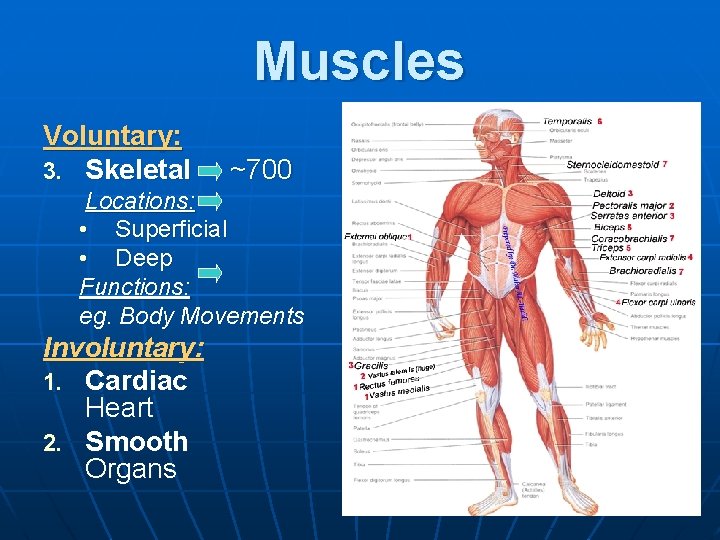
Muscles Voluntary: 3. Skeletal ~700 Locations: • Superficial • Deep Functions: eg. Body Movements Involuntary: 1. Cardiac Heart 2. Smooth Organs
Principal superficial skeletal muscles Muscles are named according to: 1. 2. 3. 4. 5. 6. 7. Direction of its fibers eg Rectus, Transverse, Oblique. Size of muscle eg Major, Minor, Vastus (huge). Shape of muscle eg Deltoid, Trapezius, Gracilis (slender). Main action eg. Flexor, Extensor, Abductor, Adductor. Number of tendons of origin eg. Biceps, Triceps. Location eg. Superficialis, Profundus (deep), Brachialis. Origin and insertion eg. Brachioradialis, from brachium (humerus) to radius.
Bone Markings § § § Bone structural features adapted for specific functions. New bone will be deposited resulting in raised or roughened areas. Appears in response to tension on bone surfaces where tendons, ligaments, aponeurosis and fascia pull on the periosteum. Compression on a surface of a bone results into a depression.
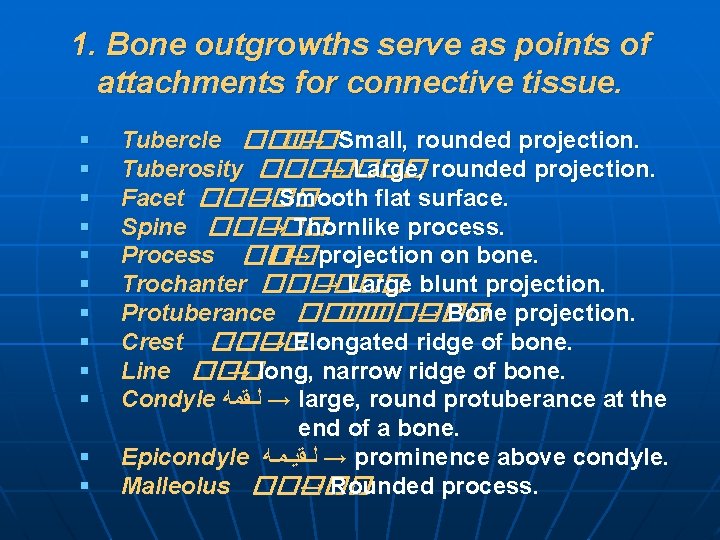
1. Bone outgrowths serve as points of attachments for connective tissue. § § § Tubercle ���� �→ Small, rounded projection. Tuberosity ������� → Large, rounded projection. Facet ����� → Smooth flat surface. Spine ����� → Thornlike process. Process �� �� → projection on bone. Trochanter ������ → Large blunt projection. Protuberance ��� �� / ����� → Bone projection. Crest ���� → Elongated ridge of bone. Line ��� → long, narrow ridge of bone. Condyle → ﻟـﻘﻤﻪ large, round protuberance at the end of a bone. Epicondyle → ﻟـﻘﻴـﻤـﻪ prominence above condyle. Malleolus ����� → Rounded process.
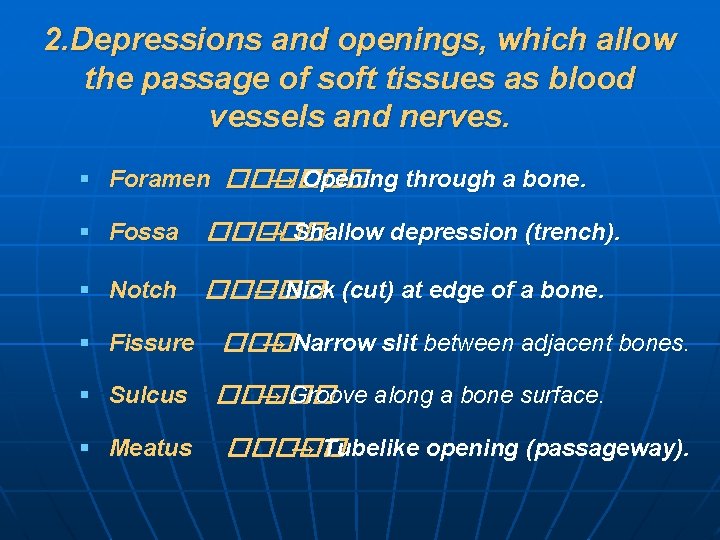
2. Depressions and openings, which allow the passage of soft tissues as blood vessels and nerves. § Foramen ������ → Opening through a bone. § Fossa ����� → Shallow depression (trench). § Notch ����� → Nick (cut) at edge of a bone. § Fissure ��� → Narrow slit between adjacent bones. § Sulcus ����� → Groove along a bone surface. § Meatus ����� → Tubelike opening (passageway).
- Slides: 19