
INTRODUCTION TO ANATOMY AND SKELETAL SYSTEM OBJECTIVES By
INTRODUCTION TO ANATOMY AND SKELETAL SYSTEM
OBJECTIVES By the end of the lecture, you should be able to: Ø Define the word “Anatomy”. Ø Enumerate the different anatomical fields. Ø Describe the anatomical position. Ø Describe different anatomical terms of position & movements as well different anatomical planes. Ø Classify bones according to shape, structure & development. Ø Enumerate different bones of both axial & appendicular skeleton.

WHAT IS ANATOMY? The word anatome is of Greek origin meaning cutting up (ana= up; tome= cutting). ■ Gross (macroscopic) anatomy: Study of human body with naked eye. ■ Microscopic anatomy; (Histology): Study of fine structure (cells & tissues) of the human body with the help of microscope. ■ Developmental anatomy; ( Embryology). ■ Radiological anatomy. ■ Applied anatomy. ■ Surface anatomy. ■ Surgical anatomy.
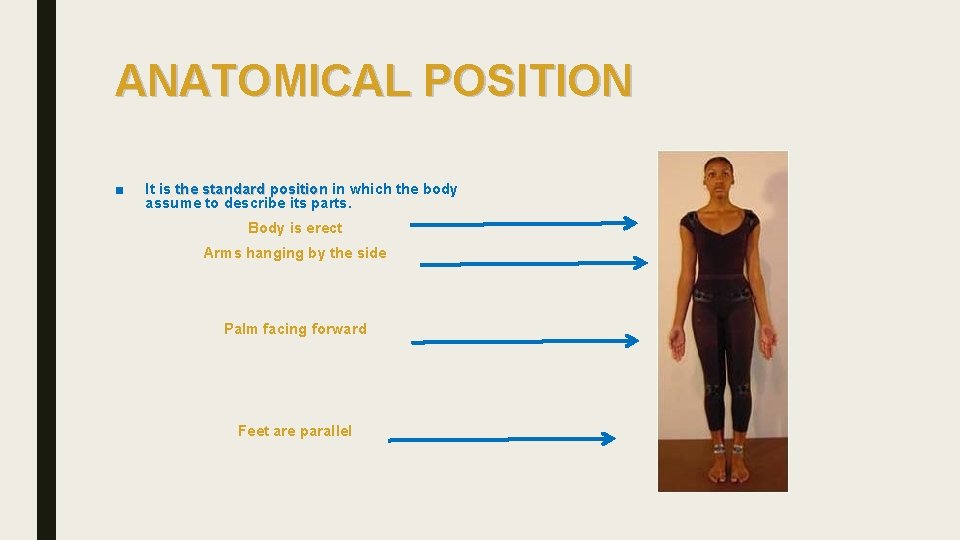
ANATOMICAL POSITION ■ It is the standard position in which the body assume to describe its parts. Body is erect Arms hanging by the side Palm facing forward Feet are parallel
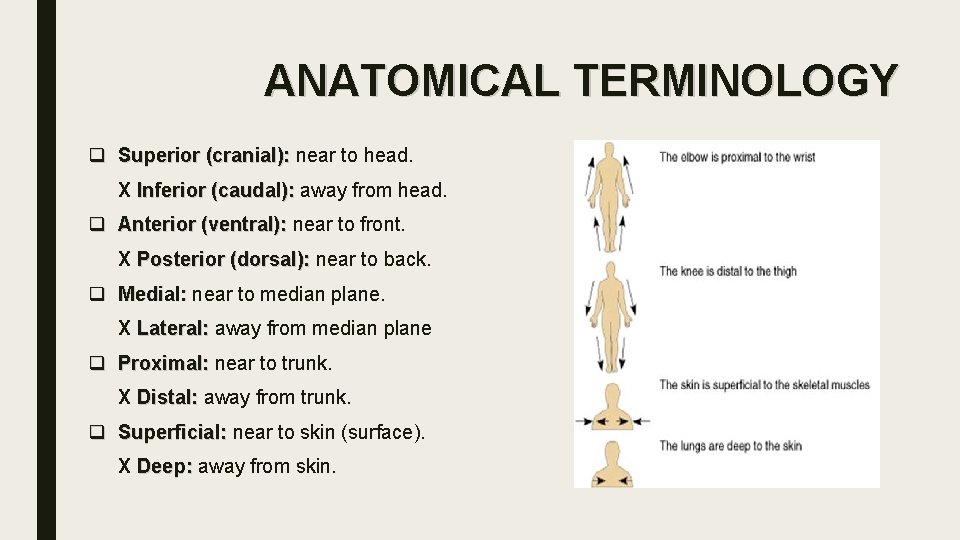
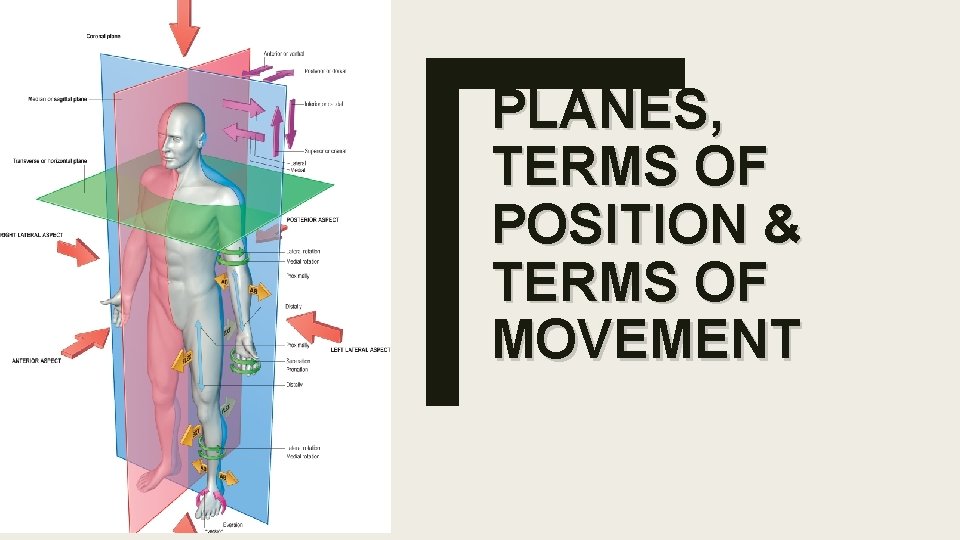
ANATOMICAL TERMINOLOGY q Superior (cranial): near to head. X Inferior (caudal): away from head. q Anterior (ventral): near to front. X Posterior (dorsal): near to back. q Medial: near to median plane. X Lateral: away from median plane q Proximal: near to trunk. X Distal: away from trunk. q Superficial: near to skin (surface). X Deep: away from skin.

ANATOMICAL TERMINOLOGY ■ TERMS OF GENERAL MOVEMENTS q Flexion: approximation of 2 parts (decreasing the angle between 2 parts). X Extension: straightening (increasing the angle between 2 parts). q Abduction: away from median plane. X Adduction: toward median plane. q Lateral rotation: rotation away from median plane. X Medial rotation: rotation toward median plane. q Circumduction: combined movements of flexion, extension, abduction & adduction.
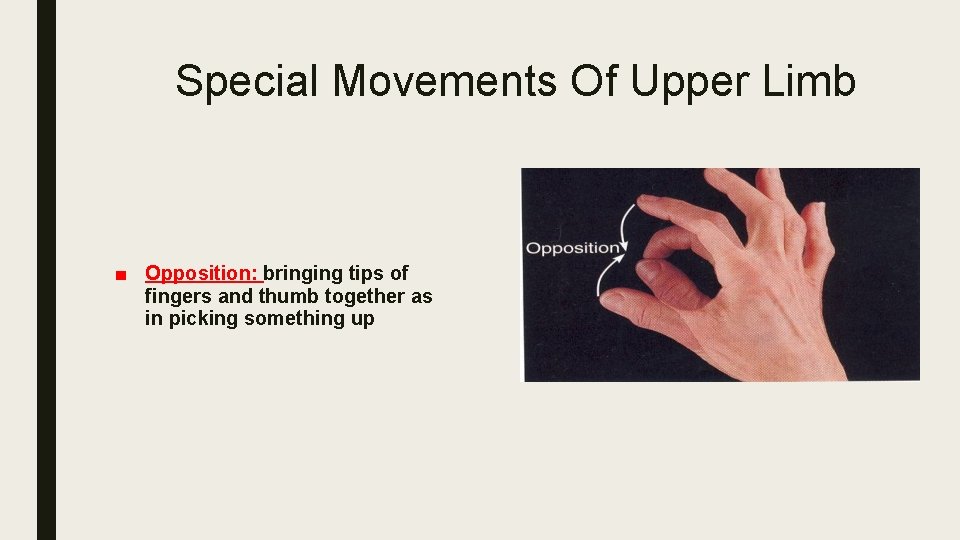
Special Movements Of Upper Limb ■ Opposition: bringing tips of fingers and thumb together as in picking something up

Special Movements Of Upper Limb ■ Supination: ■ Lateral rotation of the forearm. ■ The palm faces Anteriorly. ■ The radius and ulna are Parallel. ■ Pronation: ■ Medial rotation of the forearm. ■ The palm faces Posteriorly ■ The radius Crosses the ulna and the two bones form an X.
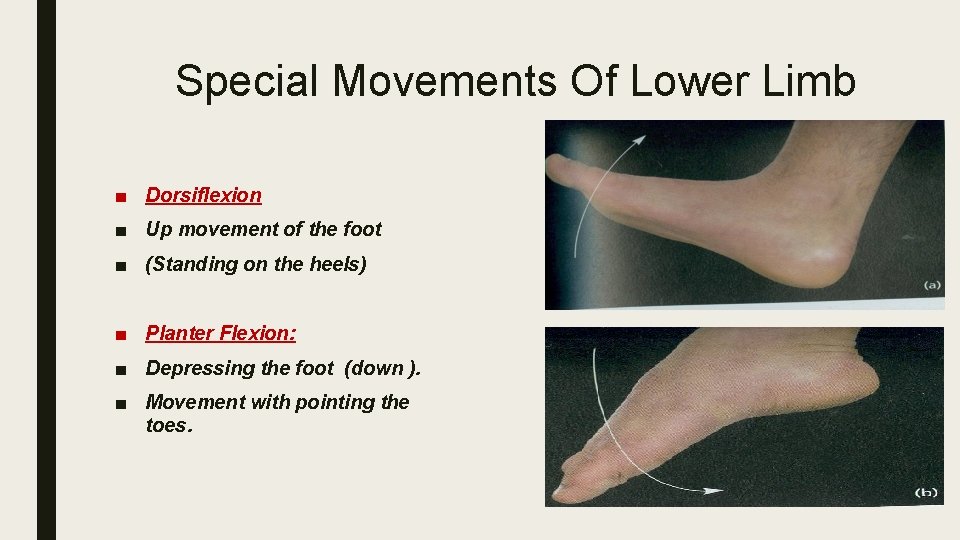
Special Movements Of Lower Limb ■ Dorsiflexion ■ Up movement of the foot ■ (Standing on the heels) ■ Planter Flexion: ■ Depressing the foot (down ). ■ Movement with pointing the toes.
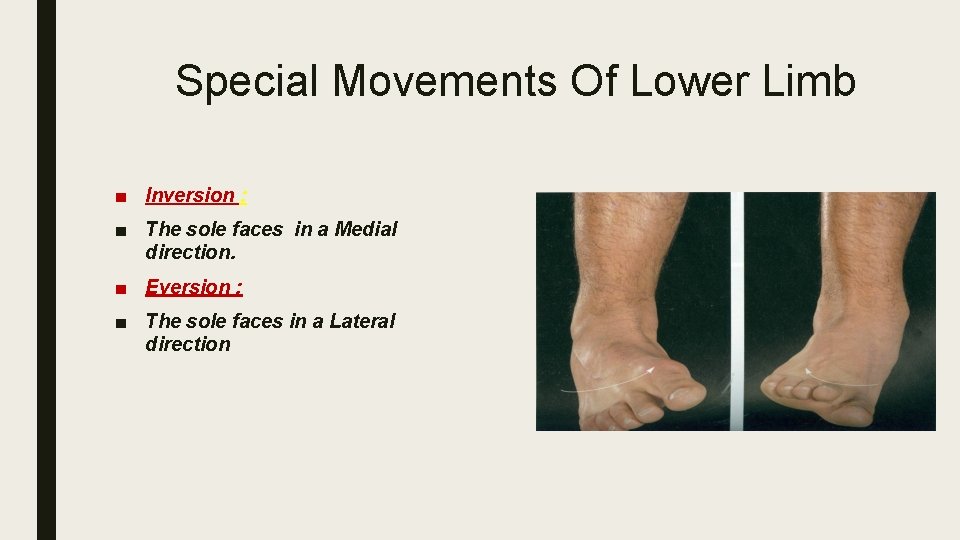
Special Movements Of Lower Limb ■ Inversion : ■ The sole faces in a Medial direction. ■ Eversion : ■ The sole faces in a Lateral direction
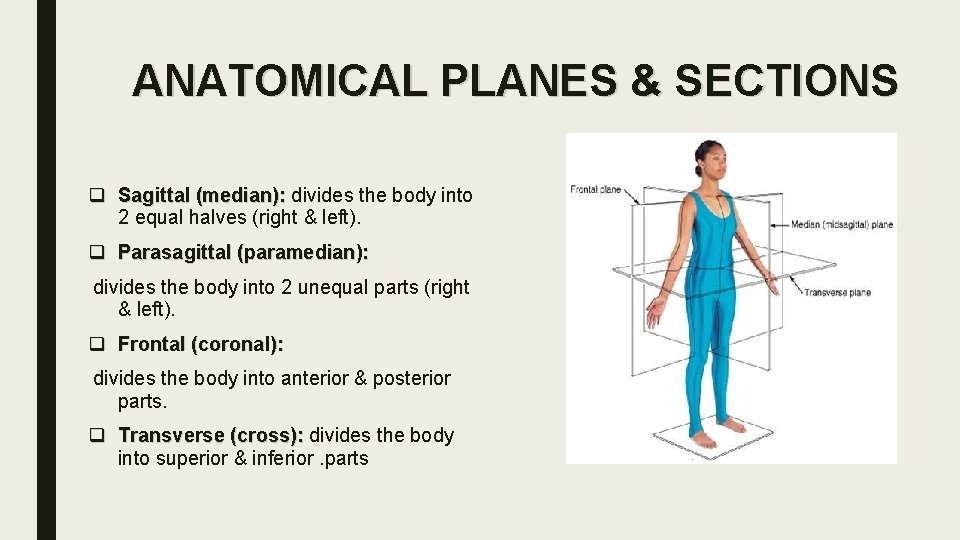
ANATOMICAL PLANES & SECTIONS q Sagittal (median): divides the body into 2 equal halves (right & left). q Parasagittal (paramedian): divides the body into 2 unequal parts (right & left). q Frontal (coronal): divides the body into anterior & posterior parts. q Transverse (cross): divides the body into superior & inferior. parts
PLANES, TERMS OF POSITION & TERMS OF MOVEMENT
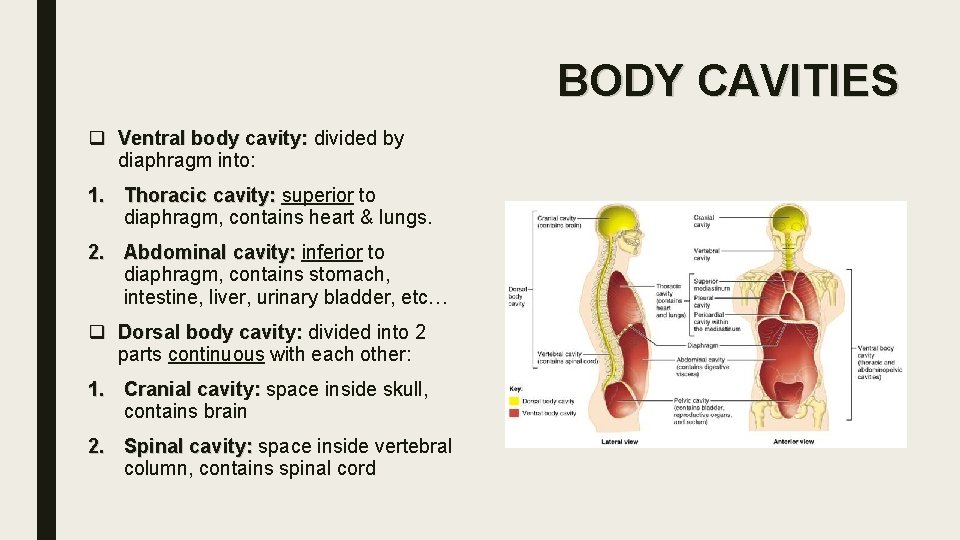
BODY CAVITIES q Ventral body cavity: divided by diaphragm into: 1. Thoracic cavity: superior to diaphragm, contains heart & lungs. 2. Abdominal cavity: inferior to diaphragm, contains stomach, intestine, liver, urinary bladder, etc… q Dorsal body cavity: divided into 2 parts continuous with each other: 1. Cranial cavity: space inside skull, contains brain 2. Spinal cavity: space inside vertebral column, contains spinal cord
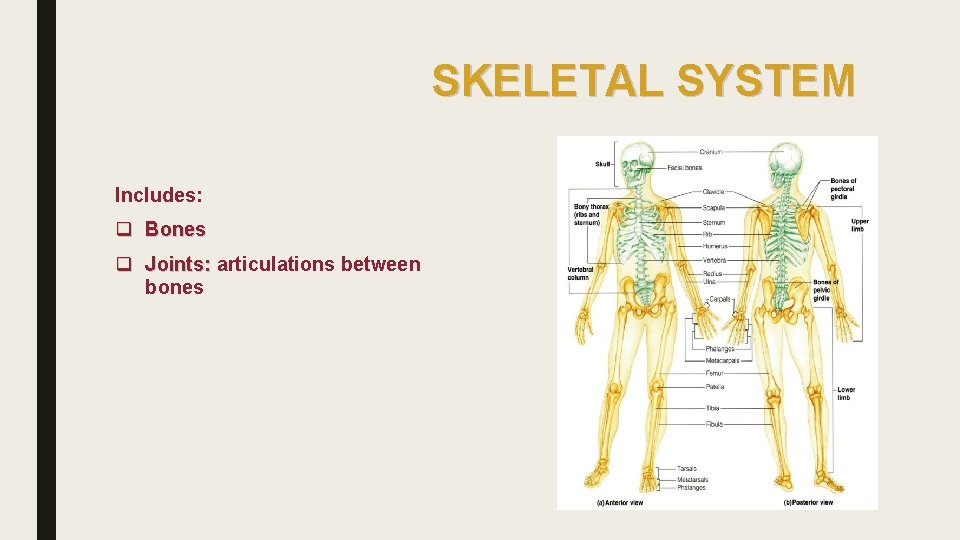
SKELETAL SYSTEM Includes: q Bones q Joints: articulations between bones
FUNCTIONS OF BONE 1. 2. 3. 4. 5. 6. Support: of the body. Storage: of fat and minerals e. g. calcium and phosphorus. Protection: of soft body organs. Attachment: of muscles. Movement: of the body as a whole, or of the body parts. Blood cell formation.
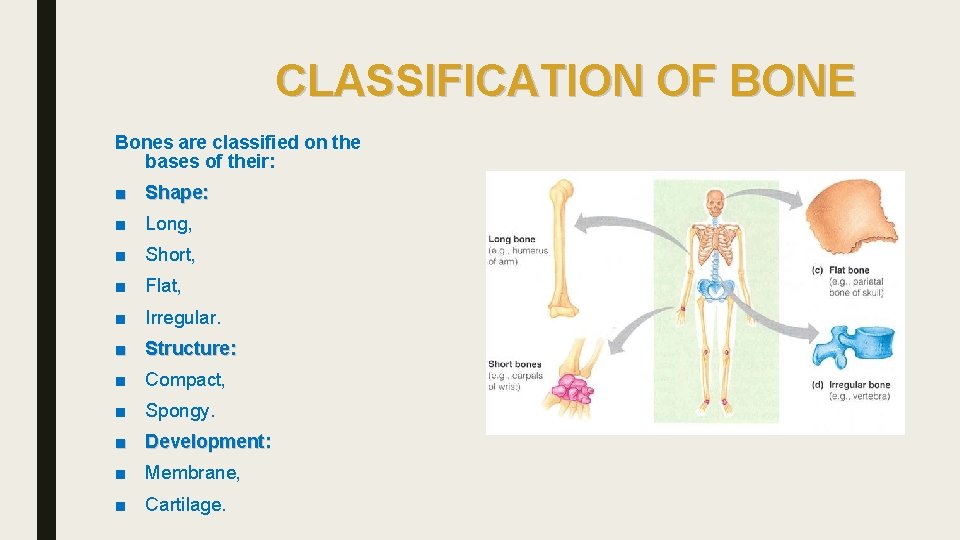
CLASSIFICATION OF BONE Bones are classified on the bases of their: ■ Shape: ■ Long, ■ Short, ■ Flat, ■ Irregular. ■ Structure: ■ Compact, ■ Spongy. ■ Development: ■ Membrane, ■ Cartilage.
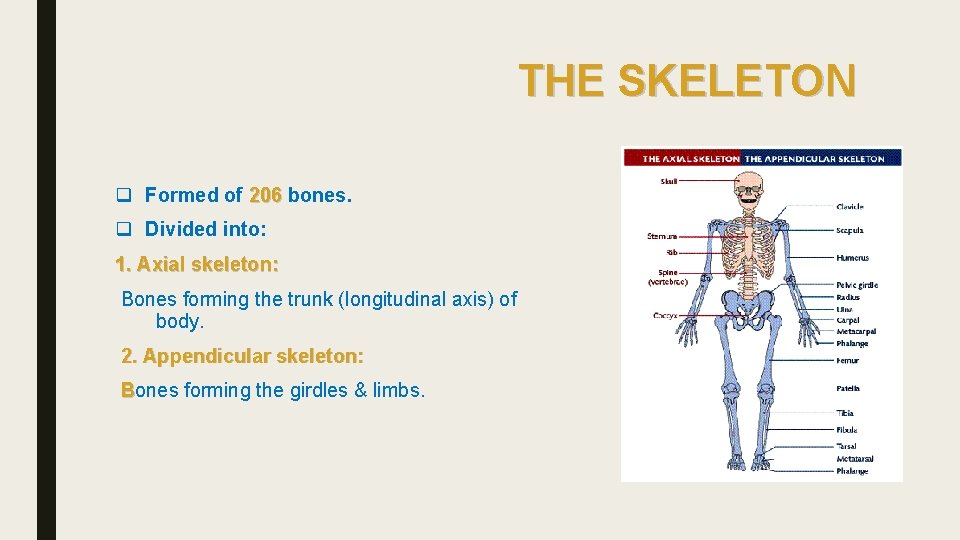
THE SKELETON q Formed of 206 bones. q Divided into: 1. Axial skeleton: Bones forming the trunk (longitudinal axis) of body. 2. Appendicular skeleton: Bones forming the girdles & limbs. B
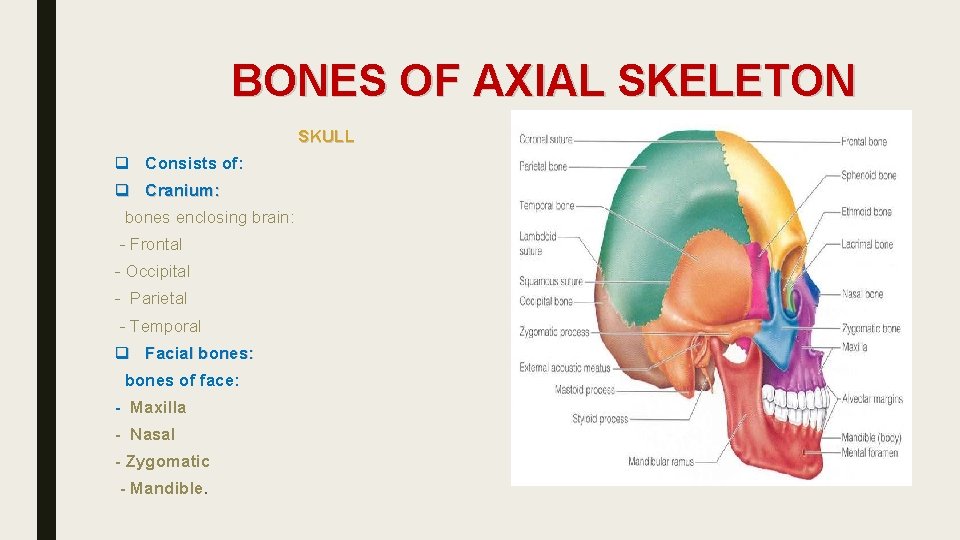
BONES OF AXIAL SKELETON SKULL q Consists of: q Cranium: bones enclosing brain: - Frontal - Occipital - Parietal - Temporal q Facial bones: bones of face: - Maxilla - Nasal - Zygomatic - Mandible.
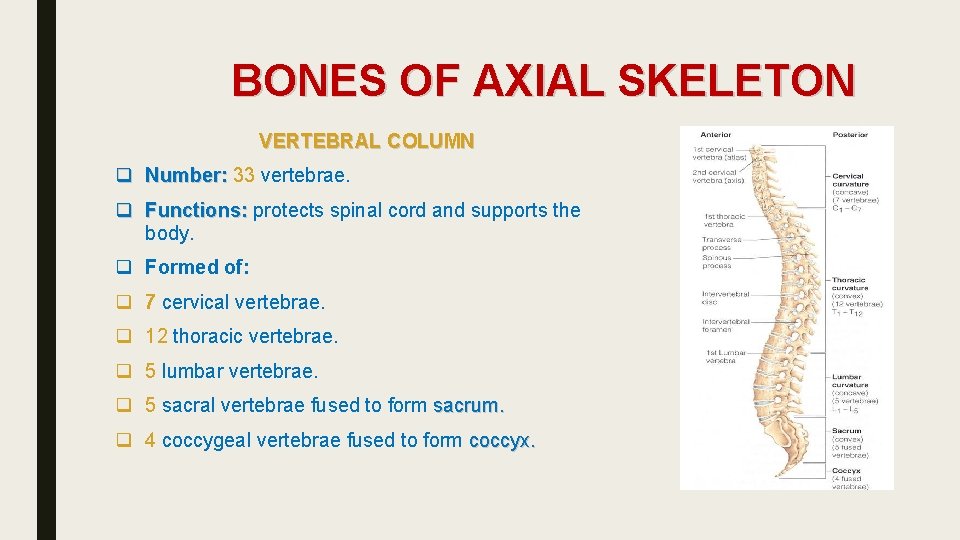
BONES OF AXIAL SKELETON VERTEBRAL COLUMN q Number: 33 vertebrae. q Functions: protects spinal cord and supports the body. q Formed of: q 7 cervical vertebrae. q 12 thoracic vertebrae. q 5 lumbar vertebrae. q 5 sacral vertebrae fused to form sacrum. q 4 coccygeal vertebrae fused to form coccyx.
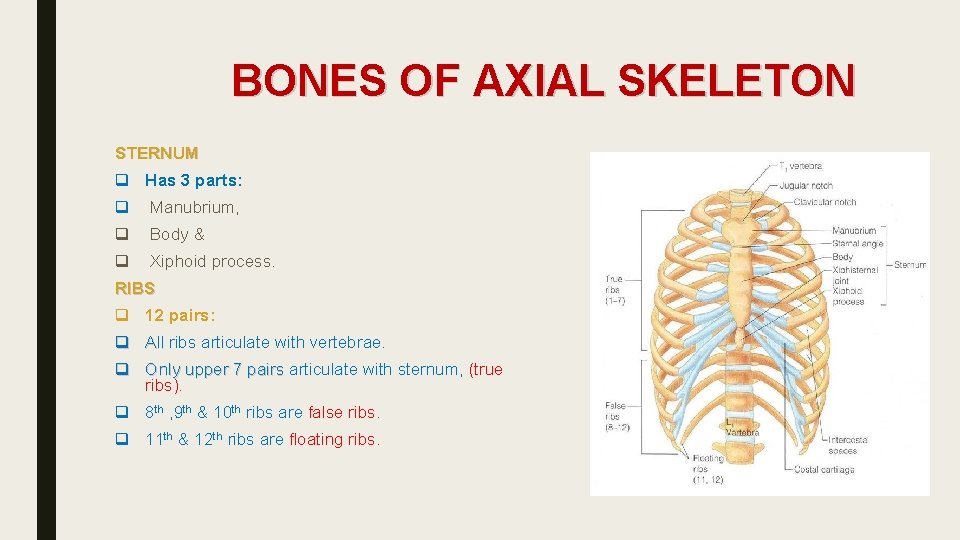
BONES OF AXIAL SKELETON STERNUM q Has 3 parts: q Manubrium, q Body & q Xiphoid process. RIBS q 12 pairs: q All ribs articulate with vertebrae. q Only upper 7 pairs articulate with sternum, (true ribs). q 8 th , 9 th & 10 th ribs are false ribs. q 11 th & 12 th ribs are floating ribs.
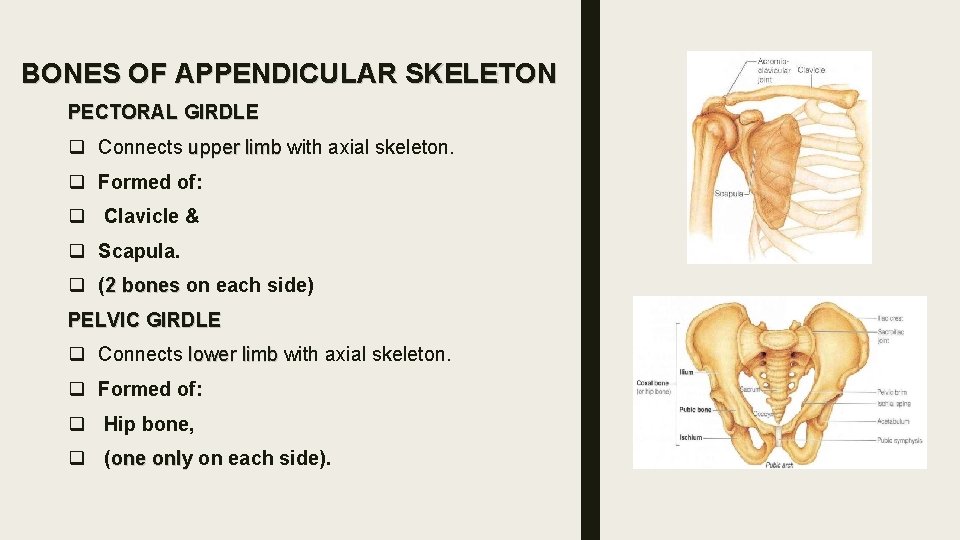
BONES OF APPENDICULAR SKELETON PECTORAL GIRDLE q Connects upper limb with axial skeleton. q Formed of: q Clavicle & q Scapula. q (2 bones on each side) PELVIC GIRDLE q Connects lower limb with axial skeleton. q Formed of: q Hip bone, q (one only on each side).
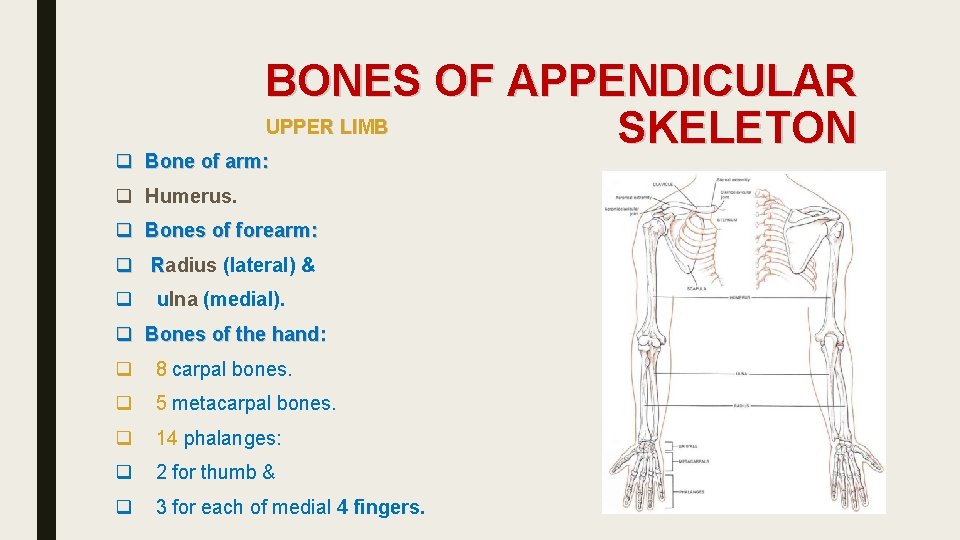
BONES OF APPENDICULAR UPPER LIMB SKELETON q Bone of arm: q Humerus. q Bones of forearm: q Radius (lateral) & R q ulna (medial). q Bones of the hand: q 8 carpal bones. q 5 metacarpal bones. q 14 phalanges: q 2 for thumb & q 3 for each of medial 4 fingers.
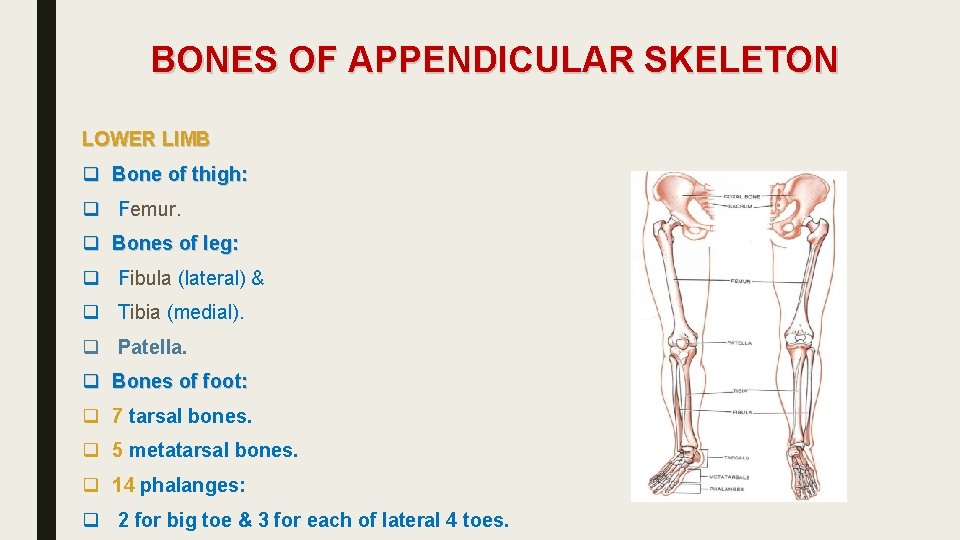
BONES OF APPENDICULAR SKELETON LOWER LIMB q Bone of thigh: q Femur. q Bones of leg: q Fibula (lateral) & q Tibia (medial). q Patella. q Bones of foot: q 7 tarsal bones. q 5 metatarsal bones. q 14 phalanges: q 2 for big toe & 3 for each of lateral 4 toes.
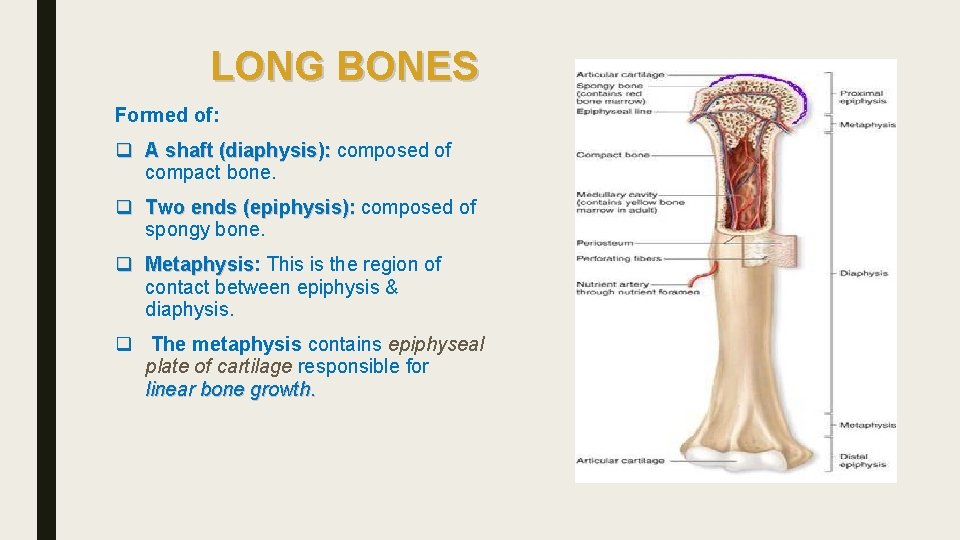
LONG BONES Formed of: q A shaft (diaphysis): composed of compact bone. q Two ends (epiphysis): composed of spongy bone. q Metaphysis: Metaphysis This is the region of contact between epiphysis & diaphysis. q The metaphysis contains epiphyseal plate of cartilage responsible for linear bone growth.
TEST YOURSELF! ■ Which one of the following bones is a bone of the axial skeleton? 1. Femur. 2. Humerus. 3. Scapula. 4. Sternum.
■ Which one of the following bones is an example of an irregular bone? 1. Femur. 2. Vertebra. 3. Scapula. 4. Sternum.
■ Which one of the following planes divides the body into superior & inferior parts? 1. Frontal (coronal) plane. 2. Sagittal (median) plane. 3. Parasagittal (Paramedian) plane 4. Transverse (cross) plane.

GOOD LUCK
- Slides: 28