
Introduction to Algorithms Analogy An algorithm is like
- Slides: 38
Introduction to Algorithms
Analogy An algorithm is like a recipe.
Analogy An algorithm is like a recipe. To make a tossed salad: • Mix together vegetables of your choice. • Add 2 parts olive oil to 1 part vinegar. • Add salt and pepper to taste. • Toss well. • Serve immediately.
Analogy An algorithm is like a recipe. To make a tossed salad: • Mix together vegetables of your choice. • Add 2 parts olive oil to 1 part vinegar. • Add salt and pepper to taste. • Toss well. • Serve immediately. The Difference: Computer algorithms are more precise.
Definition An algorithm is a step-by-step procedure that does some calculation or computation.
Definition An algorithm is a step-by-step procedure that does some calculation or computation. Each step in the algorithm must be precise and unambiguous.
Definition An algorithm is a step-by-step procedure that does some calculation or computation. Each step in the algorithm must be precise and unambiguous. Each step must be doable – i. e. , it can't be something that is impossible to do.
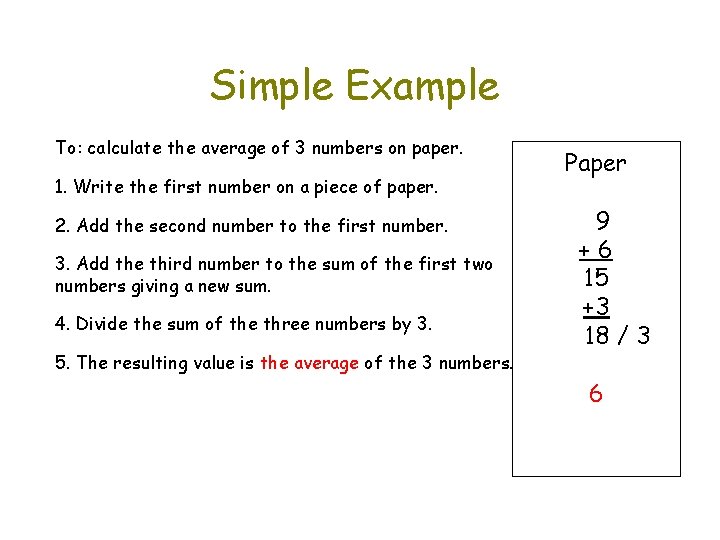
Simple Example To: calculate the average of 3 numbers on paper. Paper
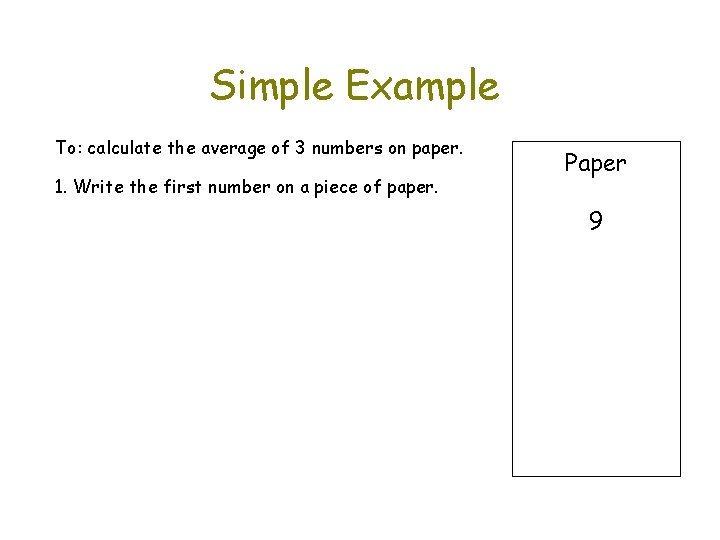
Simple Example To: calculate the average of 3 numbers on paper. 1. Write the first number on a piece of paper. Paper 9
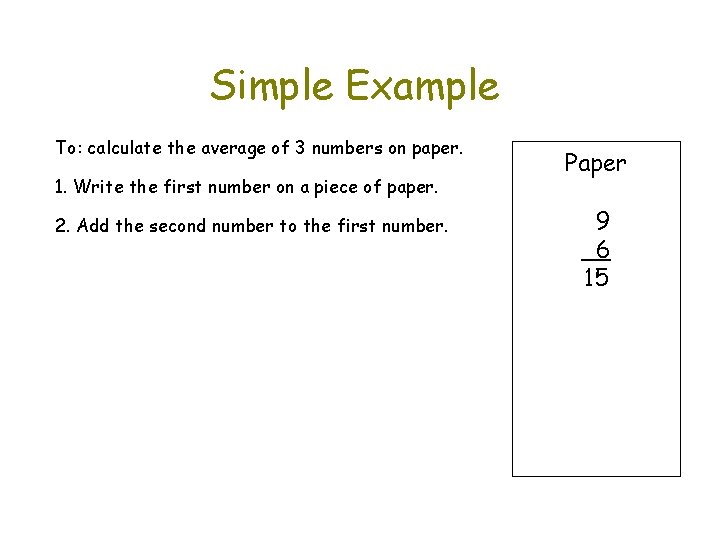
Simple Example To: calculate the average of 3 numbers on paper. 1. Write the first number on a piece of paper. 2. Add the second number to the first number. Paper 9 6 15
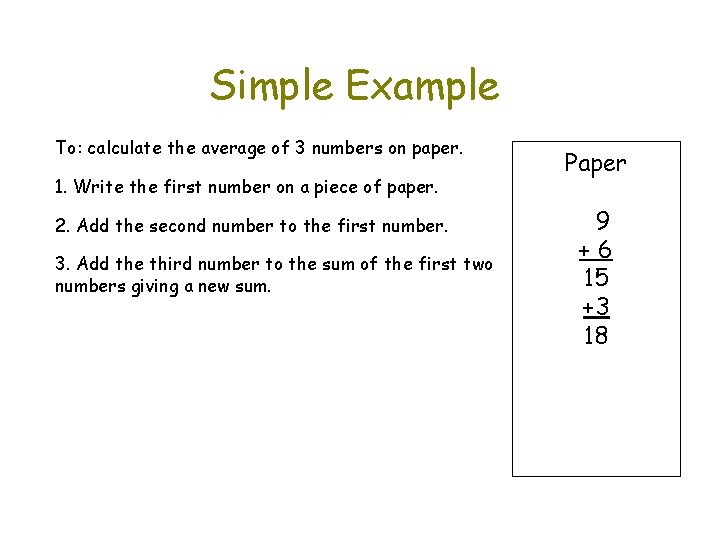
Simple Example To: calculate the average of 3 numbers on paper. 1. Write the first number on a piece of paper. 2. Add the second number to the first number. 3. Add the third number to the sum of the first two numbers giving a new sum. Paper 9 +6 15 +3 18
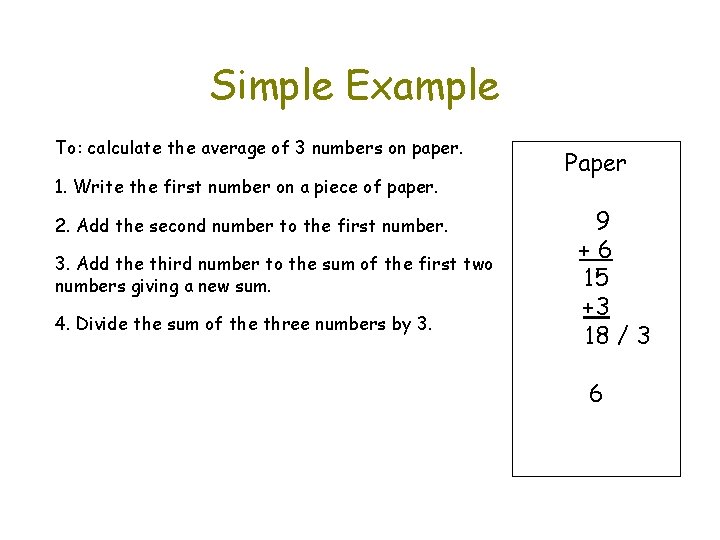
Simple Example To: calculate the average of 3 numbers on paper. 1. Write the first number on a piece of paper. 2. Add the second number to the first number. 3. Add the third number to the sum of the first two numbers giving a new sum. 4. Divide the sum of the three numbers by 3. Paper 9 +6 15 +3 18 / 3 6
Simple Example To: calculate the average of 3 numbers on paper. 1. Write the first number on a piece of paper. 2. Add the second number to the first number. 3. Add the third number to the sum of the first two numbers giving a new sum. 4. Divide the sum of the three numbers by 3. 5. The resulting value is the average of the 3 numbers. Paper 9 +6 15 +3 18 / 3 6
What's Wrong with This Example? To: wash your hair 1. Wash with the shampoo. 2. Rinse. 3. Repeat.
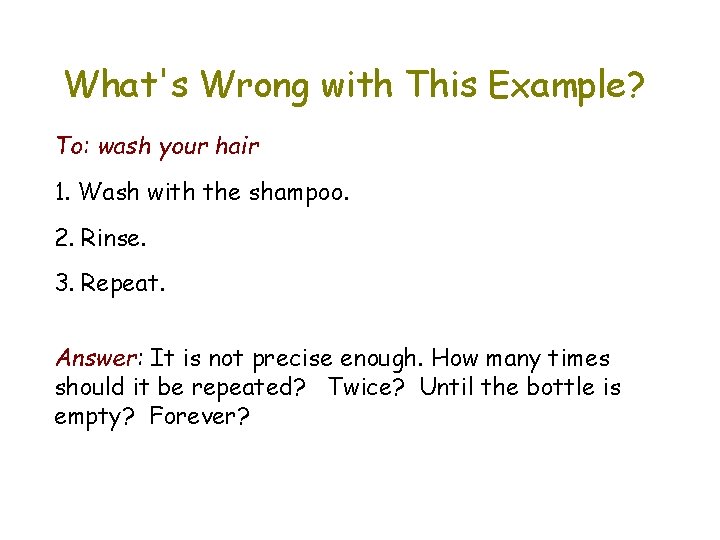
What's Wrong with This Example? To: wash your hair 1. Wash with the shampoo. 2. Rinse. 3. Repeat. Answer: It is not precise enough. How many times should it be repeated? Twice? Until the bottle is empty? Forever?
This algorithm is funny! The programmer's spouse says: "Run to the store and pick up a loaf of bread. If they have eggs, get a dozen. "
This algorithm is funny! The programmer's spouse says: "Run to the store and pick up a loaf of bread. If they have eggs, get a dozen. " The programmer comes home with 12 loaves of bread.
This algorithm is funny! The programmer's spouse says: "Run to the store and pick up a loaf of bread. If they have eggs, get a dozen. " The programmer comes home with 12 loaves of bread. Problem: Ambiguous. Right? Get a dozen what?
Another funny one! A programmer's husband sends her to the store and says "get some bread, and while you're there pick up some eggs".
Another funny one! A programmer's husband sends her to the store and says "get some bread, and while you're there pick up some eggs". The programmer never comes back.
Another funny one! A programmer's husband sends her to the store and says "get some bread, and while you're there pick up some eggs". The programmer never came back. Problem: Infinite Loop.
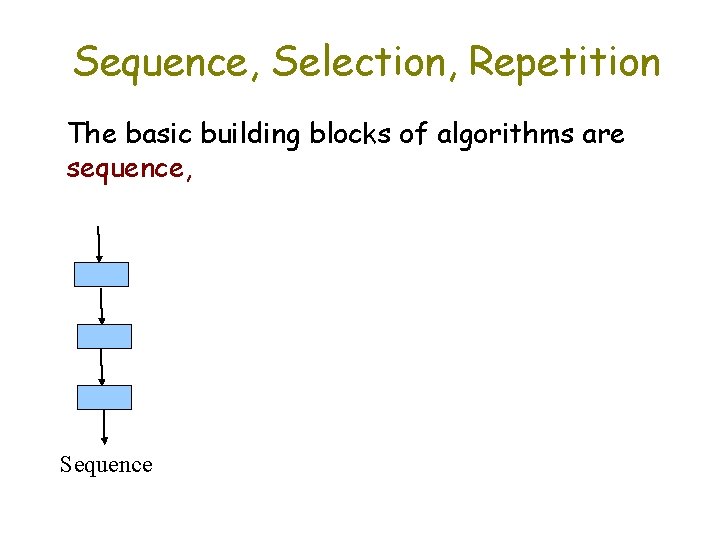
Sequence, Selection, Repetition The basic building blocks of algorithms are sequence, Sequence
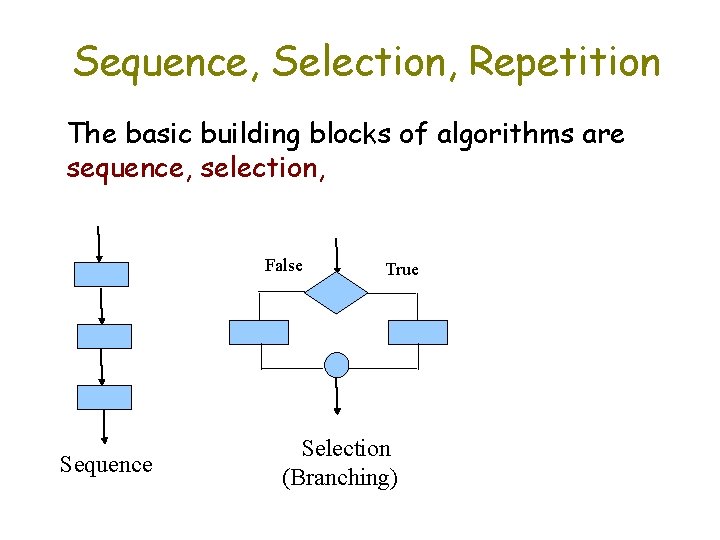
Sequence, Selection, Repetition The basic building blocks of algorithms are sequence, selection, False Sequence True Selection (Branching)
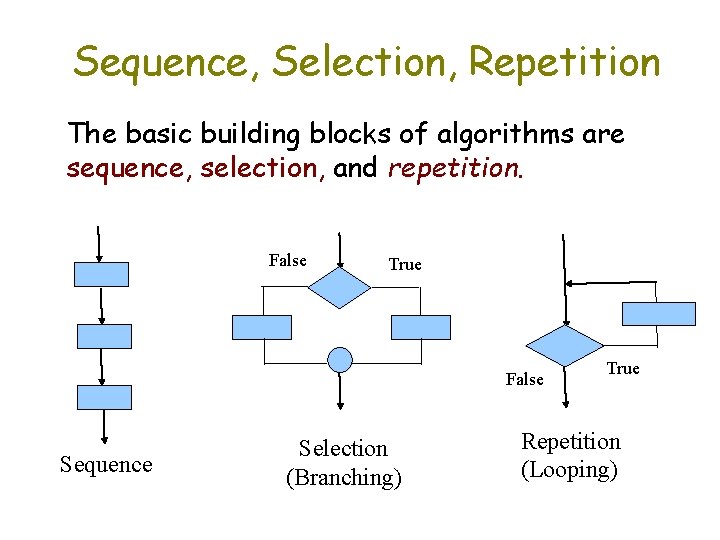
Sequence, Selection, Repetition The basic building blocks of algorithms are sequence, selection, and repetition. False True False Sequence Selection (Branching) True Repetition (Looping)
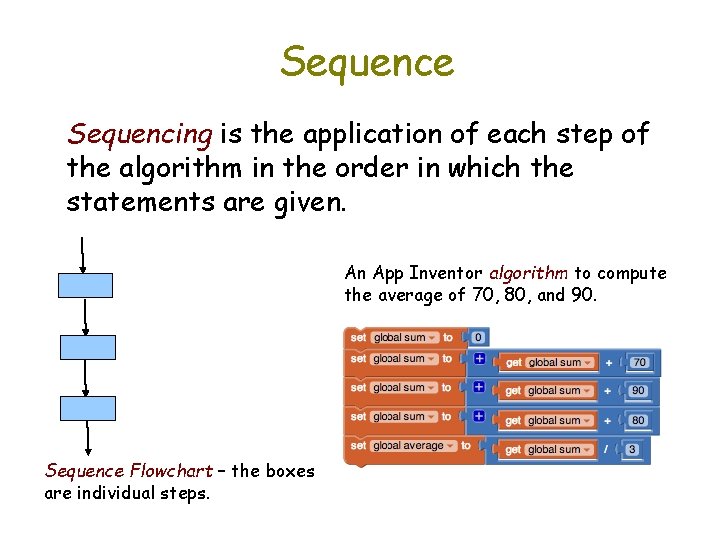
Sequence Sequencing is the application of each step of the algorithm in the order in which the statements are given. An App Inventor algorithm to compute the average of 70, 80, and 90. Sequence Flowchart – the boxes are individual steps.
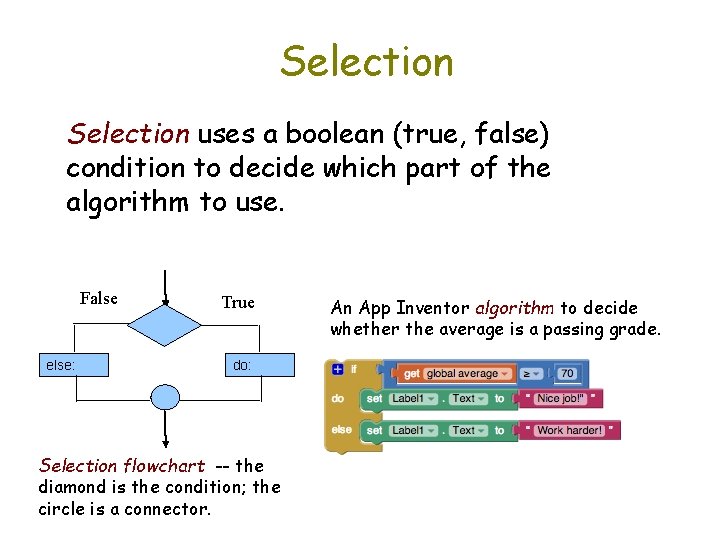
Selection uses a boolean (true, false) condition to decide which part of the algorithm to use. False else: True do: Selection flowchart -- the diamond is the condition; the circle is a connector. An App Inventor algorithm to decide whether the average is a passing grade.
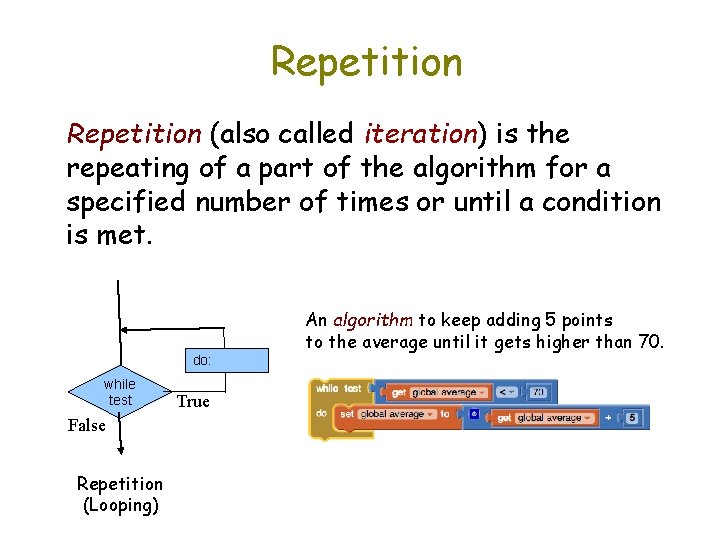
Repetition (also called iteration) is the repeating of a part of the algorithm for a specified number of times or until a condition is met. do: while test False Repetition (Looping) True An algorithm to keep adding 5 points to the average until it gets higher than 70.
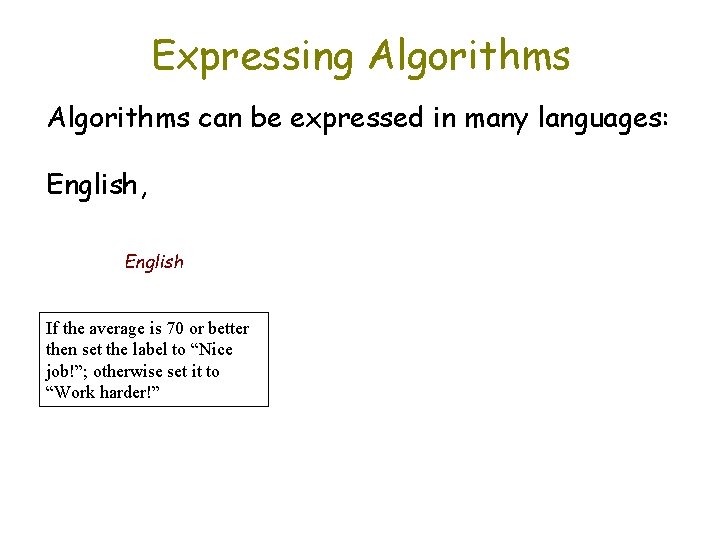
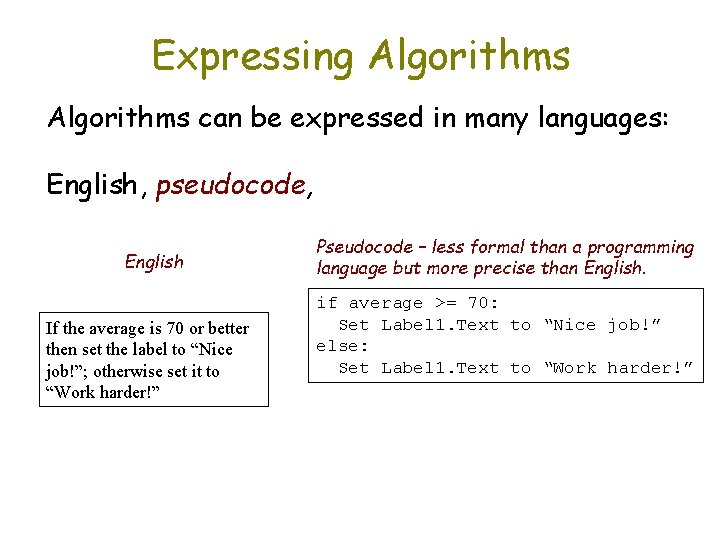
Expressing Algorithms can be expressed in many languages: English, English If the average is 70 or better then set the label to “Nice job!”; otherwise set it to “Work harder!”
Expressing Algorithms can be expressed in many languages: English, pseudocode, English If the average is 70 or better then set the label to “Nice job!”; otherwise set it to “Work harder!” Pseudocode – less formal than a programming language but more precise than English. if average >= 70: Set Label 1. Text to “Nice job!” else: Set Label 1. Text to “Work harder!”
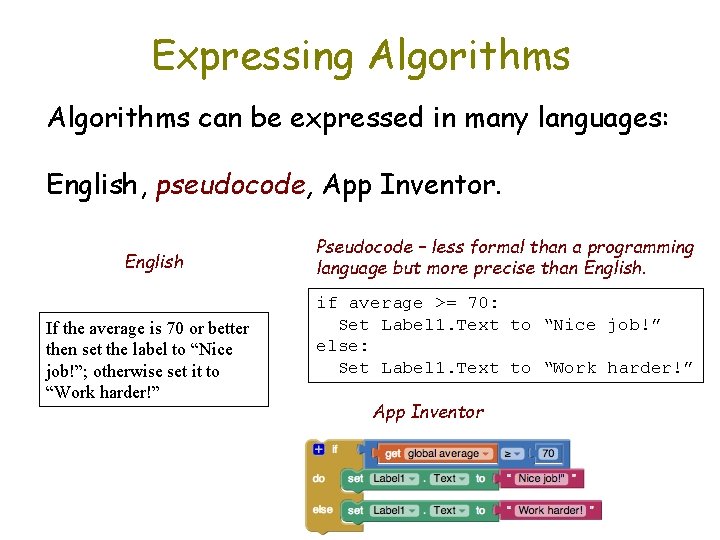
Expressing Algorithms can be expressed in many languages: English, pseudocode, App Inventor. English If the average is 70 or better then set the label to “Nice job!”; otherwise set it to “Work harder!” Pseudocode – less formal than a programming language but more precise than English. if average >= 70: Set Label 1. Text to “Nice job!” else: Set Label 1. Text to “Work harder!” App Inventor
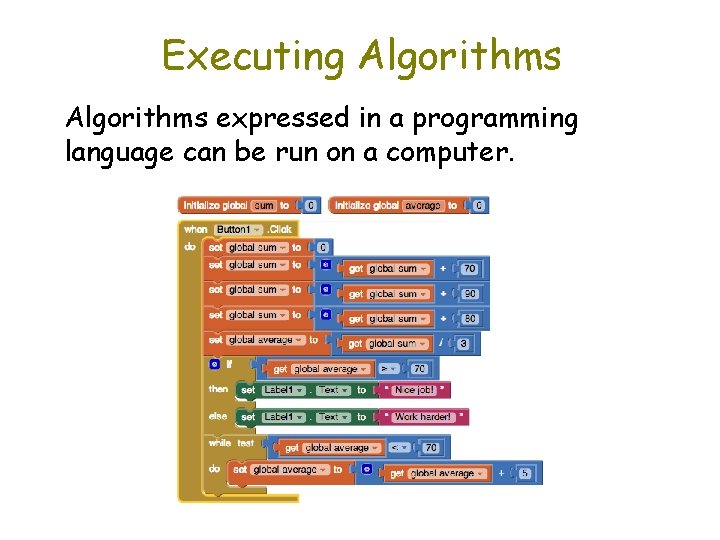
Executing Algorithms expressed in a programming language can be run on a computer.
Important Facts About Algorithms
Important Facts About Algorithms An algorithm is like a recipe but has to be more precise than most recipes.
Important Facts About Algorithms An algorithm is like a recipe but has to be more precise than most recipes. An algorithm is a step-by-step procedure to perform some calculation.
Important Facts About Algorithms An algorithm is like a recipe but has to be more precise than most recipes. An algorithm is a step-by-step procedure to perform some calculation. Each step of an algorithm must be precise and doable.
Important Facts About Algorithms An algorithm is like a recipe but has to be more precise than most recipes. An algorithm is a step-by-step procedure to perform some calculation. Each step of an algorithm must be precise and doable. Every algorithm can be constructed by using just sequence, selection, and repetition.
Important Facts About Algorithms An algorithm is like a recipe but has to be more precise than most recipes. An algorithm is a step-by-step procedure to perform some calculation. Each step of an algorithm must be precise and doable. Every algorithm can be constructed by using just sequence, selection, and repetition. Algorithms can be expressed in flowcharts, pseudocode, and many programming languages.
When finished Create your own maze to exchange with a partner. The maze should be at least 8 by 8 and should contain some patterns that can be solved using a loop.