
Introduction to Algorithms 6 046 J18 401 JSMA
- Slides: 29
Introduction to Algorithms 6. 046 J/18. 401 J/SMA 5503 Lecture 2 Prof. Erik Demaine
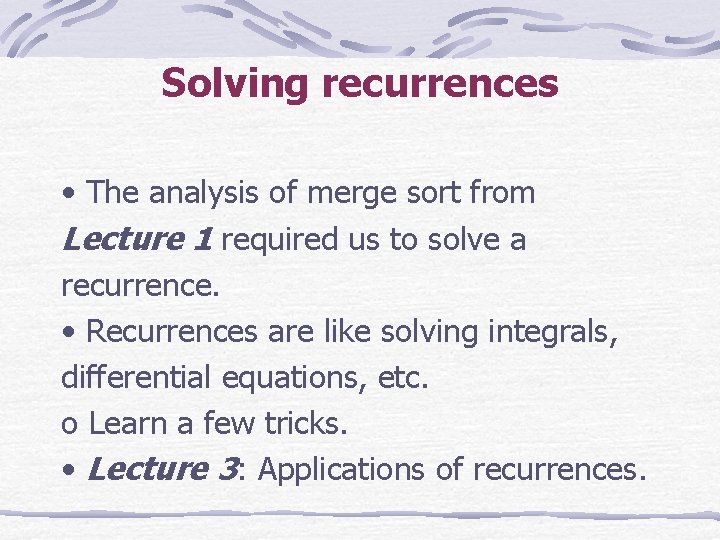
Solving recurrences • The analysis of merge sort from Lecture 1 required us to solve a recurrence. • Recurrences are like solving integrals, differential equations, etc. o Learn a few tricks. • Lecture 3: Applications of recurrences.
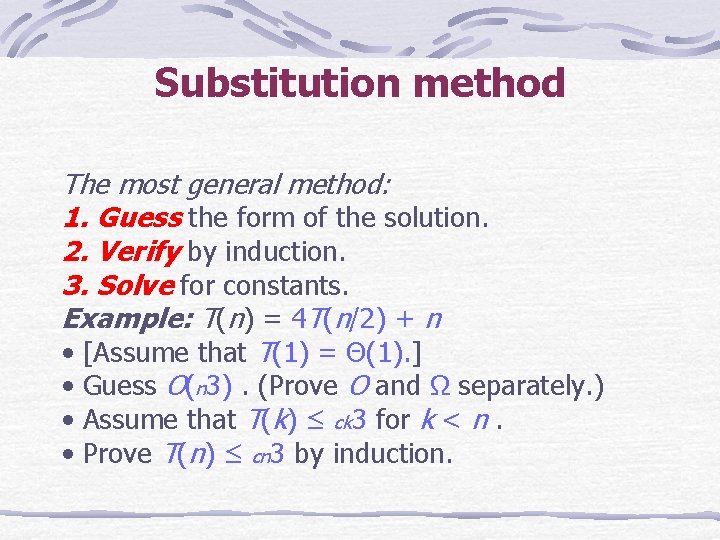
Substitution method The most general method: 1. Guess the form of the solution. 2. Verify by induction. 3. Solve for constants. Example: T(n) = 4 T(n/2) + n • [Assume that T(1) = Θ(1). ] • Guess O(n 3). (Prove O and Ω separately. ) • Assume that T(k) ≤ ck 3 for k < n. • Prove T(n) ≤ cn 3 by induction.
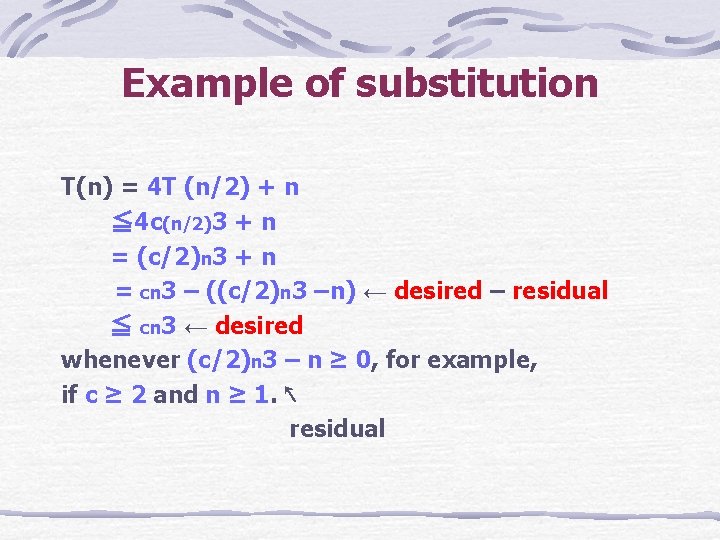
Example of substitution T(n) = 4 T (n/2) + n ≦ 4 c(n/2)3 + n = (c/2)n 3 + n = cn 3 – ((c/2)n 3 –n) ← desired – residual ≦ cn 3 ← desired whenever (c/2)n 3 – n ≥ 0, for example, if c ≥ 2 and n ≥ 1. ↖ residual
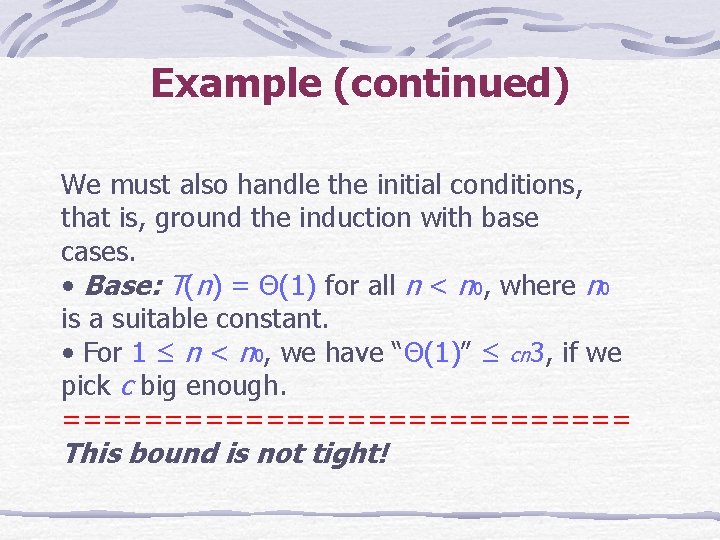
Example (continued) We must also handle the initial conditions, that is, ground the induction with base cases. • Base: T(n) = Θ(1) for all n < n 0, where n 0 is a suitable constant. • For 1 ≤ n < n 0, we have “Θ(1)” ≤ cn 3, if we pick c big enough. ============== This bound is not tight!
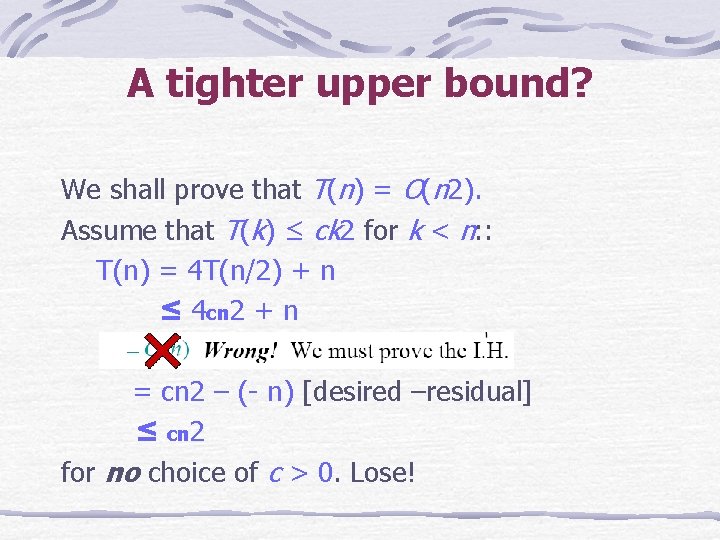
A tighter upper bound? We shall prove that T(n) = O(n 2). Assume that T(k) ≤ ck 2 for k < n: : T(n) = 4 T(n/2) + n ≤ 4 cn 2 + n = cn 2 – (- n) [desired –residual] ≤ cn 2 for no choice of c > 0. Lose!
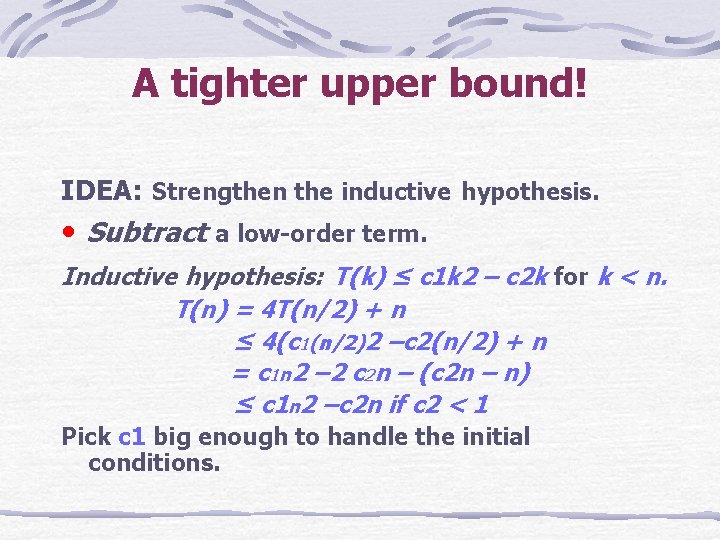
A tighter upper bound! IDEA: Strengthen the inductive hypothesis. • Subtract a low-order term. Inductive hypothesis: T(k) ≤ c 1 k 2 – c 2 k for k < n. T(n) = 4 T(n/2) + n ≤ 4(c 1(n/2)2 –c 2(n/2) + n = c 1 n 2 – 2 c 2 n – (c 2 n – n) ≤ c 1 n 2 –c 2 n if c 2 < 1 Pick c 1 big enough to handle the initial conditions.
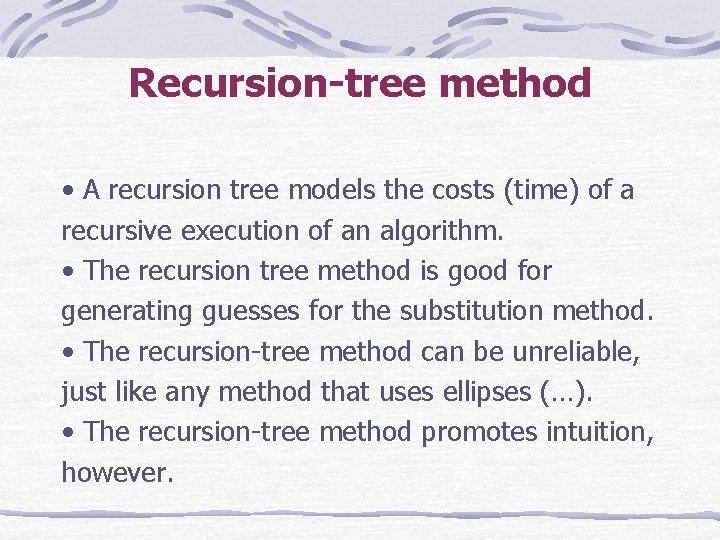
Recursion-tree method • A recursion tree models the costs (time) of a recursive execution of an algorithm. • The recursion tree method is good for generating guesses for the substitution method. • The recursion-tree method can be unreliable, just like any method that uses ellipses (…). • The recursion-tree method promotes intuition, however.
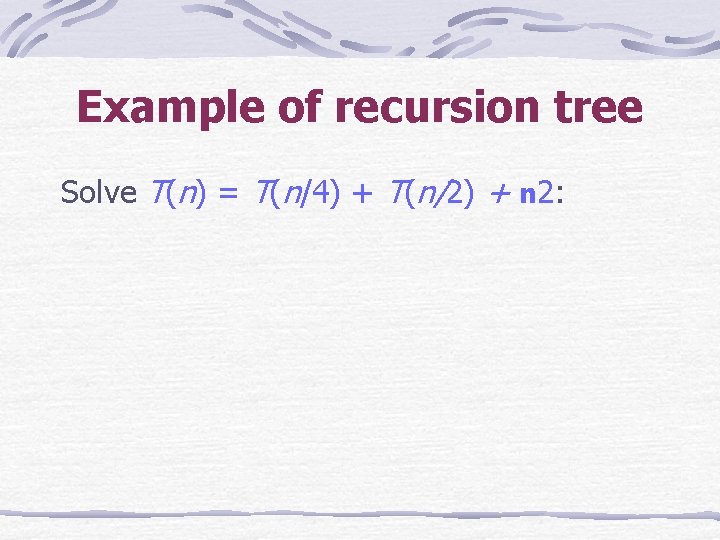
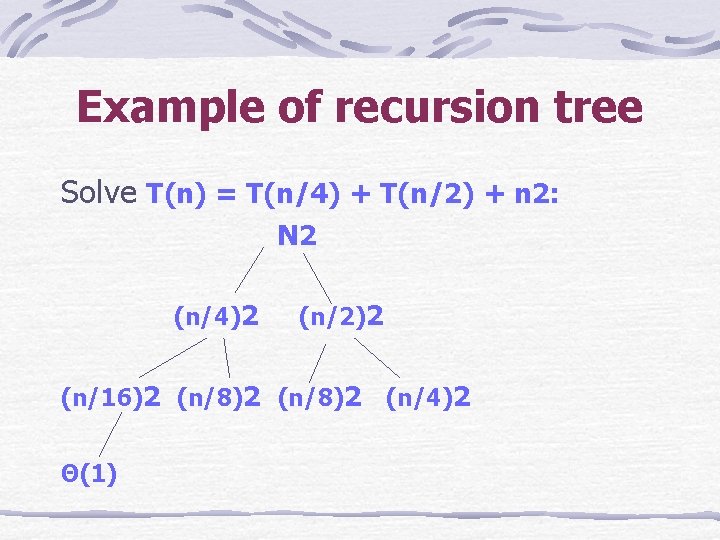
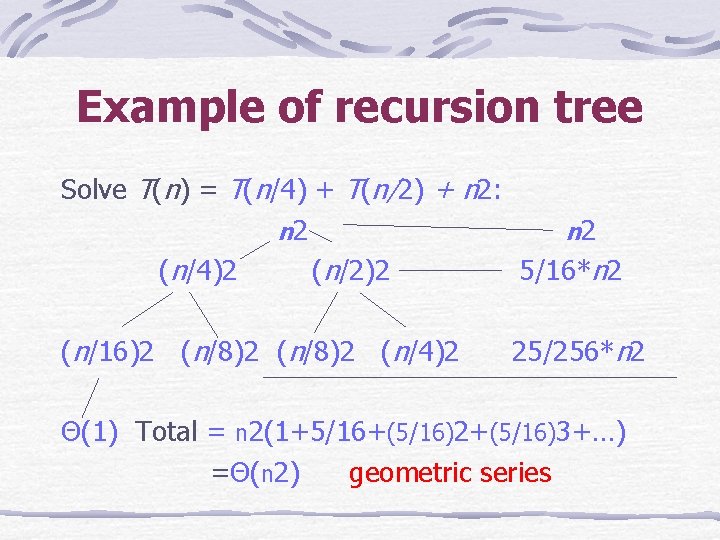
Example of recursion tree Solve T(n) = T(n/4) + T(n/2) + n 2:
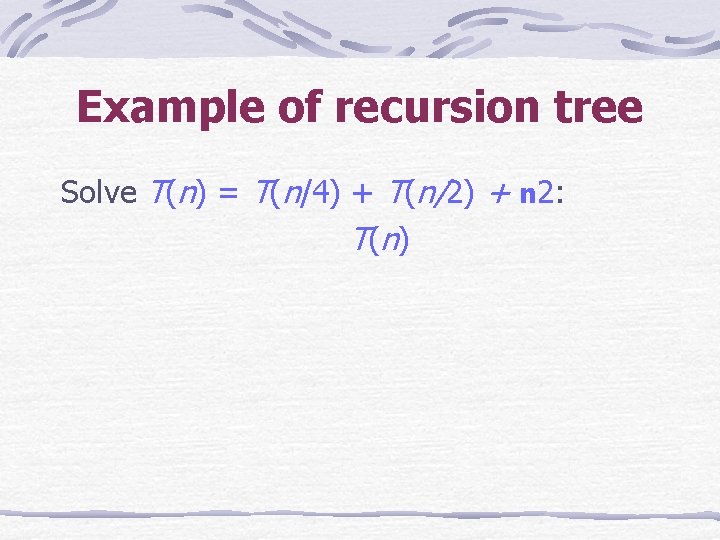
Example of recursion tree Solve T(n) = T(n/4) + T(n/2) + n 2: T ( n)
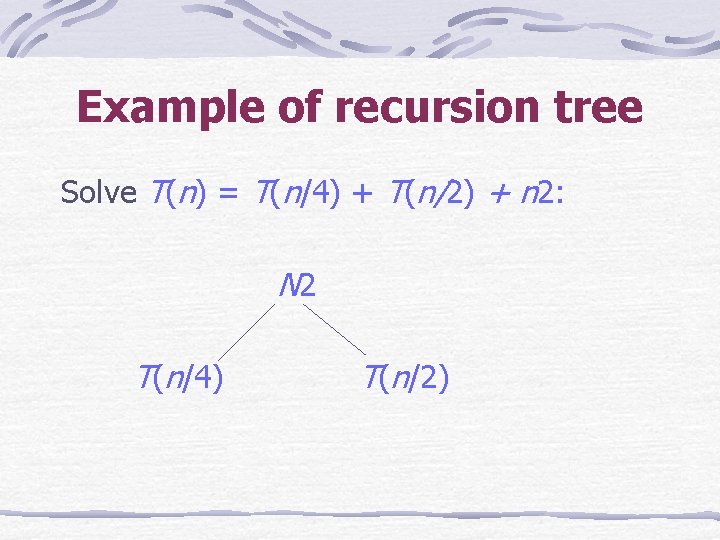
Example of recursion tree Solve T(n) = T(n/4) + T(n/2) + n 2: N 2 T(n/4) T(n/2)
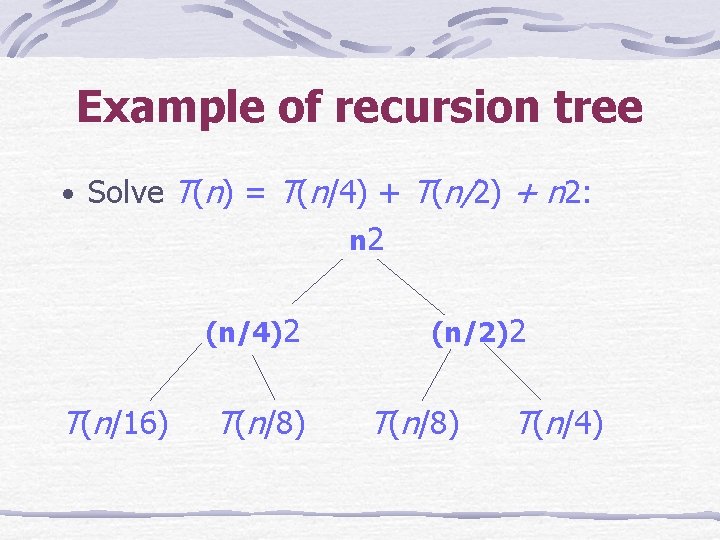
Example of recursion tree • Solve T(n) = T(n/4) + T(n/2) + n 2: n 2 (n/4)2 T(n/16) T(n/8) (n/2)2 T(n/8) T(n/4)
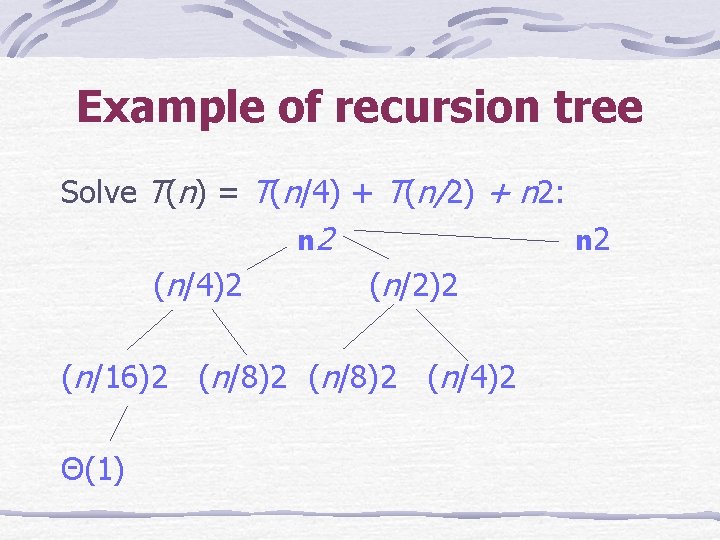
Example of recursion tree Solve T(n) = T(n/4) + T(n/2) + n 2: N 2 (n/4)2 (n/2)2 (n/16)2 (n/8)2 Θ(1) (n/4)2
Example of recursion tree Solve T(n) = T(n/4) + T(n/2) + n 2: n 2 (n/4)2 n 2 (n/2)2 (n/16)2 (n/8)2 (n/4)2 Θ(1)
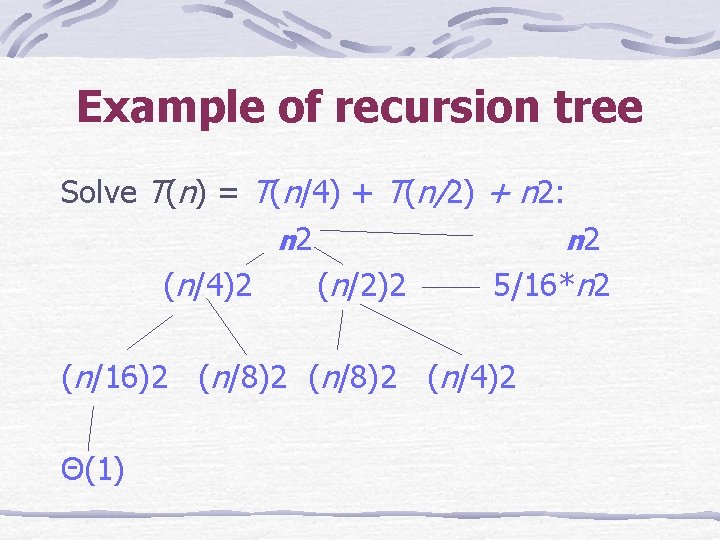
Example of recursion tree Solve T(n) = T(n/4) + T(n/2) + n 2: n 2 (n/4)2 (n/2)2 5/16*n 2 (n/16)2 (n/8)2 (n/4)2 Θ(1)
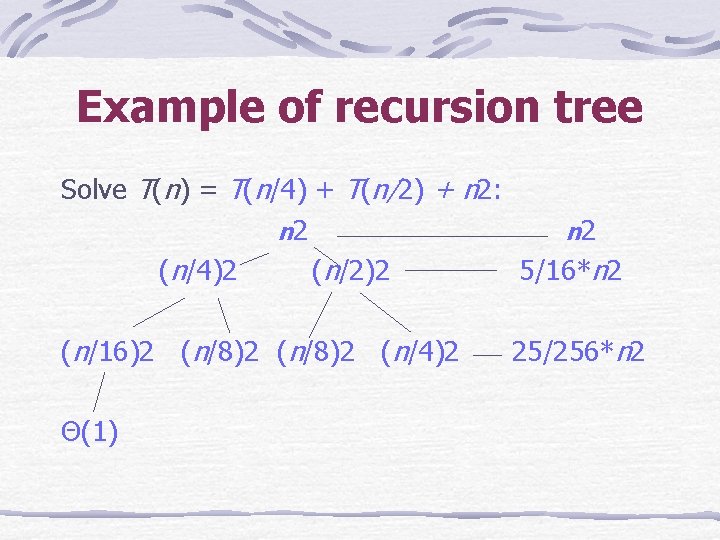
Example of recursion tree Solve T(n) = T(n/4) + T(n/2) + n 2: n 2 (n/4)2 (n/2)2 5/16*n 2 (n/16)2 (n/8)2 (n/4)2 Θ(1) 25/256*n 2
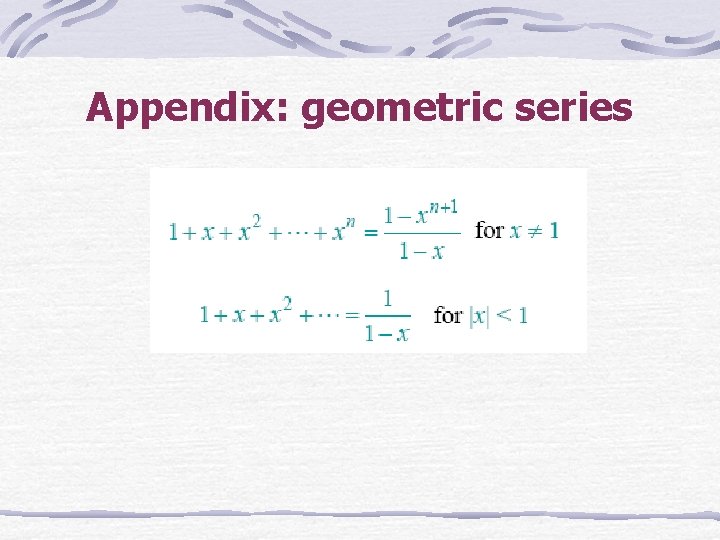
Example of recursion tree Solve T(n) = T(n/4) + T(n/2) + n 2: n 2 (n/4)2 (n/2)2 5/16*n 2 (n/16)2 (n/8)2 (n/4)2 25/256*n 2 Θ(1) Total = n 2(1+5/16+(5/16)2+(5/16)3+…) =Θ(n 2) geometric series
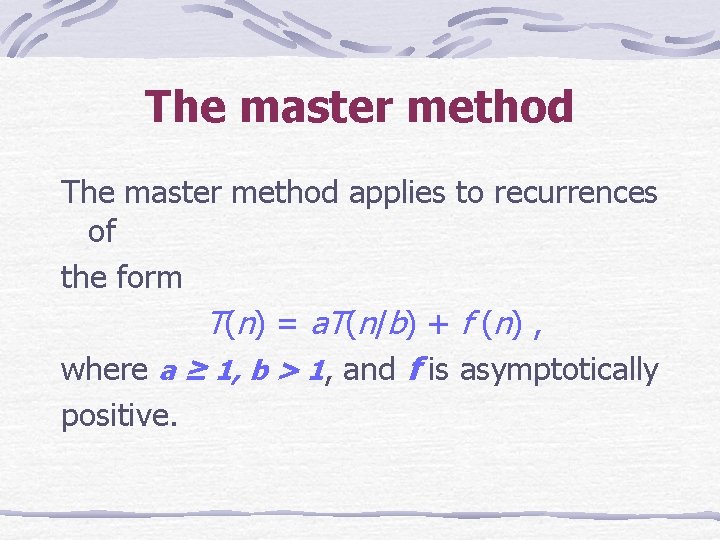
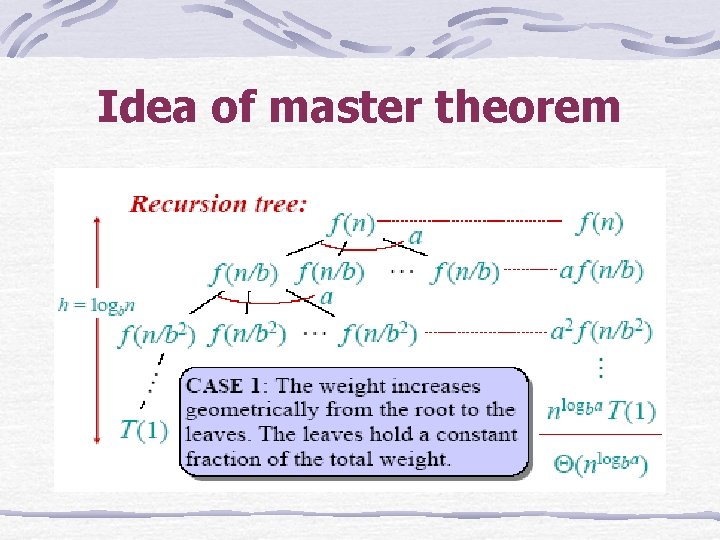
The master method applies to recurrences of the form T(n) = a. T(n/b) + f (n) , where a ≥ 1, b > 1, and f is asymptotically positive.
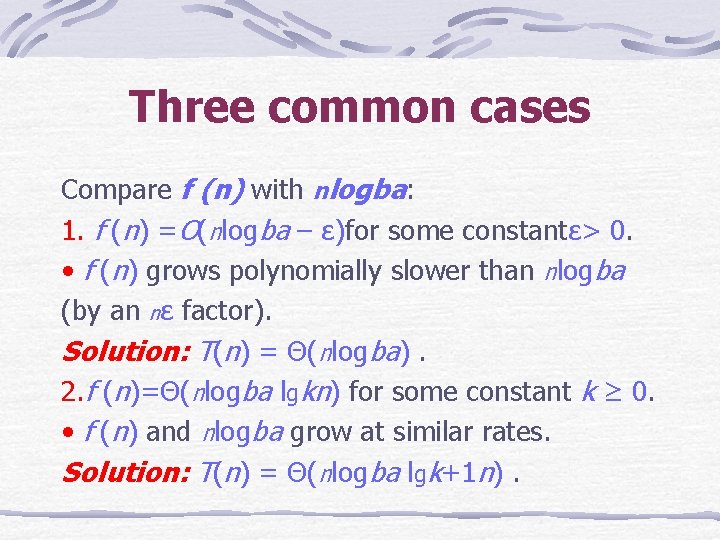
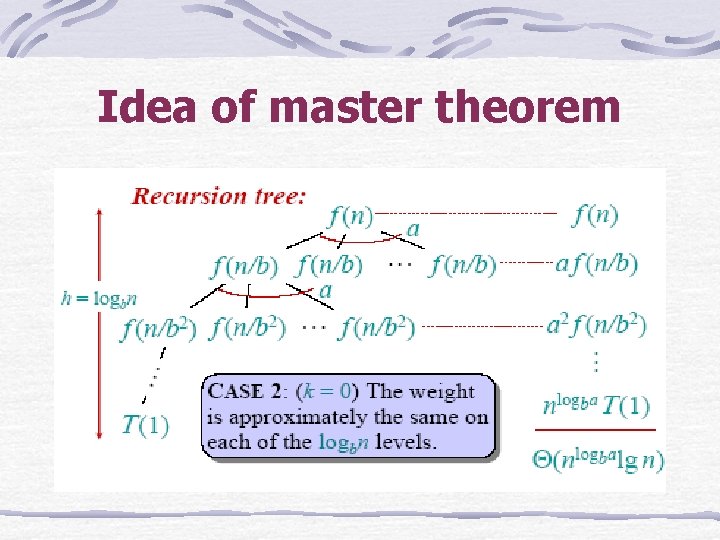
Three common cases Compare f (n) with nlogba: 1. f (n) =O(nlogba – ε)for some constantε> 0. • f (n) grows polynomially slower than nlogba (by an nε factor). Solution: T(n) = Θ(nlogba). 2. f (n)=Θ(nlogba lgkn) for some constant k ≥ 0. • f (n) and nlogba grow at similar rates. Solution: T(n) = Θ(nlogba lgk+1 n).
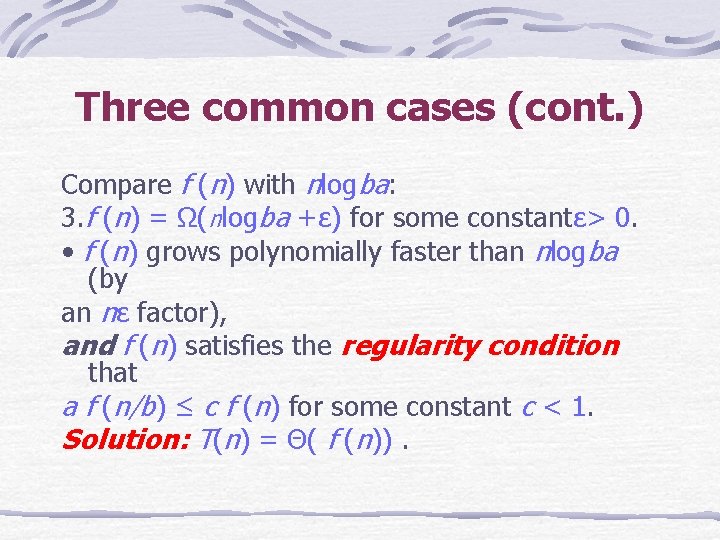
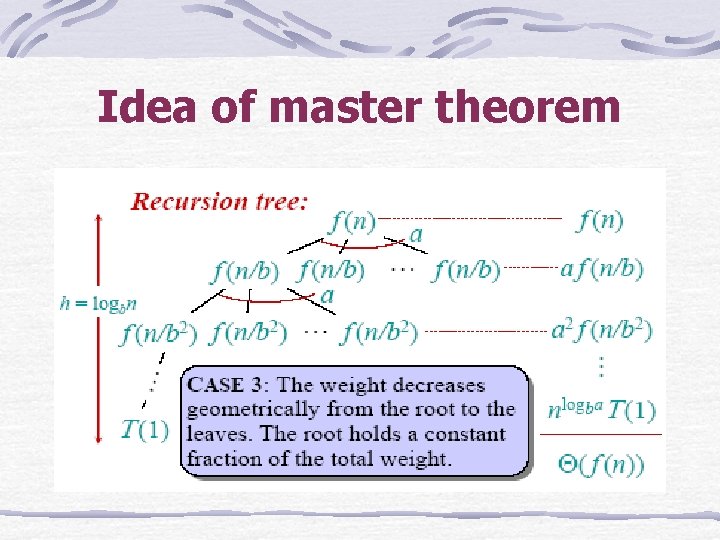
Three common cases (cont. ) Compare f (n) with nlogba: 3. f (n) = Ω(nlogba +ε) for some constantε> 0. • f (n) grows polynomially faster than nlogba (by an nε factor), and f (n) satisfies the regularity condition that a f (n/b) ≤ c f (n) for some constant c < 1. Solution: T(n) = Θ( f (n)).
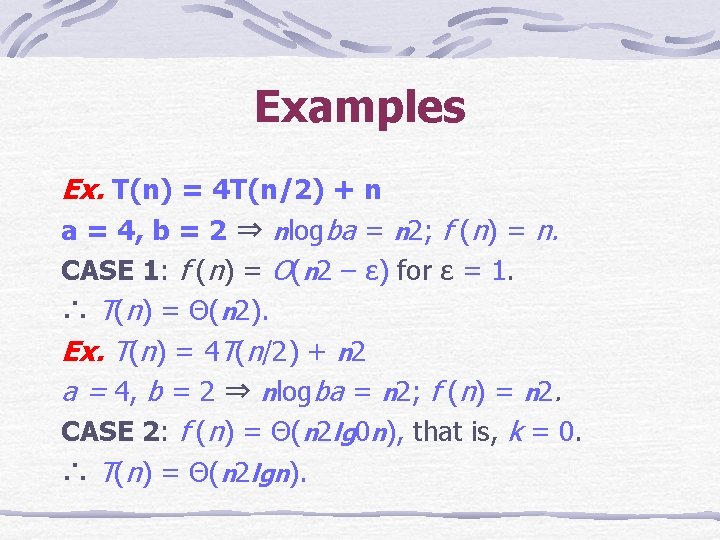
Examples Ex. T(n) = 4 T(n/2) + n a = 4, b = 2 ⇒ nlogba = n 2; f (n) = n. CASE 1: f (n) = O(n 2 – ε) for ε = 1. ∴ T(n) = Θ(n 2). Ex. T(n) = 4 T(n/2) + n 2 a = 4, b = 2 ⇒ nlogba = n 2; f (n) = n 2. CASE 2: f (n) = Θ(n 2 lg 0 n), that is, k = 0. ∴ T(n) = Θ(n 2 lgn).
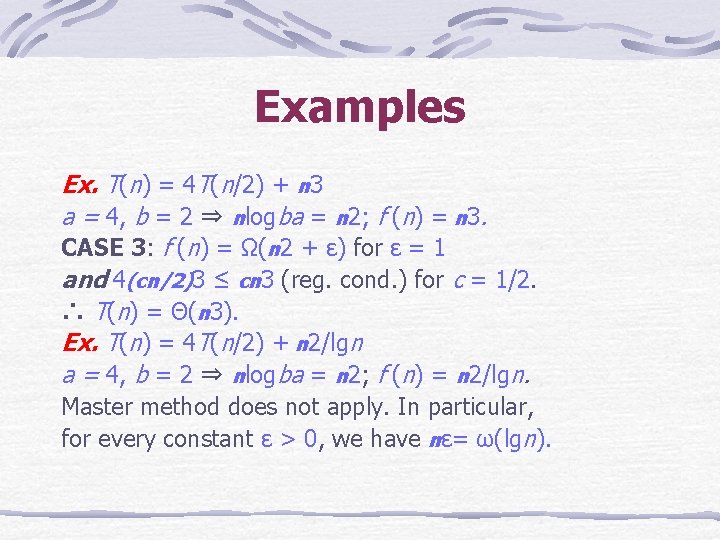
Examples Ex. T(n) = 4 T(n/2) + n 3 a = 4, b = 2 ⇒ nlogba = n 2; f (n) = n 3. CASE 3: f (n) = Ω(n 2 + ε) for ε = 1 and 4(cn/2)3 ≤ cn 3 (reg. cond. ) for c = 1/2. ∴ T(n) = Θ(n 3). Ex. T(n) = 4 T(n/2) + n 2/lgn a = 4, b = 2 ⇒ nlogba = n 2; f (n) = n 2/lgn. Master method does not apply. In particular, for every constant ε > 0, we have nε= ω(lgn).
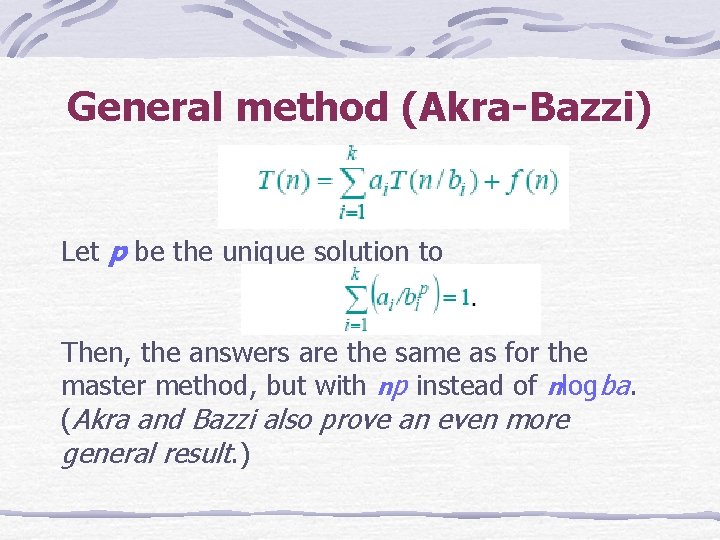
General method (Akra-Bazzi) Let p be the unique solution to Then, the answers are the same as for the master method, but with np instead of nlogba. (Akra and Bazzi also prove an even more general result. )
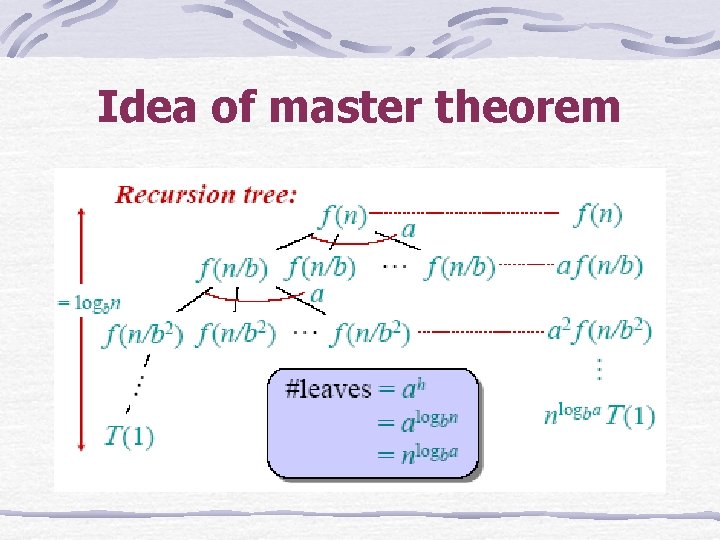
Idea of master theorem
Idea of master theorem
Idea of master theorem
Idea of master theorem
Conclusion • Next time: applying the master method. • For proof of master theorem, see CLRS.
Appendix: geometric series