
Introduction to AI 2019 Lecture 1 Lecture Plan



- Slides: 28
Introduction to AI 2019: Lecture 1
Lecture Plan First Half: 1. Course Administration 2. Course Topics Second Half: 1. The AI Revolution: Where are we?
Course Admin AI 2018
Teaching Staff Lecturer: - Mike Ashcroft (michael. ashcroft@it. uu. se) Principal Assistants: - General Matters: Amin Kaveh (amin. kaveh@it. uu. se) - Exam Matters: Alex Yuan Gao (alex. yuan. gao@it. uu. se) Secondary Assistants (for projects): - Fred Nilsson (staff email being organized) - Archit Suryawanshi (staff email being organized) Guest Teacher: - Hai Pham (staff email being organized)
Assumed Knowledge No formal prerequisites. But you should be comfortable with basic: • Probability theory / Statistics • Linear Algebra If you are not, you should brush up. An online lecture is provided to give you the basics in statistical learning that we will use in this course, but you may also need to look at some quick introductory texts.
Course Goals In this course we will examine a collection of deterministic and stochastic artificial intelligence. You will: - Understand the mathematics underlying the algorithms examined. - Understand the relationship between the algorithms, and their scope of use. - Be able to apply these algorithms on real problems.
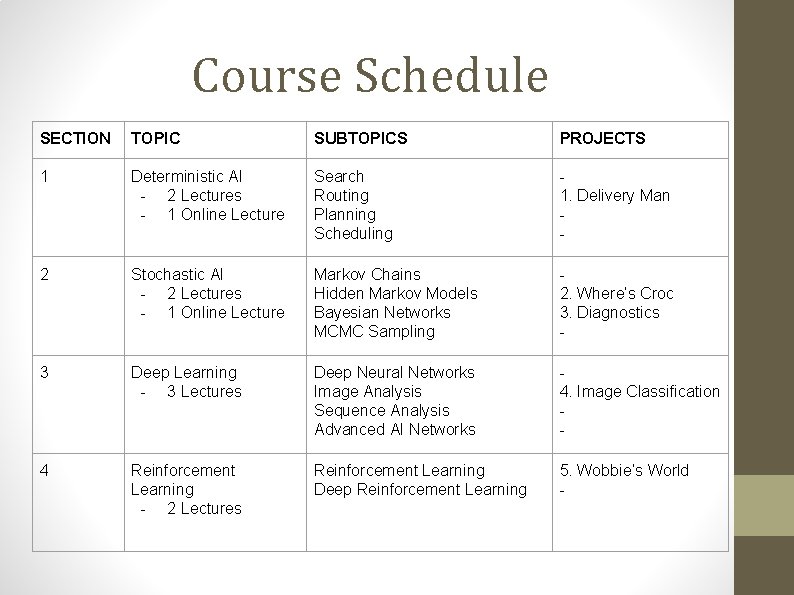
Course Schedule SECTION TOPIC SUBTOPICS PROJECTS 1 Deterministic AI - 2 Lectures - 1 Online Lecture Search Routing Planning Scheduling 1. Delivery Man - 2 Stochastic AI - 2 Lectures - 1 Online Lecture Markov Chains Hidden Markov Models Bayesian Networks MCMC Sampling 2. Where’s Croc 3. Diagnostics - 3 Deep Learning - 3 Lectures Deep Neural Networks Image Analysis Sequence Analysis Advanced AI Networks 4. Image Classification - 4 Reinforcement Learning - 2 Lectures Reinforcement Learning Deep Reinforcement Learning 5. Wobbie’s World -
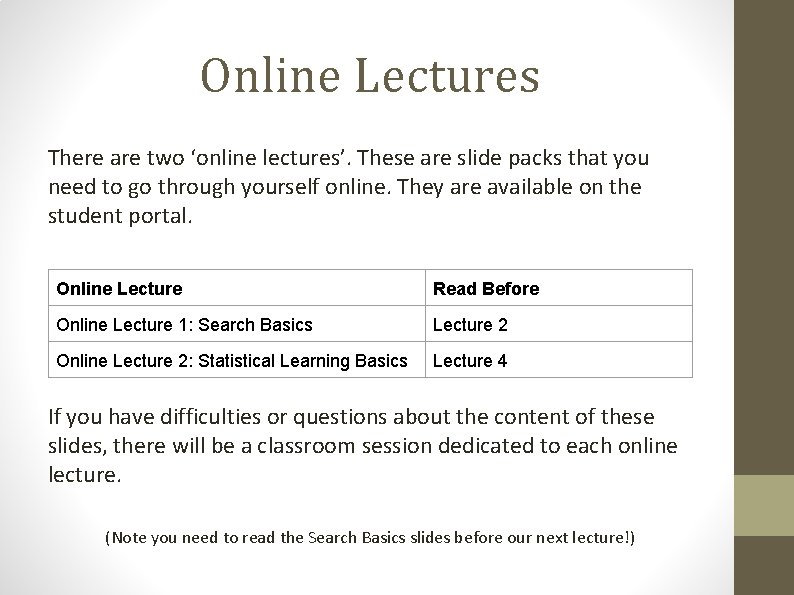
Online Lectures There are two ‘online lectures’. These are slide packs that you need to go through yourself online. They are available on the student portal. Online Lecture Read Before Online Lecture 1: Search Basics Lecture 2 Online Lecture 2: Statistical Learning Basics Lecture 4 If you have difficulties or questions about the content of these slides, there will be a classroom session dedicated to each online lecture. (Note you need to read the Search Basics slides before our next lecture!)
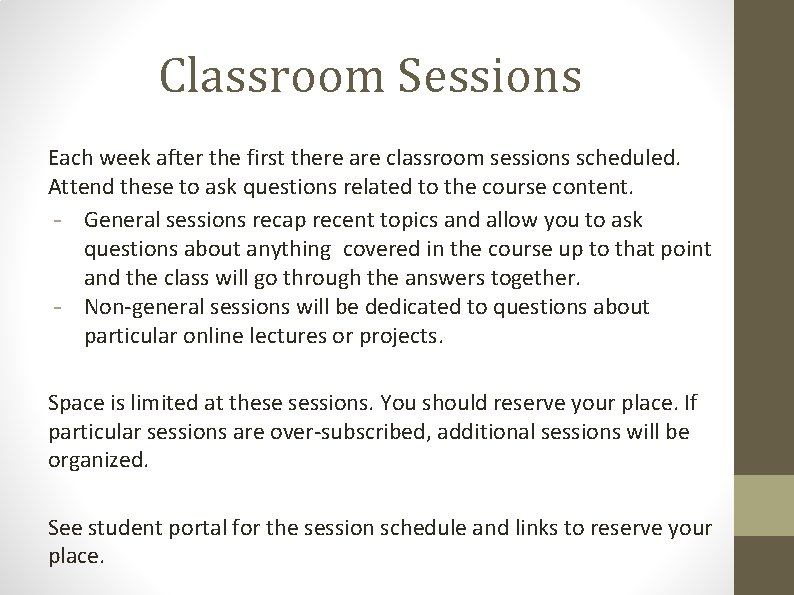
Classroom Sessions Each week after the first there are classroom sessions scheduled. Attend these to ask questions related to the course content. - General sessions recap recent topics and allow you to ask questions about anything covered in the course up to that point and the class will go through the answers together. - Non-general sessions will be dedicated to questions about particular online lectures or projects. Space is limited at these sessions. You should reserve your place. If particular sessions are over-subscribed, additional sessions will be organized. See student portal for the session schedule and links to reserve your place.
Drop-In Sessions You can also email Amin to organize one-on-one meetings.
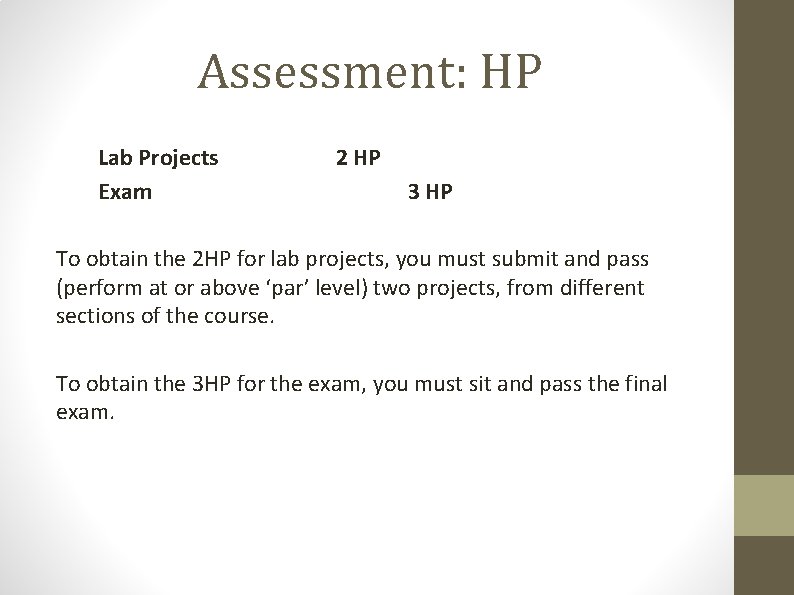
Assessment: HP Lab Projects Exam 2 HP 3 HP To obtain the 2 HP for lab projects, you must submit and pass (perform at or above ‘par’ level) two projects, from different sections of the course. To obtain the 3 HP for the exam, you must sit and pass the final exam.
Assessment: Final Grade In the normal case, the final grade in the course will depend on your exam mark. However, you can submit additional projects in order to ensure a high grade. The alternative means of obtaining grades 4 and 5 are: • (5) Five projects performed above or at par level and the exam passed • (4) Four projects performed above or at par level and the exam passed To obtain these project based final grades (i) you must take and pass the course exam in the initial exam session, not in a re-exam; and (ii) you must have contributed in a reasonable way to the projects submitted (if submitting projects as part of a pair).
Exam The exam is automatically generated, and a copy of the exam generation R script is available on student portal. Download it to generate your own exams for practice. If you have difficulty with questions generated by the exam script, you should attend classroom or drop-in sessions and discuss matters there.
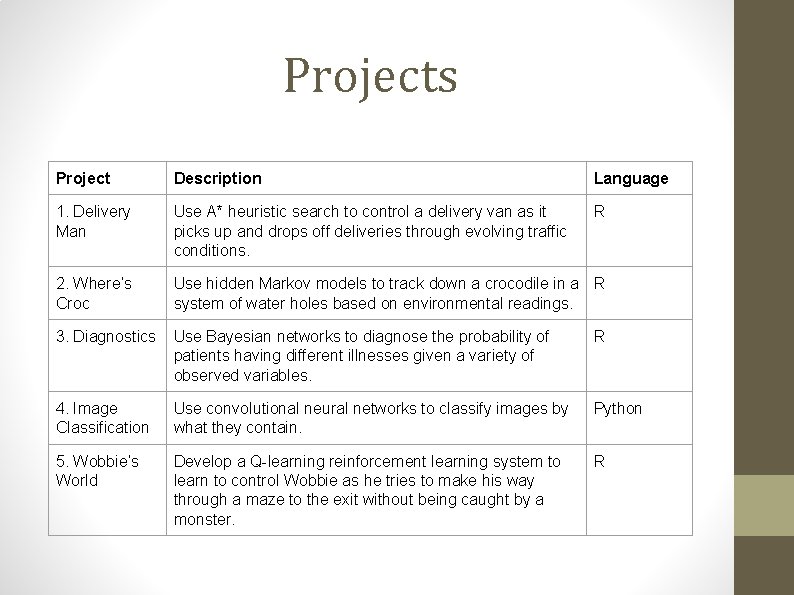
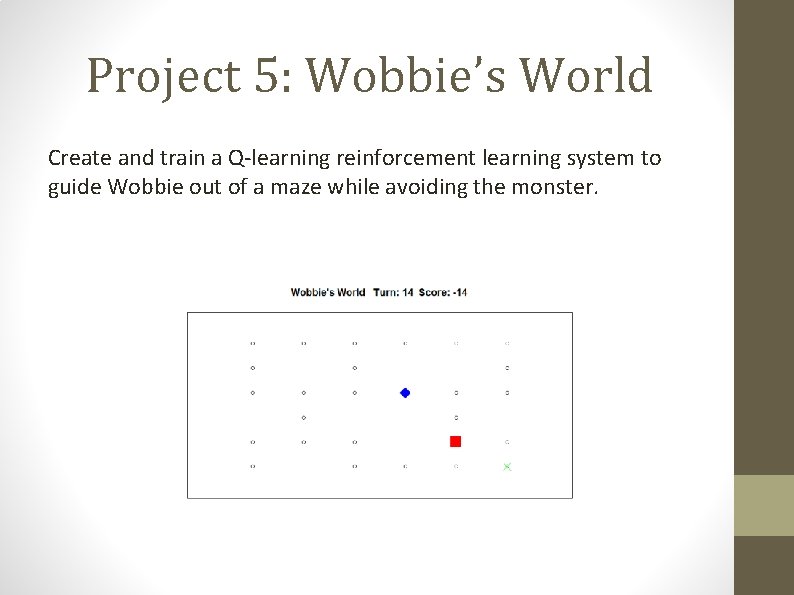
Projects Project Description Language 1. Delivery Man Use A* heuristic search to control a delivery van as it picks up and drops off deliveries through evolving traffic conditions. R 2. Where’s Croc Use hidden Markov models to track down a crocodile in a R system of water holes based on environmental readings. 3. Diagnostics Use Bayesian networks to diagnose the probability of patients having different illnesses given a variety of observed variables. R 4. Image Classification Use convolutional neural networks to classify images by what they contain. Python 5. Wobbie’s World Develop a Q-learning reinforcement learning system to learn to control Wobbie as he tries to make his way through a maze to the exit without being caught by a monster. R
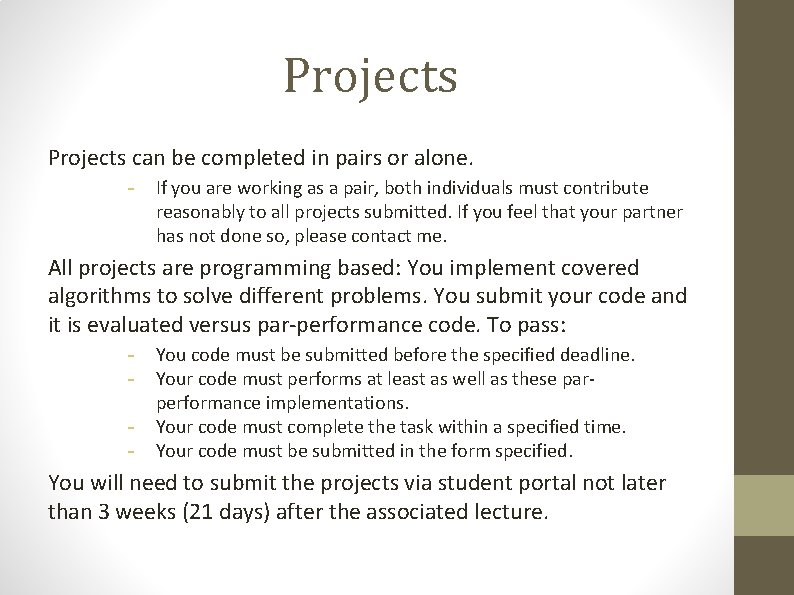
Projects can be completed in pairs or alone. - If you are working as a pair, both individuals must contribute reasonably to all projects submitted. If you feel that your partner has not done so, please contact me. All projects are programming based: You implement covered algorithms to solve different problems. You submit your code and it is evaluated versus par-performance code. To pass: - You code must be submitted before the specified deadline. Your code must performs at least as well as these parperformance implementations. Your code must complete the task within a specified time. Your code must be submitted in the form specified. You will need to submit the projects via student portal not later than 3 weeks (21 days) after the associated lecture.
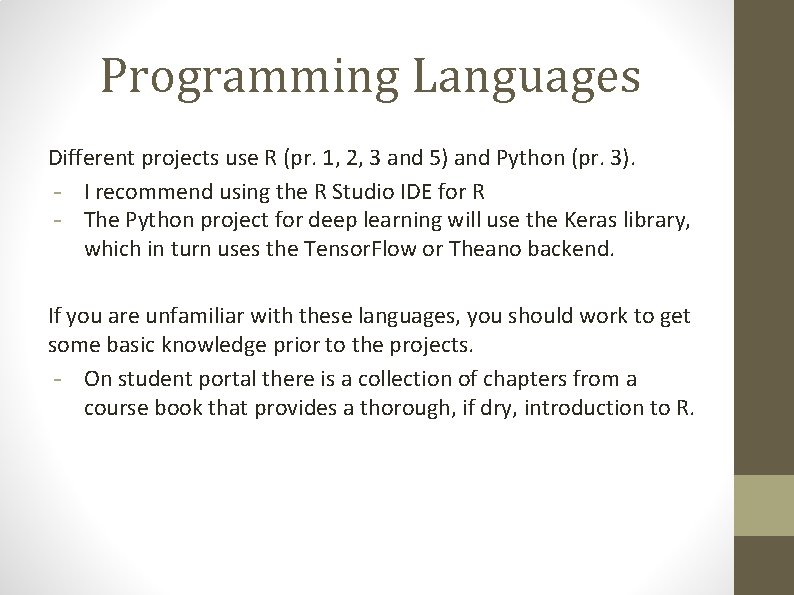
Programming Languages Different projects use R (pr. 1, 2, 3 and 5) and Python (pr. 3). - I recommend using the R Studio IDE for R - The Python project for deep learning will use the Keras library, which in turn uses the Tensor. Flow or Theano backend. If you are unfamiliar with these languages, you should work to get some basic knowledge prior to the projects. - On student portal there is a collection of chapters from a course book that provides a thorough, if dry, introduction to R.
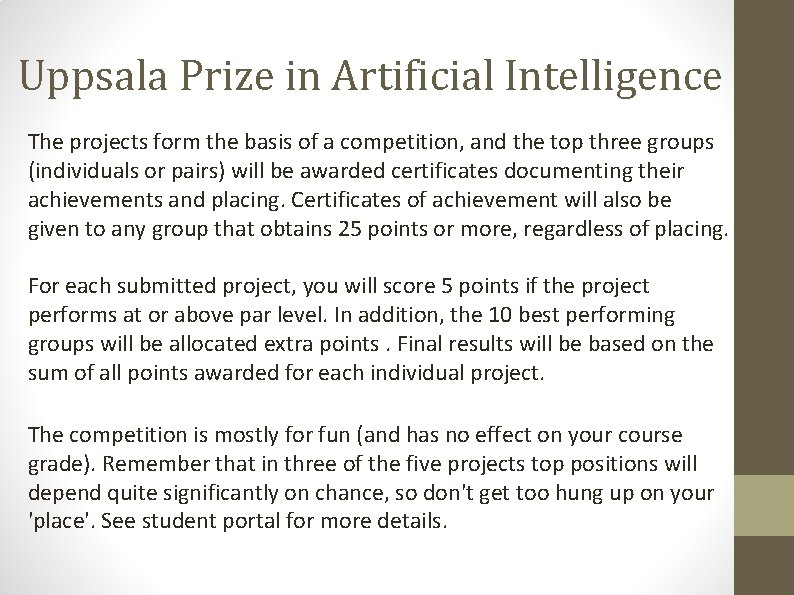
Uppsala Prize in Artificial Intelligence The projects form the basis of a competition, and the top three groups (individuals or pairs) will be awarded certificates documenting their achievements and placing. Certificates of achievement will also be given to any group that obtains 25 points or more, regardless of placing. For each submitted project, you will score 5 points if the project performs at or above par level. In addition, the 10 best performing groups will be allocated extra points. Final results will be based on the sum of all points awarded for each individual project. The competition is mostly for fun (and has no effect on your course grade). Remember that in three of the five projects top positions will depend quite significantly on chance, so don't get too hung up on your 'place'. See student portal for more details.
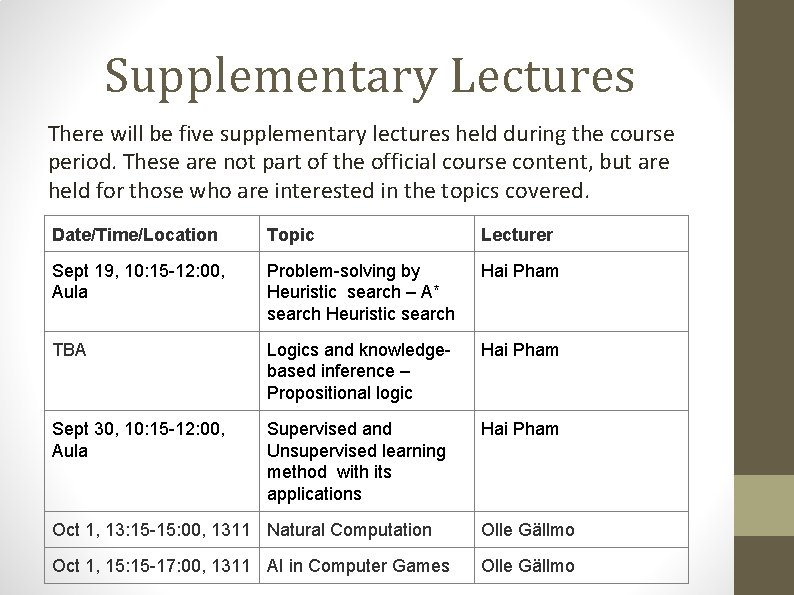
Supplementary Lectures There will be five supplementary lectures held during the course period. These are not part of the official course content, but are held for those who are interested in the topics covered. Date/Time/Location Topic Lecturer Sept 19, 10: 15 -12: 00, Aula Problem-solving by Heuristic search – A* search Heuristic search Hai Pham TBA Logics and knowledgebased inference – Propositional logic Hai Pham Sept 30, 10: 15 -12: 00, Aula Supervised and Unsupervised learning method with its applications Hai Pham Oct 1, 13: 15 -15: 00, 1311 Natural Computation Olle Gällmo Oct 1, 15: 15 -17: 00, 1311 AI in Computer Games Olle Gällmo
Course Topics AI 2018
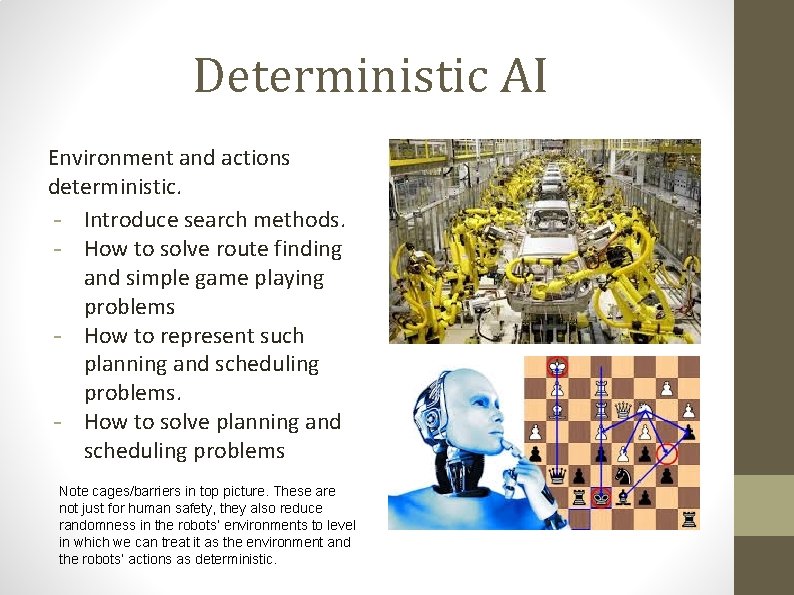
Deterministic AI Environment and actions deterministic. - Introduce search methods. - How to solve route finding and simple game playing problems - How to represent such planning and scheduling problems. - How to solve planning and scheduling problems Note cages/barriers in top picture. These are not just for human safety, they also reduce randomness in the robots’ environments to level in which we can treat it as the environment and the robots’ actions as deterministic.
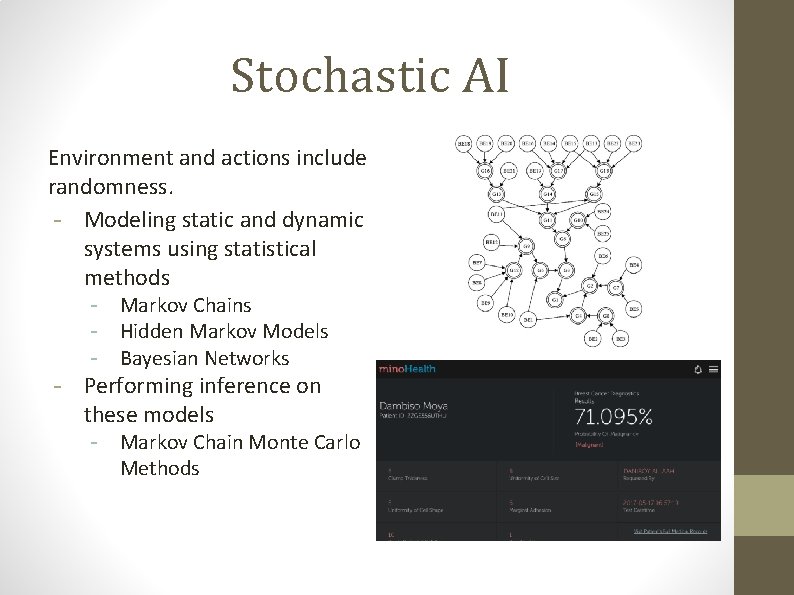
Stochastic AI Environment and actions include randomness. - Modeling static and dynamic systems using statistical methods - Markov Chains - Hidden Markov Models - Bayesian Networks - Performing inference on these models - Markov Chain Monte Carlo Methods
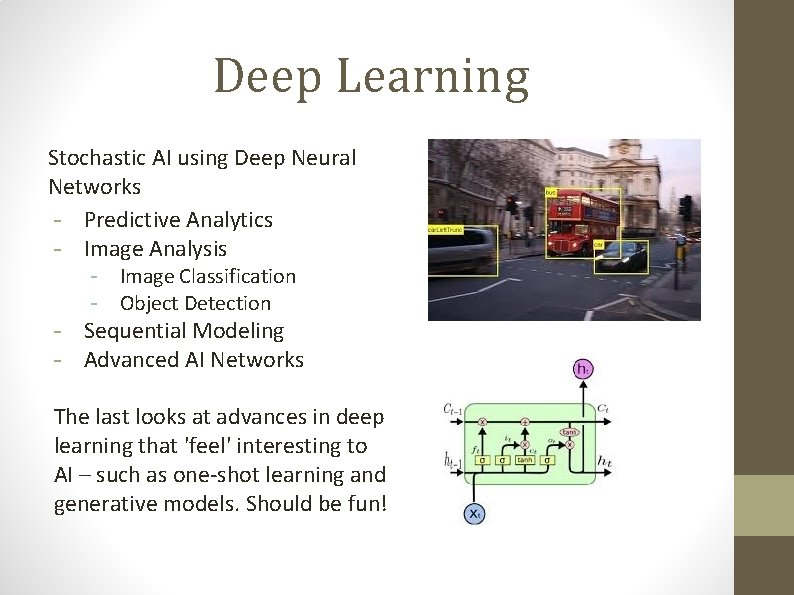
Deep Learning Stochastic AI using Deep Neural Networks - Predictive Analytics - Image Analysis - Image Classification - Object Detection - Sequential Modeling - Advanced AI Networks The last looks at advances in deep learning that 'feel' interesting to AI – such as one-shot learning and generative models. Should be fun!
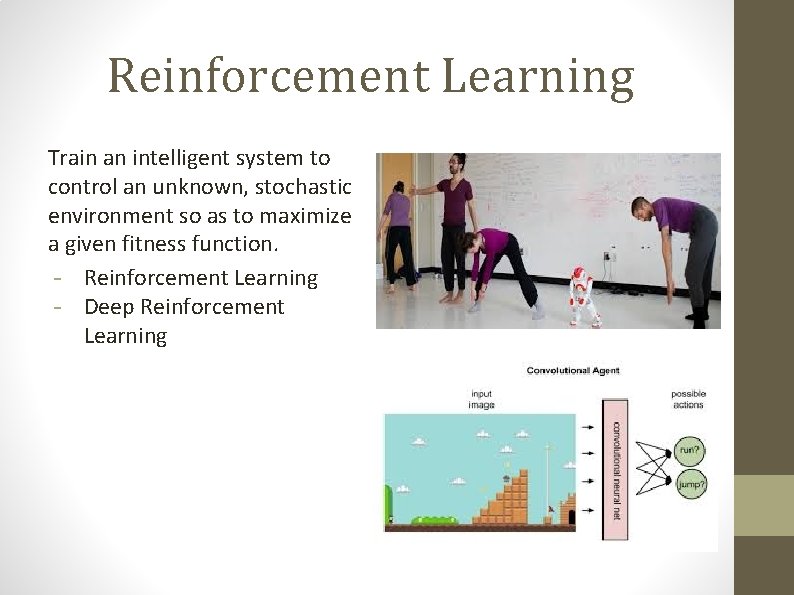
Reinforcement Learning Train an intelligent system to control an unknown, stochastic environment so as to maximize a given fitness function. - Reinforcement Learning - Deep Reinforcement Learning
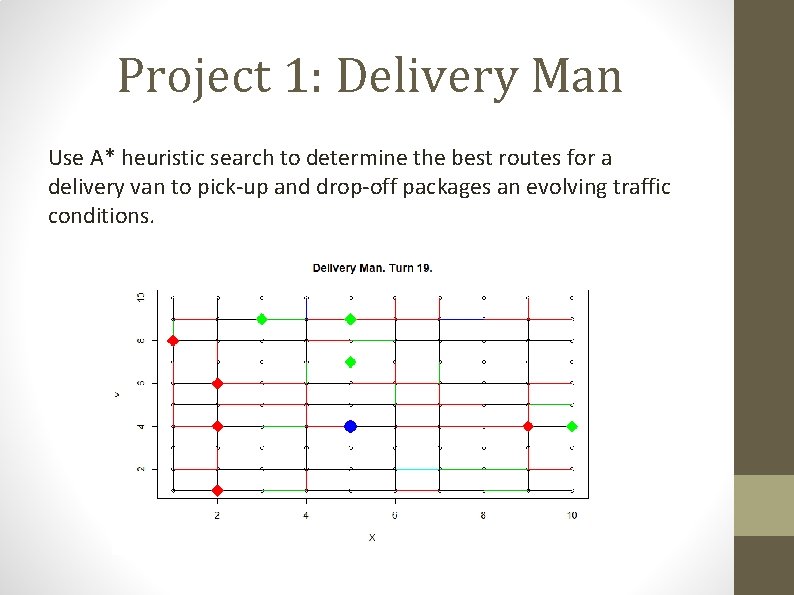
Project 1: Delivery Man Use A* heuristic search to determine the best routes for a delivery van to pick-up and drop-off packages an evolving traffic conditions.
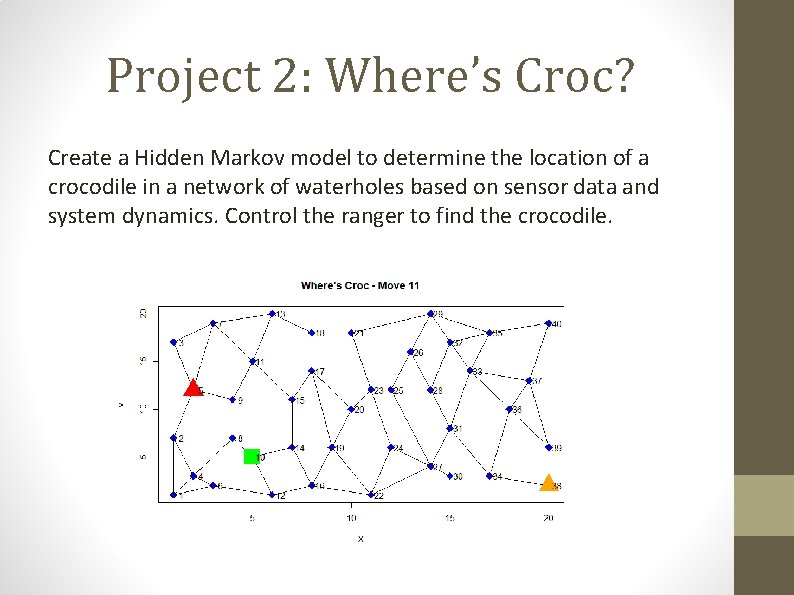
Project 2: Where’s Croc? Create a Hidden Markov model to determine the location of a crocodile in a network of waterholes based on sensor data and system dynamics. Control the ranger to find the crocodile.
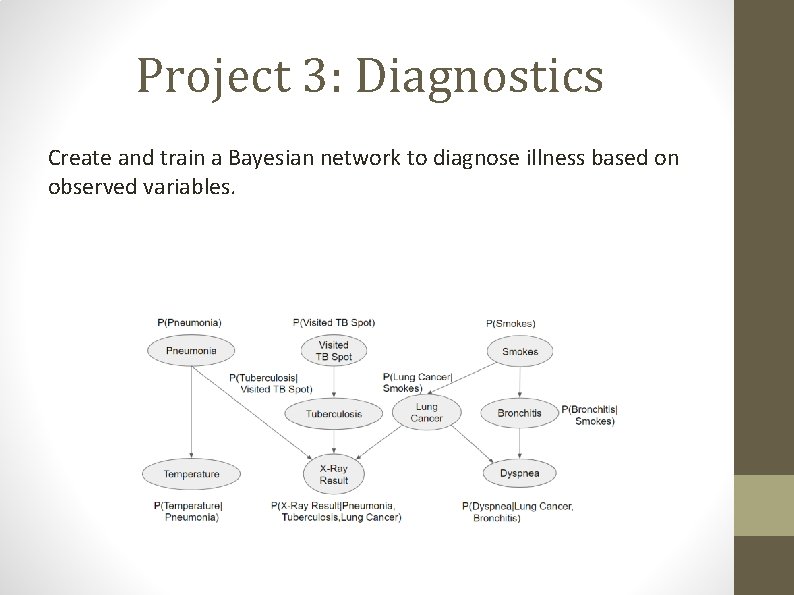
Project 3: Diagnostics Create and train a Bayesian network to diagnose illness based on observed variables.
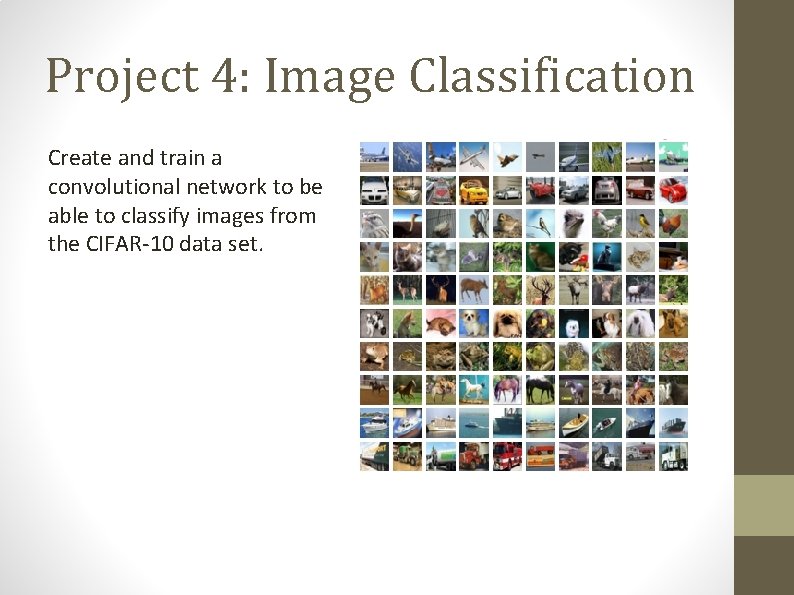
Project 4: Image Classification Create and train a convolutional network to be able to classify images from the CIFAR-10 data set.
Project 5: Wobbie’s World Create and train a Q-learning reinforcement learning system to guide Wobbie out of a maze while avoiding the monster.