
Introduction to Aggie STEM Teacher Boot Camp Mary
Introduction to Aggie STEM Teacher Boot Camp Mary M. & Robert M. Capraro Summer 2018 Teacher Boot Camp June 11 - Monday
Welcome to TAMU • • Breakfast Introductions – tell us one good thing!! Wi. Fi Connect Pre Assessment – Qualtrics Link Sign up for Activities Shirts Welcome Dr. de. Miranda
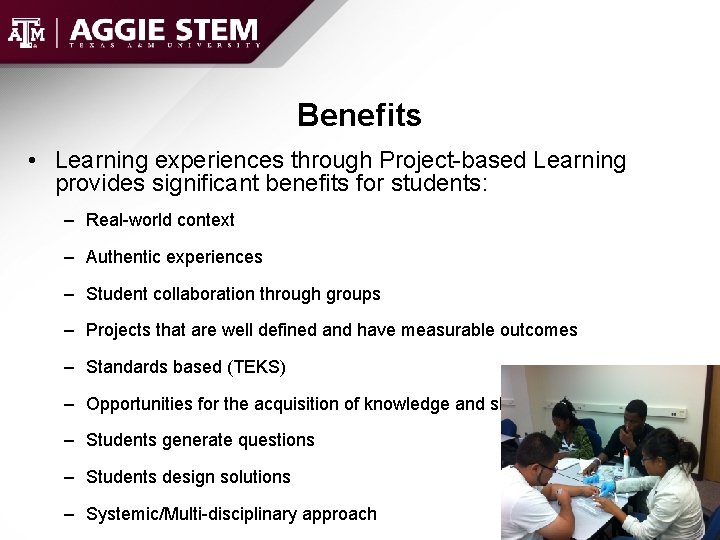
Benefits • Learning experiences through Project-based Learning provides significant benefits for students: – Real-world context – Authentic experiences – Student collaboration through groups – Projects that are well defined and have measurable outcomes – Standards based (TEKS) – Opportunities for the acquisition of knowledge and skills – Students generate questions – Students design solutions – Systemic/Multi-disciplinary approach
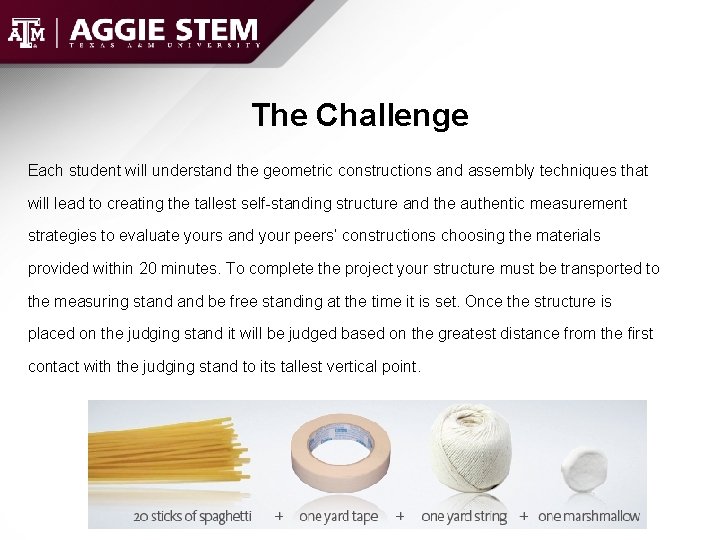
The Challenge Each student will understand the geometric constructions and assembly techniques that will lead to creating the tallest self-standing structure and the authentic measurement strategies to evaluate yours and your peers’ constructions choosing the materials provided within 20 minutes. To complete the project your structure must be transported to the measuring stand be free standing at the time it is set. Once the structure is placed on the judging stand it will be judged based on the greatest distance from the first contact with the judging stand to its tallest vertical point.
Constraints 1. 7 Sessions 1) the first session is a 120 second design session: draw a picture (plan) list the materials and the order you will gather them 2) the next 4 are 180 second construction sessions 3) your 6 th session is a 120 second reflection session to refine your model and plan 4) Your final (7 th) session is 180 seconds – finish up and bring to the stand. 2. One material should be chosen each session (2 -5). 3. One person from each group picks up one material. 4. The design is sketched during the initial 120 second session and revised during subsequent sessions 5. The tower is constructed during the sessions 6. For the tower to be judged it must be transported to the judging table 7. Your team must have a method to determine which tower is tallest base to apex (perpendicular to the base).
Reflection What prior knowledge do students need to successfully • What prior knowledge do you need to successfully complete this challenge? • What problems did you encounter and how did you solve them? • Did your final constructed tower match your design? • What do you think would happen if you had a chance to do this again (iterative process)?
Lunch • • • -Sbisa - we will walk over -12: 10 -1: 20 – no card needed – they will click you in – wear your name badge
Intro to PBL & the Engineering Design • Robert M. Capraro

Introduction to PBL • Importance of Design Process – What is the Design Process? • Systematic approach followed when developing a solution for a problem with a well-defined outcome. • Many variations in practice today, but most include same basic steps. – Why do we need to follow a Design Process? • Provides the structure needed to formulate the best solution possible • Builds problem solving skills and logic
Introduction to PBL • Importance of Design Process Cont. – Engineering applies concepts from mathematics, the sciences, and technology to solve complex problems in a systematic manner.
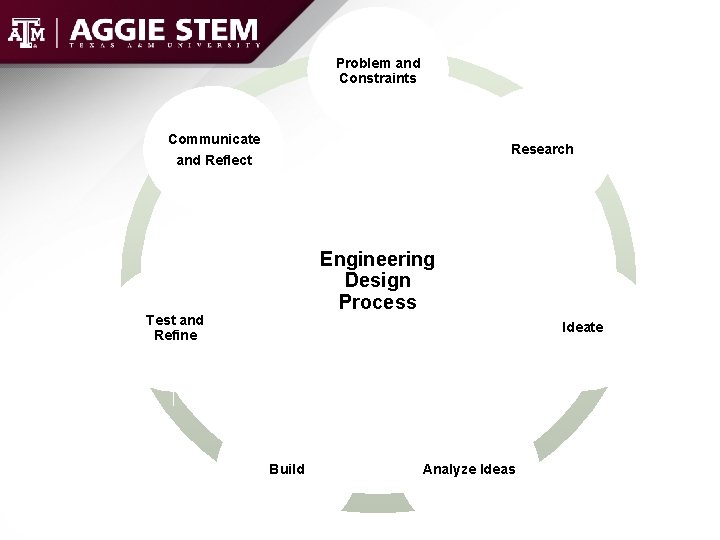
Problem and Constraints Communicate Research and Reflect Engineering Design Process Test and Refine Ideate Build Analyze Ideas
Design Process The process is, by nature, iterative in that engineers almost never work linearly through the steps, but instead, alternate between the various steps until the final design solution is identified.

Problem & Constraint Identification • Constraints – Limitations or restrictions to a design process or product – Often focused on: • Limited resources and inputs to the project • Process used when designing a solution • Business requirements or procedures • Criteria – Requirements that focus on the desirable or necessary characteristics of the final design – Evaluated on a scale
Let’s Identify a Problem • Click to Play NASA Video
Research • Provides information necessary to formulate and critically analyze design ideas – – – – Internet Books Magazines Newspapers Interviews Field Trips Experiments Observations
Ideation • Creativity (Think “outside the box. ”) • Open Mind (Place value on team members’ input. ) • Perseverance (Generate multiple solution ideas. ) • Teamwork (Build on each other’s ideas using established processes and norms. ) • Flexibility
Ideation (Cont. ) • Proper Brainstorming – Focus on generation of many different solution ideas (QUANTITY) without concern for perfecting proposed solutions (QUALITY) at this point in the process. – Avoid judgment in decision analysis. • Members should be able to take risks without being criticized. – Encourage all team members to contribute. – Make a genuine effort to listen and understand all contributions from team members.
Multiple Solutions Project design does not address a single correct answer; rather it aims to identify the best solution from amongst several possibilities. • Typically many feasible solutions • Two teams with identical problem criteria but different weights on each – Affects selection of final design • Weights given to criteria not necessarily constant – Criteria may be highly weighted only up to a certain level.
Deliverable(s) 1. Explain what students must produce? 2. Justify why you believe or do not believe that the level of the expected product matches the expected level of learning? 3. Discuss the necessary knowledge students must have to complete the deliverable.
Communication and Metacognition • Metacognition – Done incessantly throughout all phases of the project – Well documented – Conducted individually and within a team setting – Through reflection conducted at end of project
Written Communication Examples • Brainstorming ideas • Research • Sources of information • Interactions • Meeting Minutes • Test predictions and results • Reflective thoughts • Project management • Graphs and charts
Visual Communication • Helps communicate difficult concepts and undeveloped ideas • Serves as input for the build phases of the project • Stored in Journal • Examples – – – – – Illustrations Draft sketches Detailed sketches with dimensions Blueprints Diagrams Graphs Dimensions Photos Video
Safety 1. What were the classroom/school rules applicable to this task? 2. What resources were available to assist in researching this topic? 3. How did I use the resources? 4. What materials did I need? – Video
Other Aspects of Planning • There are many things that should be included in a PBL. – School rules – Subject specific rules – Teacher rules – District rules – Curriculum rules – ? ? ?
Drinking Water: Is it safe? ? Texas A&M University Luciana Barroso
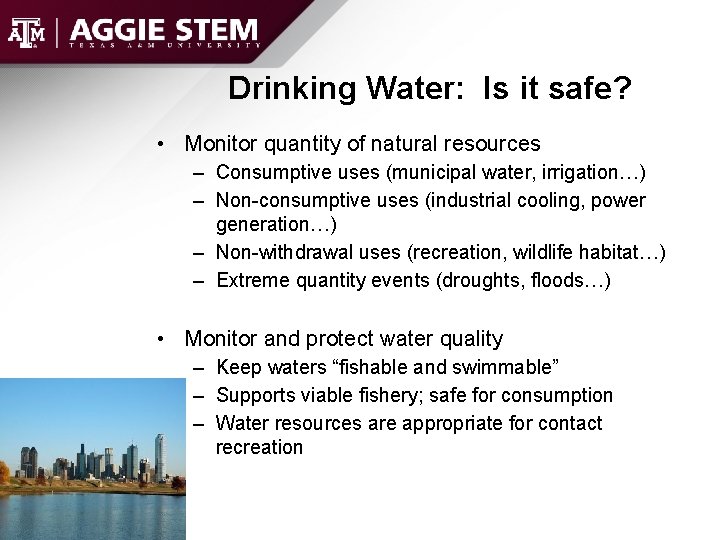
Drinking Water: Is it safe? • Monitor quantity of natural resources – Consumptive uses (municipal water, irrigation…) – Non-consumptive uses (industrial cooling, power generation…) – Non-withdrawal uses (recreation, wildlife habitat…) – Extreme quantity events (droughts, floods…) • Monitor and protect water quality – Keep waters “fishable and swimmable” – Supports viable fishery; safe for consumption – Water resources are appropriate for contact recreation
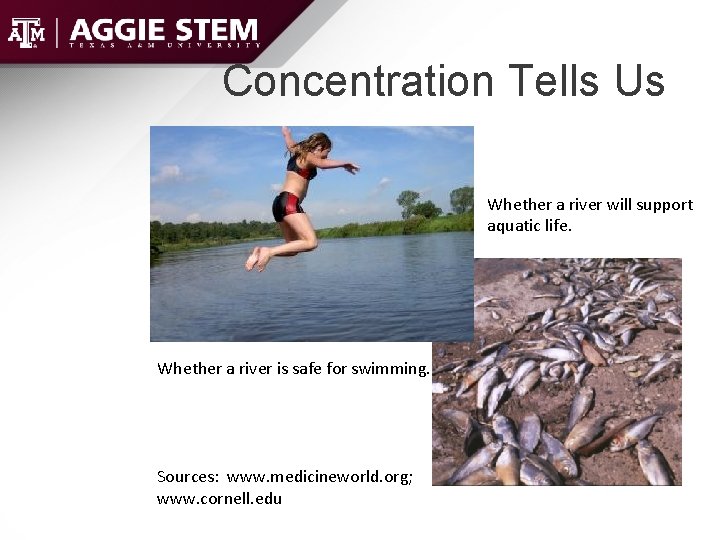
Concentration Tells Us Whether a river will support aquatic life. Whether a river is safe for swimming. Sources: www. medicineworld. org; www. cornell. edu
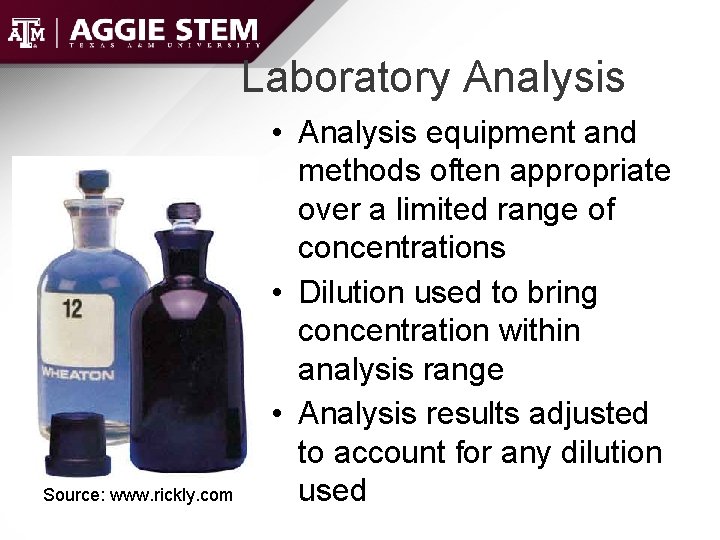
Laboratory Analysis Source: www. rickly. com • Analysis equipment and methods often appropriate over a limited range of concentrations • Dilution used to bring concentration within analysis range • Analysis results adjusted to account for any dilution used
Dilution PBL • Liquid food coloring (as sold in the bottle) has a dilution of 1 part per 10 • Using liquid food coloring and clean water, develop dilutions of: – 1 part per 100 – 1 part per 1, 000 – 1 part per 100, 000 – 1 part per 1, 000
Groups Report Out • How did you develop your dilutions? • What worked? • What didn’t work?
TEKS Alignments • What middle school mathematics TEKS aligns with this activity?
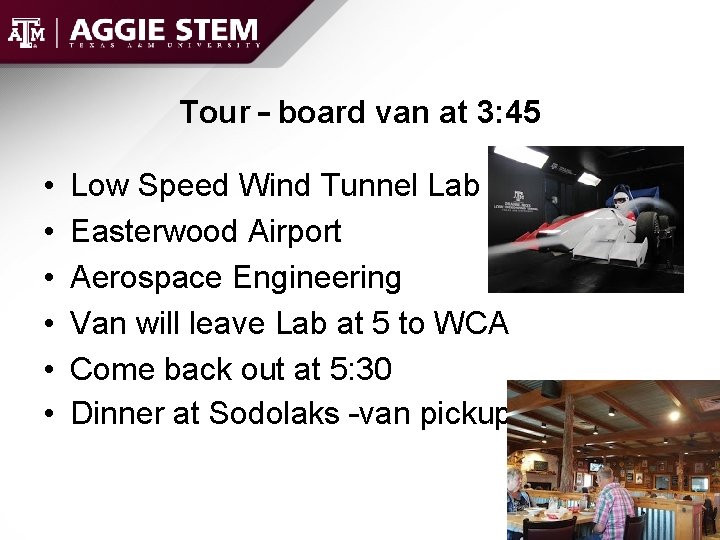
Tour – board van at 3: 45 • • • Low Speed Wind Tunnel Lab Easterwood Airport Aerospace Engineering Van will leave Lab at 5 to WCA Come back out at 5: 30 Dinner at Sodolaks –van pickup
Questions?
- Slides: 33