
Introduction to Aeronautical Data Links Introduction This presentation
- Slides: 57
Introduction to Aeronautical Data Links
Introduction This presentation is intended to be a basic introduction to Air/Ground datalinks This introduction highlights aspects on the following topics: FANS 1 A –ACARS and ATN messages The use of ATN compatible data links: SATCOM (also called AMSS) HF data link (HFDL) VHF Digital Links: VDL Mode 2 VDL Mode 3 VDL Mode 4
Free Flight - the end goal From the US FAA´s Architecture - Version 4. 0, Section 6 Free Flight Phase 1, Safe Flight 21, and Capstone - “Free Flight will allow pilots to change routes, speeds, or altitudes as needed, while in en route and oceanic air space. Air Traffic Controllers will not impose restrictions on pilot-initiated changes, except when there is a potential conflict with other aircraft or special use airspace. This capability will allow pilots to fly optimized profiles , the most efficient cruise speeds, wind-aided routes, and arrival descent profiles. Any activity that removes operational restrictions is a move towards Free Flight. ”
ATN and FANS 1/A
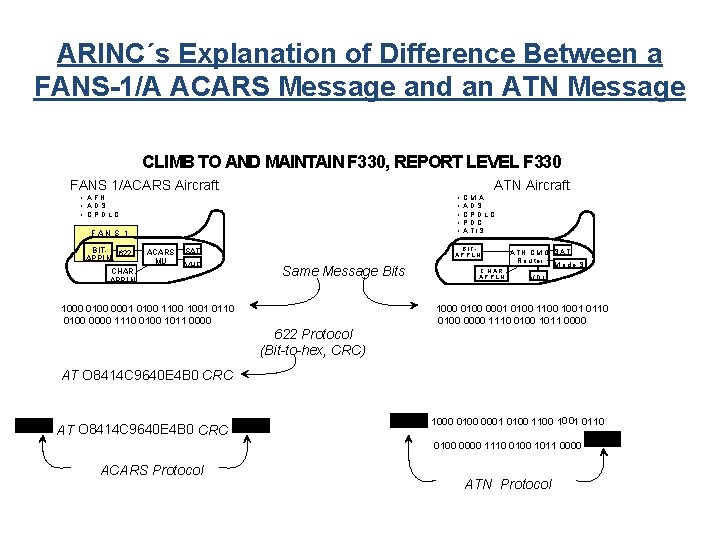
ARINC´s Explanation of Difference Between a FANS-1/A ACARS Message and an ATN Message CLIMB TO AND MAINTAIN F 330, REPORT LEVEL F 330 FANS 1/ACARS Aircraft ATN Aircraft • AFN • ADS • C PD LC • • • FAN S 1 BIT- 622 APPLN. CHAR. APPLN. ACARS MU B IT APPLN. SAT VHF CMA ADS CPD LC PDC A T IS Same Message Bits 1000 0100 0001 0100 1001 0110 0100 0000 1110 0100 1011 0000 CHAR. AP P LN. ATN CM U S A T R o u ter M ode S VDL 1000 0100 0001 0100 1001 0110 0100 0000 1110 0100 1011 0000 622 Protocol (Bit-to-hex, CRC) AT O 8414 C 9640 E 4 B 0 CRC 1000 0100 0001 0100 10 01 0110 0100 0000 1110 0100 1011 0000 ACARS Protocol ATN Protocol
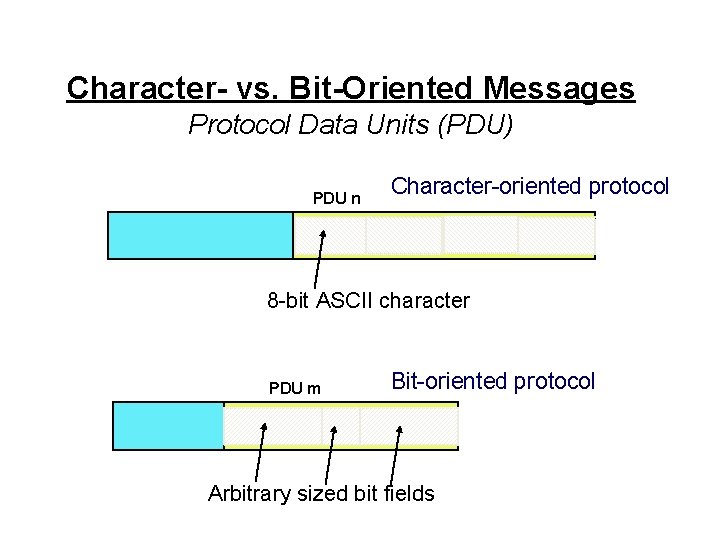
Character- vs. Bit-Oriented Messages Protocol Data Units (PDU) PDU n Character-oriented protocol 8 -bit ASCII character PDU m Bit-oriented protocol Arbitrary sized bit fields
Transition of FANS 1/A (ACARS) to ATN
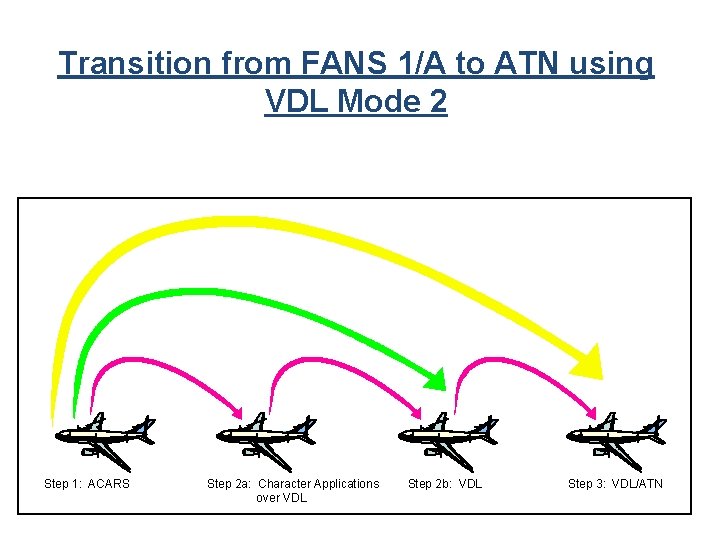
Transition from FANS 1/A to ATN using VDL Mode 2 Step 1: ACARS Step 2 a: Character Applications over VDL Step 2 b: VDL Step 3: VDL/ATN
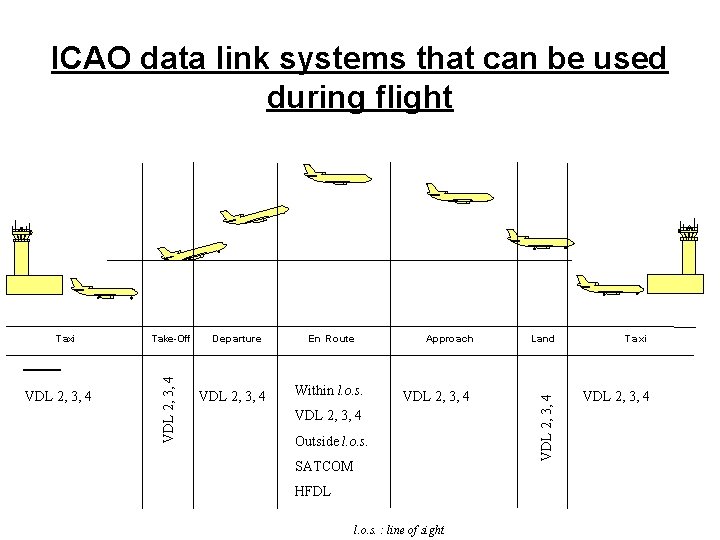
ICAO data link systems that can be used during flight D eparture VDL 2, 3, 4 En R oute Within l. o. s. Approach VDL 2, 3, 4 Outside l. o. s. SATCOM HFDL l. o. s. : line of sight Land VDL 2, 3, 4 Take-Off VDL 2, 3, 4 Taxi VDL 2, 3, 4
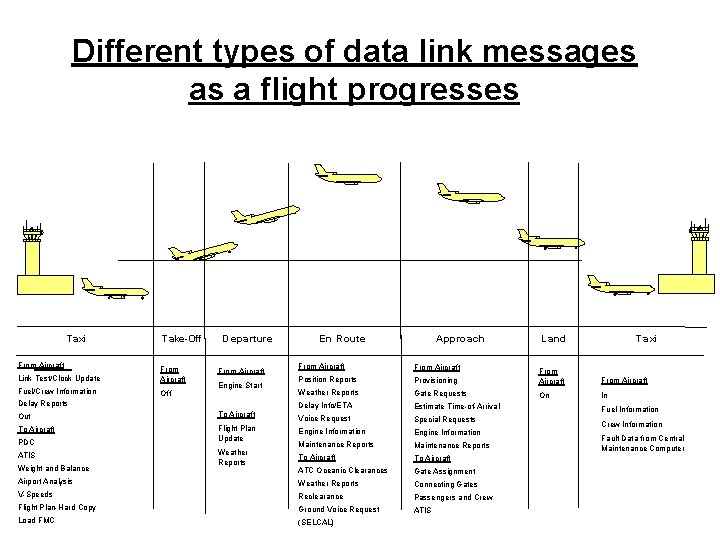
Different types of data link messages as a flight progresses Taxi From Aircraft Link Test/Clock Update Fuel/Crew Information Take-Off From Aircraft Off D eparture From Aircraft Engine Start Delay Reports En R oute Approach From Aircraft Position Reports Provisioning From Aircraft Weather Reports Gate Requests On In Delay Info/ETA Estimate Time-of-Arrival Voice Request Special Requests To Aircraft Flight Plan Update Engine Information Weather Reports Maintenance Reports To Aircraft ATC Oceanic Clearances Gate Assignment Airport Analysis Weather Reports Connecting Gates V-Speeds Reclearance Passengers and Crew Flight Plan-Hard Copy Ground Voice Request ATIS Load FMC (SELCAL) ATIS Weight and Balance Taxi From Aircraft Out PDC Land Fuel Information Crew Information Fault Data from Central Maintenance Computer
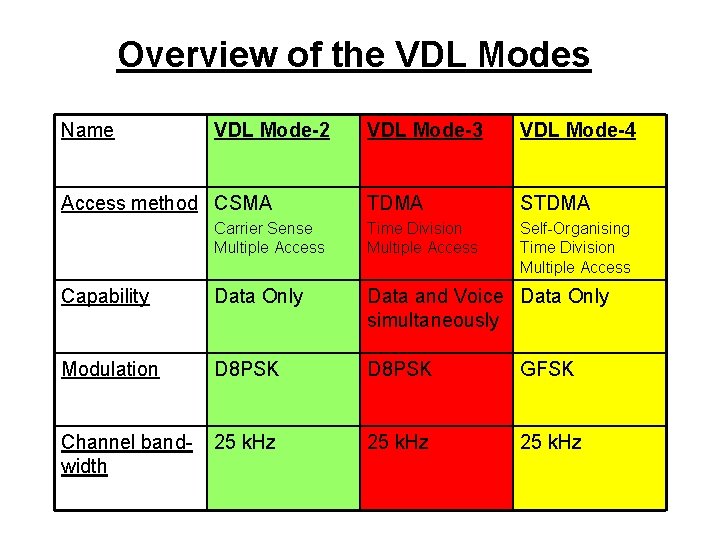
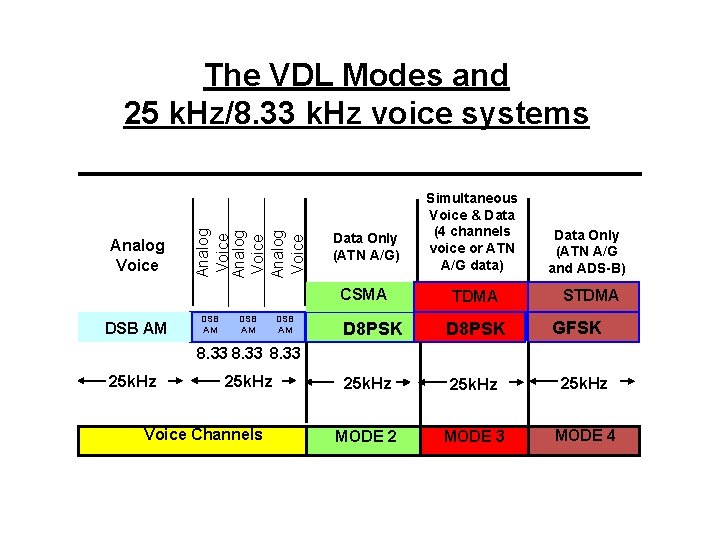
Overview of the VDL Modes Name VDL Mode-2 VDL Mode-3 VDL Mode-4 TDMA STDMA Carrier Sense Multiple Access Time Division Multiple Access Self-Organising Time Division Multiple Access Capability Data Only Data and Voice Data Only simultaneously Modulation D 8 PSK GFSK Channel bandwidth 25 k. Hz Access method CSMA
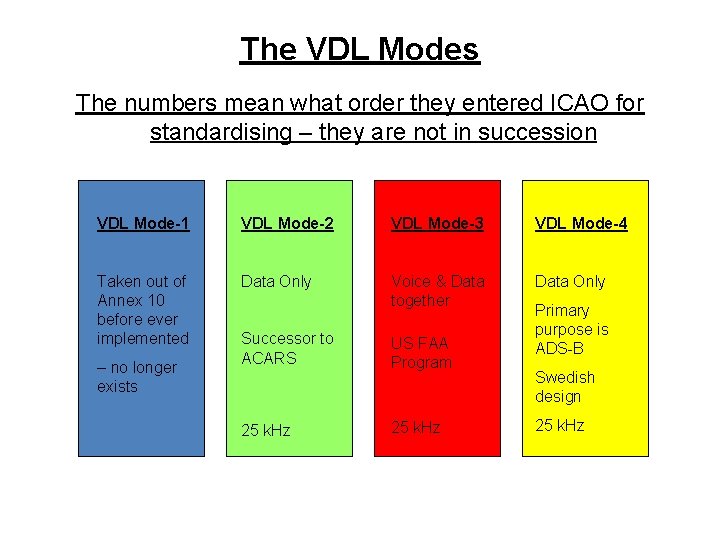
The VDL Modes The numbers mean what order they entered ICAO for standardising – they are not in succession VDL Mode-1 VDL Mode-2 VDL Mode-3 VDL Mode-4 Taken out of Annex 10 before ever implemented Data Only Voice & Data together Data Only – no longer exists Successor to ACARS 25 k. Hz US FAA Program 25 k. Hz Primary purpose is ADS-B Swedish design 25 k. Hz
Analog Voice The VDL Modes and 25 k. Hz/8. 33 k. Hz voice systems Data Only (ATN A/G) CSMA DSB DSB AM AM Simultaneous Voice & Data (4 channels voice or ATN A/G data) Data Only (ATN A/G and ADS-B) TDMA STDMA GFSK D 8 PSK 25 k. Hz MODE 2 MODE 3 MODE 4 8. 33 25 k. Hz Voice Channels
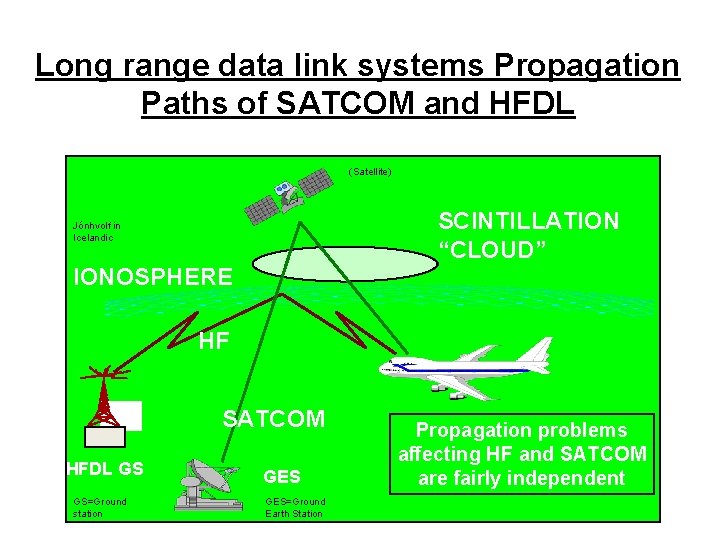
Long range data link systems Propagation Paths of SATCOM and HFDL (Satellite) SCINTILLATION “CLOUD” Jónhvolf in Icelandic IONOSPHERE HF SATCOM HFDL GS GS=Ground station GES=Ground Earth Station Propagation problems affecting HF and SATCOM are fairly independent
HFDL • • • (HF Data Link) HFDL - High Frequency Data Link With ground stations around the world Iceland Radio houses one of the Ground Stations Can accommodate ACARS or ATN Developed to be used in areas where satellite cannot be used Cheaper alternative to SATCOM
SATCOM (AMSS) • Satellite Communications • A system available for ACARS and for ATN • Satellites can be used for Data Link and for voice - often referred to as SAT Voice • Inmarsat is the current provider for aeronautical communications 1
ADS-C Automatic Dependent Surveillance-Contract • The C stands for contract. An ADS-C message is only sent after a link “contract” between the aircraft and the ground has been established. • ADS-C is currently used using SATCOM or HF data link.
ADS-B Automatic Dependent Surveillance-Broadcast ADS-B is a broadcast of the aircraft’s position, mainly derived from the GNSS system. It provides the pilot of a properly equipped aircraft a display on his instrument panel of where other aircraft are in relation to his aircraft.
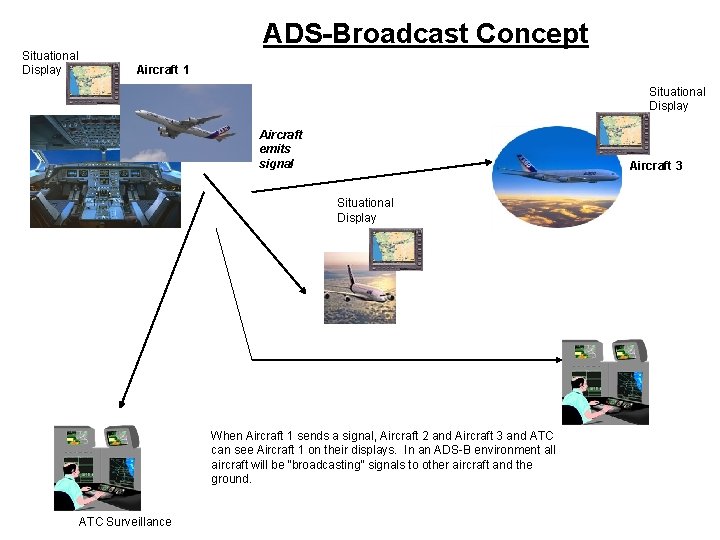
Situational Display ADS-Broadcast Concept Aircraft 1 Situational Display Aircraft emits signal Aircraft 3 Situational Display When Aircraft 1 sends a signal, Aircraft 2 and Aircraft 3 and ATC can see Aircraft 1 on their displays. In an ADS-B environment all aircraft will be “broadcasting” signals to other aircraft and the ground. ATC Surveillance
Mode-S Extended Squitter • Mode-S was standardised by ICAO several years ago • The ICAO 11 th Air Navigation Conference has decided that all ADS-B implementations should support the use of Mode-S squitter
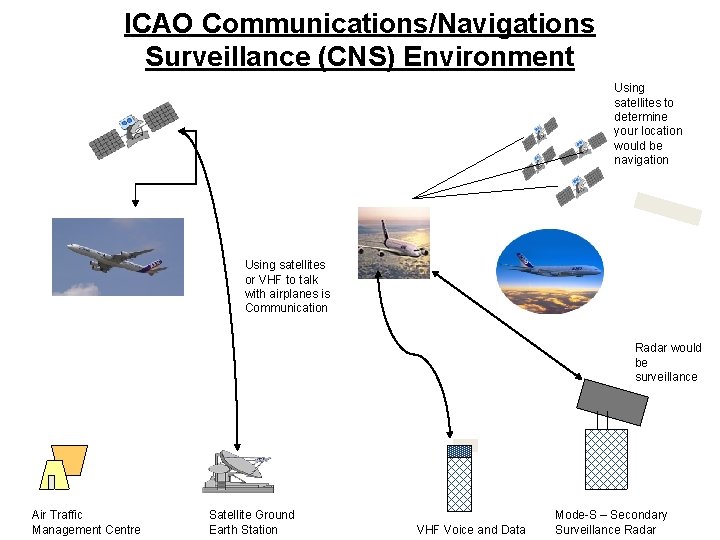
ICAO Communications/Navigations Surveillance (CNS) Environment Using satellites to determine your location would be navigation Using satellites or VHF to talk with airplanes is Communication Radar would be surveillance Air Traffic Management Centre Satellite Ground Earth Station VHF Voice and Data Mode-S – Secondary Surveillance Radar
What is the ATN? • “The ATN concept emerged from a need to interchange bit-oriented digital data over dissimilar aeronautical data links, using, for interoperability purpose, the principles of the International Organization for Standardization (ISO) open systems interconnection (OSI) architecture. ”
Describe the ATN • “The ATN design supports the incorporation of different air-ground subnetworks and different ground-ground subnetworks, resulting in a common data transfer service. Furthermore, the ATN design is such that user communication services may be introduced in an evolutionary manner”
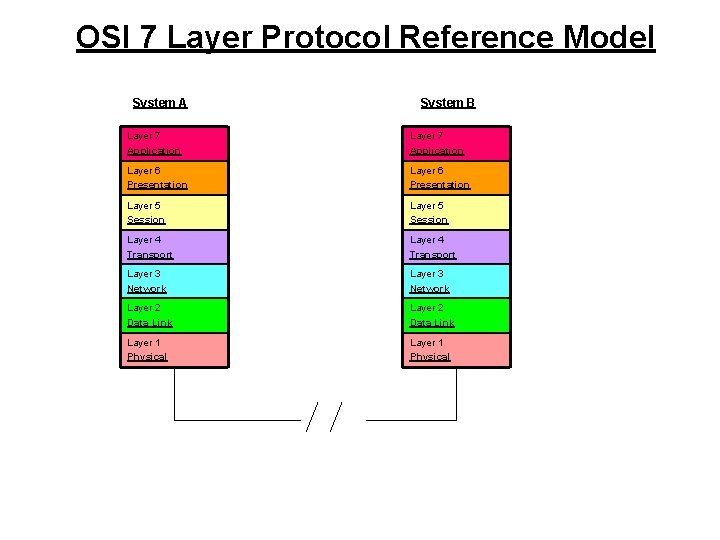
OSI 7 Layer Protocol Reference Model System A System B Layer 7 Application Layer 6 Presentation Layer 5 Session Layer 4 Transport Layer 3 Network Layer 2 Data Link Layer 1 Physical
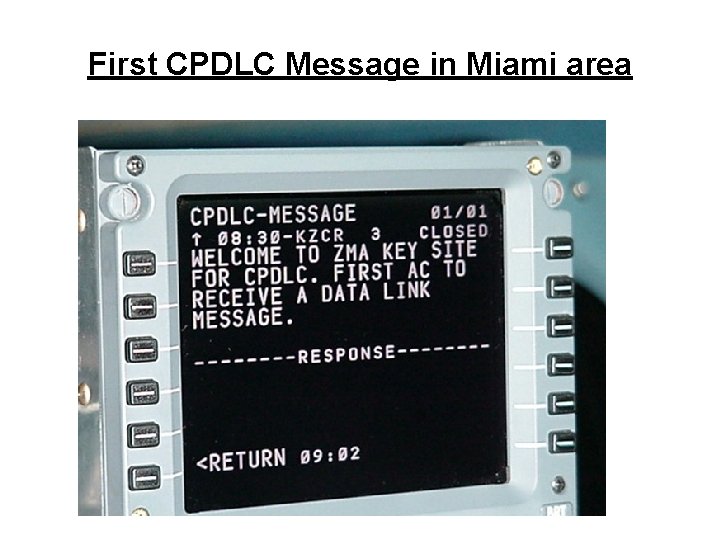
First CPDLC Message in Miami area
Aviation Wireless Communications
Agenda • Today's Aeronautical Telecommunication Network (ATN) • Potential of TCP/IP Architecture for Aviation • Mobility Management Requirements • Summary
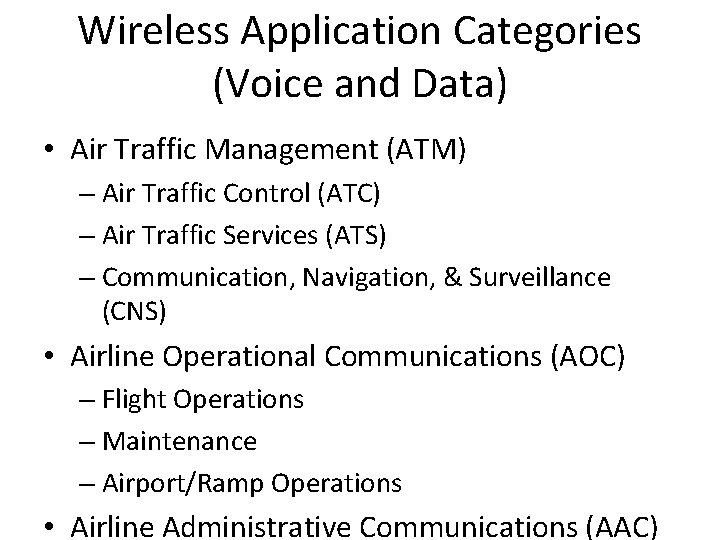
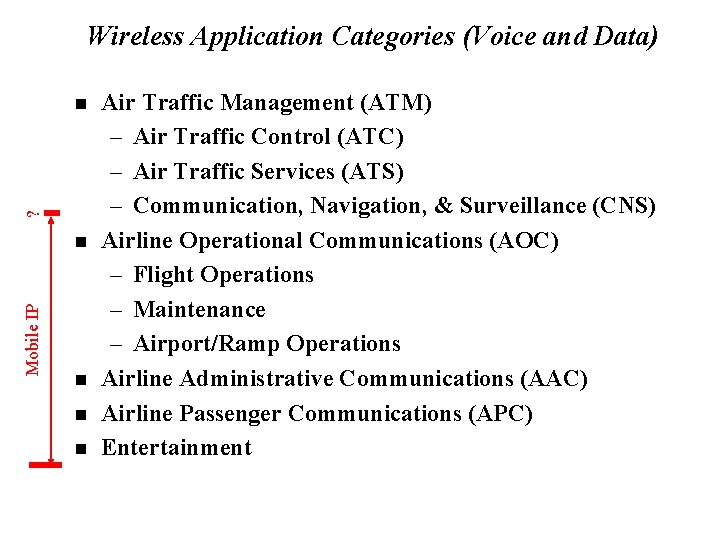
Wireless Application Categories (Voice and Data) • Air Traffic Management (ATM) – Air Traffic Control (ATC) – Air Traffic Services (ATS) – Communication, Navigation, & Surveillance (CNS) • Airline Operational Communications (AOC) – Flight Operations – Maintenance – Airport/Ramp Operations • Airline Administrative Communications (AAC)
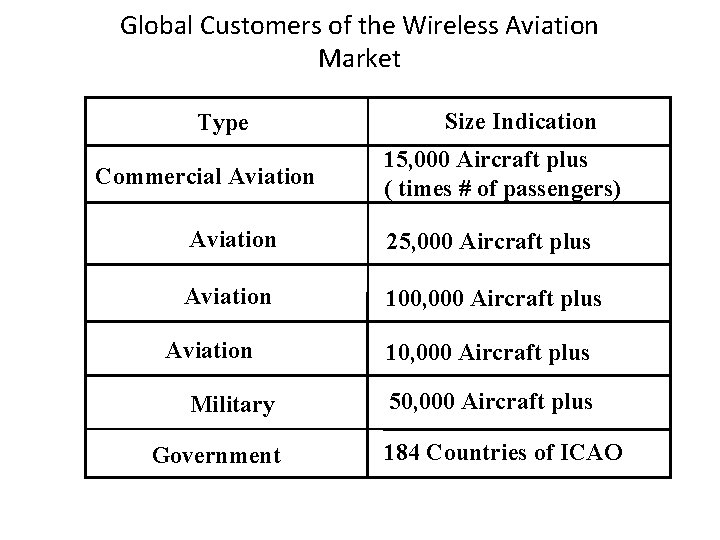
Global Customers of the Wireless Aviation Market Type Size Indication Commercial Aviation 15, 000 Aircraft plus ( times # of passengers) Business Aviation 25, 000 Aircraft plus General Aviation 100, 000 Aircraft plus Cargo Aviation 10, 000 Aircraft plus Military Government 50, 000 Aircraft plus 184 Countries of ICAO
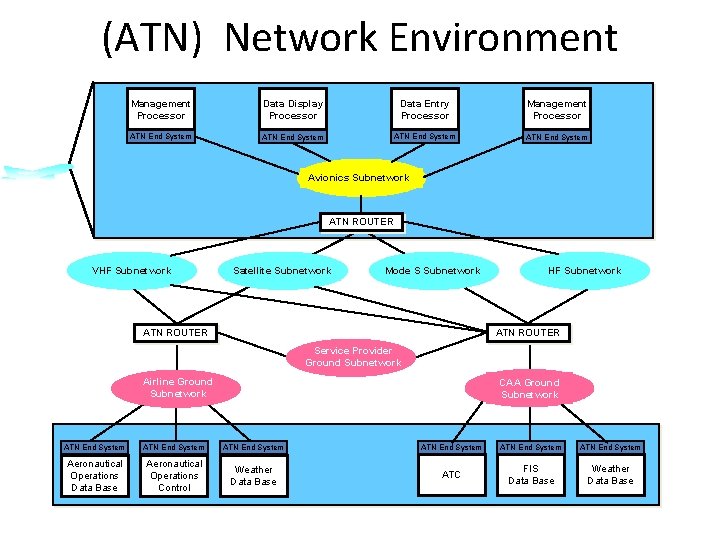
(ATN) Network Environment Management Processor Data Display Processor Data Entry Processor Management Processor ATN End System Avionics Subnetwork ATN ROUTER VHF Subnetwork Satellite Subnetwork Mode S Subnetwork ATN ROUTER HF Subnetwork ATN ROUTER Service Provider Ground Subnetwork Airline Ground Subnetwork CAA Ground Subnetwork ATN End System ATN End System Aeronautical Operations Data Base Aeronautical Operations Control Weather Data Base ATC FIS Data Base Weather Data Base
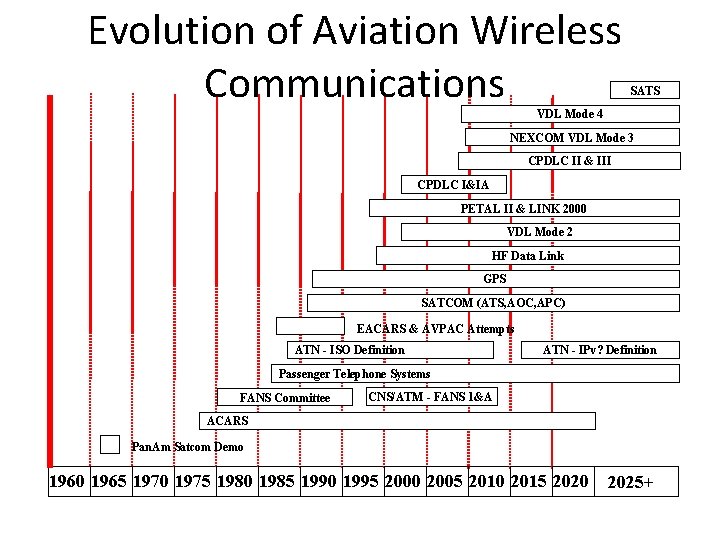
Evolution of Aviation Wireless Communications SATS VDL Mode 4 NEXCOM VDL Mode 3 CPDLC II & III CPDLC I&IA PETAL II & LINK 2000 VDL Mode 2 HF Data Link GPS SATCOM (ATS, AOC, APC) EACARS & AVPAC Attempts ATN - ISO Definition ATN - IPv? Definition Passenger Telephone Systems FANS Committee CNS/ATM - FANS 1&A ACARS Pan. Am Satcom Demo 1960 1965 1970 1975 1980 1985 1990 1995 2000 2005 2010 2015 2020 2025+
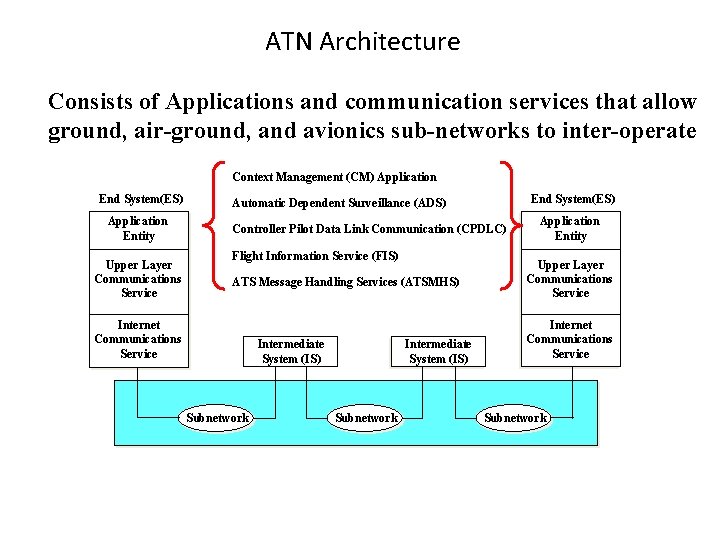
ATN Architecture Consists of Applications and communication services that allow ground, air-ground, and avionics sub-networks to inter-operate Context Management (CM) Application End System(ES) Application Entity Upper Layer Communications Service End System(ES) Automatic Dependent Surveillance (ADS) Controller Pilot Data Link Communication (CPDLC) Flight Information Service (FIS) ATS Message Handling Services (ATSMHS) Internet Communications Service Intermediate System (IS) Subnetwork Application Entity Upper Layer Communications Service Internet Communications Service Subnetwork
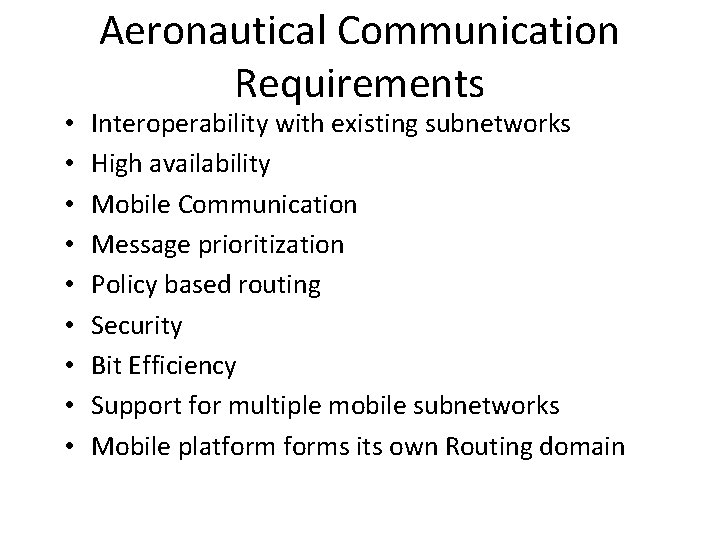
• • • Aeronautical Communication Requirements Interoperability with existing subnetworks High availability Mobile Communication Message prioritization Policy based routing Security Bit Efficiency Support for multiple mobile subnetworks Mobile platforms its own Routing domain
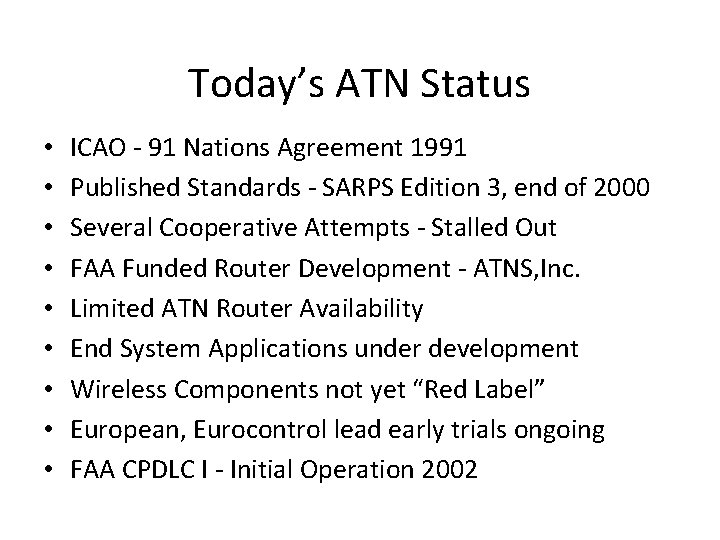
Today’s ATN Status • • • ICAO - 91 Nations Agreement 1991 Published Standards - SARPS Edition 3, end of 2000 Several Cooperative Attempts - Stalled Out FAA Funded Router Development - ATNS, Inc. Limited ATN Router Availability End System Applications under development Wireless Components not yet “Red Label” European, Eurocontrol lead early trials ongoing FAA CPDLC I - Initial Operation 2002
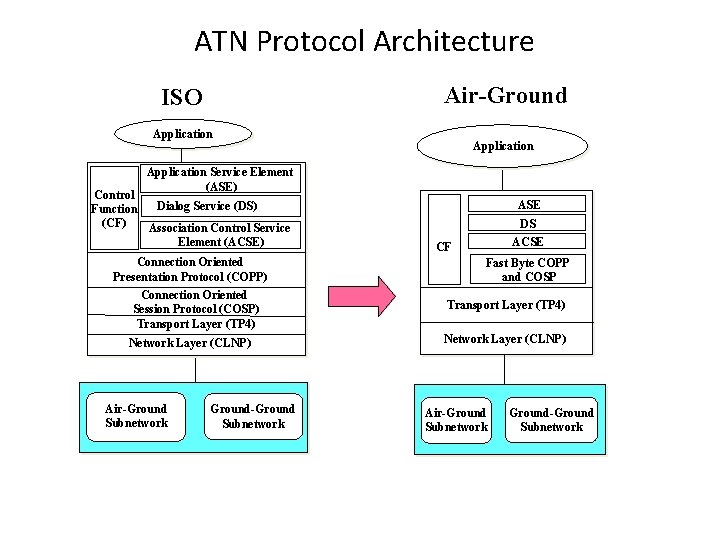
ATN Protocol Architecture Air-Ground ISO Application Service Element (ASE) Control Dialog Service (DS) Function (CF) Association Control Service Element (ACSE) Application Layer Fast Byte COPP and COSP Transport Layer (TP 4) Network Layer (CLNP) Ground-Ground Subnetwork DS ACSE CF Connection Oriented Presentation Protocol (COPP) Connection Oriented Session Protocol (COSP) Transport Layer (TP 4) Air-Ground Subnetwork ASE Sub Networks Air-Ground Subnetwork Ground-Ground Subnetwork Fast Byte approach selected to obtain bit efficiency over the Air-Ground Link
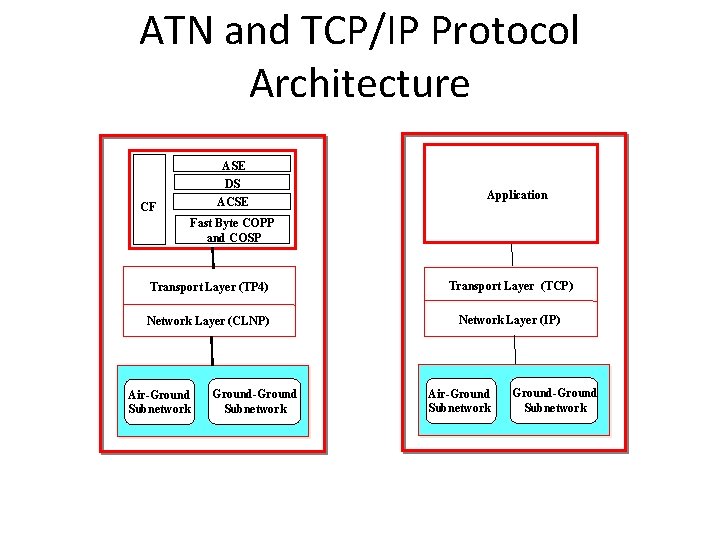
ATN and TCP/IP Protocol Architecture TCP/IP Architecture ATN Architecture Application ASE DS ACSE CF Application Fast Byte COPP and COSP Transport Layer (TP 4) Transport Layer (TCP) Network Layer (CLNP) Network Layer (IP) Air-Ground Subnetwork Ground-Ground Subnetwork With the Fast Byte enhancements, the two architectures appear similar in structure
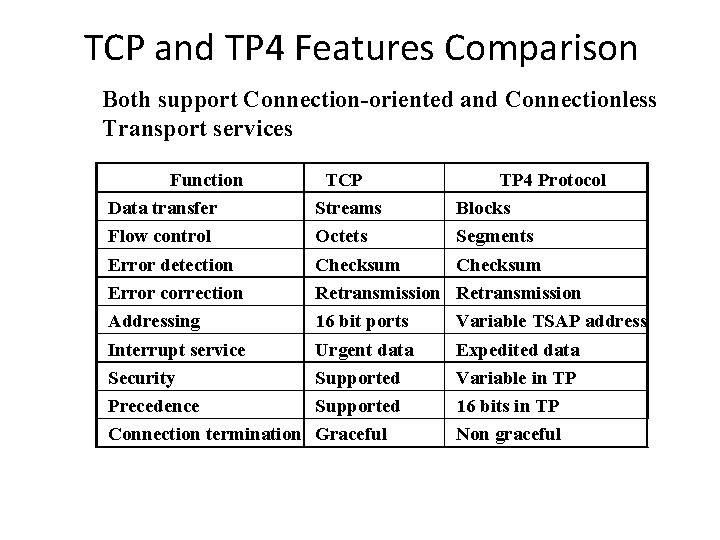
TCP and TP 4 Features Comparison Both support Connection-oriented and Connectionless Transport services Function Data transfer Flow control Error detection Error correction Addressing Interrupt service Security Precedence Connection termination TCP Protocol Streams Octets Checksum Retransmission 16 bit ports Urgent data Supported Graceful TP 4 Protocol Blocks Segments Checksum Retransmission Variable TSAP address Expedited data Variable in TP 16 bits in TP Non graceful Source: Aeronautical Related Applications Using ATN and TCP/IP Research Report, prepared by CNS for the NASA Glenn Research Center, November 23, 1999
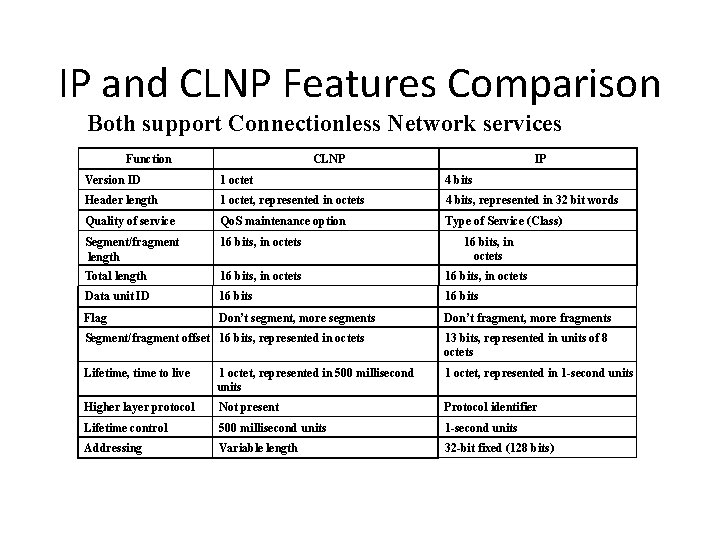
IP and CLNP Features Comparison Both support Connectionless Network services Function CLNP IP Version ID 1 octet 4 bits Header length 1 octet, represented in octets 4 bits, represented in 32 bit words Quality of service Qo. S maintenance option Type of Service (Class) Segment/fragment length 16 bits, in octets Total length 16 bits, in octets Data unit ID 16 bits Flags Don’t segment, more segments Don’t fragment, more fragments Segment/fragment offset 16 bits, represented in octets 13 bits, represented in units of 8 octets Lifetime, time to live 1 octet, represented in 500 millisecond units 1 octet, represented in 1 -second units Higher layer protocol Not present Protocol identifier Lifetime control 500 millisecond units 1 -second units Addressing Variable length 32 -bit fixed (128 bits) Source: Aeronautical Related Applications Using ATN and TCP/IP Research Report, prepared by CNS for the NASA Glenn Research Center, November 23, 1999
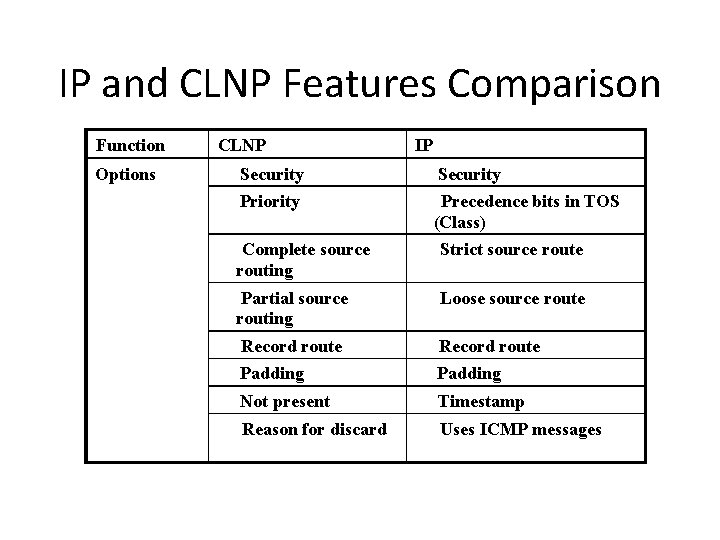
IP and CLNP Features Comparison Function CLNP Options · IP Security Priority Precedence bits in TOS (Class) · Complete source routing Strict source route · Partial source routing · Loose source route · Record route · Padding · Not present · Timestamp · Reason for discard (Error PDU only) · Uses ICMP messages Source: Aeronautical Related Applications Using ATN and TCP/IP Research Report, prepared by CNS for the NASA Glenn Research Center, November 23, 1999
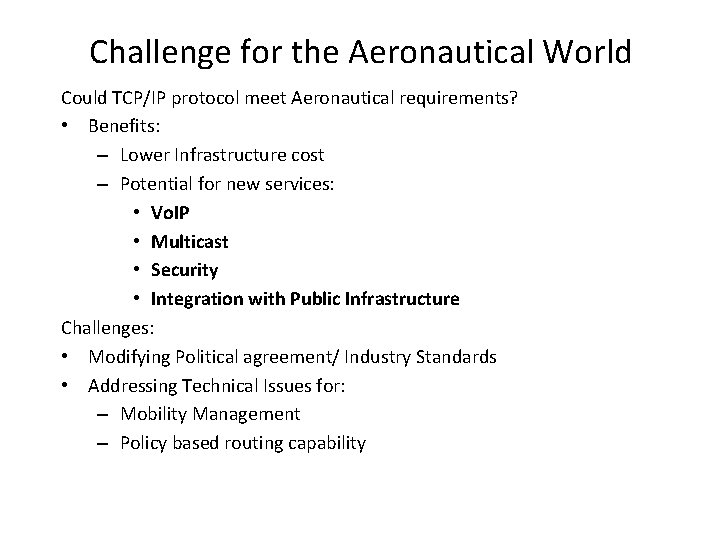
Challenge for the Aeronautical World Could TCP/IP protocol meet Aeronautical requirements? • Benefits: – Lower Infrastructure cost – Potential for new services: • Vo. IP • Multicast • Security • Integration with Public Infrastructure Challenges: • Modifying Political agreement/ Industry Standards • Addressing Technical Issues for: – Mobility Management – Policy based routing capability
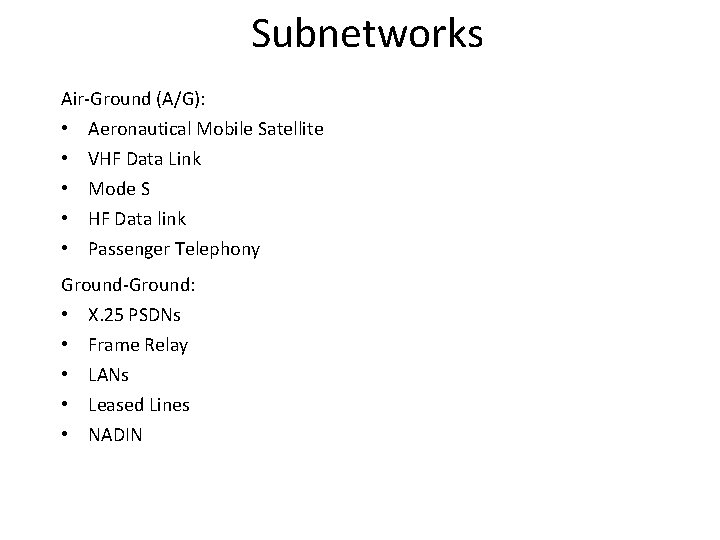
Subnetworks Air-Ground (A/G): • • • Aeronautical Mobile Satellite VHF Data Link Mode S HF Data link Passenger Telephony Ground-Ground: • X. 25 PSDNs • Frame Relay • LANs • Leased Lines • NADIN
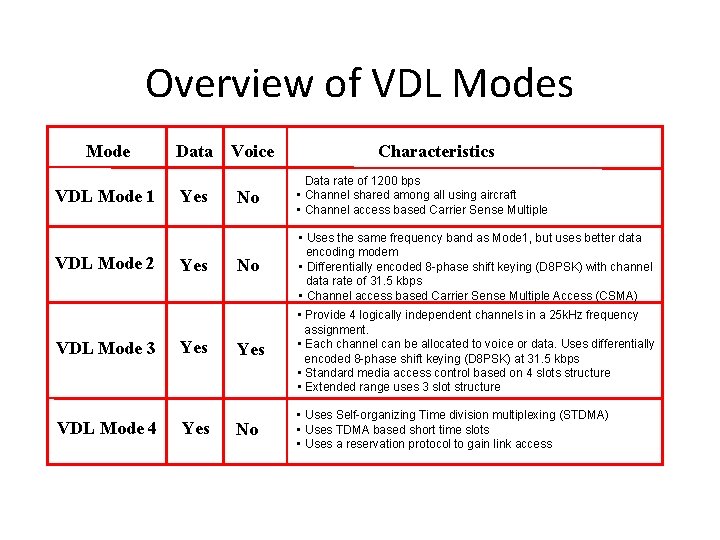
Overview of VDL Modes Mode VDL Mode 1 VDL Mode 2 VDL Mode 3 VDL Mode 4 Data Voice Yes Yes Characteristics No • Data rate of 1200 bps • Channel shared among all using aircraft • Channel access based Carrier Sense Multiple Access (CSMA) No • Uses the same frequency band as Mode 1, but uses better data encoding modem • Differentially encoded 8 -phase shift keying (D 8 PSK) with channel data rate of 31. 5 kbps • Channel access based Carrier Sense Multiple Access (CSMA) Yes • Provide 4 logically independent channels in a 25 k. Hz frequency assignment. • Each channel can be allocated to voice or data. Uses differentially encoded 8 -phase shift keying (D 8 PSK) at 31. 5 kbps • Standard media access control based on 4 slots structure • Extended range uses 3 slot structure No • Uses Self-organizing Time division multiplexing (STDMA) • Uses TDMA based short time slots • Uses a reservation protocol to gain link access
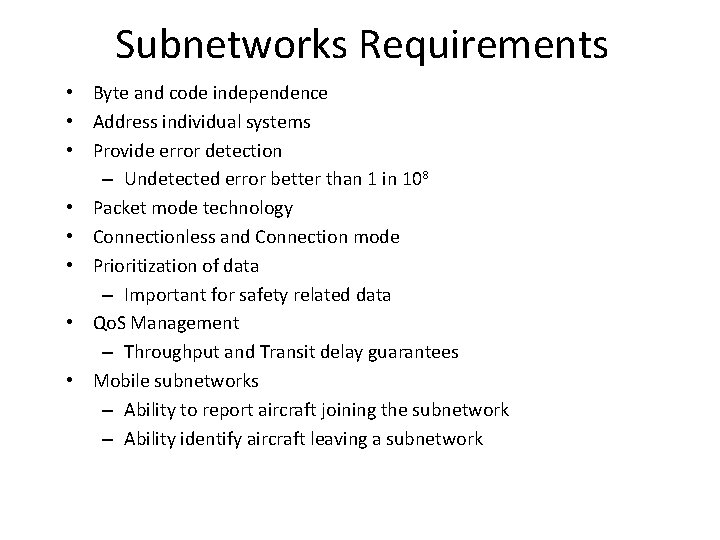
Subnetworks Requirements • Byte and code independence • Address individual systems • Provide error detection – Undetected error better than 1 in 108 • Packet mode technology • Connectionless and Connection mode • Prioritization of data – Important for safety related data • Qo. S Management – Throughput and Transit delay guarantees • Mobile subnetworks – Ability to report aircraft joining the subnetwork – Ability identify aircraft leaving a subnetwork
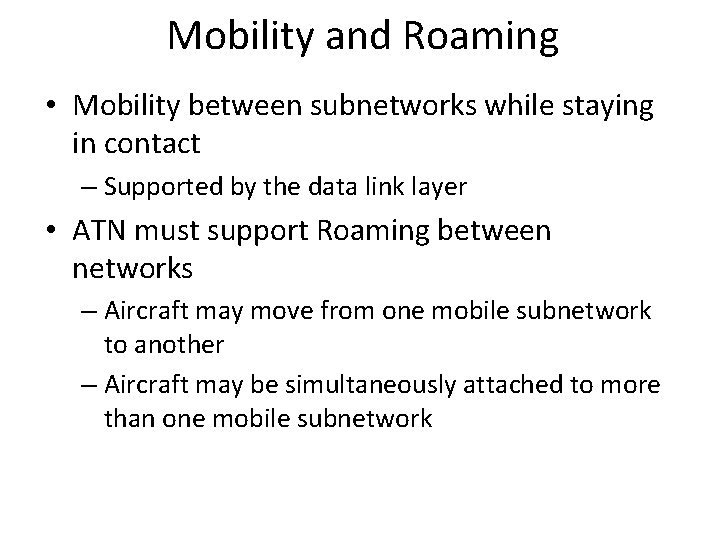
Mobility and Roaming • Mobility between subnetworks while staying in contact – Supported by the data link layer • ATN must support Roaming between networks – Aircraft may move from one mobile subnetwork to another – Aircraft may be simultaneously attached to more than one mobile subnetwork
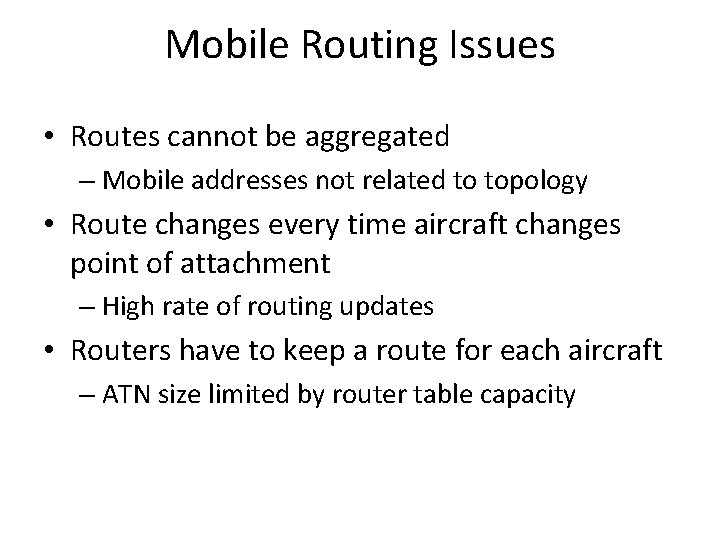
Mobile Routing Issues • Routes cannot be aggregated – Mobile addresses not related to topology • Route changes every time aircraft changes point of attachment – High rate of routing updates • Routers have to keep a route for each aircraft – ATN size limited by router table capacity
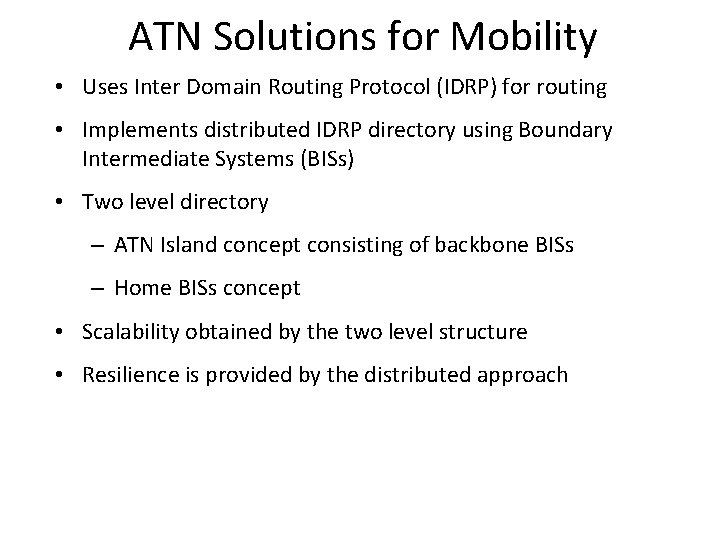
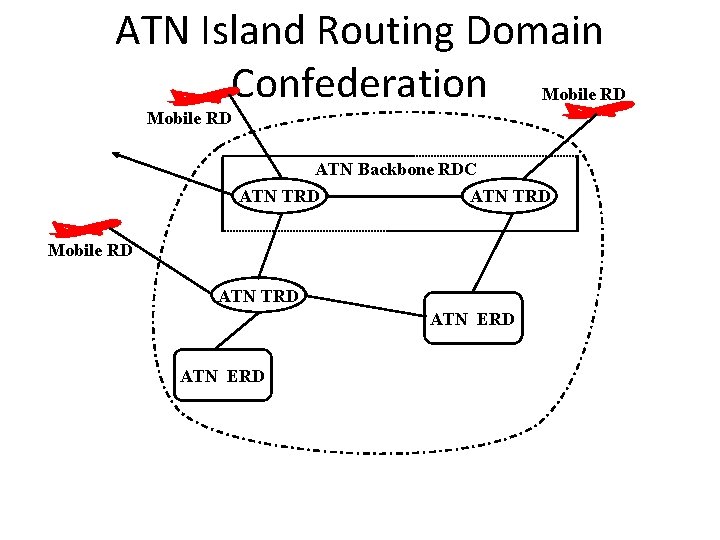
ATN Solutions for Mobility • Uses Inter Domain Routing Protocol (IDRP) for routing • Implements distributed IDRP directory using Boundary Intermediate Systems (BISs) • Two level directory – ATN Island concept consisting of backbone BISs – Home BISs concept • Scalability obtained by the two level structure • Resilience is provided by the distributed approach
ATN Island Routing Domain Confederation Mobile RD Another ATN Island ATN Backbone RDC ATN TRD Mobile RD ATN TRD ATN ERD ATN Island RDC
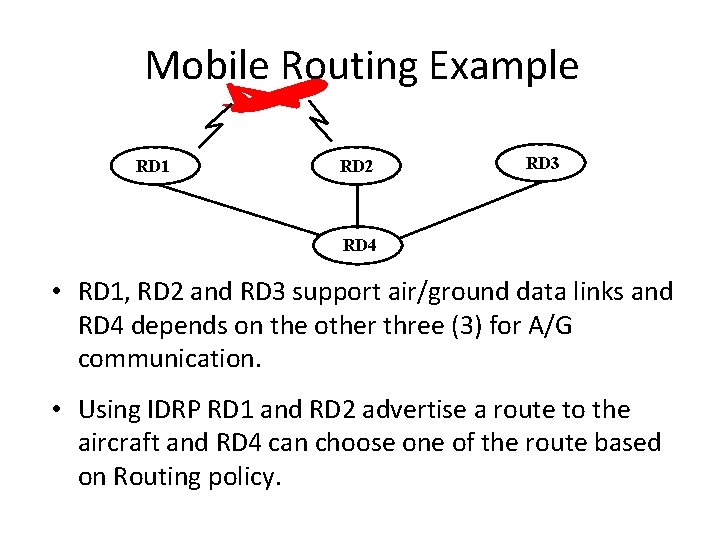
Mobile Routing Example RD 1 RD 2 RD 3 RD 4 • RD 1, RD 2 and RD 3 support air/ground data links and RD 4 depends on the other three (3) for A/G communication. • Using IDRP RD 1 and RD 2 advertise a route to the aircraft and RD 4 can choose one of the route based on Routing policy.
Mobile Routing Example • As the aircraft travels it may lose contact RD 1, RD 1 informs others using the route withdraw message. • RD 4 now has one path to the aircraft through RD 2 and thus routes all traffic through RD 2. • Further along in the flight, the aircraft may come in contact with RD 3. A data link is established and routing information is exchanged. RD 3 then advertises a new route to the aircraft. • RD 4 again has two routes to the aircraft and chooses a route based on local routing policy. The aircraft goes through a similar process to select a route.
ATN Mobile Protocol Requirements • Shall support wide variety of mobile communications networks including aeronautical mobile-satellite service (AMSS), VHF digital link (VDL), HF digital link and SSR Mode S. Shall be possible to communicate with airborne avionics in any part of the world. • Shall support wide range of Organizational and National polices, including the enforcing of restrictions on what types of traffic can pass over both ground air/ground data links, and control over which air/ground data link types are used by which applications • BISs shall advertise routes to each other, where a route consists of the set of addresses which identifies the destinations reachable over the router, and information about the route's path including the Quality of Service and Security available over the route. • Shall support policy based routing that enables users to control external access to their communications resources, and to protect themselves from problems elsewhere in the internetwork. • The ATN, mobile “platforms” on board an aircraft shall form a Routing Domain and must include an ATN Router that is also a BIS. • Shall support a two level concept of default route providers (ATN Island Home) for containing high rate of information flow, and also to avoid the problems of routing instability caused by a rapid turnover of routing information. • Mobile routing shall support the user requirement that the users can specify, on a per application basis, routing control requirements.
NASA System Testbed Configuration
Summary • Aviation’s use of TCP/IP could yield significant benefits. • Without a common solution for mobile routing, Aviation’s ISO oriented ATN will remain in place. • Adopting IDRP-like mechanisms for mobile IP versus a BGP-like approach is a step in Aviation’s direction.
Wireless Application Categories (Voice and Data) ? n Mobile IP n n Air Traffic Management (ATM) – Air Traffic Control (ATC) – Air Traffic Services (ATS) – Communication, Navigation, & Surveillance (CNS) Airline Operational Communications (AOC) – Flight Operations – Maintenance – Airport/Ramp Operations Airline Administrative Communications (AAC) Airline Passenger Communications (APC) Entertainment
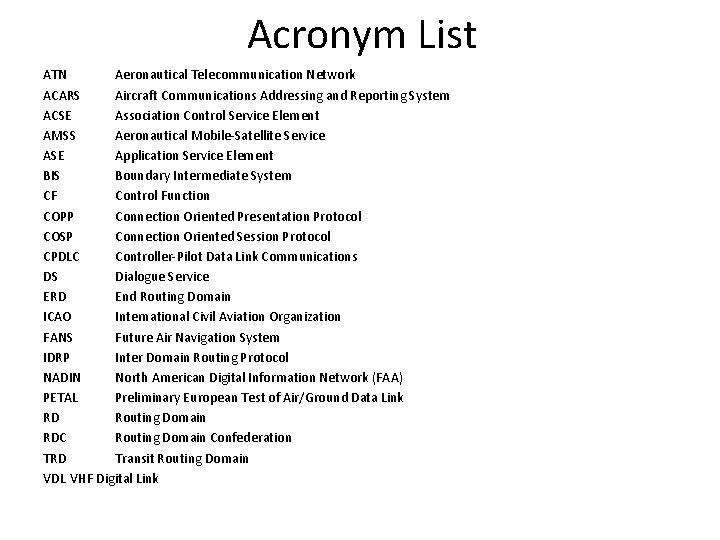
Acronym List ATN Aeronautical Telecommunication Network ACARS Aircraft Communications Addressing and Reporting System ACSE Association Control Service Element AMSS Aeronautical Mobile-Satellite Service ASE Application Service Element BIS Boundary Intermediate System CF Control Function COPP Connection Oriented Presentation Protocol COSP Connection Oriented Session Protocol CPDLC Controller-Pilot Data Link Communications DS Dialogue Service ERD End Routing Domain ICAO International Civil Aviation Organization FANS Future Air Navigation System IDRP Inter Domain Routing Protocol NADIN North American Digital Information Network (FAA) PETAL Preliminary European Test of Air/Ground Data Link RD Routing Domain RDC Routing Domain Confederation TRD Transit Routing Domain VDL VHF Digital Link
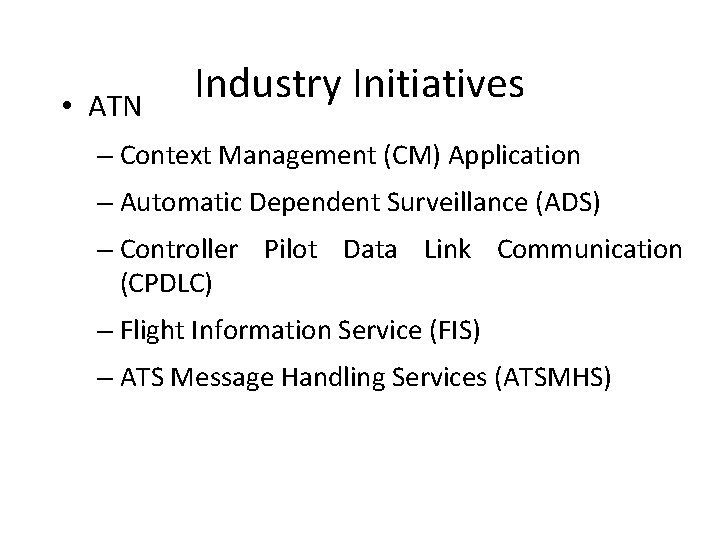
• ATN Industry Initiatives – Context Management (CM) Application – Automatic Dependent Surveillance (ADS) – Controller Pilot Data Link Communication (CPDLC) – Flight Information Service (FIS) – ATS Message Handling Services (ATSMHS)
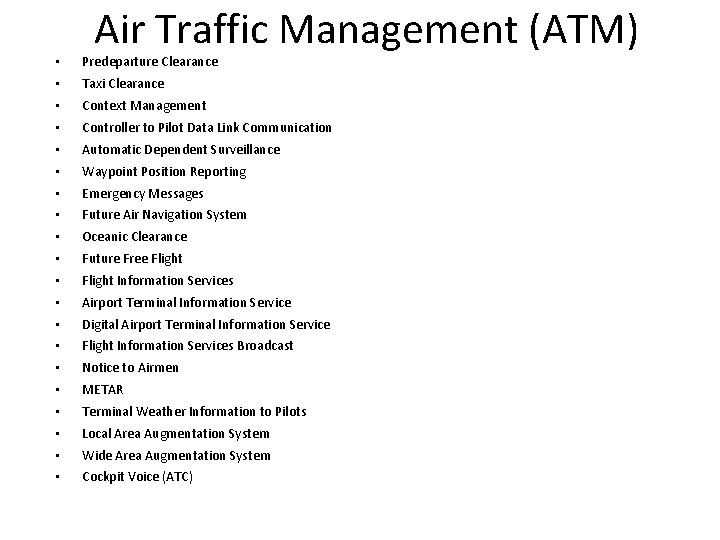
Air Traffic Management (ATM) • Predeparture Clearance • Taxi Clearance • Context Management • Controller to Pilot Data Link Communication • Automatic Dependent Surveillance • Waypoint Position Reporting • Emergency Messages • Future Air Navigation System • Oceanic Clearance • Future Free Flight • Flight Information Services • Airport Terminal Information Service • Digital Airport Terminal Information Service • Flight Information Services Broadcast • Notice to Airmen • METAR • Terminal Weather Information to Pilots • Local Area Augmentation System • Wide Area Augmentation System • Cockpit Voice (ATC)
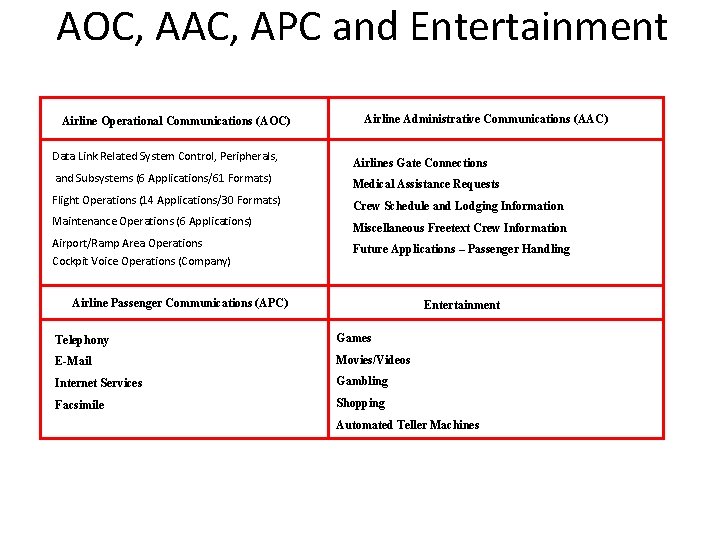
AOC, AAC, APC and Entertainment Airline Operational Communications (AOC) Airline Administrative Communications (AAC) Data Link Related System Control, Peripherals, Airlines Gate Connections and Subsystems (6 Applications/61 Formats) Medical Assistance Requests Flight Operations (14 Applications/30 Formats) Crew Schedule and Lodging Information Maintenance Operations (6 Applications) Miscellaneous Freetext Crew Information Airport/Ramp Area Operations Cockpit Voice Operations (Company) Future Applications – Passenger Handling Airline Passenger Communications (APC) Entertainment Telephony Games E-Mail Movies/Videos Internet Services Gambling Facsimile Shopping Automated Teller Machines