
Introduction to Adventures of Huckleberry Finn by Mark
Introduction to Adventures of Huckleberry Finn by Mark Twain “Huck Finn is a book of mine where a sound heart and a deformed conscience come into collision and conscience suffers defeat. ” – Mark Twain
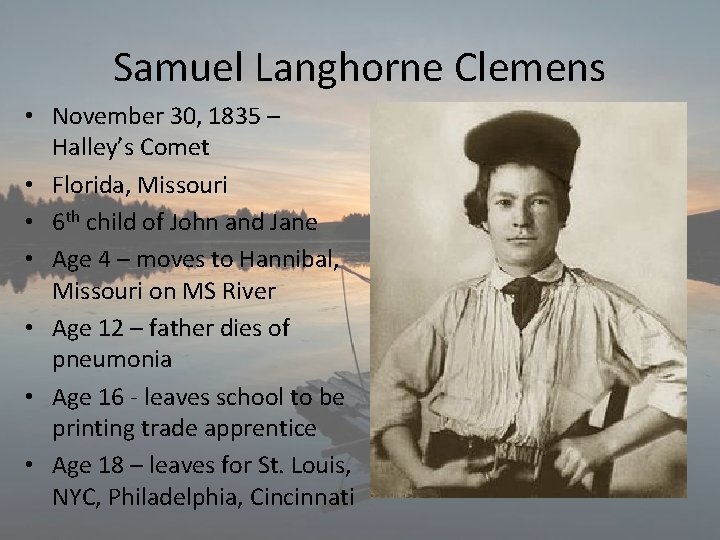
Samuel Langhorne Clemens • November 30, 1835 – Halley’s Comet • Florida, Missouri • 6 th child of John and Jane • Age 4 – moves to Hannibal, Missouri on MS River • Age 12 – father dies of pneumonia • Age 16 - leaves school to be printing trade apprentice • Age 18 – leaves for St. Louis, NYC, Philadelphia, Cincinnati
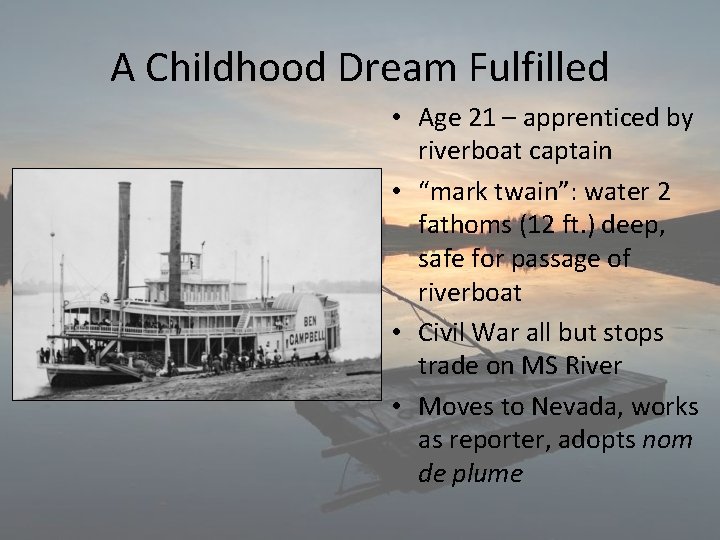
A Childhood Dream Fulfilled • Age 21 – apprenticed by riverboat captain • “mark twain”: water 2 fathoms (12 ft. ) deep, safe for passage of riverboat • Civil War all but stops trade on MS River • Moves to Nevada, works as reporter, adopts nom de plume

Becoming Mark Twain, the Writer • By 16 – writing newspaper sketches • Journalist in San Francisco & Sacramento • 1865 – short story “The Notorious Jumping Frog of Calaveras County – humorous retelling of tall tale • Wins national recognition • Writes humorous stories about travels in next few years to Hawaii, Europe, etc.
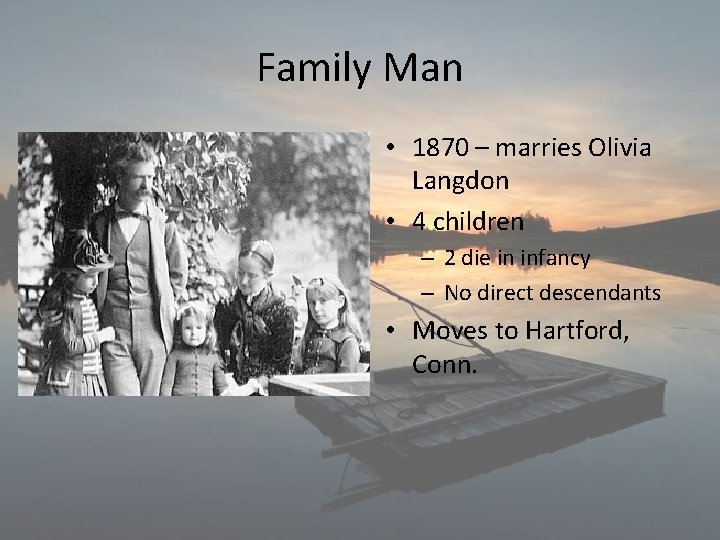
Family Man • 1870 – marries Olivia Langdon • 4 children – 2 die in infancy – No direct descendants • Moves to Hartford, Conn.
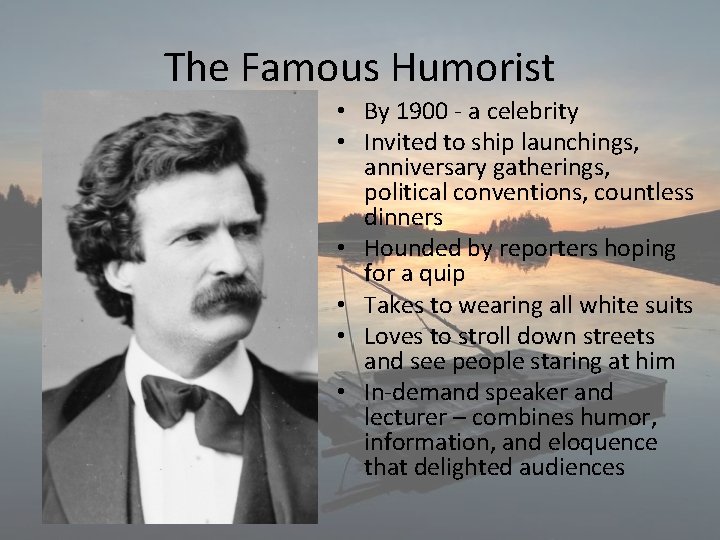
The Famous Humorist • By 1900 - a celebrity • Invited to ship launchings, anniversary gatherings, political conventions, countless dinners • Hounded by reporters hoping for a quip • Takes to wearing all white suits • Loves to stroll down streets and see people staring at him • In-demand speaker and lecturer – combines humor, information, and eloquence that delighted audiences
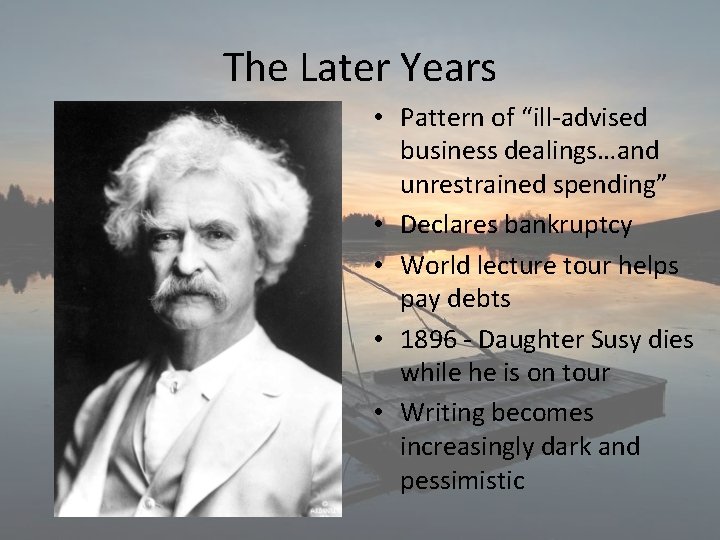
The Later Years • Pattern of “ill-advised business dealings…and unrestrained spending” • Declares bankruptcy • World lecture tour helps pay debts • 1896 - Daughter Susy dies while he is on tour • Writing becomes increasingly dark and pessimistic
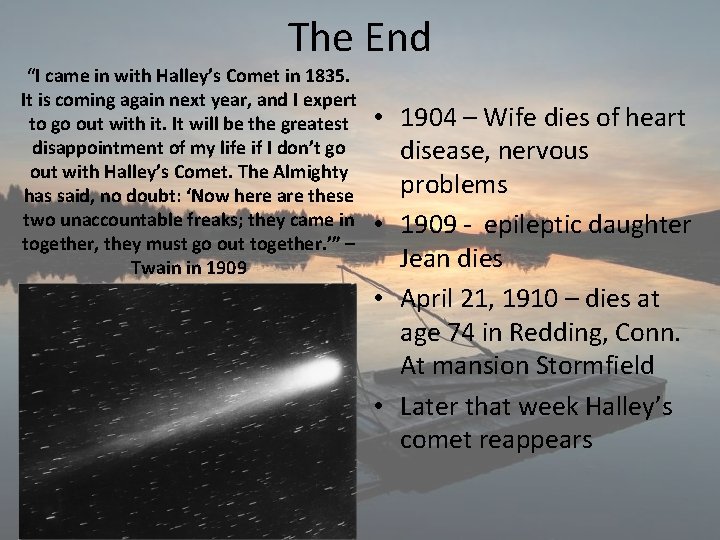
The End “I came in with Halley’s Comet in 1835. It is coming again next year, and I expert to go out with it. It will be the greatest disappointment of my life if I don’t go out with Halley’s Comet. The Almighty has said, no doubt: ‘Now here are these two unaccountable freaks; they came in together, they must go out together. ’” – Twain in 1909 • 1904 – Wife dies of heart disease, nervous problems • 1909 - epileptic daughter Jean dies • April 21, 1910 – dies at age 74 in Redding, Conn. At mansion Stormfield • Later that week Halley’s comet reappears
Twain’s Legacy • 28 books, many short stories, letters, sketches • Every 3 rd weekend in May – Calavaras County Fair and Jumping Frog Jubilee • William Dean Howells: the “Lincoln of our literature” • “I was sorry to have my name mentioned as one of the great authors, because they have a sad habit of dying off. Chaucer is dead, Spencer is dead, so is Milton, so is Shakespeare, and I’m not feeling so well myself. ” – Mark Twain
Twain’s Wisdom • “When I was a boy of fourteen, my father was so ignorant I could hardly stand to have the old man around. But when I got to be twenty-one, I was astonished at how much he had learned in seven years. ” • “Anger is an acid that can do more harm to the vessel in which it is stored than to anything on which it is stored. ” • “Of all God’s creatures there is only one that cannot be made the slave of the lash. That one is the cat. If man could be crossed with the cat it would improve man, but it would deteriorate the cat. ” • “A person who won’t read has no advantage over one who can’t. ” • “It is better to keep your mouth closed and let people think you a fool than to open your mouth and remove all doubt. ” • “The lack of money is the root of all evil. ” • “The human race has one effective weapon, and it is humor. ”
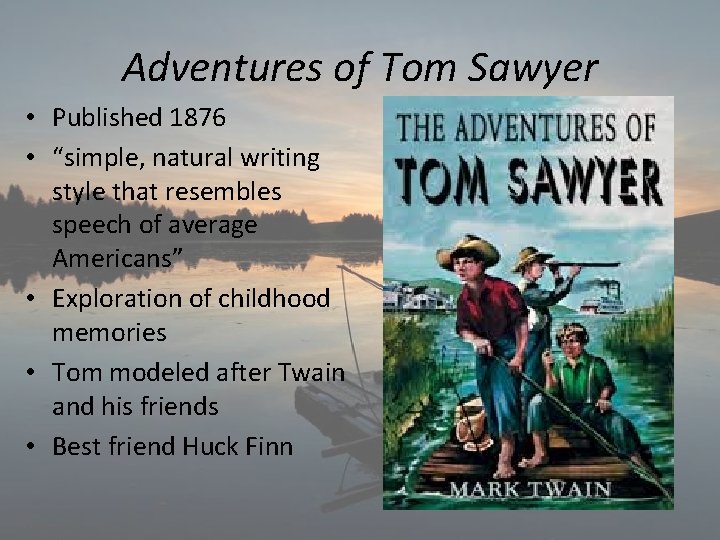
Adventures of Tom Sawyer • Published 1876 • “simple, natural writing style that resembles speech of average Americans” • Exploration of childhood memories • Tom modeled after Twain and his friends • Best friend Huck Finn
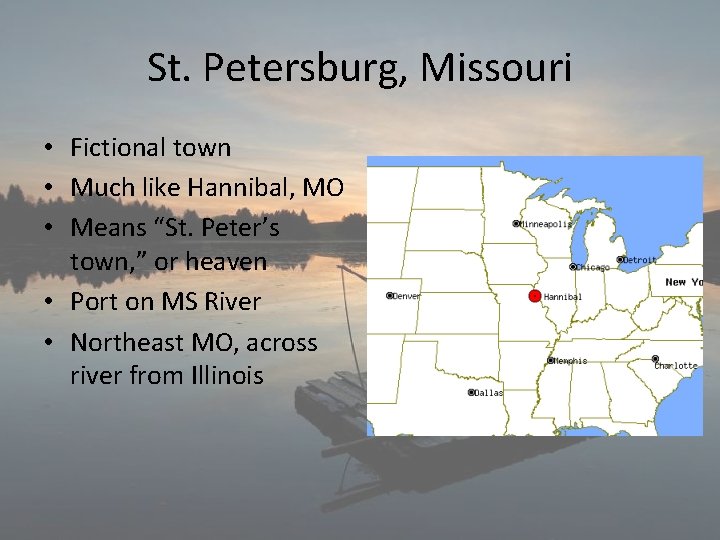
St. Petersburg, Missouri • Fictional town • Much like Hannibal, MO • Means “St. Peter’s town, ” or heaven • Port on MS River • Northeast MO, across river from Illinois
Romanticism to Realism • Romanticism – imagination and emotion over rationality; idealism • Realism – attempt to represent subjects truthfully, without artificiality – May emphasize ugly or sordid truths about the world • Regionalism – focuses on characters, dialects, customs, history, and landscape of a particular region
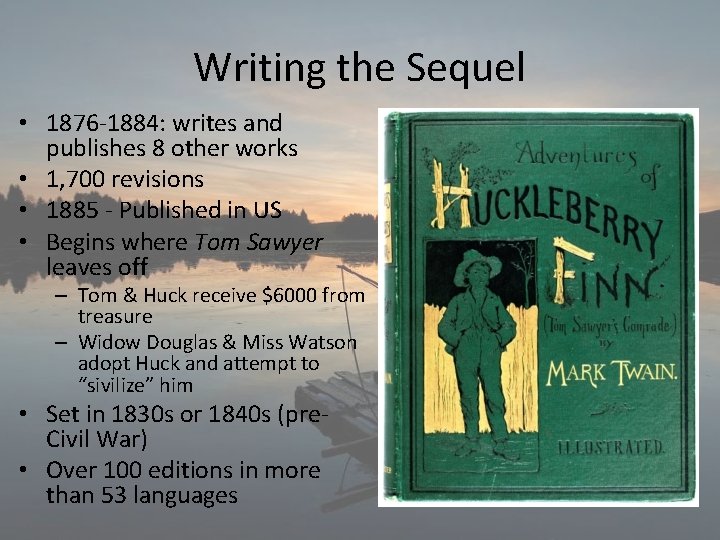
Writing the Sequel • 1876 -1884: writes and publishes 8 other works • 1, 700 revisions • 1885 - Published in US • Begins where Tom Sawyer leaves off – Tom & Huck receive $6000 from treasure – Widow Douglas & Miss Watson adopt Huck and attempt to “sivilize” him • Set in 1830 s or 1840 s (pre. Civil War) • Over 100 editions in more than 53 languages
Praise for Huck Finn • Ernest Hemingway: “All modern American literature comes from Huckleberry Finn. ” • T. S. Eliot: “a masterpiece” • Required reading in over 70 percent of American high schools • Among the most taught works of American literature • “'Classic. ' A book which people praise and don’t read. ” - Twain
Immediate & Lasting Controversy • Controversial elements: – – – Overt violence and cruelty Companionship of a black slave and a white teenager Portrayal of Southerners as ignorant or backwater Portrayal of black slave in what some see as stereotypical Use of the word nigger over 200 times • 1886 – Concord, Mass. , Public Library – “coarse, immoral, and unsuitable for young readers…the veriest trash, suitable only for the slums” • “systematic use of bad grammar and an employment of rough, coarse, inelegant expressions” • Increased popularity and sales
Positive Reception • 1884 – William E. Henley of the Anthenaeum – “In Huckleberry Finn Twain returns to his right mind” – “The book is Mark Twain at his best” – “It is meant for boys” – “Huckleberry…is the hero of such scrapes and experiences as to make your mouth water” – “Jim and Huckleberry are real creations”
Controversy cont. • 1905 – Brooklyn Public Library removes it from the children’s room because Huck was a liar who “not only itched, but scratched, ” was dirty, used bad grammar, and “said ‘sweat’ when he should have said ‘perspiration. ’” • 1907 – libraries in Denver, Omaha, and Worcester, Mass. – Huck and Tom were “bad” role models” • 1957 – NAACP – contains “racial slurs” and “belittling racial designations”
Controversy cont. • “In the first place, God made idiots. That was for practice. Then he made school boards. ” – Mark Twain • Removed from reading lists in schools, as recent as this year – Including, ironically, Mark Twain Intermediate School in Fairfax, VA • 1982 – school administrator John Wallace rewrote novel without “n-word”
Modern Praise • 1992 – Clarence Page of the Des Moines Register – “Huckleberry Finn may have been black…No, not Huck himself, but his voice. ” – “Twain exposed the lunacy and hypocrisy of American racism by showing it through the eyes of a boy who finds himself…helping a slave to escape. ” – “I, too, flinched when I heard my white teacher reading the word ‘nigger’ aloud when she introduced our ninth grade class to the book. But I soon found myself reading it on my own, at first out of curiosity, then out of sheer pleasure. ”
Response to Controversy • NAACP National Headquarters: “You don’t ban Mark Twain—you explain Mark Twain! To study an idea is not necessarily to endorse the idea. Mark Twain’s satirical novel, Huckleberry Finn, accurately portrays a time in history—the nineteenth century—and one of its evils, slavery. ” • Shelley Fisher Fishkin, scholar: “the greatest anti-racist novel by an American writer” • David Bradley, writer and professor: “Huckleberry Finn should be taught because it is a seminal and central text in White American Literature. Huckleberry Finn should be taught because it is a seminal and central text in Black American Literature. Huckleberry Finn must be taught because it is a specific point of intersection between these two American Literatures. ”
In His Own Words • “I vividly remember seeing a dozen black men and women chained to one another, once, and lying in a group on the pavement, awaiting shipment to the Southern slave market. Those were the saddest faces I have ever seen. ” • “I have no color prejudices nor caste prejudices nor creed prejudices. All I care to know is that a man is a human being, and that is enough for me; he can’t be any worse. ”
Why You Should Read the Book • Huck is a delightful, memorable, and truly unique character who will stay with you long after the novel is finished. • Twain is a master with dialect; he recreates a region and time period through language. • Huck’s adventures resonate with the most fanciful, imaginative, and universal aspects of childhood. • It is stunning—and important—to realize how far our country has come with regard to our own humanity and how we regard the humanity of others. • Most of the time, it is simply a fun read— reminiscent of our favorite tales from childhood.
Why You May Struggle with the Book • Although it is interesting to see how far our country has come, it is painful—frightening, even—to remember where we began. • Twain’s painstaking recreation of the regional dialect is very difficult to read (at first). • Although wildly imaginative and fun, Huck’s adventures tend to ramble in a few places. • The last few chapters have frustrated many readers.
Lasting Themes • • Search for identify Conformity and civilization Friendship and betrayal Freedom and enslavement Education vs. knowledge Hypocrisy Racism Main conflict: “a sound heart and a deformed conscience come into collision” - Twain
Historical Context • 1821 – Missouri Compromise • Fugitive Slave Laws • Written 20 yrs. after Emancipation Proclamation • America, esp. the South, still struggling with racism and aftereffects of slavery • Reconstruction – oppression of blacks for illogical and hypocritical reasons
Slavery and Abolitionists
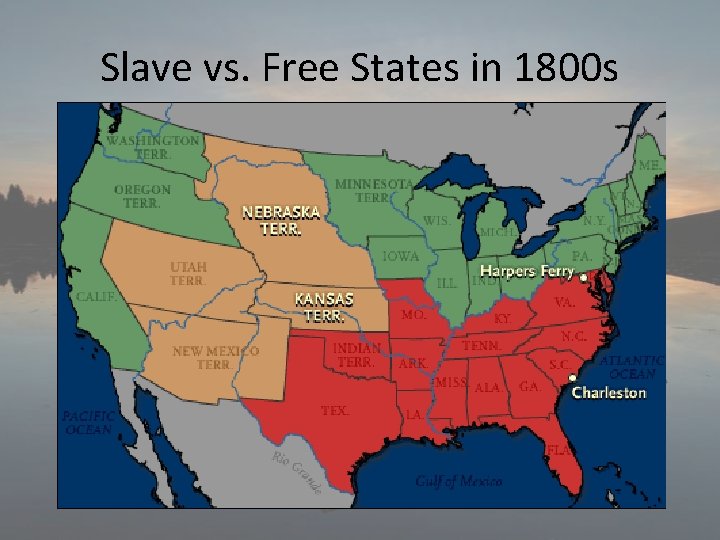
Slave vs. Free States in 1800 s
- Slides: 28