
Introduction to Accelerator Physics Spring 2018 Start of



- Slides: 48
Introduction to Accelerator Physics Spring 2018 Start of Chapter 6: Lattice Exercises I Todd Satogata (Jefferson Lab and ODU) / satogata@jlab. org http: //www. toddsatogata. net/2018 -ODU-AP ~~~~~ February 15 ~~~~~ Happy Birthday to Galileo, Charles Guillaume (1920 Nobel!), and Owen Richardson (1928 Nobel!) Happy National Gumdrop Day, National Hippo Day, and Annoy Squidward Day! T. Satogata ODU PHYS 417 Lec 11 -12 Feb 1
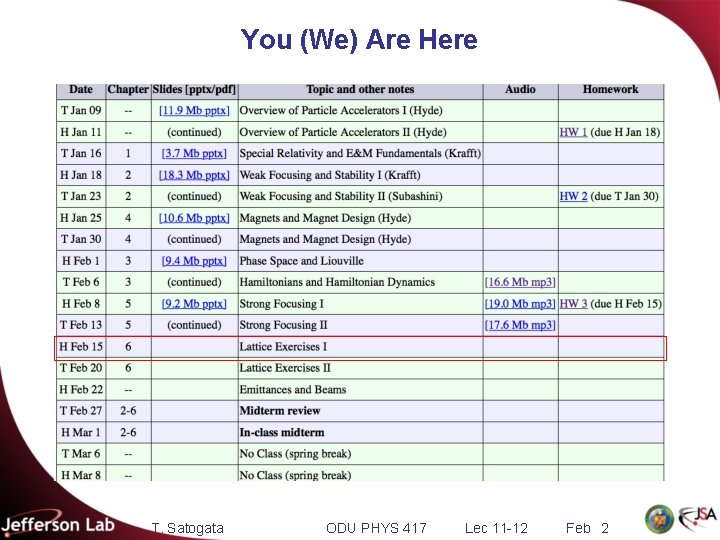
You (We) Are Here T. Satogata ODU PHYS 417 Lec 11 -12 Feb 2
Objectives for Thu Feb 15 § Quick review of Courant-Snyder parameters and FODO § Non-periodic transport matrices § Invariants and ellipses, first look at “emittance” § Rings and tunes § Stability diagrams § Dispersion and dispersion suppressors § Other insertions (pi and pi/2) T. Satogata ODU PHYS 417 Lec 11 -12 Feb 3
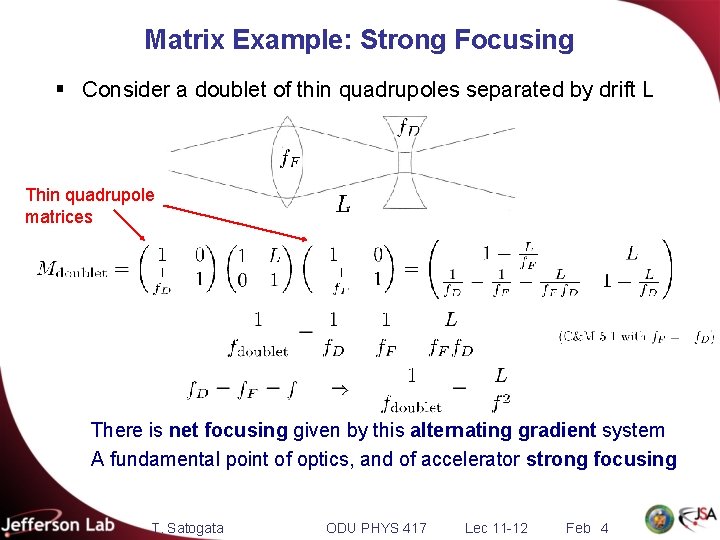
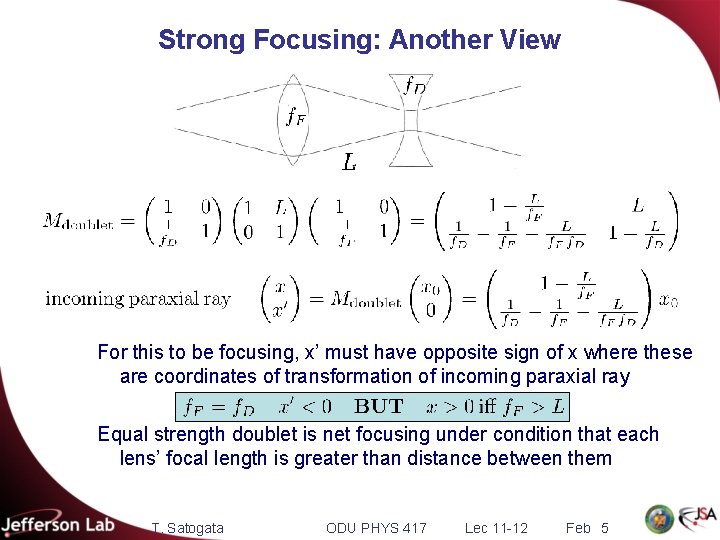
Matrix Example: Strong Focusing § Consider a doublet of thin quadrupoles separated by drift L Thin quadrupole matrices There is net focusing given by this alternating gradient system A fundamental point of optics, and of accelerator strong focusing T. Satogata ODU PHYS 417 Lec 11 -12 Feb 4
Strong Focusing: Another View For this to be focusing, x’ must have opposite sign of x where these are coordinates of transformation of incoming paraxial ray Equal strength doublet is net focusing under condition that each lens’ focal length is greater than distance between them T. Satogata ODU PHYS 417 Lec 11 -12 Feb 5
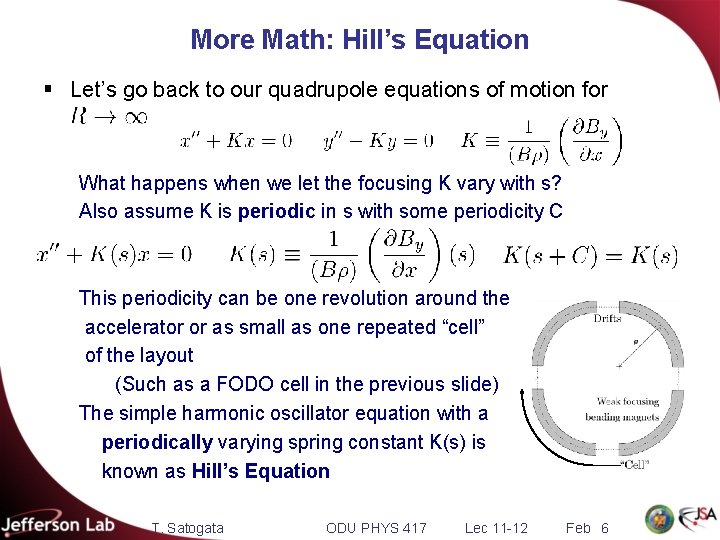
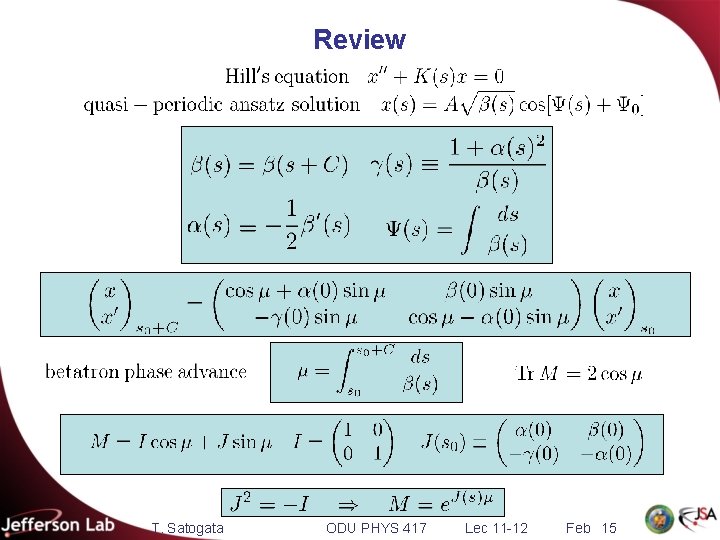
More Math: Hill’s Equation § Let’s go back to our quadrupole equations of motion for What happens when we let the focusing K vary with s? Also assume K is periodic in s with some periodicity C This periodicity can be one revolution around the accelerator or as small as one repeated “cell” of the layout (Such as a FODO cell in the previous slide) The simple harmonic oscillator equation with a periodically varying spring constant K(s) is known as Hill’s Equation T. Satogata ODU PHYS 417 Lec 11 -12 Feb 6
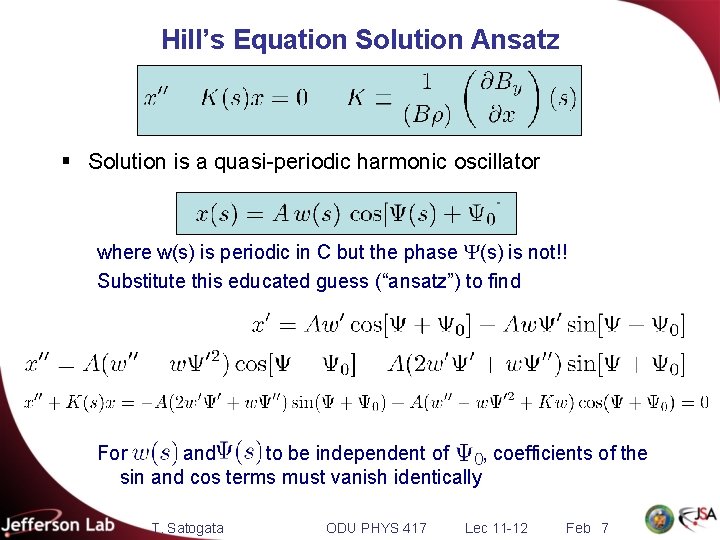
Hill’s Equation Solution Ansatz § Solution is a quasi-periodic harmonic oscillator where w(s) is periodic in C but the phase Y(s) is not!! Substitute this educated guess (“ansatz”) to find For and to be independent of , coefficients of the sin and cos terms must vanish identically T. Satogata ODU PHYS 417 Lec 11 -12 Feb 7
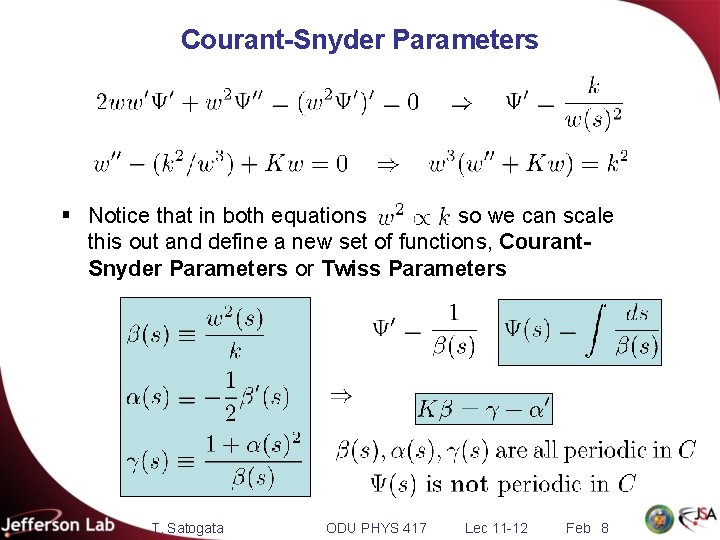
Courant-Snyder Parameters § Notice that in both equations so we can scale this out and define a new set of functions, Courant. Snyder Parameters or Twiss Parameters T. Satogata ODU PHYS 417 Lec 11 -12 Feb 8
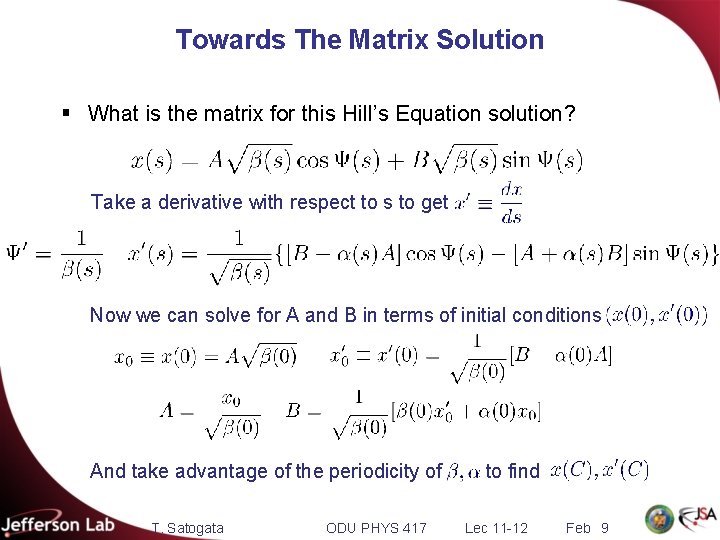
Towards The Matrix Solution § What is the matrix for this Hill’s Equation solution? Take a derivative with respect to s to get Now we can solve for A and B in terms of initial conditions And take advantage of the periodicity of T. Satogata ODU PHYS 417 to find Lec 11 -12 Feb 9
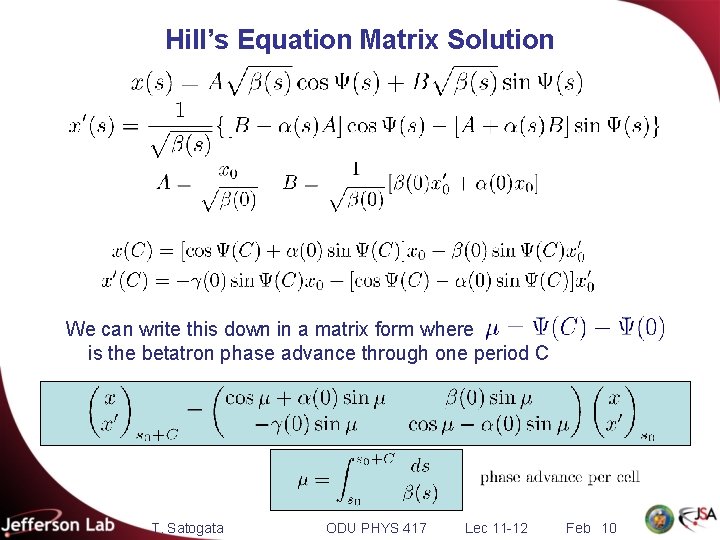
Hill’s Equation Matrix Solution We can write this down in a matrix form where is the betatron phase advance through one period C T. Satogata ODU PHYS 417 Lec 11 -12 Feb 10
Interesting Observations § is independent of s: this is the betatron phase advance of this periodic system § Determinant of matrix M is still 1! § Looks like a rotation and some scaling § M can be written down in a beautiful and deep way remember T. Satogata ODU PHYS 417 Lec 11 -12 Feb 11
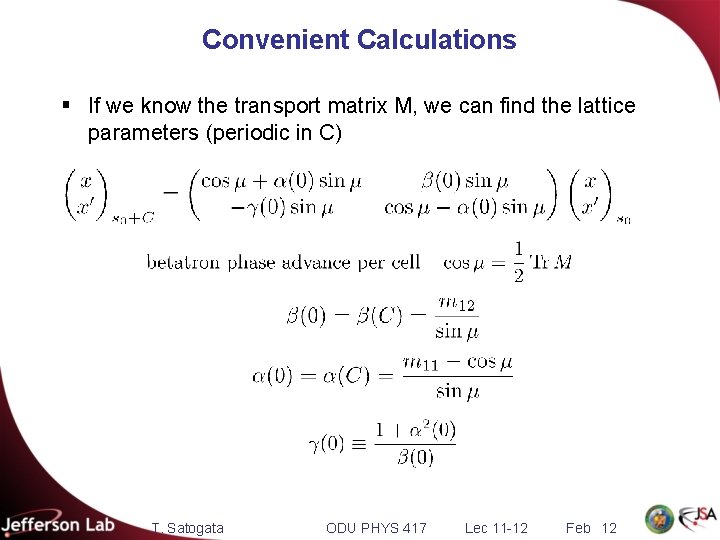
Convenient Calculations § If we know the transport matrix M, we can find the lattice parameters (periodic in C) T. Satogata ODU PHYS 417 Lec 11 -12 Feb 12
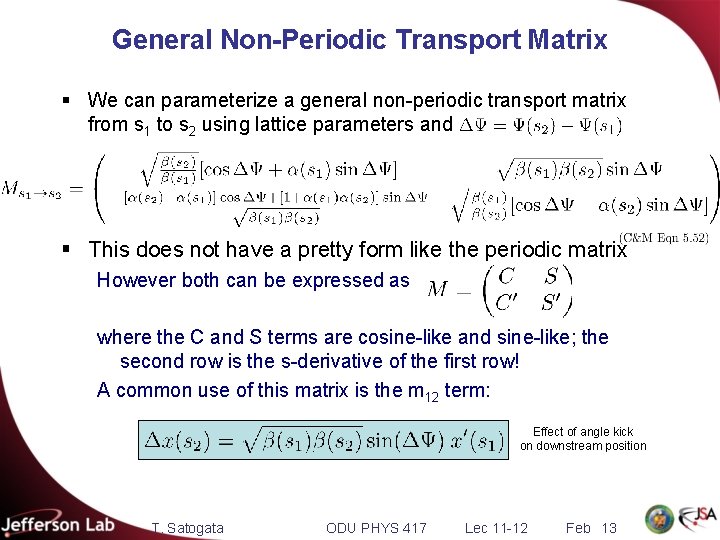
General Non-Periodic Transport Matrix § We can parameterize a general non-periodic transport matrix from s 1 to s 2 using lattice parameters and § This does not have a pretty form like the periodic matrix However both can be expressed as where the C and S terms are cosine-like and sine-like; the second row is the s-derivative of the first row! A common use of this matrix is the m 12 term: Effect of angle kick on downstream position T. Satogata ODU PHYS 417 Lec 11 -12 Feb 13
(Deriving the Non-Periodic Transport Matrix) Calculate A, B in terms of initial conditions and Substitute (A, B) and put into matrix form: T. Satogata ODU PHYS 417 Lec 11 -12 Feb 14
Review T. Satogata ODU PHYS 417 Lec 11 -12 Feb 15
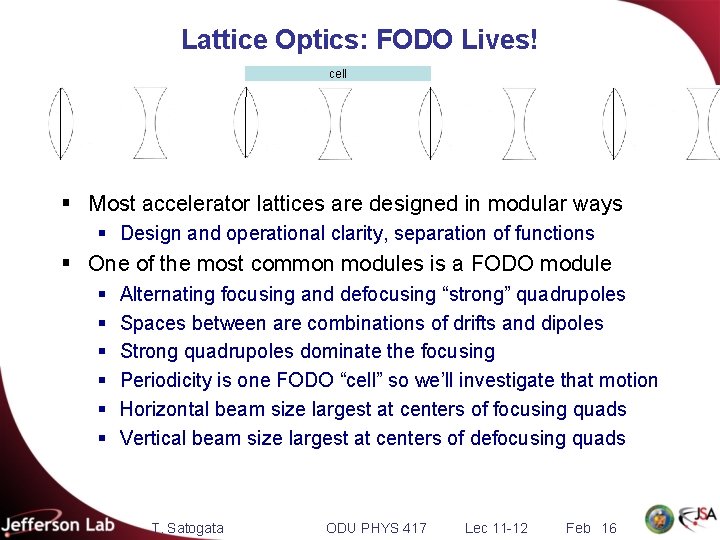
Lattice Optics: FODO Lives! cell § Most accelerator lattices are designed in modular ways § Design and operational clarity, separation of functions § One of the most common modules is a FODO module § § § Alternating focusing and defocusing “strong” quadrupoles Spaces between are combinations of drifts and dipoles Strong quadrupoles dominate the focusing Periodicity is one FODO “cell” so we’ll investigate that motion Horizontal beam size largest at centers of focusing quads Vertical beam size largest at centers of defocusing quads T. Satogata ODU PHYS 417 Lec 11 -12 Feb 16
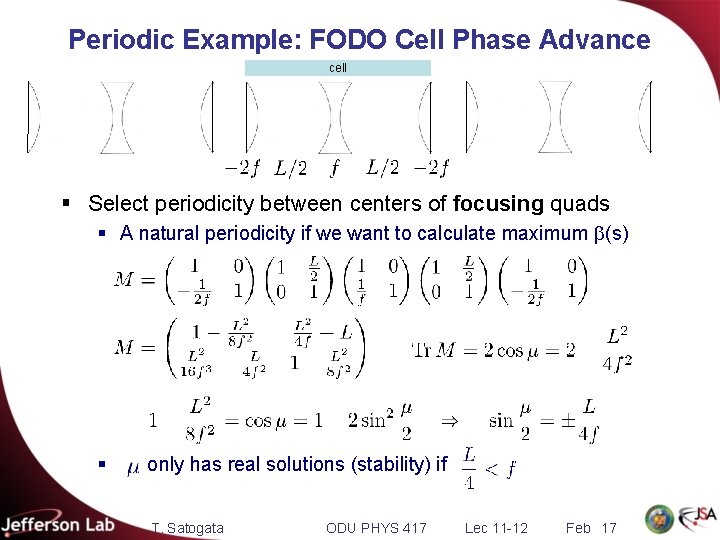
Periodic Example: FODO Cell Phase Advance cell § Select periodicity between centers of focusing quads § A natural periodicity if we want to calculate maximum b(s) § only has real solutions (stability) if T. Satogata ODU PHYS 417 Lec 11 -12 Feb 17
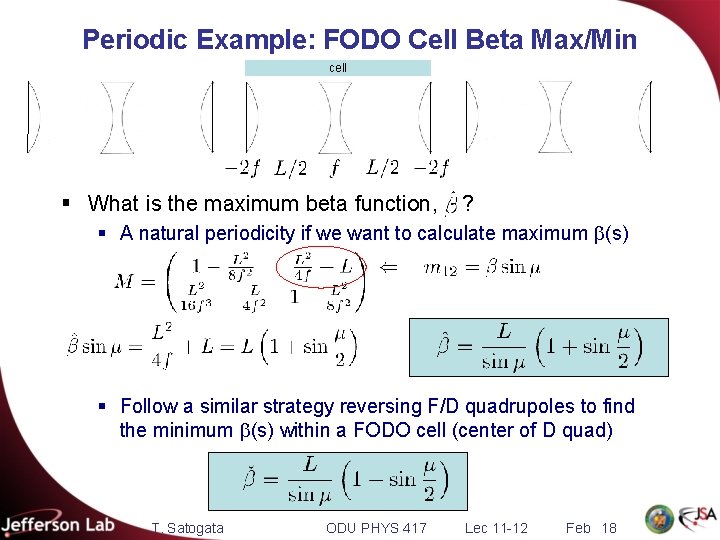
Periodic Example: FODO Cell Beta Max/Min cell § What is the maximum beta function, ? § A natural periodicity if we want to calculate maximum b(s) § Follow a similar strategy reversing F/D quadrupoles to find the minimum b(s) within a FODO cell (center of D quad) T. Satogata ODU PHYS 417 Lec 11 -12 Feb 18
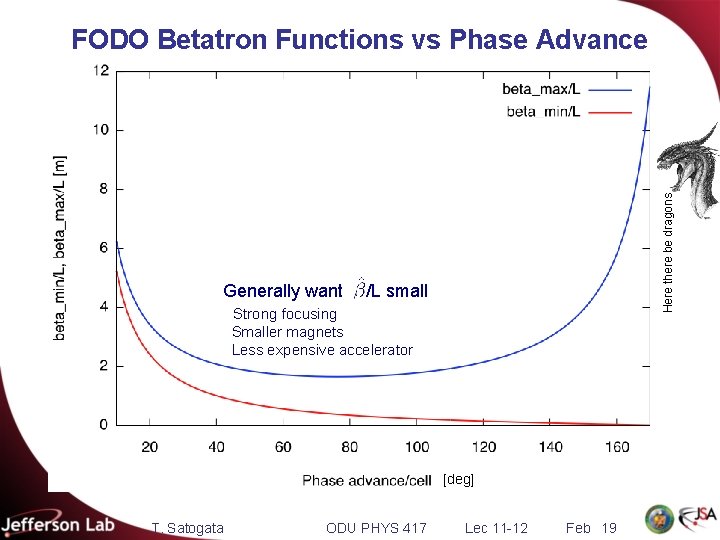
Generally want Here there be dragons FODO Betatron Functions vs Phase Advance /L small Strong focusing Smaller magnets Less expensive accelerator [deg] T. Satogata ODU PHYS 417 Lec 11 -12 Feb 19
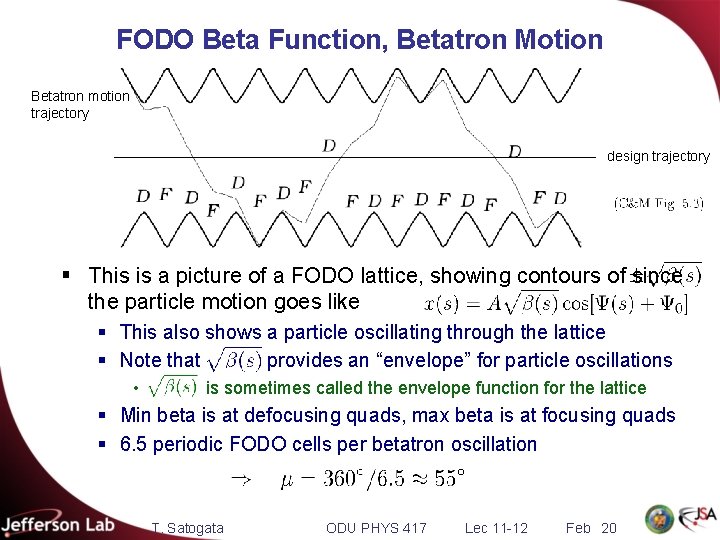
FODO Beta Function, Betatron Motion Betatron motion trajectory design trajectory § This is a picture of a FODO lattice, showing contours of since the particle motion goes like § This also shows a particle oscillating through the lattice § Note that provides an “envelope” for particle oscillations • is sometimes called the envelope function for the lattice § Min beta is at defocusing quads, max beta is at focusing quads § 6. 5 periodic FODO cells per betatron oscillation T. Satogata ODU PHYS 417 Lec 11 -12 Feb 20
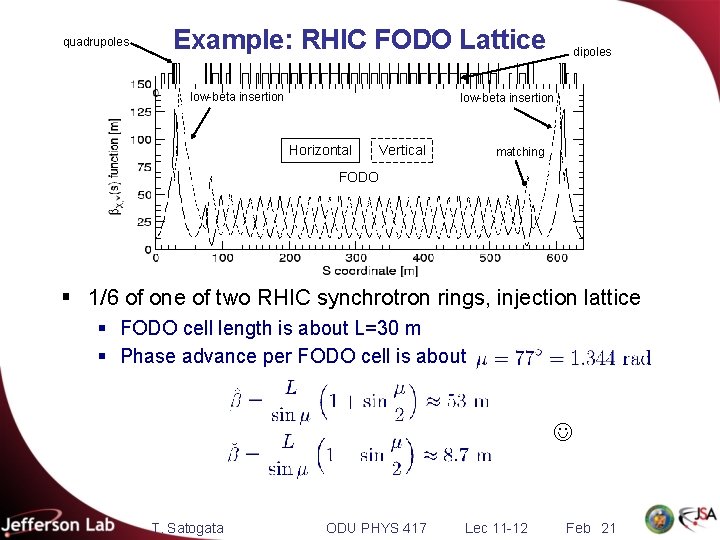
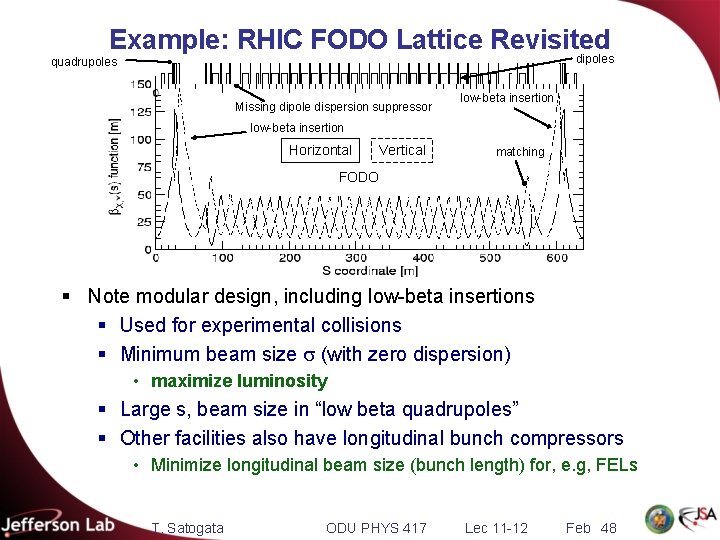
quadrupoles Example: RHIC FODO Lattice low-beta insertion dipoles low-beta insertion Horizontal Vertical matching FODO § 1/6 of one of two RHIC synchrotron rings, injection lattice § FODO cell length is about L=30 m § Phase advance per FODO cell is about T. Satogata ODU PHYS 417 Lec 11 -12 Feb 21
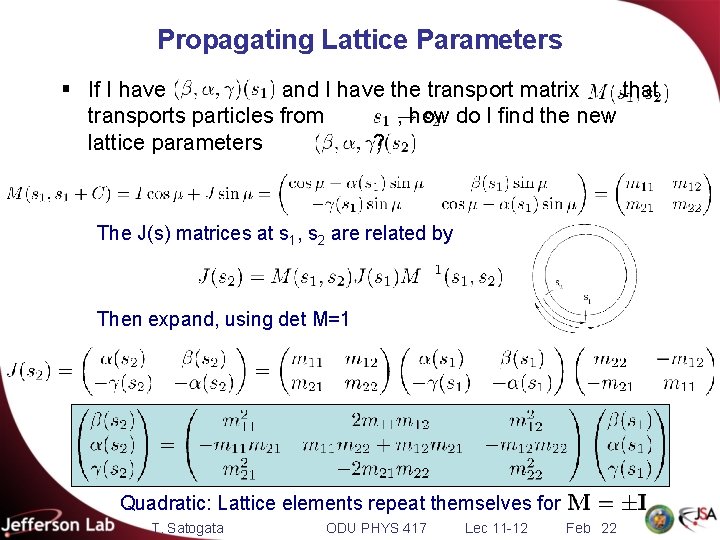
Propagating Lattice Parameters § If I have and I have the transport matrix that transports particles from , how do I find the new lattice parameters ? The J(s) matrices at s 1, s 2 are related by Then expand, using det M=1 Quadratic: Lattice elements repeat themselves for T. Satogata ODU PHYS 417 Lec 11 -12 Feb 22
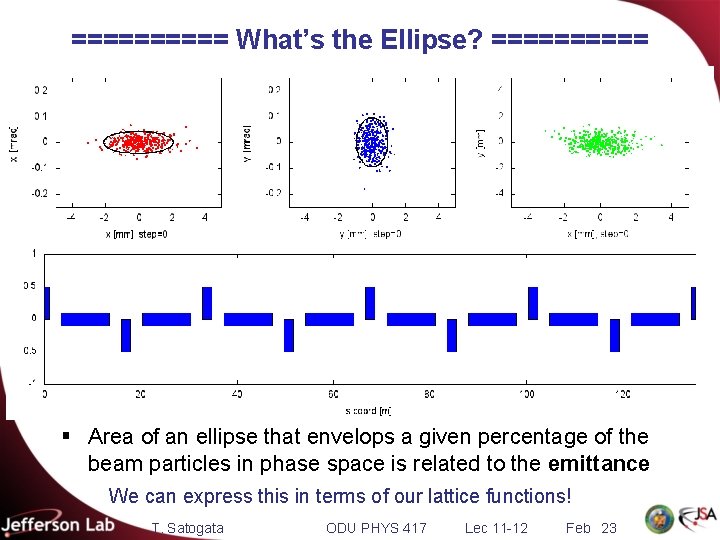
===== What’s the Ellipse? ===== § Area of an ellipse that envelops a given percentage of the beam particles in phase space is related to the emittance We can express this in terms of our lattice functions! T. Satogata ODU PHYS 417 Lec 11 -12 Feb 23
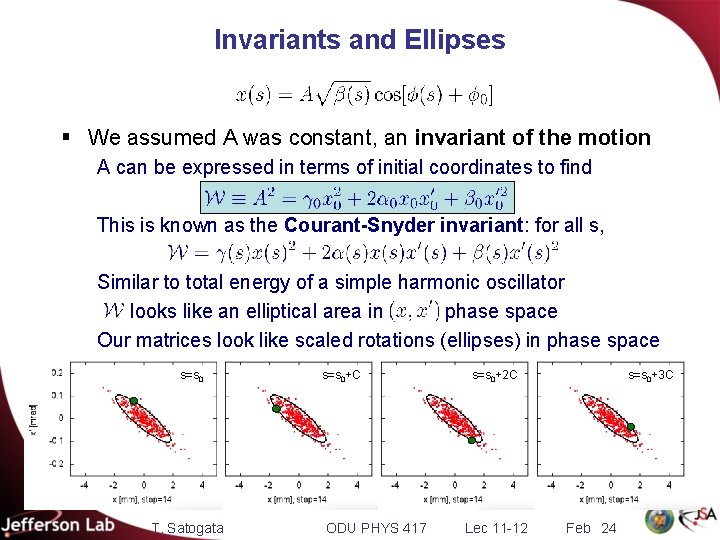
Invariants and Ellipses § We assumed A was constant, an invariant of the motion A can be expressed in terms of initial coordinates to find This is known as the Courant-Snyder invariant: for all s, Similar to total energy of a simple harmonic oscillator looks like an elliptical area in phase space Our matrices look like scaled rotations (ellipses) in phase space s=s 0 T. Satogata s=s 0+C ODU PHYS 417 s=s 0+2 C Lec 11 -12 s=s 0+3 C Feb 24
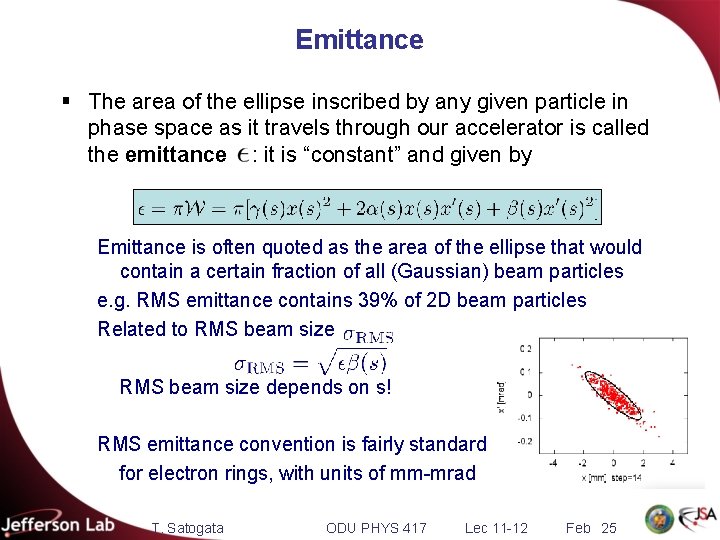
Emittance § The area of the ellipse inscribed by any given particle in phase space as it travels through our accelerator is called the emittance : it is “constant” and given by Emittance is often quoted as the area of the ellipse that would contain a certain fraction of all (Gaussian) beam particles e. g. RMS emittance contains 39% of 2 D beam particles Related to RMS beam size depends on s! RMS emittance convention is fairly standard for electron rings, with units of mm-mrad T. Satogata ODU PHYS 417 Lec 11 -12 Feb 25
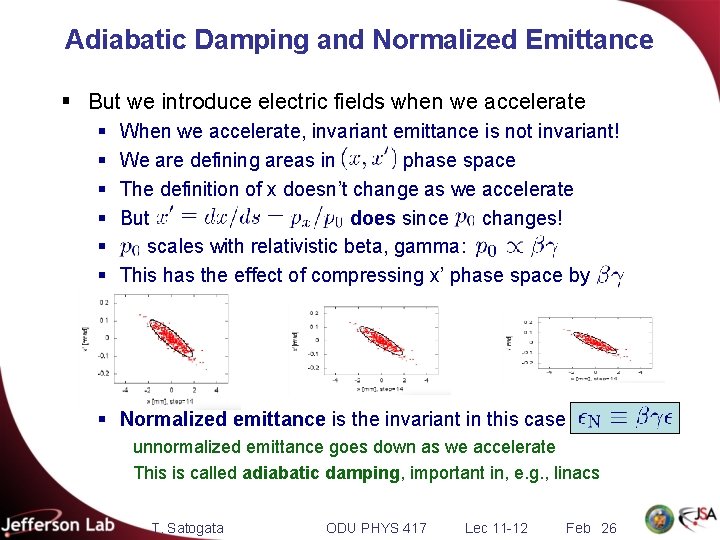
Adiabatic Damping and Normalized Emittance § But we introduce electric fields when we accelerate § § § When we accelerate, invariant emittance is not invariant! We are defining areas in phase space The definition of x doesn’t change as we accelerate But does since changes! scales with relativistic beta, gamma: This has the effect of compressing x’ phase space by § Normalized emittance is the invariant in this case unnormalized emittance goes down as we accelerate This is called adiabatic damping, important in, e. g. , linacs T. Satogata ODU PHYS 417 Lec 11 -12 Feb 26
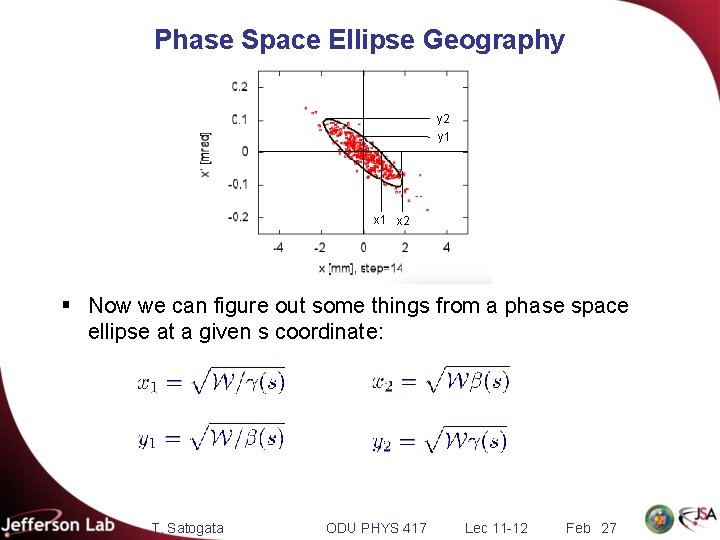
Phase Space Ellipse Geography y 2 y 1 x 2 § Now we can figure out some things from a phase space ellipse at a given s coordinate: T. Satogata ODU PHYS 417 Lec 11 -12 Feb 27
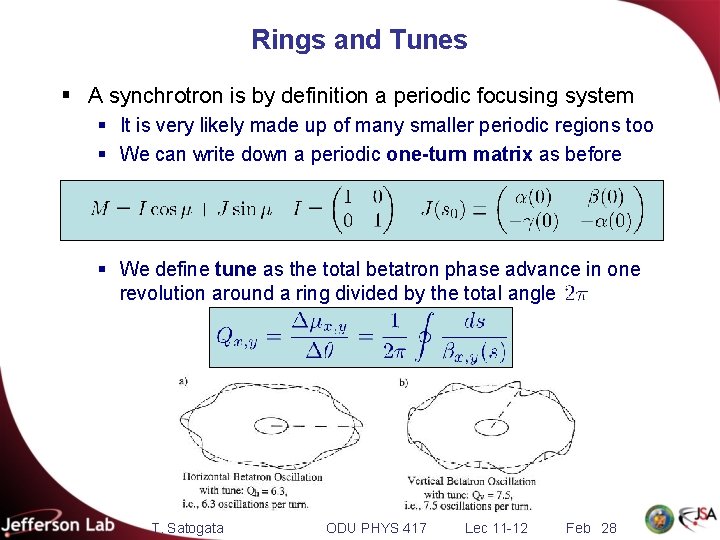
Rings and Tunes § A synchrotron is by definition a periodic focusing system § It is very likely made up of many smaller periodic regions too § We can write down a periodic one-turn matrix as before § We define tune as the total betatron phase advance in one revolution around a ring divided by the total angle T. Satogata ODU PHYS 417 Lec 11 -12 Feb 28
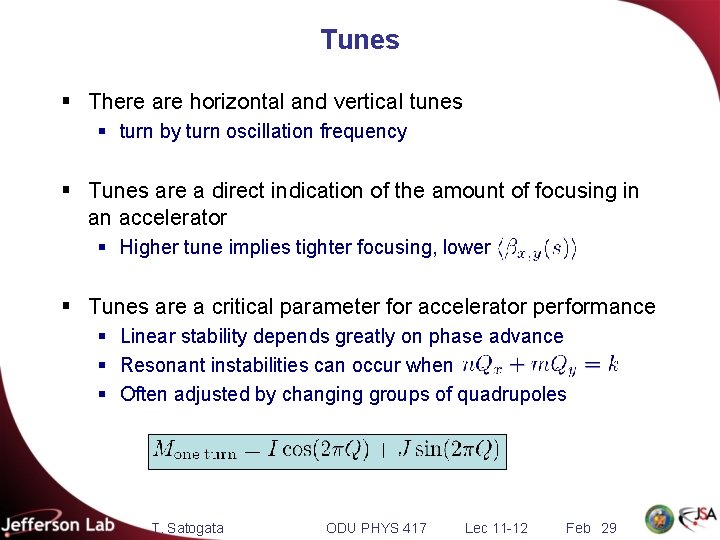
Tunes § There are horizontal and vertical tunes § turn by turn oscillation frequency § Tunes are a direct indication of the amount of focusing in an accelerator § Higher tune implies tighter focusing, lower § Tunes are a critical parameter for accelerator performance § Linear stability depends greatly on phase advance § Resonant instabilities can occur when § Often adjusted by changing groups of quadrupoles T. Satogata ODU PHYS 417 Lec 11 -12 Feb 29
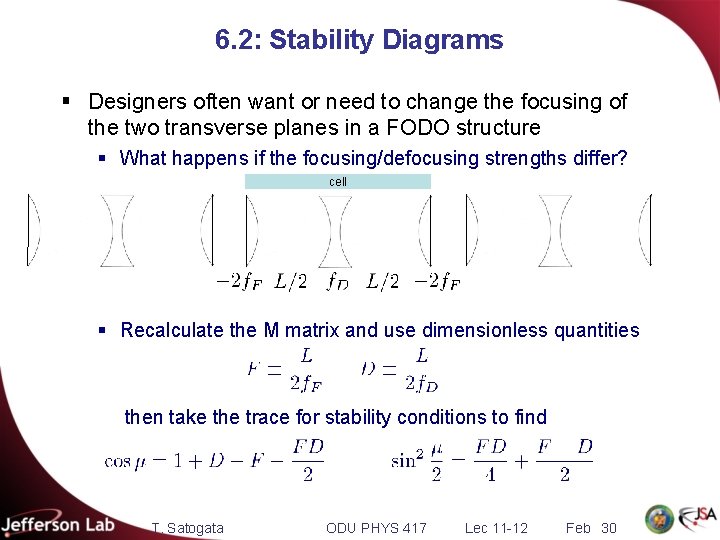
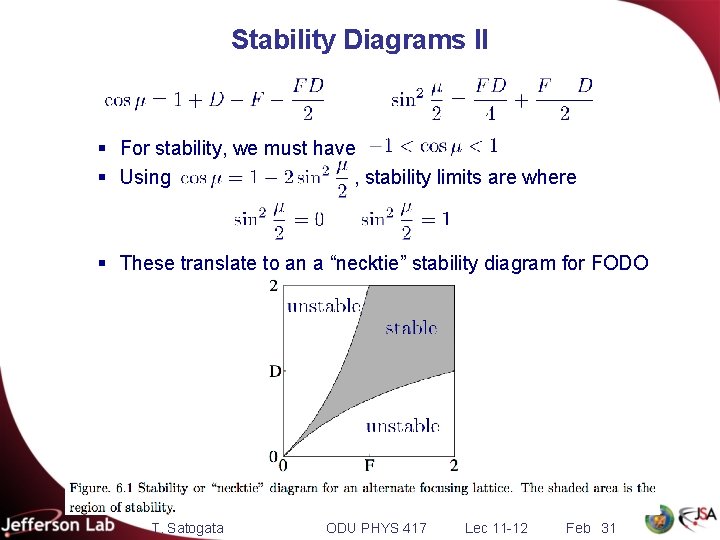
6. 2: Stability Diagrams § Designers often want or need to change the focusing of the two transverse planes in a FODO structure § What happens if the focusing/defocusing strengths differ? cell § Recalculate the M matrix and use dimensionless quantities then take the trace for stability conditions to find T. Satogata ODU PHYS 417 Lec 11 -12 Feb 30
Stability Diagrams II § For stability, we must have § Using , stability limits are where § These translate to an a “necktie” stability diagram for FODO T. Satogata ODU PHYS 417 Lec 11 -12 Feb 31
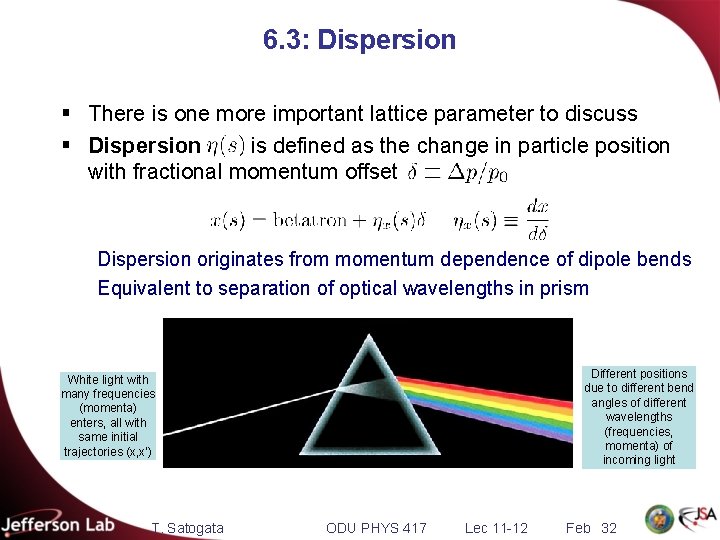
6. 3: Dispersion § There is one more important lattice parameter to discuss § Dispersion is defined as the change in particle position with fractional momentum offset Dispersion originates from momentum dependence of dipole bends Equivalent to separation of optical wavelengths in prism Different positions due to different bend angles of different wavelengths (frequencies, momenta) of incoming light White light with many frequencies (momenta) enters, all with same initial trajectories (x, x’) T. Satogata ODU PHYS 417 Lec 11 -12 Feb 32
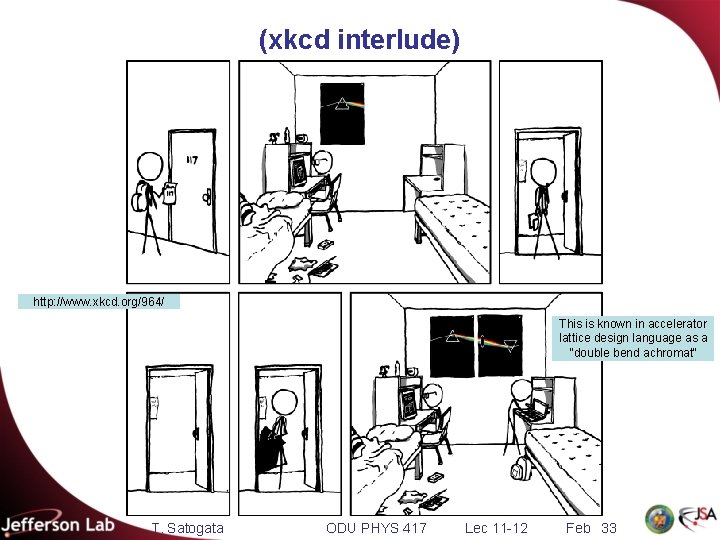
(xkcd interlude) http: //www. xkcd. org/964/ This is known in accelerator lattice design language as a “double bend achromat” T. Satogata ODU PHYS 417 Lec 11 -12 Feb 33
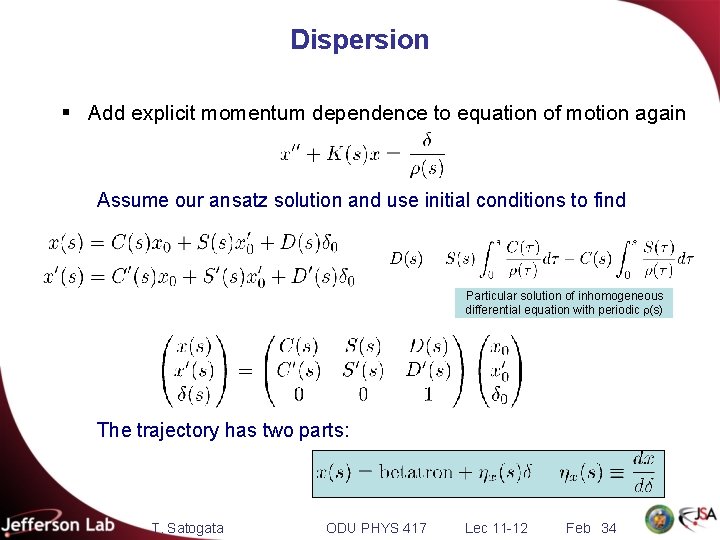
Dispersion § Add explicit momentum dependence to equation of motion again Assume our ansatz solution and use initial conditions to find Particular solution of inhomogeneous differential equation with periodic r(s) The trajectory has two parts: T. Satogata ODU PHYS 417 Lec 11 -12 Feb 34
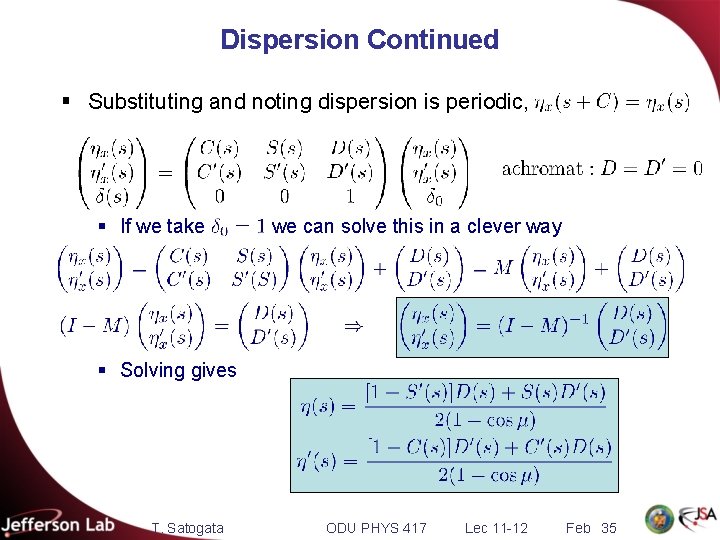
Dispersion Continued § Substituting and noting dispersion is periodic, § If we take we can solve this in a clever way § Solving gives T. Satogata ODU PHYS 417 Lec 11 -12 Feb 35
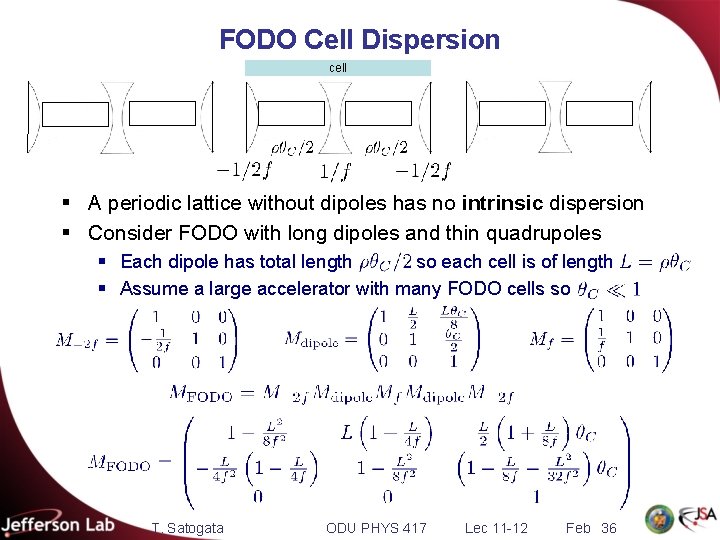
FODO Cell Dispersion cell § A periodic lattice without dipoles has no intrinsic dispersion § Consider FODO with long dipoles and thin quadrupoles § Each dipole has total length so each cell is of length § Assume a large accelerator with many FODO cells so T. Satogata ODU PHYS 417 Lec 11 -12 Feb 36
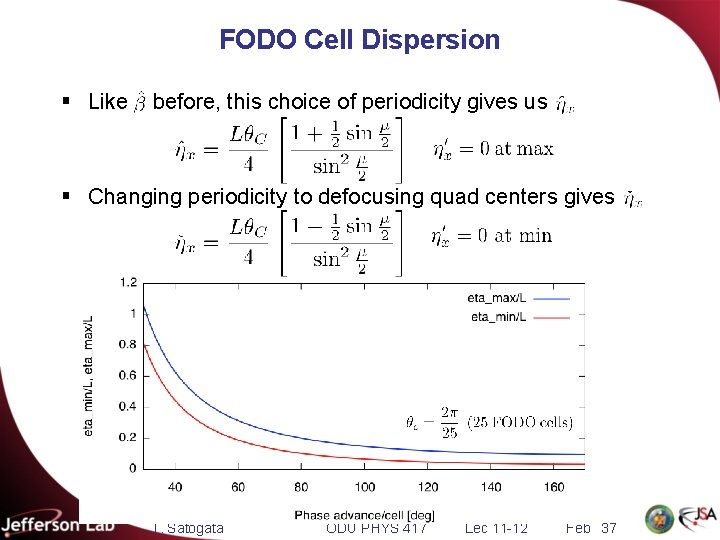
FODO Cell Dispersion § Like before, this choice of periodicity gives us § Changing periodicity to defocusing quad centers gives T. Satogata ODU PHYS 417 Lec 11 -12 Feb 37
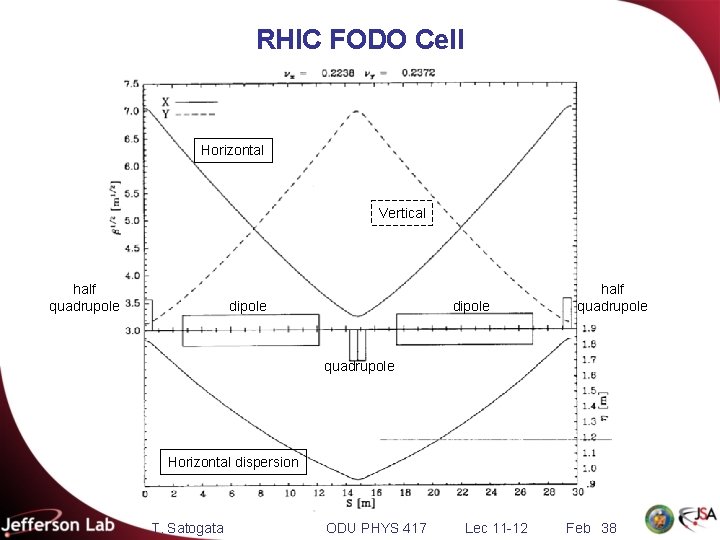
RHIC FODO Cell Horizontal Vertical half quadrupole dipole half quadrupole Horizontal dispersion T. Satogata ODU PHYS 417 Lec 11 -12 Feb 38
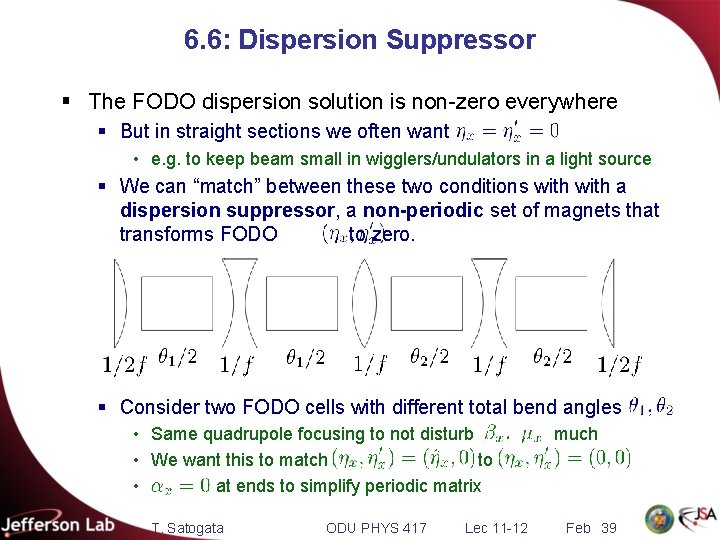
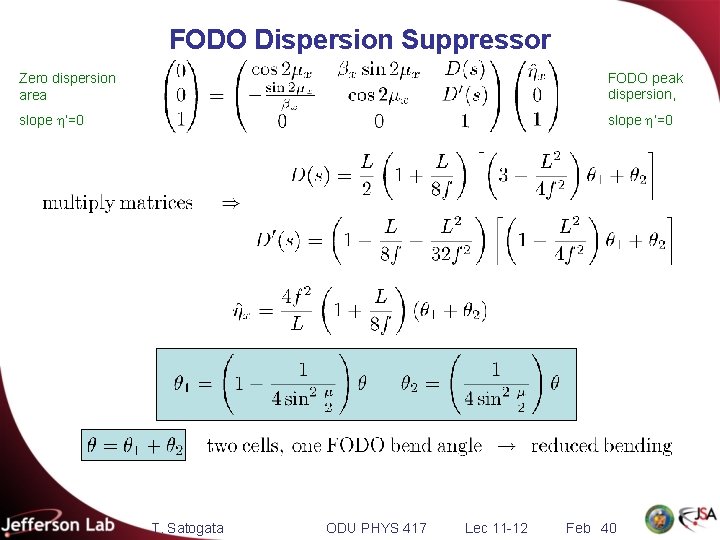
6. 6: Dispersion Suppressor § The FODO dispersion solution is non-zero everywhere § But in straight sections we often want • e. g. to keep beam small in wigglers/undulators in a light source § We can “match” between these two conditions with a dispersion suppressor, a non-periodic set of magnets that transforms FODO to zero. § Consider two FODO cells with different total bend angles • Same quadrupole focusing to not disturb • We want this to match to • at ends to simplify periodic matrix T. Satogata ODU PHYS 417 Lec 11 -12 much Feb 39
FODO Dispersion Suppressor Zero dispersion area FODO peak dispersion, slope h’=0 T. Satogata ODU PHYS 417 Lec 11 -12 Feb 40
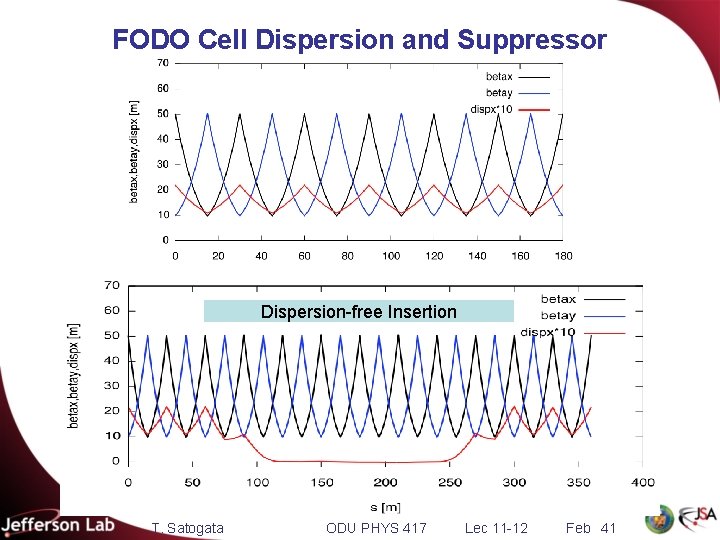
FODO Cell Dispersion and Suppressor Dispersion-free Insertion T. Satogata ODU PHYS 417 Lec 11 -12 Feb 41
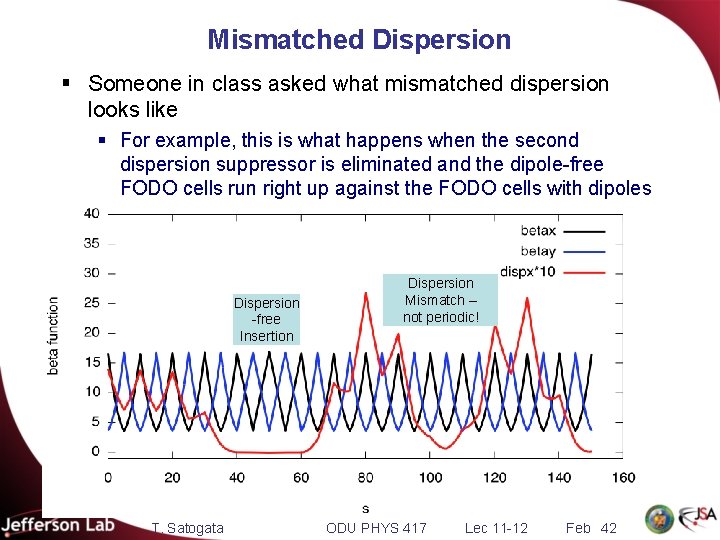
Mismatched Dispersion § Someone in class asked what mismatched dispersion looks like § For example, this is what happens when the second dispersion suppressor is eliminated and the dipole-free FODO cells run right up against the FODO cells with dipoles Dispersion -free Insertion T. Satogata Dispersion Mismatch – not periodic! ODU PHYS 417 Lec 11 -12 Feb 42
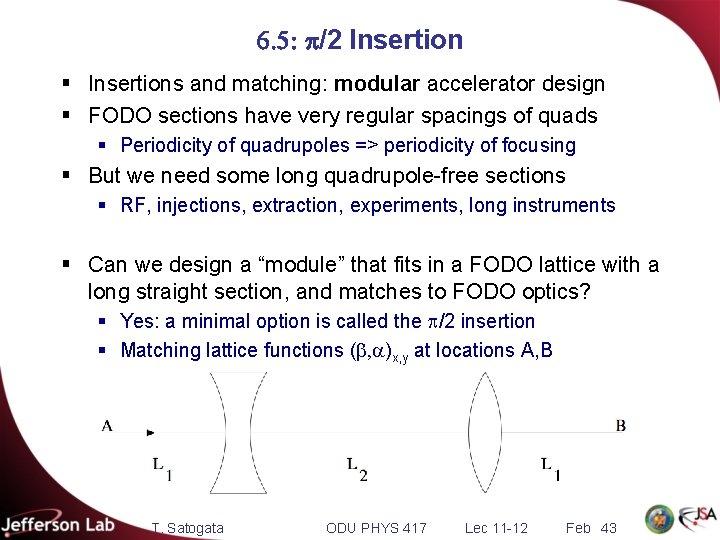
6. 5: p/2 Insertion § Insertions and matching: modular accelerator design § FODO sections have very regular spacings of quads § Periodicity of quadrupoles => periodicity of focusing § But we need some long quadrupole-free sections § RF, injections, extraction, experiments, long instruments § Can we design a “module” that fits in a FODO lattice with a long straight section, and matches to FODO optics? § Yes: a minimal option is called the p/2 insertion § Matching lattice functions (b, a)x, y at locations A, B T. Satogata ODU PHYS 417 Lec 11 -12 Feb 43
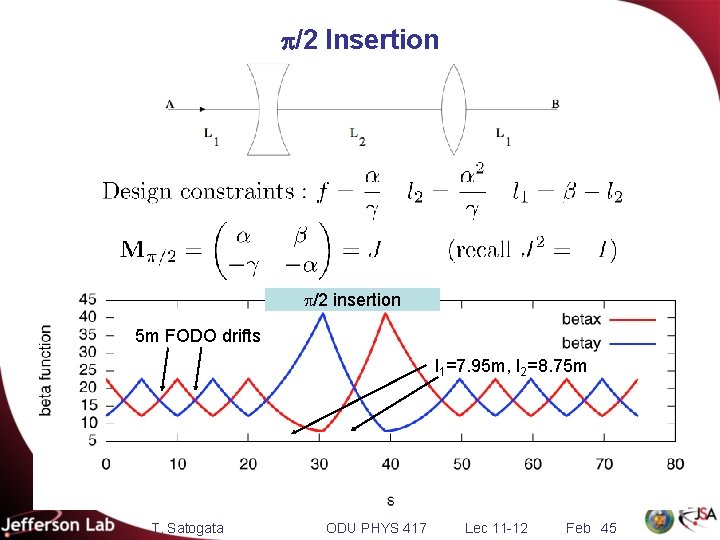
p/2 Insertion T. Satogata ODU PHYS 417 Lec 11 -12 Feb 44
p/2 Insertion p/2 insertion 5 m FODO drifts l 1=7. 95 m, l 2=8. 75 m T. Satogata ODU PHYS 417 Lec 11 -12 Feb 45
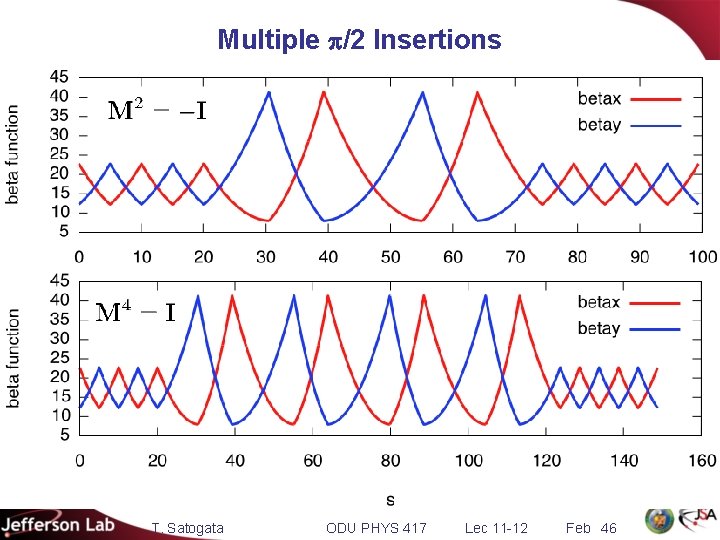
Multiple p/2 Insertions T. Satogata ODU PHYS 417 Lec 11 -12 Feb 46
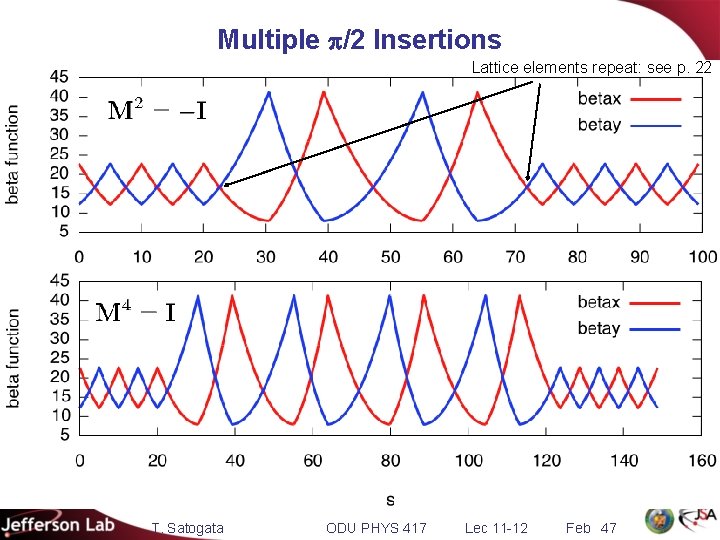
Multiple p/2 Insertions Lattice elements repeat: see p. 22 T. Satogata ODU PHYS 417 Lec 11 -12 Feb 47
Example: RHIC FODO Lattice Revisited dipoles quadrupoles Missing dipole dispersion suppressor low-beta insertion Horizontal Vertical matching FODO § Note modular design, including low-beta insertions § Used for experimental collisions § Minimum beam size s (with zero dispersion) • maximize luminosity § Large s, beam size in “low beta quadrupoles” § Other facilities also have longitudinal bunch compressors • Minimize longitudinal beam size (bunch length) for, e. g, FELs T. Satogata ODU PHYS 417 Lec 11 -12 Feb 48