
Introduction to Accelerator Physics Spring 2018 Introductions Overview

- Slides: 47
Introduction to Accelerator Physics Spring 2018 Introductions Overview of Particle Accelerators Todd Satogata (Jefferson Lab and ODU) / satogata@jlab. org http: //www. toddsatogata. net/2018 -ODU-AP Happy Birthday to Nina Dobrev, Dave Matthews, Jimmy Page, Joan Baez, and Vladimir Steklov! Happy National Cassoulet day, Static Electricity Day, and Word Nerd Day! T. Satogata ODU PHYS 417 Lecture 1 Jan 9 2017 1
Introductions and Outline § A sign-in sheet is being passed around § Introductions: Getting to know you, and us… § Let’s get it started § Course administrivia § Survey of accelerators and accelerator concepts § Next lecture § Special relativity and E&M fundamentals T. Satogata ODU PHYS 417 Lecture 1 Jan 9 2017 2
Todd’s Absence and Recovery § Todd will be absent a few weeks after his vehicle was hit by a school bus on Jefferson Ave on Dec 6 § Drs. Geoff Krafft and Charles Hyde will be filling in for the first several weeks of the class Todd <3 Toyota Airbags T. Satogata ODU PHYS 417 Lecture 1 Jan 9 2017 3
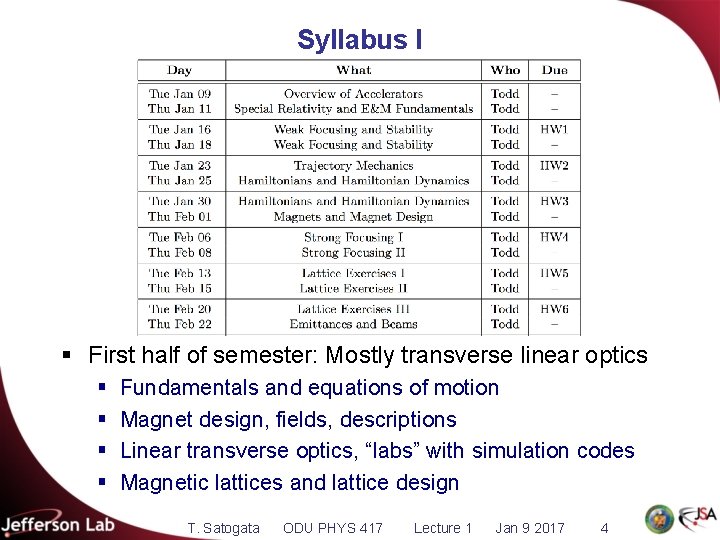
Syllabus I § First half of semester: Mostly transverse linear optics § § Fundamentals and equations of motion Magnet design, fields, descriptions Linear transverse optics, “labs” with simulation codes Magnetic lattices and lattice design T. Satogata ODU PHYS 417 Lecture 1 Jan 9 2017 4
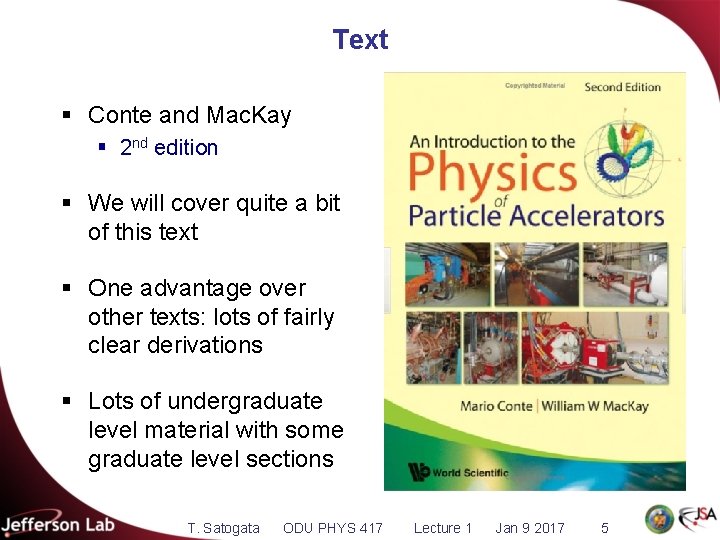
Text § Conte and Mac. Kay § 2 nd edition § We will cover quite a bit of this text § One advantage over other texts: lots of fairly clear derivations § Lots of undergraduate level material with some graduate level sections T. Satogata ODU PHYS 417 Lecture 1 Jan 9 2017 5
Homework and Schedule § Homework is half of your grade!! (50%) § Collected at start of Tuesday classes when due § Collaboration is encouraged! (Except on the midterm on Mar 1) § In fact, it’s a good part of the reason why you’re here! § Todd is available via email to help and answer questions § One-on-one meetings can be set up according to demand § Please cite references, contributions of teammates, etc § But everyone must hand in individual copies of homework T. Satogata ODU PHYS 417 Lecture 1 Jan 9 2017 6
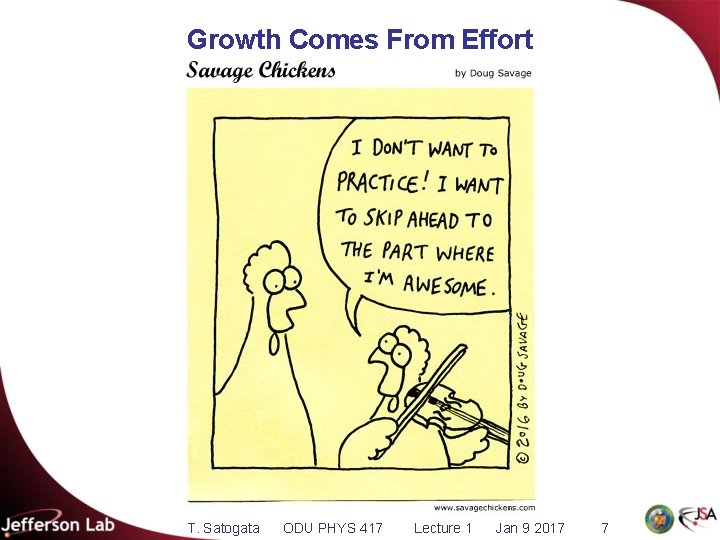
Growth Comes From Effort T. Satogata ODU PHYS 417 Lecture 1 Jan 9 2017 7
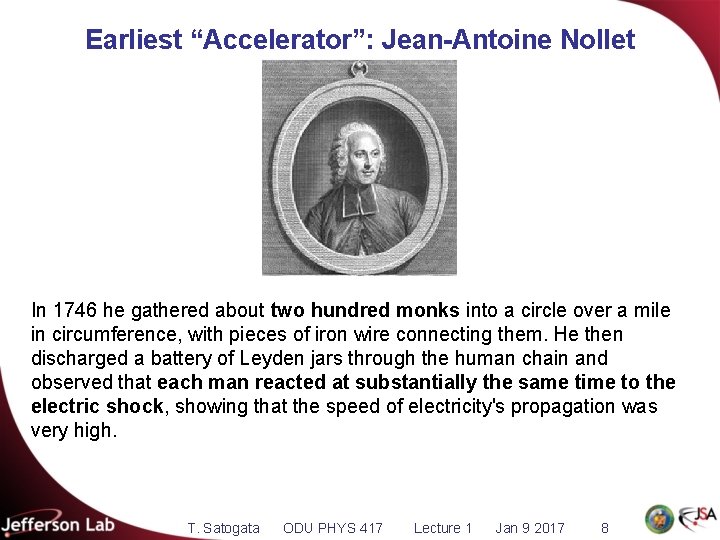
Earliest “Accelerator”: Jean-Antoine Nollet In 1746 he gathered about two hundred monks into a circle over a mile in circumference, with pieces of iron wire connecting them. He then discharged a battery of Leyden jars through the human chain and observed that each man reacted at substantially the same time to the electric shock, showing that the speed of electricity's propagation was very high. T. Satogata ODU PHYS 417 Lecture 1 Jan 9 2017 8
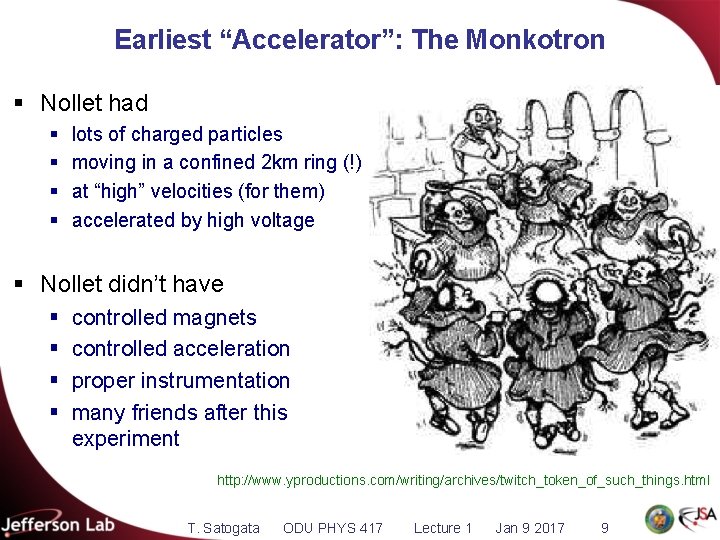
Earliest “Accelerator”: The Monkotron § Nollet had § § lots of charged particles moving in a confined 2 km ring (!) at “high” velocities (for them) accelerated by high voltage § Nollet didn’t have § § controlled magnets controlled acceleration proper instrumentation many friends after this experiment http: //www. yproductions. com/writing/archives/twitch_token_of_such_things. html T. Satogata ODU PHYS 417 Lecture 1 Jan 9 2017 9
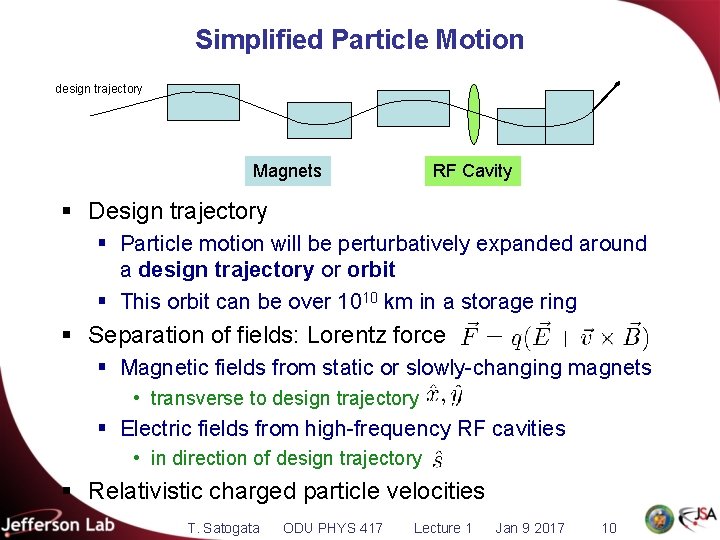
Simplified Particle Motion design trajectory Magnets RF Cavity § Design trajectory § Particle motion will be perturbatively expanded around a design trajectory or orbit § This orbit can be over 1010 km in a storage ring § Separation of fields: Lorentz force § Magnetic fields from static or slowly-changing magnets • transverse to design trajectory § Electric fields from high-frequency RF cavities • in direction of design trajectory § Relativistic charged particle velocities T. Satogata ODU PHYS 417 Lecture 1 Jan 9 2017 10
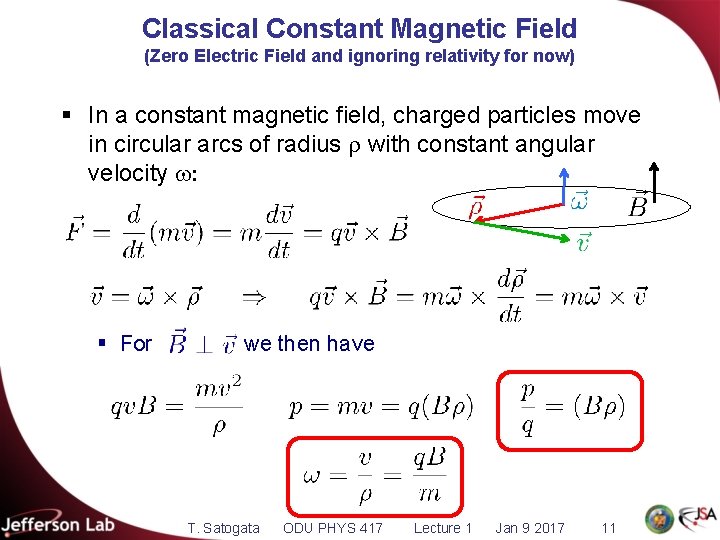
Classical Constant Magnetic Field (Zero Electric Field and ignoring relativity for now) § In a constant magnetic field, charged particles move in circular arcs of radius r with constant angular velocity : § For we then have T. Satogata ODU PHYS 417 Lecture 1 Jan 9 2017 11
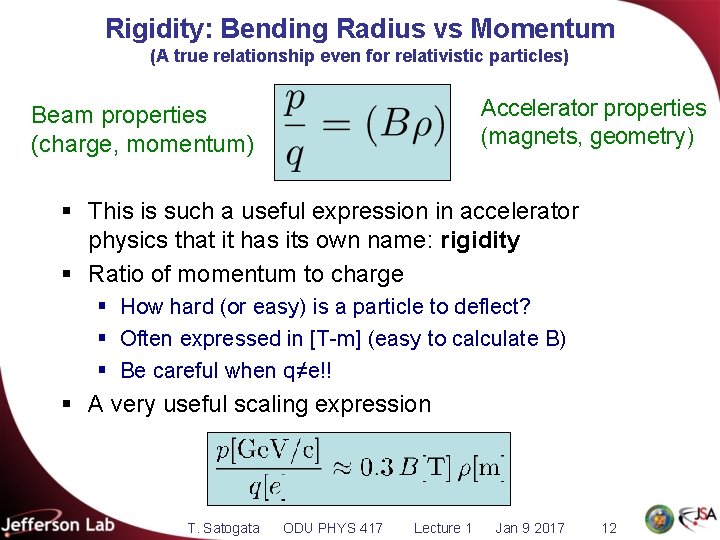
Rigidity: Bending Radius vs Momentum (A true relationship even for relativistic particles) Accelerator properties (magnets, geometry) Beam properties (charge, momentum) § This is such a useful expression in accelerator physics that it has its own name: rigidity § Ratio of momentum to charge § How hard (or easy) is a particle to deflect? § Often expressed in [T-m] (easy to calculate B) § Be careful when q≠e!! § A very useful scaling expression T. Satogata ODU PHYS 417 Lecture 1 Jan 9 2017 12
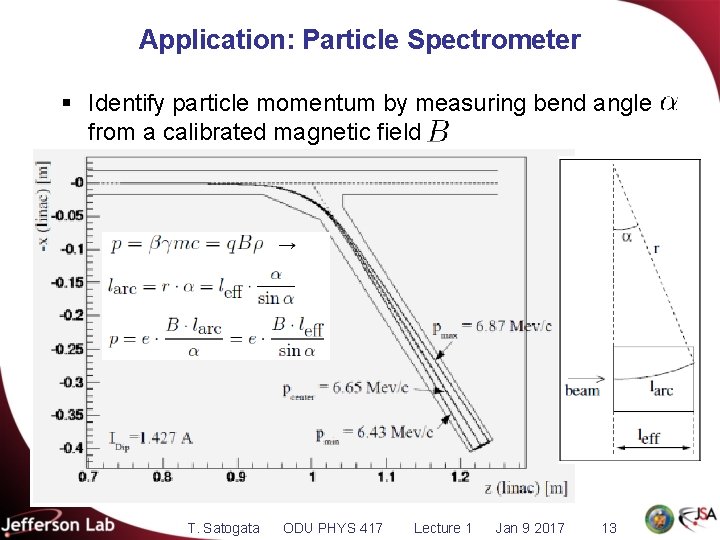
Application: Particle Spectrometer § Identify particle momentum by measuring bend angle from a calibrated magnetic field T. Satogata ODU PHYS 417 Lecture 1 Jan 9 2017 13
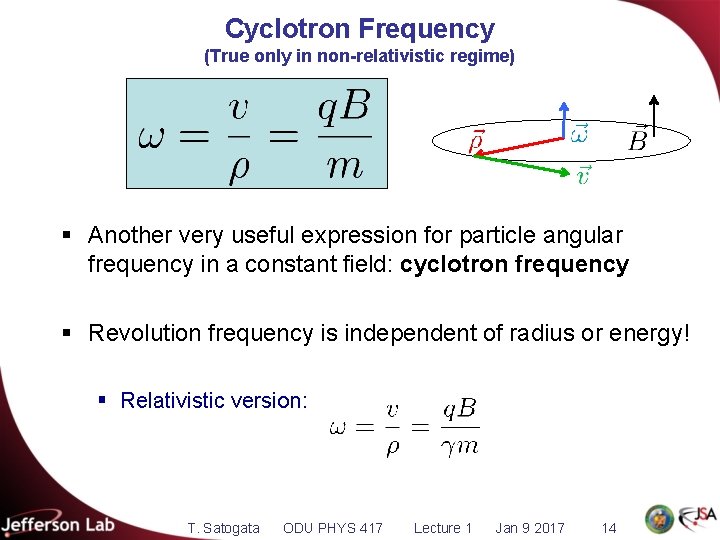
Cyclotron Frequency (True only in non-relativistic regime) § Another very useful expression for particle angular frequency in a constant field: cyclotron frequency § Revolution frequency is independent of radius or energy! § Relativistic version: T. Satogata ODU PHYS 417 Lecture 1 Jan 9 2017 14
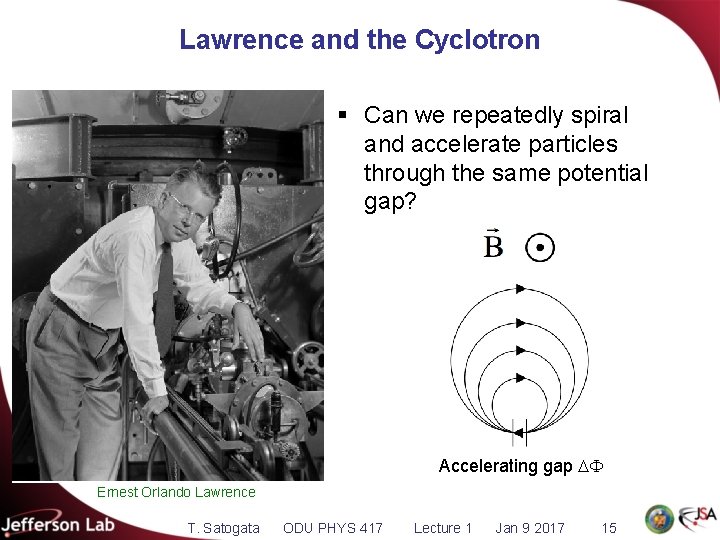
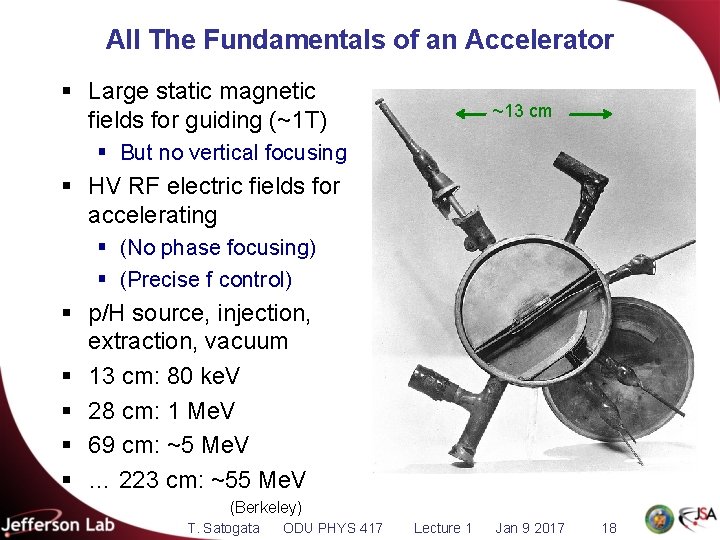
Lawrence and the Cyclotron § Can we repeatedly spiral and accelerate particles through the same potential gap? Accelerating gap DF Ernest Orlando Lawrence T. Satogata ODU PHYS 417 Lecture 1 Jan 9 2017 15
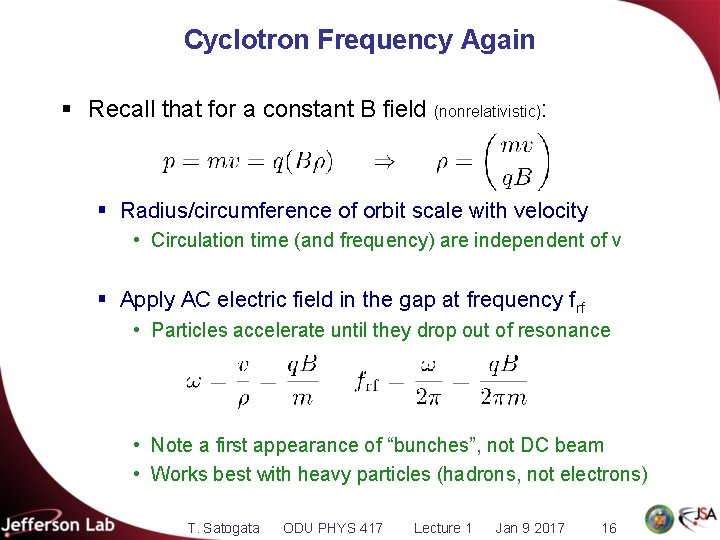
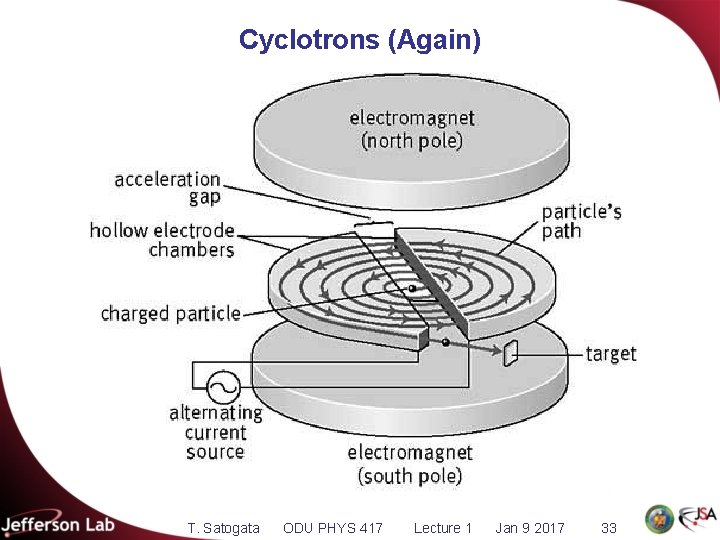
Cyclotron Frequency Again § Recall that for a constant B field (nonrelativistic): § Radius/circumference of orbit scale with velocity • Circulation time (and frequency) are independent of v § Apply AC electric field in the gap at frequency frf • Particles accelerate until they drop out of resonance • Note a first appearance of “bunches”, not DC beam • Works best with heavy particles (hadrons, not electrons) T. Satogata ODU PHYS 417 Lecture 1 Jan 9 2017 16
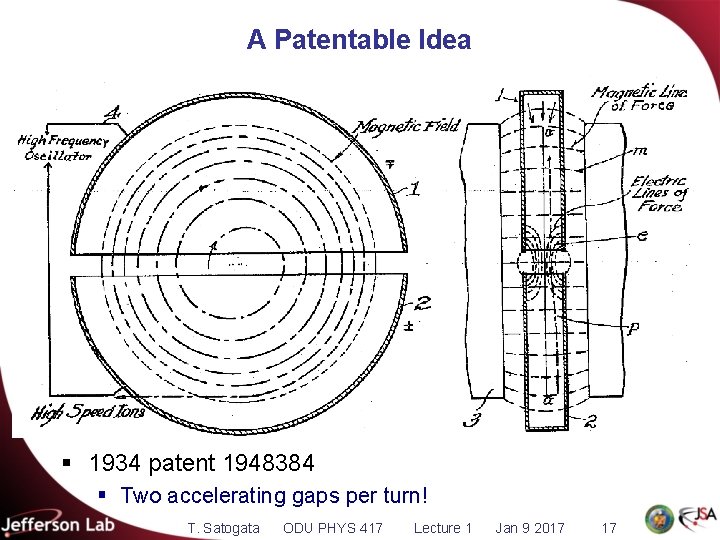
A Patentable Idea § 1934 patent 1948384 § Two accelerating gaps per turn! T. Satogata ODU PHYS 417 Lecture 1 Jan 9 2017 17
All The Fundamentals of an Accelerator § Large static magnetic fields for guiding (~1 T) ~13 cm § But no vertical focusing § HV RF electric fields for accelerating § (No phase focusing) § (Precise f control) § p/H source, injection, extraction, vacuum § 13 cm: 80 ke. V § 28 cm: 1 Me. V § 69 cm: ~5 Me. V § … 223 cm: ~55 Me. V (Berkeley) T. Satogata ODU PHYS 417 Lecture 1 Jan 9 2017 18
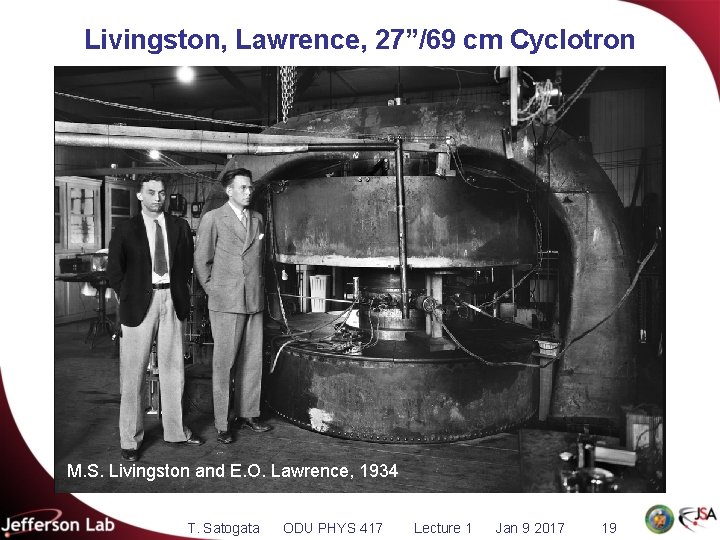
Livingston, Lawrence, 27”/69 cm Cyclotron M. S. Livingston and E. O. Lawrence, 1934 T. Satogata ODU PHYS 417 Lecture 1 Jan 9 2017 19
The Joy of Physics § Describing the events of January 9, 1932, Livingston is quoted saying: “I recall the day when I had adjusted the oscillator to a new high frequency, and, with Lawrence looking over my shoulder, tuned the magnet through resonance. As the galvanometer spot swung across the scale, indicating that protons of 1 -Me. V energy were reaching the collector, Lawrence literally danced around the room with glee. The news quickly spread through the Berkeley laboratory, and we were busy all that day demonstrating million-volt protons to eager viewers. ” APS Physics History, Ernest Lawrence and M. Stanley Livingston T. Satogata ODU PHYS 417 Lecture 1 Jan 9 2017 20
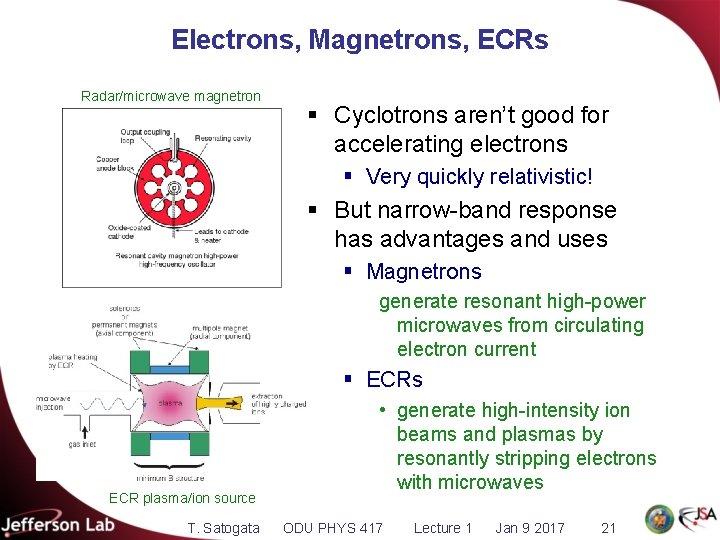
Electrons, Magnetrons, ECRs Radar/microwave magnetron § Cyclotrons aren’t good for accelerating electrons § Very quickly relativistic! § But narrow-band response has advantages and uses § Magnetrons generate resonant high-power microwaves from circulating electron current § ECRs ECR plasma/ion source T. Satogata • generate high-intensity ion beams and plasmas by resonantly stripping electrons with microwaves ODU PHYS 417 Lecture 1 Jan 9 2017 21
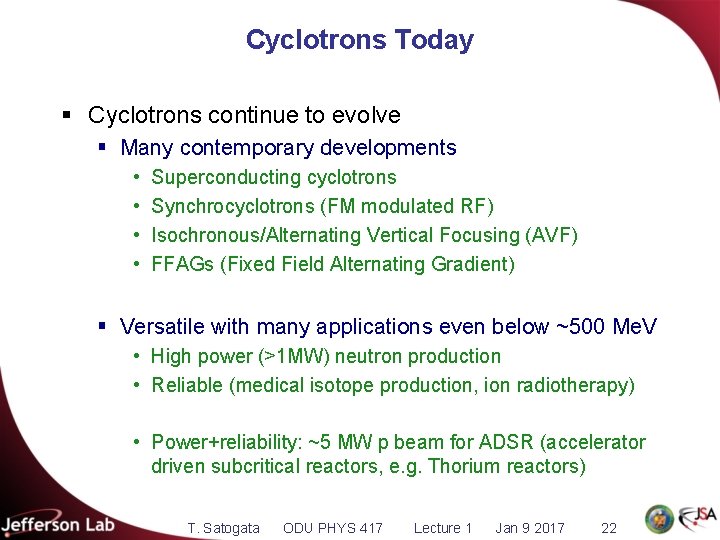
Cyclotrons Today § Cyclotrons continue to evolve § Many contemporary developments • • Superconducting cyclotrons Synchrocyclotrons (FM modulated RF) Isochronous/Alternating Vertical Focusing (AVF) FFAGs (Fixed Field Alternating Gradient) § Versatile with many applications even below ~500 Me. V • High power (>1 MW) neutron production • Reliable (medical isotope production, ion radiotherapy) • Power+reliability: ~5 MW p beam for ADSR (accelerator driven subcritical reactors, e. g. Thorium reactors) T. Satogata ODU PHYS 417 Lecture 1 Jan 9 2017 22
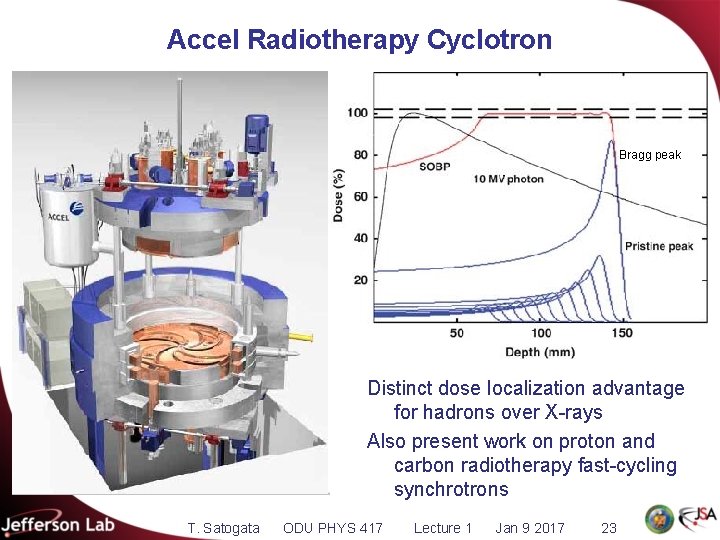
Accel Radiotherapy Cyclotron Bragg peak Distinct dose localization advantage for hadrons over X-rays Also present work on proton and carbon radiotherapy fast-cycling synchrotrons T. Satogata ODU PHYS 417 Lecture 1 Jan 9 2017 23
(Brief) Survey of Accelerator Concepts § § Producing accelerating gaps and fields (DC/AC) Microtrons and their descendants Betatrons (and betatron motion) Synchrotrons § Fixed Target Experiments § Colliders and Luminosity (Livingston Plots) § Light Sources (FELs, Compton Sources) § Others include § Medical Applications (radiotherapy, isotope production) § Spallation Sources (SNS, ESS) § Power Production (ADSR) T. Satogata ODU PHYS 417 Lecture 1 Jan 9 2017 24
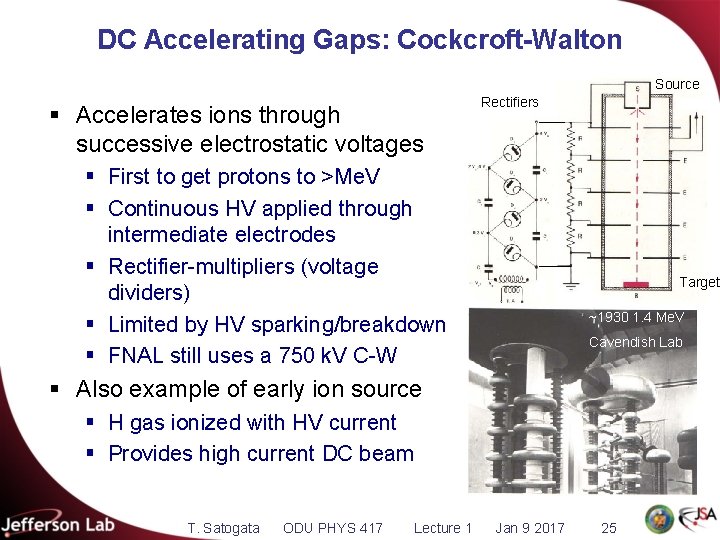
DC Accelerating Gaps: Cockcroft-Walton Source § Accelerates ions through successive electrostatic voltages Rectifiers § First to get protons to >Me. V § Continuous HV applied through intermediate electrodes § Rectifier-multipliers (voltage dividers) § Limited by HV sparking/breakdown § FNAL still uses a 750 k. V C-W Target ~1930 1. 4 Me. V Cavendish Lab § Also example of early ion source § H gas ionized with HV current § Provides high current DC beam T. Satogata ODU PHYS 417 Lecture 1 Jan 9 2017 25
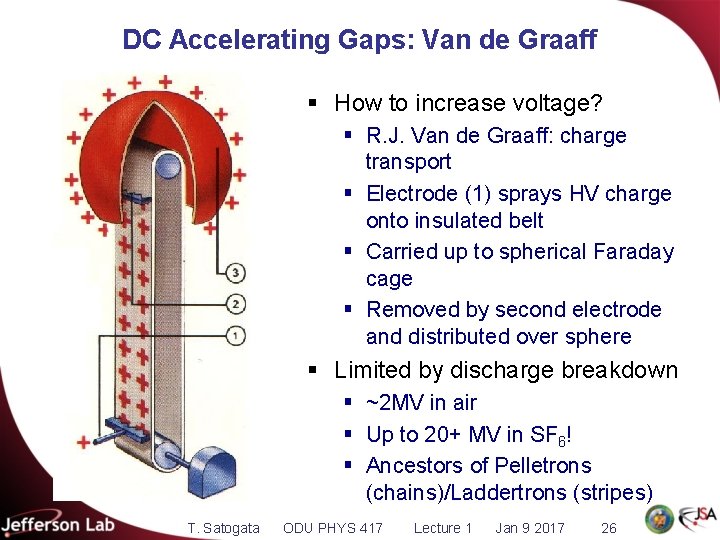
DC Accelerating Gaps: Van de Graaff § How to increase voltage? § R. J. Van de Graaff: charge transport § Electrode (1) sprays HV charge onto insulated belt § Carried up to spherical Faraday cage § Removed by second electrode and distributed over sphere § Limited by discharge breakdown § ~2 MV in air § Up to 20+ MV in SF 6! § Ancestors of Pelletrons (chains)/Laddertrons (stripes) T. Satogata ODU PHYS 417 Lecture 1 Jan 9 2017 26
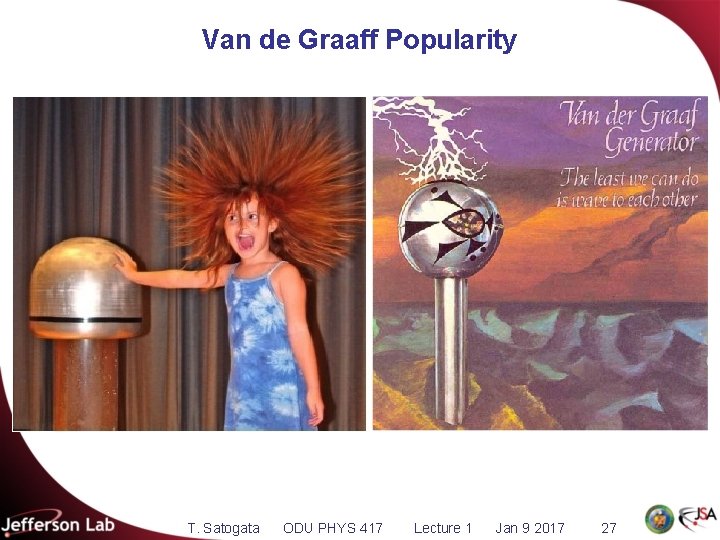
Van de Graaff Popularity T. Satogata ODU PHYS 417 Lecture 1 Jan 9 2017 27
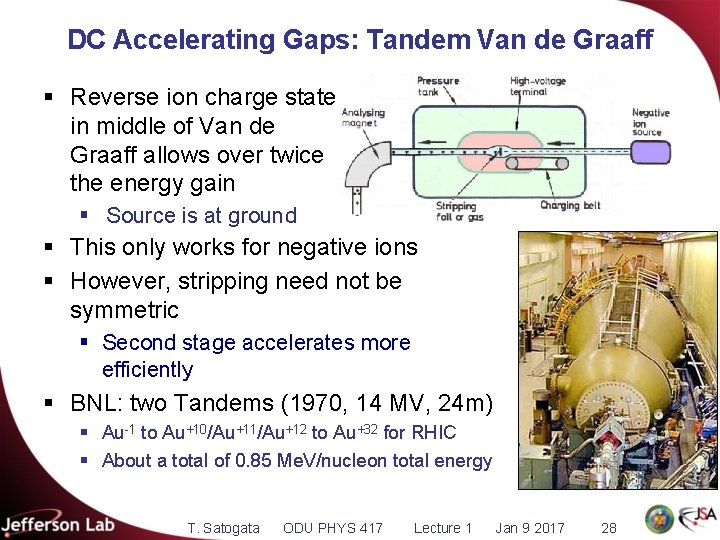
DC Accelerating Gaps: Tandem Van de Graaff § Reverse ion charge state in middle of Van de Graaff allows over twice the energy gain § Source is at ground § This only works for negative ions § However, stripping need not be symmetric § Second stage accelerates more efficiently § BNL: two Tandems (1970, 14 MV, 24 m) § Au-1 to Au+10/Au+11/Au+12 to Au+32 for RHIC § About a total of 0. 85 Me. V/nucleon total energy T. Satogata ODU PHYS 417 Lecture 1 Jan 9 2017 28
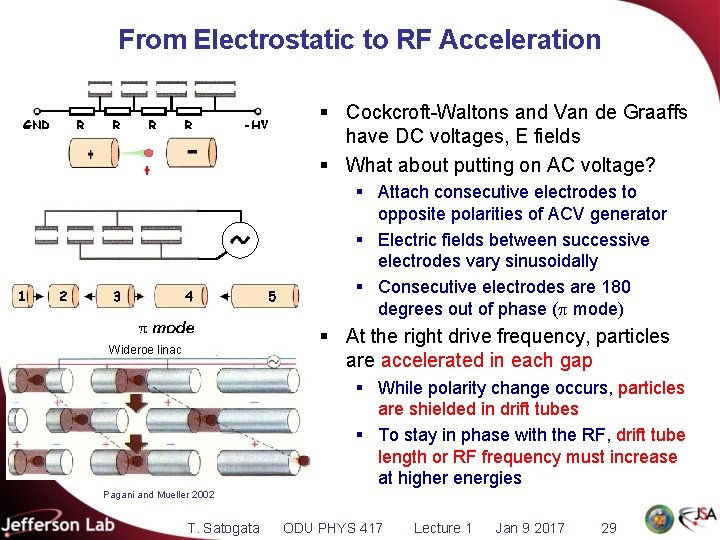
From Electrostatic to RF Acceleration § Cockcroft-Waltons and Van de Graaffs have DC voltages, E fields § What about putting on AC voltage? § Attach consecutive electrodes to opposite polarities of ACV generator § Electric fields between successive electrodes vary sinusoidally § Consecutive electrodes are 180 degrees out of phase ( mode) § At the right drive frequency, particles are accelerated in each gap Wideroe linac § While polarity change occurs, particles are shielded in drift tubes § To stay in phase with the RF, drift tube length or RF frequency must increase at higher energies Pagani and Mueller 2002 T. Satogata ODU PHYS 417 Lecture 1 Jan 9 2017 29
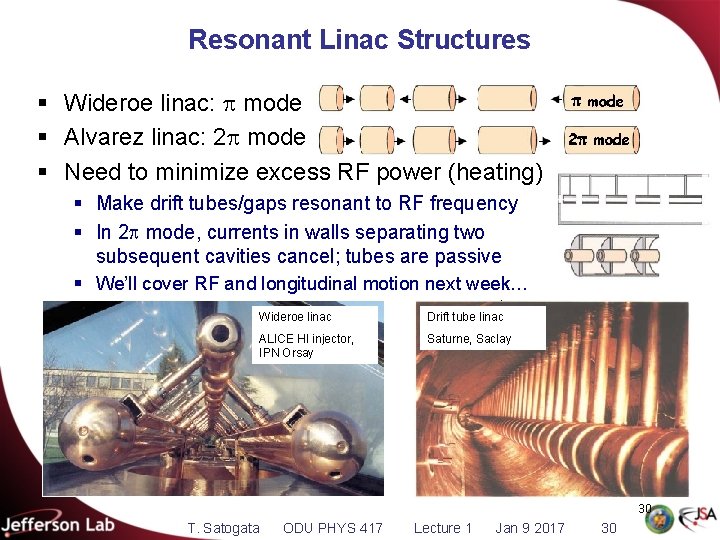
Resonant Linac Structures § Wideroe linac: mode § Alvarez linac: 2 mode § Need to minimize excess RF power (heating) § Make drift tubes/gaps resonant to RF frequency § In 2 mode, currents in walls separating two subsequent cavities cancel; tubes are passive § We’ll cover RF and longitudinal motion next week… Wideroe linac Drift tube linac ALICE HI injector, IPN Orsay Saturne, Saclay 30 T. Satogata ODU PHYS 417 Lecture 1 Jan 9 2017 30
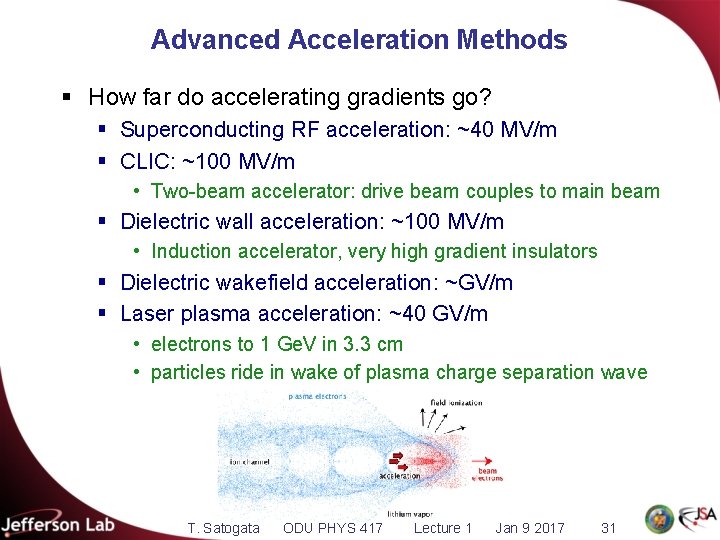
Advanced Acceleration Methods § How far do accelerating gradients go? § Superconducting RF acceleration: ~40 MV/m § CLIC: ~100 MV/m • Two-beam accelerator: drive beam couples to main beam § Dielectric wall acceleration: ~100 MV/m • Induction accelerator, very high gradient insulators § Dielectric wakefield acceleration: ~GV/m § Laser plasma acceleration: ~40 GV/m • electrons to 1 Ge. V in 3. 3 cm • particles ride in wake of plasma charge separation wave T. Satogata ODU PHYS 417 Lecture 1 Jan 9 2017 31
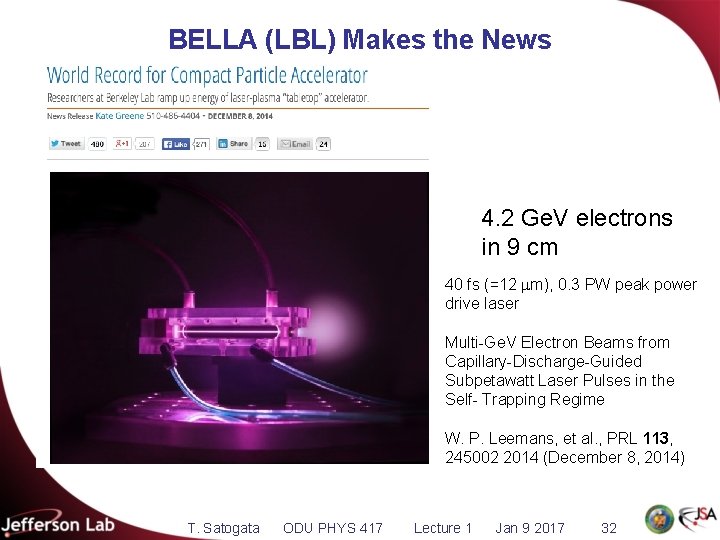
BELLA (LBL) Makes the News 4. 2 Ge. V electrons in 9 cm 40 fs (=12 mm), 0. 3 PW peak power drive laser Multi-Ge. V Electron Beams from Capillary-Discharge-Guided Subpetawatt Laser Pulses in the Self- Trapping Regime W. P. Leemans, et al. , PRL 113, 245002 2014 (December 8, 2014) T. Satogata ODU PHYS 417 Lecture 1 Jan 9 2017 32
Cyclotrons (Again) T. Satogata ODU PHYS 417 Lecture 1 Jan 9 2017 33
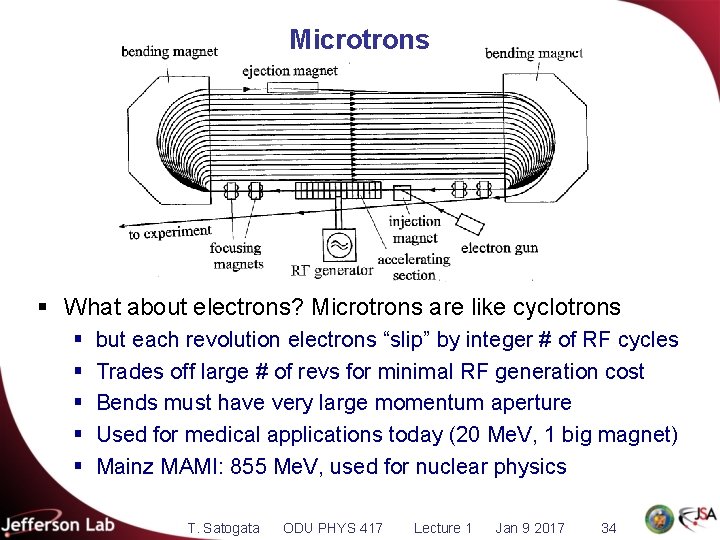
Microtrons § What about electrons? Microtrons are like cyclotrons § § § but each revolution electrons “slip” by integer # of RF cycles Trades off large # of revs for minimal RF generation cost Bends must have very large momentum aperture Used for medical applications today (20 Me. V, 1 big magnet) Mainz MAMI: 855 Me. V, used for nuclear physics T. Satogata ODU PHYS 417 Lecture 1 Jan 9 2017 34
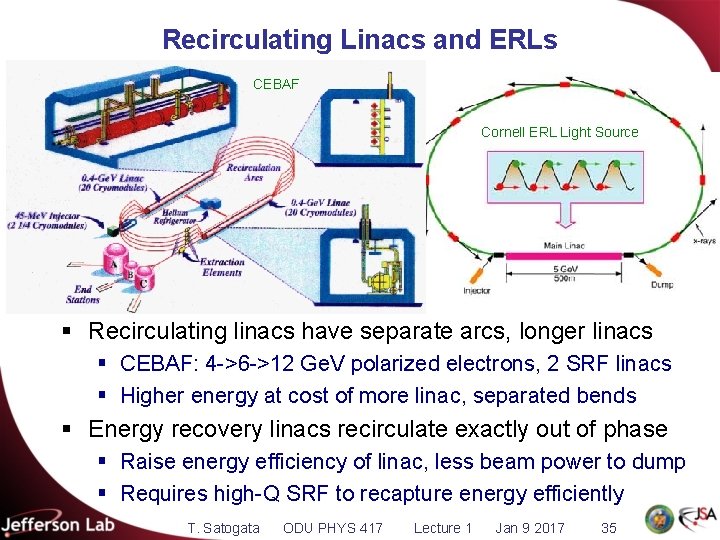
Recirculating Linacs and ERLs CEBAF Cornell ERL Light Source § Recirculating linacs have separate arcs, longer linacs § CEBAF: 4 ->6 ->12 Ge. V polarized electrons, 2 SRF linacs § Higher energy at cost of more linac, separated bends § Energy recovery linacs recirculate exactly out of phase § Raise energy efficiency of linac, less beam power to dump § Requires high-Q SRF to recapture energy efficiently T. Satogata ODU PHYS 417 Lecture 1 Jan 9 2017 35
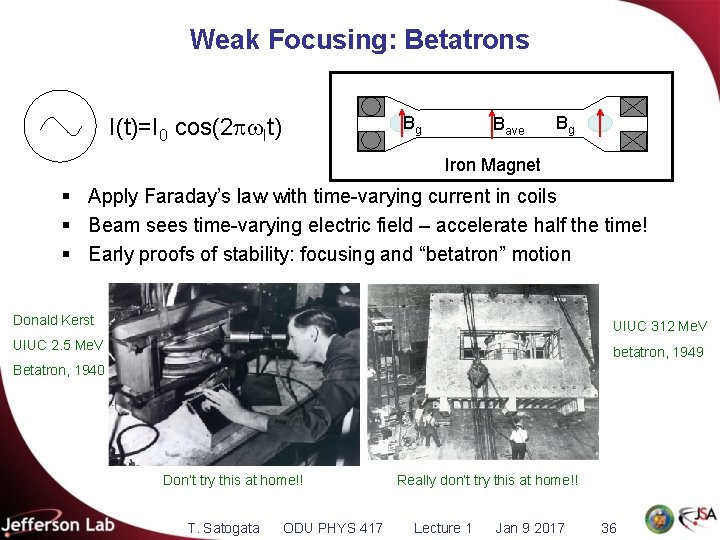
Weak Focusing: Betatrons Bg I(t)=I 0 cos(2 It) Bave Bg Iron Magnet § Apply Faraday’s law with time-varying current in coils § Beam sees time-varying electric field – accelerate half the time! § Early proofs of stability: focusing and “betatron” motion Donald Kerst UIUC 312 Me. V UIUC 2. 5 Me. V betatron, 1949 Betatron, 1940 Don’t try this at home!! T. Satogata ODU PHYS 417 Really don’t try this at home!! Lecture 1 Jan 9 2017 36
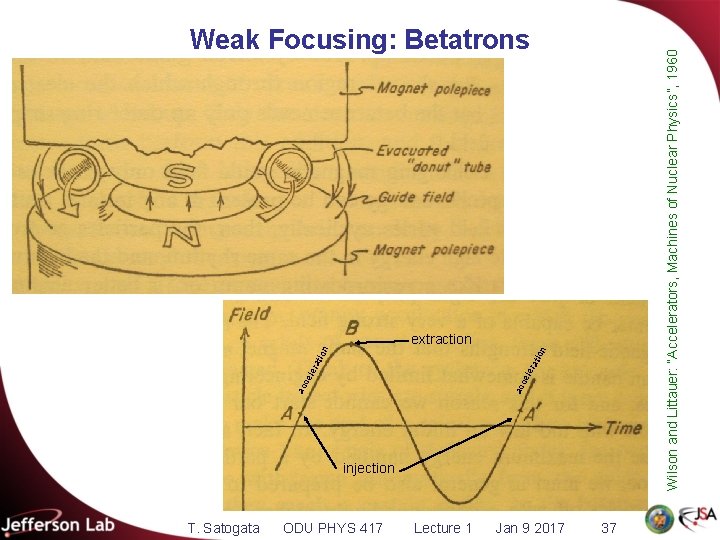
T. Satogata ion extraction injection ODU PHYS 417 Lecture 1 Jan 9 2017 Wilson and Littauer: “Accelerators, Machines of Nuclear Physics”, 1960 rat ce le ac ce ler at ac Weak Focusing: Betatrons 37
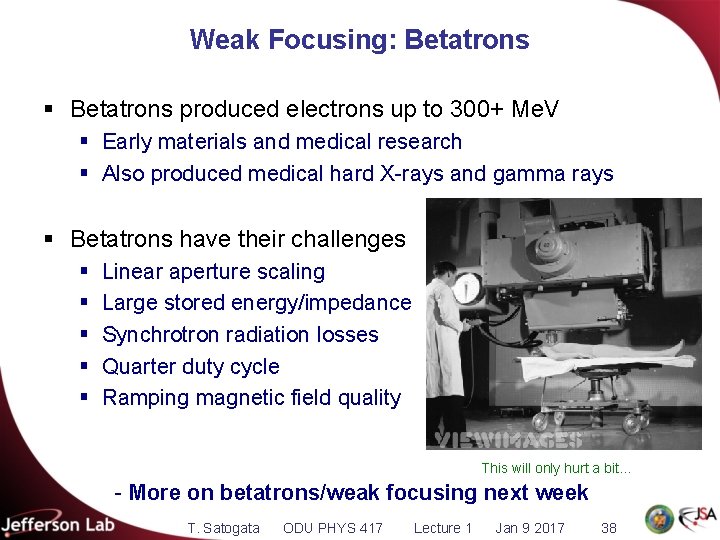
Weak Focusing: Betatrons § Betatrons produced electrons up to 300+ Me. V § Early materials and medical research § Also produced medical hard X-rays and gamma rays § Betatrons have their challenges § § § Linear aperture scaling Large stored energy/impedance Synchrotron radiation losses Quarter duty cycle Ramping magnetic field quality This will only hurt a bit… - More on betatrons/weak focusing next week T. Satogata ODU PHYS 417 Lecture 1 Jan 9 2017 38
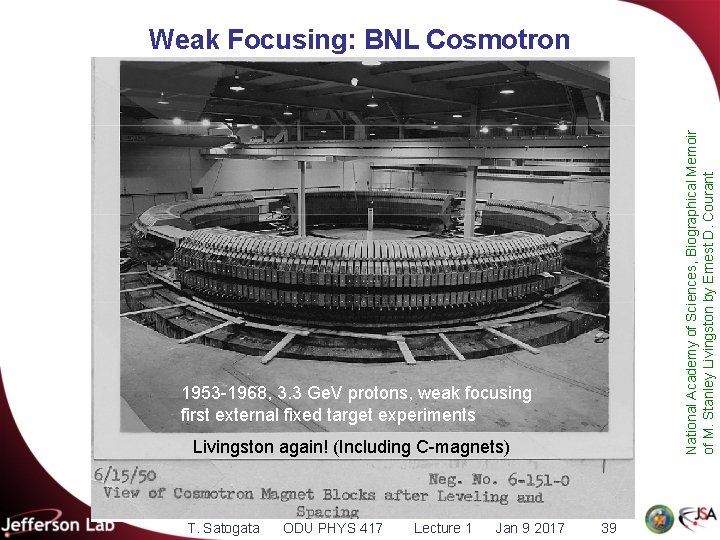
National Academy of Sciences, Biographical Memoir of M. Stanley Livingston by Ernest D. Courant Weak Focusing: BNL Cosmotron 1953 -1968, 3. 3 Ge. V protons, weak focusing first external fixed target experiments Livingston again! (Including C-magnets) T. Satogata ODU PHYS 417 Lecture 1 Jan 9 2017 39
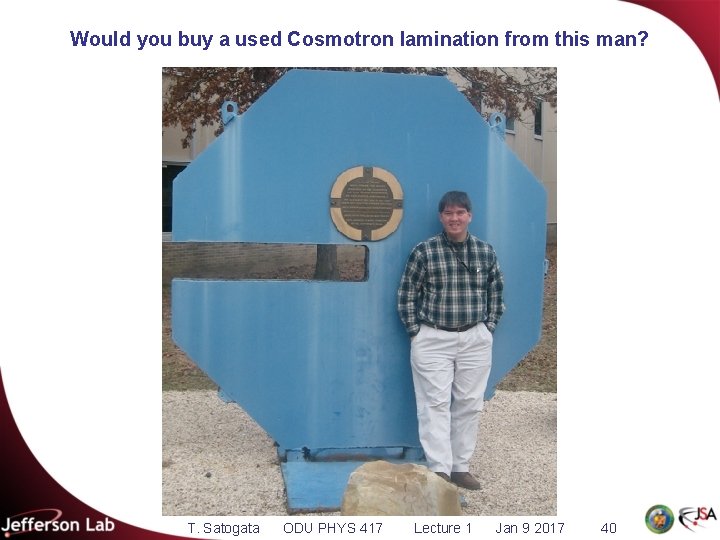
Would you buy a used Cosmotron lamination from this man? T. Satogata ODU PHYS 417 Lecture 1 Jan 9 2017 40
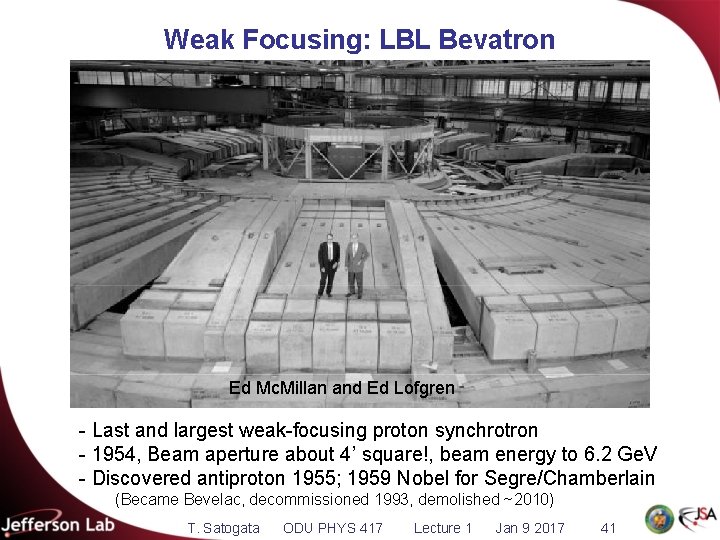
Weak Focusing: LBL Bevatron Ed Mc. Millan and Ed Lofgren - Last and largest weak-focusing proton synchrotron - 1954, Beam aperture about 4’ square!, beam energy to 6. 2 Ge. V - Discovered antiproton 1955; 1959 Nobel for Segre/Chamberlain (Became Bevelac, decommissioned 1993, demolished ~2010) T. Satogata ODU PHYS 417 Lecture 1 Jan 9 2017 41
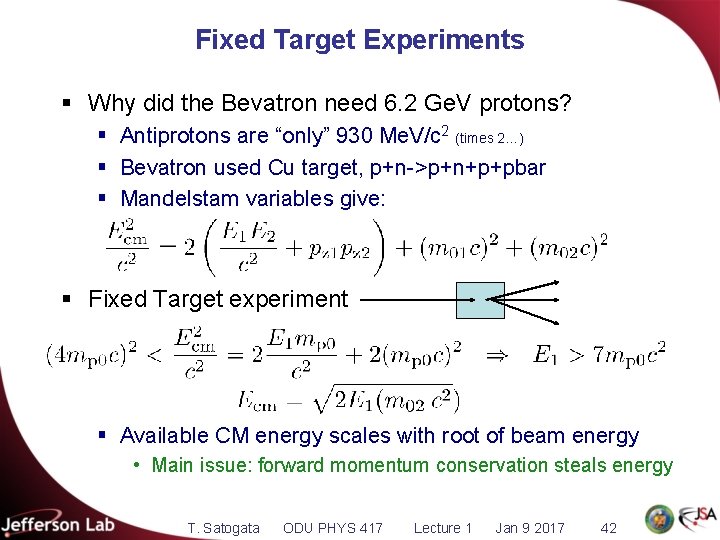
Fixed Target Experiments § Why did the Bevatron need 6. 2 Ge. V protons? § Antiprotons are “only” 930 Me. V/c 2 (times 2…) § Bevatron used Cu target, p+n->p+n+p+pbar § Mandelstam variables give: § Fixed Target experiment § Available CM energy scales with root of beam energy • Main issue: forward momentum conservation steals energy T. Satogata ODU PHYS 417 Lecture 1 Jan 9 2017 42
Two Serious Problems § These machines were getting way too big § Bevatron magnet was 10, 000 tons § Apertures scale linearly with machine size, energy (Length/circumference scales linearly with energy at fixed field strength too…) § Fixed target energy scaling is painful § Available CM energy only scales with √Ebeam § Accelerator size grew with the square of desired CM energy § Something had to be done!!! Strong Focusing (1952) and Colliders (1958 -62 ish) to the rescue!!! T. Satogata ODU PHYS 417 Lecture 1 Jan 9 2017 43
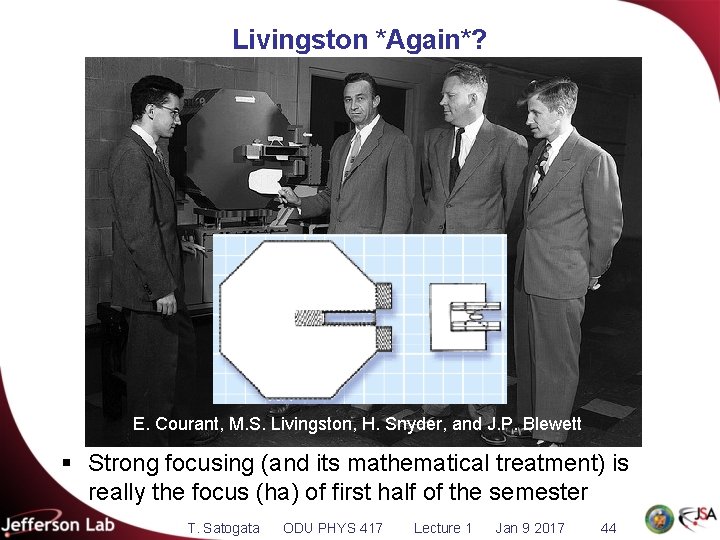
Livingston *Again*? E. Courant, M. S. Livingston, H. Snyder, and J. P. Blewett § Strong focusing (and its mathematical treatment) is really the focus (ha) of first half of the semester T. Satogata ODU PHYS 417 Lecture 1 Jan 9 2017 44
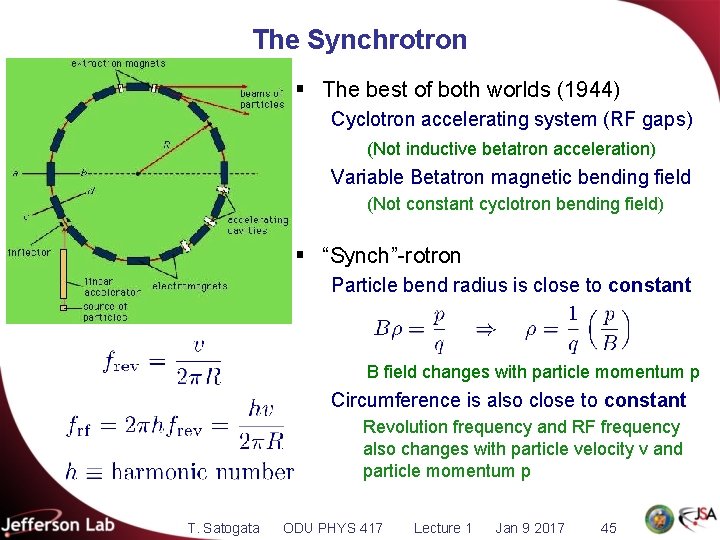
The Synchrotron § The best of both worlds (1944) Cyclotron accelerating system (RF gaps) (Not inductive betatron acceleration) Variable Betatron magnetic bending field (Not constant cyclotron bending field) § “Synch”-rotron Particle bend radius is close to constant B field changes with particle momentum p Circumference is also close to constant Revolution frequency and RF frequency also changes with particle velocity v and particle momentum p T. Satogata ODU PHYS 417 Lecture 1 Jan 9 2017 45
Why is this such a big deal? § The big deal is that both existing technologies scaled very badly with particle energy § Betatrons: central induction magnet area (flux) scales quadratically with accelerator radius (energy); beam size also scales badly § Cyclotrons: main magnet scales quadratically with energy radius (energy); problems with relativistic hadrons § (High gradient linacs weren’t quite developed yet) § Large, high-energy accelerator cost was completely dominated by scaling of large magnets § The synchrotron permitted the decoupling of peak accelerator energy and magnetic field apertures § Higher energies required more magnets (linear scaling) but not larger aperture magnets (quadratic scaling, or worse) T. Satogata ODU PHYS 417 Lecture 1 Jan 9 2017 46
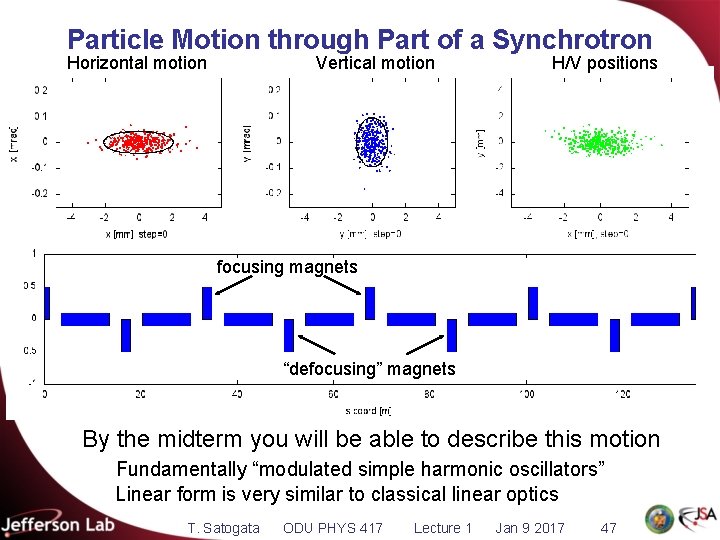
Particle Motion through Part of a Synchrotron Horizontal motion Vertical motion H/V positions focusing magnets “defocusing” magnets By the midterm you will be able to describe this motion Fundamentally “modulated simple harmonic oscillators” Linear form is very similar to classical linear optics T. Satogata ODU PHYS 417 Lecture 1 Jan 9 2017 47