
Introduction to Accelerator Beam Diagnostics Dr Peter Forck
Introduction to Accelerator Beam Diagnostics Dr. Peter Forck Gesellschaft für Schwerionenforschnung (GSI) & University Frankfurt, Germany Peter Forck, Nathiagali Summer College 2013 Demands for Beam Diagnostics L. Groening, Sept. GSI-Palaver, Dec. 15 th, 10 th, 2003, A dedicated proton accelerator for 1 p-physics at the future GSI facilities
Demands on Beam Diagnostics is the ’organ of sense’ for the beam. It deals with real beams in real technical installations including all imperfections. Four types of demands leads to different installations: Ø Quick, non-destructive measurements leading to a single number or simple plots. Used as a check for online information. Reliable technologies have to be used. Example: Current measurement by transformers. Ø Instruments for daily check, malfunction diagnosis and wanted parameter variation. Example: Profile measurement, in many cases ‘intercepting’ i. e destructive to the beam Ø Complex instruments for severe malfunctions, accelerator commissioning & development. The instrumentation might be destructive and complex. Example: determination of lattice functions at a synchrotron, e. g. tune Ø Instruments for automatic, active beam control. Example: Closed orbit feedback using position measurement by BPMs. Non-destructive (’non-intercepting’) methods are preferred: Ø The beam is not influenced Ø The instrument is not destroyed. Peter Forck, Nathiagali Summer College 2013 Demands for Beam Diagnostics L. Groening, Sept. GSI-Palaver, Dec. 15 th, 10 th, 2003, A dedicated proton accelerator for 2 p-physics at the future GSI facilities
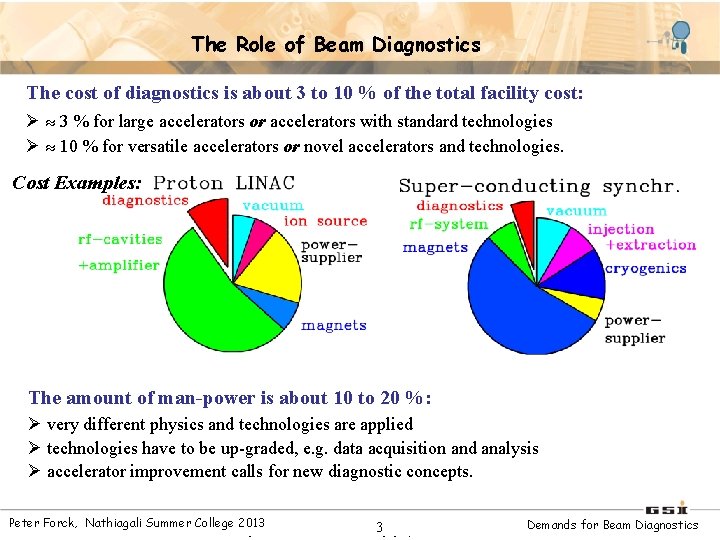
The Role of Beam Diagnostics The cost of diagnostics is about 3 to 10 % of the total facility cost: Ø 3 % for large accelerators or accelerators with standard technologies Ø 10 % for versatile accelerators or novel accelerators and technologies. Cost Examples: The amount of man-power is about 10 to 20 %: Ø very different physics and technologies are applied Ø technologies have to be up-graded, e. g. data acquisition and analysis Ø accelerator improvement calls for new diagnostic concepts. Peter Forck, Nathiagali Summer College 2013 Demands for Beam Diagnostics L. Groening, Sept. GSI-Palaver, Dec. 15 th, 10 th, 2003, A dedicated proton accelerator for 3 p-physics at the future GSI facilities
Relevant physical Processes for Beam Diagnostics ØElectro-magnetic influence by moving charges Physics: classical electro-dynamics Technology: voltage & current meas. , low & high frequencies Examples: Faraday cups, beam transformers, pick-ups ØEmission of photon by accelerated charges: (only for high relativistic electrons and p) Physics: classical electro-dynamics; Technology: optical techniques (from visible to x-ray) Example: Synchrotron radiation monitors ØInteraction of particles with photons Physics: atomic physics optics, lasers; Technology: optical techniques, particle detectors Examples: laser scanners, short bunch length measurement, polarimeters ØCoulomb interaction of charged particles with matter Physics: atomic & solid state physics; Technology: current meas. , optics, particle detectors Examples: scintillators, viewing screens, ionization chambers, residual gas monitors ØNuclear- or elementary particle physics interactions Physics: nuclear physics; Technology: particle detectors Examples: beam loss monitors, polarimeters, luminosity monitors ØAnd of cause accelerator physics for proper instrumentation layout. Beam diagnostics deals with the full spectrum of physics and technology, this calls for experts on all these fields and is a challenging task! Peter Forck, Nathiagali Summer College 2013 Demands for Beam Diagnostics L. Groening, Sept. GSI-Palaver, Dec. 15 th, 10 th, 2003, A dedicated proton accelerator for 4 p-physics at the future GSI facilities
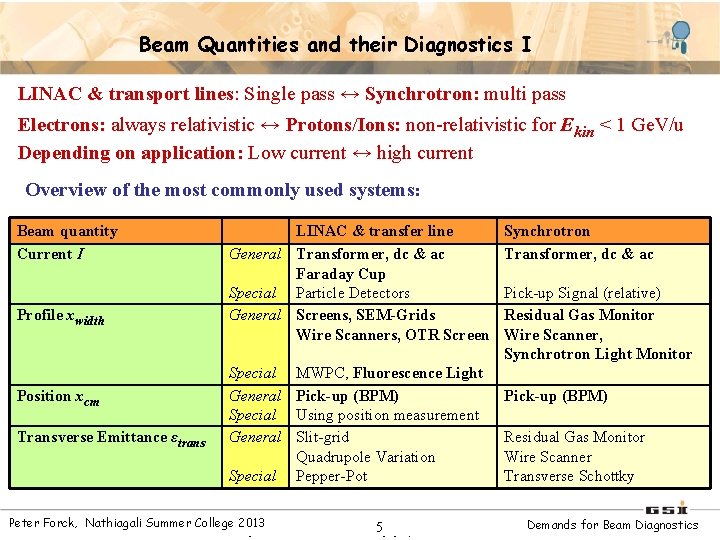
Beam Quantities and their Diagnostics I LINAC & transport lines: Single pass ↔ Synchrotron: multi pass Electrons: always relativistic ↔ Protons/Ions: non-relativistic for Ekin < 1 Ge. V/u Depending on application: Low current ↔ high current Overview of the most commonly used systems: Beam quantity Current I Profile xwidth Position xcm Transverse Emittance εtrans LINAC & transfer line General Transformer, dc & ac Faraday Cup Special Particle Detectors General Screens, SEM-Grids Wire Scanners, OTR Screen Special General Special MWPC, Fluorescence Light Pick-up (BPM) Using position measurement Slit-grid Quadrupole Variation Pepper-Pot Synchrotron Transformer, dc & ac Pick-up Signal (relative) Residual Gas Monitor Wire Scanner, Synchrotron Light Monitor Pick-up (BPM) Residual Gas Monitor Wire Scanner Transverse Schottky Peter Forck, Nathiagali Summer College 2013 Demands for Beam Diagnostics L. Groening, Sept. GSI-Palaver, Dec. 15 th, 10 th, 2003, A dedicated proton accelerator for 5 p-physics at the future GSI facilities
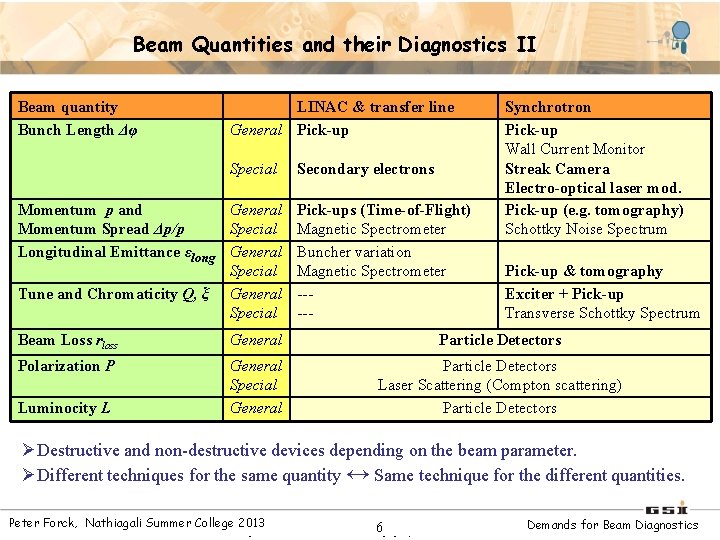
Beam Quantities and their Diagnostics II Beam quantity Bunch Length Δφ LINAC & transfer line General Pick-up Special Secondary electrons Momentum p and General Pick-ups (Time-of-Flight) Momentum Spread Δp/p Special Magnetic Spectrometer Longitudinal Emittance εlong General Buncher variation Special Magnetic Spectrometer Tune and Chromaticity Q, ξ General --Special --- Synchrotron Pick-up Wall Current Monitor Streak Camera Electro-optical laser mod. Pick-up (e. g. tomography) Schottky Noise Spectrum Pick-up & tomography Exciter + Pick-up Transverse Schottky Spectrum Beam Loss rloss General Particle Detectors Polarization P General Special General Particle Detectors Laser Scattering (Compton scattering) Particle Detectors Luminocity L ØDestructive and non-destructive devices depending on the beam parameter. ØDifferent techniques for the same quantity ↔ Same technique for the different quantities. Peter Forck, Nathiagali Summer College 2013 Demands for Beam Diagnostics L. Groening, Sept. GSI-Palaver, Dec. 15 th, 10 th, 2003, A dedicated proton accelerator for 6 p-physics at the future GSI facilities
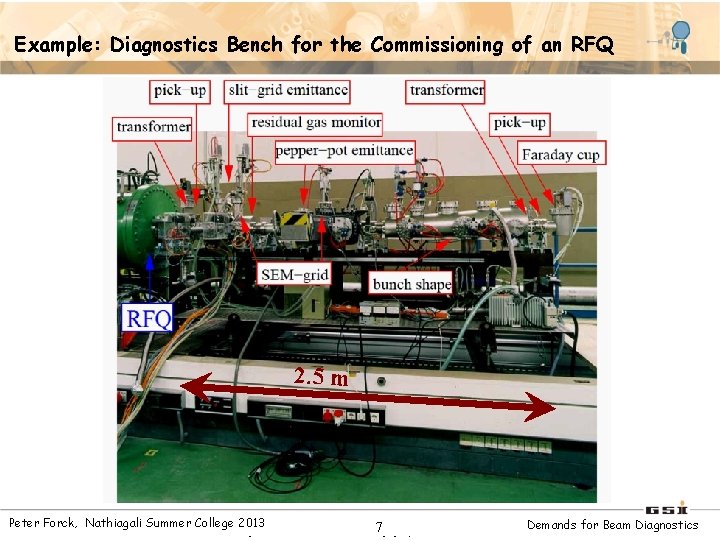
Example: Diagnostics Bench for the Commissioning of an RFQ 2. 5 m Peter Forck, Nathiagali Summer College 2013 Demands for Beam Diagnostics L. Groening, Sept. GSI-Palaver, Dec. 15 th, 10 th, 2003, A dedicated proton accelerator for 7 p-physics at the future GSI facilities

Typical Installation of a Diagnostics Device Modern trend: High performance ADC & digital signal processing → action of the beam to the detector accelerator tunnel: → low noise pre-amplifier and first signal shaping → analog treatment, partly combining other parameters local electronics room: → digitalization, data bus systems (GPIB, VME, c. PCI. . . ) → visualization and storage on PC control room: → parameter setting of the beam and the instruments Peter Forck, Nathiagali Summer College 2013 Demands for Beam Diagnostics L. Groening, Sept. GSI-Palaver, Dec. 15 th, 10 th, 2003, A dedicated proton accelerator for 8 p-physics at the future GSI facilities
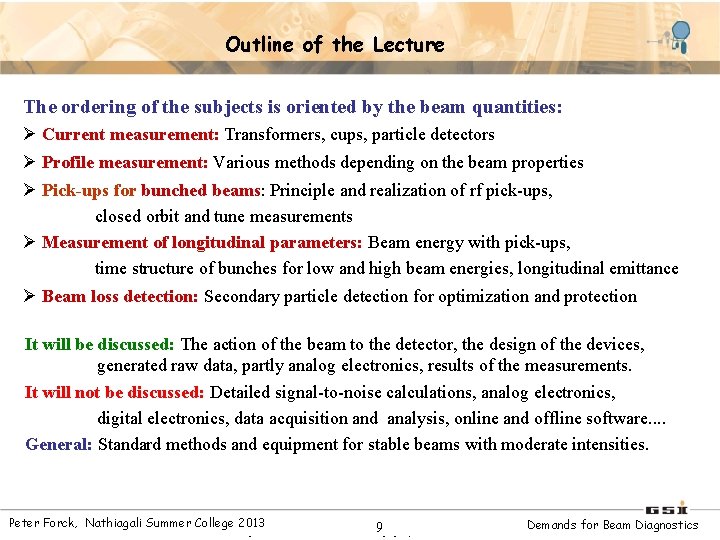
Outline of the Lecture The ordering of the subjects is oriented by the beam quantities: Ø Current measurement: Transformers, cups, particle detectors Ø Profile measurement: Various methods depending on the beam properties Ø Pick-ups for bunched beams: Principle and realization of rf pick-ups, closed orbit and tune measurements Ø Measurement of longitudinal parameters: Beam energy with pick-ups, time structure of bunches for low and high beam energies, longitudinal emittance Ø Beam loss detection: Secondary particle detection for optimization and protection It will be discussed: The action of the beam to the detector, the design of the devices, generated raw data, partly analog electronics, results of the measurements. It will not be discussed: Detailed signal-to-noise calculations, analog electronics, digital electronics, data acquisition and analysis, online and offline software. . General: Standard methods and equipment for stable beams with moderate intensities. Peter Forck, Nathiagali Summer College 2013 Demands for Beam Diagnostics L. Groening, Sept. GSI-Palaver, Dec. 15 th, 10 th, 2003, A dedicated proton accelerator for 9 p-physics at the future GSI facilities
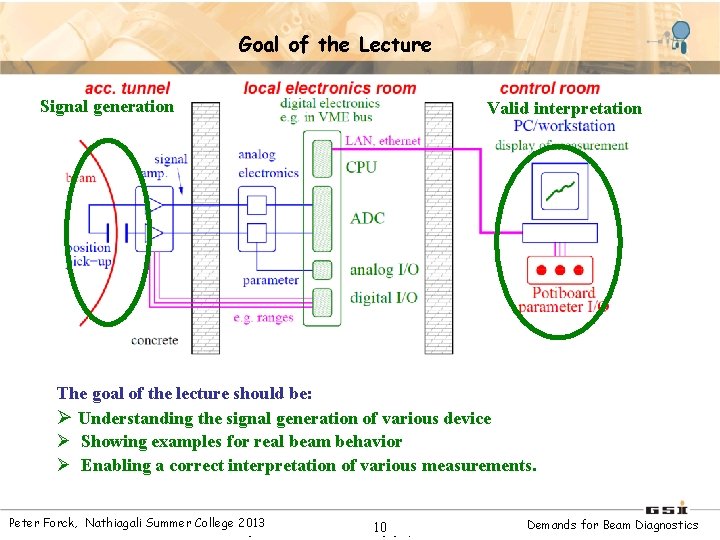
Goal of the Lecture Signal generation Valid interpretation The goal of the lecture should be: Ø Understanding the signal generation of various device Ø Showing examples for real beam behavior Ø Enabling a correct interpretation of various measurements. Peter Forck, Nathiagali Summer College 2013 Demands for Beam Diagnostics L. Groening, Sept. GSI-Palaver, Dec. 15 th, 10 th, 2003, A dedicated proton accelerator for 10 p-physics at the future GSI facilities
Literature on Beam Diagnostics Conferences (with proceedings at www. jacow. org): Ø American: Beam Instrumentation Workshop BIW Ø Europe: Diagnostics and Instrumentation at Part. Acc. Conf. DIPAC Ø now joined as International Beam Instrumentation Conference IBIC Books: ØV. Smaluk, Particle Beam Diagnostics for Accelerators: Instruments and Methods, VDM Verlag Dr. Müller, Saarbrücken 2009. Ø D. Brandt (Ed. ), Beam Diagnostics for Accelerators, Proc. CERN Accelerator School CAS, Dourdan, CERN-2009 -005 (2009) see http: //cas. web. cern. ch/cas/France-2008/Dourdan-after. html. Ø P. Strehl, Beam Instrumentation and Diagnostics, Springer-Verlag, Berlin 2006. Ø H. Koziol, Beam Diagnostic for Accelerators, Proc. CERN Accelerator School CAS, University Jyväskylä, Finland, p. 565 CERN 94 -01 (1994), see http: //cas. web. cern. ch/cas/CAS. Ø J. Bosser (Ed. ), Beam Instrumentation, CERN-PE-ED 001 -92, Rev. 1994. Ø P. Forck, JUAS Lecture Notes on Beam Diagnostics, see www-bd. gsi. de/conf/juas. html. 11 Peter Forck, Nathiagali Summer College 2013 Demands for Beam Diagnostics th 11 L. Groening, Sept. GSI-Palaver, Dec. 15 th, 10 , 2003, A dedicated proton accelerator for p-physics at the future GSI facilities
Appendix: Example of Beam Diagnostics Installations The beam diagnostics installations for two example are presented: Ø Heavy ion LINAC, synchrotron and transport line at GSI Germany Ø Electron LINAC, booster and synchrotron at light source ALBA, Barcelona, Spain 12 Peter Forck, Nathiagali Summer College 2013 Demands for Beam Diagnostics th 12 L. Groening, Sept. GSI-Palaver, Dec. 15 th, 10 , 2003, A dedicated proton accelerator for p-physics at the future GSI facilities
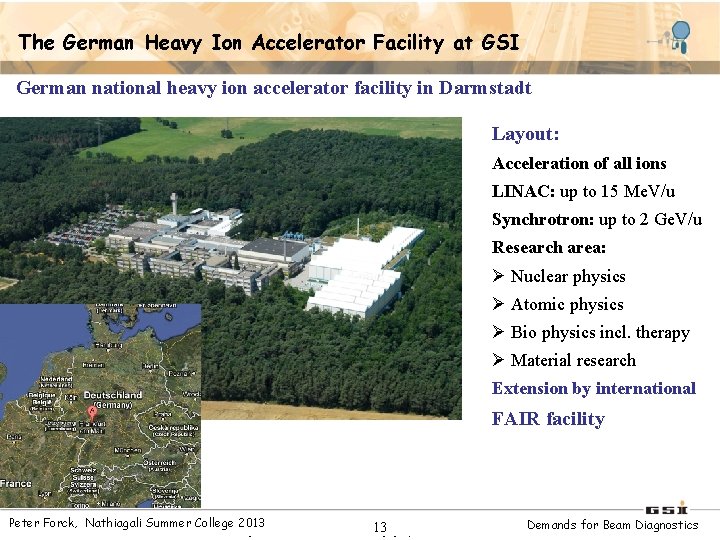
The German Heavy Ion Accelerator Facility at GSI German national heavy ion accelerator facility in Darmstadt Layout: Acceleration of all ions LINAC: up to 15 Me. V/u Synchrotron: up to 2 Ge. V/u Research area: Ø Nuclear physics Ø Atomic physics Ø Bio physics incl. therapy Ø Material research Extension by international FAIR facility Peter Forck, Nathiagali Summer College 2013 Demands for Beam Diagnostics L. Groening, Sept. GSI-Palaver, Dec. 15 th, 10 th, 2003, A dedicated proton accelerator for 13 p-physics at the future GSI facilities
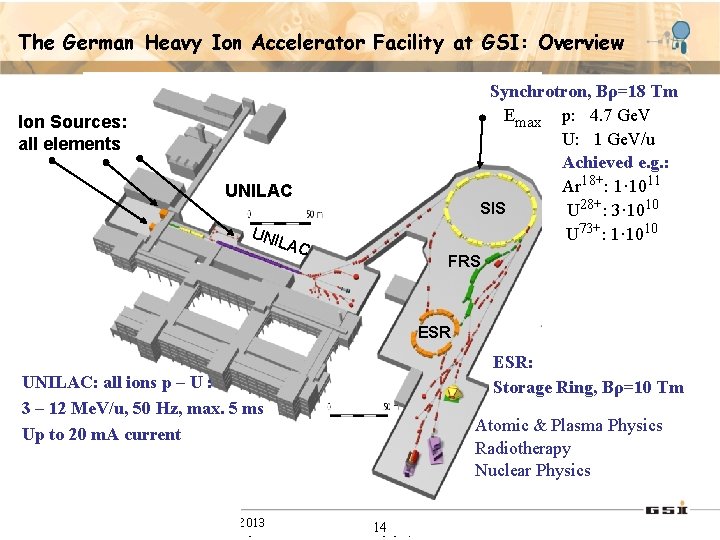
The German Heavy Ion Accelerator Facility at GSI: Overview Synchrotron, Bρ=18 Tm Emax p: 4. 7 Ge. V U: 1 Ge. V/u Achieved e. g. : Ar 18+: 1· 1011 SIS U 28+: 3· 1010 U 73+: 1· 1010 Ion Sources: all elements UNILAC UNI LAC FRS ESR UNILAC: all ions p – U : 3 – 12 Me. V/u, 50 Hz, max. 5 ms Up to 20 m. A current ESR: Storage Ring, Bρ=10 Tm Atomic & Plasma Physics Radiotherapy Nuclear Physics Peter Forck, Nathiagali Summer College 2013 Demands for Beam Diagnostics L. Groening, Sept. GSI-Palaver, Dec. 15 th, 10 th, 2003, A dedicated proton accelerator for 14 p-physics at the future GSI facilities

The German Heavy Ion Accelerator Facility at GSI: Overview Synchrotron: Current: 2 DCCT, 1 ACCT, 1 FCT Ion Sources: all elements UNILAC Profile: 1 SEM-Grid, 1 IPM, 1 Screen Position: 16 BPM Tune, mom. spread: 1 Exciter + BPM 1 Schottky SIS UNI LAC LINAC: Current: 52 transformers, 30 F-Cups Profile: 81 SEM-Grids, 6 BIF Position & phase: 25 BPM Trans. emittance: 9 Slit-Grid, 1 pepper-pot Long. emittance: 3 devices FRS ESR Transport Lines: Current: 8 FCT 15 Part. Detec. Profile: 10 SEM-Grid 26 MWPC 18 Screens Position: 8 BPM Peter Forck, Nathiagali Summer College 2013 Demands for Beam Diagnostics L. Groening, Sept. GSI-Palaver, Dec. 15 th, 10 th, 2003, A dedicated proton accelerator for 15 p-physics at the future GSI facilities
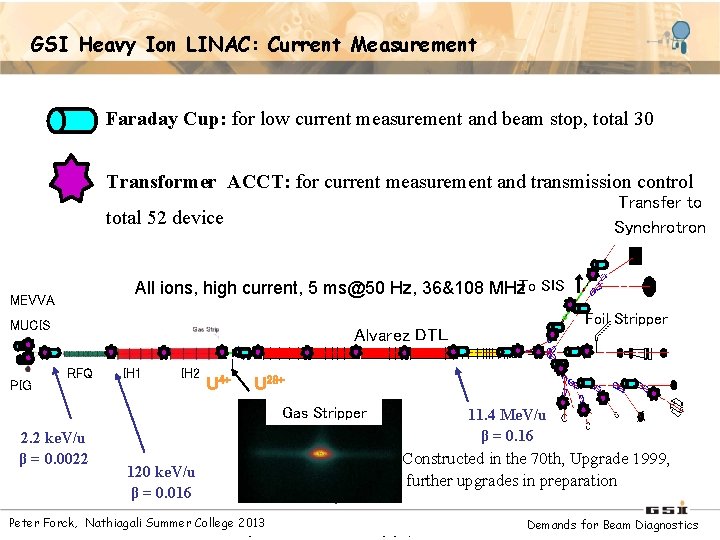
GSI Heavy Ion LINAC: Current Measurement Faraday Cup: for low current measurement and beam stop, total 30 Transformer ACCT: for current measurement and transmission control Transfer to Synchrotron total 52 device HLI: (ECR, RFQ, IH) All ions, high current, 5 ms@50 Hz, 36&108 MHz. To SIS ↑ MEVVA MUCIS PIG Foil Stripper Alvarez DTL RFQ IH 1 IH 2 U 4+ U 28+ Gas Stripper 2. 2 ke. V/u β = 0. 0022 120 ke. V/u β = 0. 016 1. 4 Me. V/u ⇔β = 0. 054 11. 4 Me. V/u β = 0. 16 Constructed in the 70 th, Upgrade 1999, further upgrades in preparation Peter Forck, Nathiagali Summer College 2013 Demands for Beam Diagnostics L. Groening, Sept. GSI-Palaver, Dec. 15 th, 10 th, 2003, A dedicated proton accelerator for p-physics at the future GSI facilities

GSI Heavy Ion Synchrotron: Overview Dipole, quadrupole, rf cavity acceleration Important parameters of SIS-18 Circumference 216 m Circumference Inj. type Multiturn Energy range 11 Me. V → 2 Ge. V Energy range injection 216 m Multiturn Acc. RF 11 Me. V → 2 Ge. V 0. 8 → → 55 MHz 0. 8 Harmonic 4 (= # bunches) Bunching factor 0. 4 → 0. 08 Harmonic 4 (= # bunches) Bunching factor Ramp duration 0. 4 → 0. 06 → 0. 08 1. 5 s Ion range (Z) Ramp duration 1 → 92 to U) 0. 06 →(p 1. 5 s Ion range (Z) 1 → 92 (p to U) extraction Dipole, quadrupole, transfer line Peter Forck, Nathiagali Summer College 2013 Demands for Beam Diagnostics L. Groening, Sept. GSI-Palaver, Dec. 15 th, 10 th, 2003, A dedicated proton accelerator for p-physics at the future GSI facilities
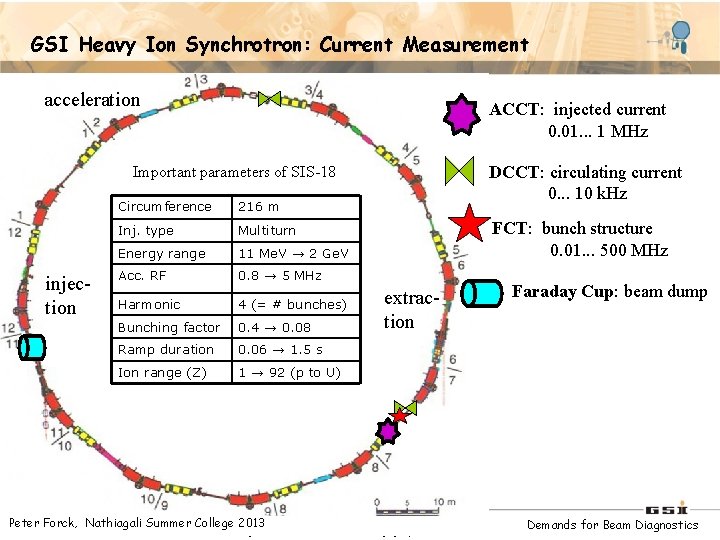
GSI Heavy Ion Synchrotron: Current Measurement acceleration ACCT: injected current 0. 01. . . 1 MHz DCCT: circulating current 0. . . 10 k. Hz Important parameters of SIS-18 injection Circumference 216 m Inj. type Multiturn Energy range 11 Me. V → 2 Ge. V Acc. RF 0. 8 → 5 MHz Harmonic 4 (= # bunches) Bunching factor 0. 4 → 0. 08 Ramp duration 0. 06 → 1. 5 s Ion range (Z) 1 → 92 (p to U) FCT: bunch structure 0. 01. . . 500 MHz extraction Faraday Cup: beam dump Peter Forck, Nathiagali Summer College 2013 Demands for Beam Diagnostics L. Groening, Sept. GSI-Palaver, Dec. 15 th, 10 th, 2003, A dedicated proton accelerator for p-physics at the future GSI facilities
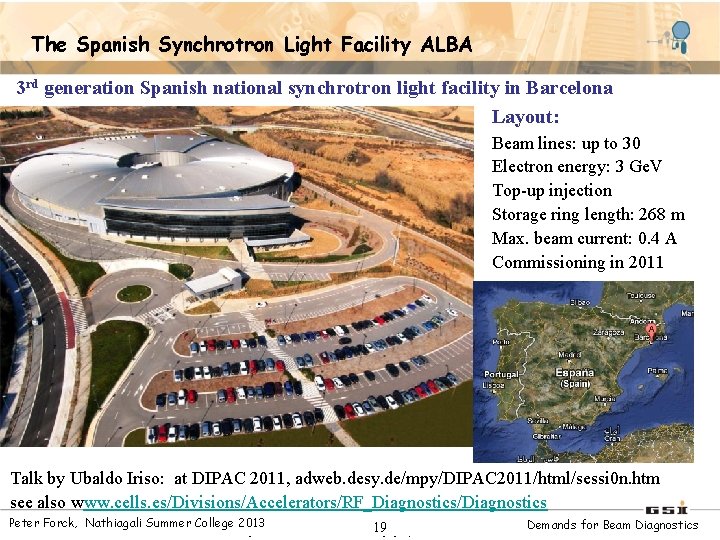
The Spanish Synchrotron Light Facility ALBA 3 rd generation Spanish national synchrotron light facility in Barcelona Layout: Beam lines: up to 30 Electron energy: 3 Ge. V Top-up injection Storage ring length: 268 m Max. beam current: 0. 4 A Commissioning in 2011 Talk by Ubaldo Iriso: at DIPAC 2011, adweb. desy. de/mpy/DIPAC 2011/html/sessi 0 n. htm see also www. cells. es/Divisions/Accelerators/RF_Diagnostics/Diagnostics Peter Forck, Nathiagali Summer College 2013 Demands for Beam Diagnostics L. Groening, Sept. GSI-Palaver, Dec. 15 th, 10 th, 2003, A dedicated proton accelerator for 19 p-physics at the future GSI facilities
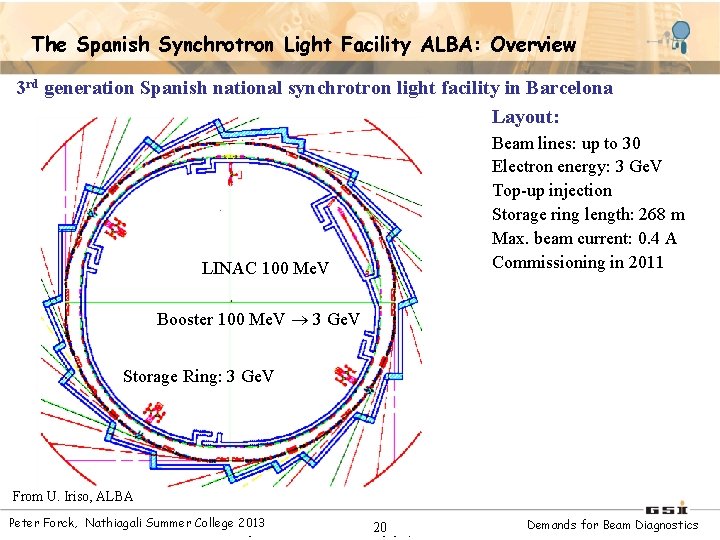
The Spanish Synchrotron Light Facility ALBA: Overview 3 rd generation Spanish national synchrotron light facility in Barcelona Layout: LINAC 100 Me. V Beam lines: up to 30 Electron energy: 3 Ge. V Top-up injection Storage ring length: 268 m Max. beam current: 0. 4 A Commissioning in 2011 Booster 100 Me. V 3 Ge. V Storage Ring: 3 Ge. V From U. Iriso, ALBA Peter Forck, Nathiagali Summer College 2013 Demands for Beam Diagnostics L. Groening, Sept. GSI-Palaver, Dec. 15 th, 10 th, 2003, A dedicated proton accelerator for 20 p-physics at the future GSI facilities
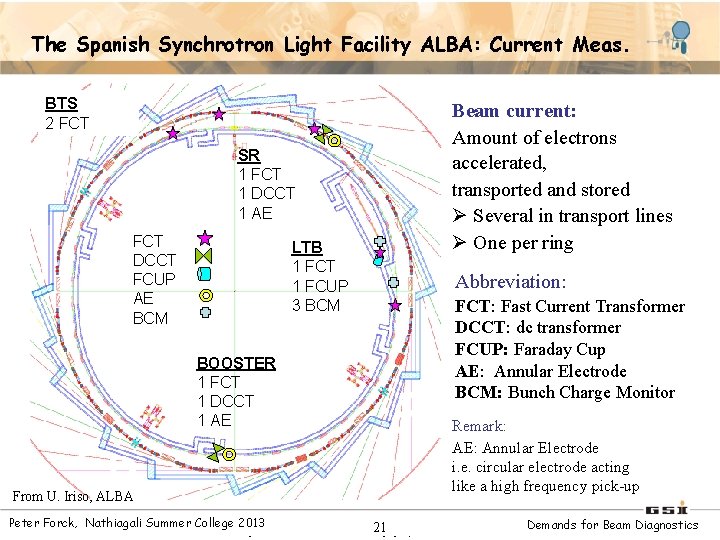
The Spanish Synchrotron Light Facility ALBA: Current Meas. BTS 2 FCT SR 1 FCT 1 DCCT 1 AE FCT DCCT FCUP AE BCM LTB 1 FCT 1 FCUP 3 BCM BOOSTER 1 FCT 1 DCCT 1 AE From U. Iriso, ALBA Beam current: Amount of electrons accelerated, transported and stored Ø Several in transport lines Ø One per ring Abbreviation: FCT: Fast Current Transformer DCCT: dc transformer FCUP: Faraday Cup AE: Annular Electrode BCM: Bunch Charge Monitor Remark: AE: Annular Electrode i. e. circular electrode acting like a high frequency pick-up Peter Forck, Nathiagali Summer College 2013 Demands for Beam Diagnostics L. Groening, Sept. GSI-Palaver, Dec. 15 th, 10 th, 2003, A dedicated proton accelerator for 21 p-physics at the future GSI facilities
- Slides: 21