
Introduction to Accelerated Learning Program ALP Bob Miller
Introduction to: Accelerated Learning Program (ALP) Bob Miller, Associate Professor of English Jamey Gallagher, Ph. D, Assistant Professor of English CADE 2015
Accelerated Learning Program (ALP) Start-Up Philosophy “Adapt, don’t adopt” “Start small; plan large” “Spread”
` ta showing Da disappointing results developmental education
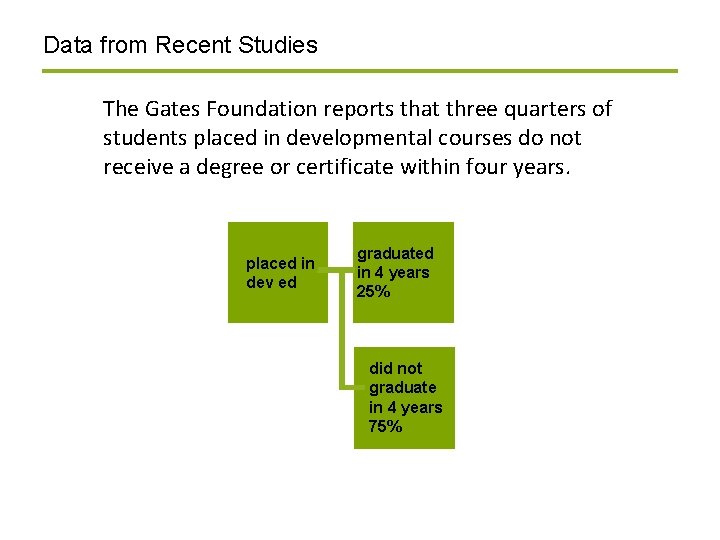
Data from Recent Studies The Gates Foundation reports that three quarters of students placed in developmental courses do not receive a degree or certificate within four years. placed in dev ed graduated in 4 years 25% did not graduate in 4 years 75%
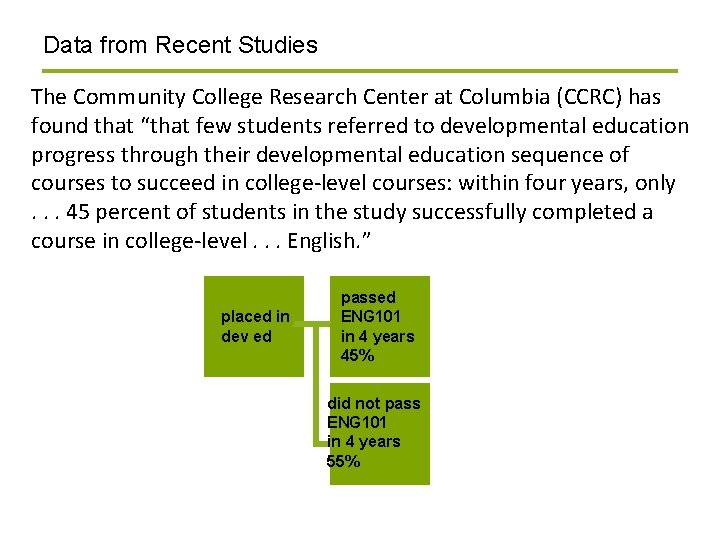
Data from Recent Studies The Community College Research Center at Columbia (CCRC) has found that “that few students referred to developmental education progress through their developmental education sequence of courses to succeed in college-level courses: within four years, only . . . 45 percent of students in the study successfully completed a course in college-level. . . English. ” placed in dev ed passed ENG 101 in 4 years 45% did not pass ENG 101 in 4 years 55%
Developmental Education Under Attack • “Why should American taxpayers be expected to pay for the same education twice? ” • “Not everyone belongs in college. ” Responses: • Many of our students are returning to college after many years have passed since high school. • Developmental education supports the American dream and provides the possibility of a “second chance. ” • Developmental education in the most democratic aspect of higher education.
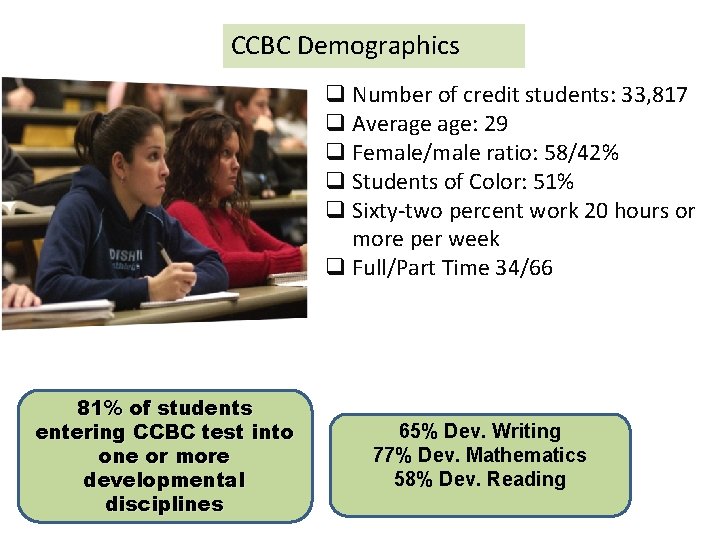
CCBC Demographics q Number of credit students: 33, 817 q Average age: 29 q Female/male ratio: 58/42% q Students of Color: 51% q Sixty-two percent work 20 hours or more per week q Full/Part Time 34/66 81% of students entering CCBC test into one or more developmental disciplines 65% Dev. Writing 77% Dev. Mathematics 58% Dev. Reading
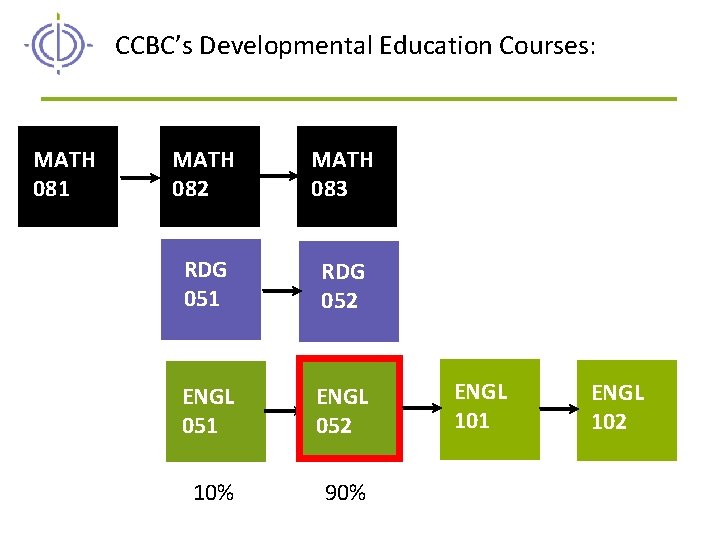
CCBC’s Developmental Education Courses: MATH 081 MATH 082 MATH 083 RDG 051 RDG 052 ENGL 051 ENGL 052 10% 90% ENGL 101 ENGL 102

ALP ENG 101 ENG 052 A L P
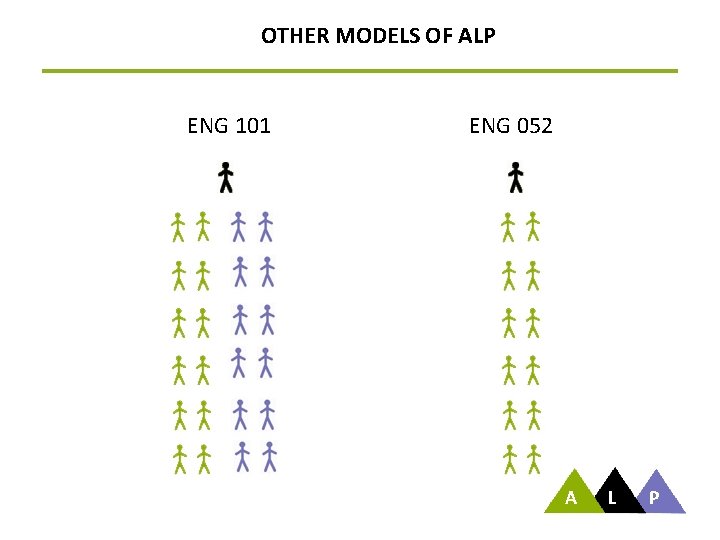
OTHER MODELS OF ALP ENG 101 ENG 052 A L P
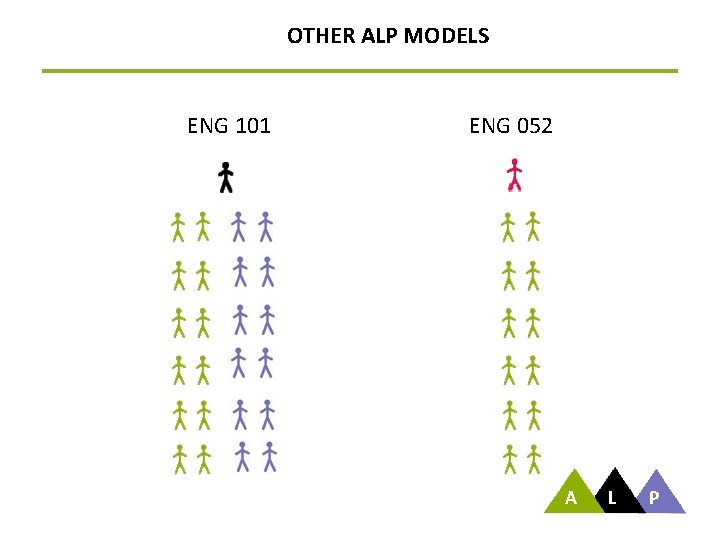
OTHER ALP MODELS ENG 101 ENG 052 A L P
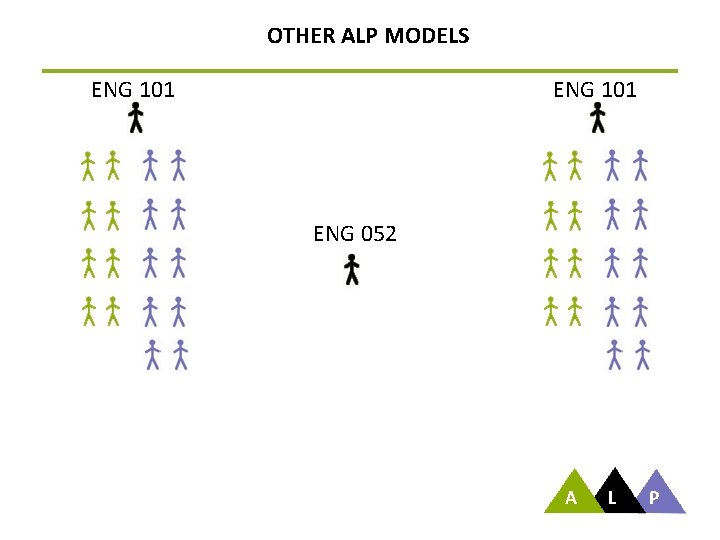
OTHER ALP MODELS ENG 101 ENG 052 A L P
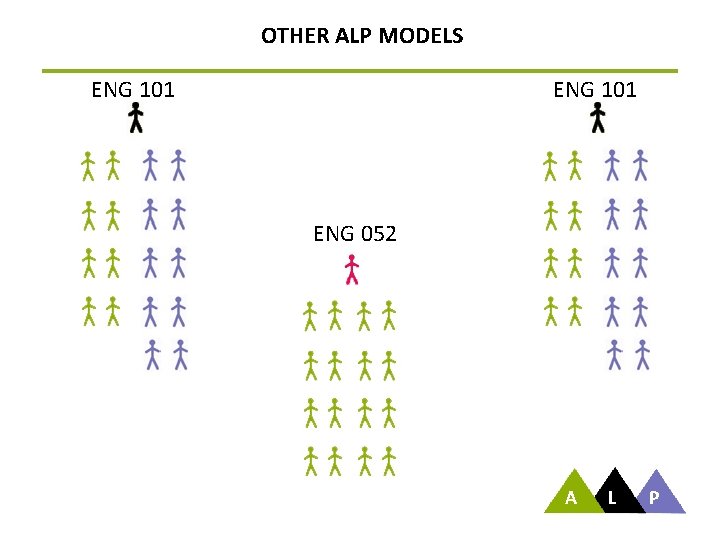
OTHER ALP MODELS ENG 101 ENG 052 A L P
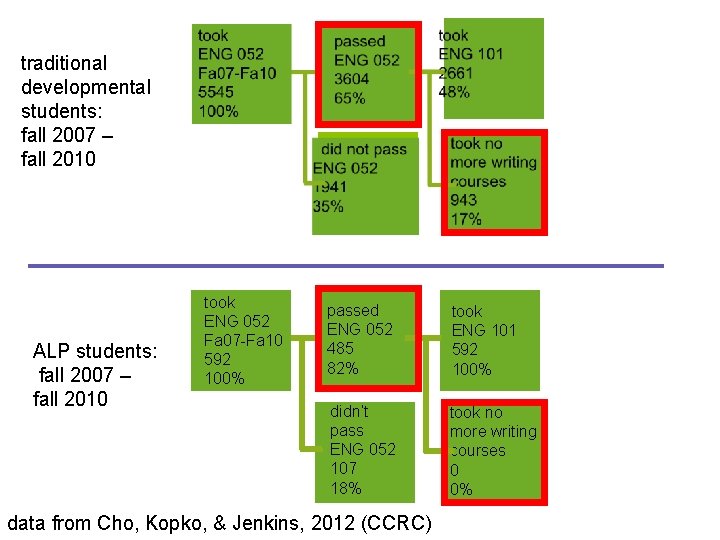
traditional developmental students: fall 2007 – fall 2010 ALP students: fall 2007 – fall 2010 took ENG 052 Fa 07 -Fa 10 592 100% passed ENG 052 485 82% took ENG 101 592 100% didn’t pass ENG 052 107 18% took no more writing courses 0 0% data from Cho, Kopko, & Jenkins, 2012 (CCRC)
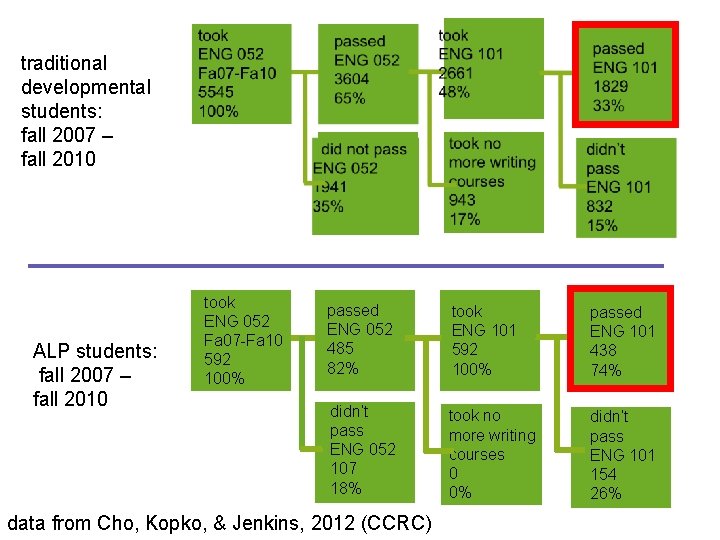
traditional developmental students: fall 2007 – fall 2010 ALP students: fall 2007 – fall 2010 took ENG 052 Fa 07 -Fa 10 592 100% passed ENG 052 485 82% took ENG 101 592 100% passed ENG 101 438 74% didn’t pass ENG 052 107 18% took no more writing courses 0 0% didn’t pass ENG 101 154 26% data from Cho, Kopko, & Jenkins, 2012 (CCRC)
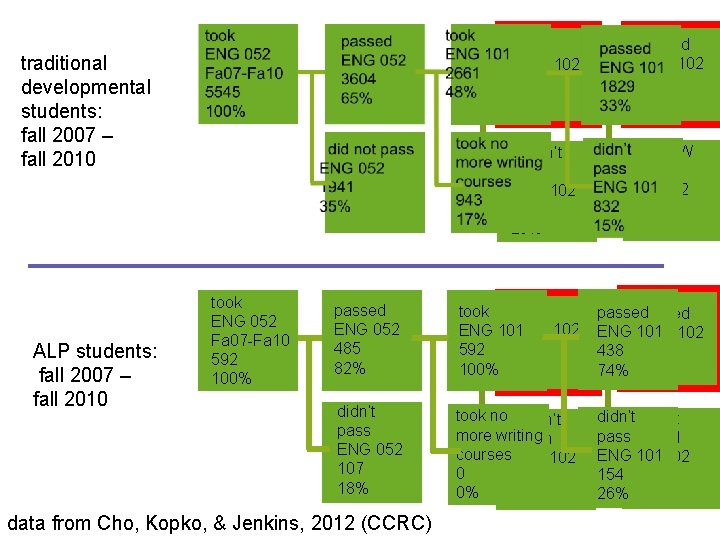
took ENG 102 721 13% traditional developmental students: fall 2007 – fall 2010 ALP students: fall 2007 – fall 2010 haven’t taken ENG 102 1109 20% took ENG 052 Fa 07 -Fa 10 592 100% passed ENG 102 554 10% F, I, or W in ENG 102 167 3% passed ENG 052 485 82% took ENG 102 ENG 101 296 592 100% 50% passed ENG 101 ENG 102 438 195 74% 33% didn’t pass ENG 052 107 18% took no haven’t more writing taken courses. ENG 102 0 142 0% 24% didn’thaven’t passed ENGENG 102 101 154 101 26%17% data from Cho, Kopko, & Jenkins, 2012 (CCRC)
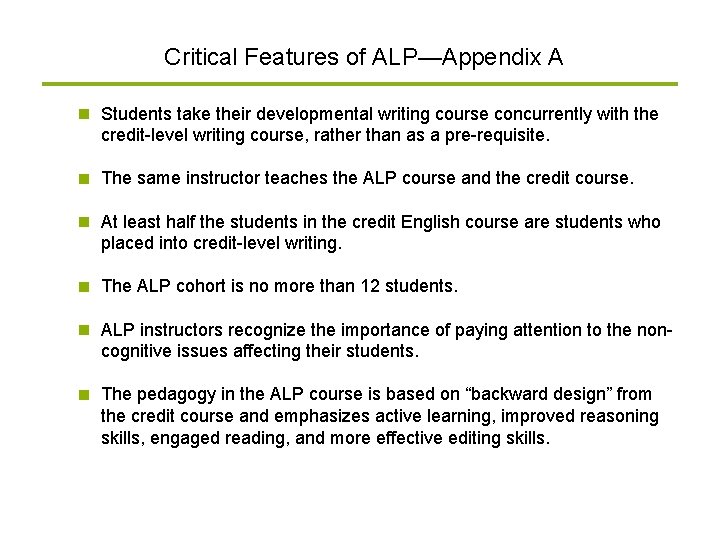
Critical Features of ALP—Appendix A Students take their developmental writing course concurrently with the credit-level writing course, rather than as a pre-requisite. The same instructor teaches the ALP course and the credit course. At least half the students in the credit English course are students who placed into credit-level writing. The ALP cohort is no more than 12 students. ALP instructors recognize the importance of paying attention to the noncognitive issues affecting their students. The pedagogy in the ALP course is based on “backward design” from the credit course and emphasizes active learning, improved reasoning skills, engaged reading, and more effective editing skills.
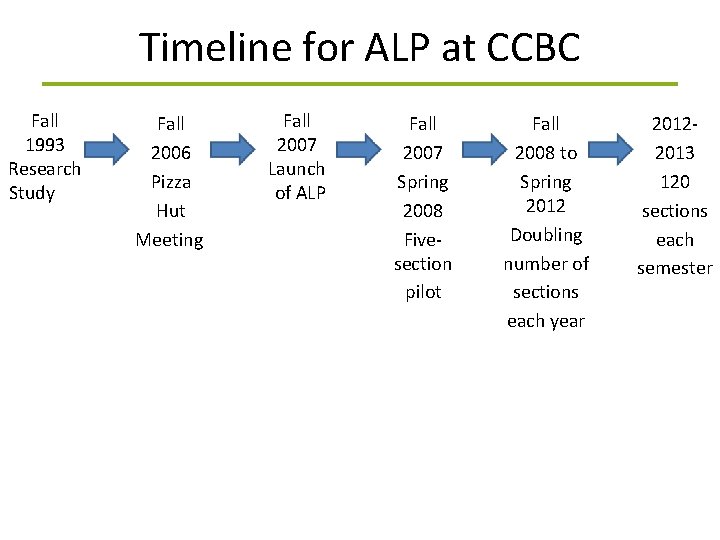
Timeline for ALP at CCBC Fall 1993 Research Study Fall 2006 Pizza Hut Meeting Fall 2007 Launch of ALP Fall 2007 Spring 2008 Fivesection pilot Fall 2008 to Spring 2012 Doubling number of sections each year 20122013 120 sections each semester
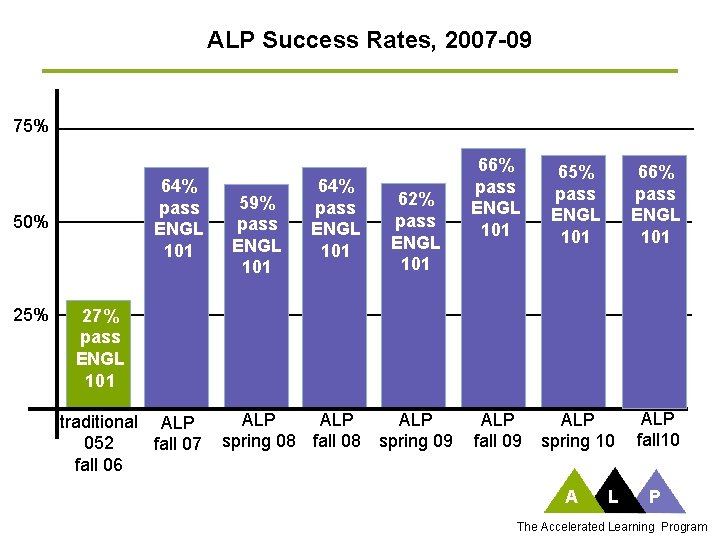
ALP Success Rates, 2007 -09 75% 64% pass ENGL 101 50% 25% 59% pass ENGL 101 64% pass ENGL 101 62% pass ENGL 101 66% pass ENGL 101 65% pass ENGL 101 66% pass ENGL 101 ALP fall 09 ALP spring 10 ALP fall 10 27% pass ENGL 101 traditional ALP 052 fall 07 fall 06 ALP spring 08 fall 08 ALP spring 09 A L P The Accelerated Learning Program
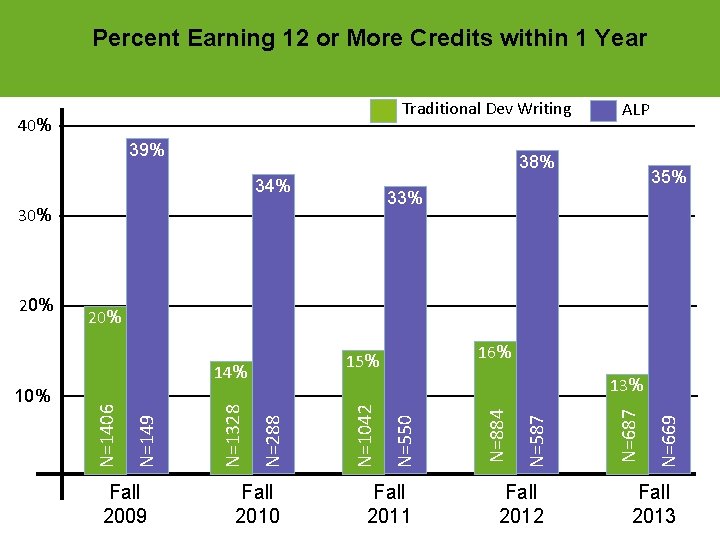
Percent Earning 12 or More Credits within 1 Year Traditional Dev Writing 40% 39% 38% 34% 20% Fall 2010 Fall 2011 Fall 2012 N=669 N=687 N=587 N=884 N=550 N=1042 13% N=288 N=1328 N=149 N=1406 Fall 2009 16% 15% 14% 10% 35% 33% 30% 20% ALP Fall 2013
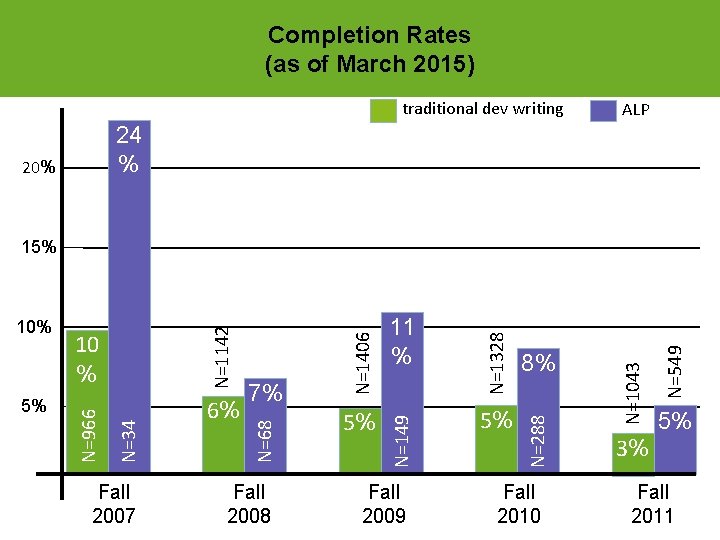
Completion Rates (as of March 2015) traditional dev writing ALP 24 % 20% Fall 2007 Fall 2008 Fall 2009 Fall 2010 3% N=549 N=1043 5% 8% N=288 N=1328 N=1406 5% 11 % N=149 6% 7% N=68 N=34 5% 10 % N=966 10% N=1142 15% 5% Fall 2011
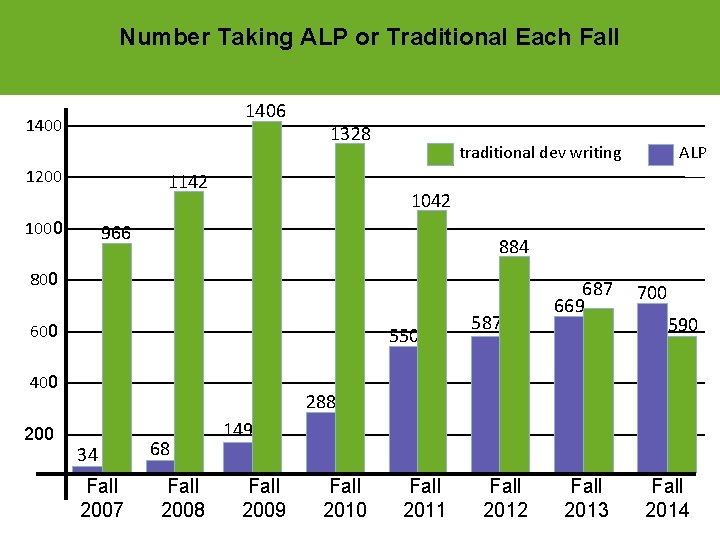
Number Taking ALP or Traditional Each Fall 1406 1400 1200 1328 1142 1000 traditional dev writing 1042 966 884 800 600 550 400 200 ALP 587 669 700 590 288 34 Fall 2007 68 Fall 2008 149 Fall 2009 Fall 2010 Fall 2011 Fall 2012 Fall 2013 Fall 2014
• Write down a list of good and bad practices in basic writing pedagogy.
How ALP encourages changes in Pedagogy • • • Not the old dev ed course slapped onto the credit class An entirely new way to think about course The goals of traditional developmental course vs. goal for ALP
Smaller Cohort “It seemed to me… that the smaller class size made all the difference. It contributed to a greater sense of comfort and freedom than could be achieved in a larger class. Students were eager to read their own work or an assigned reading out loud, which is an invaluable aid in effectively editing and proofreading one’s own work. I observed that on the whole, they were more willing to take risks and to experiment in their own writing. ” (Mary Eck, adjunct instructor) • Workshops • Able to diagnose students’ issues with writing • Ability of students to diagnose their own issues •
Integrating the Two Courses • • The two courses feed off each other Additional practice in writing: eg. making academic moves Scaffolding opportunities in ALP Sample Assignments: A Microethnography
Discourse Microethnography Discourse Communities: The Remix Professor Gallagher A Micro-Ethnography English 101 I want you to write a micro-ethnography for this paper. What is an ethnography, you ask? And why is this one micro? Good questions. An ethnography is a study of a certain group of people. Ethnographies have been written about just about any group of people you can think of—from truck drivers to South American tribes. They usually take years to complete—that’s why this one is “micro. ”
1. Think about a discourse community to which you belong. This should be more than just a random set of friends or family members. Somebody should be able to define you as belonging to this group. Think about sports you do and activities you’re involved in. I’ve done similar papers with other classes and people have written about: weight lifters, video gamers, vegans, French-Canadians. You belong to multiple discourse communities. Just pick one.
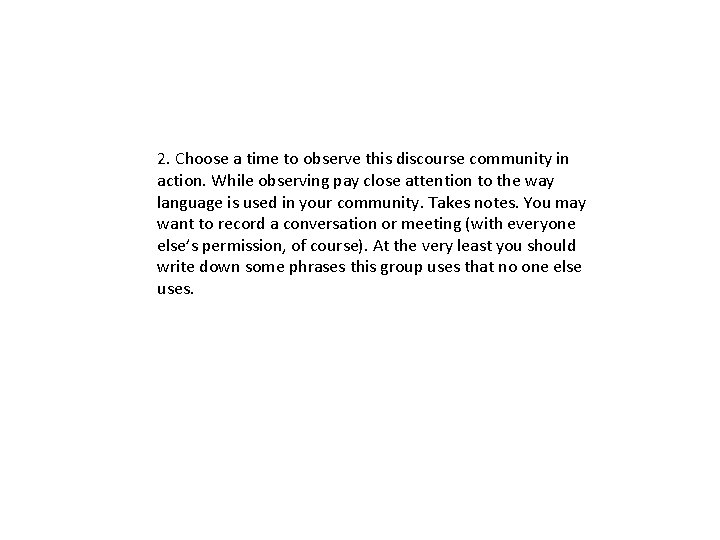
2. Choose a time to observe this discourse community in action. While observing pay close attention to the way language is used in your community. Takes notes. You may want to record a conversation or meeting (with everyone else’s permission, of course). At the very least you should write down some phrases this group uses that no one else uses.
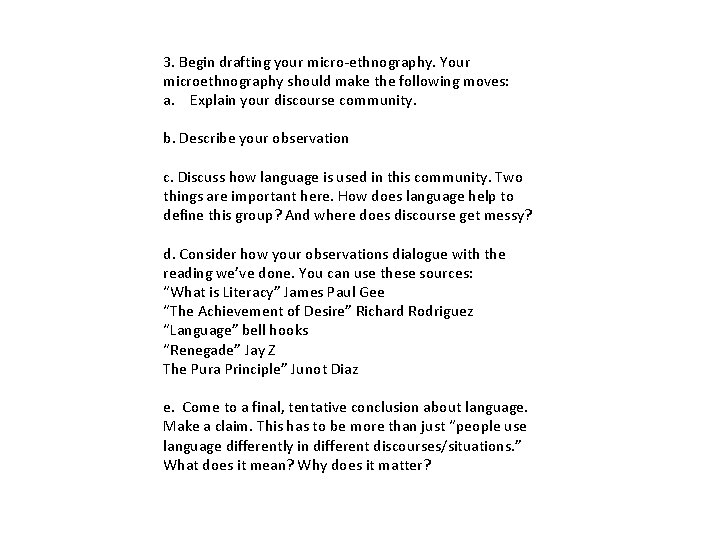
3. Begin drafting your micro-ethnography. Your microethnography should make the following moves: a. Explain your discourse community. b. Describe your observation c. Discuss how language is used in this community. Two things are important here. How does language help to define this group? And where does discourse get messy? d. Consider how your observations dialogue with the reading we’ve done. You can use these sources: “What is Literacy” James Paul Gee “The Achievement of Desire” Richard Rodriguez “Language” bell hooks “Renegade” Jay Z The Pura Principle” Junot Diaz e. Come to a final, tentative conclusion about language. Make a claim. This has to be more than just “people use language differently in different discourses/situations. ” What does it mean? Why does it matter?
Noncognitive Issues • • Listening to students List in ALP Handbook Atlantic Cape Community College approach Two for the price of one assignments
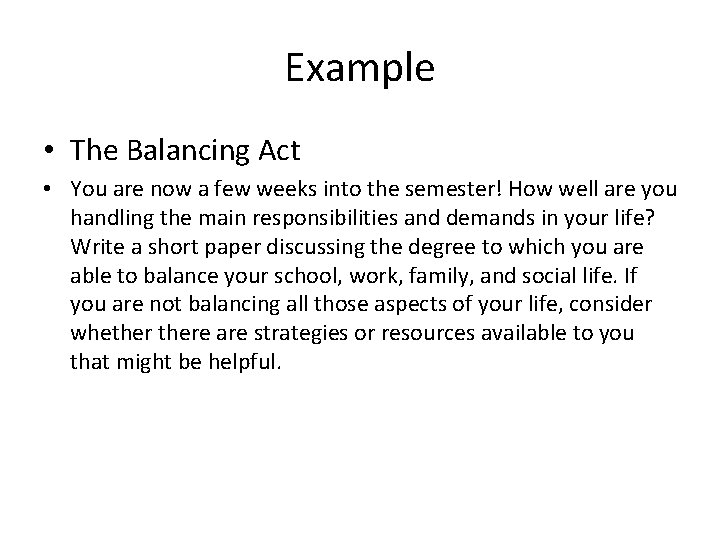
Example • The Balancing Act • You are now a few weeks into the semester! How well are you handling the main responsibilities and demands in your life? Write a short paper discussing the degree to which you are able to balance your school, work, family, and social life. If you are not balancing all those aspects of your life, consider whethere are strategies or resources available to you that might be helpful.
Integrated Reading and Writing • • More time to help students with their reading skills The Reading-Writing Cycle Group activity: how to integrate Assignment Example
Backwards Design • • College level work Belief in students’ abilities
Nuts and Bolts of ALP Start-Up • Adapt, Don’t Adopt • Getting Started—Start Small; Plan Large – While planning, think about scaling up • Building support – Use our data—more than 100 ALP schools nationally – Contact college media services/local newspapers – Administration – Advisors!
Nuts and Bolts of ALP Start-Up • Research and Data Collection—Appendix B – Webinar for ALP teams and IR staff (TBA) – Meet face to face—be explicit • Marketing to Students – Advisors! – Word of mouth • Identifying ALP Faculty and Faculty Development – The challenge of full-time faculty buy-in • Funding and Costs – ALP costs less per successful student than traditional dev ed classes – Reassigned time for your ALP director – Stipends for attending faculty development institutes
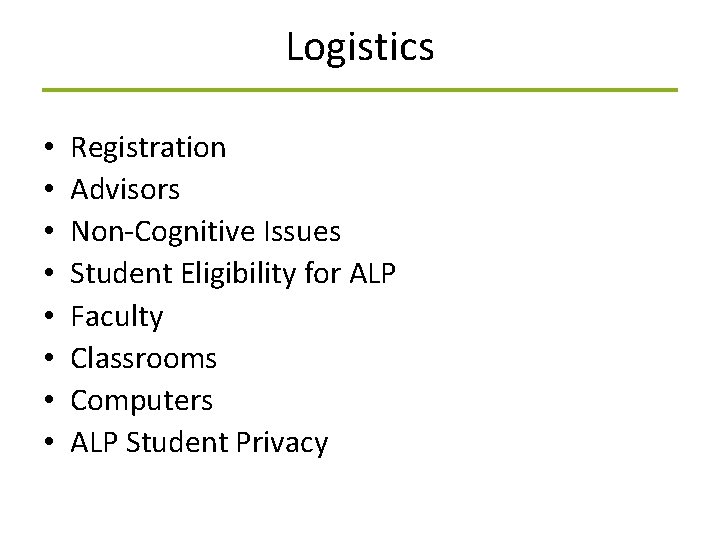
Logistics • • Registration Advisors Non-Cognitive Issues Student Eligibility for ALP Faculty Classrooms Computers ALP Student Privacy
Going Forward • Post a description of ALP at your college on the ALP website: http: //alp-deved. org/ • Stay in touch and let us know what variations in our model you introduce; we may want to incorporate them, too!
Faculty Development • Half Day Workshops • ALP Institute • Ideas moving forward
Support • Contact us: – jgallagher@ccbcmd. edu – rmiller 2@ccbcmd. edy • Visit the ALP website: – http: //alp-deved. org/
- Slides: 41