
INTRODUCTION TO ACADEMICS AT FGCU Jelene Grace Assistant
- Slides: 38
INTRODUCTION TO ACADEMICS AT FGCU Jelene Grace Assistant Director First Year Advising New Student Programs
This presentation will cover: The organization of the university; The basics of the Bachelor’s degree; The structure of the General Education Program; Some important graduation requirements; Policies you (and your student) should know; The basics of Academic Advising; The Family Educational Rights and Privacy Act.
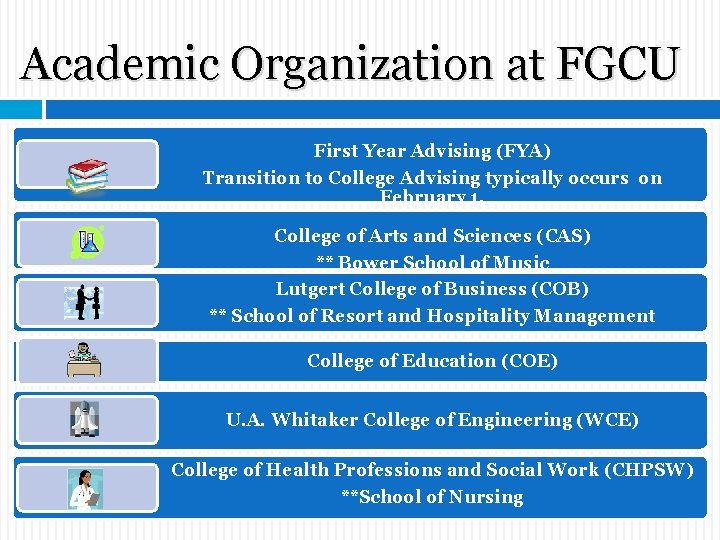
Academic Organization at FGCU First Year Advising (FYA) Transition to College Advising typically occurs on February 1. College of Arts and Sciences (CAS) ** Bower School of Music Lutgert College of Business (COB) ** School of Resort and Hospitality Management College of Education (COE) U. A. Whitaker College of Engineering (WCE) College of Health Professions and Social Work (CHPSW) **School of Nursing
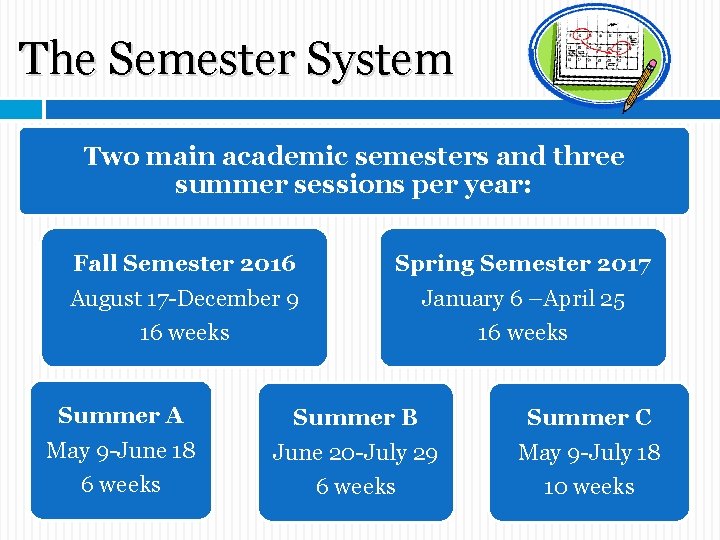
The Semester System Two main academic semesters and three summer sessions per year: Fall Semester 2016 August 17 -December 9 Spring Semester 2017 January 6 –April 25 16 weeks Summer A May 9 -June 18 Summer B Summer C June 20 -July 29 May 9 -July 18 6 weeks 10 weeks
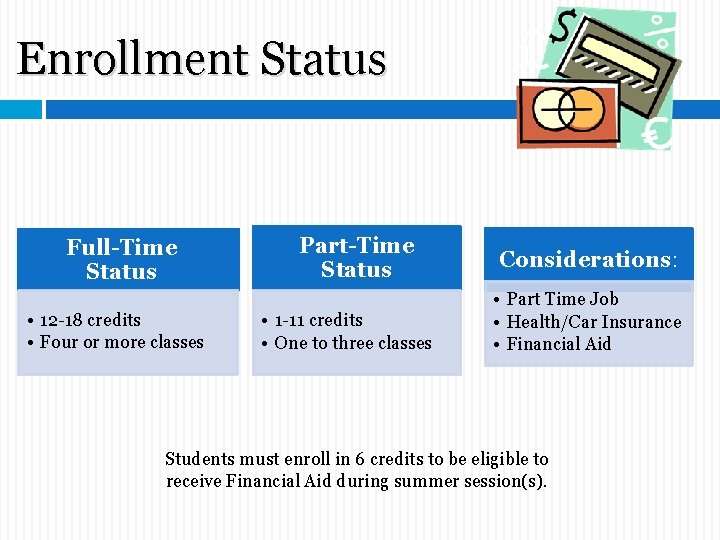
Enrollment Status Full-Time Status • 12 -18 credits • Four or more classes Part-Time Status • 1 -11 credits • One to three classes Considerations: • Part Time Job • Health/Car Insurance • Financial Aid Students must enroll in 6 credits to be eligible to receive Financial Aid during summer session(s).
The Bachelor’s Degree All degree programs and degree requirements are approved by the State of Florida. � Include a minimum of 120 credit hours A number of degree programs require MORE than 12 o credit hours: � For example: Engineering, Education, Nursing
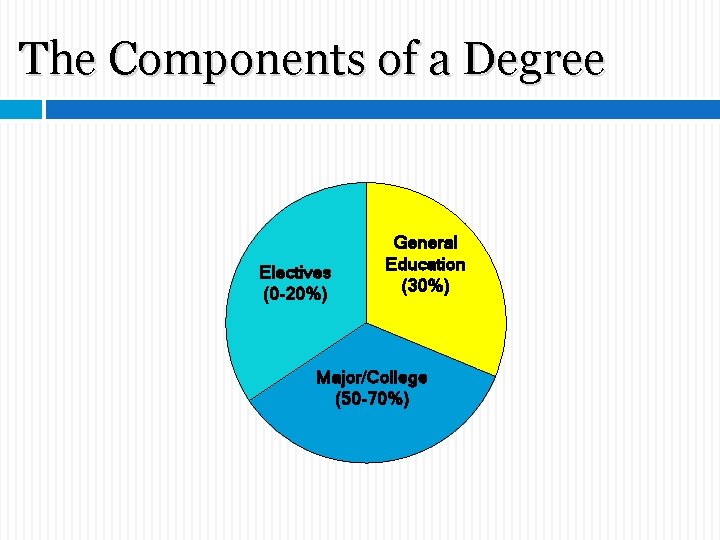
The Components of a Degree Electives (0 -20%) General Education (30%) Major/College (50 -70%)
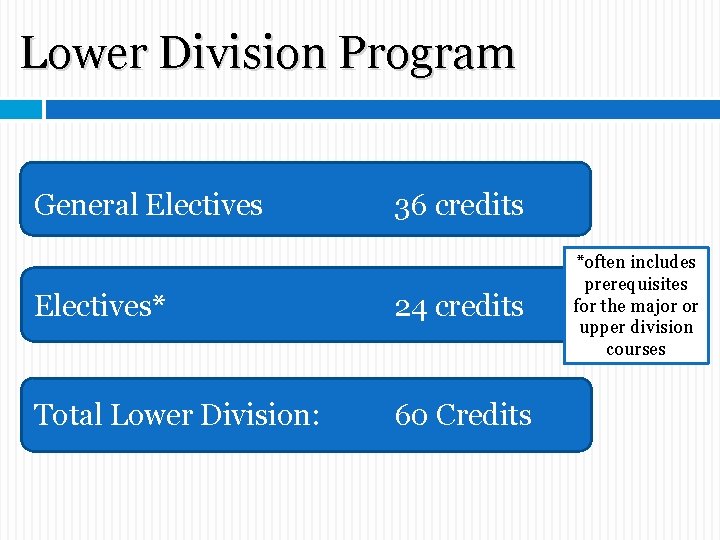
Lower and Upper Division Lower Division Program – 60 credit hours Freshman and Sophomore Years 1000 and 2000 -level courses Upper Division Program – 60 credit hours Junior and Senior Years 3000 and 4000 -level courses
Lower Division Program General Electives 36 credits Electives* 24 credits Total Lower Division: 60 Credits *often includes prerequisites for the major or upper division courses
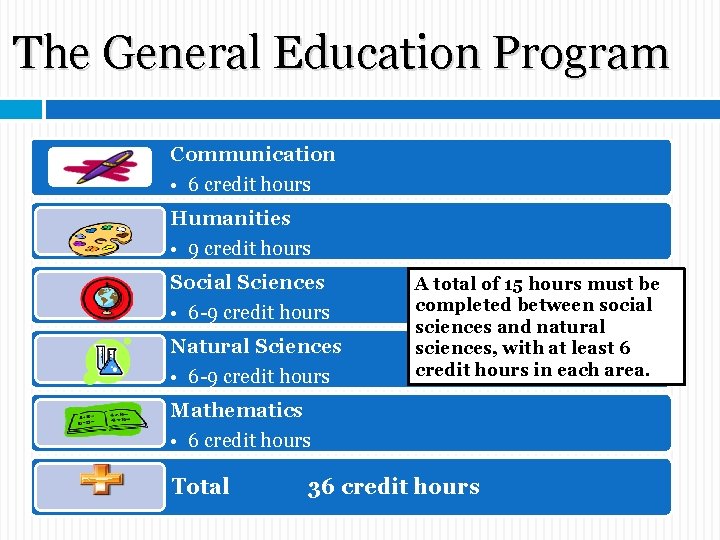
The General Education Program Communication • 6 credit hours Humanities • 9 credit hours Social Sciences • 6 -9 credit hours Natural Sciences • 6 -9 credit hours A total of 15 hours must be completed between social sciences and natural sciences, with at least 6 credit hours in each area. Mathematics • 6 credit hours Total 36 credit hours
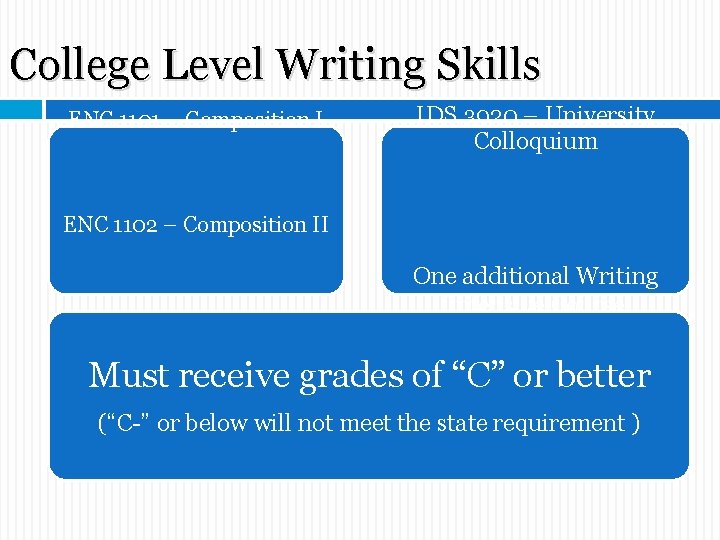
College Level Writing Skills ENC 1101 – Composition I IDS 3920 – University Colloquium ENC 1102 – Composition II One additional Writing Intensive Course Must receive grades of “C” or better (“C-” or below will not meet the state requirement )
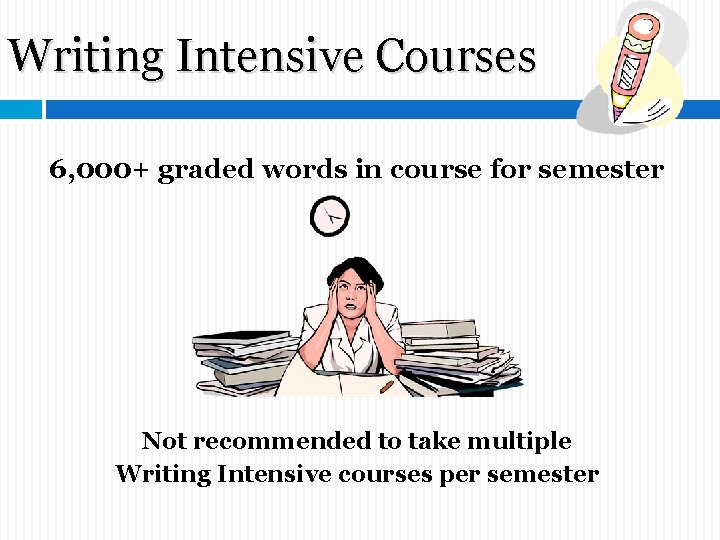
Writing Intensive Courses 6, 000+ graded words in course for semester Not recommended to take multiple Writing Intensive courses per semester
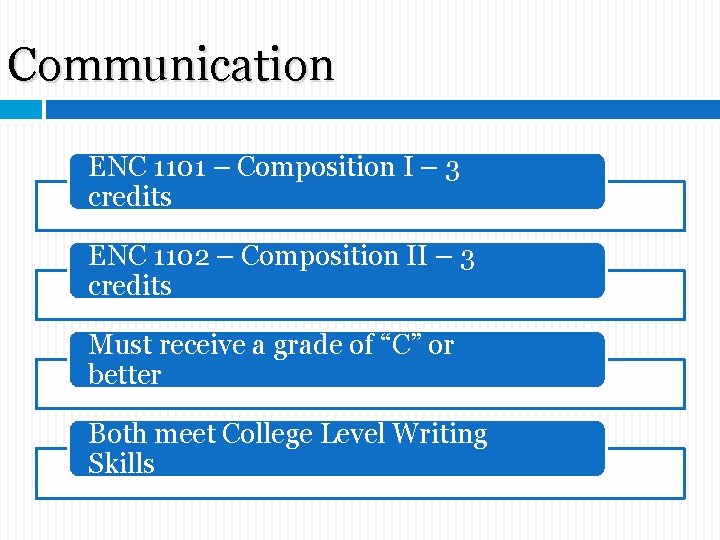
Communication ENC 1101 – Composition I – 3 credits ENC 1102 – Composition II – 3 credits Must receive a grade of “C” or better Both meet College Level Writing Skills
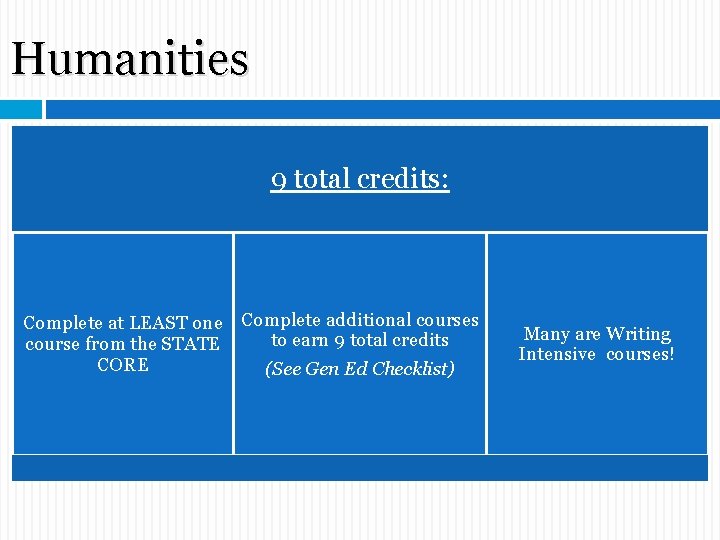
Humanities 9 total credits: Complete at LEAST one Complete additional courses to earn 9 total credits course from the STATE CORE (See Gen Ed Checklist) Many are Writing Intensive courses!
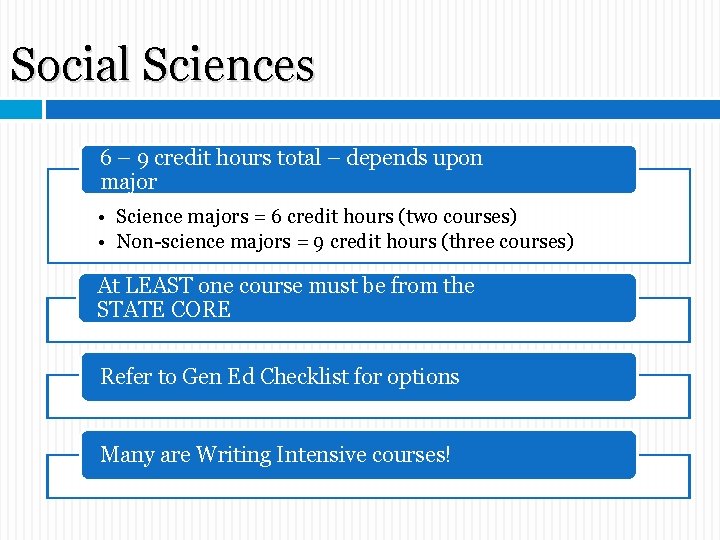
Social Sciences 6 – 9 credit hours total – depends upon major • Science majors = 6 credit hours (two courses) • Non-science majors = 9 credit hours (three courses) At LEAST one course must be from the STATE CORE Refer to Gen Ed Checklist for options Many are Writing Intensive courses!
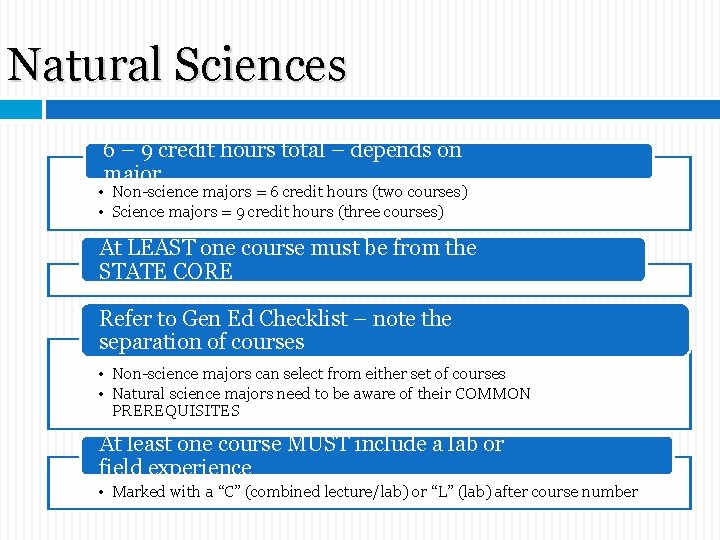
Natural Sciences 6 – 9 credit hours total – depends on major • Non-science majors = 6 credit hours (two courses) • Science majors = 9 credit hours (three courses) At LEAST one course must be from the STATE CORE Refer to Gen Ed Checklist – note the separation of courses • Non-science majors can select from either set of courses • Natural science majors need to be aware of their COMMON PREREQUISITES At least one course MUST include a lab or field experience • Marked with a “C” (combined lecture/lab) or “L” (lab) after course number
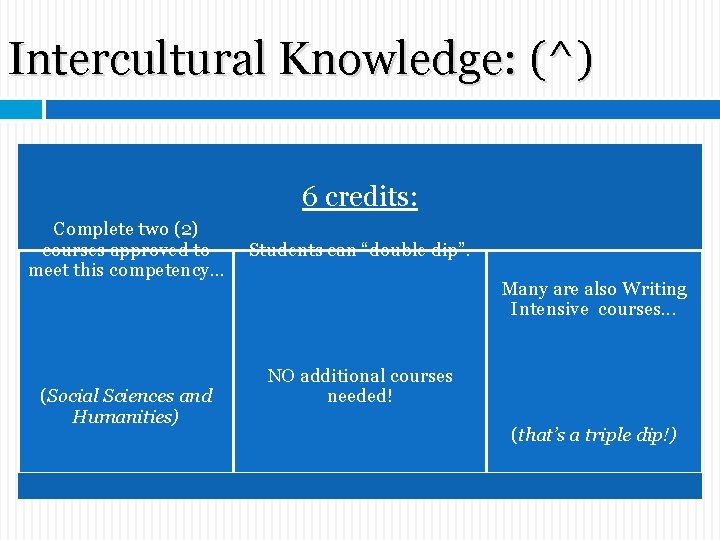
Intercultural Knowledge: (^) 6 credits: Complete two (2) courses approved to meet this competency… (Social Sciences and Humanities) Students can “double dip”. Many are also Writing Intensive courses. . . NO additional courses needed! (that’s a triple dip!)
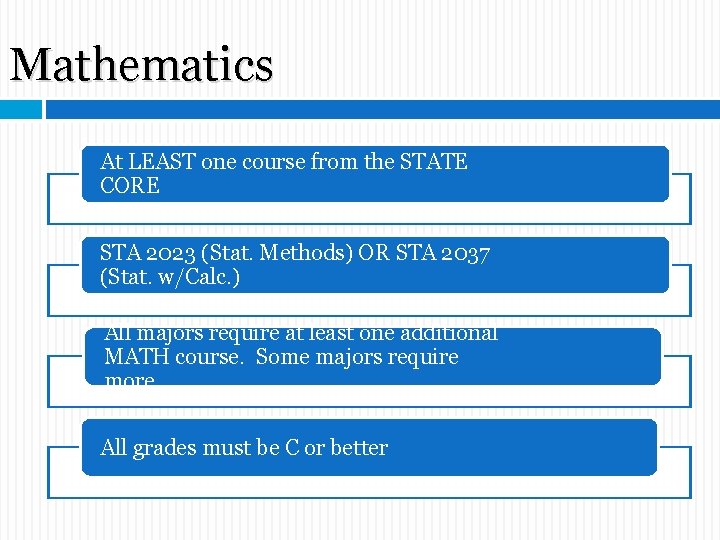
Mathematics At LEAST one course from the STATE CORE STA 2023 (Stat. Methods) OR STA 2037 (Stat. w/Calc. ) All majors require at least one additional MATH course. Some majors require more… All grades must be C or better
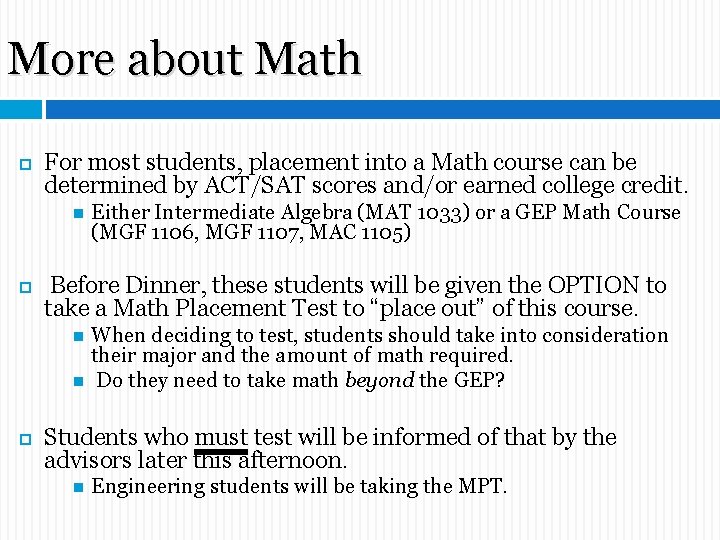
More about Math For most students, placement into a Math course can be determined by ACT/SAT scores and/or earned college credit. Either Intermediate Algebra (MAT 1033) or a GEP Math Course (MGF 1106, MGF 1107, MAC 1105) Before Dinner, these students will be given the OPTION to take a Math Placement Test to “place out” of this course. When deciding to test, students should take into consideration their major and the amount of math required. Do they need to take math beyond the GEP? Students who must test will be informed of that by the advisors later this afternoon. Engineering students will be taking the MPT.
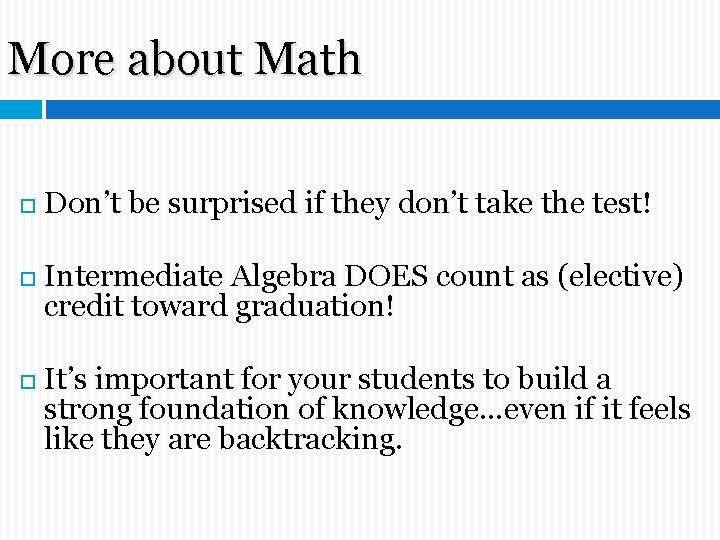
More about Math Don’t be surprised if they don’t take the test! Intermediate Algebra DOES count as (elective) credit toward graduation! It’s important for your students to build a strong foundation of knowledge…even if it feels like they are backtracking.
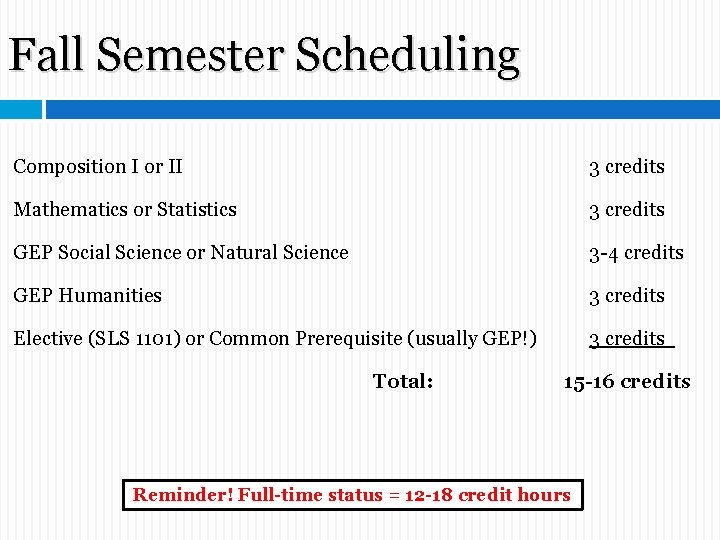
Fall Semester Scheduling Composition I or II 3 credits Mathematics or Statistics 3 credits GEP Social Science or Natural Science 3 -4 credits GEP Humanities 3 credits Elective (SLS 1101) or Common Prerequisite (usually GEP!) 3 credits Total: 15 -16 credits Reminder! Full-time status = 12 -18 credit hours
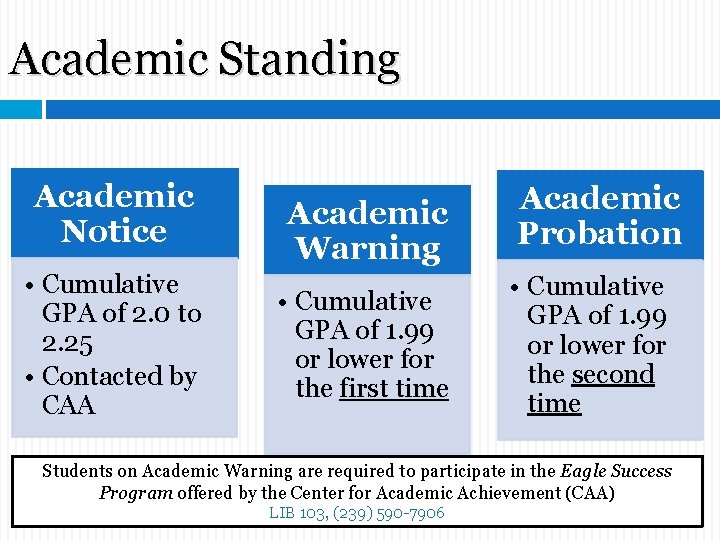
Academic Standing Academic Notice • Cumulative GPA of 2. 0 to 2. 25 • Contacted by CAA Academic Warning • Cumulative GPA of 1. 99 or lower for the first time Academic Probation • Cumulative GPA of 1. 99 or lower for the second time Students on Academic Warning are required to participate in the Eagle Success Program offered by the Center for Academic Achievement (CAA) LIB 103, (239) 590 -7906
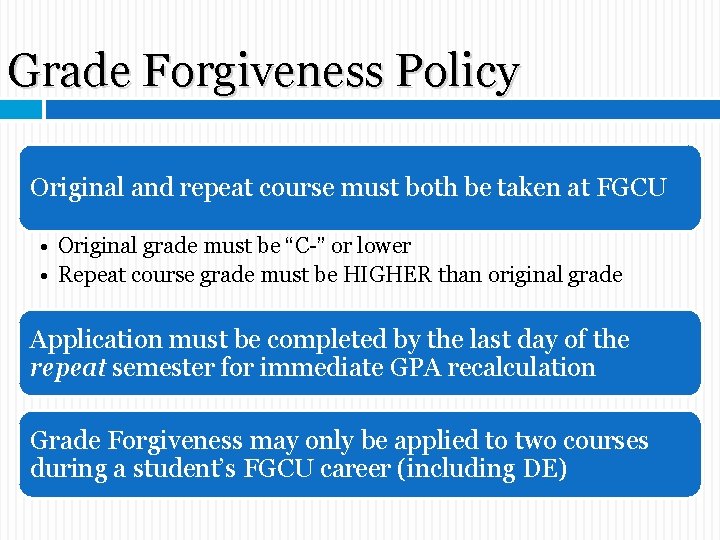
Grade Forgiveness Policy Original and repeat course must both be taken at FGCU • Original grade must be “C-” or lower • Repeat course grade must be HIGHER than original grade Application must be completed by the last day of the repeat semester for immediate GPA recalculation Grade Forgiveness may only be applied to two courses during a student’s FGCU career (including DE)
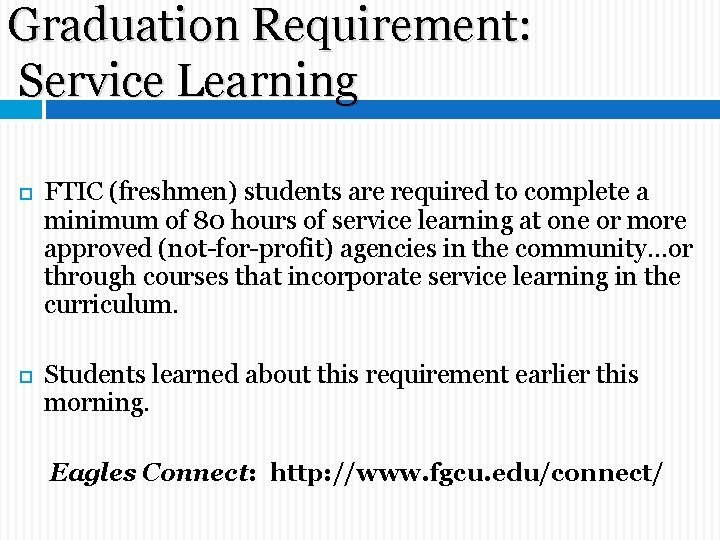
Graduation Requirement: Service Learning FTIC (freshmen) students are required to complete a minimum of 80 hours of service learning at one or more approved (not-for-profit) agencies in the community…or through courses that incorporate service learning in the curriculum. Students learned about this requirement earlier this morning. Eagles Connect: http: //www. fgcu. edu/connect/
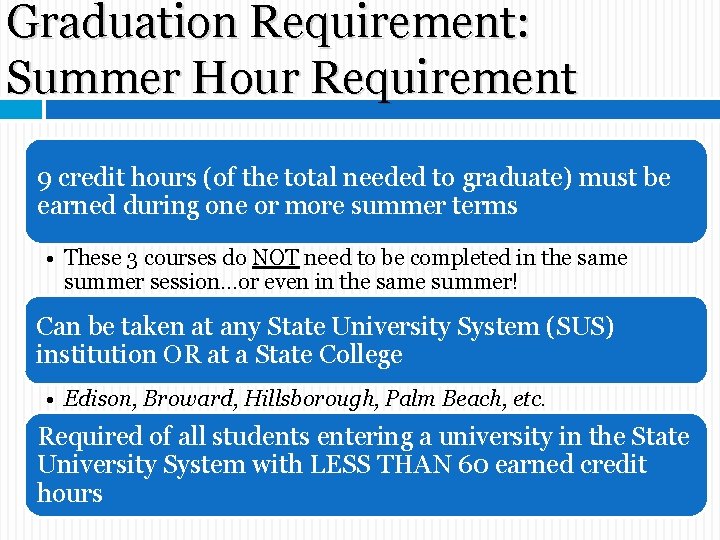
Graduation Requirement: Summer Hour Requirement 9 credit hours (of the total needed to graduate) must be earned during one or more summer terms • These 3 courses do NOT need to be completed in the same summer session…or even in the same summer! Can be taken at any State University System (SUS) institution OR at a State College • Edison, Broward, Hillsborough, Palm Beach, etc. Required of all students entering a university in the State University System with LESS THAN 60 earned credit hours
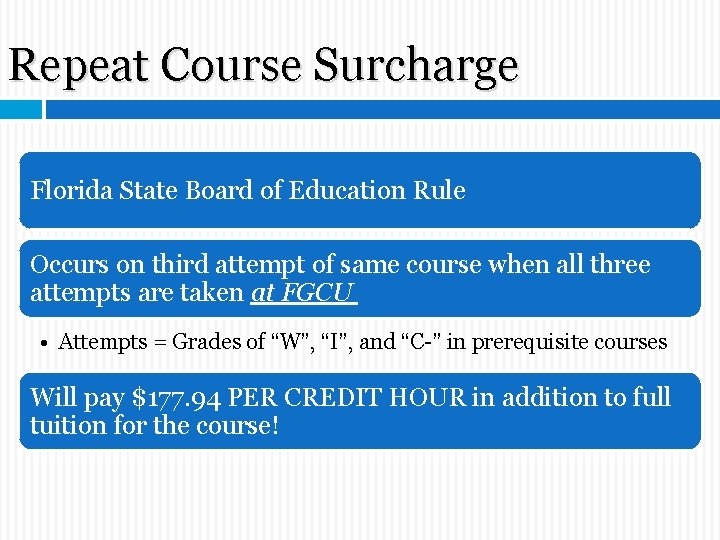
Repeat Course Surcharge Florida State Board of Education Rule Occurs on third attempt of same course when all three attempts are taken at FGCU • Attempts = Grades of “W”, “I”, and “C-” in prerequisite courses Will pay $177. 94 PER CREDIT HOUR in addition to full tuition for the course!
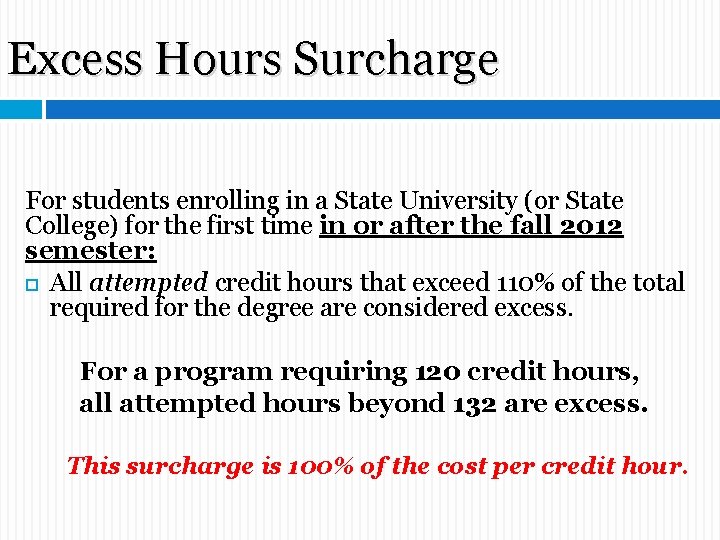
Excess Hours Surcharge For students enrolling in a State University (or State College) for the first time in or after the fall 2012 semester: All attempted credit hours that exceed 110% of the total required for the degree are considered excess. For a program requiring 120 credit hours, all attempted hours beyond 132 are excess. This surcharge is 100% of the cost per credit hour.
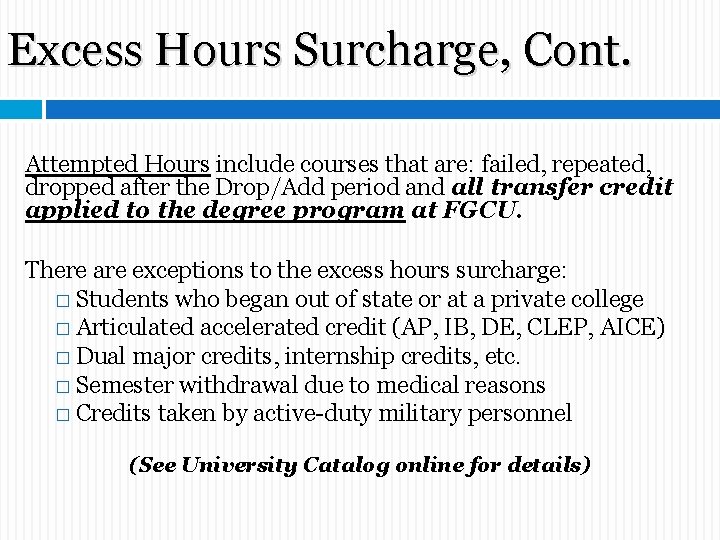
Excess Hours Surcharge, Cont. Attempted Hours include courses that are: failed, repeated, dropped after the Drop/Add period and all transfer credit applied to the degree program at FGCU. There are exceptions to the excess hours surcharge: � Students who began out of state or at a private college � Articulated accelerated credit (AP, IB, DE, CLEP, AICE) � Dual major credits, internship credits, etc. � Semester withdrawal due to medical reasons � Credits taken by active-duty military personnel (See University Catalog online for details)
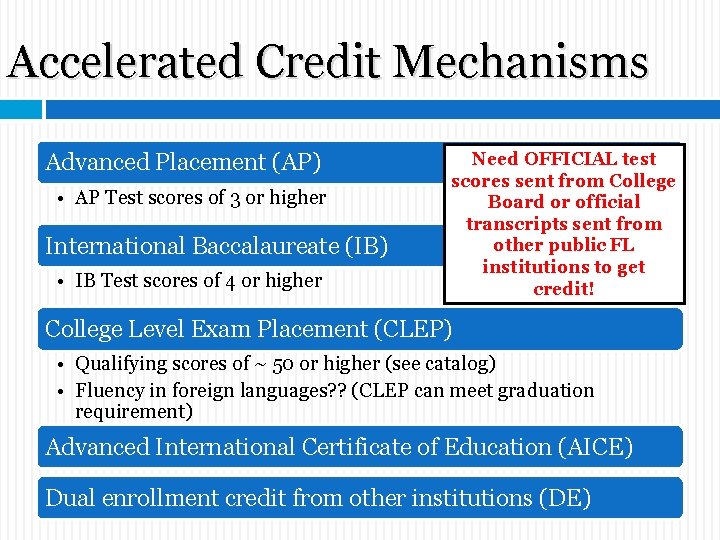
Accelerated Credit Mechanisms Advanced Placement (AP) • AP Test scores of 3 or higher International Baccalaureate (IB) • IB Test scores of 4 or higher Need OFFICIAL test scores sent from College Board or official transcripts sent from other public FL institutions to get credit! College Level Exam Placement (CLEP) • Qualifying scores of ~ 50 or higher (see catalog) • Fluency in foreign languages? ? (CLEP can meet graduation requirement) Advanced International Certificate of Education (AICE) Dual enrollment credit from other institutions (DE)
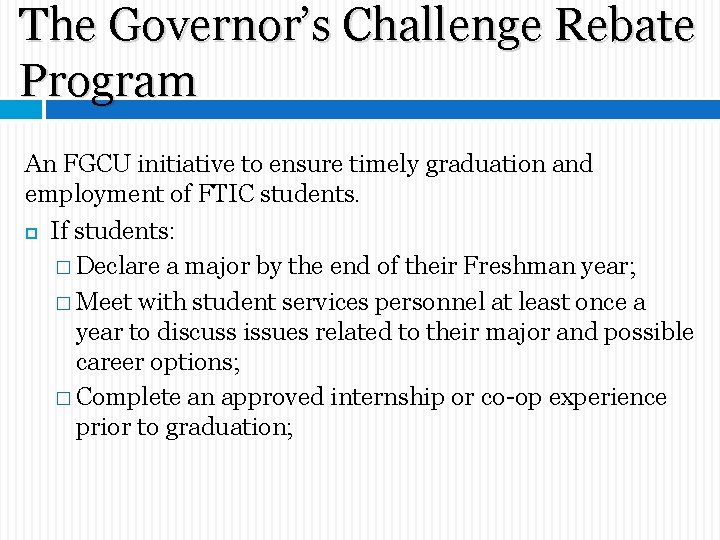
The Governor’s Challenge Rebate Program An FGCU initiative to ensure timely graduation and employment of FTIC students. If students: � Declare a major by the end of their Freshman year; � Meet with student services personnel at least once a year to discuss issues related to their major and possible career options; � Complete an approved internship or co-op experience prior to graduation;
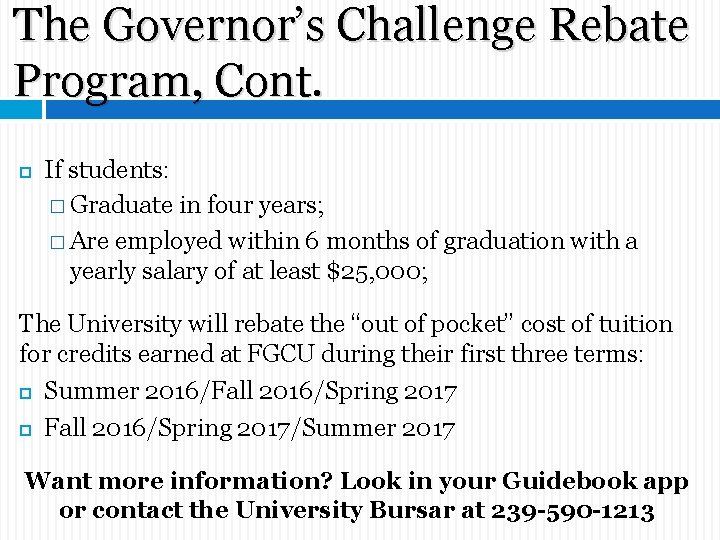
The Governor’s Challenge Rebate Program, Cont. If students: � Graduate in four years; � Are employed within 6 months of graduation with a yearly salary of at least $25, 000; The University will rebate the “out of pocket” cost of tuition for credits earned at FGCU during their first three terms: Summer 2016/Fall 2016/Spring 2017 Fall 2016/Spring 2017/Summer 2017 Want more information? Look in your Guidebook app or contact the University Bursar at 239 -590 -1213
Does Your Student Need Help? Encourage him or her to follow up with an Advisor http: //www. fgcu. edu/Info/Advising. asp
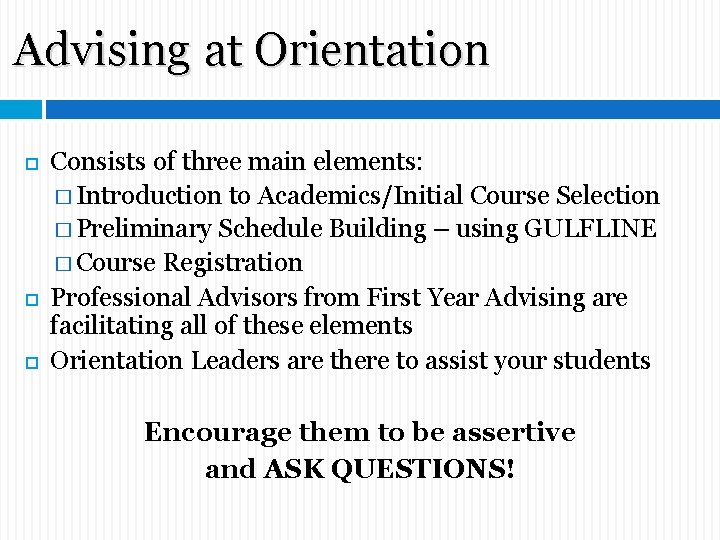
Advising at Orientation Consists of three main elements: � Introduction to Academics/Initial Course Selection � Preliminary Schedule Building – using GULFLINE � Course Registration Professional Advisors from First Year Advising are facilitating all of these elements Orientation Leaders are there to assist your students Encourage them to be assertive and ASK QUESTIONS!
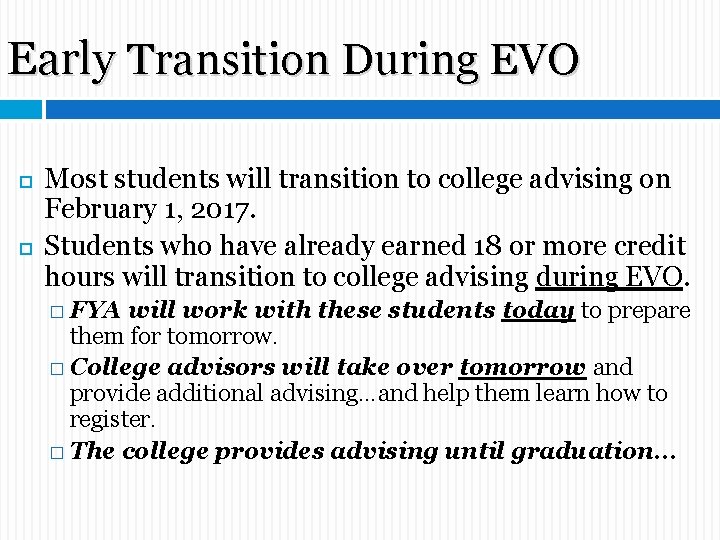
Early Transition During EVO Most students will transition to college advising on February 1, 2017. Students who have already earned 18 or more credit hours will transition to college advising during EVO. � FYA will work with these students today to prepare them for tomorrow. � College advisors will take over tomorrow and provide additional advising…and help them learn how to register. � The college provides advising until graduation…
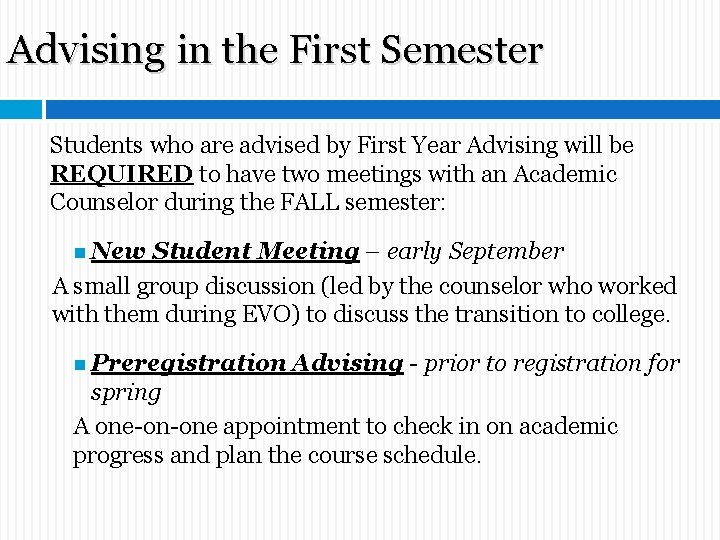
Advising in the First Semester Students who are advised by First Year Advising will be REQUIRED to have two meetings with an Academic Counselor during the FALL semester: New Student Meeting – early September A small group discussion (led by the counselor who worked with them during EVO) to discuss the transition to college. Preregistration Advising - prior to registration for spring A one-on-one appointment to check in on academic progress and plan the course schedule.
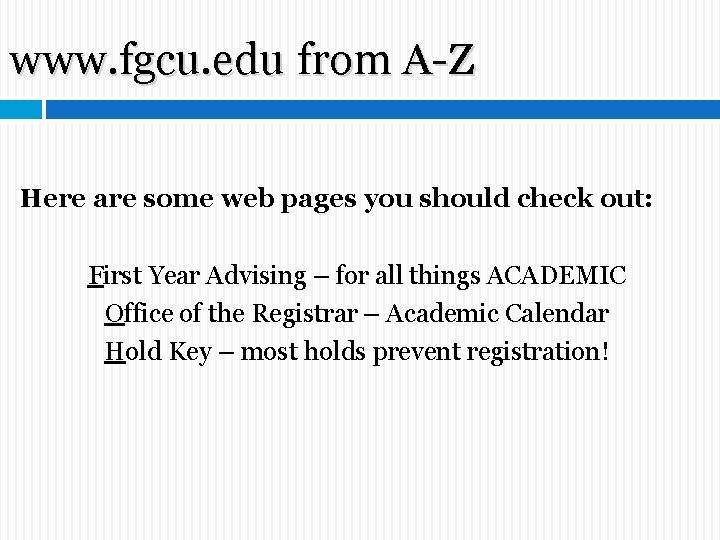
www. fgcu. edu from A-Z Here are some web pages you should check out: First Year Advising – for all things ACADEMIC Office of the Registrar – Academic Calendar Hold Key – most holds prevent registration!
The Family Educational Rights & Privacy Act (FERPA) FERPA is a United States federal law that protects the privacy of student records and includes provisions for the rights of students to review and disclose their records. Grades and academic transcripts are confidential and will not be released to anyone without the prior written consent of the student. FERPA release form must be completed, signed, and submitted BY THE STUDENT (showing a valid Driver’s License) to the Office of the Registrar on the 1 st floor of Mc. Tarnaghan Hall. Students can submit and rescind official release at will. http: //www. fgcu. edu/Registrar/ferpa. html
Welcome to Florida Gulf Coast University! Go Eagles!