
Introduction to 1 Dimensional Motion Objective Identify quantities
Introduction to 1 Dimensional Motion Objective: • Identify quantities as scalars or vectors. • Describe and analyze motion in one dimension using equations with the concepts of distance, displacement, speed and velocity
Kinematics � Mechanics is the study of the motion of objects. � Kinematics is the science of describing the motion of objects using words, diagrams, numbers, graphs, and equations. Kinematics is a branch of mechanics.
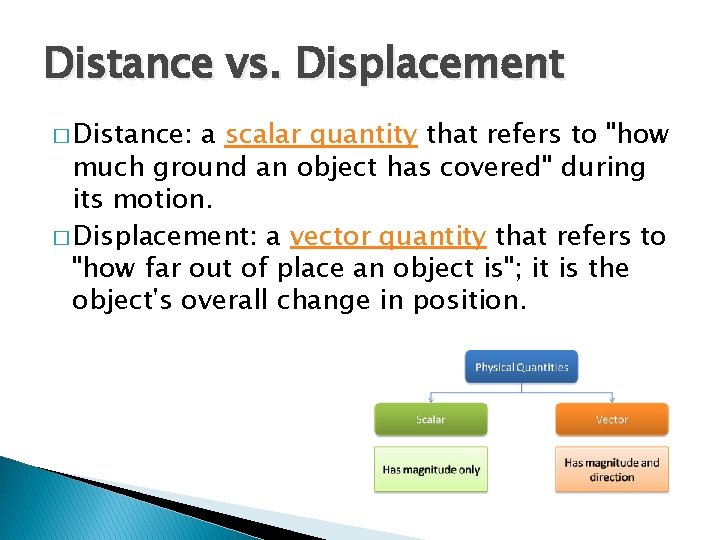
Distance vs. Displacement � Distance: a scalar quantity that refers to "how much ground an object has covered" during its motion. � Displacement: a vector quantity that refers to "how far out of place an object is"; it is the object's overall change in position.
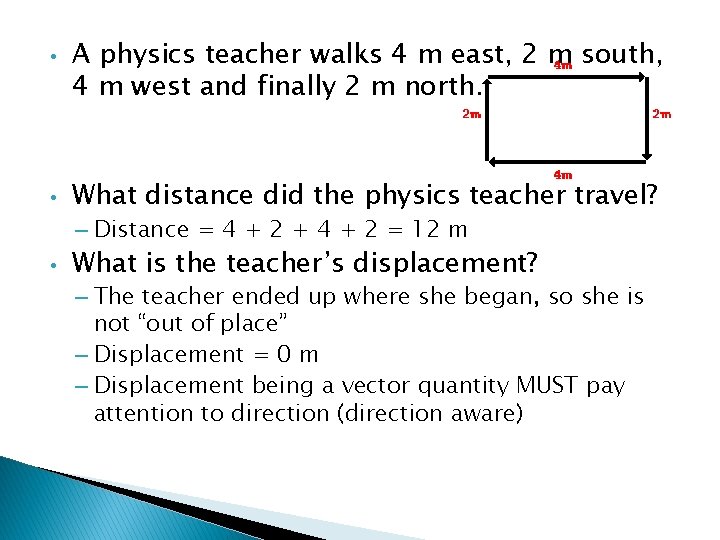
• • A physics teacher walks 4 m east, 2 m south, 4 m west and finally 2 m north. What distance did the physics teacher travel? – Distance = 4 + 2 + 4 + 2 = 12 m • What is the teacher’s displacement? – The teacher ended up where she began, so she is not “out of place” – Displacement = 0 m – Displacement being a vector quantity MUST pay attention to direction (direction aware)
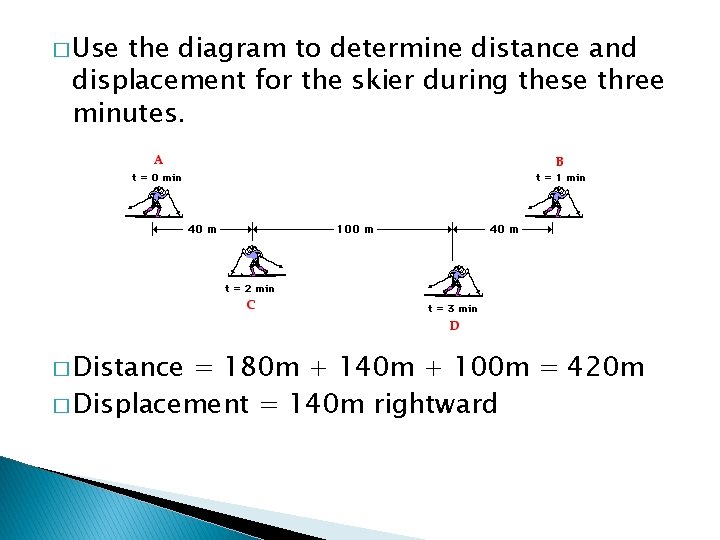
� Use the diagram to determine distance and displacement for the skier during these three minutes. � Distance = 180 m + 140 m + 100 m = 420 m � Displacement = 140 m rightward
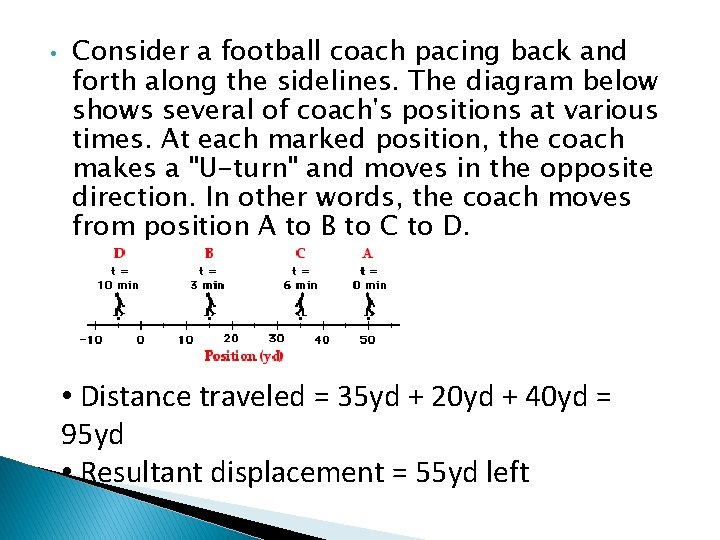
• Consider a football coach pacing back and forth along the sidelines. The diagram below shows several of coach's positions at various times. At each marked position, the coach makes a "U-turn" and moves in the opposite direction. In other words, the coach moves from position A to B to C to D. • Distance traveled = 35 yd + 20 yd + 40 yd = 95 yd • Resultant displacement = 55 yd left
Self Check 1. 2. What is the distance and displacement of the cross-country team if they begin at the school, run 10 miles and finish back at the school? What is the distance and the displacement of the race car drivers in the Indy 500?
Speed vs. Velocity � Speed: a scalar quantity that refers to "how fast an object is moving. “ � Velocity: a vector quantity that refers to "the rate at which an object changes its position. "
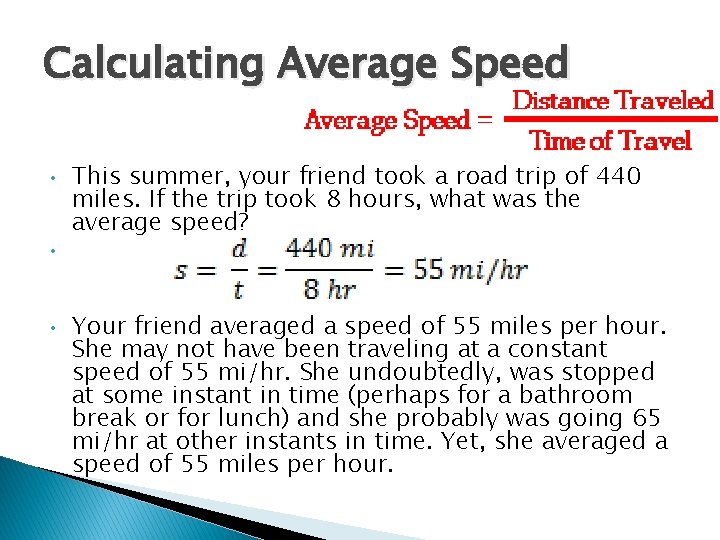
Calculating Average Speed • This summer, your friend took a road trip of 440 miles. If the trip took 8 hours, what was the average speed? • • Your friend averaged a speed of 55 miles per hour. She may not have been traveling at a constant speed of 55 mi/hr. She undoubtedly, was stopped at some instant in time (perhaps for a bathroom break or for lunch) and she probably was going 65 mi/hr at other instants in time. Yet, she averaged a speed of 55 miles per hour.
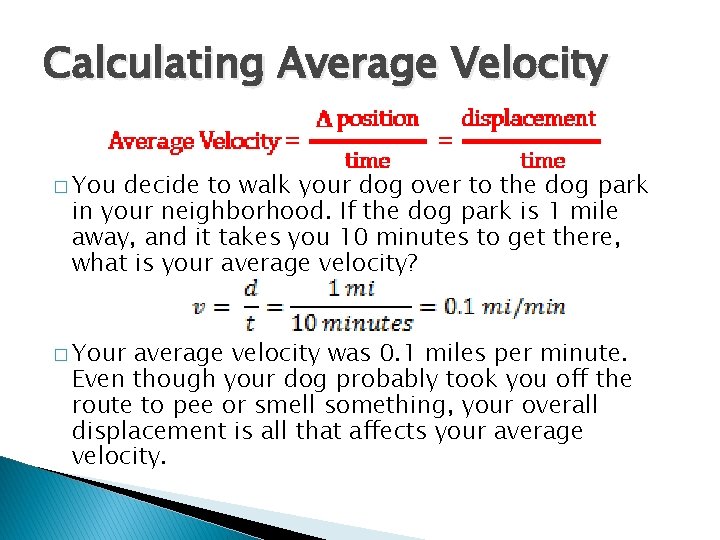
Calculating Average Velocity � You decide to walk your dog over to the dog park in your neighborhood. If the dog park is 1 mile away, and it takes you 10 minutes to get there, what is your average velocity? � Your average velocity was 0. 1 miles per minute. Even though your dog probably took you off the route to pee or smell something, your overall displacement is all that affects your average velocity.
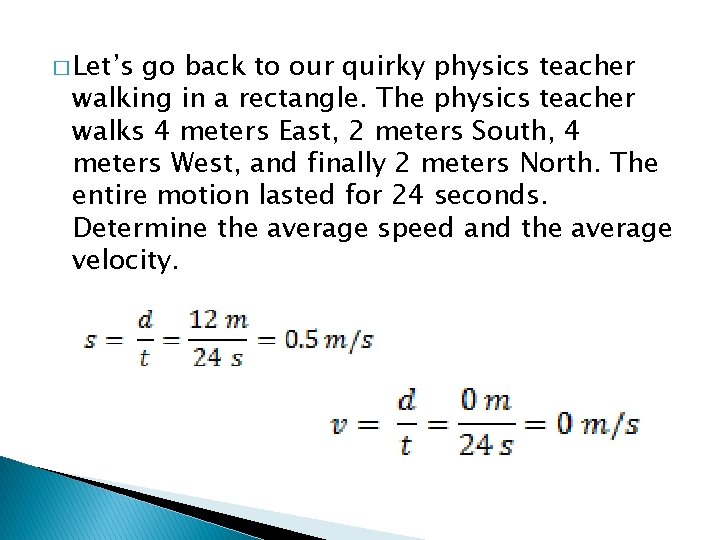
� Let’s go back to our quirky physics teacher walking in a rectangle. The physics teacher walks 4 meters East, 2 meters South, 4 meters West, and finally 2 meters North. The entire motion lasted for 24 seconds. Determine the average speed and the average velocity.
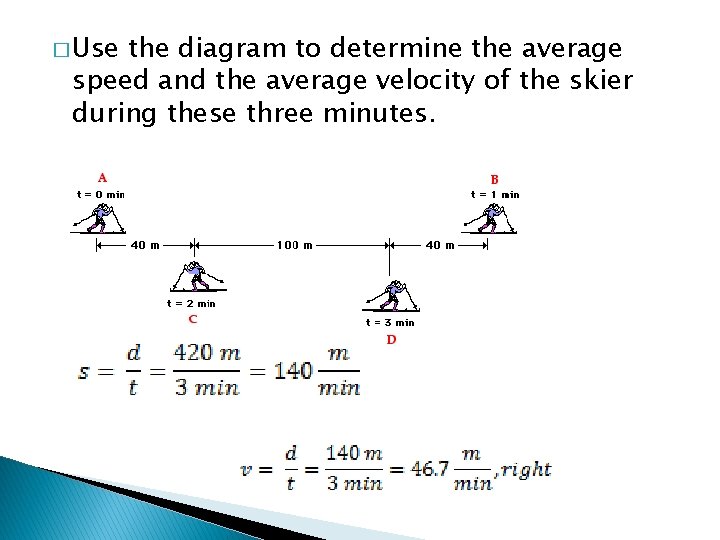
� Use the diagram to determine the average speed and the average velocity of the skier during these three minutes.
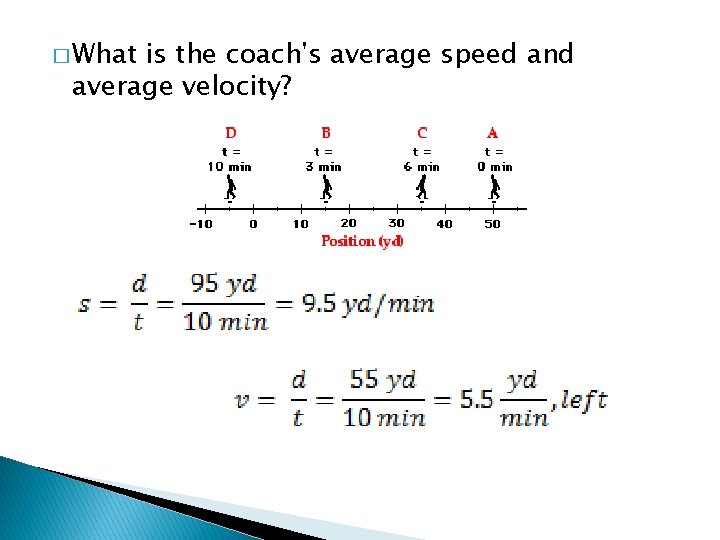
� What is the coach's average speed and average velocity?
• • Speed and velocity are kinematic quantities that have distinctly different definitions Speed, being a scalar quantity, is the rate at which an object covers distance. – The average speed is the distance (a scalar quantity) per time ratio. Speed is ignorant of direction. • Velocity is a vector quantity; it is directionaware. Velocity is the rate at which the position changes. – The average velocity is the displacement or position change (a vector quantity) per time ratio.
- Slides: 14