
Introduction This slide set is intended for use
- Slides: 31
Introduction �This slide set is intended for use by qualified clinical staff e. g. Nurse Advisors and Dental Nurse Advisors �It provides basic information on: � The use of analgesics in managing pain � The dangers of deliberate or accidental overdose with common, simple analgesics � Guidance on restarting analgesics after accidental overdose �Further information can be found in the BNF and NHS Evidence Dental Pain Guidance UKMi October 2015 1
Learning outcomes 1. Outline the key features of paracetamol, ibuprofen and other simple analgesics 2. Understand how and why overdoses of analgesics occur 3. Know when to refer calls about paracetamol and ibuprofen 4. Be able to give appropriate restarting guidance Dental Pain Guidance UKMi October 2015 2
Why worry about overdoses? �Very common �Harm to the patient �Self harm / psychological issues �Medicines readily available �Patient misconceptions of safety �Risk factors �Dental pain Dental Pain Guidance UKMi October 2015 3
Supratherapeutic overdoses Taking more than the recommended maximum dose for therapeutic purposes Examples: • Taking ibuprofen every 3 hours instead of every 6 -8 hours as pain isn’t controlled • Taking paracetamol along with co-codamol tablets for extra pain relief, without realising both contain paracetamol • Taking 3 paracetamol tablets per dose instead of 2 tablets Dental Pain Guidance UKMi October 2015 4
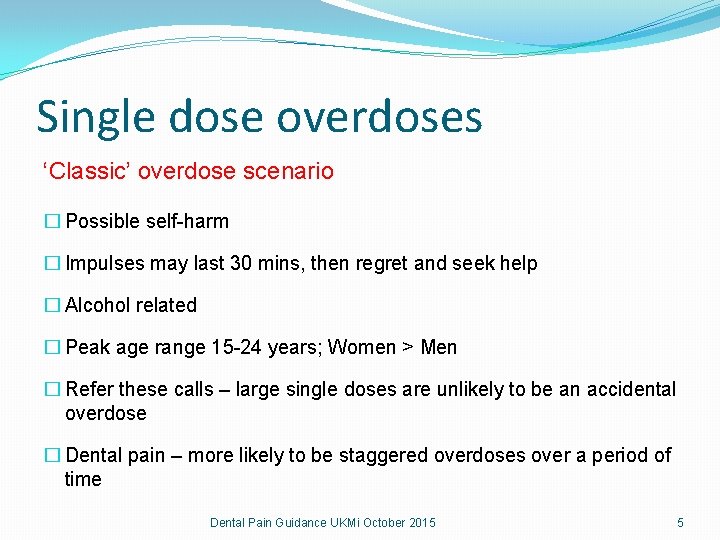
Single dose overdoses ‘Classic’ overdose scenario � Possible self-harm � Impulses may last 30 mins, then regret and seek help � Alcohol related � Peak age range 15 -24 years; Women > Men � Refer these calls – large single doses are unlikely to be an accidental overdose � Dental pain – more likely to be staggered overdoses over a period of time Dental Pain Guidance UKMi October 2015 5
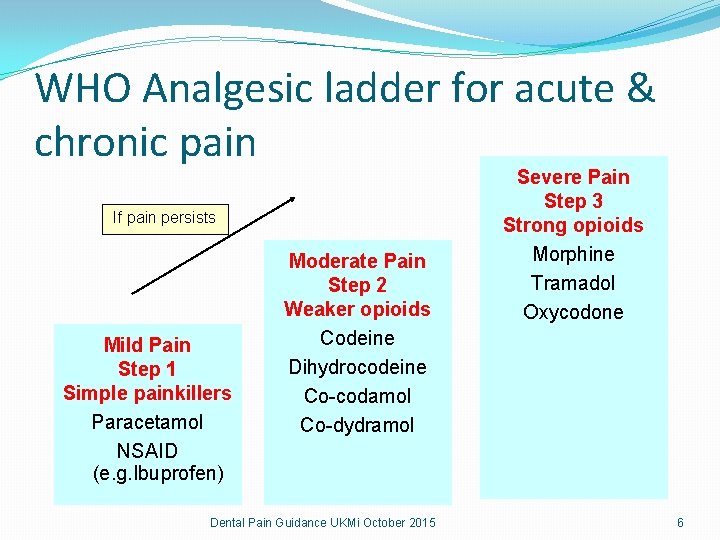
WHO Analgesic ladder for acute & chronic pain If pain persists Mild Pain Step 1 Simple painkillers Paracetamol NSAID (e. g. Ibuprofen) Moderate Pain Step 2 Weaker opioids Codeine Dihydrocodeine Co-codamol Co-dydramol Dental Pain Guidance UKMi October 2015 Severe Pain Step 3 Strong opioids Morphine Tramadol Oxycodone 6
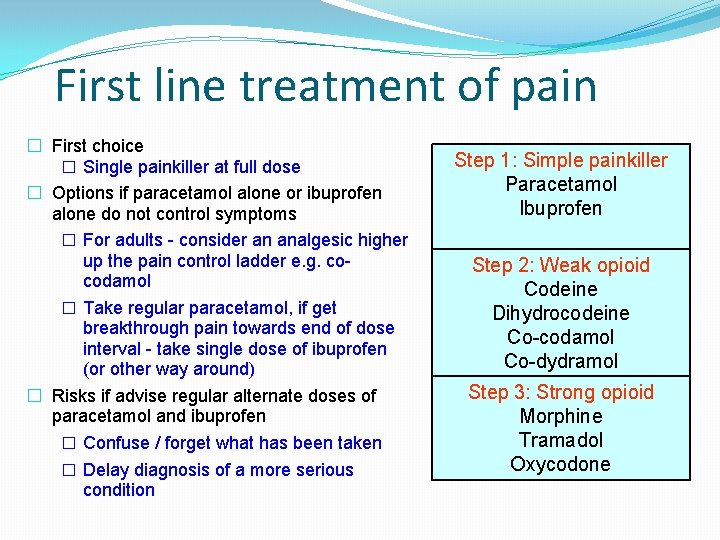
First line treatment of pain � First choice � Single painkiller at full dose � Options if paracetamol alone or ibuprofen alone do not control symptoms Step 1: Simple painkiller Paracetamol Ibuprofen � For adults - consider an analgesic higher up the pain control ladder e. g. cocodamol � Take regular paracetamol, if get breakthrough pain towards end of dose interval - take single dose of ibuprofen (or other way around) � Risks if advise regular alternate doses of paracetamol and ibuprofen � Confuse / forget what has been taken � Delay diagnosis of a more serious condition Step 2: Weak opioid Codeine Dihydrocodeine Co-codamol Co-dydramol Step 3: Strong opioid Morphine Tramadol Oxycodone
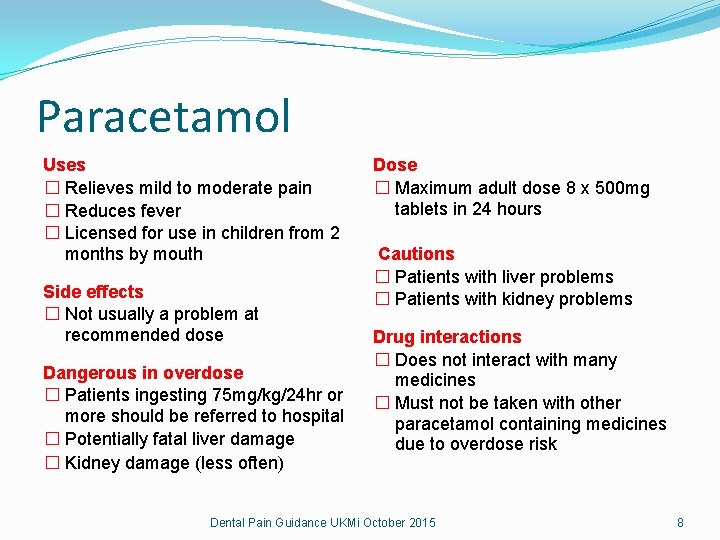
Paracetamol Uses � Relieves mild to moderate pain � Reduces fever � Licensed for use in children from 2 months by mouth Side effects � Not usually a problem at recommended dose Dangerous in overdose � Patients ingesting 75 mg/kg/24 hr or more should be referred to hospital � Potentially fatal liver damage � Kidney damage (less often) Dose � Maximum adult dose 8 x 500 mg tablets in 24 hours Cautions � Patients with liver problems � Patients with kidney problems Drug interactions � Does not interact with many medicines � Must not be taken with other paracetamol containing medicines due to overdose risk Dental Pain Guidance UKMi October 2015 8
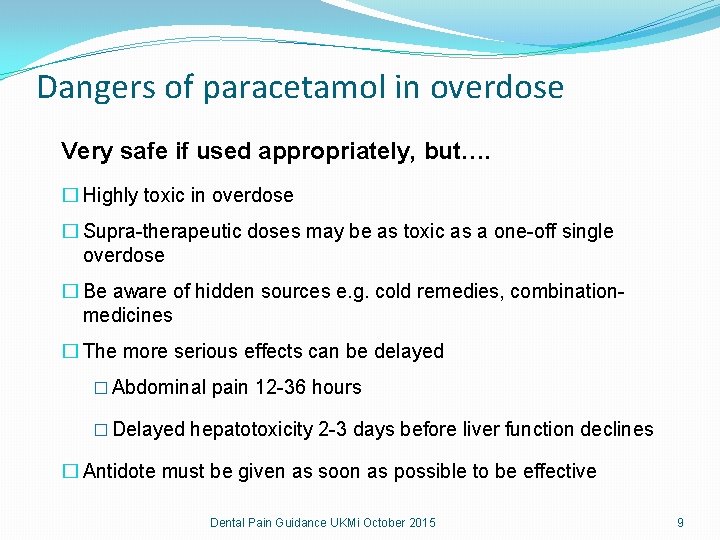
Dangers of paracetamol in overdose Very safe if used appropriately, but…. � Highly toxic in overdose � Supra-therapeutic doses may be as toxic as a one-off single overdose � Be aware of hidden sources e. g. cold remedies, combinationmedicines � The more serious effects can be delayed � Abdominal pain 12 -36 hours � Delayed hepatotoxicity 2 -3 days before liver function declines � Antidote must be given as soon as possible to be effective Dental Pain Guidance UKMi October 2015 9
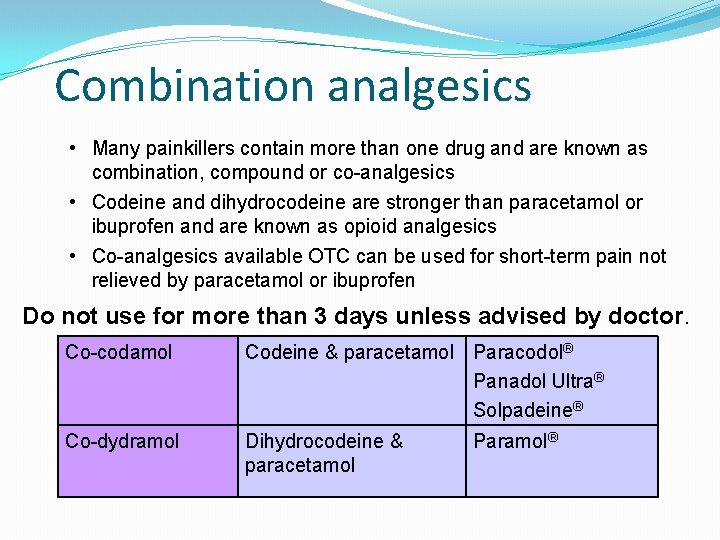
Combination analgesics • Many painkillers contain more than one drug and are known as combination, compound or co-analgesics • Codeine and dihydrocodeine are stronger than paracetamol or ibuprofen and are known as opioid analgesics • Co-analgesics available OTC can be used for short-term pain not relieved by paracetamol or ibuprofen Do not use for more than 3 days unless advised by doctor. Co-codamol Codeine & paracetamol Paracodol® Panadol Ultra® Solpadeine® Co-dydramol Dihydrocodeine & paracetamol Paramol®
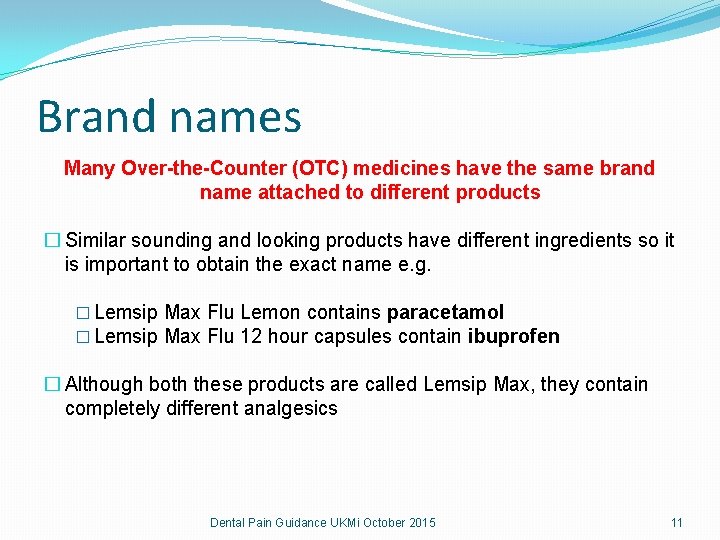
Brand names Many Over-the-Counter (OTC) medicines have the same brand name attached to different products � Similar sounding and looking products have different ingredients so it is important to obtain the exact name e. g. � Lemsip Max Flu Lemon contains paracetamol � Lemsip Max Flu 12 hour capsules contain ibuprofen � Although both these products are called Lemsip Max, they contain completely different analgesics Dental Pain Guidance UKMi October 2015 11
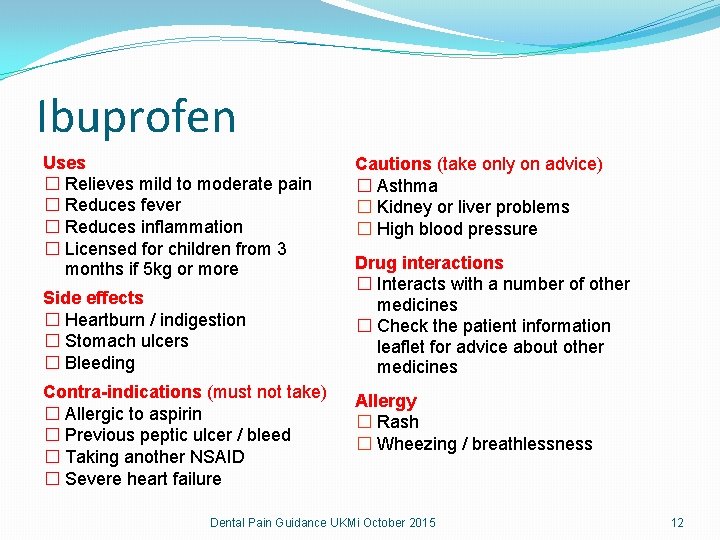
Ibuprofen Uses � Relieves mild to moderate pain � Reduces fever � Reduces inflammation � Licensed for children from 3 months if 5 kg or more Side effects � Heartburn / indigestion � Stomach ulcers � Bleeding Contra-indications (must not take) � Allergic to aspirin � Previous peptic ulcer / bleed � Taking another NSAID � Severe heart failure Cautions (take only on advice) � Asthma � Kidney or liver problems � High blood pressure Drug interactions � Interacts with a number of other medicines � Check the patient information leaflet for advice about other medicines Allergy � Rash � Wheezing / breathlessness Dental Pain Guidance UKMi October 2015 12
Ibuprofen overdose �Although it has a number of side effects with therapeutic use it has quite low toxicity in overdose �Most patients develop no more than: �Nausea, vomiting, epigastric pain or more rarely diarrhoea �Tinnitus, headache, GI bleeding also possible �Acute kidney damage - most serious complication (large doses) �CNS toxicity in serious overdose Dental Pain Guidance UKMi October 2015 13
Ibuprofen – different salts �Ibuprofen products are most commonly available as “plain” ibuprofen �Ibuprofen is also available in other forms in some products �The following few slides describe non-standard ibuprofen products and their equivalencies Dental Pain Guidance UKMi October 2015 14
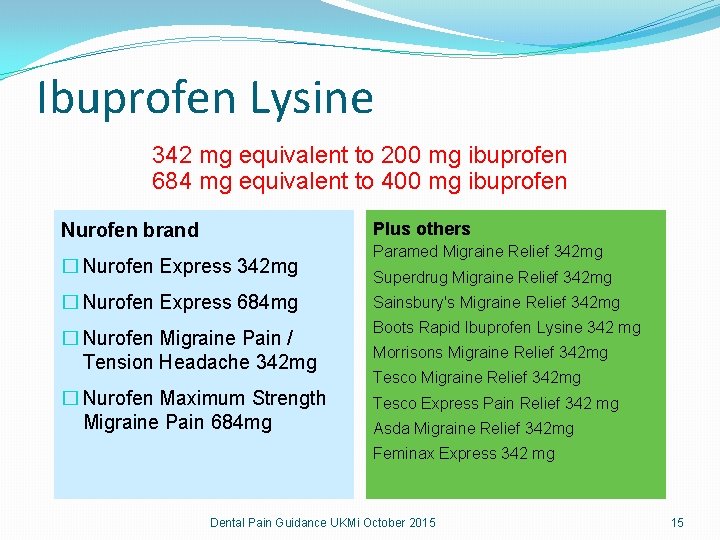
Ibuprofen Lysine 342 mg equivalent to 200 mg ibuprofen 684 mg equivalent to 400 mg ibuprofen Plus others Nurofen brand � Nurofen Express 342 mg � Nurofen Express 684 mg � Nurofen Migraine Pain / Tension Headache 342 mg � Nurofen Maximum Strength Migraine Pain 684 mg Paramed Migraine Relief 342 mg Superdrug Migraine Relief 342 mg Sainsbury's Migraine Relief 342 mg Boots Rapid Ibuprofen Lysine 342 mg Morrisons Migraine Relief 342 mg Tesco Migraine Relief 342 mg Tesco Express Pain Relief 342 mg Asda Migraine Relief 342 mg Feminax Express 342 mg Dental Pain Guidance UKMi October 2015 15
Ibuprofen Sodium 256 mg equivalent to 200 mg ibuprofen 512 mg equivalent to 400 mg ibuprofen Nurofen brand � Nurofen Express 256 mg Dental Pain Guidance UKMi October 2015 16
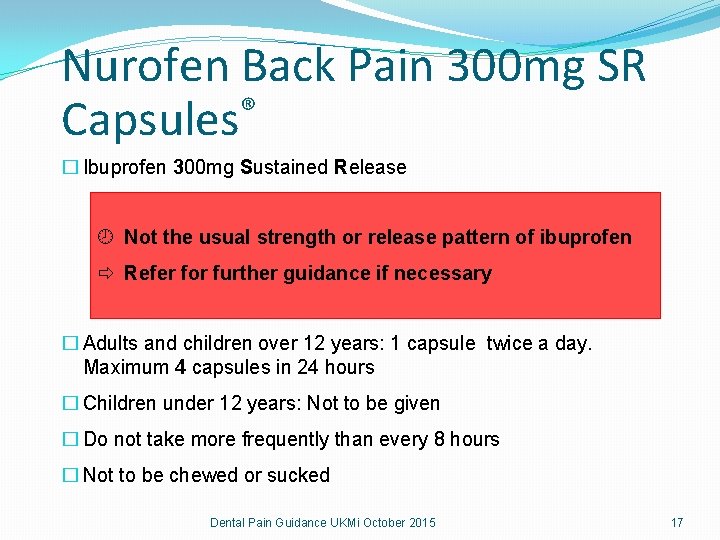
Nurofen Back Pain 300 mg SR ® Capsules � Ibuprofen 300 mg Sustained Release Not the usual strength or release pattern of ibuprofen Refer for further guidance if necessary � Adults and children over 12 years: 1 capsule twice a day. Maximum 4 capsules in 24 hours � Children under 12 years: Not to be given � Do not take more frequently than every 8 hours � Not to be chewed or sucked Dental Pain Guidance UKMi October 2015 17
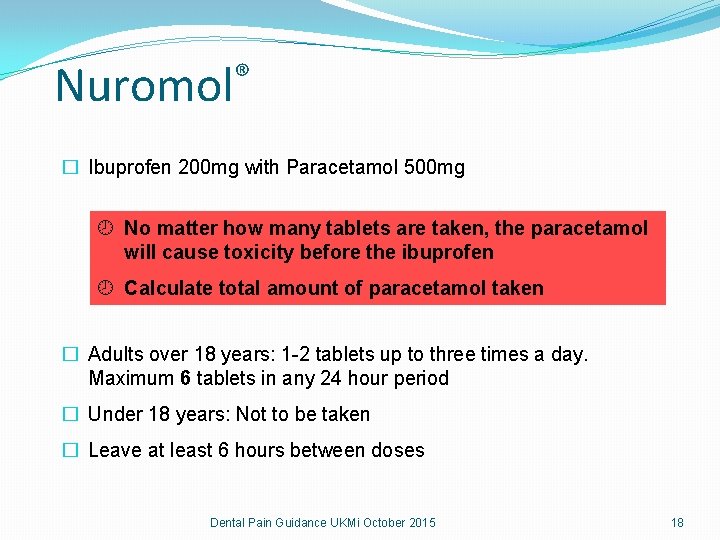
® Nuromol � Ibuprofen 200 mg with Paracetamol 500 mg No matter how many tablets are taken, the paracetamol will cause toxicity before the ibuprofen Calculate total amount of paracetamol taken � Adults over 18 years: 1 -2 tablets up to three times a day. Maximum 6 tablets in any 24 hour period � Under 18 years: Not to be taken � Leave at least 6 hours between doses Dental Pain Guidance UKMi October 2015 18
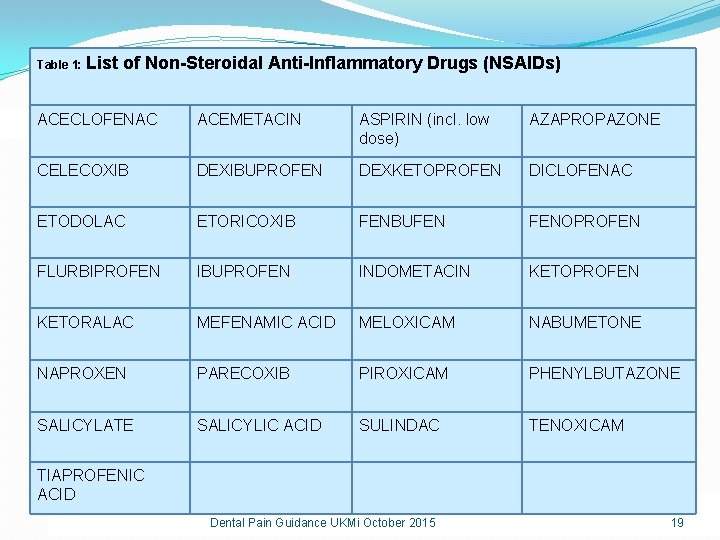
Table 1: List of Non-Steroidal Anti-Inflammatory Drugs (NSAIDs) ACECLOFENAC ACEMETACIN ASPIRIN (incl. low dose) AZAPROPAZONE CELECOXIB DEXIBUPROFEN DEXKETOPROFEN DICLOFENAC ETODOLAC ETORICOXIB FENBUFEN FENOPROFEN FLURBIPROFEN IBUPROFEN INDOMETACIN KETOPROFEN KETORALAC MEFENAMIC ACID MELOXICAM NABUMETONE NAPROXEN PARECOXIB PIROXICAM PHENYLBUTAZONE SALICYLATE SALICYLIC ACID SULINDAC TENOXICAM TIAPROFENIC ACID Dental Pain Guidance UKMi October 2015 19
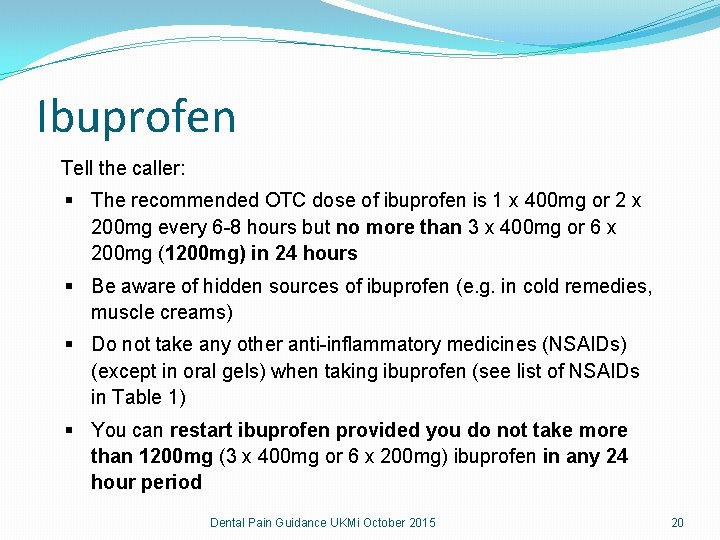
Ibuprofen Tell the caller: § The recommended OTC dose of ibuprofen is 1 x 400 mg or 2 x 200 mg every 6 -8 hours but no more than 3 x 400 mg or 6 x 200 mg (1200 mg) in 24 hours § Be aware of hidden sources of ibuprofen (e. g. in cold remedies, muscle creams) § Do not take any other anti-inflammatory medicines (NSAIDs) (except in oral gels) when taking ibuprofen (see list of NSAIDs in Table 1) § You can restart ibuprofen provided you do not take more than 1200 mg (3 x 400 mg or 6 x 200 mg) ibuprofen in any 24 hour period Dental Pain Guidance UKMi October 2015 20
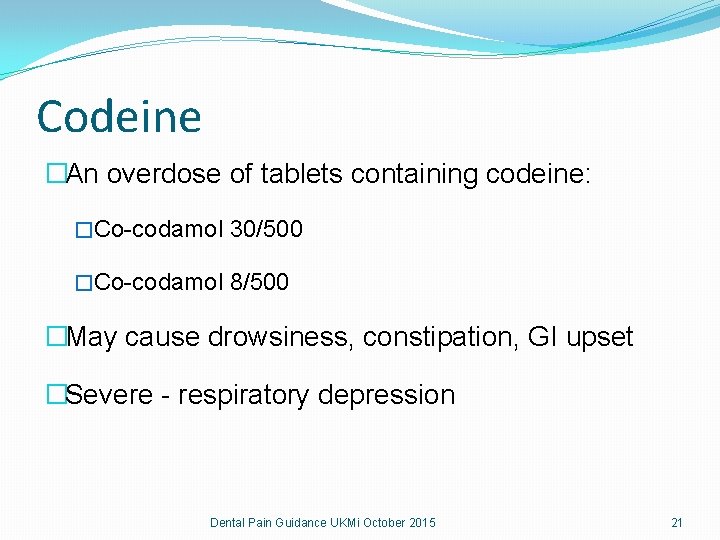
Codeine �An overdose of tablets containing codeine: �Co-codamol 30/500 �Co-codamol 8/500 �May cause drowsiness, constipation, GI upset �Severe - respiratory depression Dental Pain Guidance UKMi October 2015 21
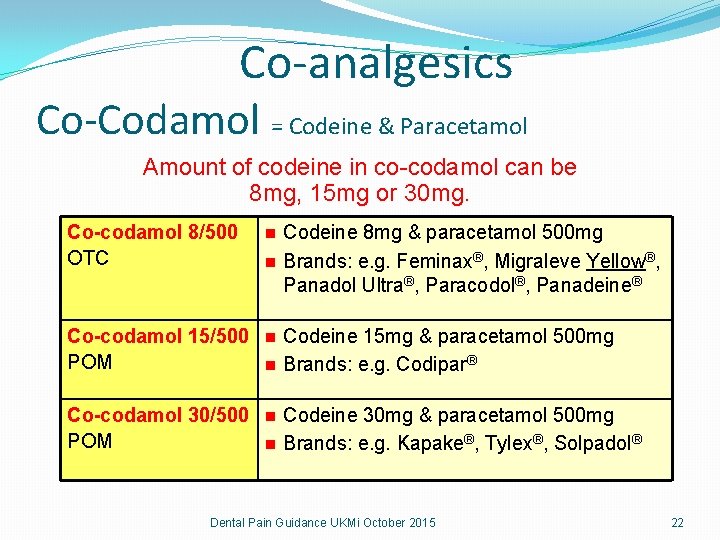
Co-analgesics Co-Codamol = Codeine & Paracetamol Amount of codeine in co-codamol can be 8 mg, 15 mg or 30 mg. Co-codamol 8/500 OTC Codeine 8 mg & paracetamol 500 mg n Brands: e. g. Feminax®, Migraleve Yellow®, Panadol Ultra®, Paracodol®, Panadeine® n Co-codamol 15/500 n Codeine 15 mg & paracetamol 500 mg POM n Brands: e. g. Codipar® Co-codamol 30/500 n Codeine 30 mg & paracetamol 500 mg POM n Brands: e. g. Kapake®, Tylex®, Solpadol® Dental Pain Guidance UKMi October 2015 22
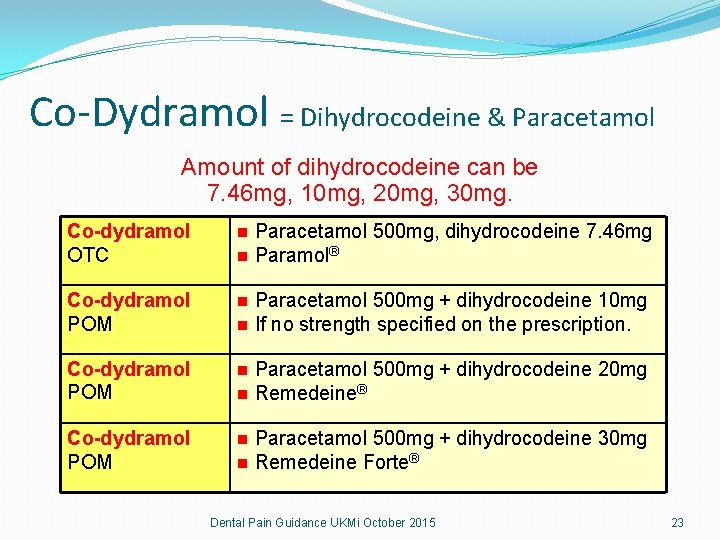
Co-Dydramol = Dihydrocodeine & Paracetamol Amount of dihydrocodeine can be 7. 46 mg, 10 mg, 20 mg, 30 mg. Co-dydramol OTC n n Paracetamol 500 mg, dihydrocodeine 7. 46 mg Paramol® Co-dydramol POM n n Paracetamol 500 mg + dihydrocodeine 10 mg If no strength specified on the prescription. Co-dydramol POM n n Paracetamol 500 mg + dihydrocodeine 20 mg Remedeine® Co-dydramol POM n n Paracetamol 500 mg + dihydrocodeine 30 mg Remedeine Forte® Dental Pain Guidance UKMi October 2015 23
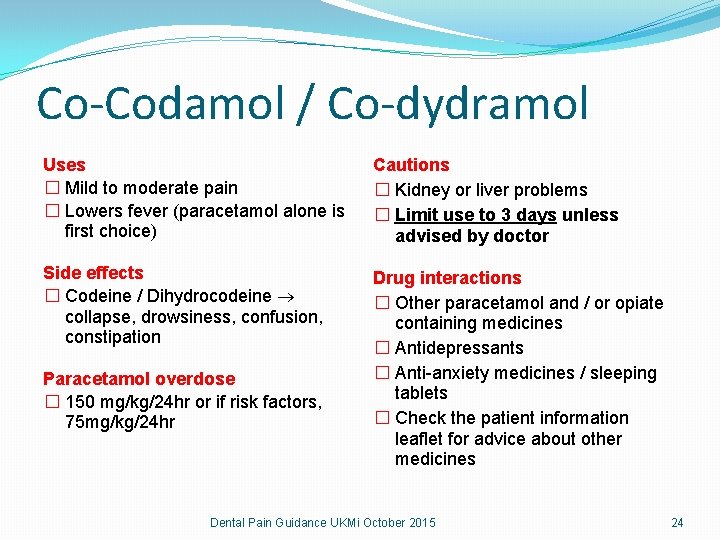
Co-Codamol / Co-dydramol Uses � Mild to moderate pain � Lowers fever (paracetamol alone is first choice) Cautions � Kidney or liver problems � Limit use to 3 days unless advised by doctor Side effects � Codeine / Dihydrocodeine collapse, drowsiness, confusion, constipation Drug interactions � Other paracetamol and / or opiate containing medicines � Antidepressants � Anti-anxiety medicines / sleeping tablets � Check the patient information leaflet for advice about other medicines Paracetamol overdose � 150 mg/kg/24 hr or if risk factors, 75 mg/kg/24 hr Dental Pain Guidance UKMi October 2015 24
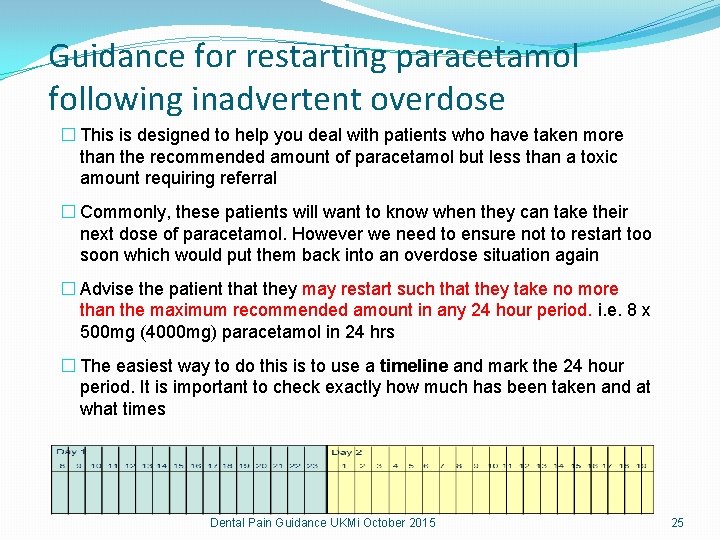
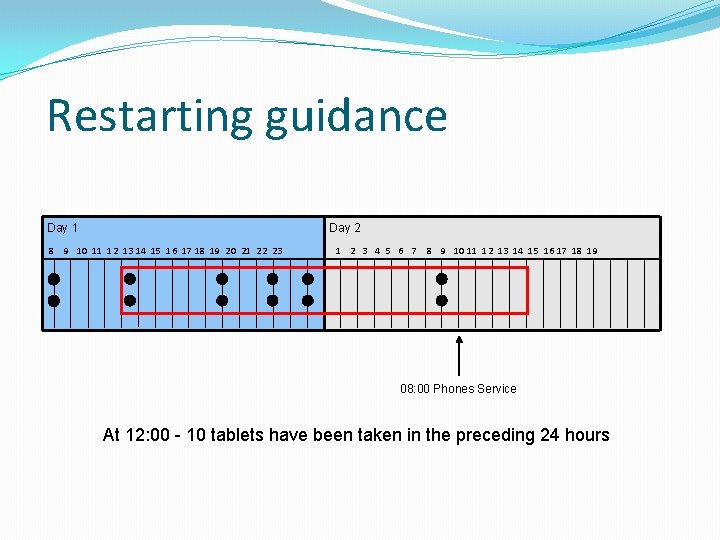
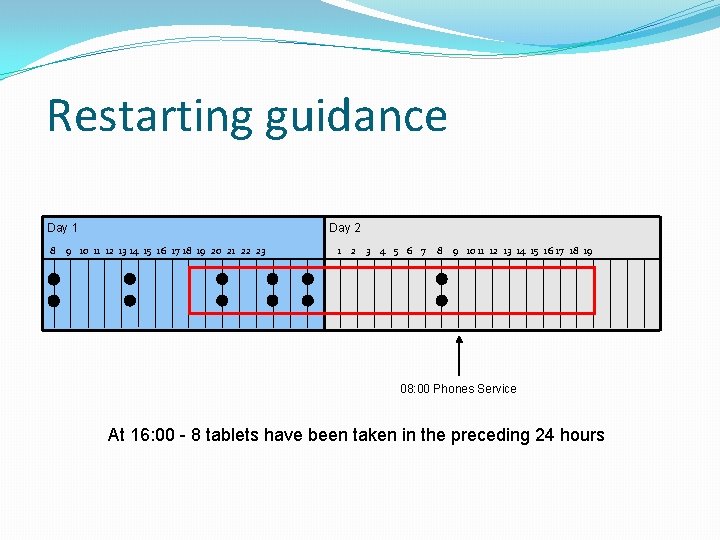
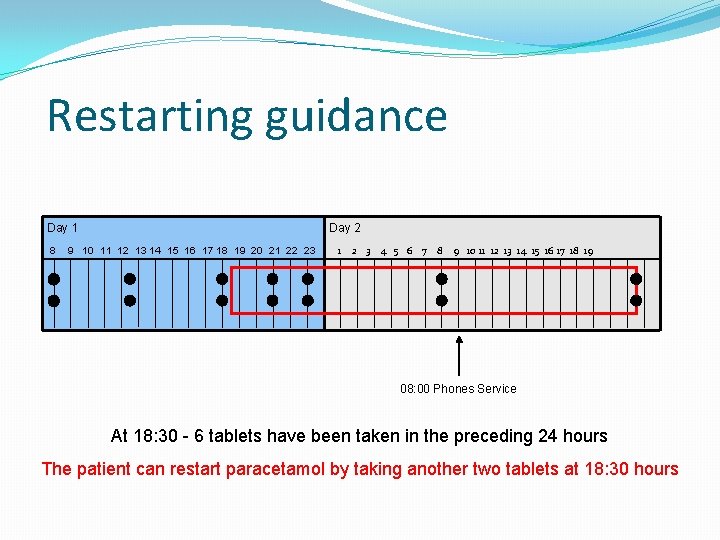
Guidance for restarting paracetamol following inadvertent overdose � This is designed to help you deal with patients who have taken more than the recommended amount of paracetamol but less than a toxic amount requiring referral � Commonly, these patients will want to know when they can take their next dose of paracetamol. However we need to ensure not to restart too soon which would put them back into an overdose situation again � Advise the patient that they may restart such that they take no more than the maximum recommended amount in any 24 hour period. i. e. 8 x 500 mg (4000 mg) paracetamol in 24 hrs � The easiest way to do this is to use a timeline and mark the 24 hour period. It is important to check exactly how much has been taken and at what times Dental Pain Guidance UKMi October 2015 25
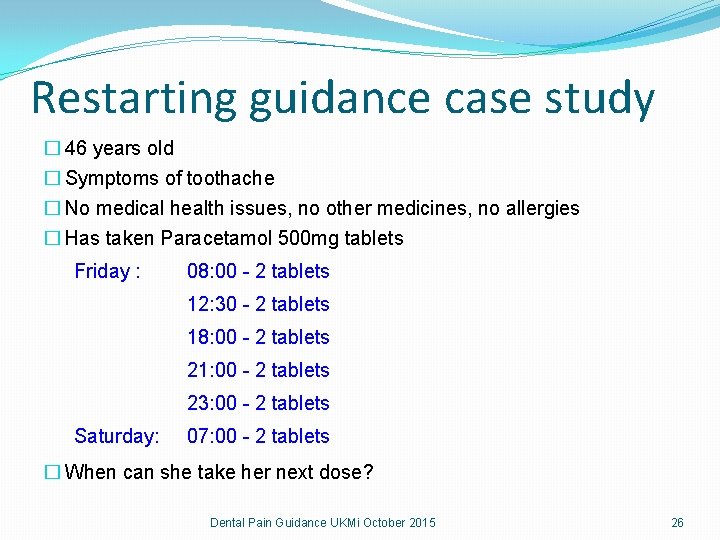
Restarting guidance case study � 46 years old � Symptoms of toothache � No medical health issues, no other medicines, no allergies � Has taken Paracetamol 500 mg tablets Friday : 08: 00 - 2 tablets 12: 30 - 2 tablets 18: 00 - 2 tablets 21: 00 - 2 tablets 23: 00 - 2 tablets Saturday: 07: 00 - 2 tablets � When can she take her next dose? Dental Pain Guidance UKMi October 2015 26
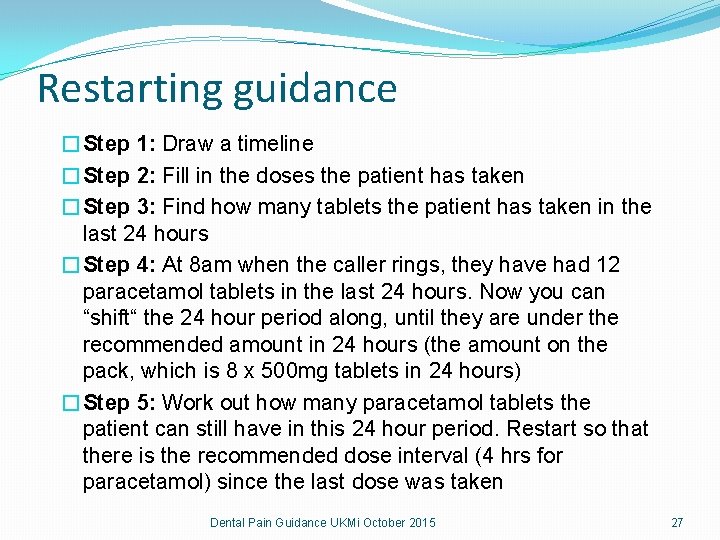
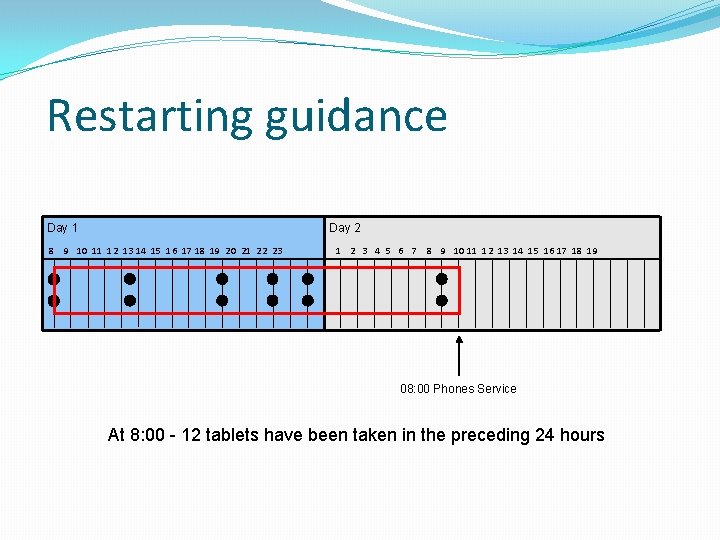
Restarting guidance �Step 1: Draw a timeline �Step 2: Fill in the doses the patient has taken �Step 3: Find how many tablets the patient has taken in the last 24 hours �Step 4: At 8 am when the caller rings, they have had 12 paracetamol tablets in the last 24 hours. Now you can “shift“ the 24 hour period along, until they are under the recommended amount in 24 hours (the amount on the pack, which is 8 x 500 mg tablets in 24 hours) �Step 5: Work out how many paracetamol tablets the patient can still have in this 24 hour period. Restart so that there is the recommended dose interval (4 hrs for paracetamol) since the last dose was taken Dental Pain Guidance UKMi October 2015 27
Restarting guidance Day 1 Day 2 8 9 10 11 12 13 14 15 16 17 18 19 20 21 22 23 1 2 3 4 5 6 7 8 9 10 11 12 13 14 15 16 17 18 19 08: 00 Phones Service At 8: 00 - 12 tablets have been taken in the preceding 24 hours
Restarting guidance Day 1 Day 2 8 9 10 11 12 13 14 15 16 17 18 19 20 21 22 23 1 2 3 4 5 6 7 8 9 10 11 12 13 14 15 16 17 18 19 08: 00 Phones Service At 12: 00 - 10 tablets have been taken in the preceding 24 hours
Restarting guidance Day 1 8 Day 2 9 10 11 12 13 14 15 16 17 18 19 20 21 22 23 1 2 3 4 5 6 7 8 9 10 11 12 13 14 15 16 17 18 19 08: 00 Phones Service At 16: 00 - 8 tablets have been taken in the preceding 24 hours
Restarting guidance Day 1 Day 2 8 9 10 11 12 13 14 15 16 17 18 19 20 21 22 23 1 2 3 4 5 6 7 8 9 10 11 12 13 14 15 16 17 18 19 08: 00 Phones Service At 18: 30 - 6 tablets have been taken in the preceding 24 hours The patient can restart paracetamol by taking another two tablets at 18: 30 hours