
Introduction There are many types of equations used

- Slides: 33
Introduction There are many types of equations used in solving mathematics. The type of equation you work with depends largely on the problem situation, the information given, and what you are trying to find out. In this lesson, you will work with rational equations, equations that have a variable in a denominator. 1 3. 5. 1: Creating Rational Equations
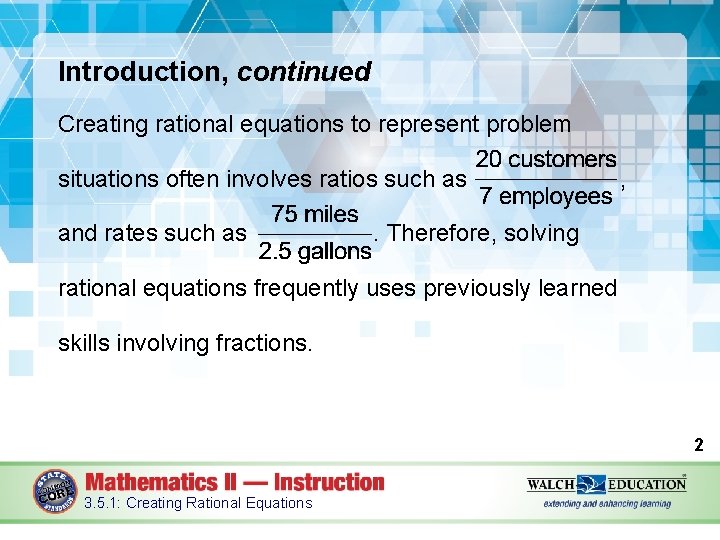
Introduction, continued Creating rational equations to represent problem situations often involves ratios such as and rates such as , . Therefore, solving rational equations frequently uses previously learned skills involving fractions. 2 3. 5. 1: Creating Rational Equations
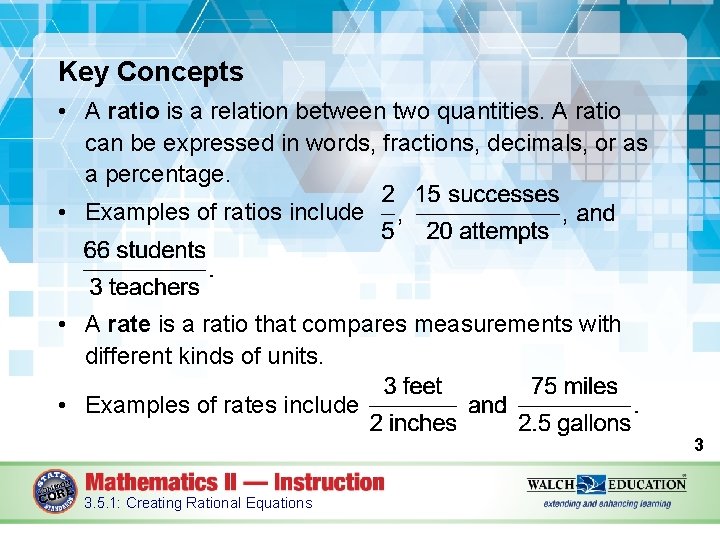
Key Concepts • A ratio is a relation between two quantities. A ratio can be expressed in words, fractions, decimals, or as a percentage. • Examples of ratios include • A rate is a ratio that compares measurements with different kinds of units. • Examples of rates include 3 3. 5. 1: Creating Rational Equations
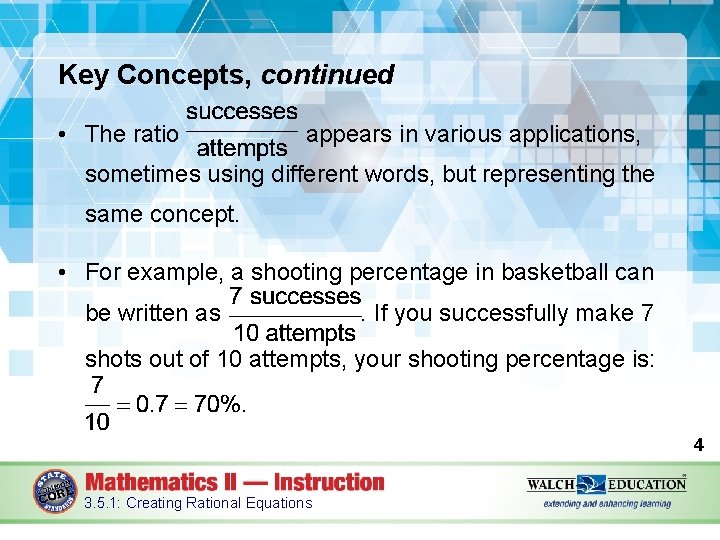
Key Concepts, continued • The ratio appears in various applications, sometimes using different words, but representing the same concept. • For example, a shooting percentage in basketball can be written as . If you successfully make 7 shots out of 10 attempts, your shooting percentage is: 4 3. 5. 1: Creating Rational Equations
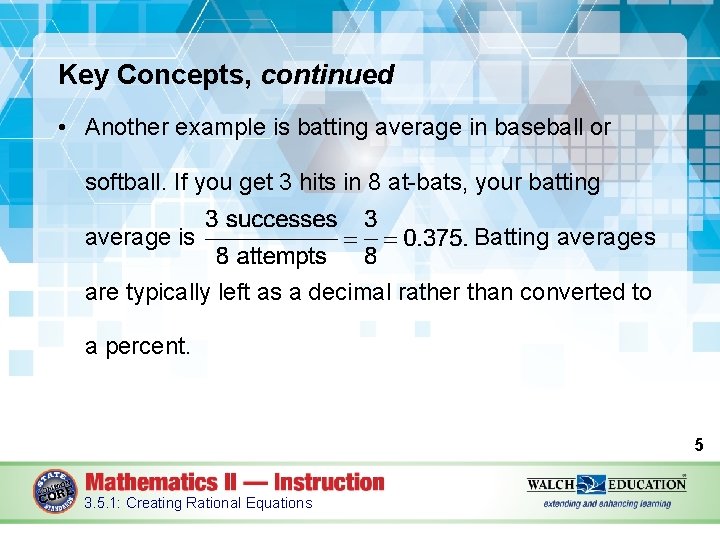
Key Concepts, continued • Another example is batting average in baseball or softball. If you get 3 hits in 8 at-bats, your batting average is Batting averages are typically left as a decimal rather than converted to a percent. 5 3. 5. 1: Creating Rational Equations
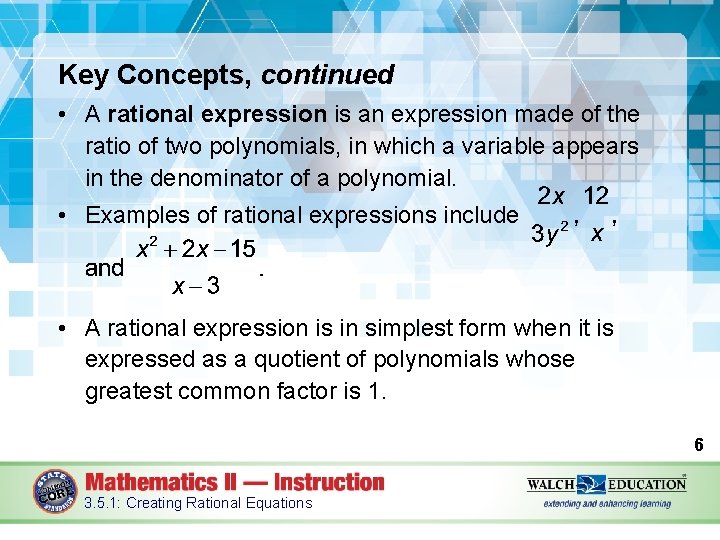
Key Concepts, continued • A rational expression is an expression made of the ratio of two polynomials, in which a variable appears in the denominator of a polynomial. • Examples of rational expressions include • A rational expression is in simplest form when it is expressed as a quotient of polynomials whose greatest common factor is 1. 6 3. 5. 1: Creating Rational Equations
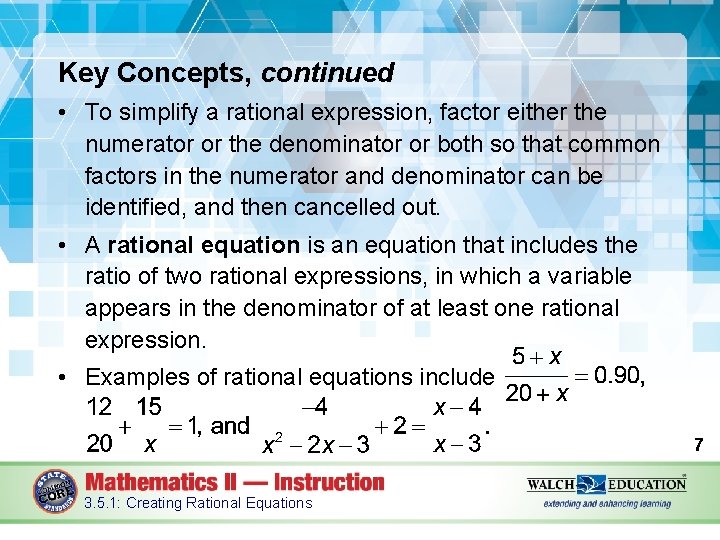
Key Concepts, continued • To simplify a rational expression, factor either the numerator or the denominator or both so that common factors in the numerator and denominator can be identified, and then cancelled out. • A rational equation is an equation that includes the ratio of two rational expressions, in which a variable appears in the denominator of at least one rational expression. • Examples of rational equations include 7 3. 5. 1: Creating Rational Equations
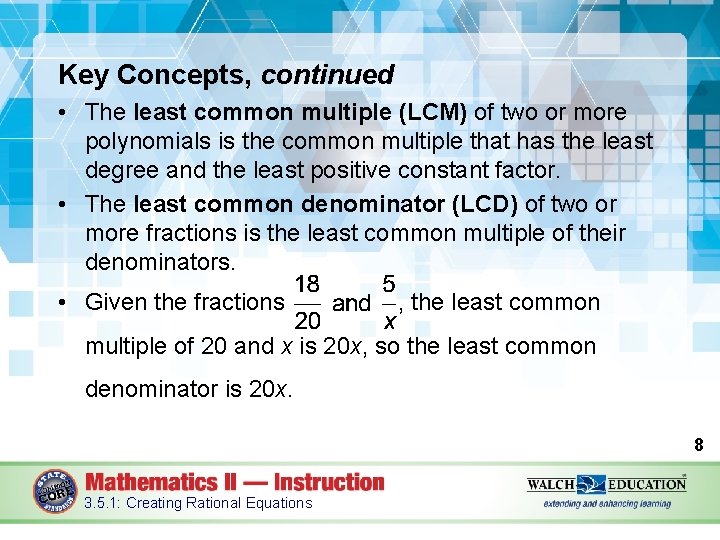
Key Concepts, continued • The least common multiple (LCM) of two or more polynomials is the common multiple that has the least degree and the least positive constant factor. • The least common denominator (LCD) of two or more fractions is the least common multiple of their denominators. • Given the fractions , the least common multiple of 20 and x is 20 x, so the least common denominator is 20 x. 8 3. 5. 1: Creating Rational Equations
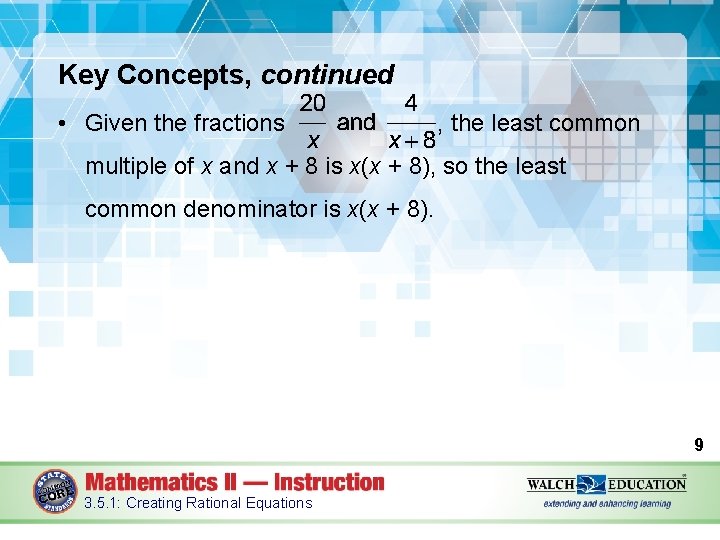
Key Concepts, continued • Given the fractions , the least common multiple of x and x + 8 is x(x + 8), so the least common denominator is x(x + 8). 9 3. 5. 1: Creating Rational Equations
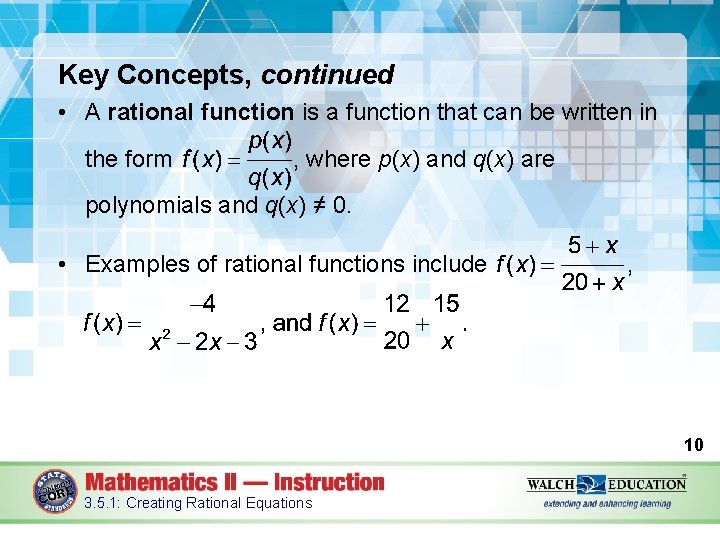
Key Concepts, continued • A rational function is a function that can be written in the form , where p(x) and q(x) are polynomials and q(x) ≠ 0. • Examples of rational functions include 10 3. 5. 1: Creating Rational Equations
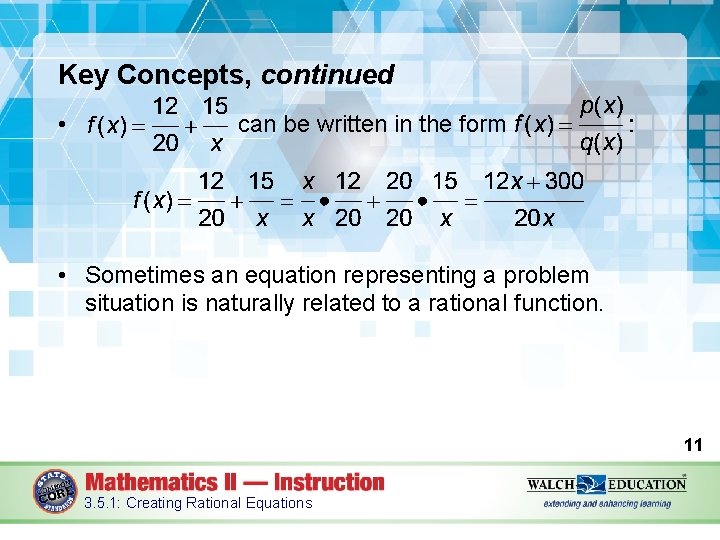
Key Concepts, continued • can be written in the form • Sometimes an equation representing a problem situation is naturally related to a rational function. 11 3. 5. 1: Creating Rational Equations
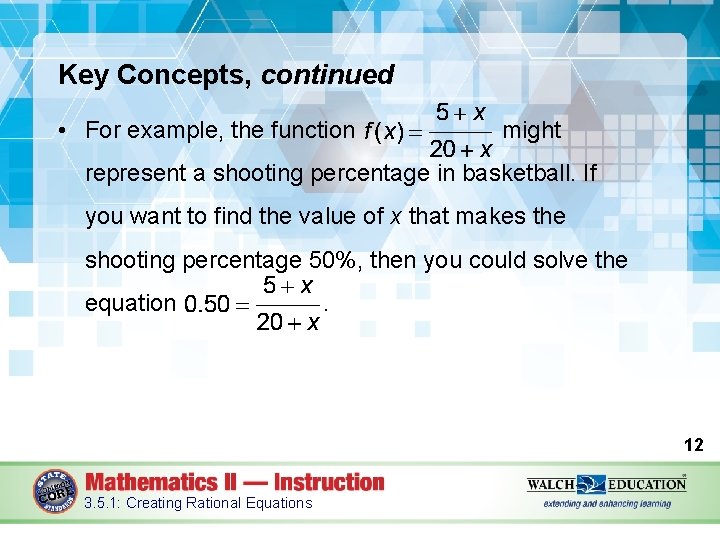
Key Concepts, continued • For example, the function might represent a shooting percentage in basketball. If you want to find the value of x that makes the shooting percentage 50%, then you could solve the equation . 12 3. 5. 1: Creating Rational Equations
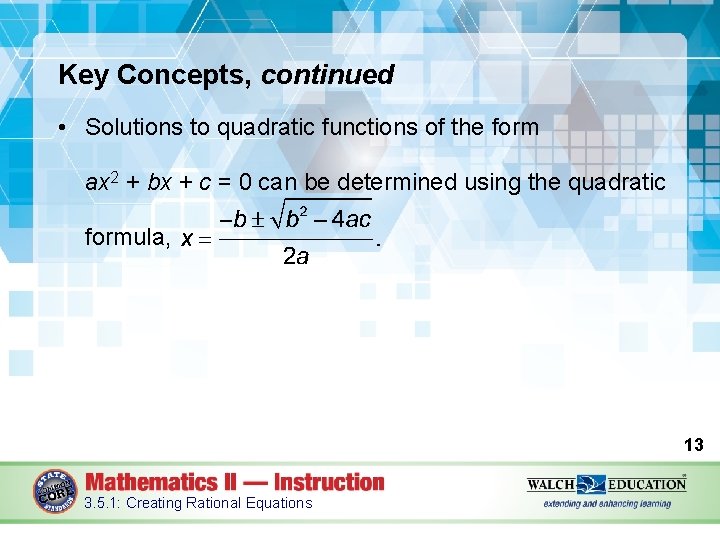
Key Concepts, continued • Solutions to quadratic functions of the form ax 2 + bx + c = 0 can be determined using the quadratic formula, 13 3. 5. 1: Creating Rational Equations
Key Concepts, continued • An extraneous solution, or extraneous root, of an equation is a solution of an equation that arises during the solving process, but which is not a solution of the original equation. • Extraneous solutions sometimes occur when solving rational equations, so it is important to check all apparent solutions by substituting them into the original equation and determining if they make it true. 14 3. 5. 1: Creating Rational Equations
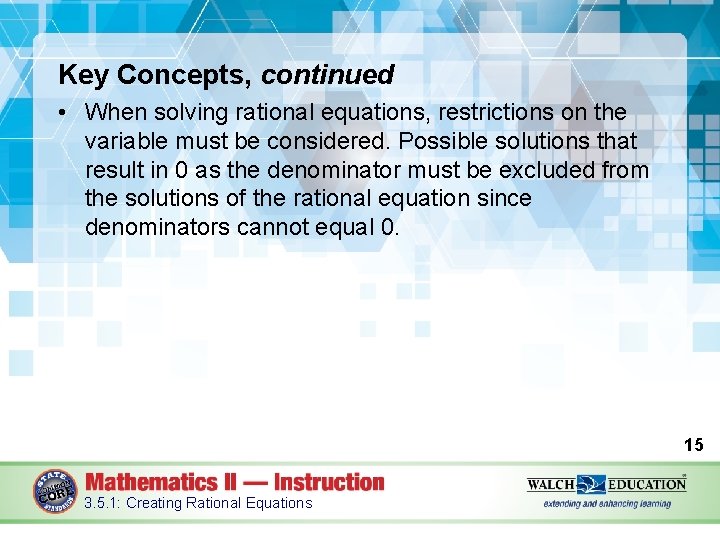
Key Concepts, continued • When solving rational equations, restrictions on the variable must be considered. Possible solutions that result in 0 as the denominator must be excluded from the solutions of the rational equation since denominators cannot equal 0. 15 3. 5. 1: Creating Rational Equations
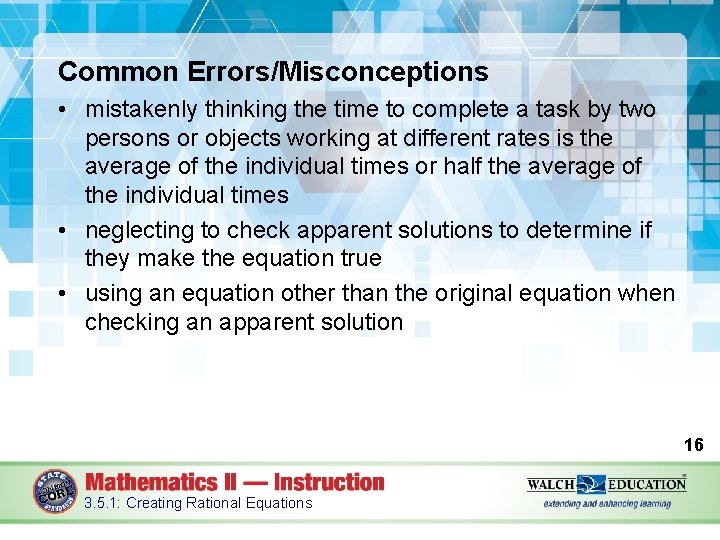
Common Errors/Misconceptions • mistakenly thinking the time to complete a task by two persons or objects working at different rates is the average of the individual times or half the average of the individual times • neglecting to check apparent solutions to determine if they make the equation true • using an equation other than the original equation when checking an apparent solution 16 3. 5. 1: Creating Rational Equations
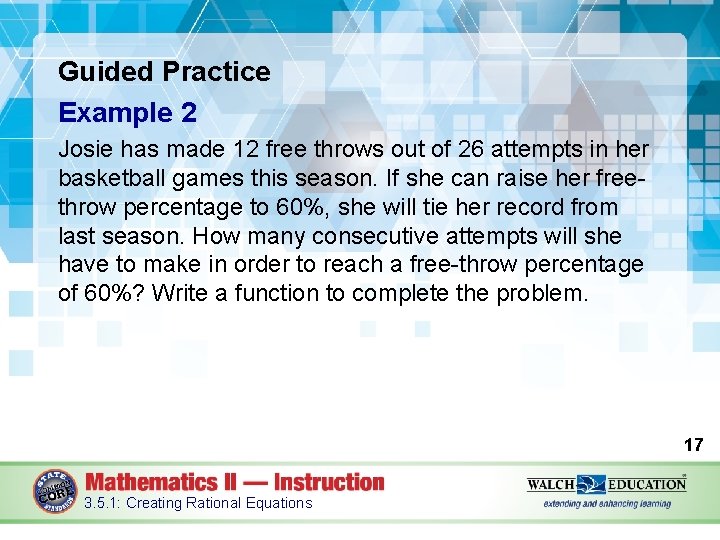
Guided Practice Example 2 Josie has made 12 free throws out of 26 attempts in her basketball games this season. If she can raise her freethrow percentage to 60%, she will tie her record from last season. How many consecutive attempts will she have to make in order to reach a free-throw percentage of 60%? Write a function to complete the problem. 17 3. 5. 1: Creating Rational Equations
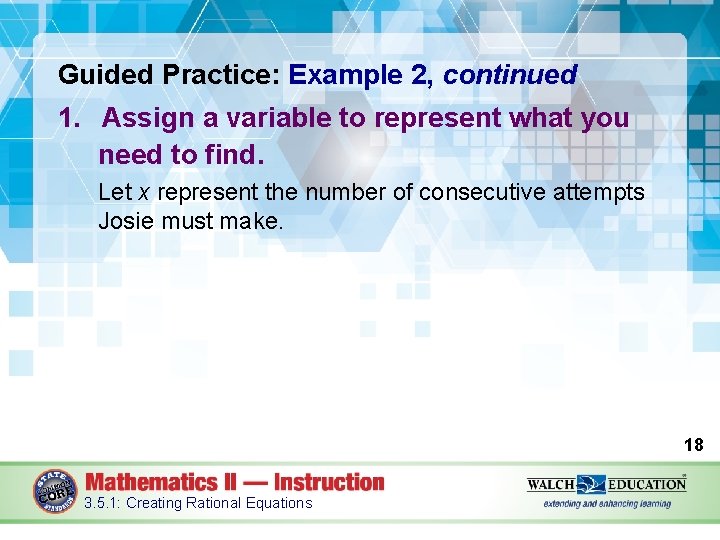
Guided Practice: Example 2, continued 1. Assign a variable to represent what you need to find. Let x represent the number of consecutive attempts Josie must make. 18 3. 5. 1: Creating Rational Equations
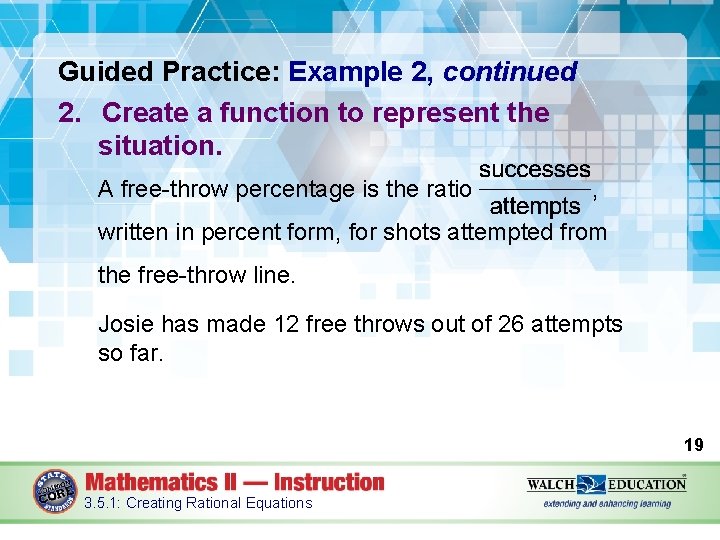
Guided Practice: Example 2, continued 2. Create a function to represent the situation. A free-throw percentage is the ratio , written in percent form, for shots attempted from the free-throw line. Josie has made 12 free throws out of 26 attempts so far. 19 3. 5. 1: Creating Rational Equations
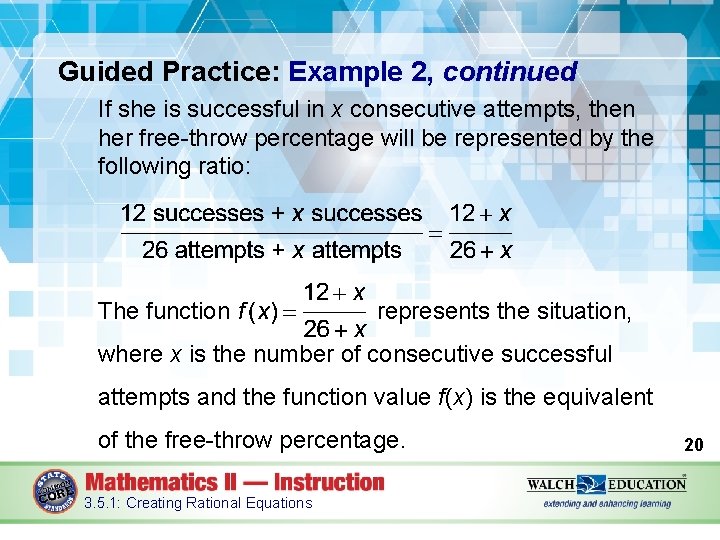
Guided Practice: Example 2, continued If she is successful in x consecutive attempts, then her free-throw percentage will be represented by the following ratio: The function represents the situation, where x is the number of consecutive successful attempts and the function value f(x) is the equivalent of the free-throw percentage. 3. 5. 1: Creating Rational Equations 20
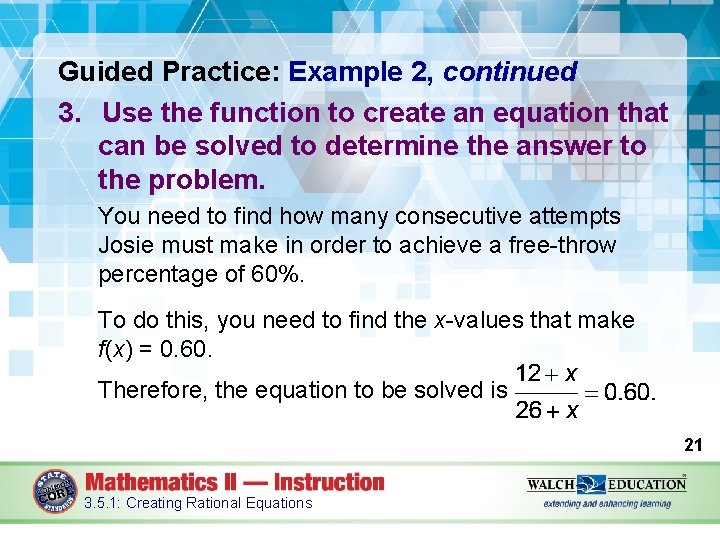
Guided Practice: Example 2, continued 3. Use the function to create an equation that can be solved to determine the answer to the problem. You need to find how many consecutive attempts Josie must make in order to achieve a free-throw percentage of 60%. To do this, you need to find the x-values that make f(x) = 0. 60. Therefore, the equation to be solved is 21 3. 5. 1: Creating Rational Equations
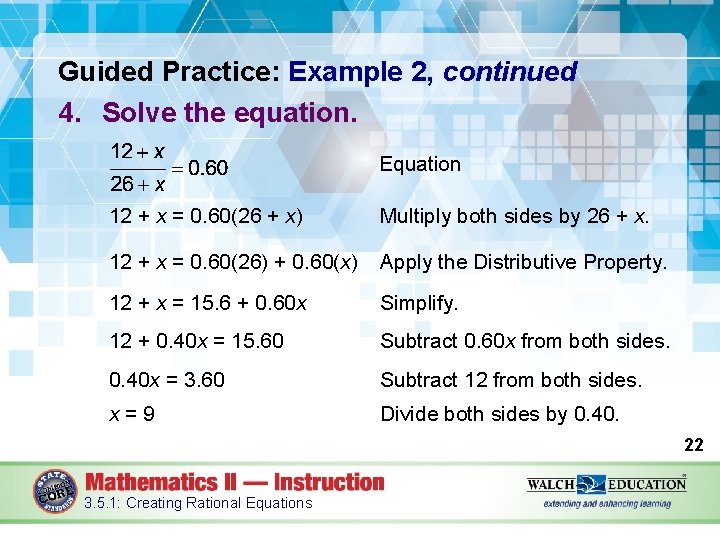
Guided Practice: Example 2, continued 4. Solve the equation. Equation 12 + x = 0. 60(26 + x) Multiply both sides by 26 + x. 12 + x = 0. 60(26) + 0. 60(x) Apply the Distributive Property. 12 + x = 15. 6 + 0. 60 x Simplify. 12 + 0. 40 x = 15. 60 Subtract 0. 60 x from both sides. 0. 40 x = 3. 60 Subtract 12 from both sides. x=9 Divide both sides by 0. 40. 22 3. 5. 1: Creating Rational Equations
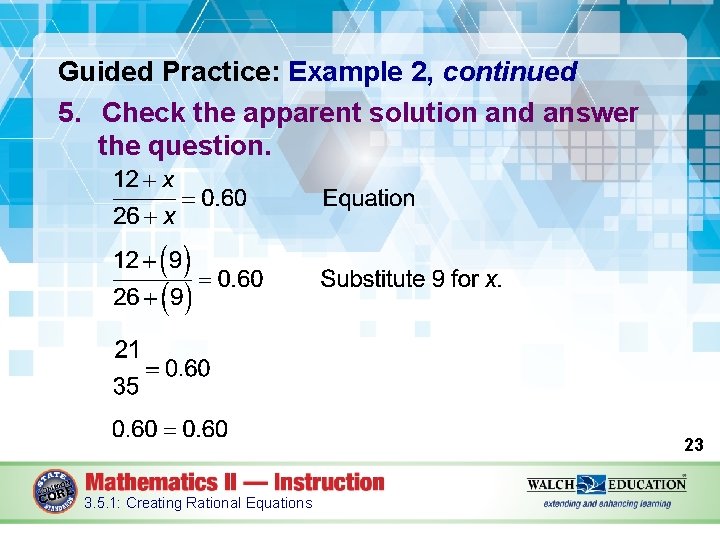
Guided Practice: Example 2, continued 5. Check the apparent solution and answer the question. 23 3. 5. 1: Creating Rational Equations
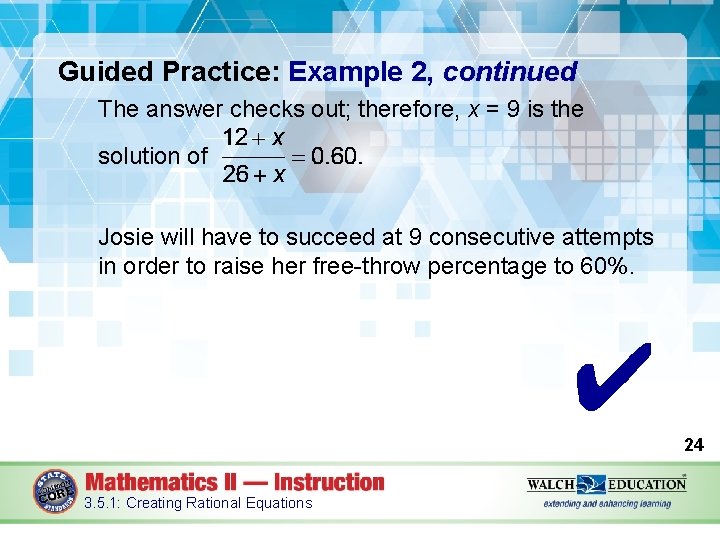
Guided Practice: Example 2, continued The answer checks out; therefore, x = 9 is the solution of Josie will have to succeed at 9 consecutive attempts in order to raise her free-throw percentage to 60%. ✔ 24 3. 5. 1: Creating Rational Equations
Guided Practice: Example 2, continued 25 3. 5. 1: Creating Rational Equations
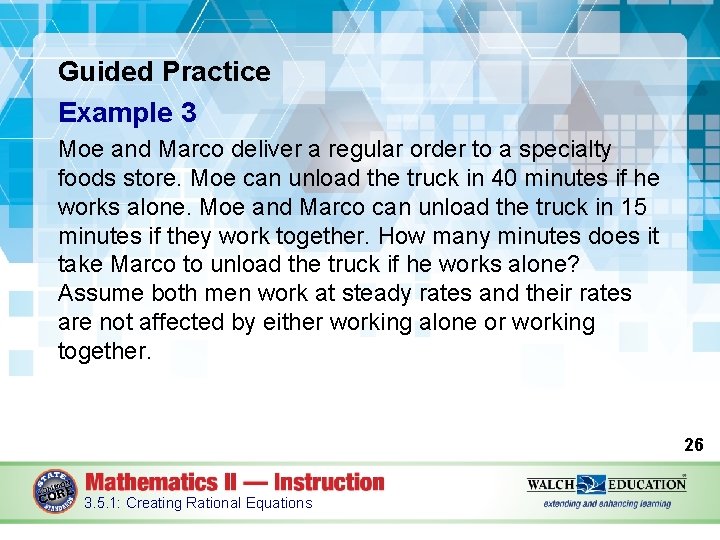
Guided Practice Example 3 Moe and Marco deliver a regular order to a specialty foods store. Moe can unload the truck in 40 minutes if he works alone. Moe and Marco can unload the truck in 15 minutes if they work together. How many minutes does it take Marco to unload the truck if he works alone? Assume both men work at steady rates and their rates are not affected by either working alone or working together. 26 3. 5. 1: Creating Rational Equations
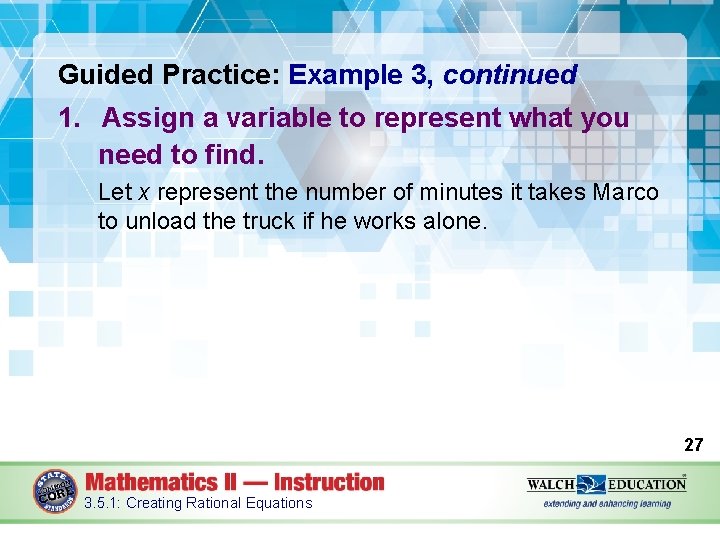
Guided Practice: Example 3, continued 1. Assign a variable to represent what you need to find. Let x represent the number of minutes it takes Marco to unload the truck if he works alone. 27 3. 5. 1: Creating Rational Equations
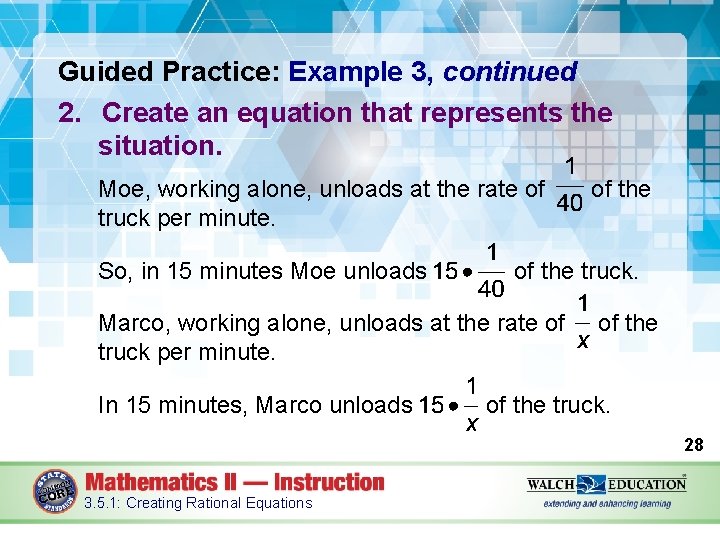
Guided Practice: Example 3, continued 2. Create an equation that represents the situation. Moe, working alone, unloads at the rate of truck per minute. So, in 15 minutes Moe unloads of the truck. Marco, working alone, unloads at the rate of truck per minute. In 15 minutes, Marco unloads of the truck. 28 3. 5. 1: Creating Rational Equations
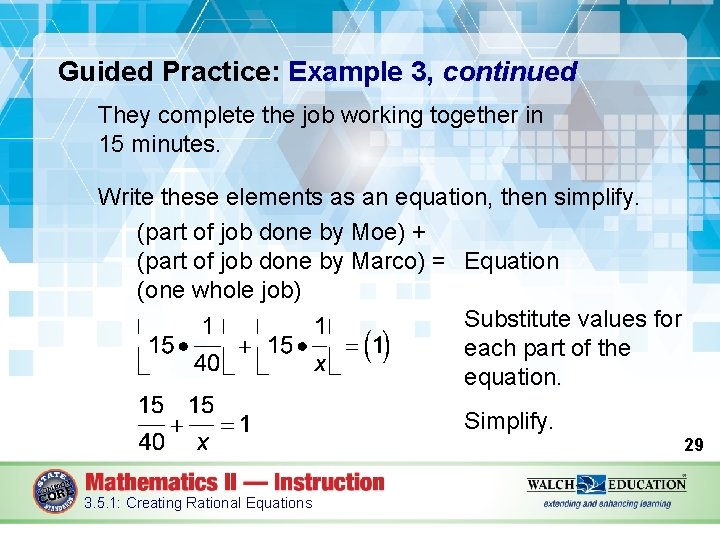
Guided Practice: Example 3, continued They complete the job working together in 15 minutes. Write these elements as an equation, then simplify. (part of job done by Moe) + (part of job done by Marco) = Equation (one whole job) Substitute values for each part of the equation. Simplify. 29 3. 5. 1: Creating Rational Equations
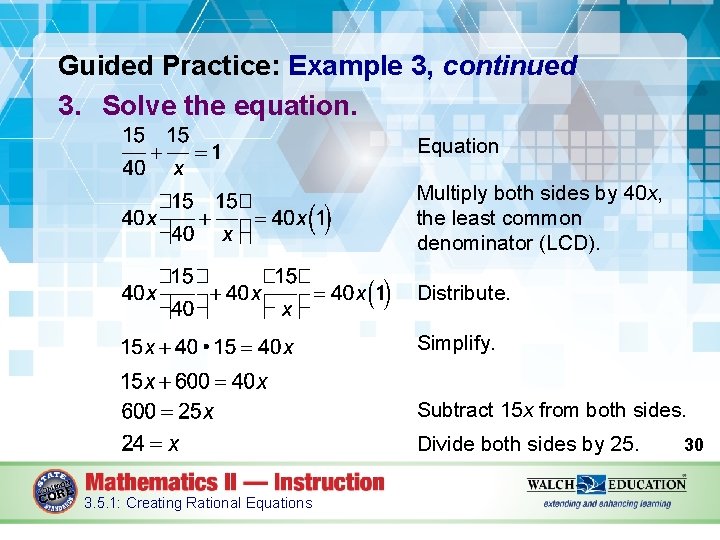
Guided Practice: Example 3, continued 3. Solve the equation. Equation Multiply both sides by 40 x, the least common denominator (LCD). Distribute. Simplify. Subtract 15 x from both sides. Divide both sides by 25. 3. 5. 1: Creating Rational Equations 30
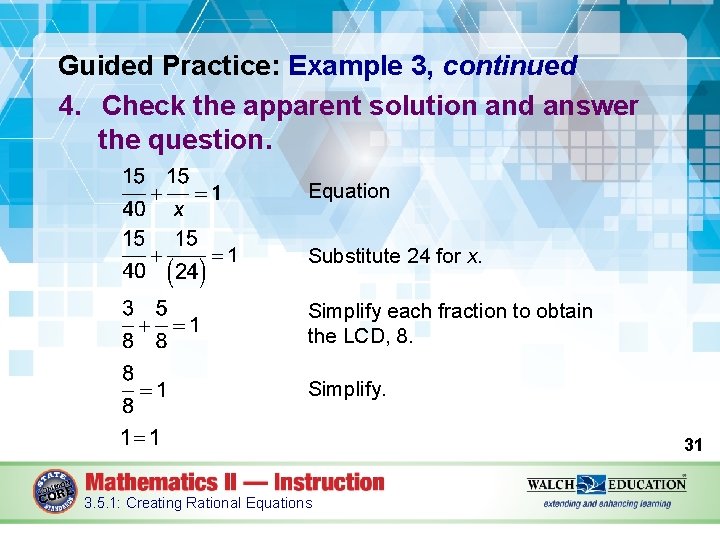
Guided Practice: Example 3, continued 4. Check the apparent solution and answer the question. Equation Substitute 24 for x. Simplify each fraction to obtain the LCD, 8. Simplify. 31 3. 5. 1: Creating Rational Equations
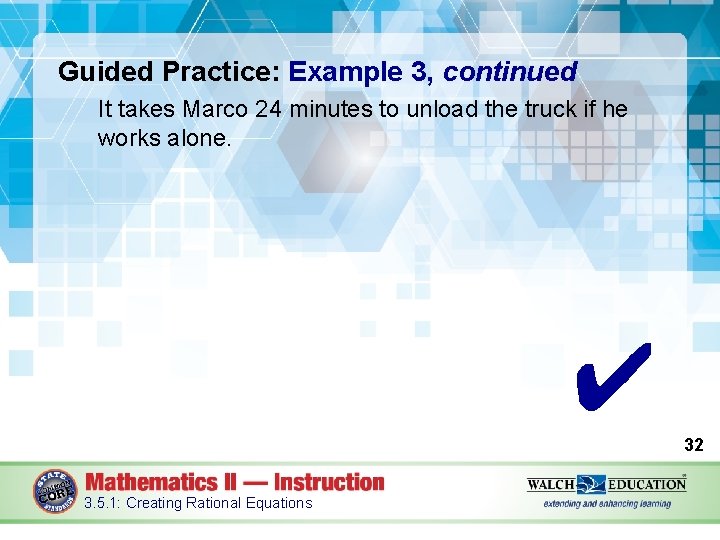
Guided Practice: Example 3, continued It takes Marco 24 minutes to unload the truck if he works alone. ✔ 32 3. 5. 1: Creating Rational Equations
Guided Practice: Example 3, continued 33 3. 5. 1: Creating Rational Equations