
Introduction The textbook Classical Mechanics 3 rd Edition

Introduction
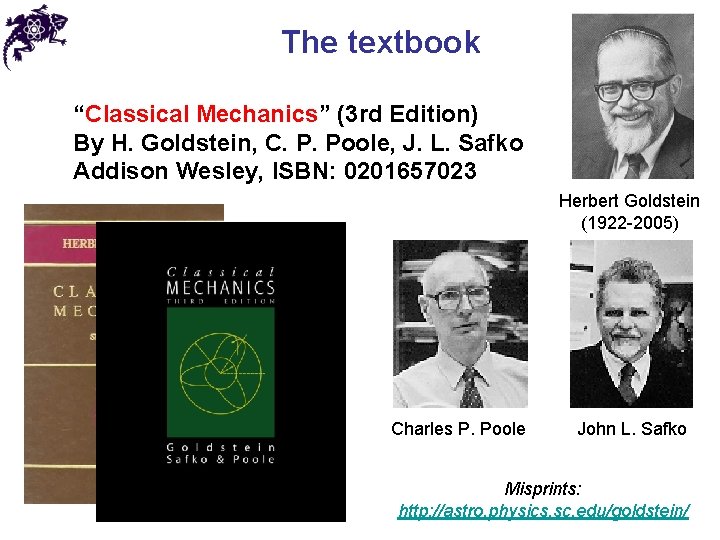
The textbook “Classical Mechanics” (3 rd Edition) By H. Goldstein, C. P. Poole, J. L. Safko Addison Wesley, ISBN: 0201657023 Herbert Goldstein (1922 -2005) Charles P. Poole John L. Safko Misprints: http: //astro. physics. sc. edu/goldstein/
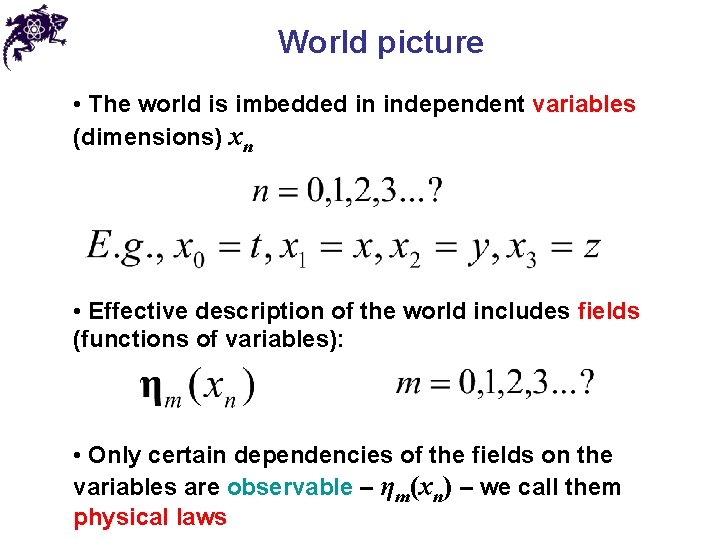
World picture • The world is imbedded in independent variables (dimensions) xn • Effective description of the world includes fields (functions of variables): • Only certain dependencies of the fields on the variables are observable – ηm(xn) – we call them physical laws
Systems • Usually we consider only finite sets of objects: systems • Complete description of a system is almost always impossible: need of approximations (models, reductions, truncations, etc. ) • Some systems can be approximated as closed, with no interaction with the rest of the world • Some systems can not be adequately modeled as closed and have to be described as open, interacting with the environment
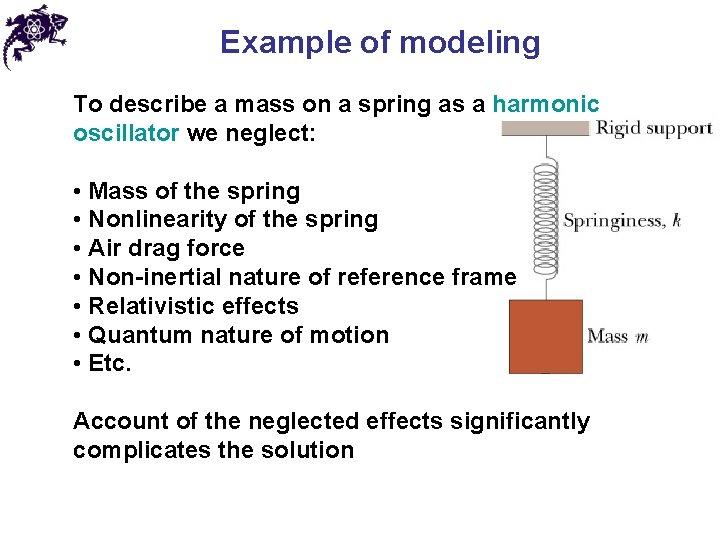
Example of modeling To describe a mass on a spring as a harmonic oscillator we neglect: • Mass of the spring • Nonlinearity of the spring • Air drag force • Non-inertial nature of reference frame • Relativistic effects • Quantum nature of motion • Etc. Account of the neglected effects significantly complicates the solution
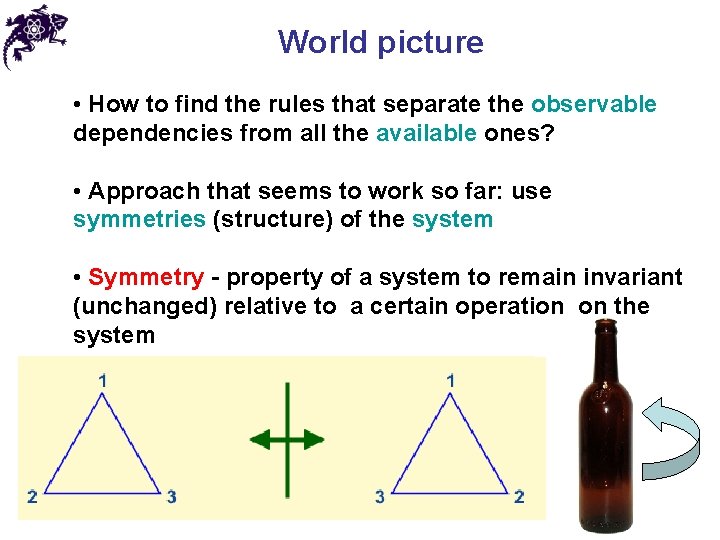
World picture • How to find the rules that separate the observable dependencies from all the available ones? • Approach that seems to work so far: use symmetries (structure) of the system • Symmetry - property of a system to remain invariant (unchanged) relative to a certain operation on the system
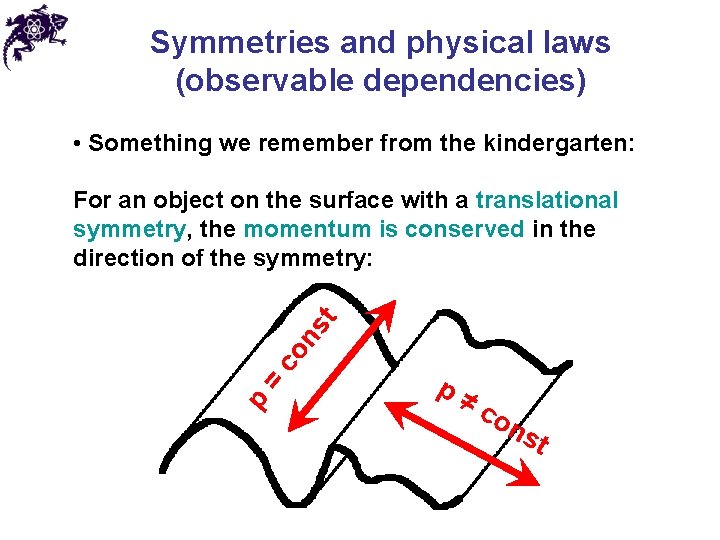
Symmetries and physical laws (observable dependencies) • Something we remember from the kindergarten: p = co ns t For an object on the surface with a translational symmetry, the momentum is conserved in the direction of the symmetry: p≠ co ns t
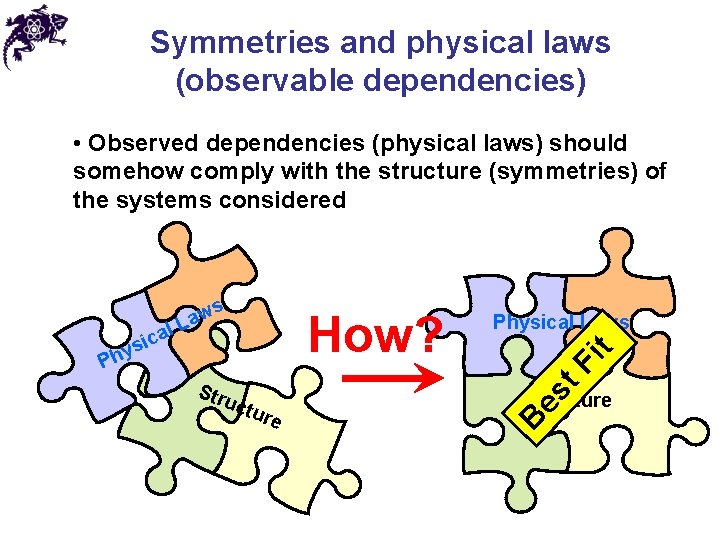
Symmetries and physical laws (observable dependencies) • Observed dependencies (physical laws) should somehow comply with the structure (symmetries) of the systems considered Str uct ure it How? Physical Laws B es t. F y Ph s l ica s w La Structure
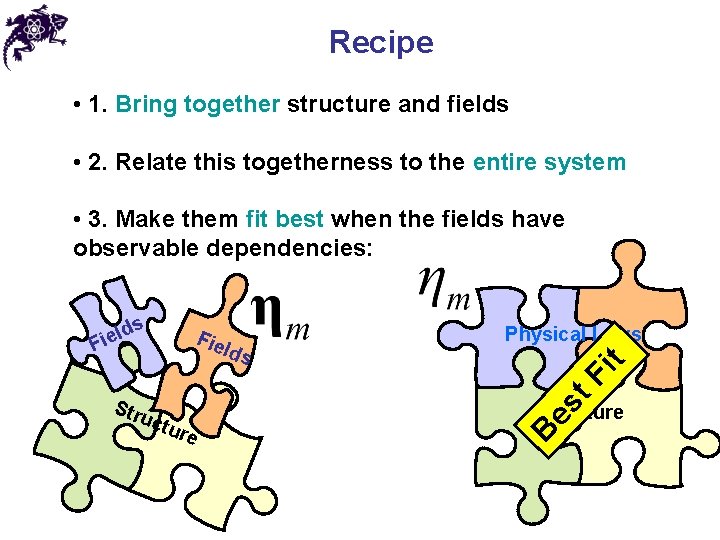
Recipe • 1. Bring together structure and fields • 2. Relate this togetherness to the entire system • 3. Make them fit best when the fields have observable dependencies: Fie lds F Str uc ture Physical Laws B es t. F it s d l ie Structure
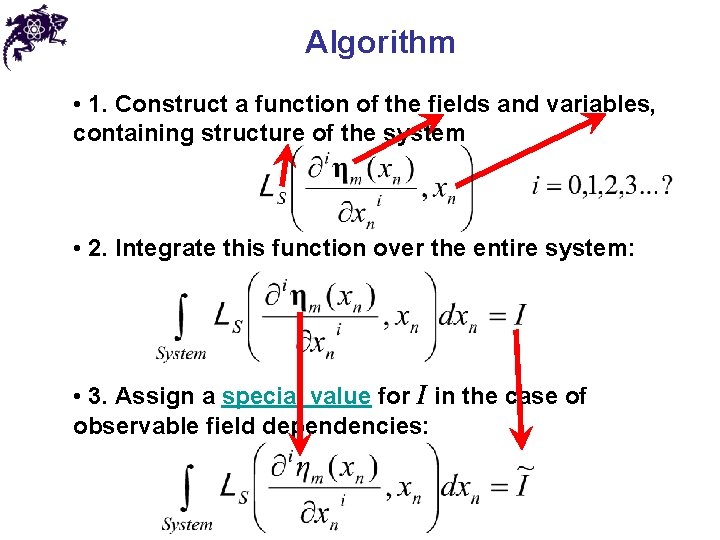
Algorithm • 1. Construct a function of the fields and variables, containing structure of the system • 2. Integrate this function over the entire system: • 3. Assign a special value for I in the case of observable field dependencies:
Some questions • Why such an algorithm? Suggest anything better that works • How difficult is it to construct an appropriate relationship between system structure and fields? It depends. You’ll see (here and in other physics courses) • Is there a known universal relationship between symmetries and fields? Not yet • How do we define the “best fit” value for I ? You’ll see
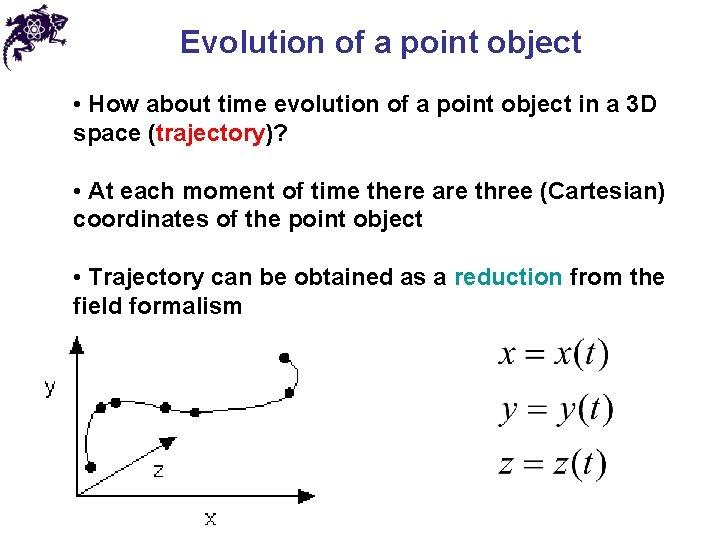
Evolution of a point object • How about time evolution of a point object in a 3 D space (trajectory)? • At each moment of time there are three (Cartesian) coordinates of the point object • Trajectory can be obtained as a reduction from the field formalism
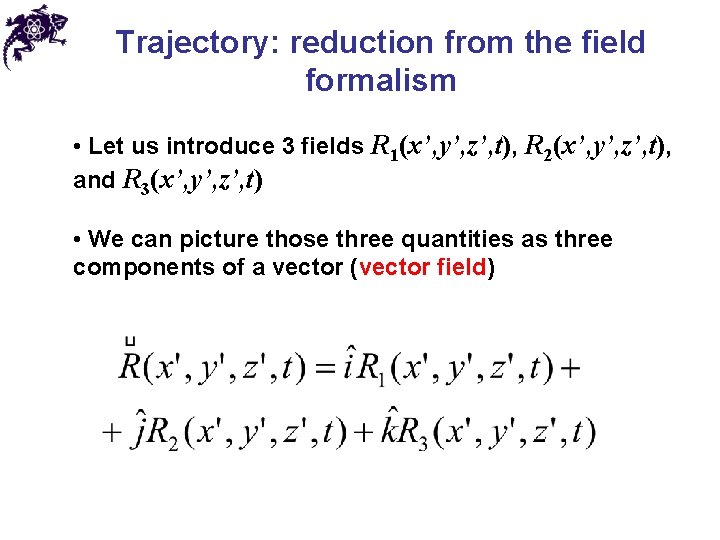
Trajectory: reduction from the field formalism • Let us introduce 3 fields R 1(x’, y’, z’, t), R 2(x’, y’, z’, t), and R 3(x’, y’, z’, t) • We can picture those three quantities as three components of a vector (vector field)
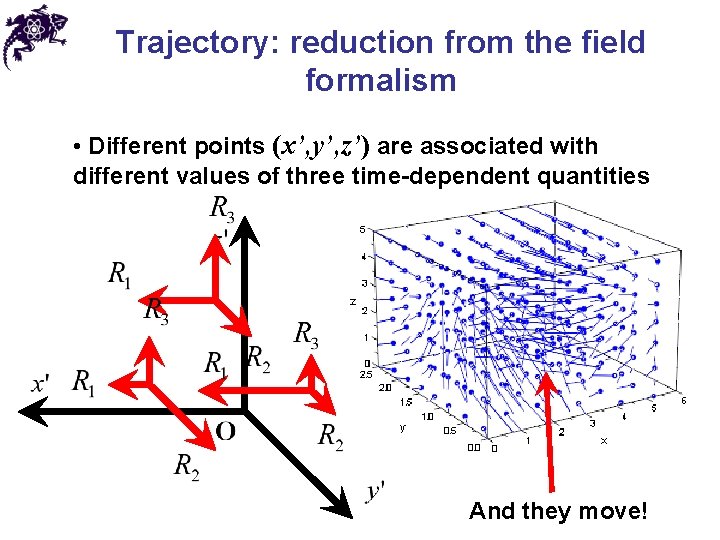
Trajectory: reduction from the field formalism • Different points (x’, y’, z’) are associated with different values of three time-dependent quantities And they move!
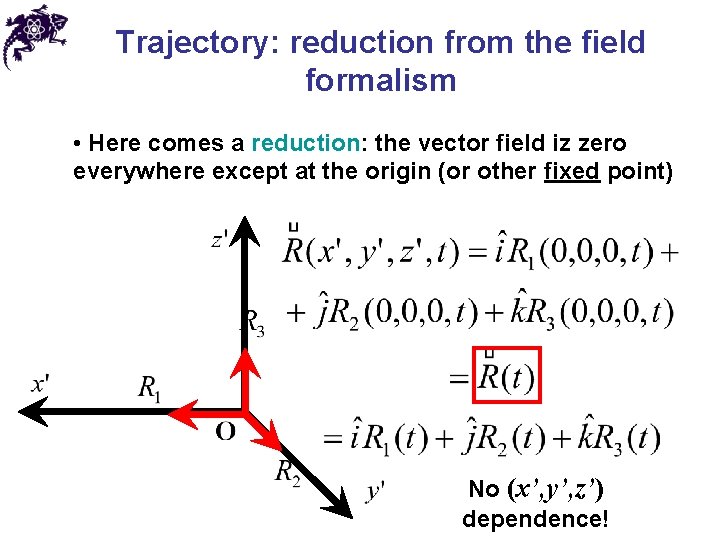
Trajectory: reduction from the field formalism • Here comes a reduction: the vector field iz zero everywhere except at the origin (or other fixed point) No (x’, y’, z’) dependence!
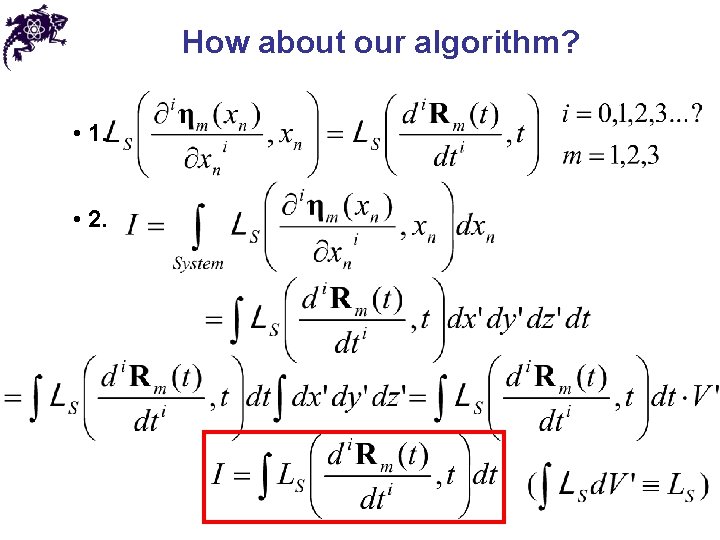
How about our algorithm? • 1. • 2.
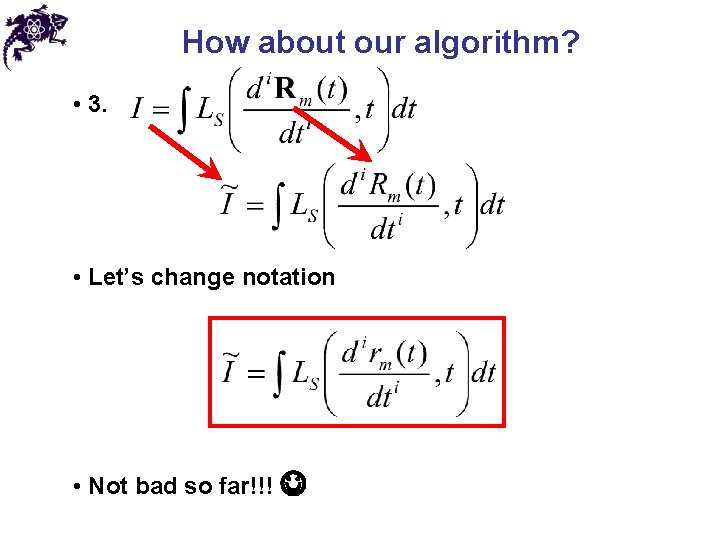
How about our algorithm? • 3. • Let’s change notation • Not bad so far!!!

Questions?
- Slides: 18