
Introduction The Beetle MA 0 backup solution A
Introduction The Beetle. MA 0 back-up solution. A readout chip that complies to the LHCb read out specifications and can interface directly to a Multi-anode pmt with a photon response of 300, 000 electrons. The Beetle. MA 0 was submitted on the 2 nd of December 2002 and arrived in Oxford on 8 th of April 2003. 1. 2. 3. 4. 5. 6. 7. Set up Analogue response to single photon Pipeline response to single photon News on Beetle 1. 3 submission 30 th June. Is Beetle 1. 3 MA 1 submission needed Conclusion Future work 26/06/2003 Nigel Smale University of Oxford
Set up 1. No common mode correction. 2. Analogue test point is an access point to the buffer of a front end of a Beetle 1. 2 MA 0 amplifier located at channel 1. This input is bonded and connected to a MApmt. 3. A pipe line measurement is when channel 1 (bullet point 2 above) is read out via the pipe line column number 35 H through CLC 400 receiver circuitry. 4. MAPmt has the serial number 9 C 23 A 4. 5. Chip 42 from wafer D 4 KKGZKT is under test. 6. In total 12 channels are bonded and connected to the MAPmt, test channel (standard front end), ch 0 -2 (Attenuation amp), ch 810 (standard front end) and ch 115 -119 (Attenuation amp). 7. Ipre=596, Isha=78, Ibuf=110, Ipipe=102, vd=1265, vdcl=1216, 8. Ivoltbuf=204, Isf=204 and Icurrent=533, vfs=0, vfp=0. 26/06/2003 Nigel Smale University of Oxford
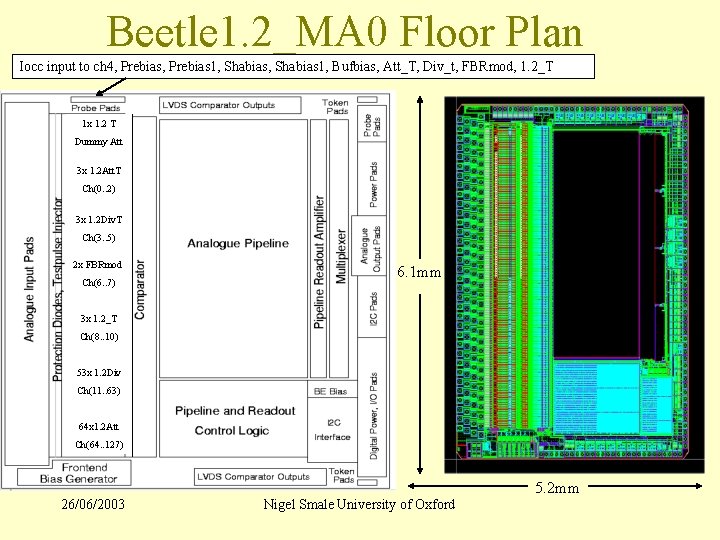
Beetle 1. 2_MA 0 Floor Plan Iocc input to ch 4, Prebias 1, Shabias 1, Bufbias, Att_T, Div_t, FBRmod, 1. 2_T 1 x 1. 2 T Dummy Att 3 x 1. 2 Att. T Ch(0. . 2) 3 x 1. 2 Div. T Ch(3. . 5) 2 x FBRmod Ch(6. . 7) 6. 1 mm 3 x 1. 2_T Ch(8. . 10) 53 x 1. 2 Div Ch(11. . 63) 64 x 1. 2 Att Ch(64. . 127) 5. 2 mm 26/06/2003 Nigel Smale University of Oxford
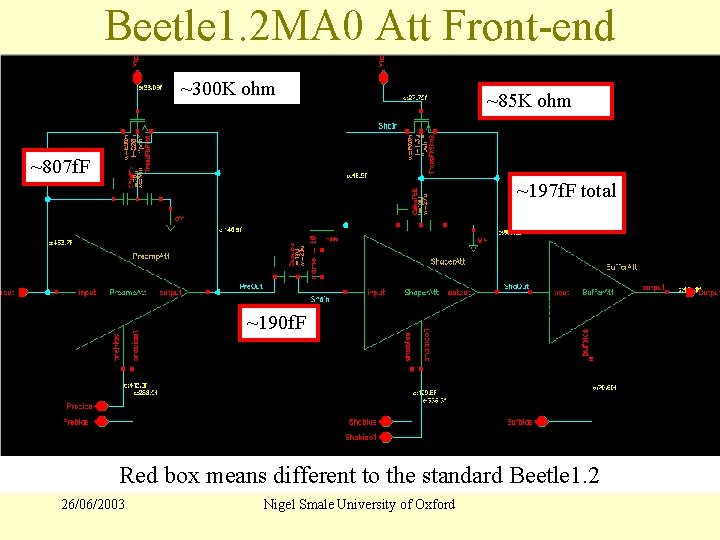
Beetle 1. 2 MA 0 Att Front-end ~300 K ohm ~85 K ohm ~807 f. F ~197 f. F total ~190 f. F Red box means different to the standard Beetle 1. 2 26/06/2003 Nigel Smale University of Oxford
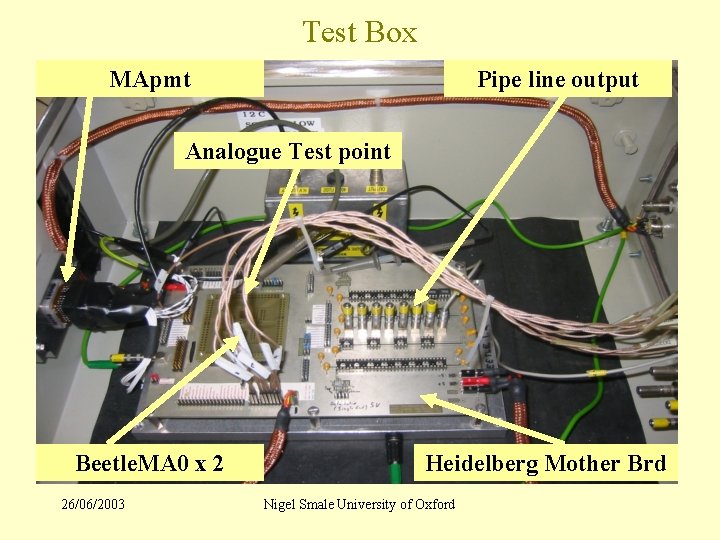
Test Box MApmt Pipe line output Analogue Test point Beetle. MA 0 x 2 26/06/2003 Heidelberg Mother Brd Nigel Smale University of Oxford
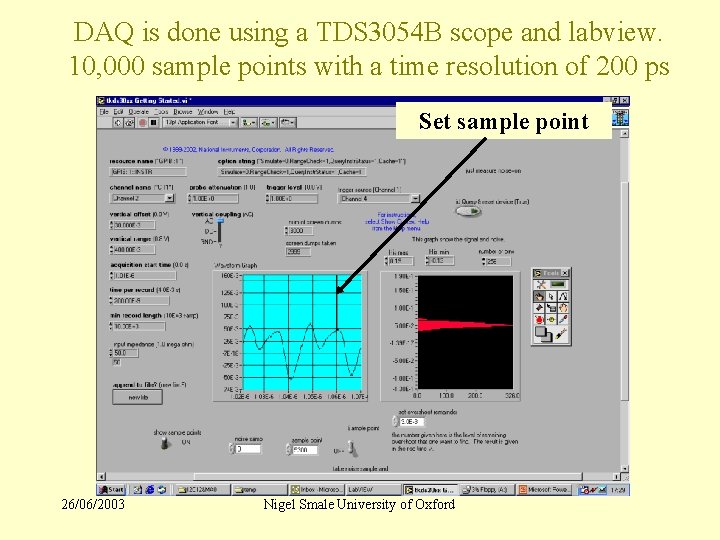
DAQ is done using a TDS 3054 B scope and labview. 10, 000 sample points with a time resolution of 200 ps Set sample point 26/06/2003 Nigel Smale University of Oxford
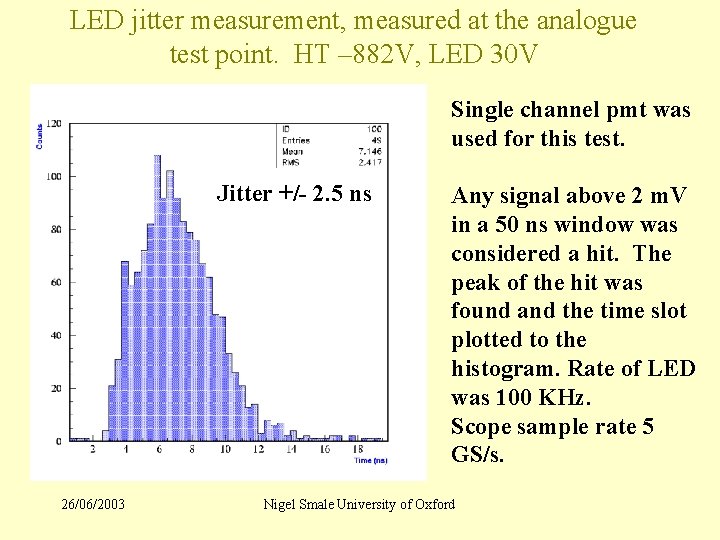
LED jitter measurement, measured at the analogue test point. HT – 882 V, LED 30 V Single channel pmt was used for this test. Jitter +/- 2. 5 ns 26/06/2003 Any signal above 2 m. V in a 50 ns window was considered a hit. The peak of the hit was found and the time slot plotted to the histogram. Rate of LED was 100 KHz. Scope sample rate 5 GS/s. Nigel Smale University of Oxford
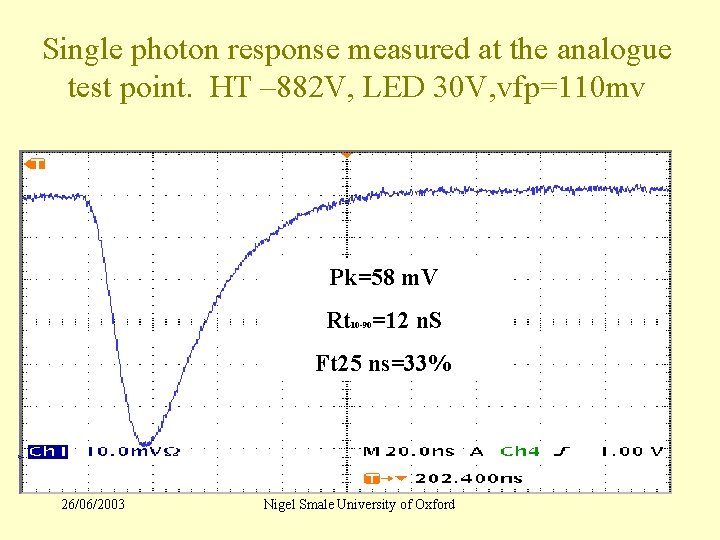
Single photon response measured at the analogue test point. HT – 882 V, LED 30 V, vfp=110 mv Pk=58 m. V Rt =12 n. S 10 -90 Ft 25 ns=33% 26/06/2003 Nigel Smale University of Oxford
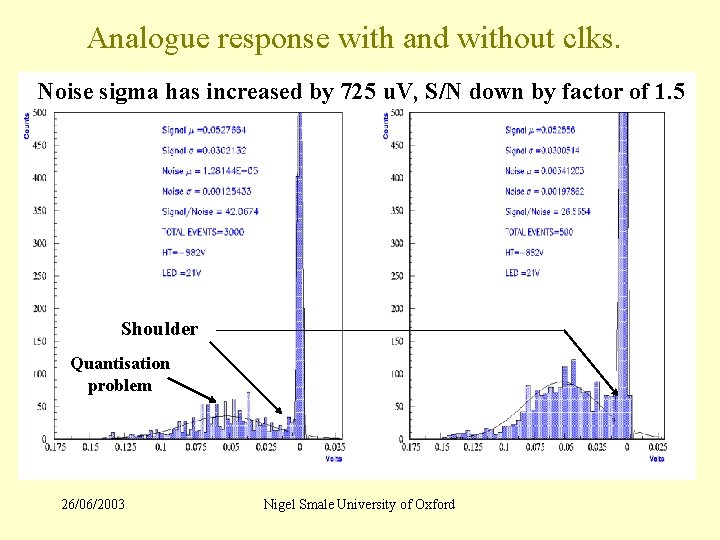
Analogue response with and without clks. Noise sigma has increased by 725 u. V, S/N down by factor of 1. 5 Shoulder Quantisation problem 26/06/2003 Nigel Smale University of Oxford
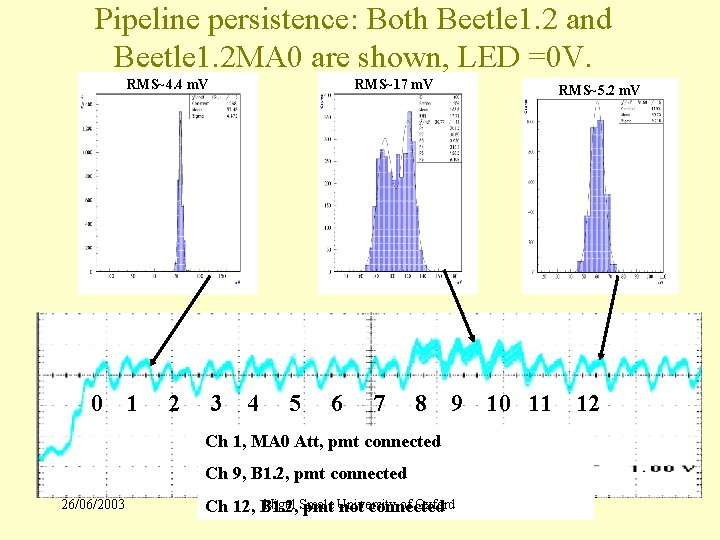
Pipeline persistence: Both Beetle 1. 2 and Beetle 1. 2 MA 0 are shown, LED =0 V. RMS~4. 4 m. V 0 1 2 RMS~17 m. V 3 4 5 6 7 8 RMS~5. 2 m. V 9 Ch 1, MA 0 Att, pmt connected Ch 9, B 1. 2, pmt connected 26/06/2003 Nigel Smale of Oxford Ch 12, B 1. 2, pmt University not connected 10 11 12
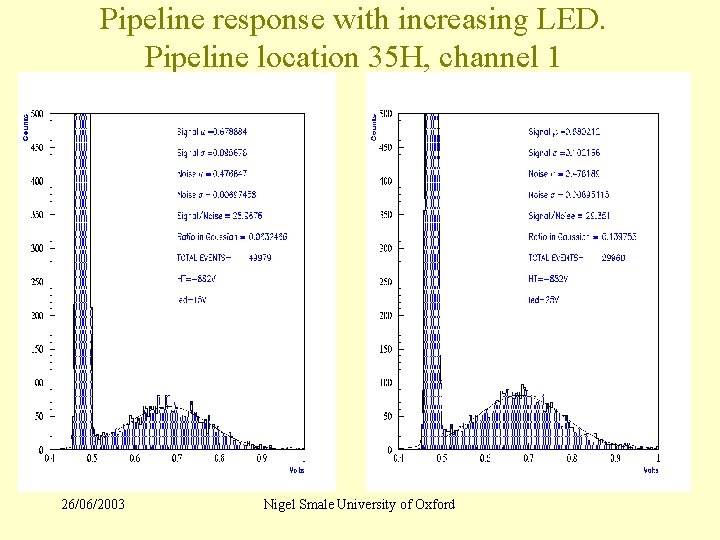
Pipeline response with increasing LED. Pipeline location 35 H, channel 1 26/06/2003 Nigel Smale University of Oxford
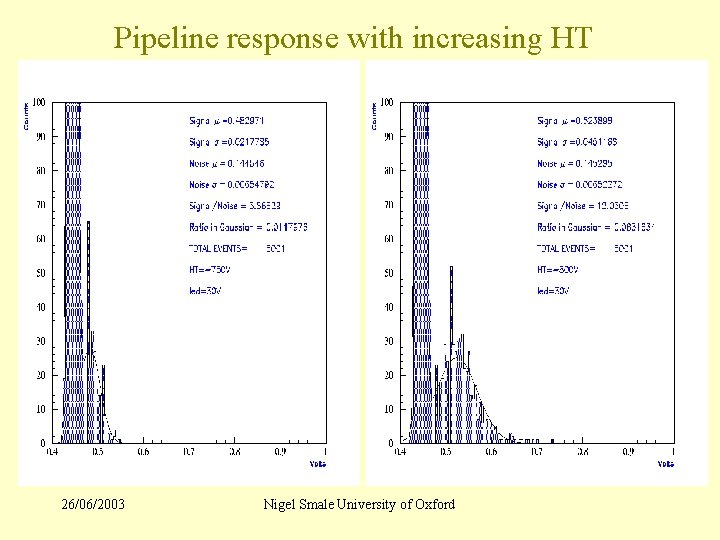
Pipeline response with increasing HT 26/06/2003 Nigel Smale University of Oxford
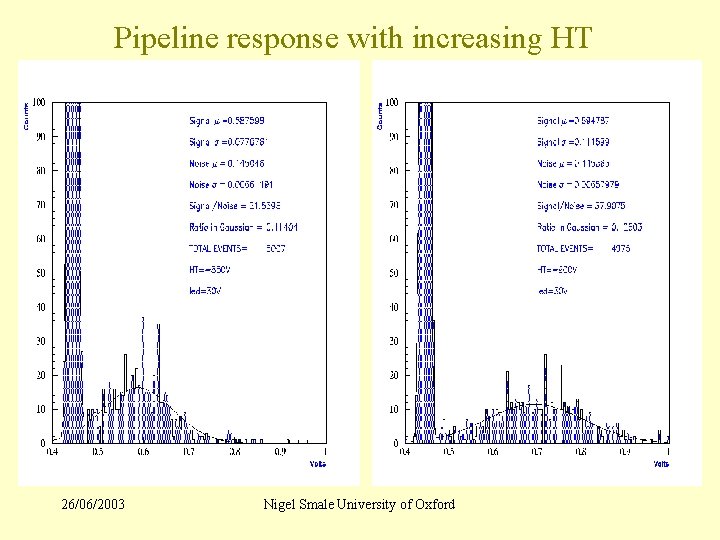
Pipeline response with increasing HT 26/06/2003 Nigel Smale University of Oxford
New on Beetle 1. 3 • Sticky charge effect. Fault has been simulated, die has been opened and probe inserted to emulate bug fix. Problem solved by adding analogue delay to the reset of pipe amp (might be track and hold). No change in digital control logic needed. • Base-line variation. Fault has been simulated and die opened to measure Vdd of shaper to show voltage drop. External source has been supplied to show fix will work. Fix is by increasing x of chip by ~200 um and increasing power rail. • Comparator. No change of control logic, just change 3 bit shift reg to a 5 bit shift reg. • Over-voltage problem. Current on output buffer killed chip, output is now restricted to 100 u. A, should be done by user. • 80 MHz clk feed through, understood, to many fanouts. Fix is to change clk trunk and control layout. • Next MPW submission is 30 th June, Engineering run Q 1 2004. 26/06/2003 Nigel Smale University of Oxford
Chip submission considerations • Heidelberg engineering & production run has been paid for, this is considered to be MPI’s contribution to LHCb. • If we take 1. 3 chips or join the HD submission in Q 1 2004 with MA chips the cost for the RICH group will probably be wavered. • If we do not take 1. 3 chips and go for a later MA engineering/production run then we will be liable for the full cost. 26/06/2003 Nigel Smale University of Oxford
Chip submission costing • Cost of an engineering run is about 20% more than a production run. Can share these costs with other groups. • Sharing production runs is not easy. Timing is difficult, can be restrictions on die sizes because of dicing, have to also share the engineering run as engineering mask must go to production. • Around 800 chips/wafer for a Beetle. MAP size chip. LHCb RICH needs around 2000 chips (assuming an 80% yield and no spares) therefore 2. 5 wafers. • Engineering run gives 2 -6 wafers, but only guarantees 2. So maybe possible to get all the chips from an engineering run. But if the target is not met then will have to pay out for a full production of 48 wafers, might be wise to consider sharing. 26/06/2003 Nigel Smale University of Oxford
Conclusions Beetle 1. 2 MA 0 is performing well. The analogue response to a MApmt looks good and complies with LHCb. Signal to noise has been measured at the output of the pipeline. This can be improved with improved cmr and better layout. The comparator is yet to be tested. Further improvement would be made by replacing the back end B 1. 2 with a B 1. 3. Comparisons between B 1. 2 and MA 0 shows that MA 0 seems to be much less sensitive to it’s environment and hence has better performance in S/N. This should be further studied. Decision on MA 0 must be made by the end of November if we want to take advantage of being a part of the HD submission. 26/06/2003 Nigel Smale University of Oxford
Future Work 1. Analogue pipeline offsets 2. Noise measurements, increasing in c load 3. Gain measurements, spread if any across channels 4. Best parameters for running 5. A/c response, I. e bandwidth 6. Corner measurements I. e temp, max clk, jitter 7. Threshold scans for comp out and pipeline out 8. Cross talk, analogue and binary 9. Time walk into adjacent pipeline cells 10. Common mode power rejection, effects of varying Vsupply 11. Supply voltage margin > 2. 5 V 12. Dead time for large saturating input pulse 13. DC drift over time 14. And more 26/06/2003 Nigel Smale University of Oxford
- Slides: 18