
Introduction Taxes are the basic source of revenue
Introduction �Taxes are the basic source of revenue for the govt. Revenue raised from taxes are utilized for meeting the expenses of govt. like, Provision of education, Infrastructure facilities such as roads, dams etc. , �Tax is the financial charge imposed by the government on income, commodity or activity.
�The first income tax act in India, was introduced in 1860. The present law concerning tax regulations are governed in Income tax Act 1961. This act is the charging statute of Income tax in India. It provides for levy, administration, Collection and recovery of Income Tax. Direct Tax : Direct tax , as the name suggests, are taxes that are directly paid to the government by the tax payer. Ex. Income tax, Corporation tax, wealth tax.
PREVIEW OF TAX LAWS Kinds of Taxes � Direct Tax � Indirect Tax �Meaning of Direct Tax: The person on whom the tax liability falls can be ascertained is called Direct Tax. If not, Indirect Tax.
Legal Compliance �Income Tax Rules which were framed in early 1960 s considered to be the frontrunner for Income tax act 1961. �The act came into force from April 1 st, 1962.
Classifications in Income �Income from salary. �Income House Property. �Income from Business/ profession. �Income Capital gain. �Income from other Sources.
Meaning for important terms �Assessee �Assessment year �Previous year �Income �Gross Salary �Rebate �Exemptions �Person
�Exemptions: There are identified sources of income which have been designated as sources free from attracting tax liability owing to certain reasons. Such sources are collectively known as exempted categories or exemptions.
�Assessee: The person who is under obligation to report financial particulars as per the IT act is called assessee. �Assessment year: The year in which the process of computation of income is done is called Assessment year. �Previous year: It is also known as income earned year. The particulars of financial information pertaining to this year alone subjected to assessment in a particular assessment year.
�Income : periodically or otherwise through a year in different forms is known as income. �Gross Salary: It is a sum of all sub heads of salary income put together for the purpose of arriving over all receipts under the head salary. �Rebate: It is a concession granted, in monetary terms, in appreciation of commitment of funds in a earmarked investment avenue.
�Person: Sec 2(31) � An Individual : An Individual may be Male or female or lunatic. � A Hindu Undivided family(HUF). �A Company. �A Firm. �An Association of persons. � Body of Individuals.
Types of Assessee �Ordinary Assessee �Representative or Deemed assessee �Assessee – in – default
�Representative Assessee: on certain a cases, In own income or loss but also for the income or loss of other persons. In such cases, he is treated as “ deemed” or “ Representative assessee”. The following are the situations: �In the case of deceased person �In case of lunatic or minor or idiot �Non- Residents.
�Assessee – in – default : If a person fails to fulfil his statutory obligations as per the income tax act he is called as ‘ Assessee in default’: � Employers who fail to report any income knowingly or unknowingly may be an example for assessee in default.
Scope of Total Income “Scope of Income” means which items of income are included and which are excluded while computing Tax Liability. It depends upon the residential Status of the Person. There are three broad categories of Person. (i) Resident and Ordinary Resident (ii) Non – Resident and (iii) Resident but Not – Ordinary Resident
Income Slabs for Individuals & HUF. (age < 60 years) �Up to Rs. 2, 50, 000 �Rs 2, 50, 000 to Rs. 5, 000 �Rs 5, 000 to Rs. 10, 000 �Above Rs. 10, 000 - Nil -5% -20% -30%
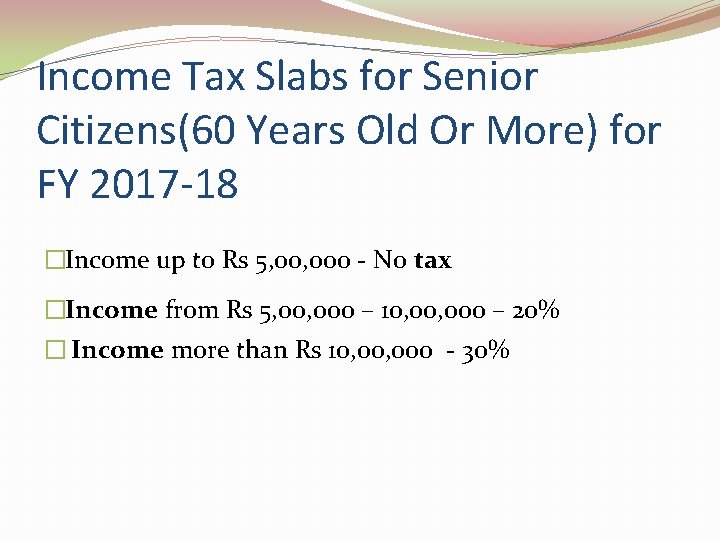
Income Tax Slabs for Senior Citizens(60 Years Old Or More) for FY 2017 -18 �Income up to Rs 5, 000 - No tax �Income from Rs 5, 000 – 10, 000 – 20% � Income more than Rs 10, 000 - 30%
Objectives of Taxation �Regulating Consumption �Regulating Production �Regulating Imports and Exports �Regulating Inflation & Depression �For Capital Formation �For Employment Generation �For Reduction in regional imbalances �For Reduction in Economic disparities
Features of a Good Tax System �Progressive �Flexible �Economical �Judicious �Productive �Convenience �Simple �Practicable
Fully Exempted Allowance �Allowances to Government Employees, Rendering Services outside India. �House rent allowances granted to Judges of high court and Supreme court. �Sumptuary allowance given to high Court and Supreme Court Judges. �Allowances received by an employee of UNO from his employer.
- Slides: 20