
Introduction System Modeling Electrical and Mechanical Components Motion
- Slides: 31
Introduction. System Modeling. Electrical and Mechanical Components. Motion Mechanisms. Laplace Domain Equations. M. V. Iordache, EEGR 3523 Mechatronics, Spring 2021, Le. Tourneau University
Mechatronics—Introduction What is Mechatronics? At a first glance: • Mechanics + Electronics Mechatronics • Mechatronics: The introduction of electronic controls into mechanical components. (Web definition) Mechatronics—Introduction
Mechatronic designs involve: n n Mechanical systems Electrical systems n Actuators (such as motors) Sensors n Control systems n n Implemented in software and/or hardware Mechatronics—Introduction
The design approach of Mechatronics: n n Subsystems of different nature (such as electrical and mechanical) are designed together, rather than independently. Manufacturing considered also at design time. Mechatronics—Introduction
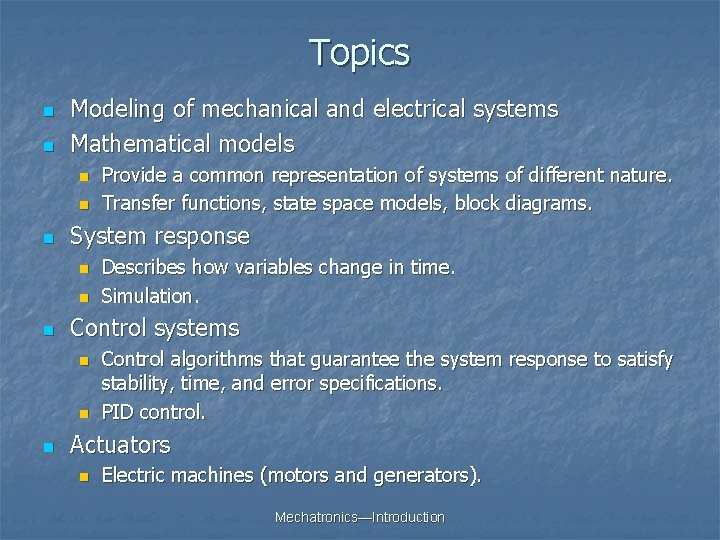
Topics n n Modeling of mechanical and electrical systems Mathematical models n n n System response n n n Describes how variables change in time. Simulation. Control systems n n n Provide a common representation of systems of different nature. Transfer functions, state space models, block diagrams. Control algorithms that guarantee the system response to satisfy stability, time, and error specifications. PID control. Actuators n Electric machines (motors and generators). Mechatronics—Introduction
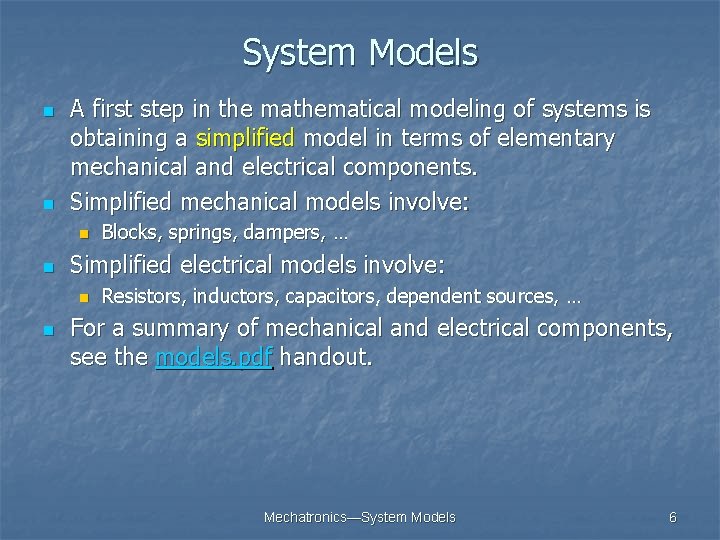
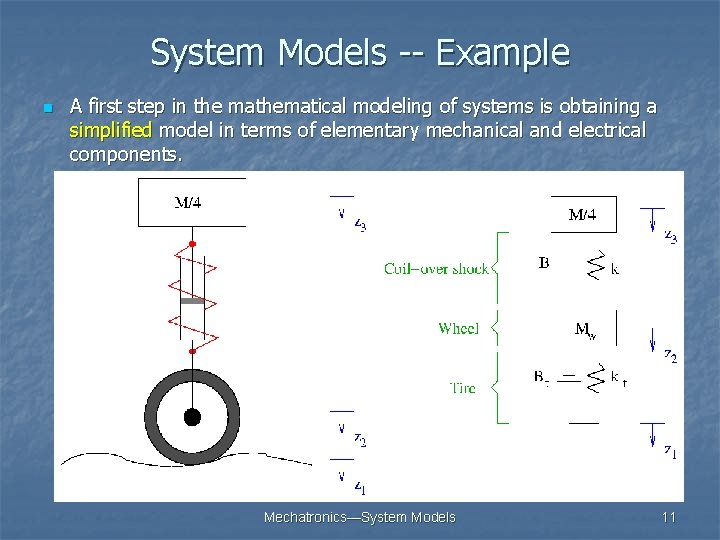
System Models n n A first step in the mathematical modeling of systems is obtaining a simplified model in terms of elementary mechanical and electrical components. Simplified mechanical models involve: n n Simplified electrical models involve: n n Blocks, springs, dampers, … Resistors, inductors, capacitors, dependent sources, … For a summary of mechanical and electrical components, see the models. pdf handout. Mechatronics—System Models 6
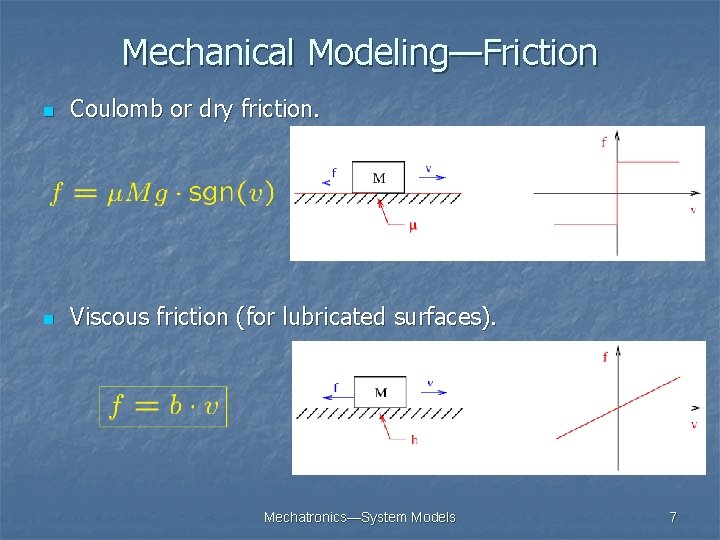
Mechanical Modeling—Friction n Coulomb or dry friction. n Viscous friction (for lubricated surfaces). Mechatronics—System Models 7
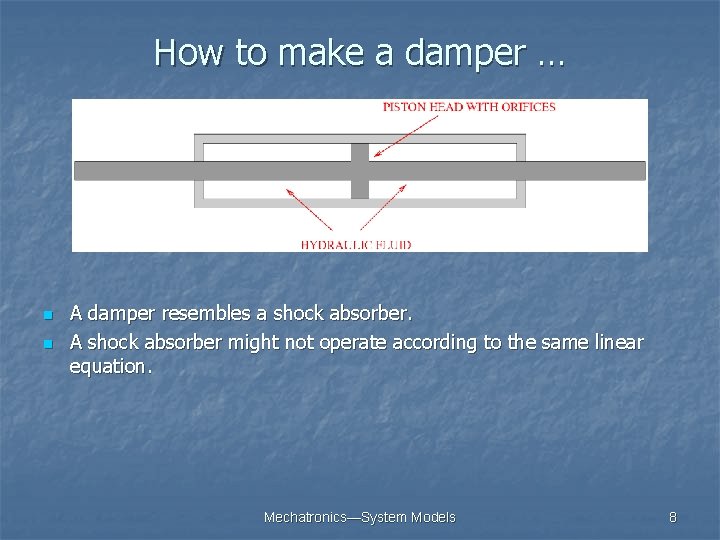
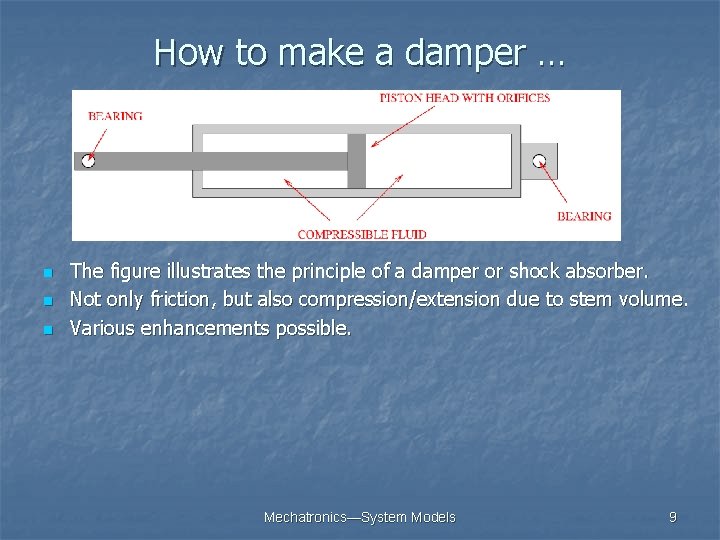
How to make a damper … n n A damper resembles a shock absorber. A shock absorber might not operate according to the same linear equation. Mechatronics—System Models 8
How to make a damper … n n n The figure illustrates the principle of a damper or shock absorber. Not only friction, but also compression/extension due to stem volume. Various enhancements possible. Mechatronics—System Models 9
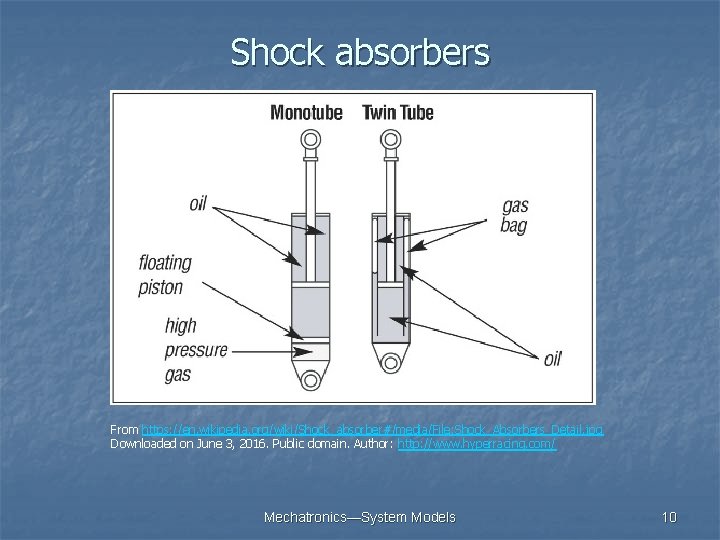
Shock absorbers From https: //en. wikipedia. org/wiki/Shock_absorber#/media/File: Shock_Absorbers_Detail. jpg Downloaded on June 3, 2016. Public domain. Author: http: //www. hyperracing. com/ Mechatronics—System Models 10
System Models -- Example n A first step in the mathematical modeling of systems is obtaining a simplified model in terms of elementary mechanical and electrical components. Mechatronics—System Models 11
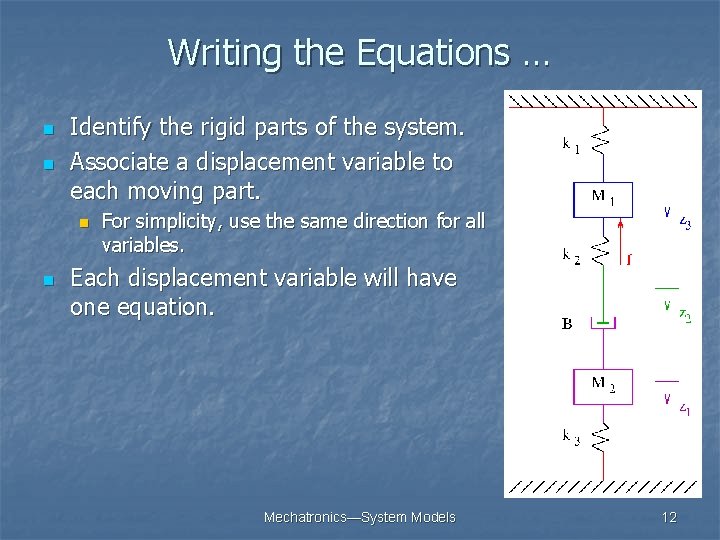
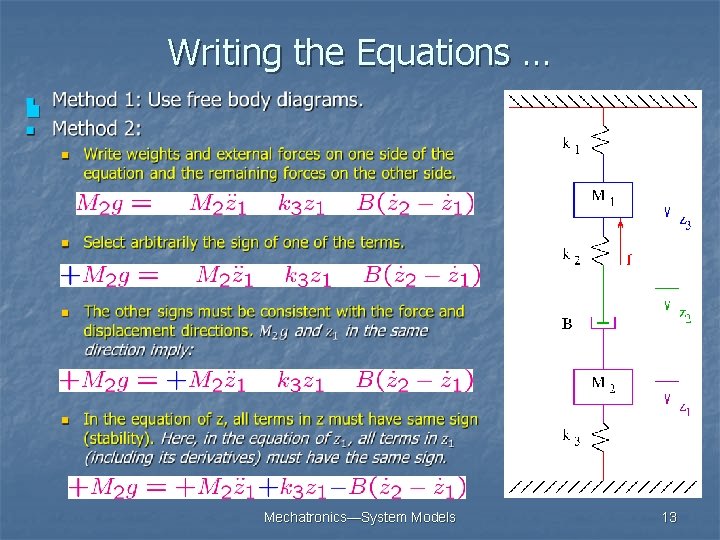
Writing the Equations … n n Identify the rigid parts of the system. Associate a displacement variable to each moving part. n n For simplicity, use the same direction for all variables. Each displacement variable will have one equation. Mechatronics—System Models 12
Writing the Equations … n Mechatronics—System Models 13
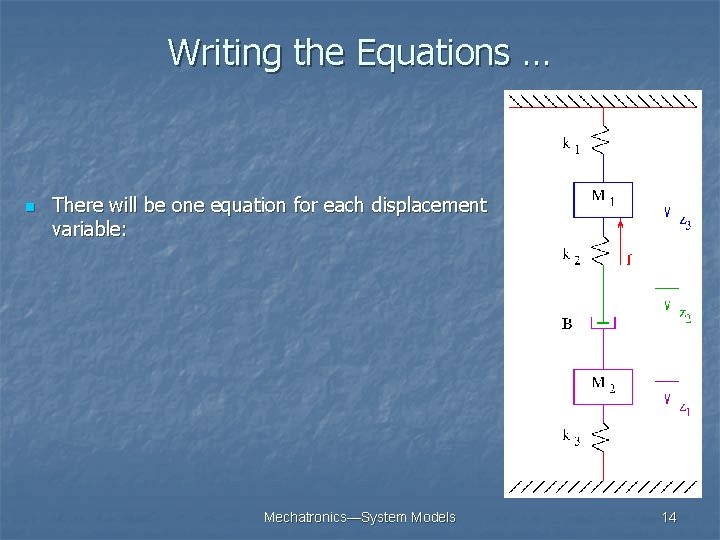
Writing the Equations … n There will be one equation for each displacement variable: Mechatronics—System Models 14
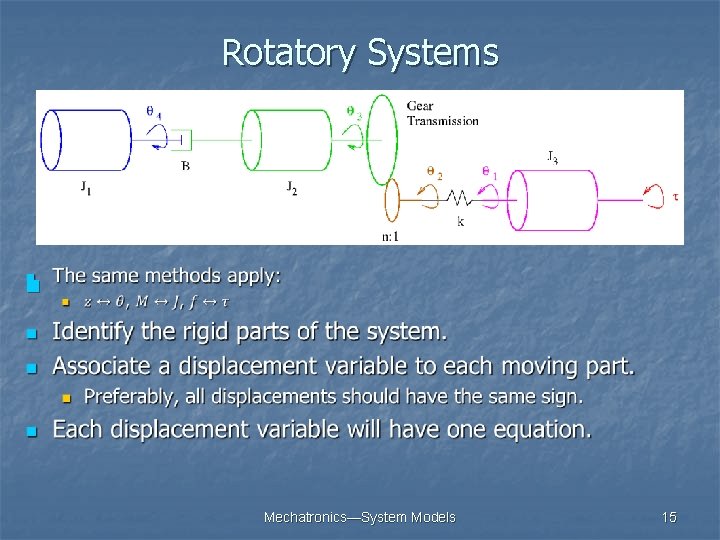
Rotatory Systems n Mechatronics—System Models 15
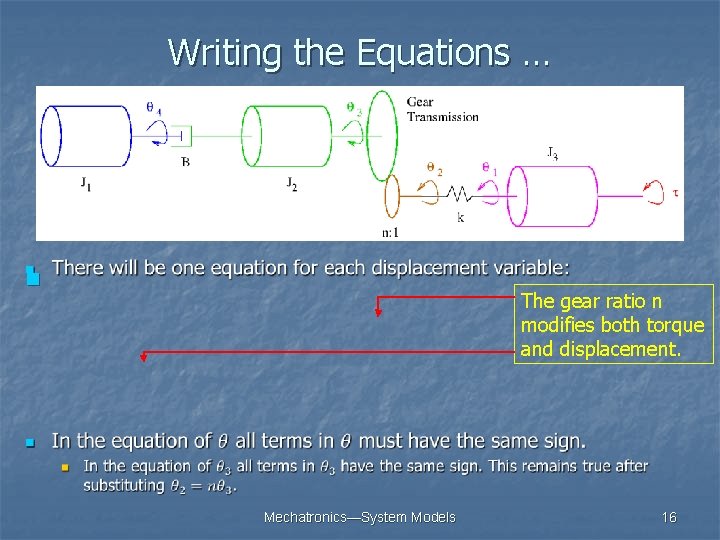
Writing the Equations … n The gear ratio n modifies both torque and displacement. Mechatronics—System Models 16
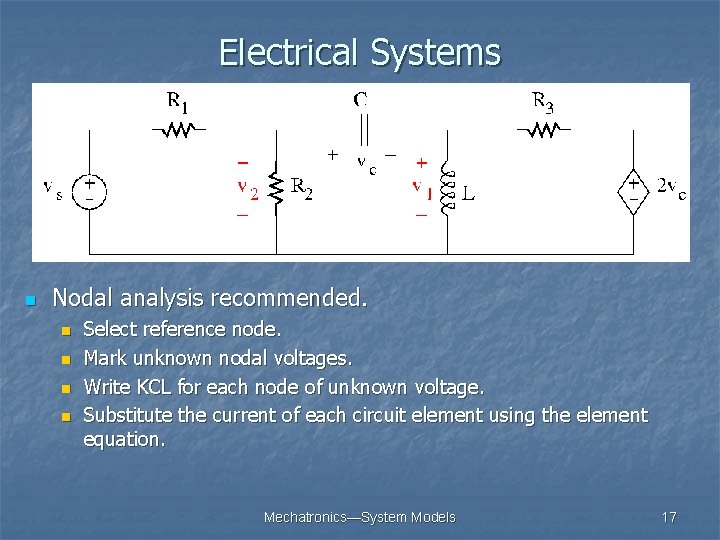
Electrical Systems n Nodal analysis recommended. n n Select reference node. Mark unknown nodal voltages. Write KCL for each node of unknown voltage. Substitute the current of each circuit element using the element equation. Mechatronics—System Models 17
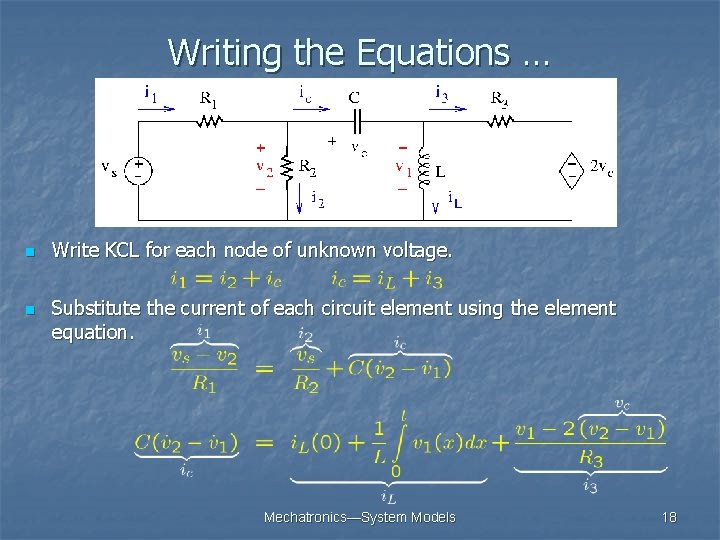
Writing the Equations … n n Write KCL for each node of unknown voltage. Substitute the current of each circuit element using the element equation. Mechatronics—System Models 18
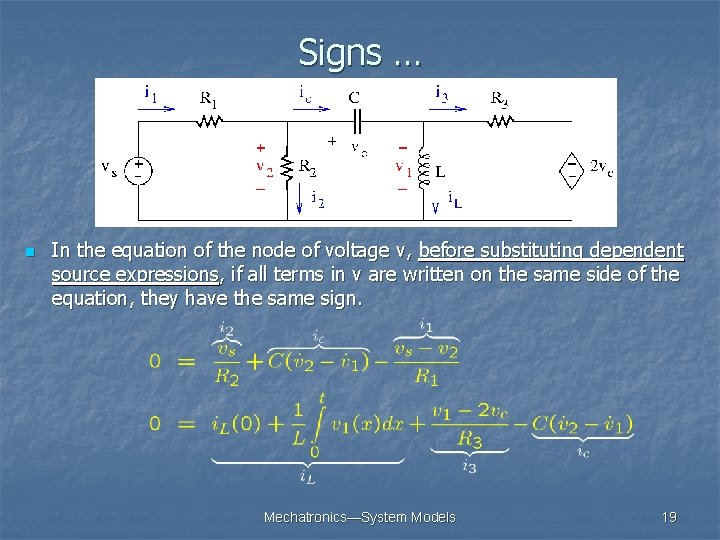
Signs … n In the equation of the node of voltage v, before substituting dependent source expressions, if all terms in v are written on the same side of the equation, they have the same sign. Mechatronics—System Models 19
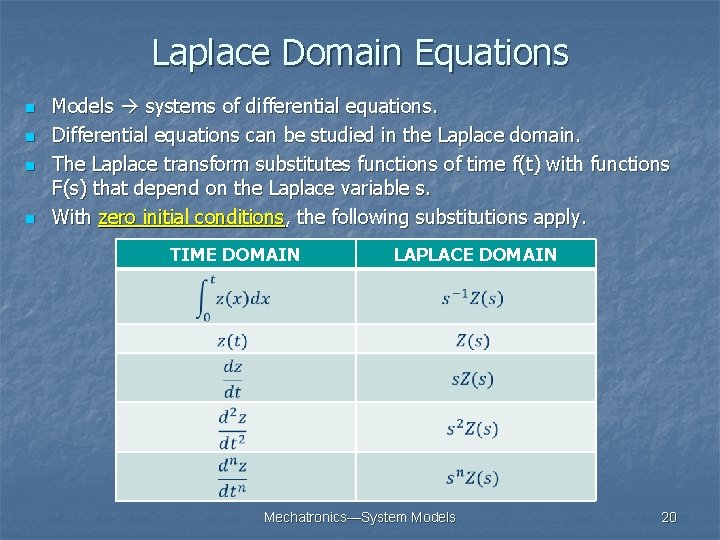
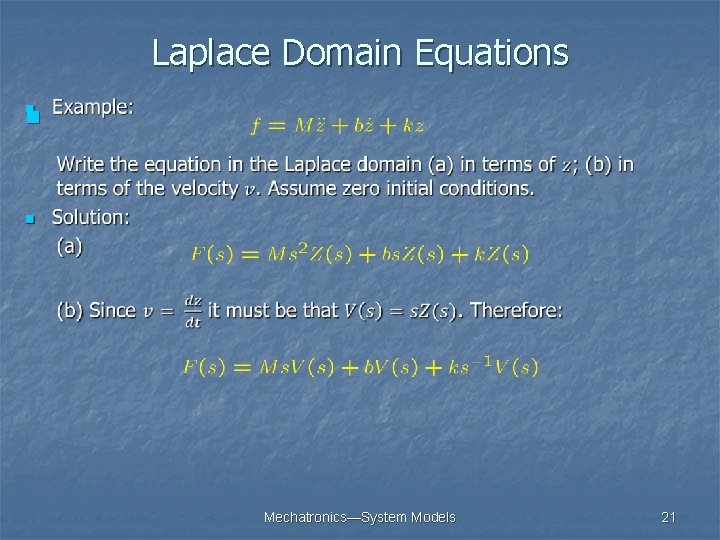
Laplace Domain Equations n n Models systems of differential equations. Differential equations can be studied in the Laplace domain. The Laplace transform substitutes functions of time f(t) with functions F(s) that depend on the Laplace variable s. With zero initial conditions, the following substitutions apply. TIME DOMAIN LAPLACE DOMAIN Mechatronics—System Models 20
Laplace Domain Equations n Mechatronics—System Models 21
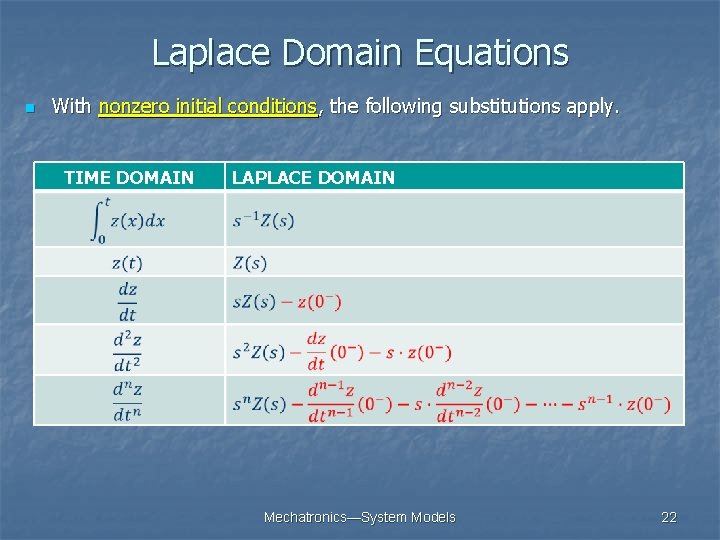
Laplace Domain Equations n With nonzero initial conditions, the following substitutions apply. TIME DOMAIN LAPLACE DOMAIN Mechatronics—System Models 22
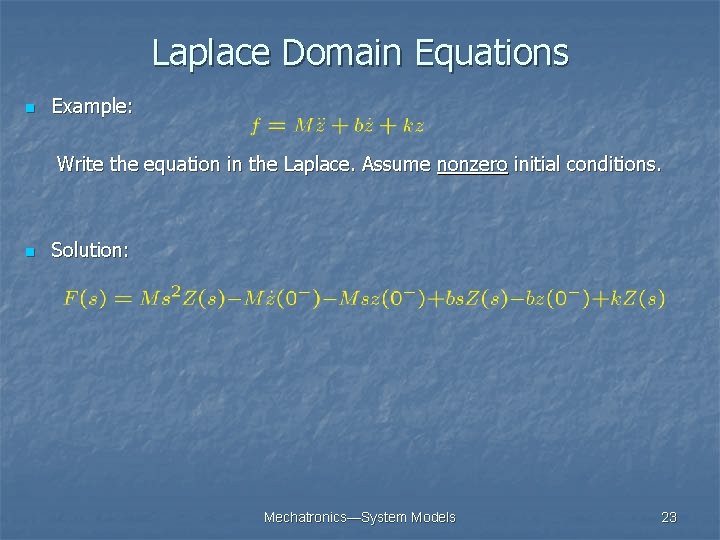
Laplace Domain Equations n Example: Write the equation in the Laplace. Assume nonzero initial conditions. n Solution: Mechatronics—System Models 23
Circuits in the Laplace Domain Mechatronics—System Models 24
Impedance Diagrams n Impedance diagrams represent electric circuits in the Laplace domain. Mechatronics—System Models 25
Analogies n Electric analogy of mechanical systems: M C k 1/L B 1/R f i v v. Mechatronics—System Models 26
Impedance Diagrams n Impedance diagrams applied also to mechanical systems, using the electric system analogy: M C, k 1/L, B 1/R, f i, and v v. n n A block is represented by a ground connected capacitor. Mechanical equivalent of an ungrounded capacitor: the inerter (invented by Prof. Malcolm C. Smith). Mechatronics—System Models 27
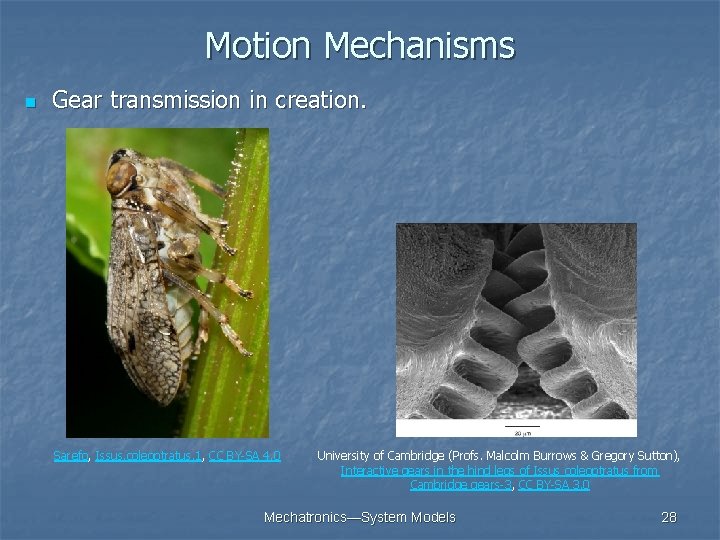
Motion Mechanisms n Gear transmission in creation. Sarefo, Issus. coleoptratus. 1, CC BY-SA 4. 0 University of Cambridge (Profs. Malcolm Burrows & Gregory Sutton), Interactive gears in the hind legs of Issus coleoptratus from Cambridge gears-3, CC BY-SA 3. 0 Mechatronics—System Models 28
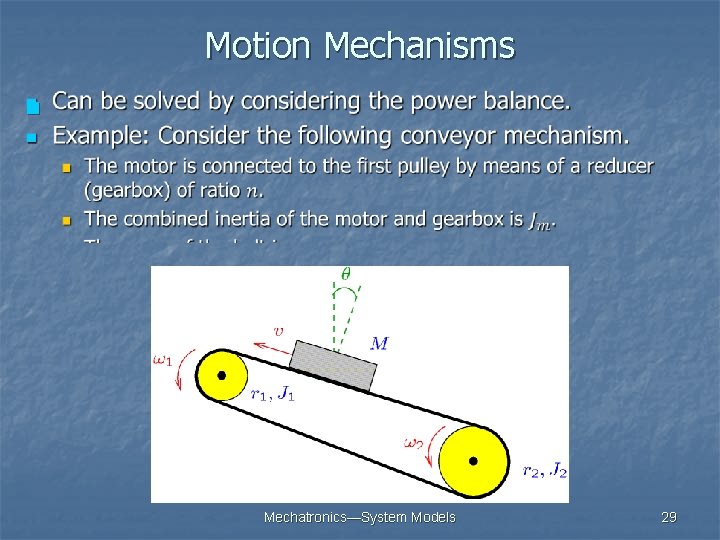
Motion Mechanisms n Mechatronics—System Models 29
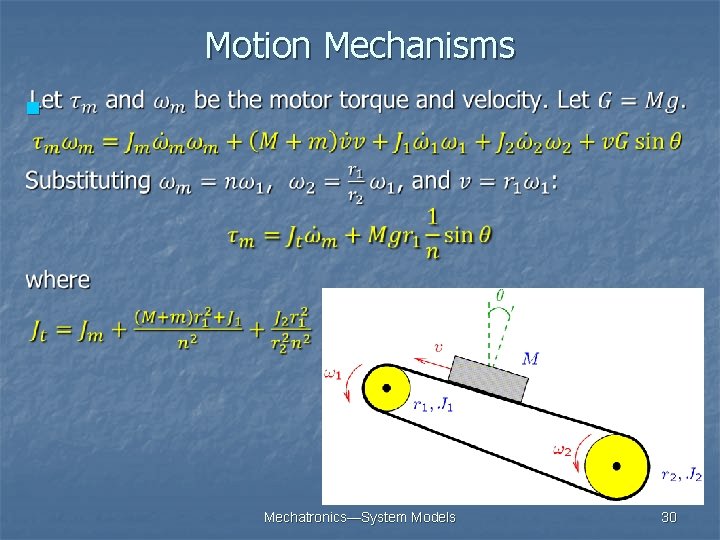
Motion Mechanisms n Mechatronics—System Models 30
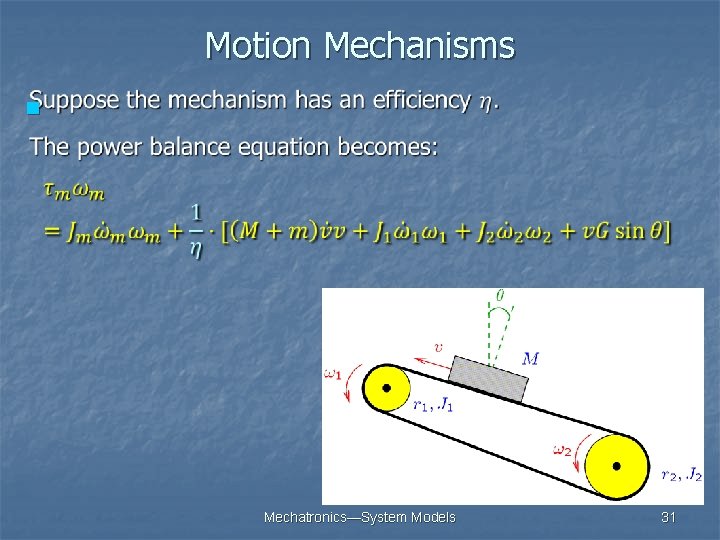
Motion Mechanisms n Mechatronics—System Models 31