
Introduction Starting in Early Years children are taught
- Slides: 18
Introduction Starting in Early Years, children are taught phonics; the journey of learning to read, write and spell. These vital skills, are the beginning of a lifelong literacy journey. Phonics, which can also be referred to as ‘Letters and Sounds’ is the process of children learning to read. The process of learning to read and write begins from an early age, where children can learn and practise many skills. This can be done in a range of ways and settings, including home. Exposing children to conversation and books is essential.
Spoken Language Listening and talking to your child is essential. As part of everyday activities, talk to your child, explaining what you are doing. Speaking and listening are the building blocks for reading and writing. The more language your child is exposed to, the more they will understand use for themselves.
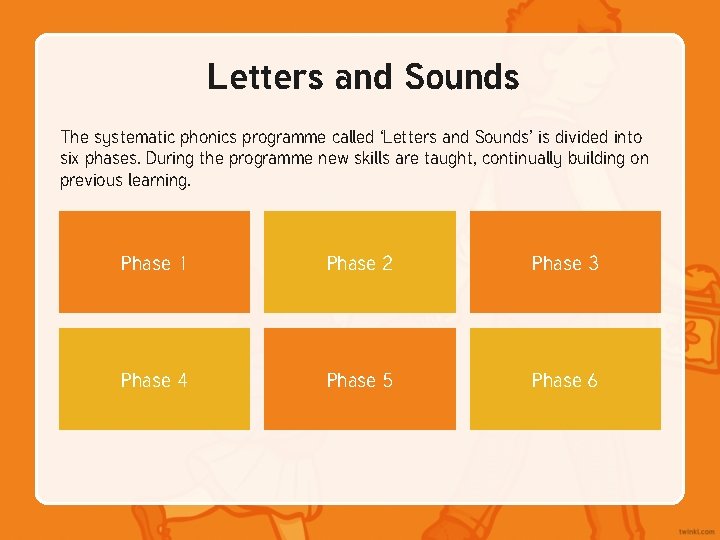
Letters and Sounds The systematic phonics programme called ‘Letters and Sounds’ is divided into six phases. During the programme new skills are taught, continually building on previous learning. Phase 1 Phase 2 Phase 3 Phase 4 Phase 5 Phase 6
Phase 1 This phase is divided into seven strands: Aspect 1: Environmental Sounds. Children are exposed to a variety of sounds in the environment, being encouraged to copy them. Aspect 2: Instrumental Sounds. Children are encouraged to listen to and make sounds using different instruments. Aspect 3: Body Percussion. Children use their body to accompany songs and rhymes, for example by clapping and tapping. Aspect 4: Rhythm and Rhyme Children are exposed to a range of books and rhymes. Children are encouraged to join in with repeated refrains and rhymes. Aspect 5: Alliteration. Children are encouraged to listen to initial sounds within words. They are asked to think of other words beginning with the same sound. Aspect 6: Voice Sounds Children are asked to create different mouth movements and say a range of sounds.
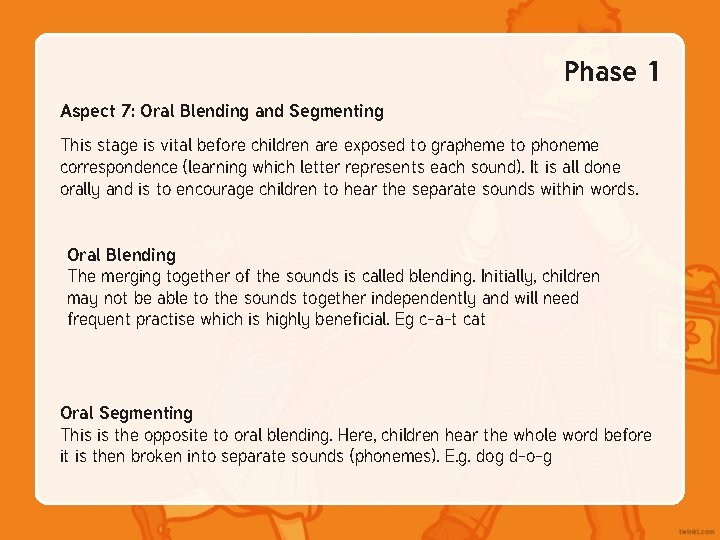
Phase 1 Aspect 7: Oral Blending and Segmenting This stage is vital before children are exposed to grapheme to phoneme correspondence (learning which letter represents each sound). It is all done orally and is to encourage children to hear the separate sounds within words. Oral Blending The merging together of the sounds is called blending. Initially, children may not be able to the sounds together independently and will need frequent practise which is highly beneficial. Eg c-a-t cat Oral Segmenting This is the opposite to oral blending. Here, children hear the whole word before it is then broken into separate sounds (phonemes). E. g. dog d-o-g
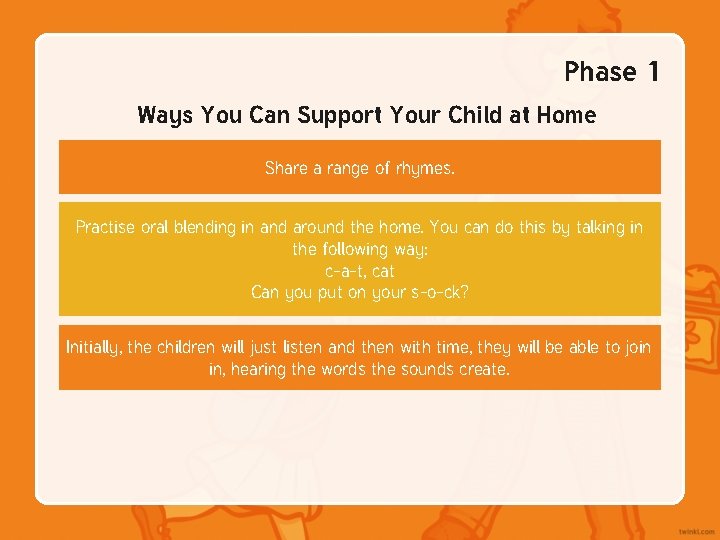
Phase 1 Ways You Can Support Your Child at Home Share a range of rhymes. Practise oral blending in and around the home. You can do this by talking in the following way: c-a-t, cat Can you put on your s-o-ck? Initially, the children will just listen and then with time, they will be able to join in, hearing the words the sounds create.
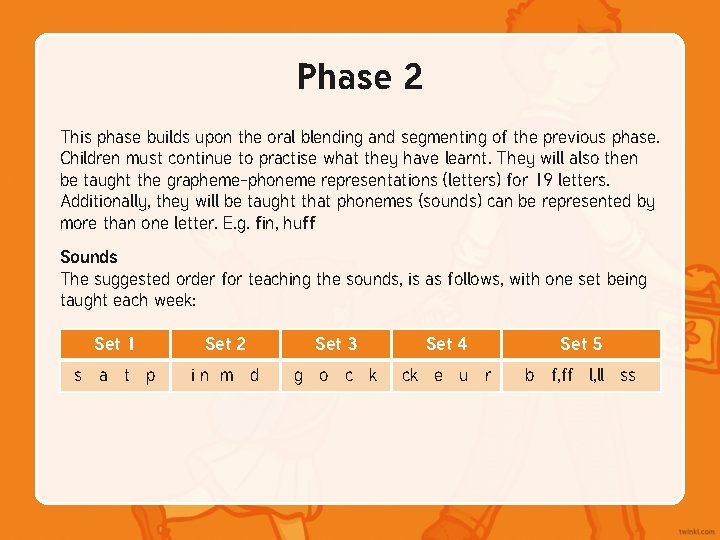
Phase 2 This phase builds upon the oral blending and segmenting of the previous phase. Children must continue to practise what they have learnt. They will also then be taught the grapheme-phoneme representations (letters) for 19 letters. Additionally, they will be taught that phonemes (sounds) can be represented by more than one letter. E. g. fin, huff Sounds The suggested order for teaching the sounds, is as follows, with one set being taught each week: Set 1 Set 2 Set 3 Set 4 Set 5 s a t p in m d g o c k ck e u r b f, ff l, ll ss
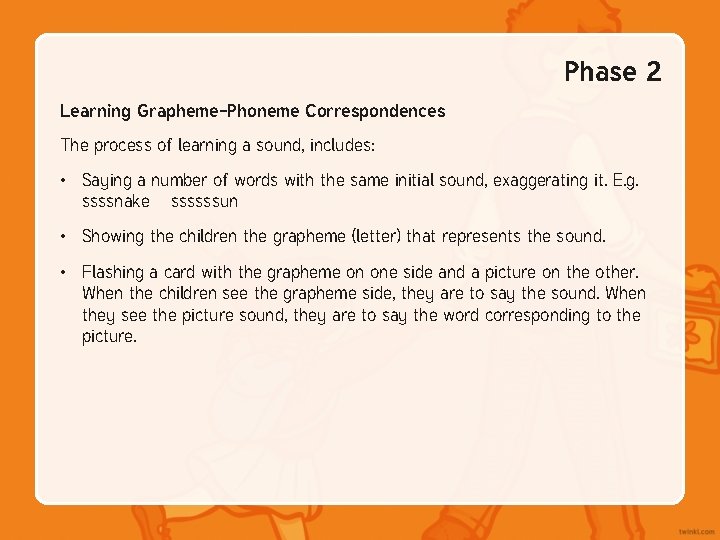
Phase 2 Learning Grapheme-Phoneme Correspondences The process of learning a sound, includes: • Saying a number of words with the same initial sound, exaggerating it. E. g. ssssnake ssssssun • Showing the children the grapheme (letter) that represents the sound. • Flashing a card with the grapheme on one side and a picture on the other. When the children see the grapheme side, they are to say the sound. When they see the picture sound, they are to say the word corresponding to the picture.
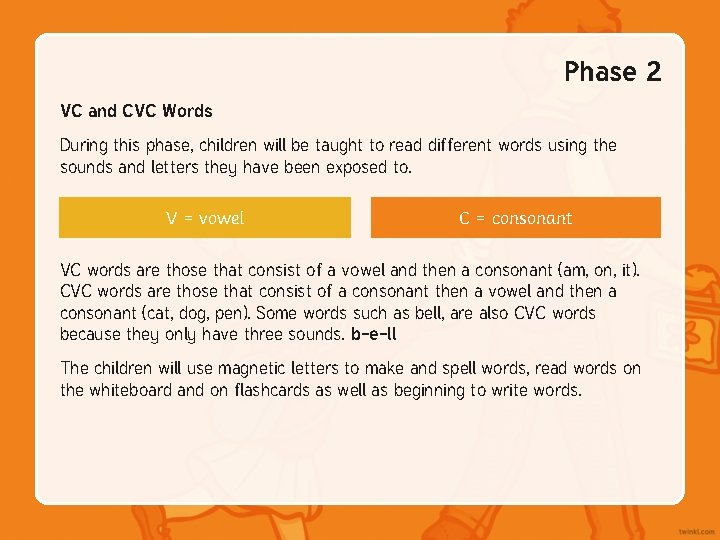
Phase 2 VC and CVC Words During this phase, children will be taught to read different words using the sounds and letters they have been exposed to. V = vowel C = consonant VC words are those that consist of a vowel and then a consonant (am, on, it). CVC words are those that consist of a consonant then a vowel and then a consonant (cat, dog, pen). Some words such as bell, are also CVC words because they only have three sounds. b-e-ll The children will use magnetic letters to make and spell words, read words on the whiteboard and on flashcards as well as beginning to write words.
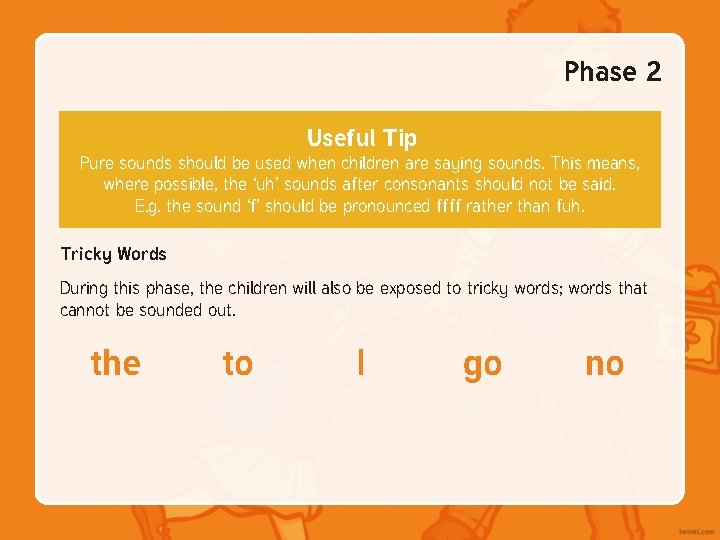
Phase 2 Useful Tip Pure sounds should be used when children are saying sounds. This means, where possible, the ‘uh’ sounds after consonants should not be said. E. g. the sound ‘f’ should be pronounced ffff rather than fuh. Tricky Words During this phase, the children will also be exposed to tricky words; words that cannot be sounded out. the to I go no
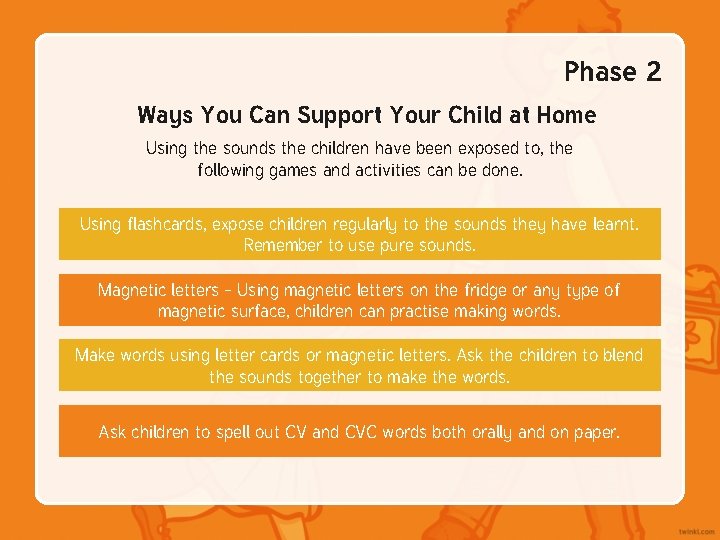
Phase 2 Ways You Can Support Your Child at Home Using the sounds the children have been exposed to, the following games and activities can be done. Using flashcards, expose children regularly to the sounds they have learnt. Remember to use pure sounds. Magnetic letters - Using magnetic letters on the fridge or any type of magnetic surface, children can practise making words. Make words using letter cards or magnetic letters. Ask the children to blend the sounds together to make the words. Ask children to spell out CV and CVC words both orally and on paper.
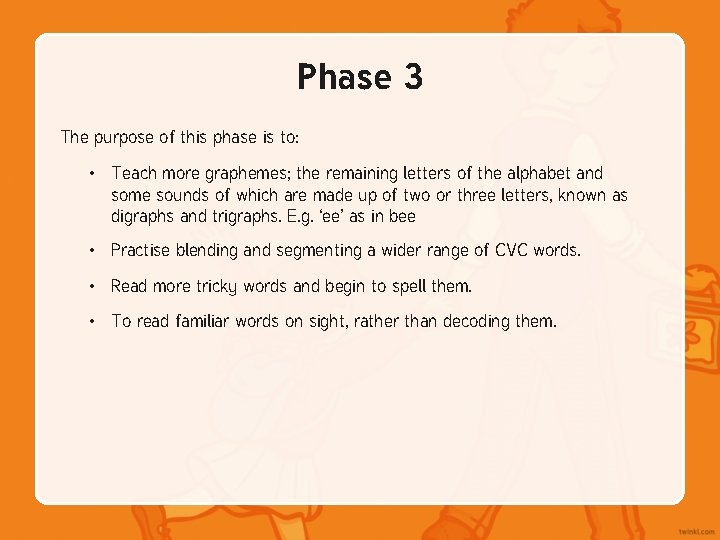
Phase 3 The purpose of this phase is to: • Teach more graphemes; the remaining letters of the alphabet and some sounds of which are made up of two or three letters, known as digraphs and trigraphs. E. g. ‘ee’ as in bee • Practise blending and segmenting a wider range of CVC words. • Read more tricky words and begin to spell them. • To read familiar words on sight, rather than decoding them.
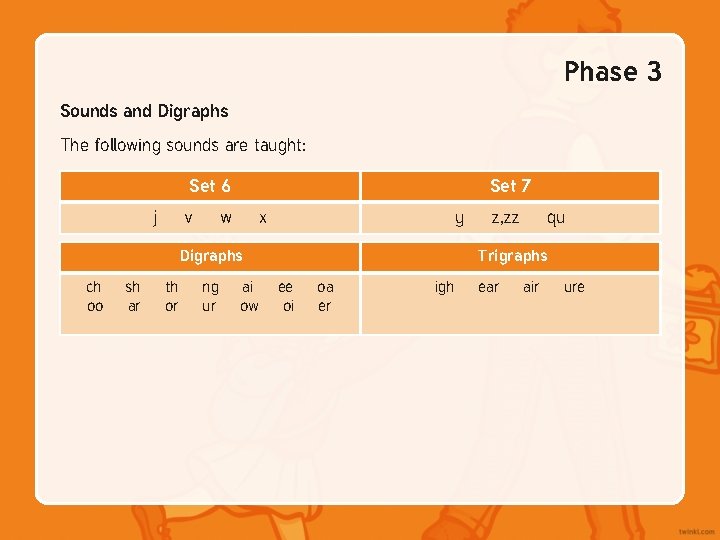
Phase 3 Sounds and Digraphs The following sounds are taught: Set 6 j v Set 7 w x y Digraphs ch oo sh ar th or ng ur ai ow z, zz qu Trigraphs ee oi oa er igh ear air ure
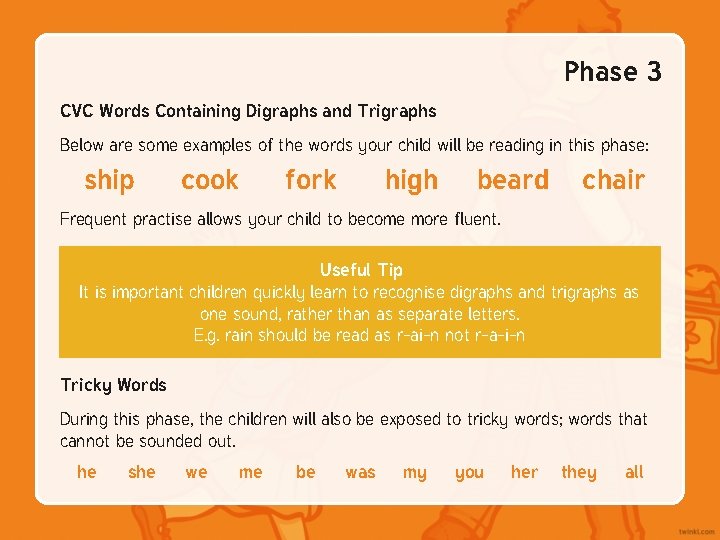
Phase 3 CVC Words Containing Digraphs and Trigraphs Below are some examples of the words your child will be reading in this phase: ship cook fork high beard chair Frequent practise allows your child to become more fluent. Useful Tip It is important children quickly learn to recognise digraphs and trigraphs as one sound, rather than as separate letters. E. g. rain should be read as r-ai-n not r-a-i-n Tricky Words During this phase, the children will also be exposed to tricky words; words that cannot be sounded out. he she we me be was my you her they all
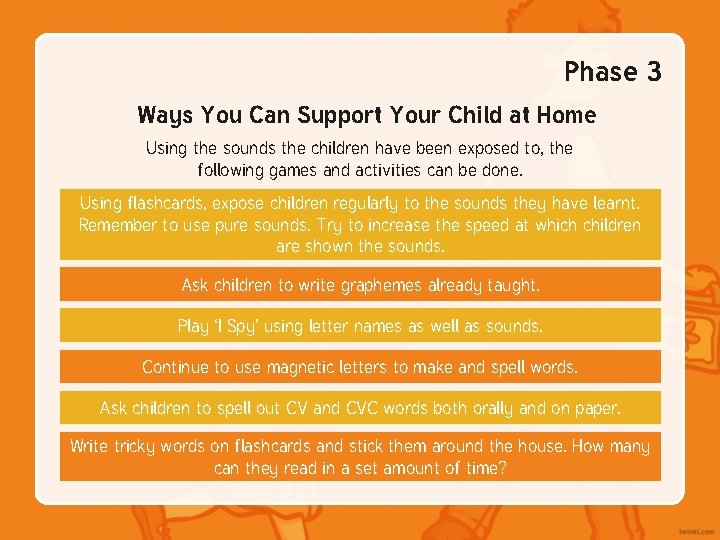
Phase 3 Ways You Can Support Your Child at Home Using the sounds the children have been exposed to, the following games and activities can be done. Using flashcards, expose children regularly to the sounds they have learnt. Remember to use pure sounds. Try to increase the speed at which children are shown the sounds. Ask children to write graphemes already taught. Play ‘I Spy’ using letter names as well as sounds. Continue to use magnetic letters to make and spell words. Ask children to spell out CV and CVC words both orally and on paper. Write tricky words on flashcards and stick them around the house. How many can they read in a set amount of time?
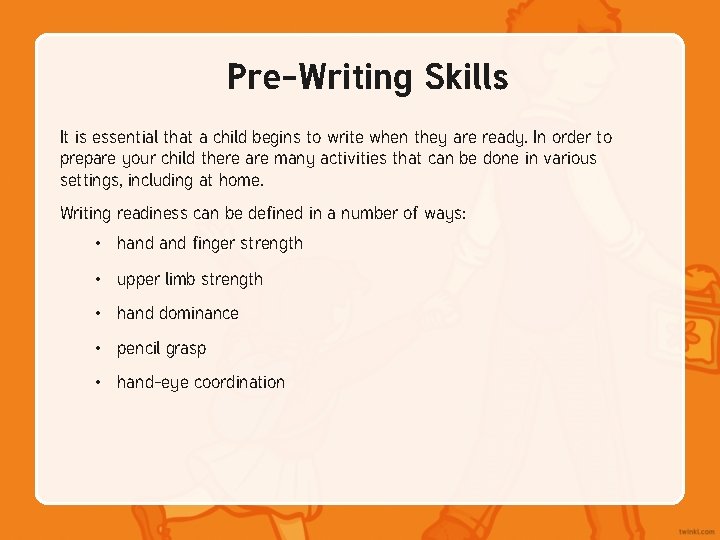
Pre-Writing Skills It is essential that a child begins to write when they are ready. In order to prepare your child there are many activities that can be done in various settings, including at home. Writing readiness can be defined in a number of ways: • hand finger strength • upper limb strength • hand dominance • pencil grasp • hand-eye coordination
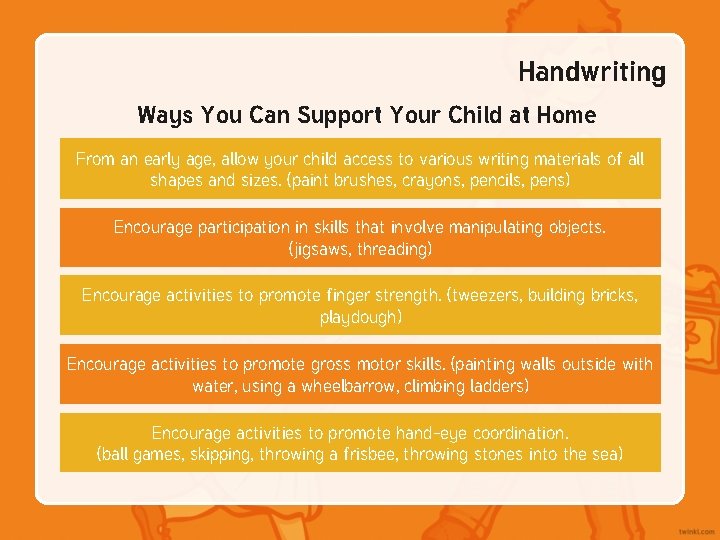
Handwriting Ways You Can Support Your Child at Home From an early age, allow your child access to various writing materials of all shapes and sizes. (paint brushes, crayons, pencils, pens) Encourage participation in skills that involve manipulating objects. (jigsaws, threading) Encourage activities to promote finger strength. (tweezers, building bricks, playdough) Encourage activities to promote gross motor skills. (painting walls outside with water, using a wheelbarrow, climbing ladders) Encourage activities to promote hand-eye coordination. (ball games, skipping, throwing a frisbee, throwing stones into the sea)
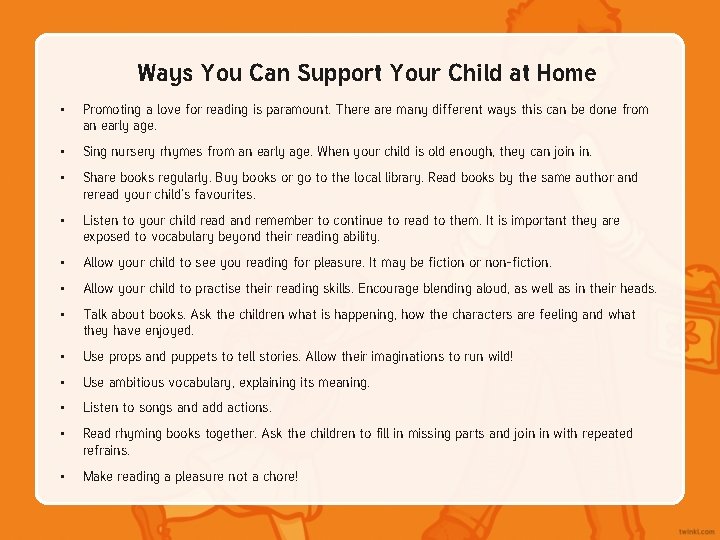
Ways You Can Support Your Child at Home • Promoting a love for reading is paramount. There are many different ways this can be done from an early age. • Sing nursery rhymes from an early age. When your child is old enough, they can join in. • Share books regularly. Buy books or go to the local library. Read books by the same author and reread your child’s favourites. • Listen to your child read and remember to continue to read to them. It is important they are exposed to vocabulary beyond their reading ability. • Allow your child to see you reading for pleasure. It may be fiction or non-fiction. • Allow your child to practise their reading skills. Encourage blending aloud, as well as in their heads. • Talk about books. Ask the children what is happening, how the characters are feeling and what they have enjoyed. • Use props and puppets to tell stories. Allow their imaginations to run wild! • Use ambitious vocabulary, explaining its meaning. • Listen to songs and add actions. • Read rhyming books together. Ask the children to fill in missing parts and join in with repeated refrains. • Make reading a pleasure not a chore!