
Introduction Spending time in a natural environment reduces
- Slides: 1
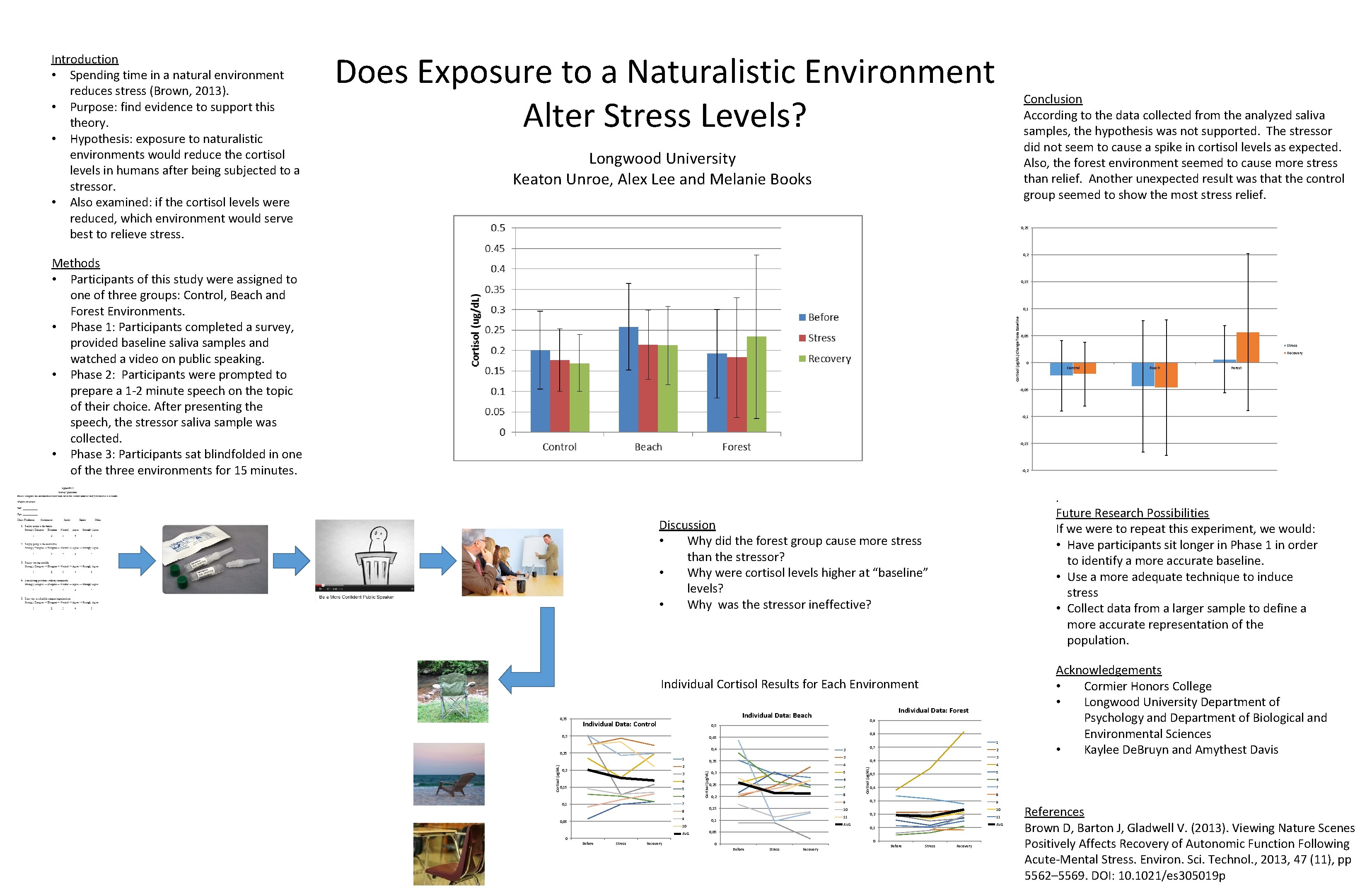
Introduction • Spending time in a natural environment reduces stress (Brown, 2013). • Purpose: find evidence to support this theory. • Hypothesis: exposure to naturalistic environments would reduce the cortisol levels in humans after being subjected to a stressor. • Also examined: if the cortisol levels were reduced, which environment would serve best to relieve stress. Does Exposure to a Naturalistic Environment Alter Stress Levels? Conclusion According to the data collected from the analyzed saliva samples, the hypothesis was not supported. The stressor did not seem to cause a spike in cortisol levels as expected. Also, the forest environment seemed to cause more stress than relief. Another unexpected result was that the control group seemed to show the most stress relief. Longwood University Keaton Unroe, Alex Lee and Melanie Books 0, 25 0, 2 Methods • Participants of this study were assigned to one of three groups: Control, Beach and Forest Environments. • Phase 1: Participants completed a survey, provided baseline saliva samples and watched a video on public speaking. • Phase 2: Participants were prompted to prepare a 1 -2 minute speech on the topic of their choice. After presenting the speech, the stressor saliva sample was collected. • Phase 3: Participants sat blindfolded in one of the three environments for 15 minutes. 0, 15 Cortisol (ug/d. L) Change from Baseline 0, 1 0, 05 Stress Recovery 0 Control Beach Forest -0, 05 -0, 15 -0, 2 . Future Research Possibilities If we were to repeat this experiment, we would: • Have participants sit longer in Phase 1 in order to identify a more accurate baseline. • Use a more adequate technique to induce stress • Collect data from a larger sample to define a more accurate representation of the population. Discussion • Why did the forest group cause more stress than the stressor? • Why were cortisol levels higher at “baseline” levels? • Why was the stressor ineffective? Individual Cortisol Results for Each Environment Individual Data: Control 0, 3 0, 8 0, 45 0, 4 0, 25 1 3 3 4 0, 15 5 6 7 0, 1 8 9 0, 05 5 0, 3 6 0, 25 7 8 0, 2 9 0, 15 10 11 0, 1 AVG 10 AVG 0 Before Stress Recovery 0, 05 2 3 0, 6 4 2 0, 2 1 0, 7 2 0, 35 Cortisol (ug/d. L) 0, 9 0, 5 Cortisol (ug/d. L) 0, 35 Individual Data: Forest Individual Data: Beach 4 5 0, 5 6 7 0, 4 8 0, 3 9 10 0, 2 11 AVG 0, 1 0 0 Before Stress Recovery Acknowledgements • Cormier Honors College • Longwood University Department of Psychology and Department of Biological and Environmental Sciences • Kaylee De. Bruyn and Amythest Davis Before Stress Recovery References Brown D, Barton J, Gladwell V. (2013). Viewing Nature Scenes Positively Affects Recovery of Autonomic Function Following Acute-Mental Stress. Environ. Sci. Technol. , 2013, 47 (11), pp 5562– 5569. DOI: 10. 1021/es 305019 p