
INTRODUCTION SMART CITIES CONTEXT OF NEPAL ABUSHAN PANT
INTRODUCTION SMART CITIES CONTEXT OF NEPAL ABUSHAN PANT DAMODAR ACHARYA PUSP RAJ BHATT (201) (204) (213) DATE : 2 nd DECEMBER , 2016
OVERVIEW Smart Cities, Context of Nepal Concept entered in Nepalese Urban Planning arena through the budget speech of 2072 -2073 to develop 10 cities including Palungtaar, Waling, Nijgadh and Lumbini as Smart City Not universally accepted definition but idea of smart cities have evolved to meet the demand of urban population and to solve the urban problems including climate change, urban infrastructures, urban economy and governance with the optimum use of Information technology. SMART CITIES- CONTEXT OF NEPAL
SMART CITIES IN NEPAL National Declarations The development of smart city will be initiated by laying the optical fiber in the mid-hill highway with the utilization of rural telecommunication development fund. Continuity will be given to establish the rural information centers. ” Keeping Palungtar of Gorkha at a center, smart city master plan will be developed and implemented in the surrounding areas of Marsyangdi. In order to develop Walling, Lumbini and Dadeldhura including 10 cities as modern and prosperous smart cities, infrastructure construction work will be initiated through preparing the master plan. ” A city‟s “Smartness” begins at the planning stage. Smart cities know what they want to be; cities must make an effort to “know thyself” through a self-assessment of strengths and weaknesses and ultimately decide on an overarching economic vision and where they want to go in the future Concept Paper- DUDBC, NTPCO
INDICATORS & CHARACTERISTICS Sustainable, Measurable, Accessible, Replicable Technical CITY, smart city Characteristics Ø Smart People Ø Smart Governance Ø Smart Infrastructures Ø Smart Economy Concept Paper- National Planning Commission
INDICATORS & CHARACTERISTICS SMART PEOPLE Ø Inclusiveness, Education, Health, Creativity, Security SMART Governance Ø Information & Technology Infrastructure, Online Services, Transparent and Open Government, Identity SMART INFRASTRUCTURE Ø Physical Infrastructure (Building and Housing, , Urban Services Infrastructures, Social Infrastructure, Green Infrastructure, Security Infrastructure SMART ECONOMICS Ø Innovation and Entrepreneurship, Productivity and Job Creation, Green Business. Concept Paper – National Planning Commission
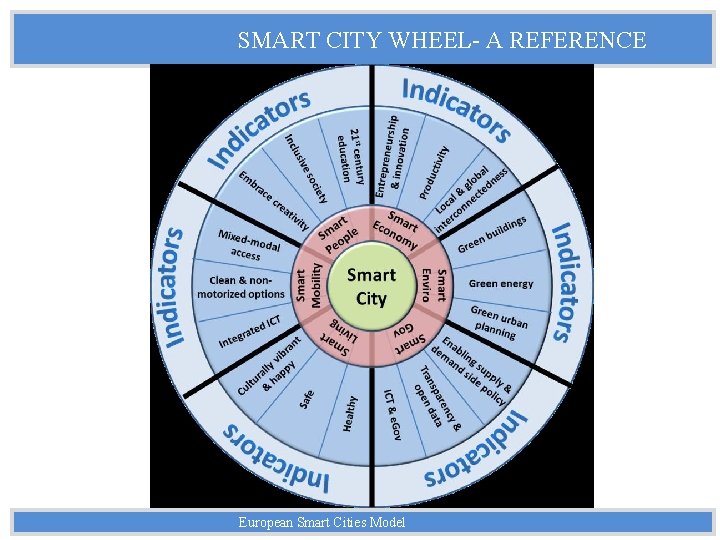
SMART CITY WHEEL- A REFERENCE European Smart Cities Model
SMART CITIES IN NEPAL Basic Concept A smart city is a city that makes appropriate use of Information and Communication Technology (ICT) in establishing itself as a disaster resilient, ecofriendly and people centric city. Inferences In a smart city, the use of technology must assist in: • addressing the issues of safety and convenience • upgrading and maintenance of infrastructure as well as sustainable management of resources • uplifting the quality of life and conditions of the citizens • ensuring effective delivery system from Government to Community • enhancing mobility - Provision of comfortable public transport Concept Paper- DUDBC, NTPCO
CHARACTERISTICS AND INDICATORS OF SMART CITIES IN NEPAL 1. 2. 3. 4. 5. 6. Smart People Smart Governance Smart Mobility Smart Economy Smart Living Smart Environment Concept Paper- DUDBC, NTPCO
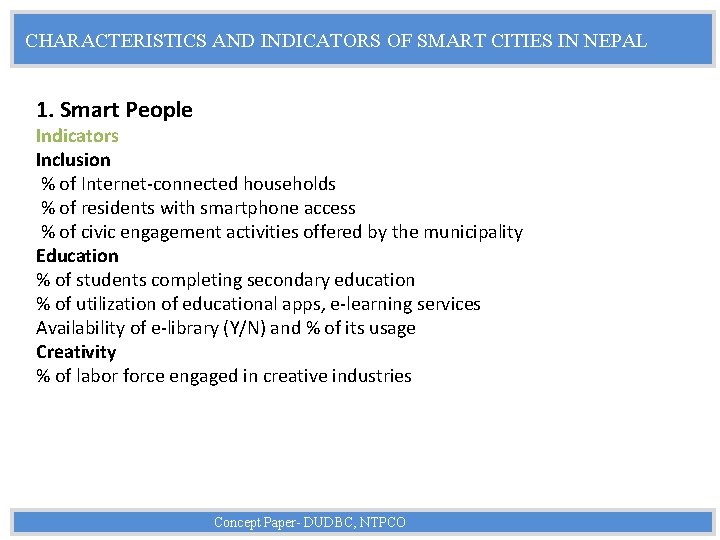
CHARACTERISTICS AND INDICATORS OF SMART CITIES IN NEPAL 1. Smart People Indicators Inclusion % of Internet-connected households % of residents with smartphone access % of civic engagement activities offered by the municipality Education % of students completing secondary education % of utilization of educational apps, e-learning services Availability of e-library (Y/N) and % of its usage Creativity % of labor force engaged in creative industries Concept Paper- DUDBC, NTPCO
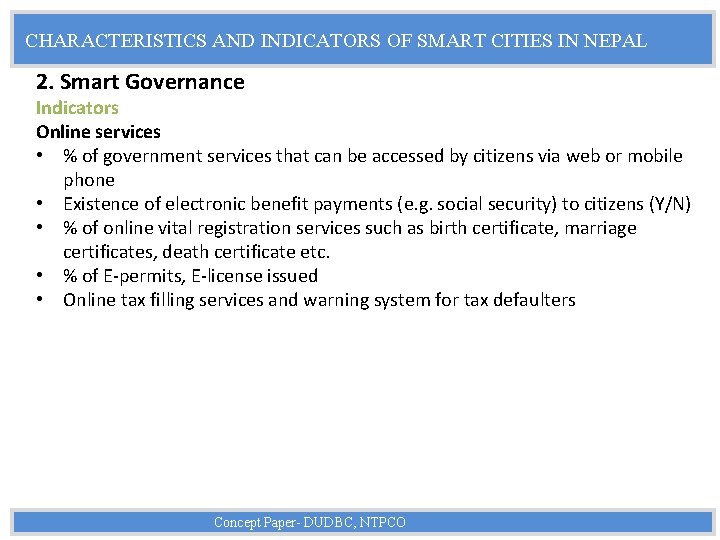
CHARACTERISTICS AND INDICATORS OF SMART CITIES IN NEPAL 2. Smart Governance Indicators Online services • % of government services that can be accessed by citizens via web or mobile phone • Existence of electronic benefit payments (e. g. social security) to citizens (Y/N) • % of online vital registration services such as birth certificate, marriage certificates, death certificate etc. • % of E-permits, E-license issued • Online tax filling services and warning system for tax defaulters Concept Paper- DUDBC, NTPCO
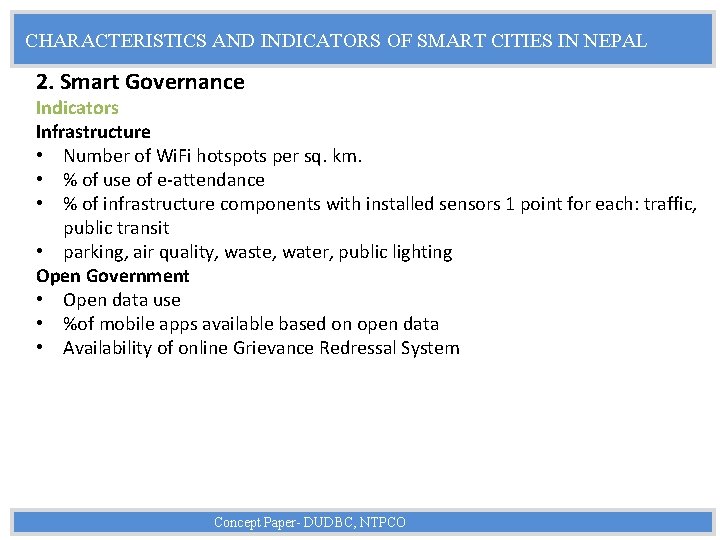
CHARACTERISTICS AND INDICATORS OF SMART CITIES IN NEPAL 2. Smart Governance Indicators Infrastructure • Number of Wi. Fi hotspots per sq. km. • % of use of e-attendance • % of infrastructure components with installed sensors 1 point for each: traffic, public transit • parking, air quality, waste, water, public lighting Open Government • Open data use • %of mobile apps available based on open data • Availability of online Grievance Redressal System Concept Paper- DUDBC, NTPCO
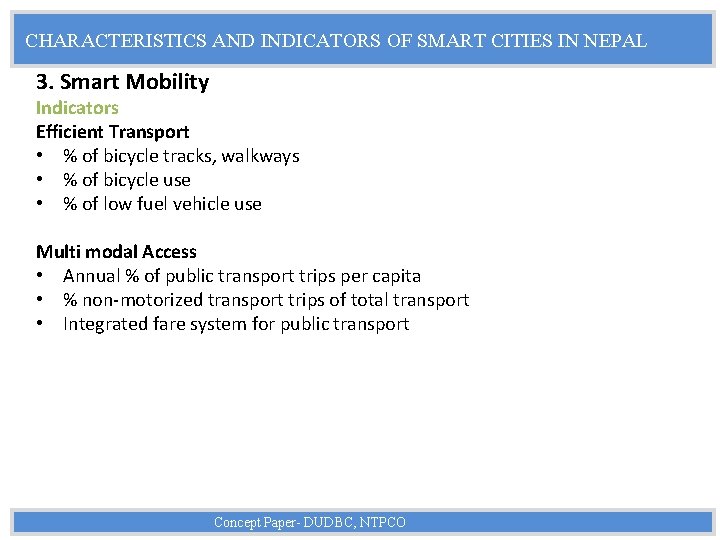
CHARACTERISTICS AND INDICATORS OF SMART CITIES IN NEPAL 3. Smart Mobility Indicators Efficient Transport • % of bicycle tracks, walkways • % of bicycle use • % of low fuel vehicle use Multi modal Access • Annual % of public transport trips per capita • % non-motorized transport trips of total transport • Integrated fare system for public transport Concept Paper- DUDBC, NTPCO
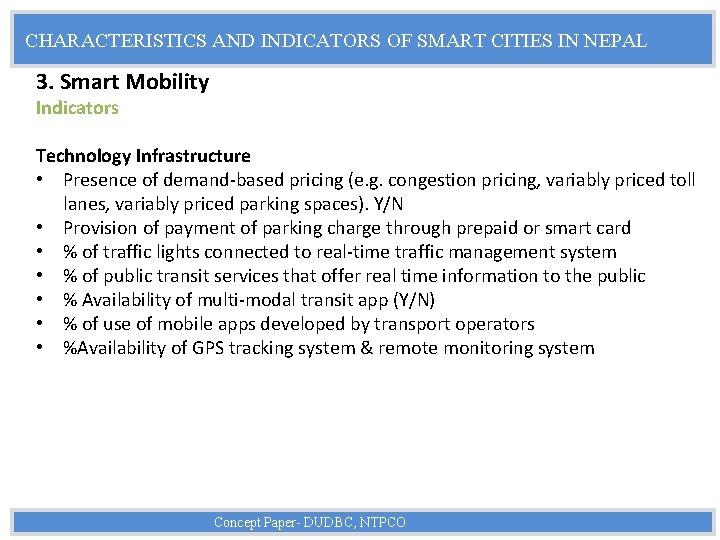
CHARACTERISTICS AND INDICATORS OF SMART CITIES IN NEPAL 3. Smart Mobility Indicators Technology Infrastructure • Presence of demand-based pricing (e. g. congestion pricing, variably priced toll lanes, variably priced parking spaces). Y/N • Provision of payment of parking charge through prepaid or smart card • % of traffic lights connected to real-time traffic management system • % of public transit services that offer real time information to the public • % Availability of multi-modal transit app (Y/N) • % of use of mobile apps developed by transport operators • %Availability of GPS tracking system & remote monitoring system Concept Paper- DUDBC, NTPCO
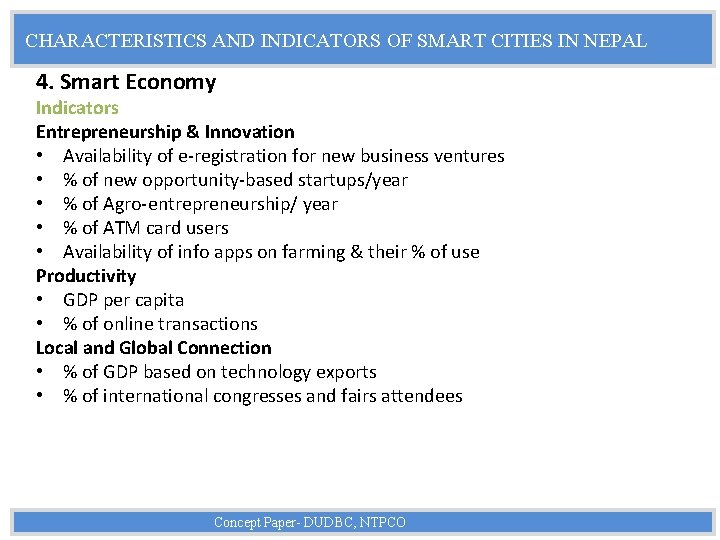
CHARACTERISTICS AND INDICATORS OF SMART CITIES IN NEPAL 4. Smart Economy Indicators Entrepreneurship & Innovation • Availability of e-registration for new business ventures • % of new opportunity-based startups/year • % of Agro-entrepreneurship/ year • % of ATM card users • Availability of info apps on farming & their % of use Productivity • GDP per capita • % of online transactions Local and Global Connection • % of GDP based on technology exports • % of international congresses and fairs attendees Concept Paper- DUDBC, NTPCO
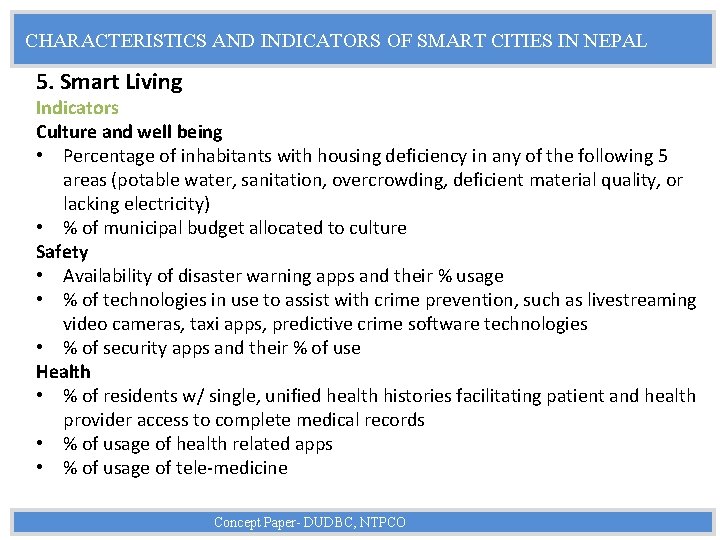
CHARACTERISTICS AND INDICATORS OF SMART CITIES IN NEPAL 5. Smart Living Indicators Culture and well being • Percentage of inhabitants with housing deficiency in any of the following 5 areas (potable water, sanitation, overcrowding, deficient material quality, or lacking electricity) • % of municipal budget allocated to culture Safety • Availability of disaster warning apps and their % usage • % of technologies in use to assist with crime prevention, such as livestreaming video cameras, taxi apps, predictive crime software technologies • % of security apps and their % of use Health • % of residents w/ single, unified health histories facilitating patient and health provider access to complete medical records • % of usage of health related apps • % of usage of tele-medicine Concept Paper- DUDBC, NTPCO
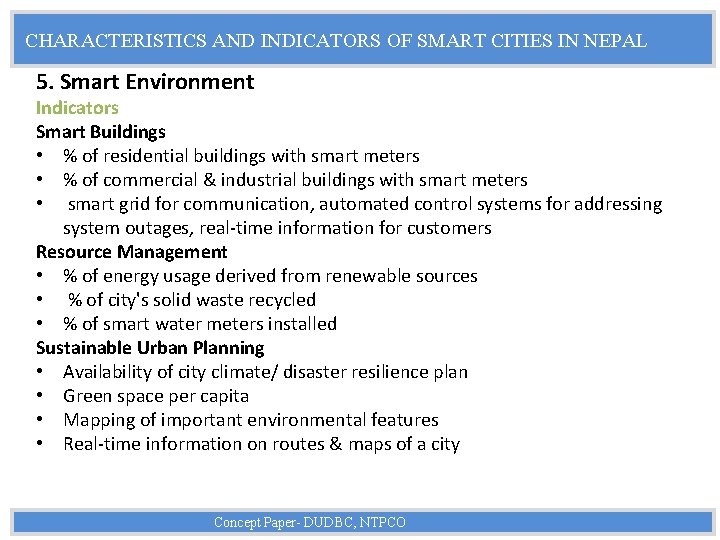
CHARACTERISTICS AND INDICATORS OF SMART CITIES IN NEPAL 5. Smart Environment Indicators Smart Buildings • % of residential buildings with smart meters • % of commercial & industrial buildings with smart meters • smart grid for communication, automated control systems for addressing system outages, real-time information for customers Resource Management • % of energy usage derived from renewable sources • % of city's solid waste recycled • % of smart water meters installed Sustainable Urban Planning • Availability of city climate/ disaster resilience plan • Green space per capita • Mapping of important environmental features • Real-time information on routes & maps of a city Concept Paper- DUDBC, NTPCO
ISSUES STILL TO BE CONFRONTED • Making a decision on making a certain city smart from the top level is not going to help in actually making cities smarter. • Studies need to be conducted about the cities named for „smart cities‟ on their population density, the level of infrastructure already available and their prevailing conditions. • There appears to be a need for the implementation of a pilot project as a test before venturing into multiple smart cities projects through investments from Government as well as private sector Concept Paper- DUDBC, NTPCO
CONCLUSION In Nepalese context, a smart city is a city that makes appropriate use of Information and Communication Technology (ICT) in establishing itself as a disaster resilient, eco-friendly and people centric city. It is suggested that cities' individuality and their identity should be the primary focus while making them smarter. It is first imperative to distinguish the sectors where a city needs to become smart. Concept Paper- DUDBC, NTPCO
CONCLUSION Thank You Concept Paper- DUDBC, NTPCO
- Slides: 19