
INTRODUCTION Sampling is the process of selecting observations

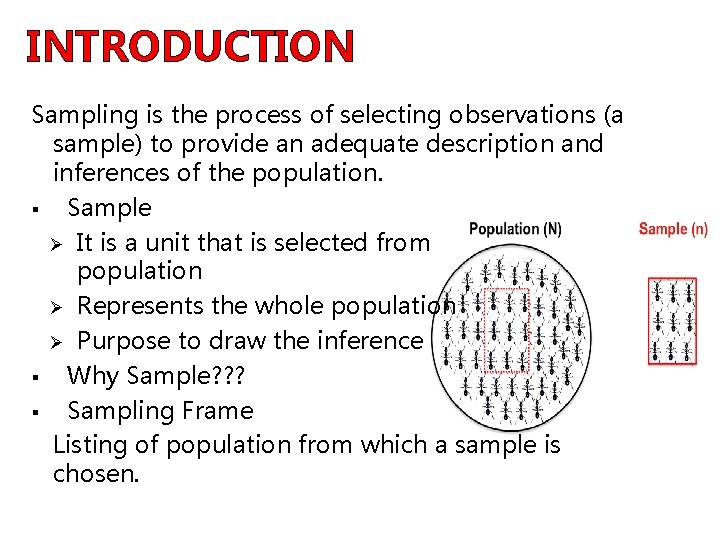
INTRODUCTION Sampling is the process of selecting observations (a sample) to provide an adequate description and inferences of the population. § Sample Ø It is a unit that is selected from population Ø Represents the whole population Ø Purpose to draw the inference § Why Sample? ? ? § Sampling Frame Listing of population from which a sample is chosen.
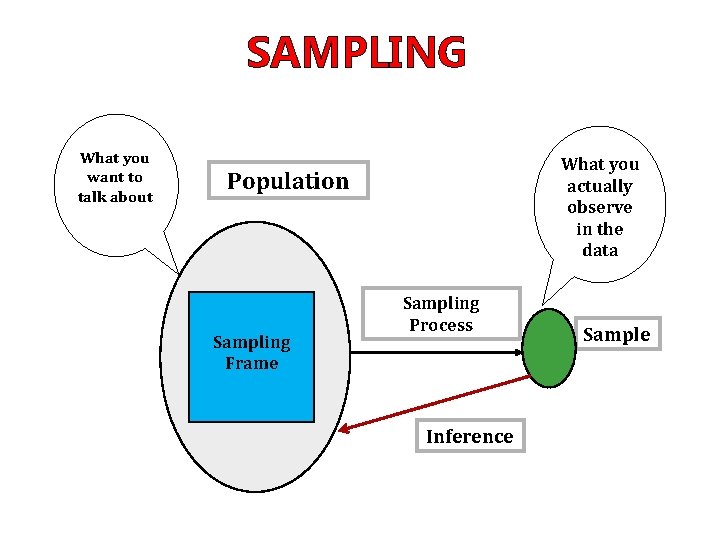
SAMPLING What you want to talk about What you actually observe in the data Population Sampling Frame Sampling Process Inference Sample

IF THE POPULATION IS HOMOGENEOUS A homogeneous population is one where all individuals can be regarded as the same type.

IF THE POPULATION IS HETEROGENEOUS A heterogeneous population is one containing subpopulations of different types.

SAMPLING DESIGN PROCESS
PROBABILITY SAMPLING A probability sampling method is any method of sampling that utilizes some form of random selection. In order to have a random selection method, you must set up some process or procedure that assures that the different units in your population have equal probabilities of being chosen.
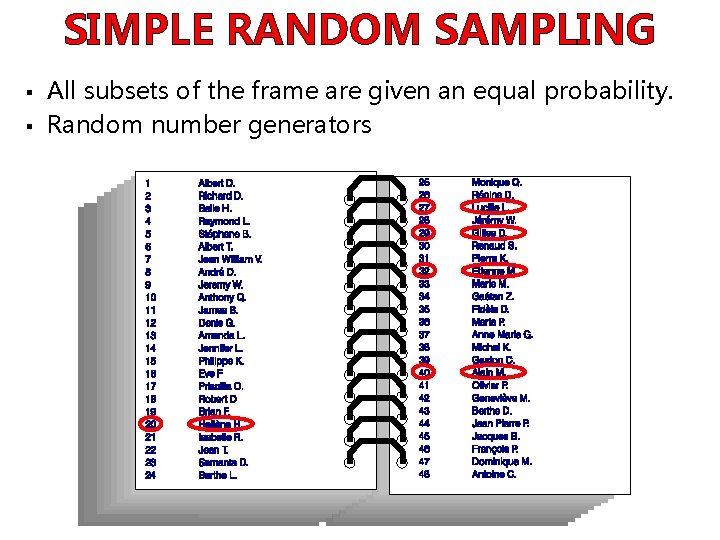
SIMPLE RANDOM SAMPLING § § All subsets of the frame are given an equal probability. Random number generators
SIMPLE RANDOM SAMPLING � � Advantages: Ø Minimal knowledge of population needed Ø Easy to analyze data Disadvantages: Ø Low frequency of use Ø Does not use researchers’ expertise Ø Larger risk of random error
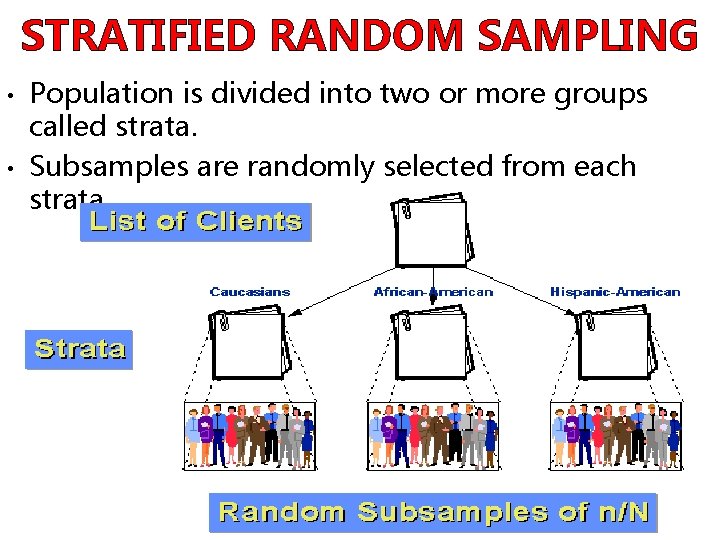
STRATIFIED RANDOM SAMPLING • • Population is divided into two or more groups called strata. Subsamples are randomly selected from each strata.
STRATIFIED RANDOM SAMPLING • • • Advantages: Assures representation of all groups in sample population Characteristics of each stratum can be estimated and comparisons made Disadvantages: Requires accurate information on proportions of each stratum Stratified lists costly to prepare
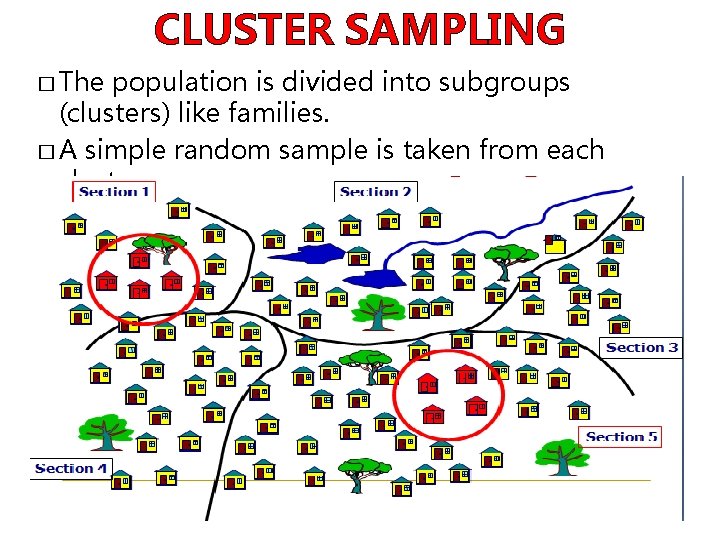
CLUSTER SAMPLING � The population is divided into subgroups (clusters) like families. � A simple random sample is taken from each cluster.
CLUSTER SAMPLING Advantages: § Can estimate characteristics cluster and population of both Disadvantages: § The cost to reach an element to sample is very high § Each stage in cluster sampling introduces sampling error—the more stages there are, the more error there tends to be
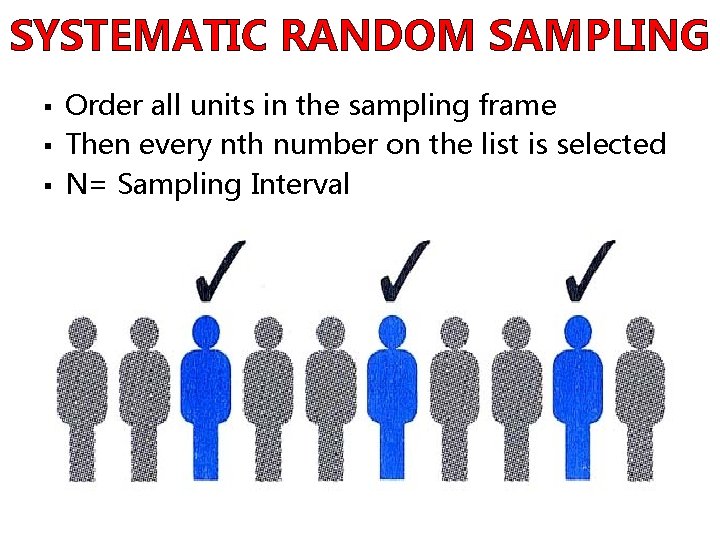
SYSTEMATIC RANDOM SAMPLING § § § Order all units in the sampling frame Then every nth number on the list is selected N= Sampling Interval
SYSTEMATIC RANDOM SAMPLING Advantages: § Moderate cost; moderate usage § Simple to draw sample § Easy to verify Disadvantages: § Periodic ordering required
MULTISTAGE SAMPLING � Carried out in stages � Using smaller and smaller sampling units at each stage
MULTISTAGE SAMPLING Advantages: § More Accurate § More Effective Disadvantages: § Costly § Each stage in sampling introduces sampling error—the more stages there are, the more error there tends to be.
NONPROBABILITY SAMPLES § § § The probability of each case being selected from the total population is not known. Units of the sample are chosen on the basis of personal judgment or convenience. There are NO statistical techniques for measuring random sampling error in a
NONPROBABILITY SAMPLING § A. Convenience Sampling § B. Quota Sampling § C. Judgmental Sampling (Purposive Sampling) § D. Snowball sampling § E. Self-selection sampling
A. CONVENIENCE SAMPLING § Convenience sampling involves choosing respondents at the convenience of the researcher. Advantages § Very low cost § Extensively used/understood Disadvantages § Variability and bias cannot be measured or controlled § Projecting data beyond sample not justified § Restriction of Generalization.
B. QUOTA SAMPLING § The population is first segmented into mutually exclusive sub-groups, just as in stratified sampling. Advantages § Used when research budget is limited § Very extensively used/understood § No need for list of population elements Disadvantages § Variability and bias cannot be measured/controlled
C. JUDGEMENTAL SAMPLING § Researcher employs his or her own "expert” judgment about. Advantages § There is a assurance of Quality response § Meet the specific objective. Disadvantages § Bias selection of sample may occur § Time consuming process.
D. SNOWBALL SAMPLING § The research starts with a key person and introduce the next one to become a chain Advantages § Low cost § Useful in specific circumstances & for locating rare populations Disadvantages § Not independent § Projecting data beyond sample not justified
E. SELF-SELECTION SAMPLING § It occurs when you allow each case usually individuals, to identify their desire to take part in the research. Advantages § More accurate § Useful in specific circumstances to serve the purpose. Disadvantages § More costly due to Advertizing § Mass are left
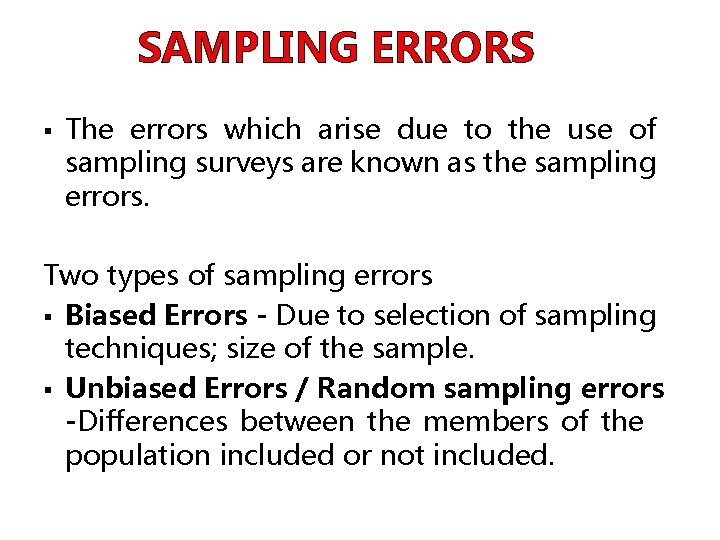
SAMPLING ERRORS § The errors which arise due to the use of sampling surveys are known as the sampling errors. Two types of sampling errors § Biased Errors - Due to selection of sampling techniques; size of the sample. § Unbiased Errors / Random sampling errors -Differences between the members of the population included or not included.
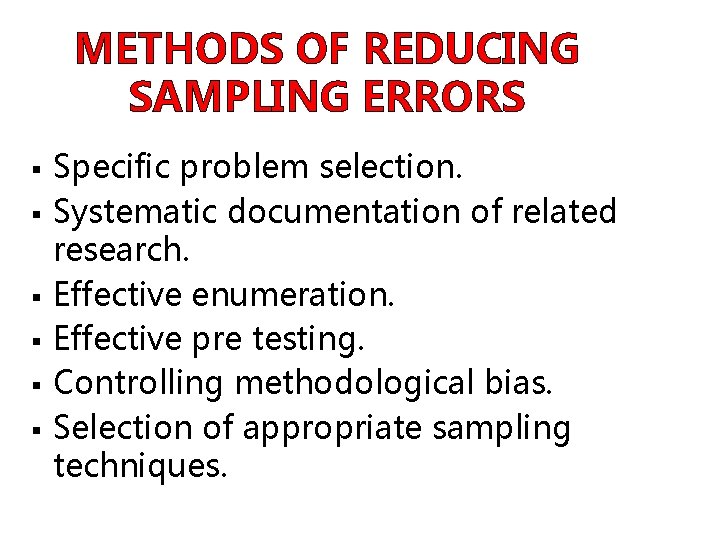
METHODS OF REDUCING SAMPLING ERRORS § § § Specific problem selection. Systematic documentation of related research. Effective enumeration. Effective pre testing. Controlling methodological bias. Selection of appropriate sampling techniques.
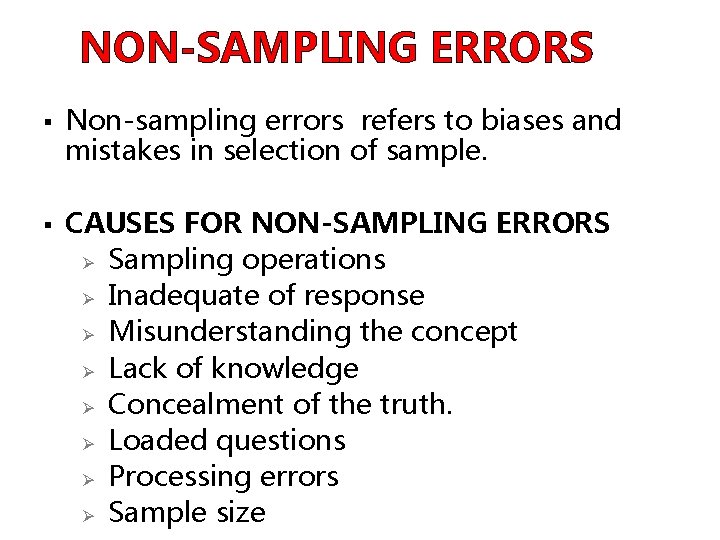
NON-SAMPLING ERRORS § § Non-sampling errors refers to biases and mistakes in selection of sample. CAUSES FOR NON-SAMPLING ERRORS Ø Sampling operations Ø Inadequate of response Ø Misunderstanding the concept Ø Lack of knowledge Ø Concealment of the truth. Ø Loaded questions Ø Processing errors Ø Sample size
- Slides: 27