
Introduction Reading comprehension RC is a basic literacy
Introduction Reading comprehension (RC) is a basic literacy skill that should acquired and facilitated from early school years u Learners in early grades often experience RC problems u They struggle to construct meaning from what they are reading u RC problems generally arise from various factors e. g. teachers’ instructional and assessment practices (Block & Pressley, 2002). u improved assessment practices can result in improved learning ( Black & Wiliam, 1998) 2 u
Introduction (cont) Formative assessment (FA) is a central aspect of classroom assessment that connects teaching and learning. u Role of FA during the learning process is to inform teachers and learners about the learners’ progress in order to achieve the expected objectives u Teachers should communicate FA data to learners through feedback and should use the data to plan for instructions u Purpose of this study is that effective use of FA can support the teaching of RC. u 3
Rationale u u u Low achievements of South African learners in reading Grade 4, 2011 Progress International Reading Literacy Study (pre. PIRLS) indicated that the South African learners’ performance falls below the international standard PIRLS reported that most SA learners in grade 4 struggle with basic reading and higher order comprehension (interpretive, inferential, analytical and critical skills). SACMEQ III (2009) indicated that South African Grade 6 pupils perform very low in all levels of reading comprehension SACMEQ III (2009) showed - basic reading achievement was at 21 %, in higher order of comprehension the overall performance was below 20%. 4
Rationale (cont) u u ANA qualitative report (2011) indicated that Grade 3 learners perform better in literal comprehension as most learners were able to retrieve explicit stated information, while the majority of learners struggle to interpret and integrate ideas and information. Mpumalanga tends to achieve lower than National scores in standardised testing. 5
Why focus on FA to support the teaching of RC ? l l l International literature recognizes FA as the body of knowledge It is highly recommended to support learners’ learning and to inform teachers’ instructions There is substantial evidence on literature to confirm that effective practice of formative assessment enhances learners’ performance and improve the standards (Taras, 2009). 6

FA in SA Context l l FA should be administered within the Assessment Guidelines of the Provincial Education Department, which complies with the National Policy on Assessment (DBE, 2007). Little research has been conducted on FA of the foundation phase learners This research study is being undertaken to obtain evidence–based data on the facilitation of FA activities in the foundation phase. Making recommendations, based on the findings, to improve the practice of formative assessment in a Grade 3 class. 7
Purpose l to explore and describe Grade 3 teachers’ use of FA to enhance the teaching of RC 8
Main Research questions l How do Grade 3 teachers use formative assessment to enhance the teaching of reading comprehension in si. Swati? 9
Sub- questions l l l What do Grade 3 teachers understand about formative assessment? How do Grade 3 teachers employ formative assessment in the implementation of reading comprehension? What is the nature of feedback given by Grade 3 teachers when teaching reading comprehension in si. Swati home language? 10
Clarification of the key concepts What is reading comprehension l constructive and interactive process between the written text, the reader and the context in the construction of meaning from the print (Gunning, 2000 ) 11
Clarification of the key concepts (cont) What is assessment ? “assessment is a continuous planned process of identifying, gathering and interpreting information about the performance of learners. It involves four steps namely, generating and collecting evidence of achievement; evaluating evidence; recording the findings and using information to understand thereby assist the learner’s development in order to improve the process of learning and teaching. Assessment should be continuous and support teaching and learning in order to achieve the outcomes (DBE, 2012). What is feedback ? information about the gap between the learners’ demonstrated learning and the learning they should achieve (Sadler, 1989). 12
Clarification of the key concepts (cont) What is formative assessment ? l l All assessment activities undertaken by teachers during the learning process, which intention is to support the learning process through feedback (Black & Wiliam, 1998). Feedback is an important aspect of formative assessment, which provides information to teachers about the progress of the lesson 13
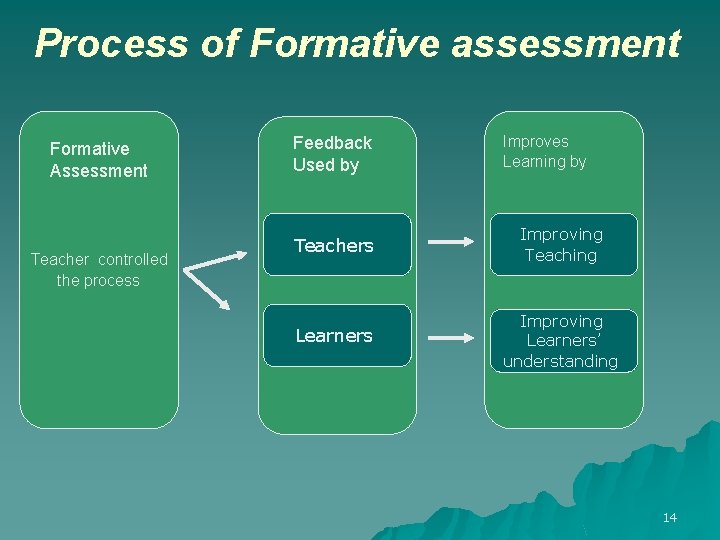
Process of Formative assessment Formative Assessment Teacher controlled the process Feedback Used by Improves Learning by Teachers Improving Teaching Learners Improving Learners’ understanding 14
Characteristics of FA u u u Assessment takes place during the learning and teaching ; Learners are given feedback on their performance; Scaffolding activities are used to support learning; Teachers’ feedback to learners in their learning; Useful practice activities in a variety of materials to move children towards independence ; Assessment data is used for future planning of instructions. 15
Literature on FA l Worldwide, there is growing interest in the use of assessment by teachers to enhance learners’ learning and improve classroom instructions. 16
Challenges regarding implementation of FA l l u implementation is weak since it is not well understood by teachers. The results of formative assessment had been challenged on validity and reliability (Oberholzer, 1999) There is limited scope on empirical research literature. 17
Literature on the teaching and assessment of RC l l l l provided three principles on how teachers should provide comprehension instructions to the learners (Duffy et al, (1986). comprehension instructions should be explicit; modelled by skilful readers ; and taught in a scaffold pattern teachers should communicate declarative, procedural and conditional knowledge to learners (Almasi, 2003). Declarative knowledge - direct explanation of the strategy or knowledge about the strategy. Procedural knowledge - how to carry the strategy. conditional knowledge - when and why the reading strategy should be used. 18
Literature on the teaching and assessment of RC (cont) l l Comprehension should be taught and assessed through cognitive and meta cognitive comprehension instructions common cognitive and meta cognitive comprehension instructions in early grades include: activating of prior knowledge; making predictions about the text; teachers question; self questioning and summarising Comprehension instructions should be taught in an integrated way Spȍrer, et al (2008) Classroom-based assessment process for the assessment of reading comprehension (Fiene & Macmahon (2007) 19
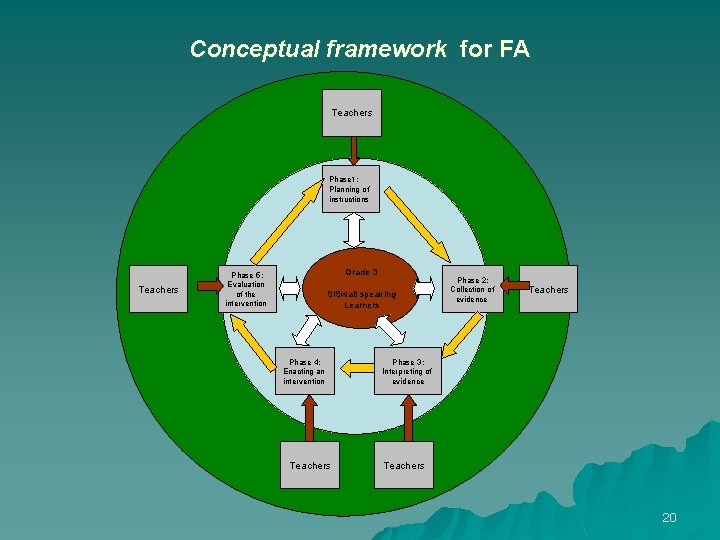
Conceptual framework for FA Teachers Phase 1: Planning of instructions Teachers Grade 3 Phase 5: Evaluation of the intervention Si. Swati speaking Learners Phase 4: Enacting an intervention Teachers Phase 2: Collection of evidence Teachers Phase 3: Interpreting of evidence Teachers 20
Research Methodology l Qualitative approach Data collected through semi- structured interviews, lesson observations , analysis of learners’ workbooks Interactive qualitative enquiry Interpretive orientation l Instrumental, explorative and descriptive case study l l l 21
Sampling l l Convenience and purposeful 7 teachers from 4 schools in 1 circuit in Ehlanzeni district All 7 teachers had attended CAPS training in 2011. First year of implementing CAPS with Grade 3 learners in 2012 22
Data analysis l within-case and cross-case analysis as suggested by Merriam l (2009) in a multiple-case study Deductive and inductive approach Data reported through themes l 23
Findings l l l Teachers lack understanding of FA FA activities were identified during teaching of RC , though they need modification Teachers' lack of understanding of feedback They described feedback as merely the corrections teachers and learners engage in after the written tasks. Do not give constructive feedback , instead they give marks, ticks , crosses and evaluative comments ( e. g. good, you are a star ) No guideline documents to support teachers for the teaching of reading comprehension No reading resources for the learners 24
Recommendations l l Teachers should have ongoing professional development on formative assessment. Professional development programmes should be developed by academic institutions. Teacher training institutions should develop and offer a module on the formative assessment of reading comprehension as part of the literacy programme Formative assessment should form an integral part of Initial Teacher Training (ITT) The Do. E should offer school- based and classroom- support of teachers. 25
- Slides: 24