
INTRODUCTION PROJECT REQUIREMENTS Abstract Design Objectives Design a
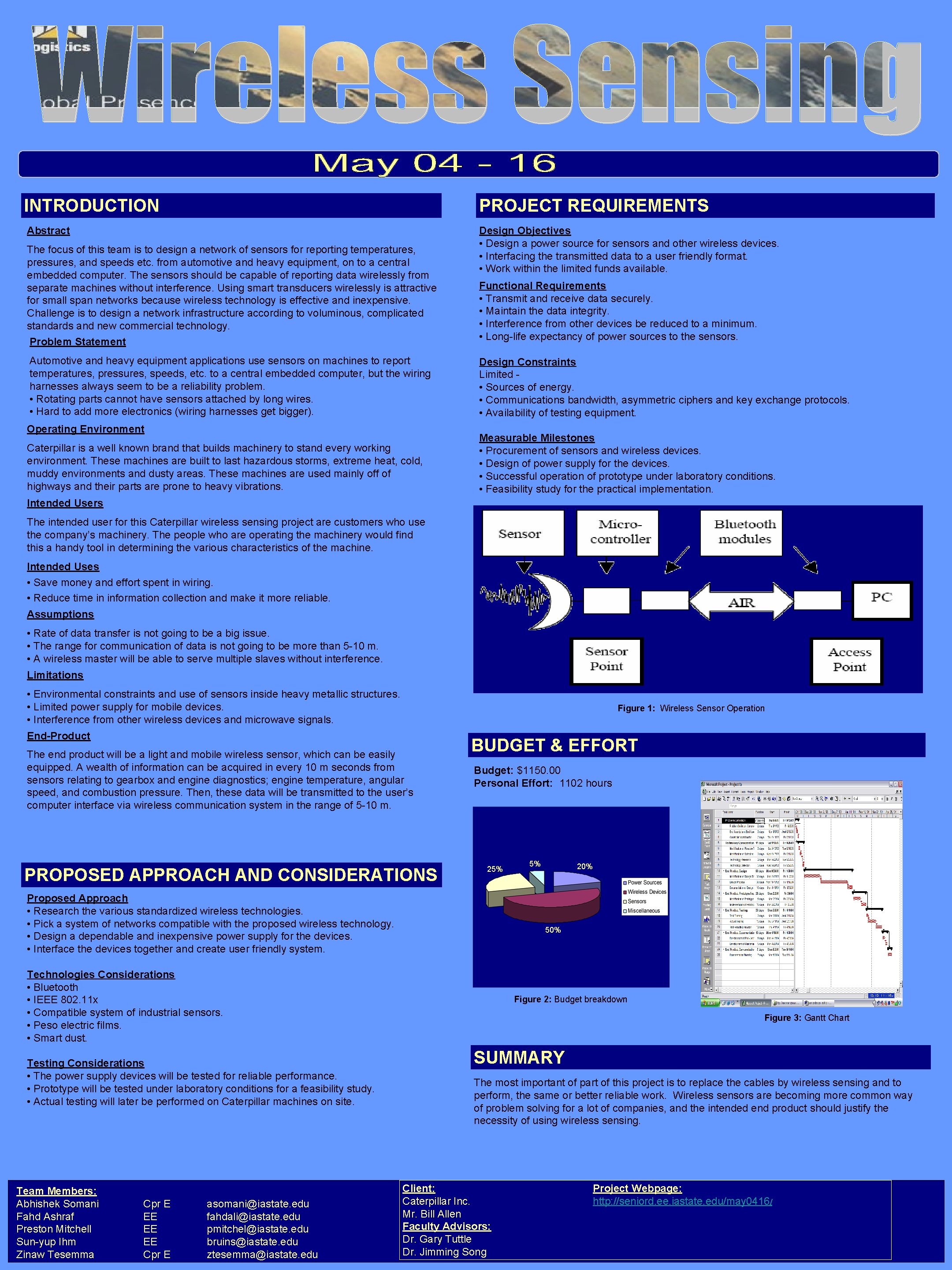
INTRODUCTION PROJECT REQUIREMENTS Abstract Design Objectives • Design a power source for sensors and other wireless devices. • Interfacing the transmitted data to a user friendly format. • Work within the limited funds available. The focus of this team is to design a network of sensors for reporting temperatures, pressures, and speeds etc. from automotive and heavy equipment, on to a central embedded computer. The sensors should be capable of reporting data wirelessly from separate machines without interference. Using smart transducers wirelessly is attractive for small span networks because wireless technology is effective and inexpensive. Challenge is to design a network infrastructure according to voluminous, complicated standards and new commercial technology. Problem Statement Automotive and heavy equipment applications use sensors on machines to report temperatures, pressures, speeds, etc. to a central embedded computer, but the wiring harnesses always seem to be a reliability problem. • Rotating parts cannot have sensors attached by long wires. • Hard to add more electronics (wiring harnesses get bigger). Operating Environment Caterpillar is a well known brand that builds machinery to stand every working environment. These machines are built to last hazardous storms, extreme heat, cold, muddy environments and dusty areas. These machines are used mainly off of highways and their parts are prone to heavy vibrations. Functional Requirements • Transmit and receive data securely. • Maintain the data integrity. • Interference from other devices be reduced to a minimum. • Long-life expectancy of power sources to the sensors. Design Constraints Limited • Sources of energy. • Communications bandwidth, asymmetric ciphers and key exchange protocols. • Availability of testing equipment. Measurable Milestones • Procurement of sensors and wireless devices. • Design of power supply for the devices. • Successful operation of prototype under laboratory conditions. • Feasibility study for the practical implementation. Intended Users The intended user for this Caterpillar wireless sensing project are customers who use the company’s machinery. The people who are operating the machinery would find this a handy tool in determining the various characteristics of the machine. Intended Uses • Save money and effort spent in wiring. • Reduce time in information collection and make it more reliable. Assumptions • Rate of data transfer is not going to be a big issue. • The range for communication of data is not going to be more than 5 -10 m. • A wireless master will be able to serve multiple slaves without interference. Limitations • Environmental constraints and use of sensors inside heavy metallic structures. • Limited power supply for mobile devices. • Interference from other wireless devices and microwave signals. Figure 1: Wireless Sensor Operation End-Product The end product will be a light and mobile wireless sensor, which can be easily equipped. A wealth of information can be acquired in every 10 m seconds from sensors relating to gearbox and engine diagnostics; engine temperature, angular speed, and combustion pressure. Then, these data will be transmitted to the user’s computer interface via wireless communication system in the range of 5 -10 m. PROPOSED APPROACH AND CONSIDERATIONS BUDGET & EFFORT Budget: $1150. 00 Personal Effort: 1102 hours 25% Proposed Approach • Research the various standardized wireless technologies. • Pick a system of networks compatible with the proposed wireless technology. • Design a dependable and inexpensive power supply for the devices. • Interface the devices together and create user friendly system. Team Members: Abhishek Somani Fahd Ashraf Preston Mitchell Sun-yup Ihm Zinaw Tesemma Cpr E EE EE EE Cpr E asomani@iastate. edu fahdali@iastate. edu pmitchel@iastate. edu bruins@iastate. edu ztesemma@iastate. edu 20% 50% Technologies Considerations • Bluetooth • IEEE 802. 11 x • Compatible system of industrial sensors. • Peso electric films. • Smart dust. Testing Considerations • The power supply devices will be tested for reliable performance. • Prototype will be tested under laboratory conditions for a feasibility study. • Actual testing will later be performed on Caterpillar machines on site. 5% Figure 2: Budget breakdown Figure 3: Gantt Chart SUMMARY The most important of part of this project is to replace the cables by wireless sensing and to perform, the same or better reliable work. Wireless sensors are becoming more common way of problem solving for a lot of companies, and the intended end product should justify the necessity of using wireless sensing. Client: Caterpillar Inc. Mr. Bill Allen Faculty Advisors: Dr. Gary Tuttle Dr. Jimming Song Project Webpage: http: //seniord. ee. iastate. edu/may 0416/
- Slides: 1