
Introduction Product Description Tissue Mend is a strong
- Slides: 30
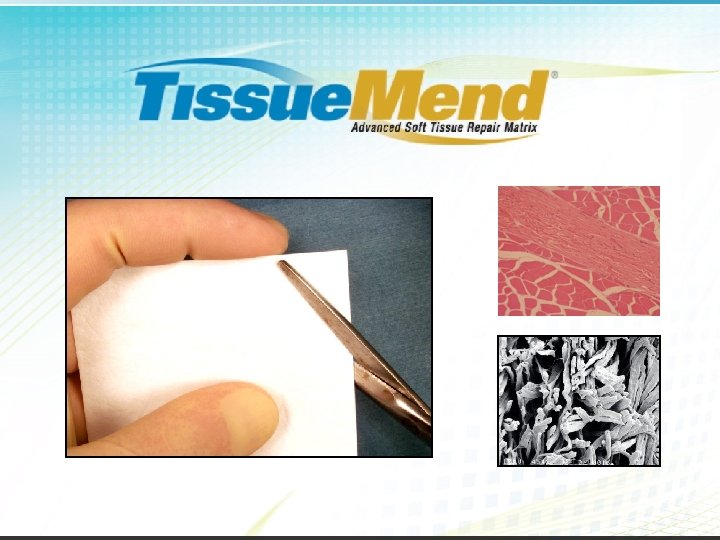
Introduction Product Description Tissue. Mend® is a strong, suturable, porous collagen biomembrane that is derived from fetal bovine dermis. Through a proprietary process, the producers of Tissue. Mend® remove all cellular components from this dermal layer, leaving nothing but intact, non-denatured collagen fibers. The Tissue. Mend® collagen fibers function as a foundation for cellular growth, essentailly providing a scaffold within which the patient’s cells populate, grow and mature.
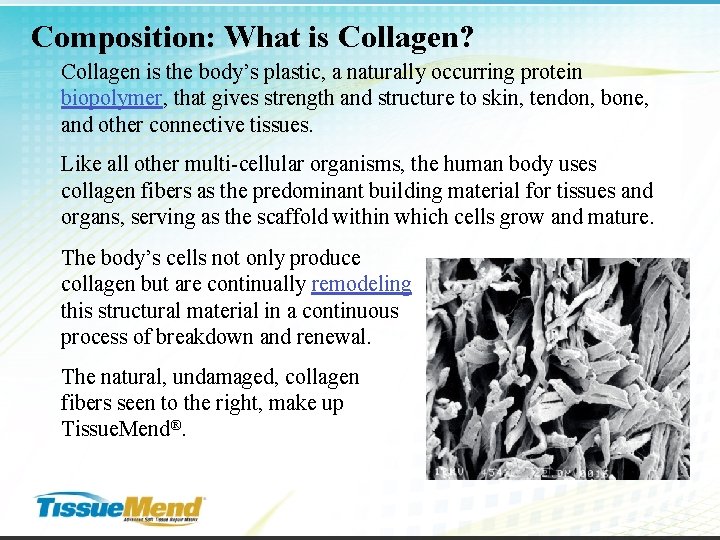
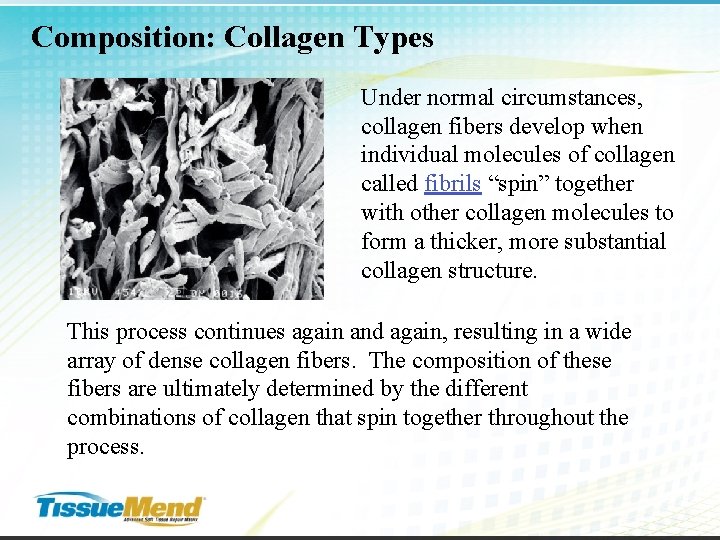
Composition: What is Collagen? Collagen is the body’s plastic, a naturally occurring protein biopolymer, that gives strength and structure to skin, tendon, bone, and other connective tissues. Like all other multi-cellular organisms, the human body uses collagen fibers as the predominant building material for tissues and organs, serving as the scaffold within which cells grow and mature. The body’s cells not only produce collagen but are continually remodeling this structural material in a continuous process of breakdown and renewal. The natural, undamaged, collagen fibers seen to the right, make up Tissue. Mend®.
Composition: Collagen Types Under normal circumstances, collagen fibers develop when individual molecules of collagen called fibrils “spin” together with other collagen molecules to form a thicker, more substantial collagen structure. This process continues again and again, resulting in a wide array of dense collagen fibers. The composition of these fibers are ultimately determined by the different combinations of collagen that spin together throughout the process.
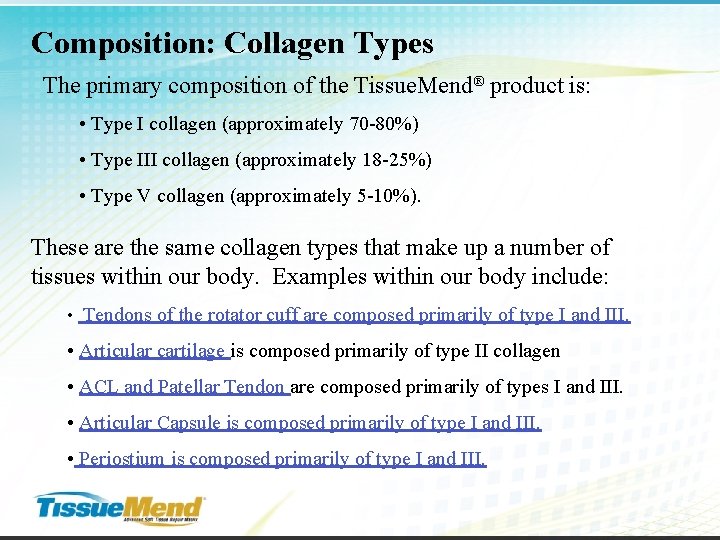
Composition: Collagen Types The primary composition of the Tissue. Mend® product is: • Type I collagen (approximately 70 -80%) • Type III collagen (approximately 18 -25%) • Type V collagen (approximately 5 -10%). These are the same collagen types that make up a number of tissues within our body. Examples within our body include: • Tendons of the rotator cuff are composed primarily of type I and III. • Articular cartilage is composed primarily of type II collagen • ACL and Patellar Tendon are composed primarily of types I and III. • Articular Capsule is composed primarily of type I and III. • Periostium is composed primarily of type I and III.
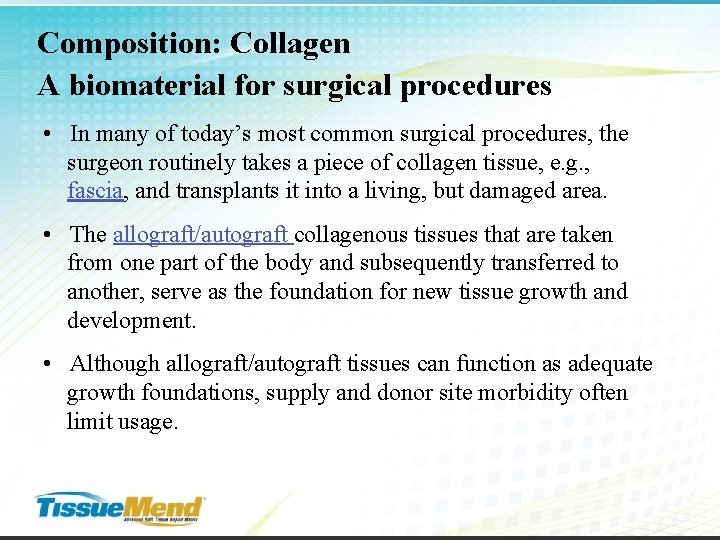
Composition: Collagen A biomaterial for surgical procedures • In many of today’s most common surgical procedures, the surgeon routinely takes a piece of collagen tissue, e. g. , fascia, and transplants it into a living, but damaged area. • The allograft/autograft collagenous tissues that are taken from one part of the body and subsequently transferred to another, serve as the foundation for new tissue growth and development. • Although allograft/autograft tissues can function as adequate growth foundations, supply and donor site morbidity often limit usage.
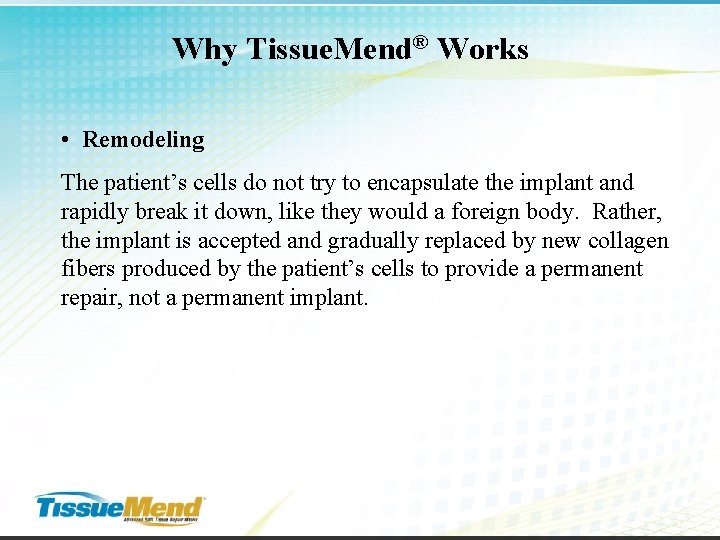
Why Tissue. Mend® Works • Remodeling The patient’s cells do not try to encapsulate the implant and rapidly break it down, like they would a foreign body. Rather, the implant is accepted and gradually replaced by new collagen fibers produced by the patient’s cells to provide a permanent repair, not a permanent implant.
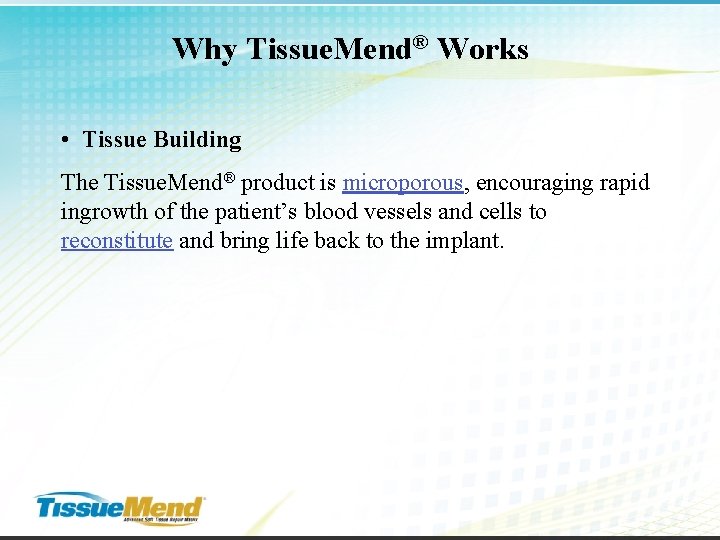
Why Tissue. Mend® Works • Tissue Building The Tissue. Mend® product is microporous, encouraging rapid ingrowth of the patient’s blood vessels and cells to reconstitute and bring life back to the implant.
Why Tissue. Mend® Works • Natural Biomaterial Tissue. Mend® is made of an intertwined network of natural, undamaged collagen fibers, the same strong, structural biomaterial that makes up all dense soft tissues such as tendons, ligaments, articular capsules, periosteum, and fascia.
Why Tissue. Mend® Works • The Gold Standard The Tissue. Mend® product handles, behaves, and interacts much the same as the autograft/allograft collagen tissues used effectively everyday in the operating room.
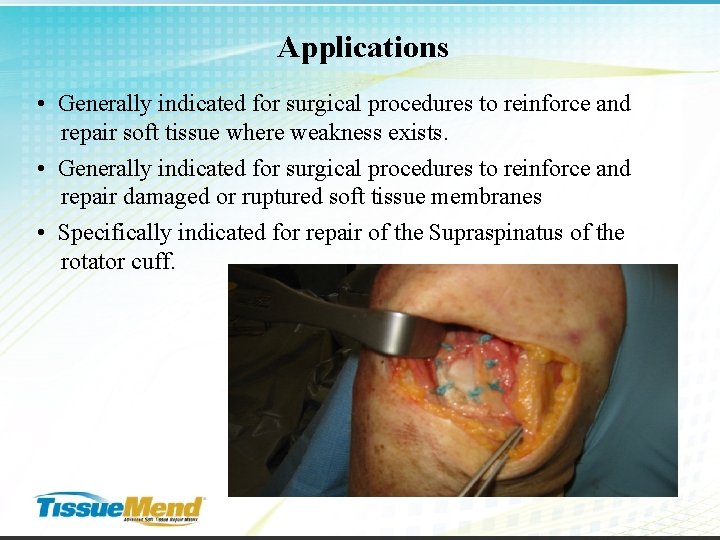
Applications • Generally indicated for surgical procedures to reinforce and repair soft tissue where weakness exists. • Generally indicated for surgical procedures to reinforce and repair damaged or ruptured soft tissue membranes • Specifically indicated for repair of the Supraspinatus of the rotator cuff.
Product Strengths Biocompatibility: The Tissue. Mend® product elicits no foreign body response 1, allowing for rapid cell infiltration. Remodeling: The Tissue. Mend® product provides a scaffold for cellular growth, allowing for gradual remodeling over time. Physical and Handling Characteristics: The Tissue. Mend® product exhibits superior handling characteristics and physical features, allowing for obvious competitive Advantages.
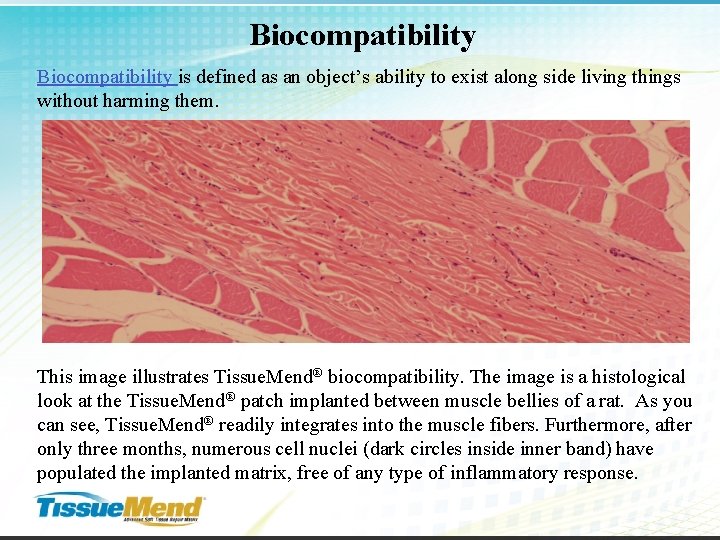
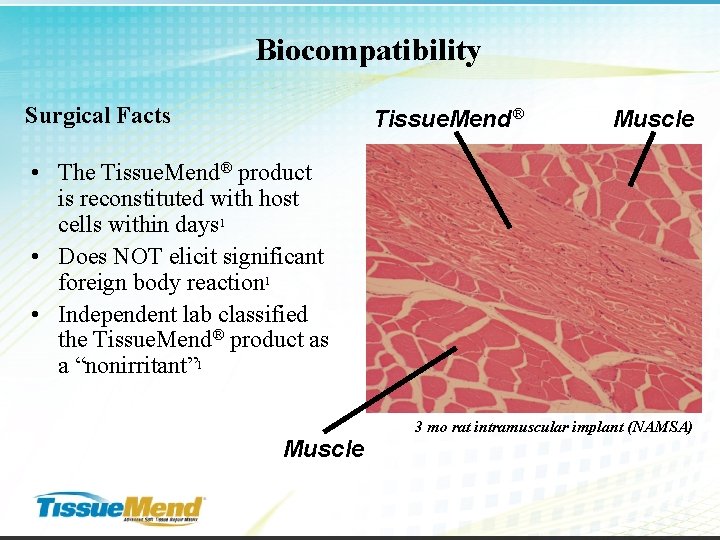
Biocompatibility is defined as an object’s ability to exist along side living things without harming them. This image illustrates Tissue. Mend® biocompatibility. The image is a histological look at the Tissue. Mend® patch implanted between muscle bellies of a rat. As you can see, Tissue. Mend® readily integrates into the muscle fibers. Furthermore, after only three months, numerous cell nuclei (dark circles inside inner band) have populated the implanted matrix, free of any type of inflammatory response.
Biocompatibility Surgical Facts Tissue. Mend® Muscle • The Tissue. Mend® product is reconstituted with host cells within days 1 • Does NOT elicit significant foreign body reaction 1 • Independent lab classified the Tissue. Mend® product as a “nonirritant” 1 Muscle 3 mo rat intramuscular implant (NAMSA)
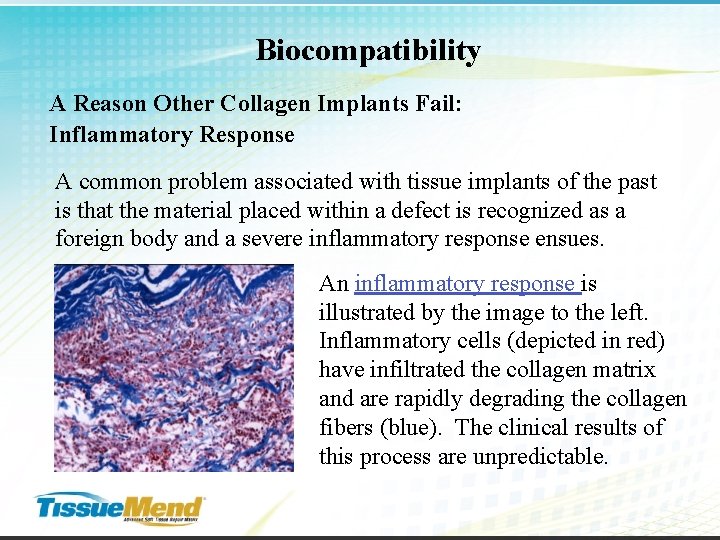
Biocompatibility A Reason Other Collagen Implants Fail: Inflammatory Response A common problem associated with tissue implants of the past is that the material placed within a defect is recognized as a foreign body and a severe inflammatory response ensues. An inflammatory response is illustrated by the image to the left. Inflammatory cells (depicted in red) have infiltrated the collagen matrix and are rapidly degrading the collagen fibers (blue). The clinical results of this process are unpredictable.
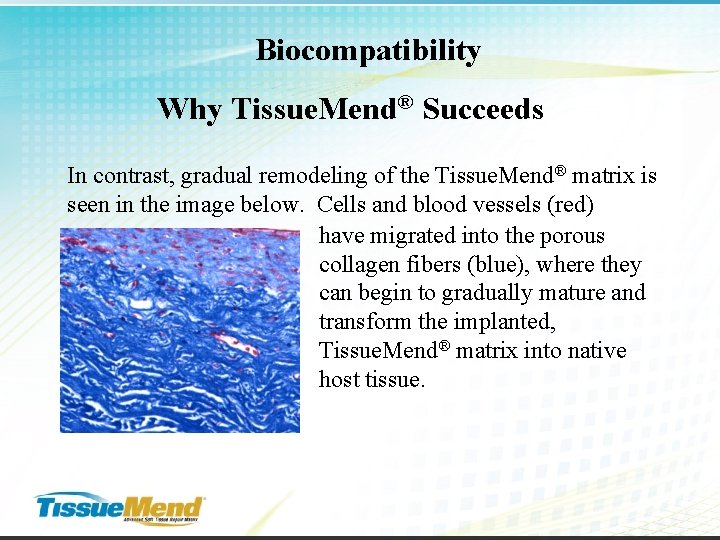
Biocompatibility Why Tissue. Mend® Succeeds In contrast, gradual remodeling of the Tissue. Mend® matrix is seen in the image below. Cells and blood vessels (red) have migrated into the porous collagen fibers (blue), where they can begin to gradually mature and transform the implanted, Tissue. Mend® matrix into native host tissue.
Remodeling is defined as a process by which collagen maintains a dynamic steady state, through sequential resorption and formation of small amounts of collagen at the same site. Therefore, through the gradual process of remodeling, the implanted Tissue. Mend® collagen fibers are slowly reconstituted and simultaneously replaced by new collagen fibers that are native to the area of implantation.
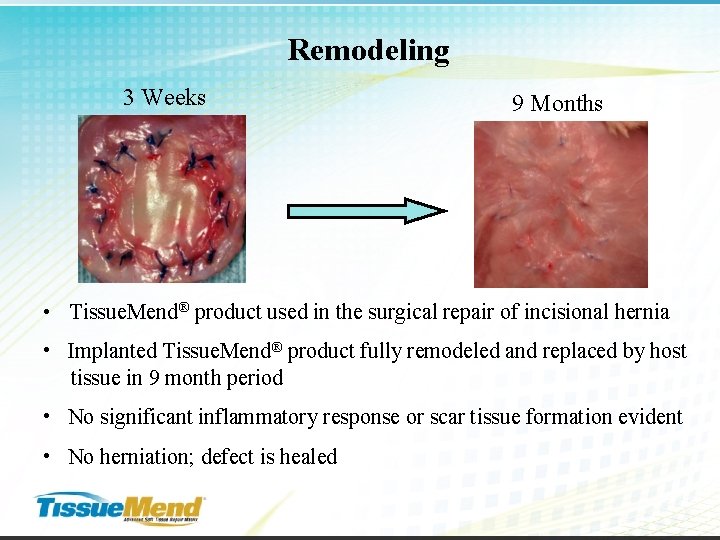
Remodeling 3 Weeks 9 Months • Tissue. Mend® product used in the surgical repair of incisional hernia • Implanted Tissue. Mend® product fully remodeled and replaced by host tissue in 9 month period • No significant inflammatory response or scar tissue formation evident • No herniation; defect is healed
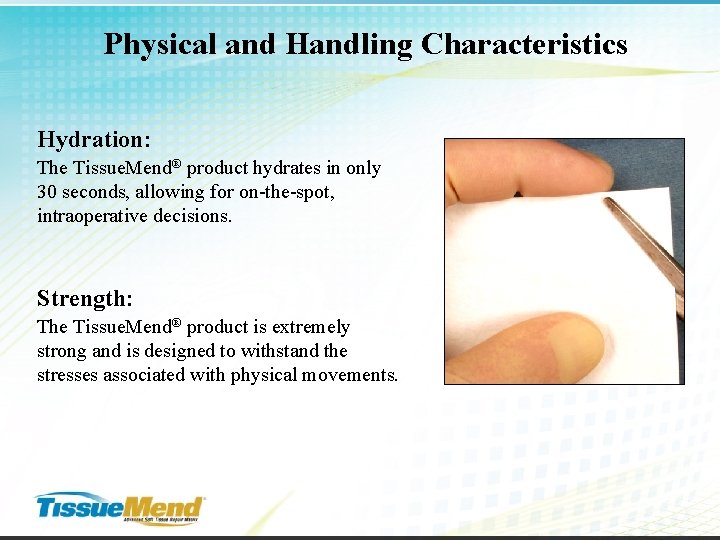
Physical and Handling Characteristics Hydration: The Tissue. Mend® product hydrates in only 30 seconds, allowing for on-the-spot, intraoperative decisions. Strength: The Tissue. Mend® product is extremely strong and is designed to withstand the stresses associated with physical movements.
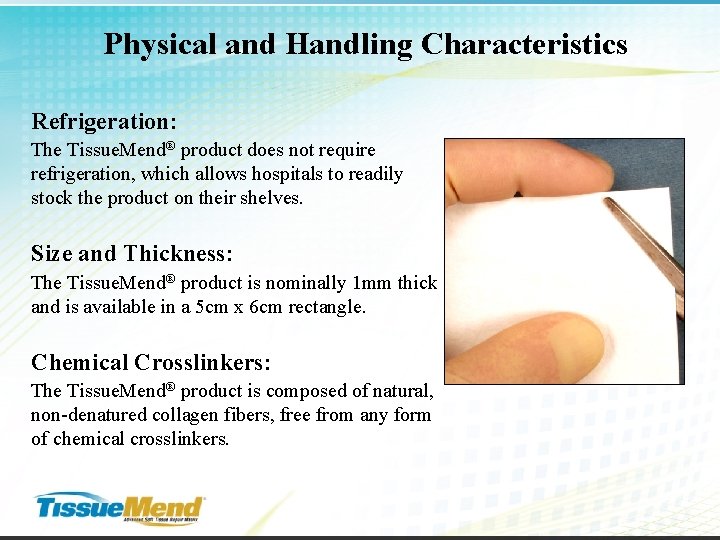
Physical and Handling Characteristics Refrigeration: The Tissue. Mend® product does not require refrigeration, which allows hospitals to readily stock the product on their shelves. Size and Thickness: The Tissue. Mend® product is nominally 1 mm thick and is available in a 5 cm x 6 cm rectangle. Chemical Crosslinkers: The Tissue. Mend® product is composed of natural, non-denatured collagen fibers, free from any form of chemical crosslinkers.
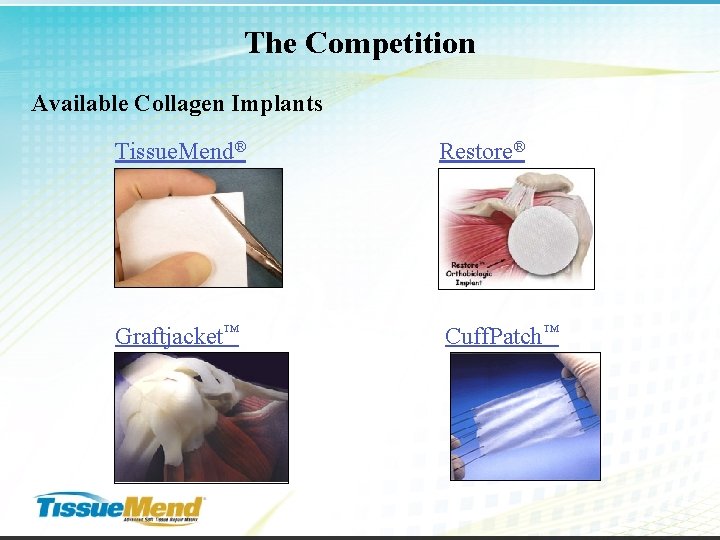
The Competition Available Collagen Implants Tissue. Mend® Restore® Graftjacket™ Cuff. Patch™
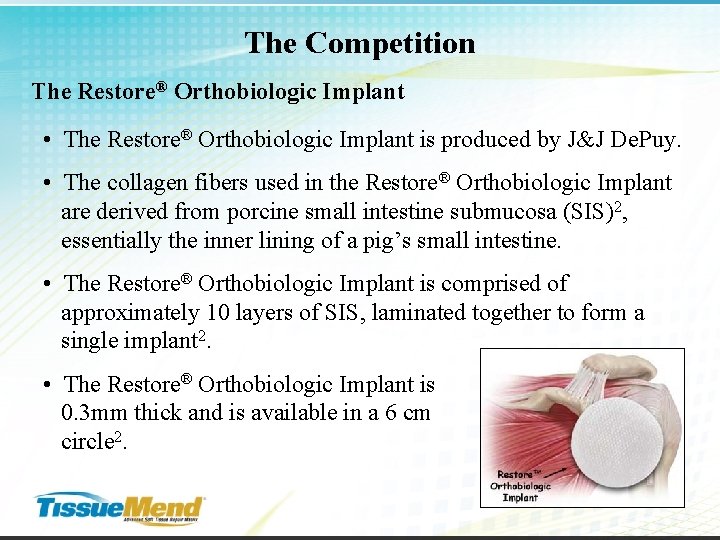
The Competition The Restore® Orthobiologic Implant • The Restore® Orthobiologic Implant is produced by J&J De. Puy. • The collagen fibers used in the Restore® Orthobiologic Implant are derived from porcine small intestine submucosa (SIS)2, essentially the inner lining of a pig’s small intestine. • The Restore® Orthobiologic Implant is comprised of approximately 10 layers of SIS, laminated together to form a single implant 2. • The Restore® Orthobiologic Implant is 0. 3 mm thick and is available in a 6 cm circle 2.
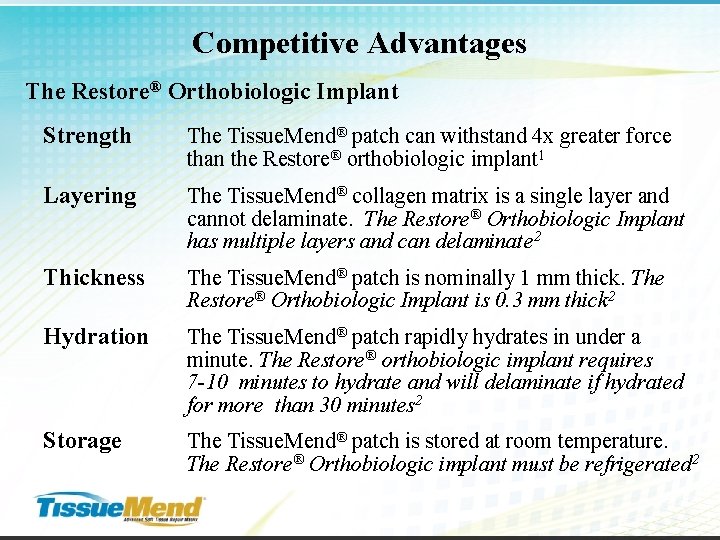
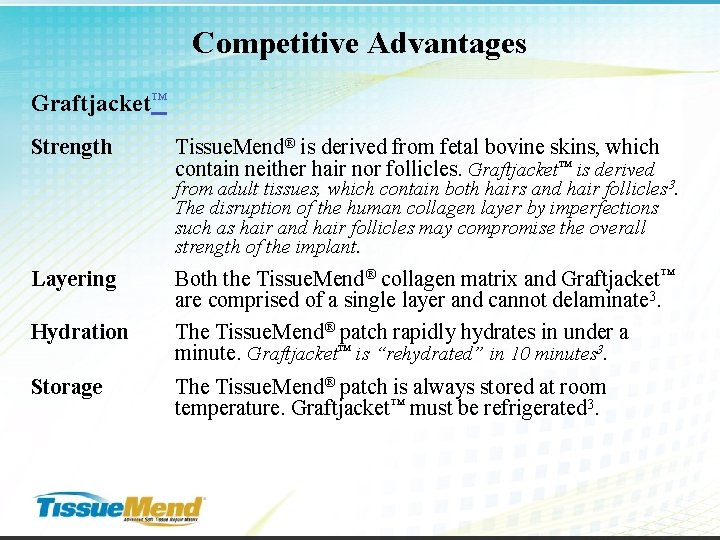
Competitive Advantages The Restore® Orthobiologic Implant Strength The Tissue. Mend® patch can withstand 4 x greater force than the Restore® orthobiologic implant 1 Layering The Tissue. Mend® collagen matrix is a single layer and cannot delaminate. The Restore® Orthobiologic Implant has multiple layers and can delaminate 2 Thickness The Tissue. Mend® patch is nominally 1 mm thick. The Restore® Orthobiologic Implant is 0. 3 mm thick 2 Hydration The Tissue. Mend® patch rapidly hydrates in under a minute. The Restore® orthobiologic implant requires 7 -10 minutes to hydrate and will delaminate if hydrated for more than 30 minutes 2 Storage The Tissue. Mend® patch is stored at room temperature. The Restore® Orthobiologic implant must be refrigerated 2
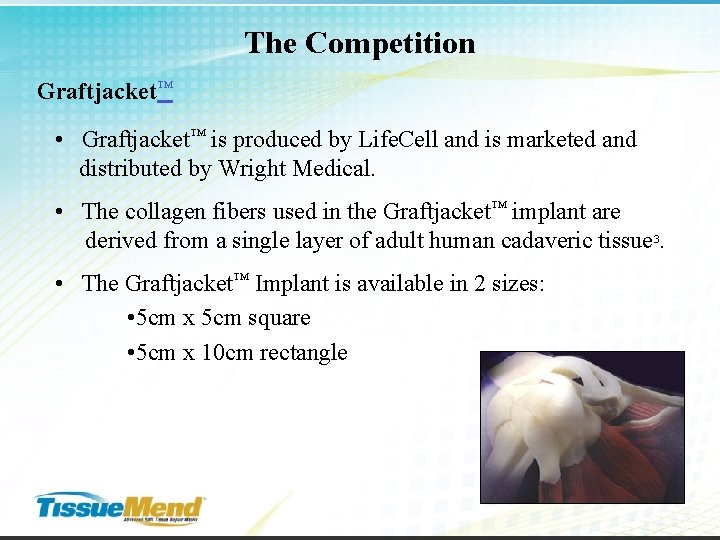
The Competition Graftjacket™ • Graftjacket™ is produced by Life. Cell and is marketed and distributed by Wright Medical. • The collagen fibers used in the Graftjacket™ implant are derived from a single layer of adult human cadaveric tissue 3. • The Graftjacket™ Implant is available in 2 sizes: • 5 cm x 5 cm square • 5 cm x 10 cm rectangle
Competitive Advantages Graftjacket™ Strength Tissue. Mend® is derived from fetal bovine skins, which contain neither hair nor follicles. Graftjacket™ is derived from adult tissues, which contain both hairs and hair follicles 3. The disruption of the human collagen layer by imperfections such as hair and hair follicles may compromise the overall strength of the implant. Layering Both the Tissue. Mend® collagen matrix and Graftjacket™ are comprised of a single layer and cannot delaminate 3. Hydration The Tissue. Mend® patch rapidly hydrates in under a minute. Graftjacket™ is “rehydrated” in 10 minutes 3. Storage The Tissue. Mend® patch is always stored at room temperature. Graftjacket™ must be refrigerated 3.
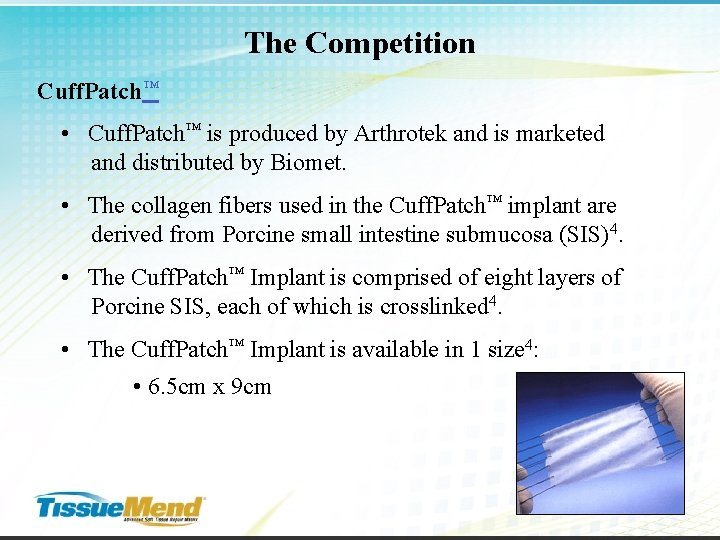
The Competition Cuff. Patch™ • Cuff. Patch™ is produced by Arthrotek and is marketed and distributed by Biomet. • The collagen fibers used in the Cuff. Patch™ implant are derived from Porcine small intestine submucosa (SIS)4. • The Cuff. Patch™ Implant is comprised of eight layers of Porcine SIS, each of which is crosslinked 4. • The Cuff. Patch™ Implant is available in 1 size 4: • 6. 5 cm x 9 cm
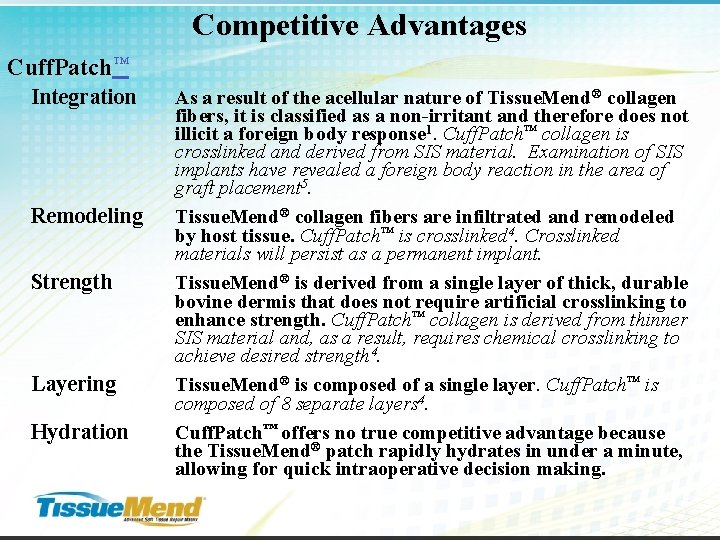
Competitive Advantages Cuff. Patch™ Integration As a result of the acellular nature of Tissue. Mend® collagen fibers, it is classified as a non-irritant and therefore does not illicit a foreign body response 1. Cuff. Patch™ collagen is crosslinked and derived from SIS material. Examination of SIS implants have revealed a foreign body reaction in the area of graft placement 5. Remodeling Tissue. Mend® collagen fibers are infiltrated and remodeled by host tissue. Cuff. Patch™ is crosslinked 4. Crosslinked materials will persist as a permanent implant. Strength Tissue. Mend® is derived from a single layer of thick, durable bovine dermis that does not require artificial crosslinking to enhance strength. Cuff. Patch™ collagen is derived from thinner SIS material and, as a result, requires chemical crosslinking to achieve desired strength 4. Layering Tissue. Mend® is composed of a single layer. Cuff. Patch™ is composed of 8 separate layers 4. Hydration Cuff. Patch™ offers no true competitive advantage because the Tissue. Mend® patch rapidly hydrates in under a minute, allowing for quick intraoperative decision making.
Safety Tissue. Mend® is a biological, collagen membrane derived from bovine dermis. In view of the bovine spongiform encephalopathy (BSE) (“mad cow disease”) epidemic in the U. K, a number of safety measures have been taken by TEI Biosciences.
Safety TEI Biosciences has adopted a series of five effective methods known by the World Health Organization (WHO), the Food and Drug Administration (FDA) and the Commission of European Communities reduce BSE risks: • source materials are traceable to herds having no known incidences of BSE • source materials are from animals certified fit for human consumption • all source materials are exposed to sodium hydroxide, a recognized prion inactivant • the source material is of fetal origin; per the World Health Organization, infectious BSE agents have not been identified in any fetal bovine tissues • the source material is bovine dermis, a Category IV WHO designated tissue indicating no detectable BSE infectivity of the tissue source