
Introduction Phonetics Speech production and perception Phonology Study
![ARPABET: English-based phonetic system Example. Phone Example Phone [iy]beat [b] [ih] bit [eh] bet](https://slidetodoc.com/presentation_image_h2/417e8de7d44231d2ef000f1a3035a9f4/image-46.jpg "ARPABET: English-based phonetic system Example. Phone Example Phone [iy]beat [b] [ih] bit [eh] bet")
- Slides: 52
Introduction • Phonetics: Speech production and perception • Phonology: Study of sound combinations • Orthography: Writing Systems We’ll talk about each area and how they impact Natural Language Processing
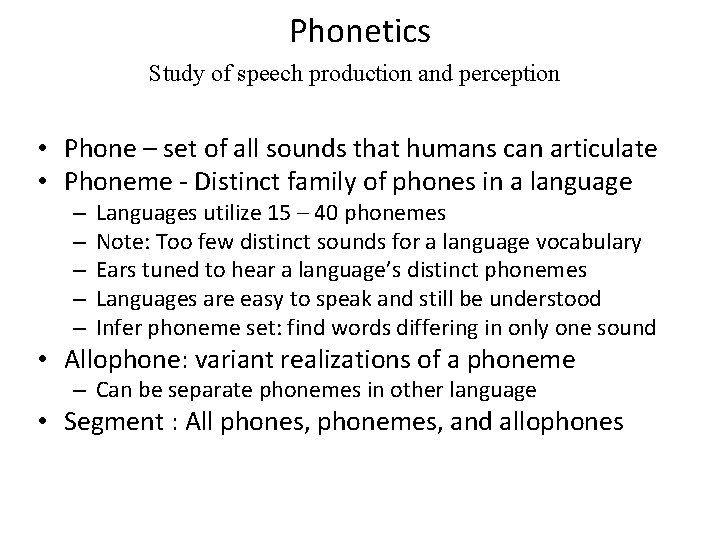
Phonetics Study of speech production and perception • Phone – set of all sounds that humans can articulate • Phoneme - Distinct family of phones in a language – – – Languages utilize 15 – 40 phonemes Note: Too few distinct sounds for a language vocabulary Ears tuned to hear a language’s distinct phonemes Languages are easy to speak and still be understood Infer phoneme set: find words differing in only one sound • Allophone: variant realizations of a phoneme – Can be separate phonemes in other language • Segment : All phones, phonemes, and allophones
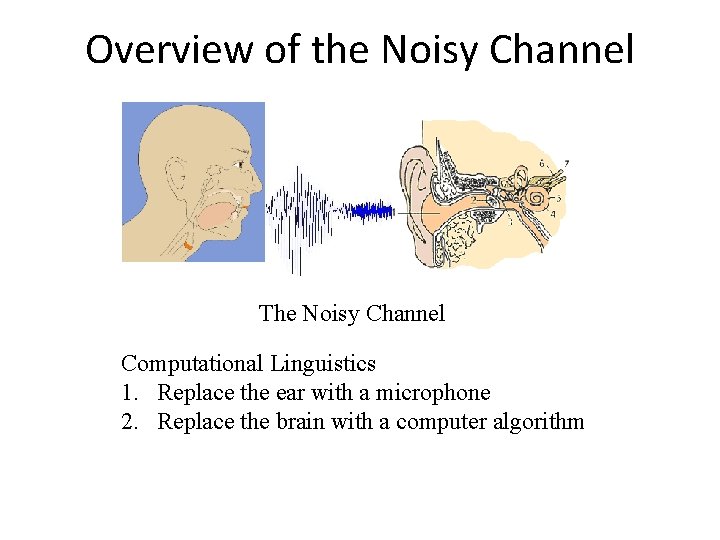
Overview of the Noisy Channel The Noisy Channel Computational Linguistics 1. Replace the ear with a microphone 2. Replace the brain with a computer algorithm
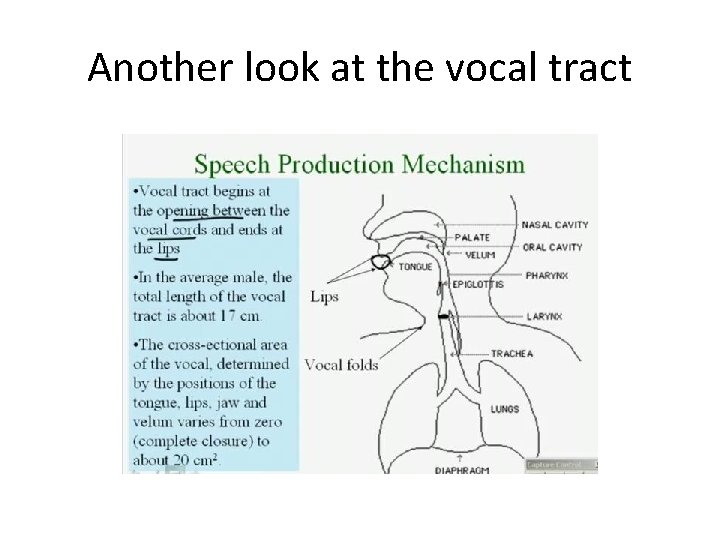
Production • We have a complete but approximate of how speech is produced • We cannot accurately predict the audio signal corresponding to given articulatory positions • The best synthesis methods, for now, use concatenation-based algorithms to create computerized speech. • Model: Pulmonic egressive air-stream from the source (glottis) through the vocal tract operating as source-filter.
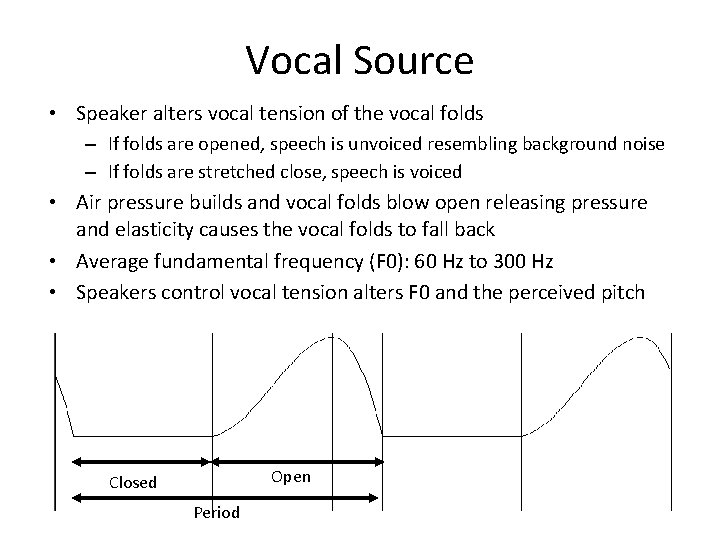
Vocal Source • Speaker alters vocal tension of the vocal folds – If folds are opened, speech is unvoiced resembling background noise – If folds are stretched close, speech is voiced • Air pressure builds and vocal folds blow open releasing pressure and elasticity causes the vocal folds to fall back • Average fundamental frequency (F 0): 60 Hz to 300 Hz • Speakers control vocal tension alters F 0 and the perceived pitch Open Closed Period
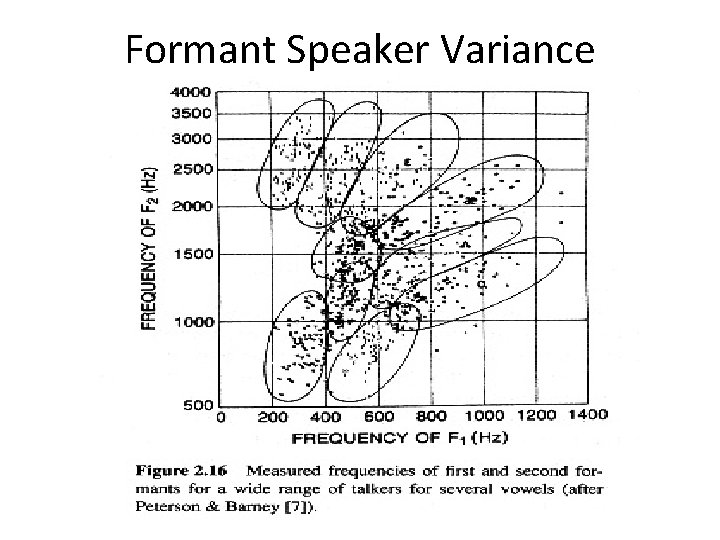
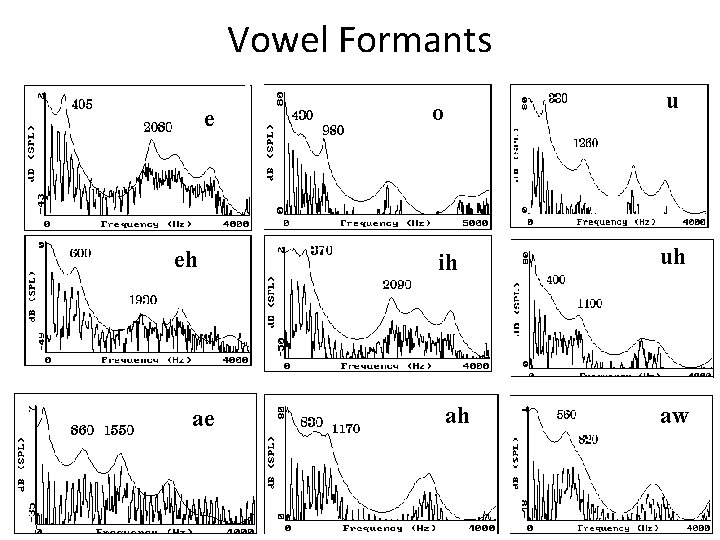
Formants • Definition: harmonics of F 0 – F 1, F 2, F 3, etc. – Adds timbre to voiced sounds – Vowels have distinct harmonic patterns – Vocal articulators change emphasis of the harmonics and alter their frequencies – There are complex relationships between formants dependent on vocal musculature – Formants spread out as the pitch goes higher
Formant Speaker Variance
Vowel Formants e eh ae o u ih uh ah aw
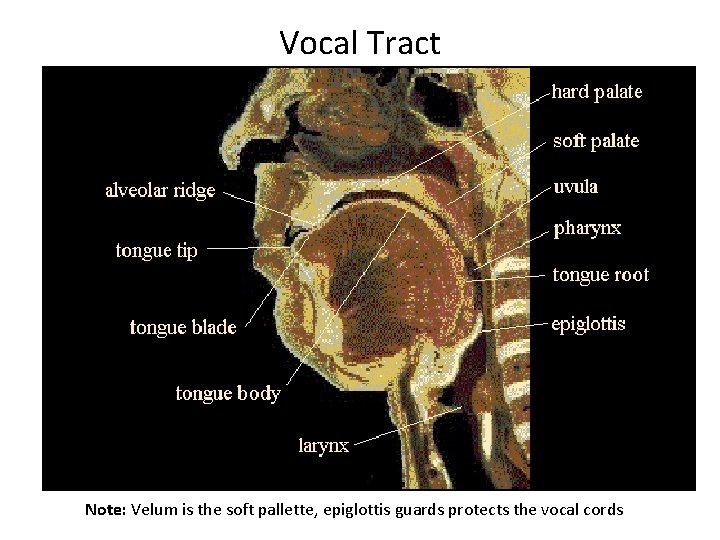
Vocal Tract Note: Velum is the soft pallette, epiglottis guards protects the vocal cords
Another look at the vocal tract
Different Voices • Falsetto – The vocal cords are stretched and become thin causing high frequency • Creaky – Only the front vocal folds vibrate, giving a low frequency • Breathy – Vocal cords vibrate, but air is escaping through the glottis • Each person tends to consistently use particular phonation patterns. This makes the voice uniquely theirs.
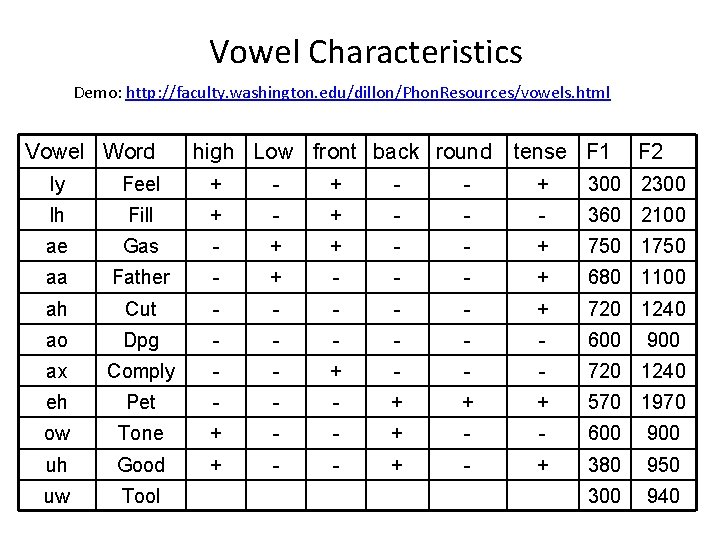
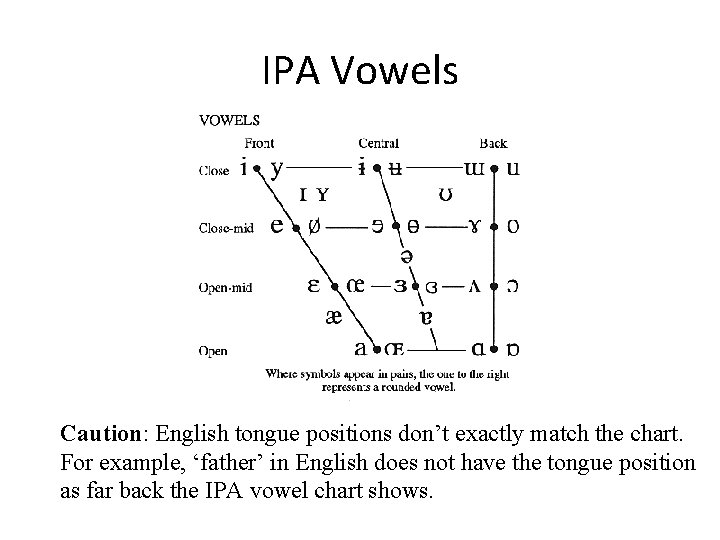
Vowels No restriction of the vocal tract, articulators alter the formants • Diphthong: Syllabics which show a marked glide from one vowel to another, usually a steady vowel plus a glide • Nasalized: Some air flow through the nasal cavity • Rounding: Shape of the lips • Tense: Sound more extreme (further from the schwa) and tend to have the tongue body higher • Relaxed: Sounds closer to schwa (tonally neutral) • Tongue position: Front to back, high to low
Vowel Characteristics Demo: http: //faculty. washington. edu/dillon/Phon. Resources/vowels. html Vowel Word high Low front back round tense F 1 F 2 Iy Feel + - - + 300 2300 Ih Fill + - - - 360 2100 ae Gas - + + - - + 750 1750 aa Father - + - - - + 680 1100 ah Cut - - - + 720 1240 ao Dpg - - - 600 ax Comply - - + - - - 720 1240 eh Pet - - - + + + 570 1970 ow Tone + - - 600 900 uh Good + - - + 380 950 uw Tool 300 940 900
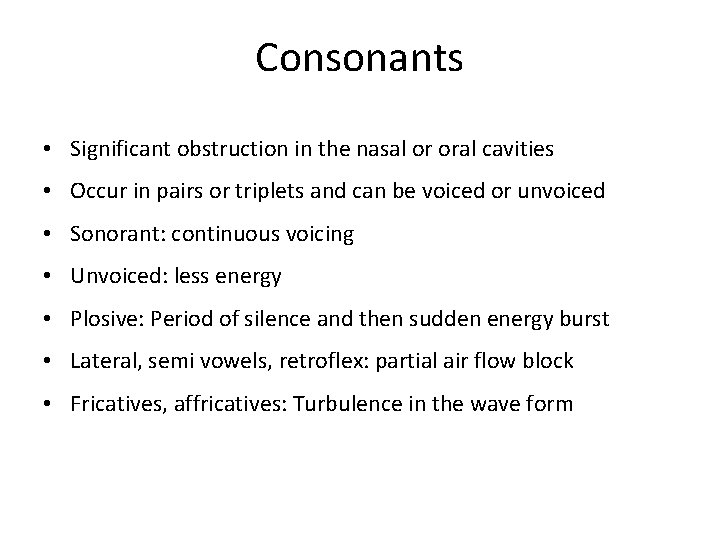
Consonants • Significant obstruction in the nasal or oral cavities • Occur in pairs or triplets and can be voiced or unvoiced • Sonorant: continuous voicing • Unvoiced: less energy • Plosive: Period of silence and then sudden energy burst • Lateral, semi vowels, retroflex: partial air flow block • Fricatives, affricatives: Turbulence in the wave form
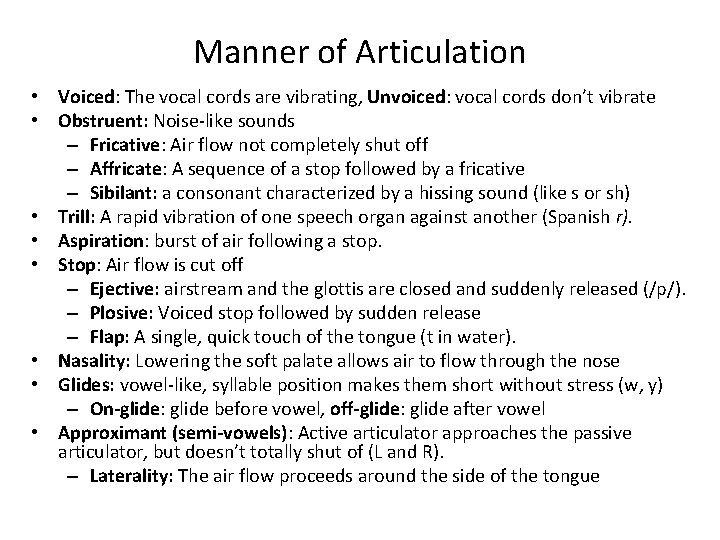
Manner of Articulation • Voiced: The vocal cords are vibrating, Unvoiced: vocal cords don’t vibrate • Obstruent: Noise-like sounds – Fricative: Air flow not completely shut off – Affricate: A sequence of a stop followed by a fricative – Sibilant: a consonant characterized by a hissing sound (like s or sh) • Trill: A rapid vibration of one speech organ against another (Spanish r). • Aspiration: burst of air following a stop. • Stop: Air flow is cut off – Ejective: airstream and the glottis are closed and suddenly released (/p/). – Plosive: Voiced stop followed by sudden release – Flap: A single, quick touch of the tongue (t in water). • Nasality: Lowering the soft palate allows air to flow through the nose • Glides: vowel-like, syllable position makes them short without stress (w, y) – On-glide: glide before vowel, off-glide: glide after vowel • Approximant (semi-vowels): Active articulator approaches the passive articulator, but doesn’t totally shut of (L and R). – Laterality: The air flow proceeds around the side of the tongue
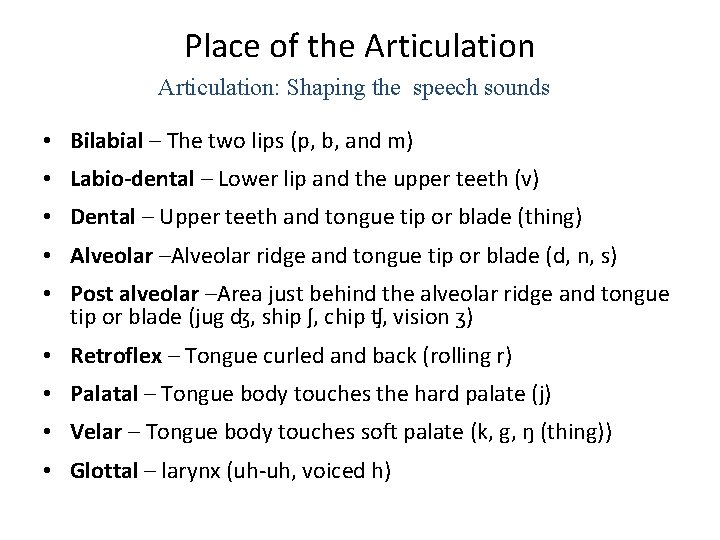
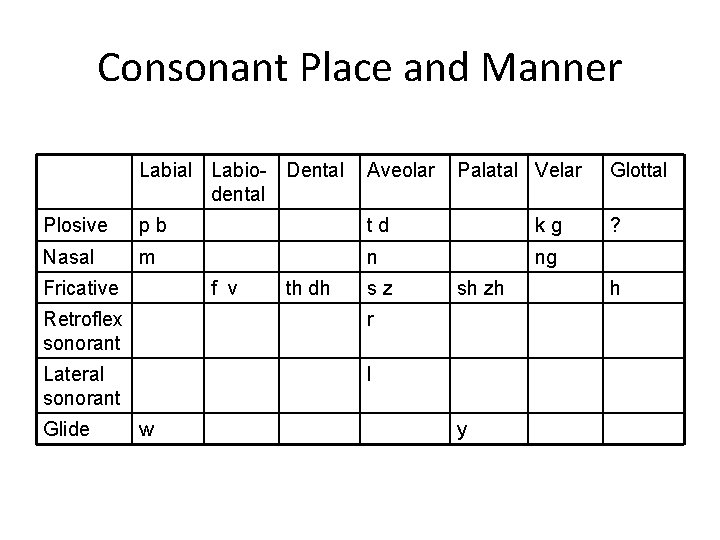
Place of the Articulation: Shaping the speech sounds • Bilabial – The two lips (p, b, and m) • Labio-dental – Lower lip and the upper teeth (v) • Dental – Upper teeth and tongue tip or blade (thing) • Alveolar –Alveolar ridge and tongue tip or blade (d, n, s) • Post alveolar –Area just behind the alveolar ridge and tongue tip or blade (jug ʤ, ship ʃ, chip ʧ, vision ʒ) • Retroflex – Tongue curled and back (rolling r) • Palatal – Tongue body touches the hard palate (j) • Velar – Tongue body touches soft palate (k, g, ŋ (thing)) • Glottal – larynx (uh-uh, voiced h)
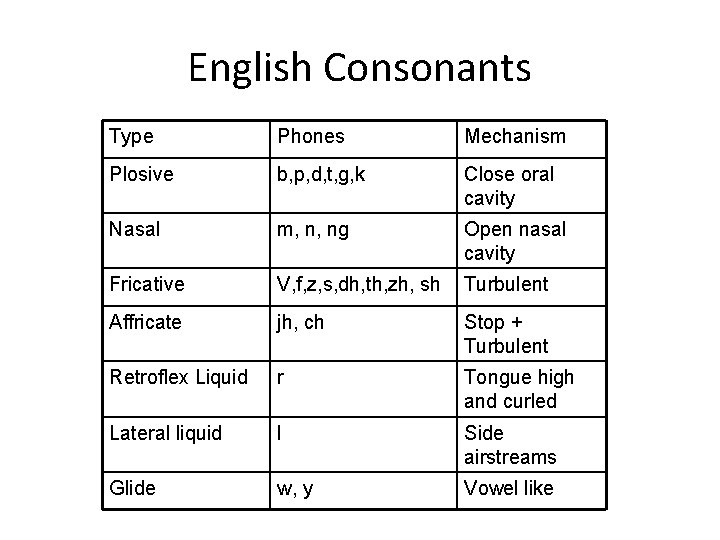
English Consonants Type Phones Mechanism Plosive b, p, d, t, g, k Close oral cavity Nasal m, n, ng Open nasal cavity Fricative V, f, z, s, dh, th, zh, sh Turbulent Affricate jh, ch Stop + Turbulent Retroflex Liquid r Tongue high and curled Lateral liquid l Side airstreams Glide w, y Vowel like
Consonant Place and Manner Labial Labio- Dental dental Aveolar Plosive pb td kg Nasal m n ng Fricative f v th dh sz Retroflex sonorant r Lateral sonorant l Glide w Palatal Velar sh zh y Glottal ? h
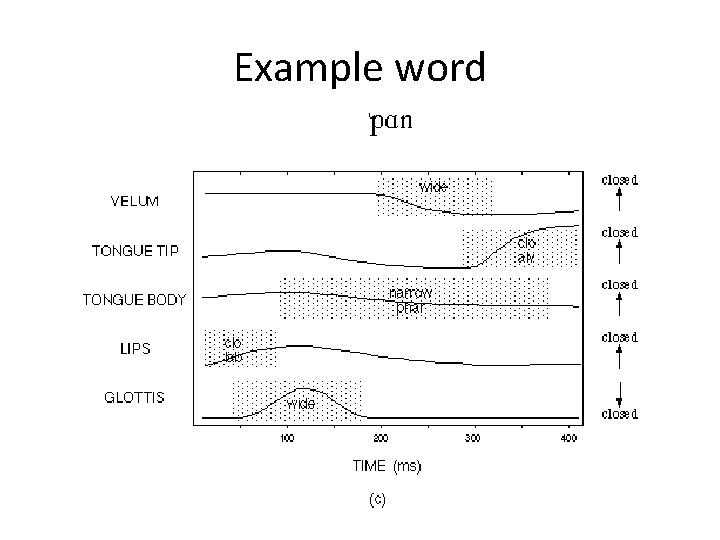
Example word
Speech Production Analysis • • Plate attached to roof of mouth measuring contact Collar around the neck measuring glottis vibrations Measure air flow from mouth and nose Three dimension images using MRI Note: IPA was designed before the above technologies existed. They were devised by a linguist looking down someone’s mouth or feeling how sounds are made.
Perception • Some perceptual components are understood, but knowledge concerning the entire human perception model is rudimentary • Understood Components 1. The inner ear works as a filter bank 2. Sounds are perceived on a logarithmic scale 3. Some sounds will mask others
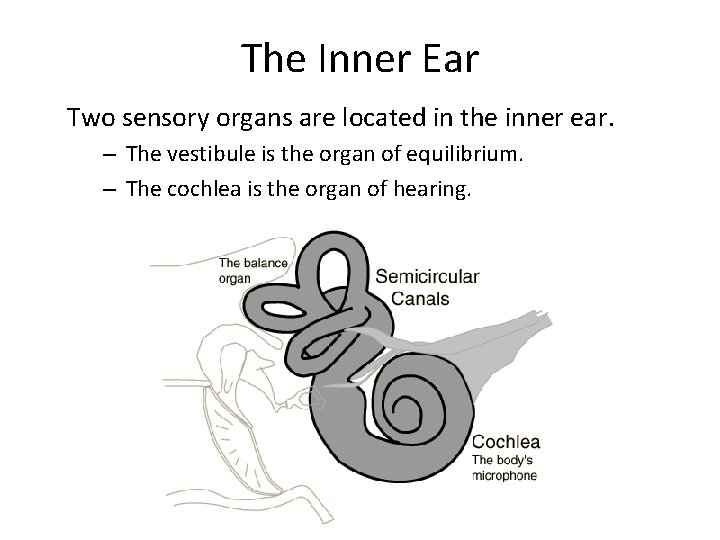
The Inner Ear Two sensory organs are located in the inner ear. – The vestibule is the organ of equilibrium. – The cochlea is the organ of hearing.
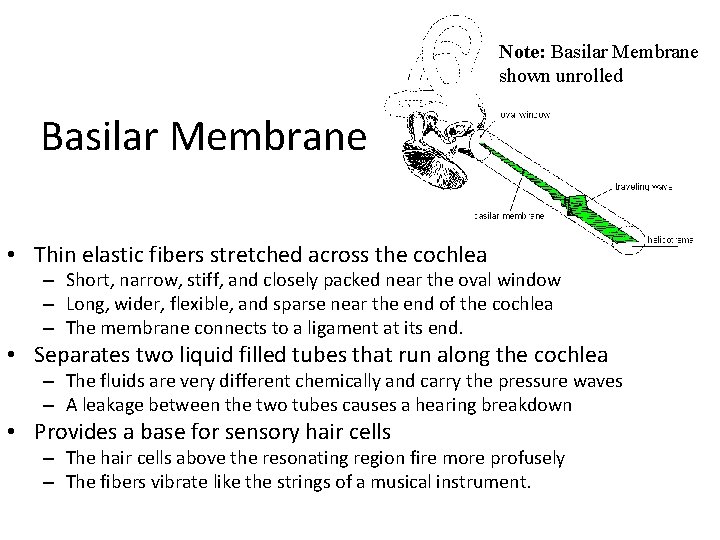
Note: Basilar Membrane shown unrolled Basilar Membrane • Thin elastic fibers stretched across the cochlea – Short, narrow, stiff, and closely packed near the oval window – Long, wider, flexible, and sparse near the end of the cochlea – The membrane connects to a ligament at its end. • Separates two liquid filled tubes that run along the cochlea – The fluids are very different chemically and carry the pressure waves – A leakage between the two tubes causes a hearing breakdown • Provides a base for sensory hair cells – The hair cells above the resonating region fire more profusely – The fibers vibrate like the strings of a musical instrument.
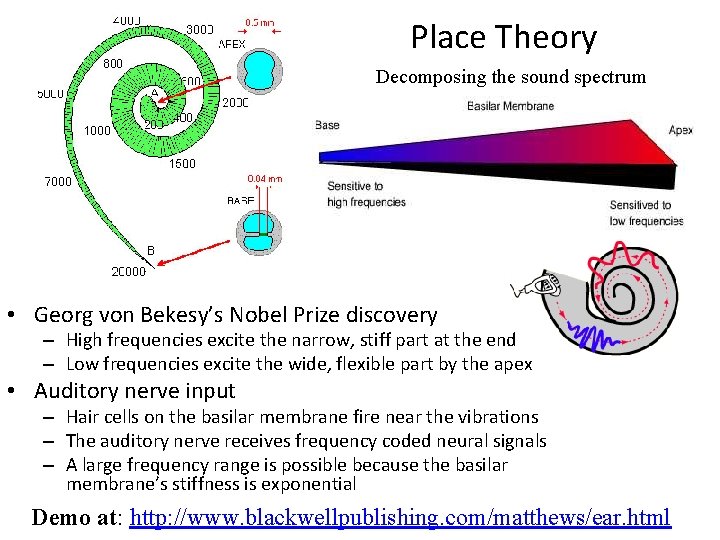
Place Theory Decomposing the sound spectrum • Georg von Bekesy’s Nobel Prize discovery – High frequencies excite the narrow, stiff part at the end – Low frequencies excite the wide, flexible part by the apex • Auditory nerve input – Hair cells on the basilar membrane fire near the vibrations – The auditory nerve receives frequency coded neural signals – A large frequency range is possible because the basilar membrane’s stiffness is exponential Demo at: http: //www. blackwellpublishing. com/matthews/ear. html
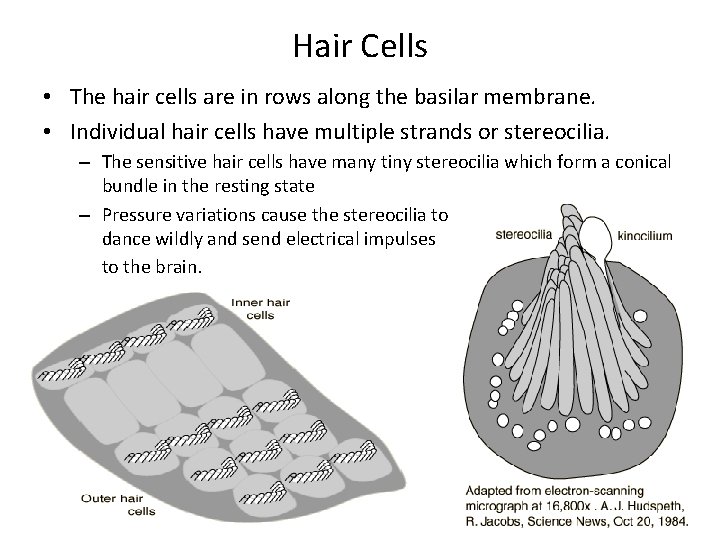
Hair Cells • The hair cells are in rows along the basilar membrane. • Individual hair cells have multiple strands or stereocilia. – The sensitive hair cells have many tiny stereocilia which form a conical bundle in the resting state – Pressure variations cause the stereocilia to dance wildly and send electrical impulses to the brain.
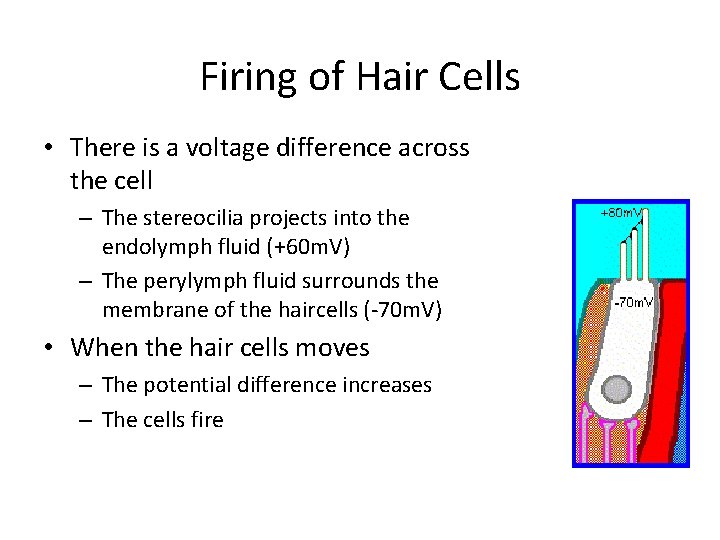
Firing of Hair Cells • There is a voltage difference across the cell – The stereocilia projects into the endolymph fluid (+60 m. V) – The perylymph fluid surrounds the membrane of the haircells (-70 m. V) • When the hair cells moves – The potential difference increases – The cells fire
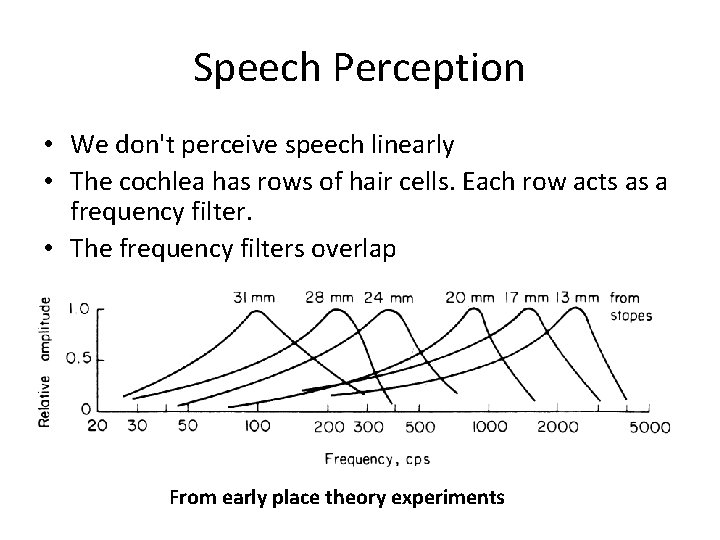
Speech Perception • We don't perceive speech linearly • The cochlea has rows of hair cells. Each row acts as a frequency filter. • The frequency filters overlap From early place theory experiments
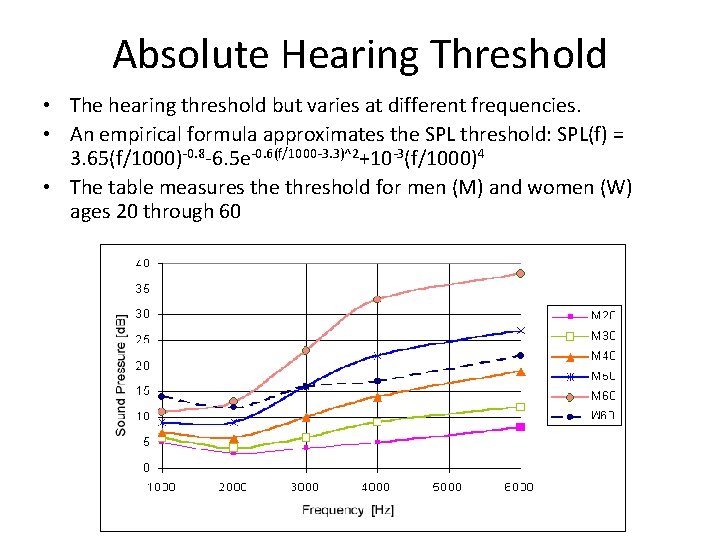
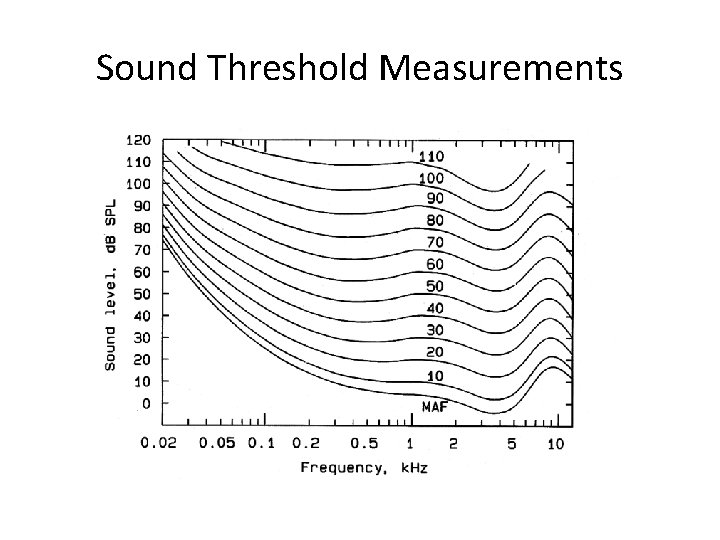
Absolute Hearing Threshold • The hearing threshold but varies at different frequencies. • An empirical formula approximates the SPL threshold: SPL(f) = 3. 65(f/1000)-0. 8 -6. 5 e-0. 6(f/1000 -3. 3)^2+10 -3(f/1000)4 • The table measures the threshold for men (M) and women (W) ages 20 through 60
Sound Threshold Measurements
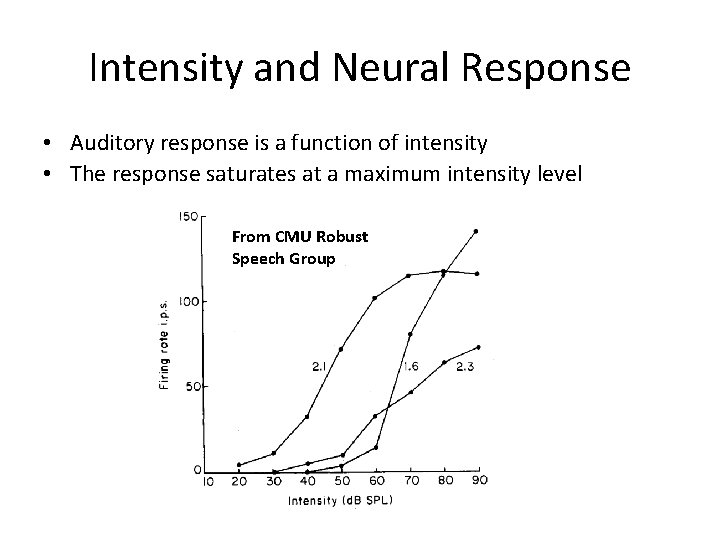
Intensity and Neural Response • Auditory response is a function of intensity • The response saturates at a maximum intensity level From CMU Robust Speech Group
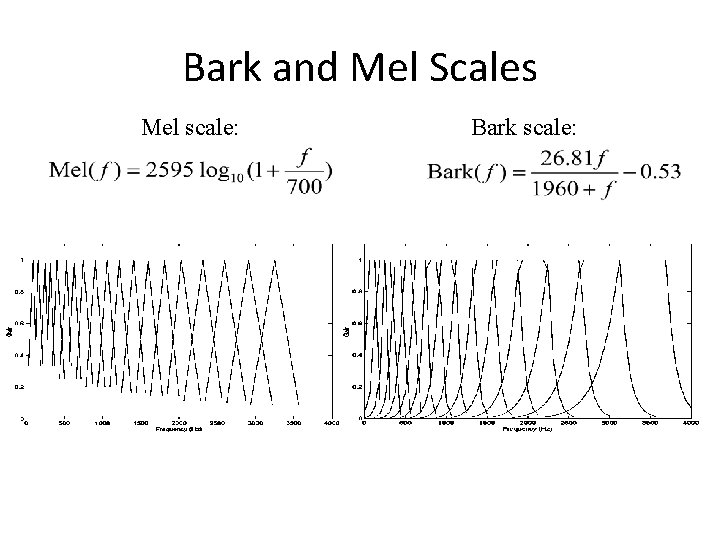
Bark and Mel Scales Mel scale: Bark scale:
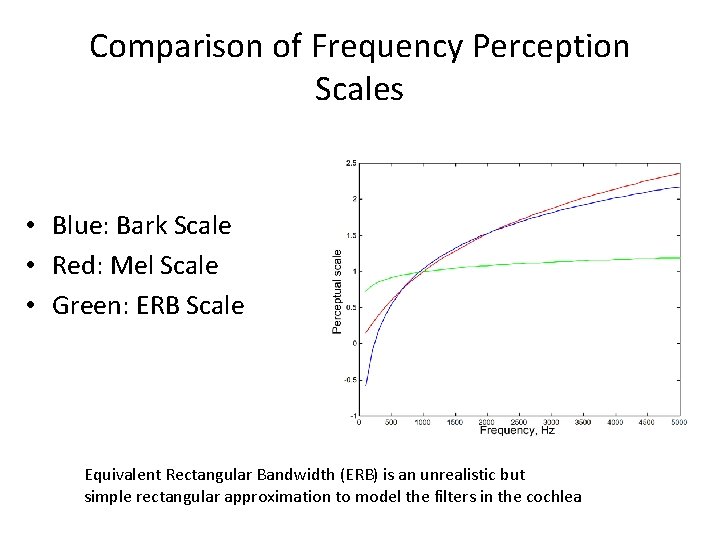
Comparison of Frequency Perception Scales • Blue: Bark Scale • Red: Mel Scale • Green: ERB Scale Equivalent Rectangular Bandwidth (ERB) is an unrealistic but simple rectangular approximation to model the filters in the cochlea
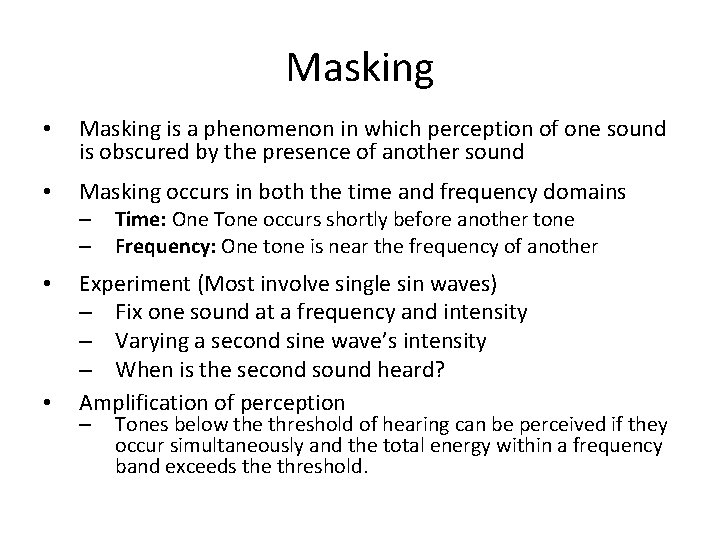
Masking • Masking is a phenomenon in which perception of one sound is obscured by the presence of another sound • Masking occurs in both the time and frequency domains – – • • Time: One Tone occurs shortly before another tone Frequency: One tone is near the frequency of another Experiment (Most involve single sin waves) – Fix one sound at a frequency and intensity – Varying a second sine wave’s intensity – When is the second sound heard? Amplification of perception – Tones below the threshold of hearing can be perceived if they occur simultaneously and the total energy within a frequency band exceeds the threshold.
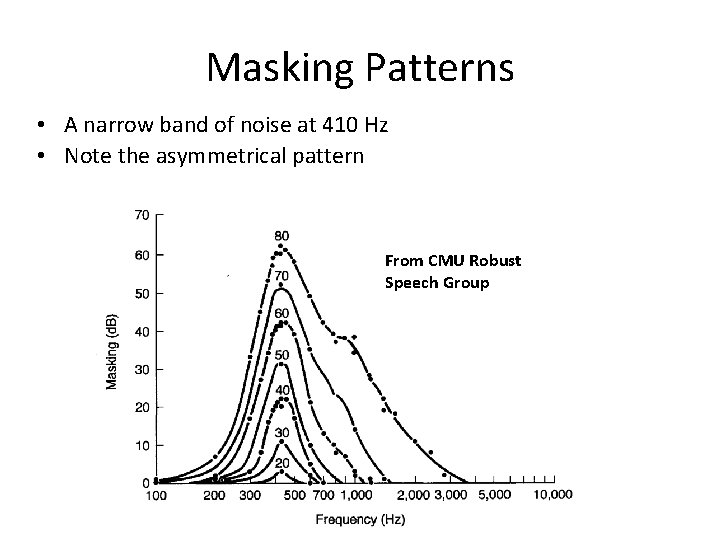
Masking Patterns • A narrow band of noise at 410 Hz • Note the asymmetrical pattern From CMU Robust Speech Group
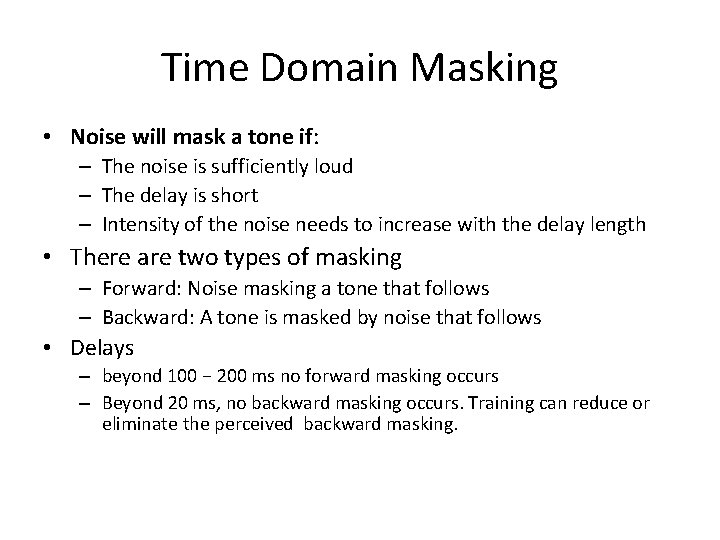
Time Domain Masking • Noise will mask a tone if: – The noise is sufficiently loud – The delay is short – Intensity of the noise needs to increase with the delay length • There are two types of masking – Forward: Noise masking a tone that follows – Backward: A tone is masked by noise that follows • Delays – beyond 100 − 200 ms no forward masking occurs – Beyond 20 ms, no backward masking occurs. Training can reduce or eliminate the perceived backward masking.
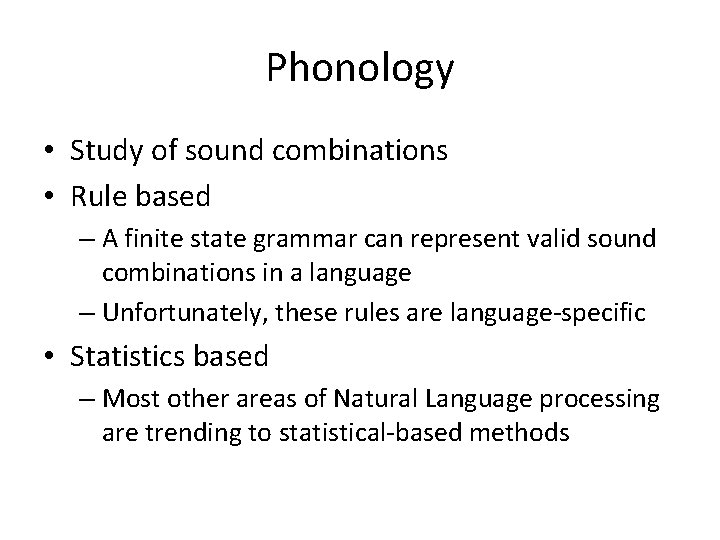
Phonology • Study of sound combinations • Rule based – A finite state grammar can represent valid sound combinations in a language – Unfortunately, these rules are language-specific • Statistics based – Most other areas of Natural Language processing are trending to statistical-based methods
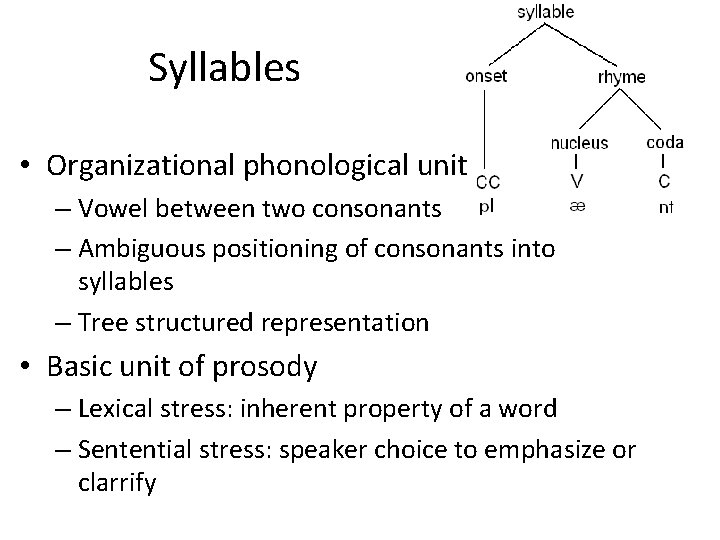
Syllables • Organizational phonological unit – Vowel between two consonants – Ambiguous positioning of consonants into syllables – Tree structured representation • Basic unit of prosody – Lexical stress: inherent property of a word – Sentential stress: speaker choice to emphasize or clarrify
Representing Stress • There have been unsuccessful attempts to automatically assign stress to phonemes • Notations for representing stress – IPA (International Phonetic Alphabet) has a diacritic symbol for stress – Numeric representation • 0: reduced, 1: normal, 2: stressed – Relative • Reduced (R) or Stressed (S) • No notation means undistinguished
Phonological Grammars • SPC: Sound Pattern for English – 13 features for 8192 combinations – Complete descriptive grammar • Recent research – Trend towards context-sensitive descriptions – Little thought concerning computational feasibility – Its unlikely that listeners apply thousands of rules to perceive speech
Morphology • How phonemes combine to make words • Important for speech synthesis • Example: singular to plural – Run to runs: z sound (voiced) – Hit to Hits: s sound (unvoiced) • Devise sets of rules of pronunciation
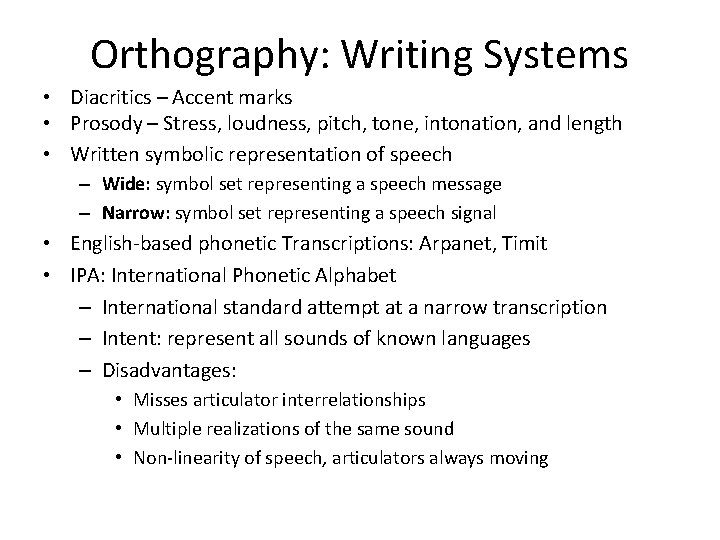
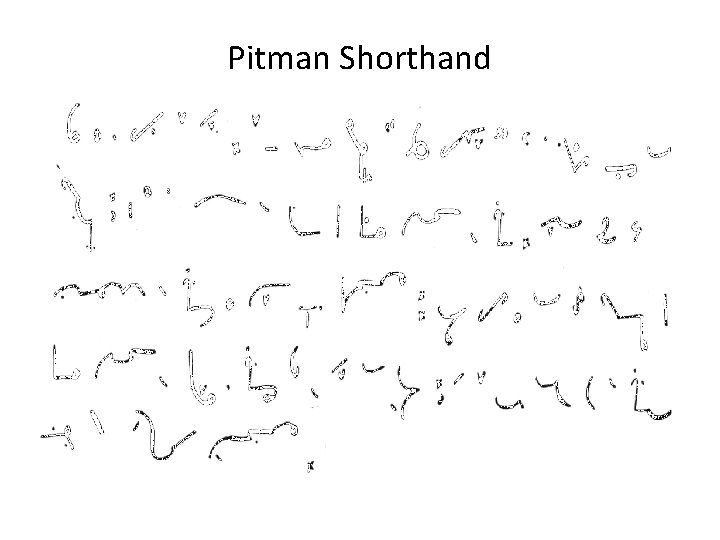
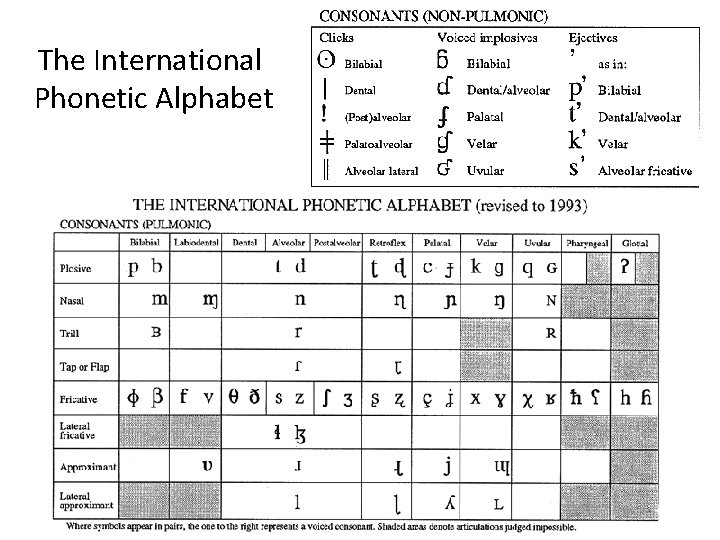
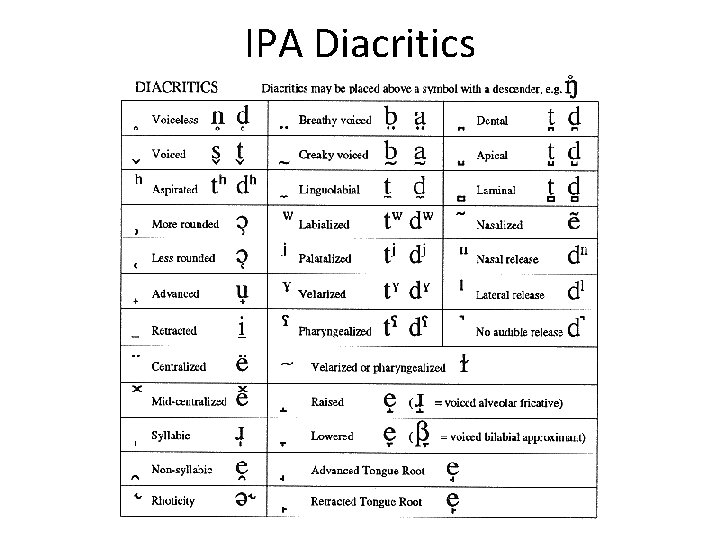
Orthography: Writing Systems • Diacritics – Accent marks • Prosody – Stress, loudness, pitch, tone, intonation, and length • Written symbolic representation of speech – Wide: symbol set representing a speech message – Narrow: symbol set representing a speech signal • English-based phonetic Transcriptions: Arpanet, Timit • IPA: International Phonetic Alphabet – International standard attempt at a narrow transcription – Intent: represent all sounds of known languages – Disadvantages: • Misses articulator interrelationships • Multiple realizations of the same sound • Non-linearity of speech, articulators always moving
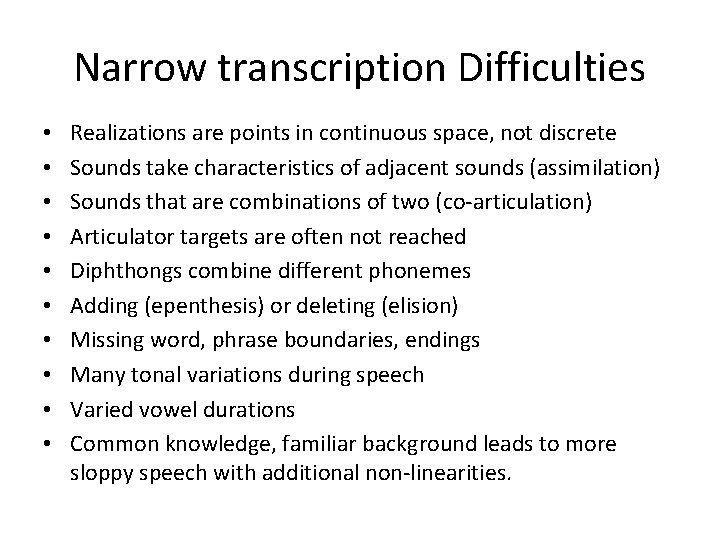
Narrow transcription Difficulties • • • Realizations are points in continuous space, not discrete Sounds take characteristics of adjacent sounds (assimilation) Sounds that are combinations of two (co-articulation) Articulator targets are often not reached Diphthongs combine different phonemes Adding (epenthesis) or deleting (elision) Missing word, phrase boundaries, endings Many tonal variations during speech Varied vowel durations Common knowledge, familiar background leads to more sloppy speech with additional non-linearities.
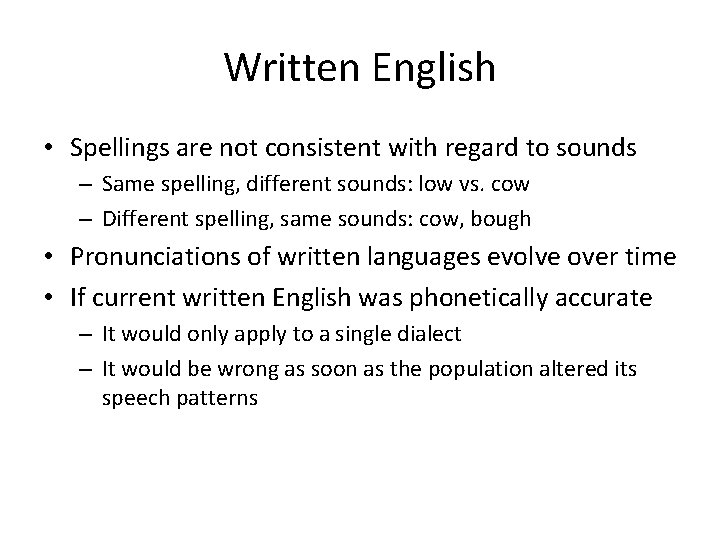
Written English • Spellings are not consistent with regard to sounds – Same spelling, different sounds: low vs. cow – Different spelling, same sounds: cow, bough • Pronunciations of written languages evolve over time • If current written English was phonetically accurate – It would only apply to a single dialect – It would be wrong as soon as the population altered its speech patterns
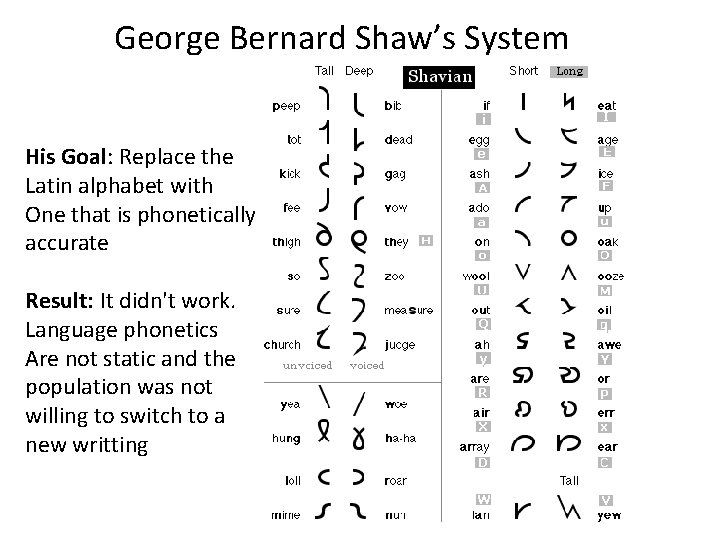
George Bernard Shaw’s System His Goal: Replace the Latin alphabet with One that is phonetically accurate Result: It didn't work. Language phonetics Are not static and the population was not willing to switch to a new writting
Pitman Shorthand
ARPABET: English-based phonetic system Example. Phone Example Phone [iy]beat [b] [ih] bit [eh] bet [ah] but [x] bat [ao] bought [ow] boat [uh] book [ey] bait [er] bert [ay] buy [oy] boy [arr] dinner [aw] down [ax] about [ix]roses [eng] [aa] cot bet [p] [ch] chet [d] debt [f] fat [g] get [hh] hat [hy] high [jh] jet [k] kick [l] let [m] met [em] bottom [n] net [en] button [ng] sing washing pet [r] [sh] [th] [dx] [v] [wh] rat set shoe ten thick that butter vet which [y] [zh] yet zoo measure [-] silence
The International Phonetic Alphabet
IPA Vowels Caution: English tongue positions don’t exactly match the chart. For example, ‘father’ in English does not have the tongue position as far back the IPA vowel chart shows.
IPA Diacritics
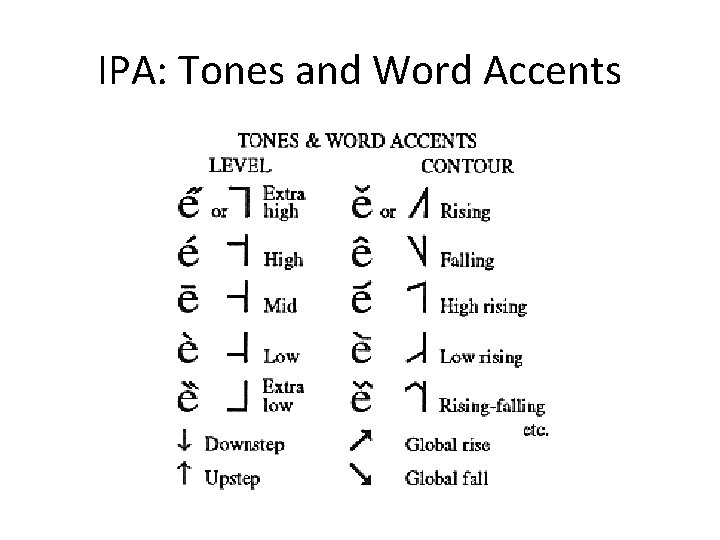
IPA: Tones and Word Accents
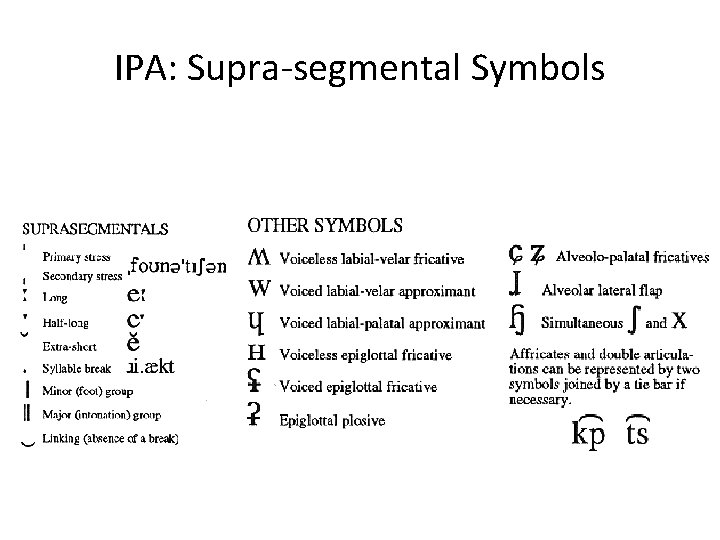
IPA: Supra-segmental Symbols
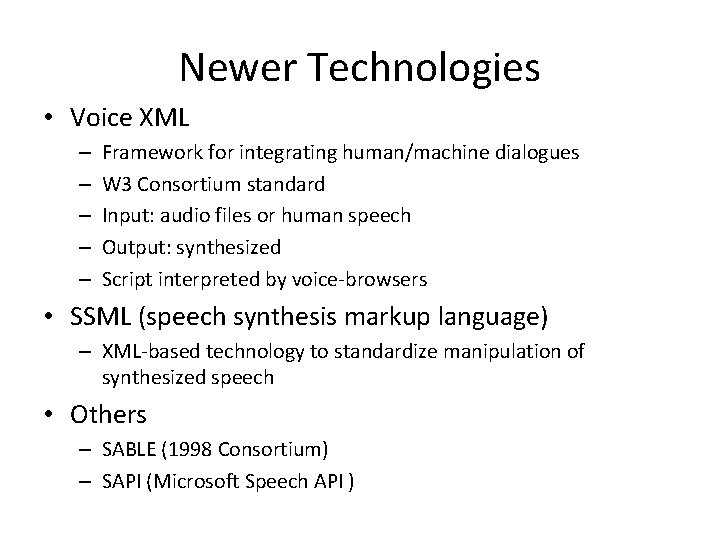
Newer Technologies • Voice XML – – – Framework for integrating human/machine dialogues W 3 Consortium standard Input: audio files or human speech Output: synthesized Script interpreted by voice-browsers • SSML (speech synthesis markup language) – XML-based technology to standardize manipulation of synthesized speech • Others – SABLE (1998 Consortium) – SAPI (Microsoft Speech API )