
Introduction Outline 1 1 layer model 2 1

![9 depth [m] Zonal velocity of the Kuroshio Extension [m/s] • In general, ocean](https://slidetodoc.com/presentation_image_h2/c7a8242a74865f1b36f338f24d36f1e9/image-9.jpg "9 depth [m] Zonal velocity of the Kuroshio Extension [m/s] • In general, ocean")

- Slides: 17
Introduction Outline: 1. 1 layer model 2. 1. 5 layer model
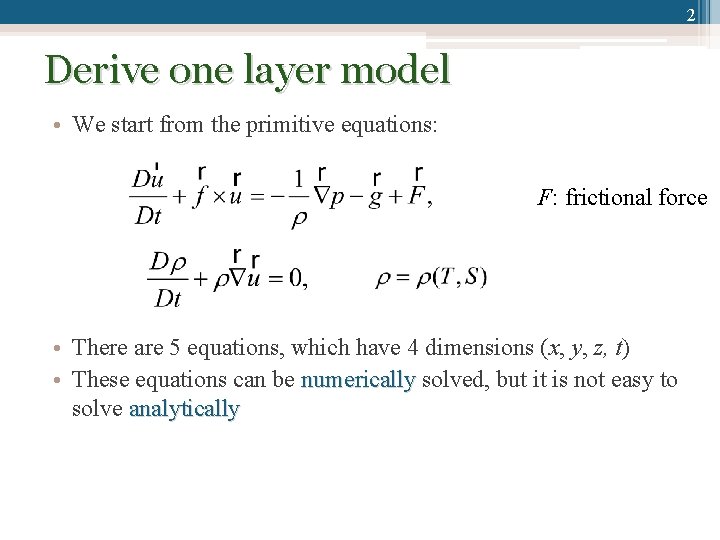
2 Derive one layer model • We start from the primitive equations: F: frictional force • There are 5 equations, which have 4 dimensions (x, y, z, t) • These equations can be numerically solved, but it is not easy to solve analytically
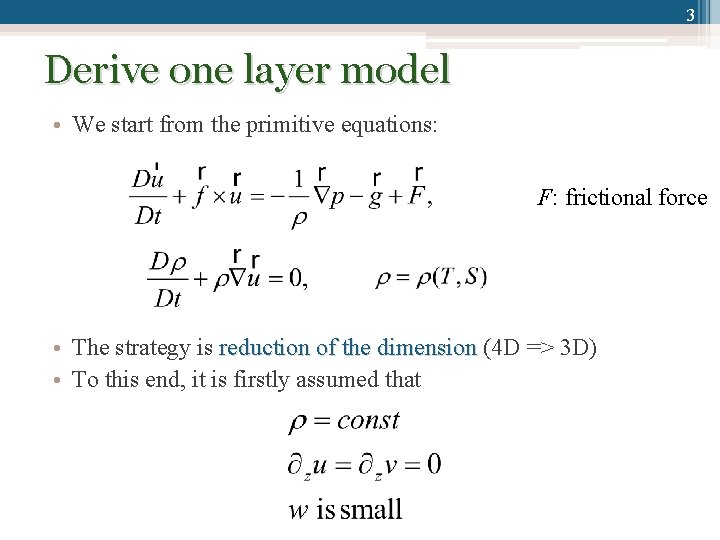
3 Derive one layer model • We start from the primitive equations: F: frictional force • The strategy is reduction of the dimension (4 D => 3 D) • To this end, it is firstly assumed that
4 Derive one layer model momentum equations hydrostatic equation (balance) continuous equation • We have 4 equations and 4 unknowns
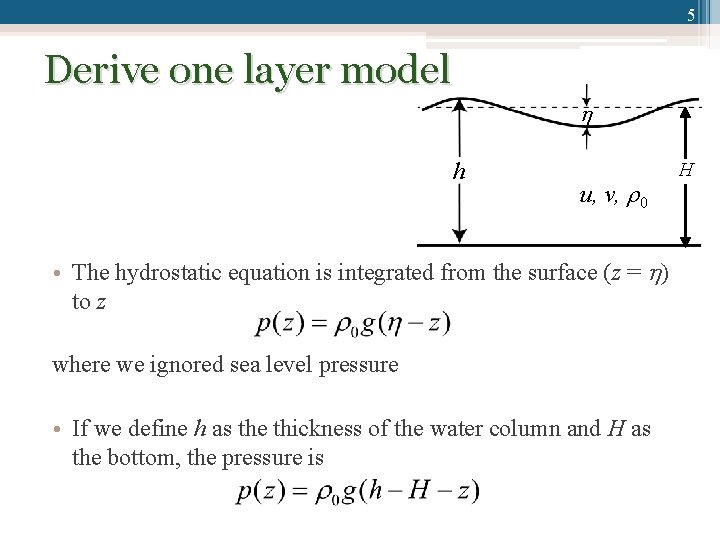
5 Derive one layer model h u, v, 0 • The hydrostatic equation is integrated from the surface (z = ) to z where we ignored sea level pressure • If we define h as the thickness of the water column and H as the bottom, the pressure is H
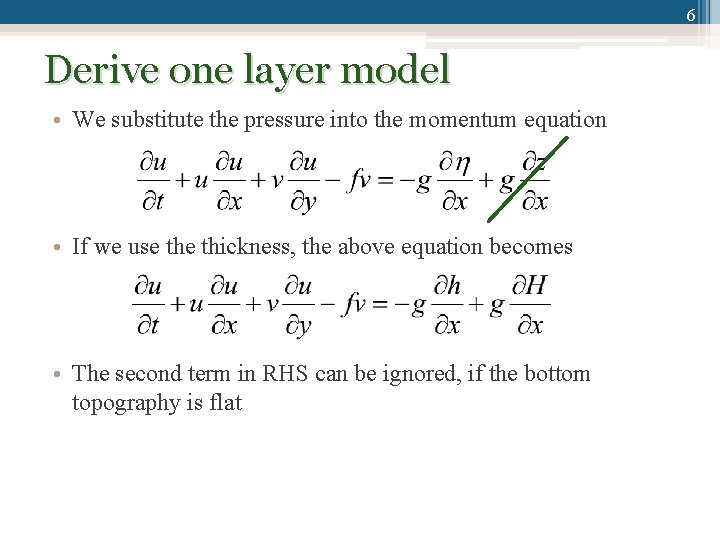
6 Derive one layer model • We substitute the pressure into the momentum equation • If we use thickness, the above equation becomes • The second term in RHS can be ignored, if the bottom topography is flat
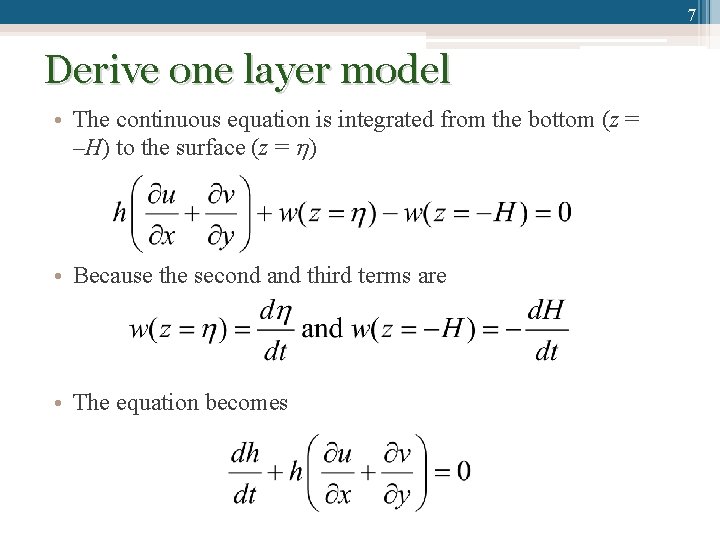
7 Derive one layer model • The continuous equation is integrated from the bottom (z = ‒H) to the surface (z = ) • Because the second and third terms are • The equation becomes
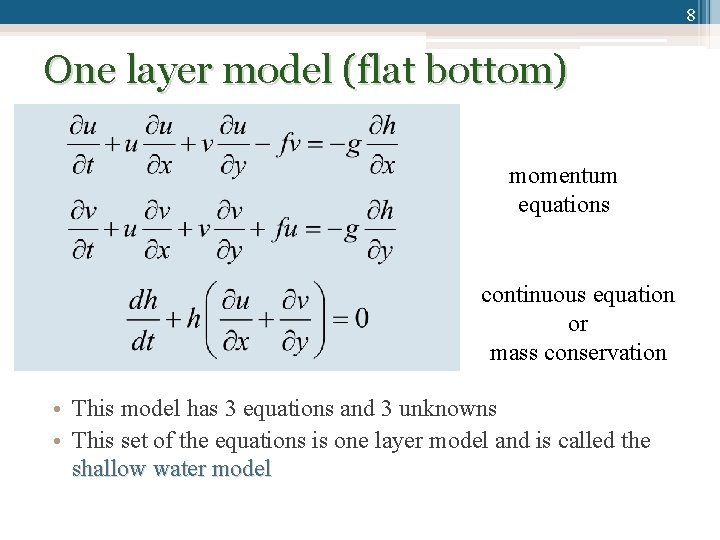
8 One layer model (flat bottom) momentum equations continuous equation or mass conservation • This model has 3 equations and 3 unknowns • This set of the equations is one layer model and is called the shallow water model
9 depth [m] Zonal velocity of the Kuroshio Extension [m/s] • In general, ocean currents are only strong in the upper layer and are quite weak in the lower layer
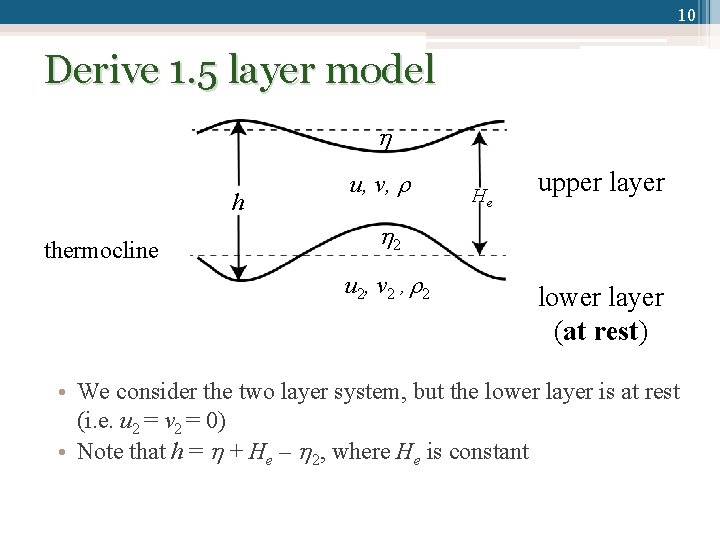
10 Derive 1. 5 layer model h thermocline u, v, He upper layer 2 u 2, v 2 , 2 lower layer (at rest) • We consider the two layer system, but the lower layer is at rest (i. e. u 2 = v 2 = 0) • Note that h = + He ‒ 2, where He is constant
11 Derive 1. 5 layer model • The hydrostatic equation is integrated from the surface (z = ) to the lower layer depth z • Since the lower layer is at rest, x p 2 = y p 2 =0. Thus, • This equation is valid, even though = 2 =0. Thus,
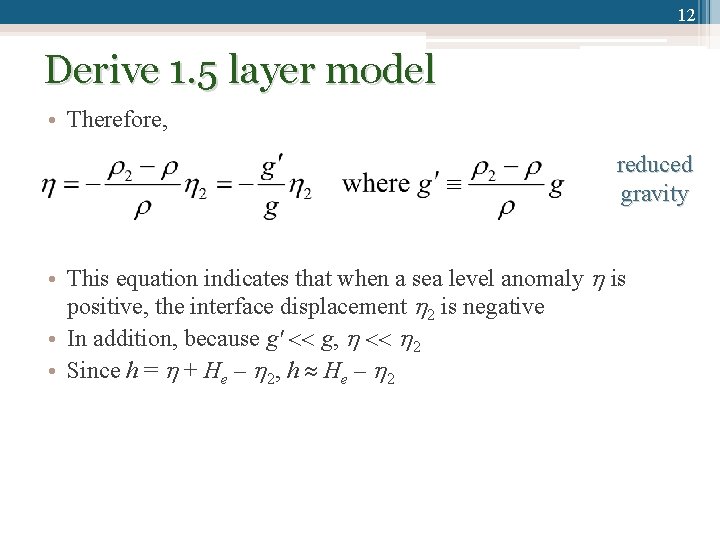
12 Derive 1. 5 layer model • Therefore, reduced gravity • This equation indicates that when a sea level anomaly is positive, the interface displacement 2 is negative • In addition, because g' g, 2 • Since h = + He ‒ 2, h He ‒ 2
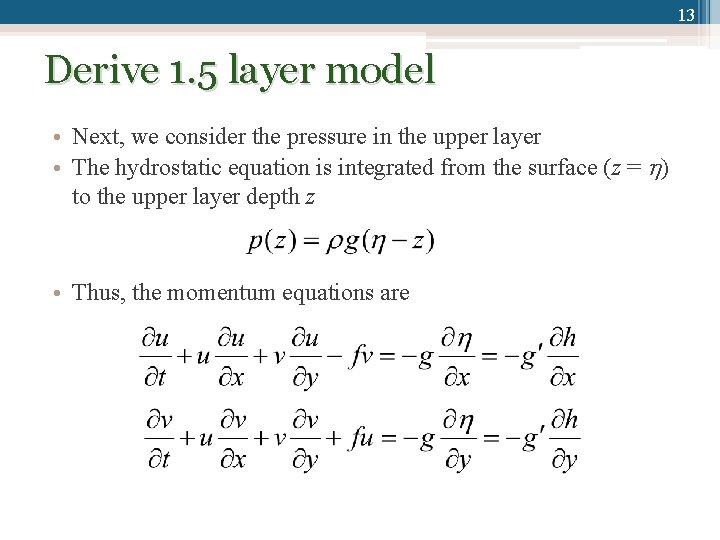
13 Derive 1. 5 layer model • Next, we consider the pressure in the upper layer • The hydrostatic equation is integrated from the surface (z = ) to the upper layer depth z • Thus, the momentum equations are
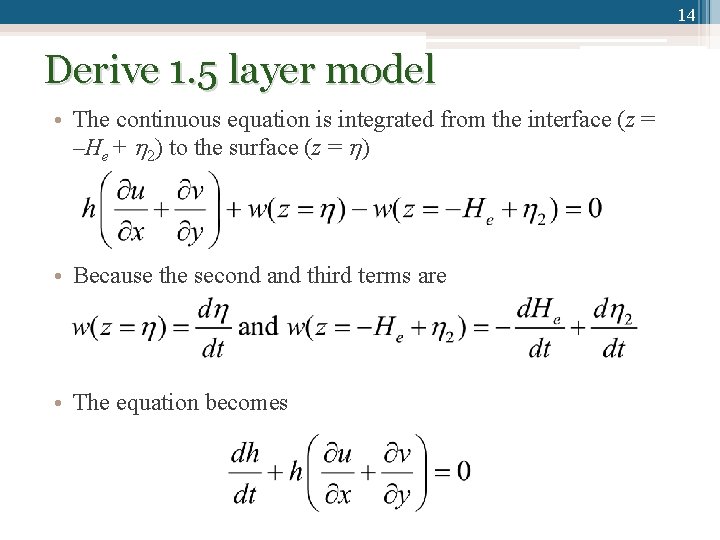
14 Derive 1. 5 layer model • The continuous equation is integrated from the interface (z = ‒He + 2) to the surface (z = ) • Because the second and third terms are • The equation becomes
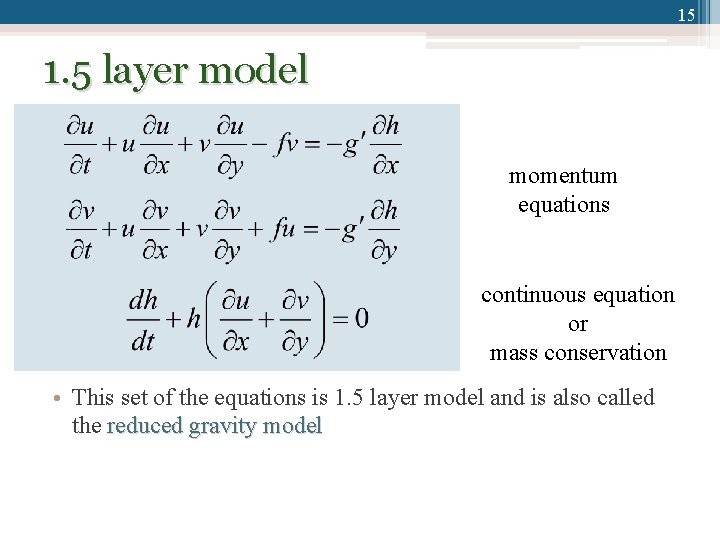
15 1. 5 layer model momentum equations continuous equation or mass conservation • This set of the equations is 1. 5 layer model and is also called the reduced gravity model
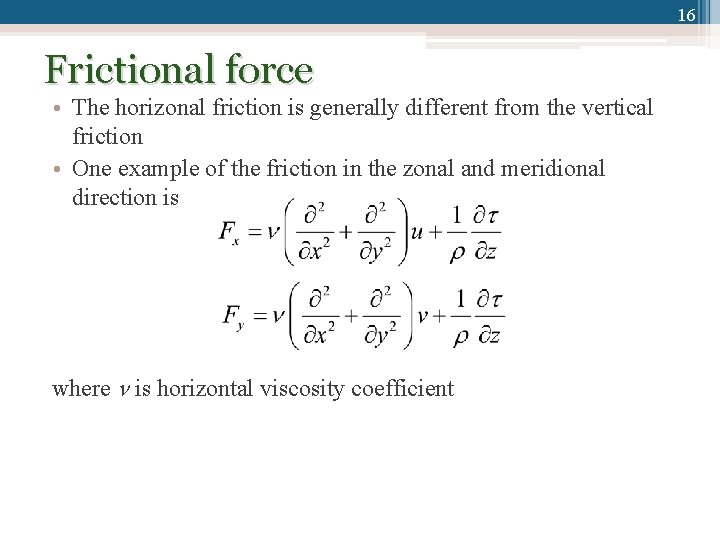
16 Frictional force • The horizonal friction is generally different from the vertical friction • One example of the friction in the zonal and meridional direction is where is horizontal viscosity coefficient
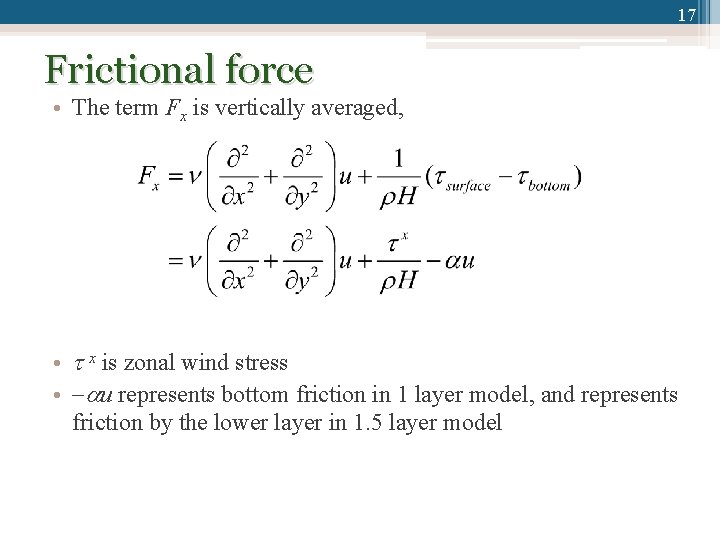
17 Frictional force • The term Fx is vertically averaged, • x is zonal wind stress • u represents bottom friction in 1 layer model, and represents friction by the lower layer in 1. 5 layer model