
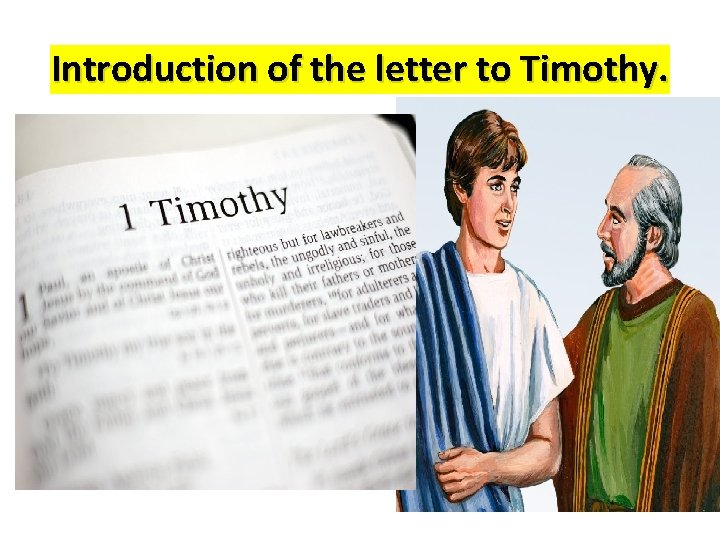
Introduction of the letter to Timothy 1 Timothy

![1 Timothy 1: 1 NKJV[1] Paul, an apostle of Jesus Christ, by the commandment](https://slidetodoc.com/presentation_image_h2/0c7fcd7e2b6e3fa9cc7f145f733c15a4/image-3.jpg "1 Timothy 1: 1 NKJV[1] Paul, an apostle of Jesus Christ, by the commandment")
![1 Timothy 1: 2 NKJV[2] To Timothy, a true son in the faith: Grace,](https://slidetodoc.com/presentation_image_h2/0c7fcd7e2b6e3fa9cc7f145f733c15a4/image-4.jpg "1 Timothy 1: 2 NKJV[2] To Timothy, a true son in the faith: Grace,")
![1 Timothy 1: 5 NKJV[5] Now the purpose of the commandment is love from](https://slidetodoc.com/presentation_image_h2/0c7fcd7e2b6e3fa9cc7f145f733c15a4/image-7.jpg "1 Timothy 1: 5 NKJV[5] Now the purpose of the commandment is love from")
![1 Timothy 1: 7 NKJV[7] desiring to be teachers of the law, understanding neither](https://slidetodoc.com/presentation_image_h2/0c7fcd7e2b6e3fa9cc7f145f733c15a4/image-9.jpg "1 Timothy 1: 7 NKJV[7] desiring to be teachers of the law, understanding neither")
![1 Timothy 1: 8 NKJV[8] But we know that the law is good if](https://slidetodoc.com/presentation_image_h2/0c7fcd7e2b6e3fa9cc7f145f733c15a4/image-10.jpg "1 Timothy 1: 8 NKJV[8] But we know that the law is good if")
![1 Timothy 1: 8 NKJV[8] But we know that the law is good if](https://slidetodoc.com/presentation_image_h2/0c7fcd7e2b6e3fa9cc7f145f733c15a4/image-11.jpg "1 Timothy 1: 8 NKJV[8] But we know that the law is good if")
![1 Timothy 1: 8 NKJV[8] But we know that the law is good if](https://slidetodoc.com/presentation_image_h2/0c7fcd7e2b6e3fa9cc7f145f733c15a4/image-12.jpg "1 Timothy 1: 8 NKJV[8] But we know that the law is good if")
![1 Timothy 1: 8 NKJV[8] But we know that the law is good if](https://slidetodoc.com/presentation_image_h2/0c7fcd7e2b6e3fa9cc7f145f733c15a4/image-13.jpg "1 Timothy 1: 8 NKJV[8] But we know that the law is good if")
![1 Timothy 1: 9 NKJV[9] knowing this: that the law is not made for](https://slidetodoc.com/presentation_image_h2/0c7fcd7e2b6e3fa9cc7f145f733c15a4/image-14.jpg "1 Timothy 1: 9 NKJV[9] knowing this: that the law is not made for")
![1 Timothy 1: 9 NKJV[9] knowing this: that the law is not made for](https://slidetodoc.com/presentation_image_h2/0c7fcd7e2b6e3fa9cc7f145f733c15a4/image-15.jpg "1 Timothy 1: 9 NKJV[9] knowing this: that the law is not made for")
![1 Timothy 1: 9 NKJV[9] knowing this: that the law is not made for](https://slidetodoc.com/presentation_image_h2/0c7fcd7e2b6e3fa9cc7f145f733c15a4/image-16.jpg "1 Timothy 1: 9 NKJV[9] knowing this: that the law is not made for")
![1 Timothy 1: 10 NKJV[10] fornicators, for sodomites, for kidnappers, for liars, for perjurers,](https://slidetodoc.com/presentation_image_h2/0c7fcd7e2b6e3fa9cc7f145f733c15a4/image-17.jpg "1 Timothy 1: 10 NKJV[10] fornicators, for sodomites, for kidnappers, for liars, for perjurers,")
![1 Timothy 1: 10 NKJV[10] fornicators, for sodomites, for kidnappers, for liars, for perjurers,](https://slidetodoc.com/presentation_image_h2/0c7fcd7e2b6e3fa9cc7f145f733c15a4/image-18.jpg "1 Timothy 1: 10 NKJV[10] fornicators, for sodomites, for kidnappers, for liars, for perjurers,")
![1 Timothy 1: 11 NKJV[11] according to the glorious gospel of the blessed God](https://slidetodoc.com/presentation_image_h2/0c7fcd7e2b6e3fa9cc7f145f733c15a4/image-19.jpg "1 Timothy 1: 11 NKJV[11] according to the glorious gospel of the blessed God")
![1 Timothy 1: 12 NKJV[12] And I thank Christ Jesus our Lord who has](https://slidetodoc.com/presentation_image_h2/0c7fcd7e2b6e3fa9cc7f145f733c15a4/image-20.jpg "1 Timothy 1: 12 NKJV[12] And I thank Christ Jesus our Lord who has")
![1 Timothy 1: 17 NKJV[17] Now to the King eternal, immortal, invisible, to God](https://slidetodoc.com/presentation_image_h2/0c7fcd7e2b6e3fa9cc7f145f733c15a4/image-26.jpg "1 Timothy 1: 17 NKJV[17] Now to the King eternal, immortal, invisible, to God")
![1 Timothy 1: 18 NKJV[18] This charge I commit to you, son Timothy, according](https://slidetodoc.com/presentation_image_h2/0c7fcd7e2b6e3fa9cc7f145f733c15a4/image-27.jpg "1 Timothy 1: 18 NKJV[18] This charge I commit to you, son Timothy, according")
![1 Timothy 1: 19 NKJV[19] having faith and a good conscience, which some having](https://slidetodoc.com/presentation_image_h2/0c7fcd7e2b6e3fa9cc7f145f733c15a4/image-28.jpg "1 Timothy 1: 19 NKJV[19] having faith and a good conscience, which some having")
![1 Timothy 1: 19 NKJV[19] having faith and a good conscience, which some having](https://slidetodoc.com/presentation_image_h2/0c7fcd7e2b6e3fa9cc7f145f733c15a4/image-29.jpg "1 Timothy 1: 19 NKJV[19] having faith and a good conscience, which some having")
![1 Timothy 1: 20 NKJV[20] of whom are Hymenaeus and Alexander, whom I delivered](https://slidetodoc.com/presentation_image_h2/0c7fcd7e2b6e3fa9cc7f145f733c15a4/image-30.jpg "1 Timothy 1: 20 NKJV[20] of whom are Hymenaeus and Alexander, whom I delivered")
![1 Timothy 1: 20 NKJV[20] of whom are Hymenaeus and Alexander, whom I delivered](https://slidetodoc.com/presentation_image_h2/0c7fcd7e2b6e3fa9cc7f145f733c15a4/image-31.jpg "1 Timothy 1: 20 NKJV[20] of whom are Hymenaeus and Alexander, whom I delivered")
- Slides: 31
Introduction of the letter to Timothy.
1 Timothy 1: 1 NKJV[1] Paul, an apostle of Jesus Christ, by the commandment of God our Savior and the Lord Jesus Christ, our hope, Paul Παῦλος Paulos; this is Paul’s new “Roman” name. In the beginning he’s was “Saul” his Hebrew nam, later is know as Paul. Apostle ἀπόστολος apostolos; a delegate; specially, an ambassador of the Gospel; officially a commissioner of Christ (with miraculous powers) Ro 1: 1. 1 Co 1: 1. Why the emphasis? Gal 1: 1, 10. Jesus Ἰησοῦς Ie sous; of Hebrew origin Jesus (Jehoshua, Joshua), the name of our Lord Jesus, Joshua. The meaning is: “Jehovah Saves” Christ Χριστός Christos; anointed, the Messiah. by the commandment ἐπιταγή epitage ; an injunction or decree; by implication, authority, commandment. 1 Ti 2: 7. Ac 9: 15; 26: 16 -18; Ro 16: 26. of God our Savior God is called "Savior" 19 times. and the Lord Jesus Christ is called "Savior" 16 times our hope, ἐλπίς elpis; expectation confidence faith, hope. Ro 15: 12, 13; Col 1: 27; 2 Th 2: 16; 1 P 1: 3, 21.
1 Timothy 1: 2 NKJV[2] To Timothy, a true son in the faith: Grace, mercy, and peace from God our Father and Jesus Christ our Lord. Timothy. Τιμόθεος Timotheos; dear to God; a Christian: Timothy. Ac 16: 1 -3. 1 Th 3: 2. 2 Ti 1: 2. a true son in the faith. Only Timothy (2 Tim. 1: 2; 2: 1) and Titus (1: 4) received this special expression of Paul’s favor. The Gr. word for “son” is better translated “child, ” which emphasizes Paul’s role as spiritual father to Timothy. Grace, mercy, and peace from God our Father and Jesus Christ our Lord. The three comes from the same sources. God the Father gave us peace, Jesus the Son also gave us peace. Keep in mind that in verse 1 both are Saviors, and for that reason Grace, Mercy and Peace are from both. John 1: 1; Phil 2: 5 -11; Heb 1: 1 -3 When we understand the relationship of Father and Son, then is easy to understand the GODHEAD
1 Timothy 1: 3 As I urged you when I went into Macedonia-remain in Ephesus that you may charge some that they teach no other doctrine, As I Urged you. v According to Paul, this is an urgent matter that demands attention. Timothy is being warned by Paul of the problems he will be facing in Ephesus. Ac 18: 21; 19: 1, 2 Ti 1: 18. 4: 12. When I went into Macedonia. v Before Paul left Ephesus, he likely began the confrontation with the expulsion of Hymenaeus and Alexander (v. 20), then assigned Timothy to stay on and complete what he had begun. Charge some. v The church in Ephesus is the same as in Acts 19: 1, the church in Ephesus is the same as the book of Ephesians, the church in Ephesus is the same as in the book of Revelations 2: 1 -5. What happen? v Paul talked to the elders of Ephesus in Acts 20: 28 -32. That they teach no other doctrine. v Apostasy has already began and many are teaching now different doctrines. Gal 1: 6 -9. Can that happen here at Northside? v Who is responsible for confronting false teachers? Jude 3 v In Ephesus Timothy was the preacher. That’s why Paul left him there. v Now days who is responsible to stop sectarian doctrines from among us?
1 Timothy 1: 4 nor give heed to fables and endless genealogies, which cause disputes rather than godly edification which is in faith. nor give heed to fables and endless genealogies, v Not to listen to Fables (MUTHOS---Myth). Stories in Jewish history without Scripture background & teaching. v Rabbinical fabrications…. . false ideas. v Not to listen to Endless Genealogies. v Tracing lineages to draw false conclusions. Such are not of value to the church. They do not strengthen one’s faith in Christ. v The reason for doing this? which cause disputes rather than godly edification which is in faith. v When we entertain man and their ideas and false teachings, most likely we are going to end up in disputes. 1 Tim 4: 1 -3. v The Bible has already prophesied that many false teachers will come, even here at Northside, what can we do? 1 Peter 2: 1 -3. v Who is going to stop their mouth? Jude 16 -18. v Is it good for me to warn you about this, or is it a waste of time?
1 Timothy 1: 5 NKJV[5] Now the purpose of the commandment is love from a pure heart, from a good conscience, and from sincere faith, The purpose of the commandment. o What commandment? The one in verse 3. There is a purpose why Paul is telling Timothy to “teach what is right”. “LOVE from a pure heart” o We must have a pure and clean intention when dealing with others. Jn 13: 34; Ro 14: 15; 1 Co 8: 1 -3; 14: 1. 1 P 4: 8; 2 P 1: 7; 1 J 3: 18, 19. From and good conscience. § Hebrews 10: 22; 1 Peter 1: 22. “What Timothy is to seek in believer’s lives is a loving life-style that is not just the result of a guilty conscience” § “With a conscience which is not condemning, the believer can have an unhypocritical faith. And from sincere faith. • A genuine faith that is developed by following the sound doctrine (Romans 10: 17). • This is not a lip-service type of faith, but an entire and sincere trust from the heart. • The full counsel of God will produce such a faith, as well as a good conscience and genuine love (Acts 15: 9; Hebrews 4: 12; 1 Peter 3: 21).
1 Timothy 1: 6 from which some, having strayed, have turned aside to idle talk, From Which some, (1: 3) v The “Some men” of verse 6 are likely the same false teachers introduce as “certain men” in verse 3. Having strayed. v “Straying” translates a word which means “to deviate from, to miss the mark, to stray, to depart. v According to Paul these men missed the real goal or end of the gospel (love from a pure heart etc). And reached instead only vain and boastful talking. 1 Ti 6: 21; 2 Ti 2: 18; 4: 10. Have turned aside to idle talk. v What I can see from here is that these men at one point where on the right path, on the right track, following the truth but now have turned aside. v As the result of their “straying” they have “turned aside”. v Notice, Paul still consider these men member of the church in Ephesus, else Timothy could have exercised no possible authority over them, as Paul was exhorting him to do. (V 3) v Can we turned aside from the faith and start practicing idle talk? v The warning is for all, many think �� that we are immune to this!
1 Timothy 1: 7 NKJV[7] desiring to be teachers of the law, understanding neither what they say nor the things which they affirm. Desiring to be teachers of the law. v That is, they want to be viewed as experts concerning the Law of Moses (Luke 5: 17. v They desired and coveted the respect that was given to the official teachers of the Law of Moses and this desire indicates that his apostasy came from Christians of a Jewish background. v In the First Century there were various groups that tried to cling to the Law of Moses and argue that it was still binding upon Christians (Acts 15: 1 -5). understanding neither what they say nor the things which they affirm. Ø They were pretending to know Moses’ law and Paul says that they didn’t even understand what the affirm calling them: Ignorants! Ø The “Things” in this verse would include the strange doctrines in 1: 3. Ø These false teachers were very confident in what they were saying, they were forceful, positive, and presented their position strongly, yet they were dead wrong. Ø Confidence is no substitute for the truth, and being confident about something does not make it right or true. Ø “The false teachers announce their errors with assurance”
1 Timothy 1: 8 NKJV[8] But we know that the law is good if one uses it lawfully, But we now. v Paul, Timothy, and other faithful Christians are not ignorant as the false teachers, rather they “know” the following. That the law is good. v The origin of these errors is not found in the Law itself, but in the wrong use of the Law. v Paul did not condemn the Law just because some were seeking to pervert its use or design. v The purpose of the Law was good, that is, to point men to Jesus Christ (Galatians 3: 24). v Compare with Romans 7: 7, 12. v In addition, Paul was not an enemy of the Law of Moses, even though God revealed through Him that the Law of Moses ended at the cross (Colossians 2: 14 -17. v The above passage is not saying that we are still under the Law of Moses, rather the Law is still good. v It still leads people to Christ (Galatians 3: 24). v It still teaches us valuable lessons about sin and the character of God (Romans 15: 4; 1 Corinthians 11: 11).
1 Timothy 1: 8 NKJV[8] But we know that the law is good if one uses it lawfully, This is the assignment following what Paul said in verse 8.
1 Timothy 1: 8 NKJV[8] But we know that the law is good if one uses it lawfully, But we know that the law is good. Ø The origin of these errors is not found in the Law itself, but in the wrong use of the Law. Ø Paul did not condemn the Law just because some were seeking to pervert its use or design. Ø The purpose of the Law was good, that is, to point men to Jesus Christ (Galatians 3: 24; Romans 7: 7, 12. Ø In addition, Paul was not an enemy of the Law of Moses, even though God revealed through Him that the Law of Moses ended at the cross Col 2: 14 -17; Ephesians 2: 15) Ø The above verse is not saying that we are still under the Law of Moses, rather the Law is still good. Ø It still leads people to Christ (Galatians 3: 24). Ø It still teaches us valuable lessons about sin and the character of God (Romans 15: 4; 1 Corinthians 11: 11).
1 Timothy 1: 8 NKJV[8] But we know that the law is good if one uses it lawfully, If one uses it lawfully. There are wrong uses of the Law of Moses: Ø Idle speculation. Ø The attempt to use it to teach an ascetic lifestyle. Ø Arguing that the Law of Moses is binding today and that we are still under the first covenant (Hebrews 8: 13). Ø “When the Law is used as God intended for it to be used, then truth and benefits result. Ø But when the Law is used only as a springboard into hopeless speculation, fanciful legends, and erroneous instruction, then the law is being abused to become an introducer of evil rather than the foundation of truth” Ø “Those who did not see that the law ended in Christ and was taken out of the way by Him understood neither the law nor its aim and end” Ø Many in 2019 are so confuse as to what was the real purpose of the law of Moses. Ro 7: 12, 13, 16, 18, 22: 10: 4, 12: 2. Ga 3: 11, 21.
1 Timothy 1: 9 NKJV[9] knowing this: that the law is not made for a righteous person, but for the lawless and insubordinate, for the ungodly and for sinners, for the unholy and profane, for murderers of fathers and murderers of mothers, for manslayers, knowing this: that the law is not made for a righteous person ü It would appear that this principle of truth applies to the Law of Moses as well as law in general. ü The righteous man is of course the Christian, the person justified by his obedient faith in God and the person who keeps God’s commands. ü Laws are not enacted to control good men, and neither are laws enacted because men are good and are behaving themselves (Galatians 3: 19) ü “Why the Law then? ü It was added because of transgressions”. “Law is not intended for a lawabiding man”. ü There may be another thought here: ü These false teachers may have been attempting to bind the Law of Moses upon Christians and Paul reminds Timothy and his brethren that the Law of Moses was not designed to make a man righteous, rather a man can only become righteous by coming to Jesus Christ (Rom 1: 16 -17, 10: 4 -10).
1 Timothy 1: 9 NKJV[9] knowing this: that the law is not made for a righteous person, but for the lawless and insubordinate, for the ungodly and for sinners, for the unholy and profane, for murderers of fathers and murderers of mothers, for manslayers, But for the lawless. Greek (anomos) Point to Note: The person who complains about something the Bible condemns is basically saying by their attitude that such a law was written precisely for them and anyone else with such an attitude. ü Those who depart from the law, Those who live as if there is no law. ü The Law was added because of human rebellion (Galatians 3: 19). And Insubordinate. Greek (anupotaktos) Romans 1: 30 v That cannot be subjected to control, disobedient”. Those who resist lawful authority. For the ungodly. Greek asebes) 1 P 4: 18; Jude 1: 4, 15. v “Those who have no religion, who do not worship or honor God” v “Positive, active irreligion direction opposition to God” One who has no fear of God. For sinners. Greek (hamartols) Mark 8: 38 v “Those who have missed the mark of their existence”
1 Timothy 1: 9 NKJV[9] knowing this: that the law is not made for a righteous person, but for the lawless and insubordinate, for the ungodly and for sinners, for the unholy and profane, for murderers of fathers and murderers of mothers, for manslayers, For the unholy Greek (anosios) 2 Tim 3: 2 v “Men who are careless of their duties before God”. v People who are impure in life and irreverent towards that which is sacred. And profane. Greek (bebelos) Heb 12: 16 v“Who walk over everything and make it as common as dirt”. v. The person who treats the things of God with contempt, mockery, and scorn. For murderers of fathers and muderers of mothers. Greek (patrolas and (metraloas) v. The terms here can also mean besides killing, to abuse, see Exodus 21: 15. Literally, father-smiters and mother-smiters. For manslayers. v. Pre-mediated murder, homicide, not accidental death.
1 Timothy 1: 10 NKJV[10] fornicators, for sodomites, for kidnappers, for liars, for perjurers, and if there is any other thing that is contrary to sound doctrine, For fornicators. Greek (pornois) v “That is, those involved in sex outside the marriage relationship, including fornication, adultery, and prostitution. The word here is the word rendered “sexual immorality” or “fornicators” in other passages. For sodomites. Greek (arsenokoitais) sexual perverts. 1 Cor 6: 9 v “One who lies with a male as with a female”. v This would include men who abuse young boys as well. v Note, such people are called lawless, godless, profane, unholy, and sinners. v God does not view the homosexual as a enlightened and loving person. For kidnappers. Greek (andrapodistais) v “Slave dealer, kidnapper”. It was common in the ancient world to steal boys and girls and sell them into slavery. For liars. Greek (pseustais) v God has a deep abhorrence for this too common sin (Rev 21: 8; Acts 5: 1). For perjurers. Greek (epiorkois) v That is someone who swears falsely, those who break oaths, the person who lies under oath.
1 Timothy 1: 10 NKJV[10] fornicators, for sodomites, for kidnappers, for liars, for perjurers, and if there is any other thing that is contrary to sound doctrine, v This is God’s loophole plug. v These things are wrong and anything else that contradicts God’s truth. v In this section Paul has not mentioned drunkenness, envy, jealousy and other sins. Compare with Galatians 5: 21. v Note that sound teaching contains all of God’s teaching on morality; in fact, sound teaching includes all our obligations towards God and man. SOUND v True and uncorrupt, healthy. v Doctrine or teaching that is both accurate and healthy for the hearer, in contrast to false doctrine that is both false and dangerous. v The sound doctrine is the teaching revealed through the apostles (2 Timothy 1: 13; 4: 3; Titus 2: 1). v Be impressed that sound teaching can be both obeyed and understood. v Anyone who would argue that anything in the above list is lawful or
1 Timothy 1: 11 NKJV[11] according to the glorious gospel of the blessed God which was committed to my trust. According to the glorious gospel. v The gospel of Jesus is blessed in all aspects. The gospel of Jesus is glorious because: v Is the power of God. Rom 1: 16. v It judge us when we are wrong Rom 2: 16 v It bring blessing to the hearers Rom 15: 29 v It bring salvation when we obey it. Eph 1: 3 v It bring fellowship with others christians. Phil 1: 5 v It bring the right conduct to the hearers Phil 1: 27 Glorious v The gospel reveals the glory of God (2 Corinthians 3: 8; 4: 4). Of the blessed God. v 1 Timothy 6: 15. Perhaps he means that when people know about His eternal and changeless perfection, and the blessed gift of forgiveness that he offers to all sinners who obeys. In this sense He comes to be blessed” Which was committed to my trust. v Paul views the gospel message as a precious treasure or deposit that has been given for his safekeeping. Compare with 1 Corinthians 9: 17; Galatians 2: 7. v The gospel that Paul preached came by divine revelation.
1 Timothy 1: 12 NKJV[12] And I thank Christ Jesus our Lord who has enabled me, because He counted me faithful, putting me into the ministry, And I thank Christ Jesus our Lord v The words ‘I thank’ literally are ‘gratitude I am having’. v I thank Christ Jesus, why? Because is only through Christ that we are who we are. It was Jesus sacrifice who made us alive. Save from sin. Eph 2: 1, 7 That had enable me. v The term “enable” means, “to make strong, endow with strength” v In this verse this “strengthening” may refer to God giving Him the Holy Spirit for the purpose of inspiration and working miracles. Acts 9: 22; 1 Co 15: 10; Ph 4: 13. 2 Ti 4: 17. v That is, trustworthy, dependable. “Even when Paul was a persecutor of the church, Christ had seen in him the capabilities of what he later became. Putting me into the ministry. v That is, putting him into the service of being an apostle, teacher, and preacher. v We should remember that the “service” in which Jesus placed Paul was a very difficult area of service (Acts 9: 16; 2 Cor 4: 5 -10; 6: 4 -10; 11: 22 -33), yet he was very grateful for being allowed to serve Christ even when it involved tremendous suffering.
1 Timothy 1: 13 although I was formerly a blasphemer, a persecutor, and an insolent man; but I obtained mercy because I did it ignorantly in unbelief. Although I was formerly. v His description of himself must not be attributed to false humility or exaggeration, but was undoubtedly the way he felt about his past life. v The word “formerly” is such a hopeful word, a person can break from the past and does not have to accept an existence in which sin is dominating them (1 Corinthians 6: 11). A blasphemer. v (Acts 9: 1; 26: 9, 11). v Paul had spoken evil, slanderous and reproachful things against Christ and His people. v Paul had rejected Jesus’ Messianic claims and had labeled Him an imposter. v He not only spoke against the Lord, but also tried to get others to do the same (Acts 26: 11). Persecutor. v (Acts 9: 4 -5; 22: 4 “I persecuted this Way unto death”; 26: 11 “persecuted them even unto foreign cities”; Galatians 1: 13 “How that beyond measure I persecuted the church of God, and made havoc of it”). v Paul even traveled from Jerusalem to Damascus, 120 miles to the NE, in the hopes of finding Christians to persecute.
1 Timothy 1: 13 although I was formerly a blasphemer, a persecutor, and an insolent man; but I obtained mercy because I did it ignorantly in unbelief. An insolent man. v “One whose insolence and contempt of others break forth in wanton and outrageous acts. If the term could be allowed, ‘a bully’, one who not only ill-treats others but does so with the insolence of superior strength” v Paul not only arrested people, but he was violent in so doing (Acts 8: 3 “dragging men and women” Acts 9: 13; 26: 10 -11). v He had no mercy on Christians, he acted like a tyrant, he treated them with spite, and he handled them roughly. But I obtained mercy. v A mercy that Paul had not shown Christians. v Paul realizes that his chance to become a Christian was completely undeserved (1 Corinthians 15: 10; Galatians 1: 15; Acts 9: 6; Because I did it ignorantly in unbelief. v This statement of ignorance was not an excuse for his guilt, for he calls himself a former blasphemer. v Sins committed in ignorance are still sins before God. v Yet Paul is noting that his opposition to Christ was not a determined opposition to God or His will, for Paul thought he was serving God by persecuting the church (Acts 26: 9 -11; 23: 1; Galatians 1: 14; Philippians 3: 5 -6). The “unbelief” was not in God, but unbelief in Jesus and His claims.
1 Timothy 1: 14 And the grace of our Lord was exceedingly abundant, with faith and love which are in Christ Jesus. And the grace of our Lord Was exceedingly abundant. v Even sins committed in ignorance by conscientious people need abundant grace. v His ignorance did not make his sins any less sinful or any less in need of God’s grace. Romans 5: 20. v Grace was extended to Paul when Jesus appeared to him (Galatians 1: 15), and by his faith, and his willingness to repent and be baptized, Paul entered into God’s grace. With faith and love which are in Christ Jesus. v One is not saved by grace alone, rather along with God’s grace, faith, and love on the part of Paul were also needed. “Whereas before his trip to Damascus, Paul had been a blasphemer, now he came to love Jesus Christ” v Calvinists seek to argue that faith and love are the miraculous result of God’s grace, that is, apart from God’s grace, Paul could not believe. v Rather, faith is the product of hearing the gospel (Romans 10: 17), and love is something that man must exercise. v Jesus is the object of all the things that were happening in Paul’s life. v Apart from Jesus nothing is possible. If you believe in God but do not take Jesus into consideration nothing is going to happen in our life.
1 Timothy 1: 15 This is a faithful saying and worthy of all acceptance, that Christ Jesus came into the world to save sinners, of whom I am chief. This is a faithful saying and worthy of all acceptance. v See 1 Timothy 3: 1; 4: 9; 2 Timothy 2: 11; Titus 3: 8. Hearty and full acceptance is the type of reception such a faithful saying would trigger. “This saying about to be quoted is entitled to wholehearted and universal personal application with no reservations of any kind (with no strings attached)” That Christ Jesus Came into the world to save sinners. v See John 3: 16; Matthew 20: 28; Luke 5: 32; Luke 19: 10; 24: 46; Philippians 2: 8. v The word “came” infers that Jesus had a pre-existence before He came into the world (John 1: 1, 14). Of whom I am chief. Ø 1 Corinthians 15: 9; Ephesians 3: 8. Ø Paul writes “I am” and not, “I was”. Ø “This indicates that even now, years after his conversion, he deeply regrets his past” Ø In addition, Paul is saying that he still needs the blood of Christ to forgive him of sins that he still commits from time to time. Ø Some have accused Paul of exaggerating when he calls himself the chief of sinners. Ø “He does not say ‘the chief sinner’, but that he is one of many great sinners who need forgiveness” Yet, the word “chief” does mean, “the first, most important, most prominent”.
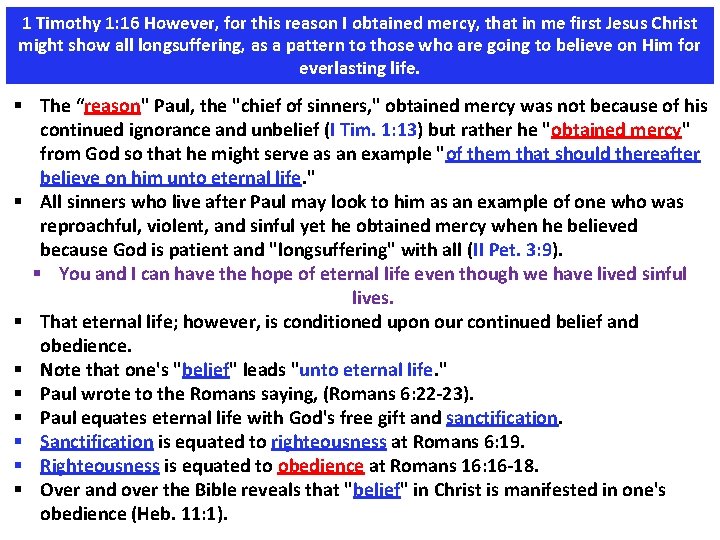
1 Timothy 1: 16 However, for this reason I obtained mercy, that in me first Jesus Christ might show all longsuffering, as a pattern to those who are going to believe on Him for everlasting life. § The “reason" Paul, the "chief of sinners, " obtained mercy was not because of his continued ignorance and unbelief (I Tim. 1: 13) but rather he "obtained mercy" from God so that he might serve as an example "of them that should thereafter believe on him unto eternal life. " § All sinners who live after Paul may look to him as an example of one who was reproachful, violent, and sinful yet he obtained mercy when he believed because God is patient and "longsuffering" with all (II Pet. 3: 9). § You and I can have the hope of eternal life even though we have lived sinful lives. § That eternal life; however, is conditioned upon our continued belief and obedience. § Note that one's "belief" leads "unto eternal life. " § Paul wrote to the Romans saying, (Romans 6: 22 -23). § Paul equates eternal life with God's free gift and sanctification. § Sanctification is equated to righteousness at Romans 6: 19. § Righteousness is equated to obedience at Romans 16: 16 -18. § Over and over the Bible reveals that "belief" in Christ is manifested in one's obedience (Heb. 11: 1).
1 Timothy 1: 17 NKJV[17] Now to the King eternal, immortal, invisible, to God who alone is wise, be honor and glory forever and ever. Amen. § Paul breaks out in a doxology of praise unto Jehovah God due to His love, mercy, and longsuffering spirit that permits man the opportunity to be justified from unlawful actions. § Paul states that there is only one such God… § who is the eternal King (ever will be), Jesus is Eternal. Revelation 1: 8 § cannot be seen, Jesus as God cannot be seen. Phil 2: 5 -8 § and He is immortal. Jesus is Immortal Hebrews 13: 8 § He alone is wise. Jesus is wise for ever and ever. Matthew 12: 42 § To such is to be heaped upon honor and glory for ever by His subjects. § This is the way that Christian must view our Saviour Jesus, we love him for he is the one who died and open the door unto forgiveness for people like Paul and us.
1 Timothy 1: 18 NKJV[18] This charge I commit to you, son Timothy, according to the prophecies previously made concerning you, that by them you may wage the good warfare, § He’s making reference to the commandments of verses 3, 4 and particular verse 5. The context is talking about Timothy dealing with false teachers. § There were some prophecies about Timothy that were made at some point. We don’t know when. § that by them you may wage the good warfare, § The memories of these prophecies from the Lord are to strengthen Timothy in the performance of his duty. § Timothy must continue to fight the good fight. § “The military figure has reference not to a single battle but to the whole campaign. § Here the special reference is to Timothy’s task of contending with the false teachers”. § Such a soldier the Christian should be”. § Compare with Ephesians 6: 10 -17; 1 Cor 9: 7; 2 Cor 4: 4.
1 Timothy 1: 19 NKJV[19] having faith and a good conscience, which some having rejected, concerning the faith have suffered shipwreck, § Fighting the good fight includes continuing to trust in God and His revelation. § “The evangelist must be uncompromising on the matter of sound doctrine” § “Keeping”: Steadfast adherence, holding fast. § In fighting error the preacher must make sure that he does not lose his own faith. Faith is our shield (Ephesians 6: 16) and it guards us (1 Peter 1: 5). § Good conscience”: Deviations from the true faith are preceded by violations of the conscience (1 Timothy 4: 2; Titus 1: 15). § “The teacher who knows the truth but teaches falsehood, or allows it to be taught under his jurisdiction, will not have a good conscience”. § In addition, in fighting error Timothy is not allowed to violate his conscience and fight error in a way that would be sinful and underhanded. When we fight the enemy without, we must always take good care of our inner man.
1 Timothy 1: 19 NKJV[19] having faith and a good conscience, which some having rejected, concerning the faith have suffered shipwreck, § Which some have rejected”: § Rejecting the faith and violating one’s conscience is a choice. § The term “rejected” means “to thrust it away” and implies a willful resistance to the faith and the voice of conscience. § “Failing to heed the conscience, when it was prompting guilty feelings because one has failed to ‘keep the faith’ is what these ‘some’ have done”. § And suffered shipwreck in regard to their faith”: § The expression “their faith” may mean either their own personal faith, or “the faith”, the body of faith or belief. § There is a “the” in the Greek before the word “faith”. § In seeking to pervert the gospel message the result was that their own personal faith was destroyed in the process. § “The Christian teacher who does not practice what he preaches will find his faith failing him”.
1 Timothy 1: 20 NKJV[20] of whom are Hymenaeus and Alexander, whom I delivered to Satan that they may learn not to blaspheme. § Among these are Hymenaeus and Alexander”: Which indicates that these two men are not the only ones in this category, “among these are”. § This is perhaps the same Hymenaeus as is mentioned in 2 Tim 2: 17 -18 who taught that the resurrection was already past. § One way of claiming that the resurrection was past was to argue that the only resurrection mentioned in the Scriptures is when a person rises in newness of life after baptism. § Whom I have delivered over to Satan”: § To deliver one to Satan is to withdraw from those mentioned, that is to exercise the withdrawal mentioned in Matthew 18: 15 -17; 1 Cor 5: 1. § What a terrifying phrase is that the man was already in Satan's possession. § Withdrawal is simply the formal declaration by the visible community of what has already taken place in the invisible realm. § Withdrawal suggests our stepping back and leaving the man alone”
1 Timothy 1: 20 NKJV[20] of whom are Hymenaeus and Alexander, whom I delivered to Satan that they may learn not to blaspheme. § So that they may learn not to blaspheme”: § The purpose of such discipline was to teach these men a lesson, the hope is that such action will bring them back to God and His If the false teachers were allowed to continue in their evil practices unhindered, they would not only lead others astray, but would delude themselves into a false sense of spiritual security”. § “If the false teachers were allowed to continue in their evil practices unhindered, they would not only lead others astray, but would delude themselves into a false sense of spiritual security”. § Hopefully removal from the local congregation will cause these two men to face the fact that teaching false doctrine in this instance amounts to blasphemy, for they are contradicting and opposing what God has said, in effect, calling God a liar. § To blaspheme means to “speak reproachfully”, and there are many in the religious world today who do speak reproachfully of the Scriptures.